

SEO for property management companies has one job: bring in property owners. Not tenants. And almost every property management website is built the other way round, because tenants are the audience that shows up in the analytics.
That inversion is the whole problem, and it is worth doing the arithmetic before touching a keyword tool.
What a single owner is actually worth
Start here, because the number reframes everything that follows.
Management fees in 2026 run roughly 8 to 12 percent of monthly rent, with 10 percent the common rate on a single-family home, according to Baselane. Take a $2,000 a month rental at 10 percent. That is $200 a month, $2,400 a year, and doors tend to stay for years rather than months. Add the placement fee, typically 50 to 100 percent of one month's rent per new lease, and the renewal fees on top.
One owner signing one door is worth somewhere in the region of $7,000 to $12,000 over a normal holding period. An owner with four doors is a five-figure relationship.
Now price a tenant lead. Someone searching for a two-bed rental costs you time, showings and screening, and produces revenue only through a placement fee that the owner pays on a property you already manage. The tenant is not your customer. They are the operational load attached to your customer.
So the two audiences differ in value by something like two orders of magnitude, and they differ in search volume by roughly the same amount in the opposite direction.
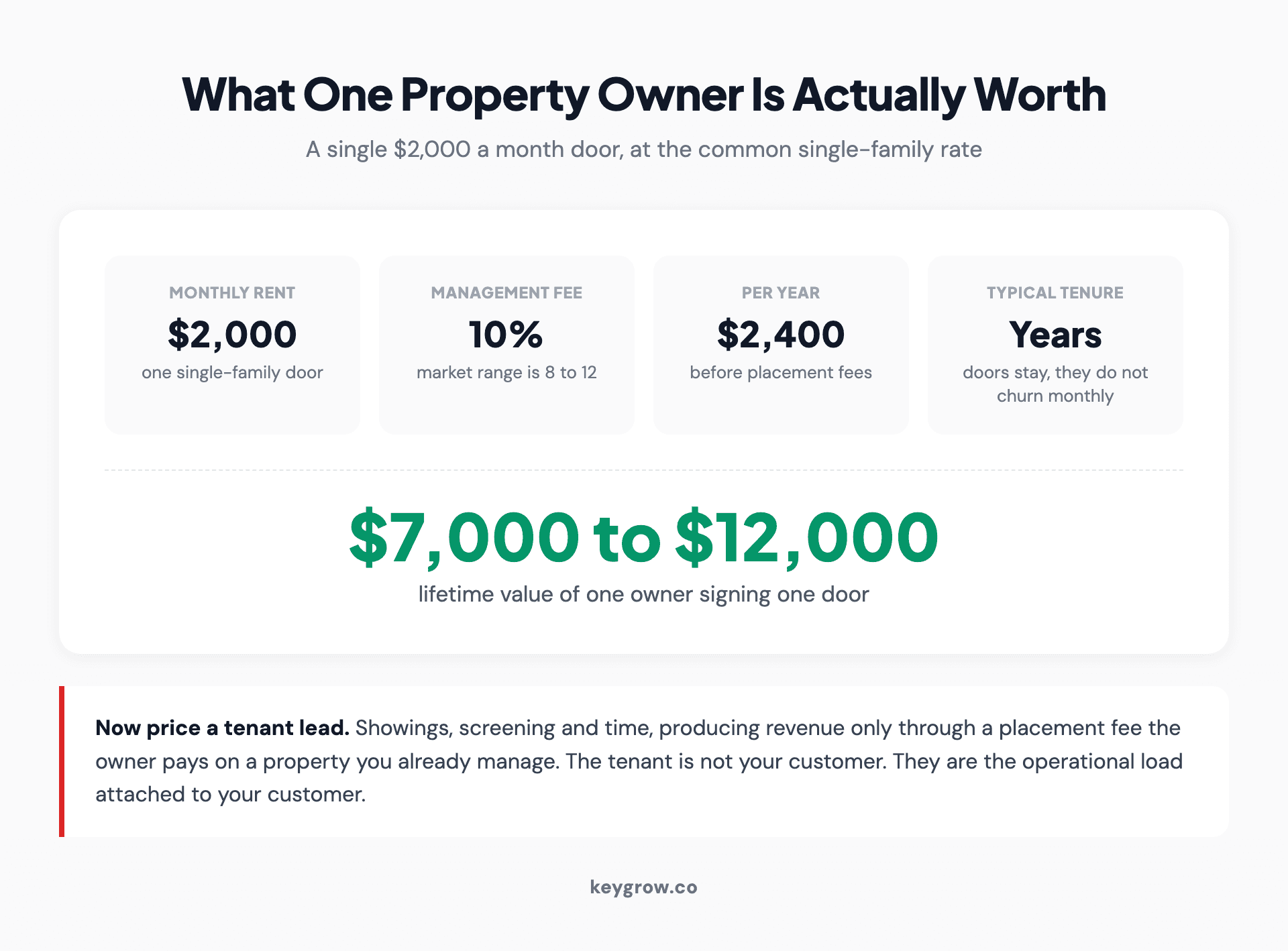
The lifetime value of one property owner worked through: a $2,000 monthly rental at a 10 percent management fee produces $2,400 a year, and over a typical multi-year tenure one signed door is worth roughly $7,000 to $12,000.
The traffic points the wrong way
Here is the trap that catches almost everyone in this industry.
"Apartments for rent [city]" is searched constantly. "Property management company [city]" is searched by a handful of people a month in most markets. If you rank content by search volume, which is what every keyword tool invites you to do, you will build a tenant-facing site and wonder why the management portfolio is not growing.
Worse, the tenant traffic largely is not winnable anyway. Rental searches are dominated by the big listing portals, which have budgets, inventory and domain authority you are not going to out-rank on generic rental terms. You would be spending years competing for traffic that does not pay you, against opponents you cannot beat.
The owner terms are the opposite on every axis. Low volume, low competition, and each one attached to a five-figure relationship. That is an unusually good trade, and it only looks bad on a traffic chart.
This is the same pattern we found measuring our own Texas market data, where the majority of city-qualified service keywords returned no recorded volume at all and the pages still earned their keep. Low volume is not the same as low value, and the distinction matters more in this industry than in almost any other. There is more on that in how to do local keyword research.
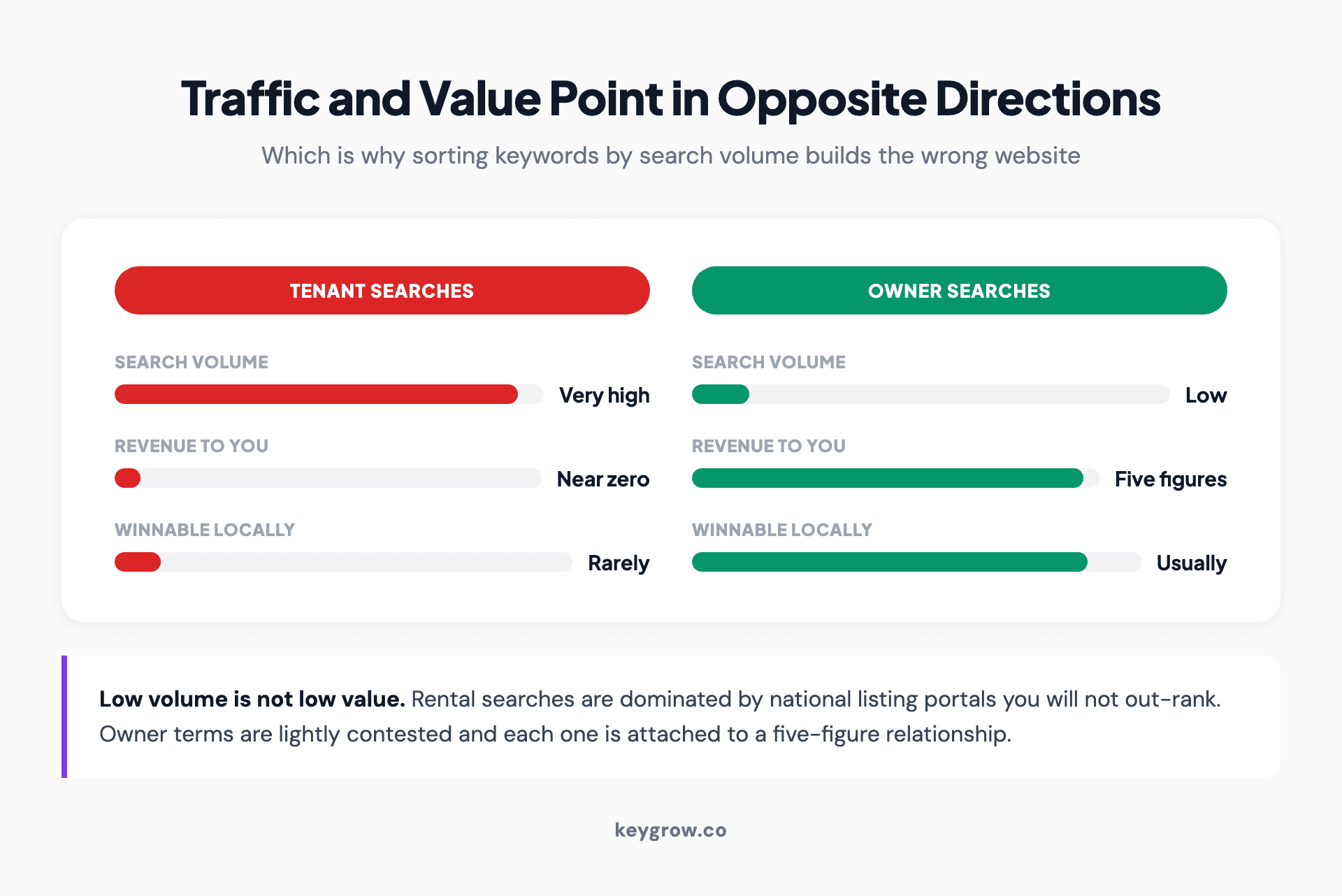
Tenant searches compared with owner searches across search volume, revenue to the property manager, and whether the terms are winnable locally, showing the two measures pointing in opposite directions.
What owner-intent keywords actually look like
Owners do not search the way marketers assume. They rarely start with "property management company". They start with a problem.
Problem-first searches. Someone tired of the job: how to handle a tenant who stopped paying, what to do about a rental you inherited, whether to sell or rent out a house you are moving out of.
Comparison searches. Should I hire a property manager, property management fees, self-managing versus hiring, what does a property manager actually do.
Decision searches, the smallest and most valuable group. Property management company plus a city, property manager for single-family homes, best property management in a named neighborhood.
Niche and asset-type searches. Short-term rental management, HOA management, commercial property management, multi-family, student housing. These convert well because the searcher has already self-selected.
The pattern worth noticing: most owner journeys begin at the problem stage, months before anyone types a decision keyword. A site that only targets the decision terms is arriving at the end of a conversation it never joined.
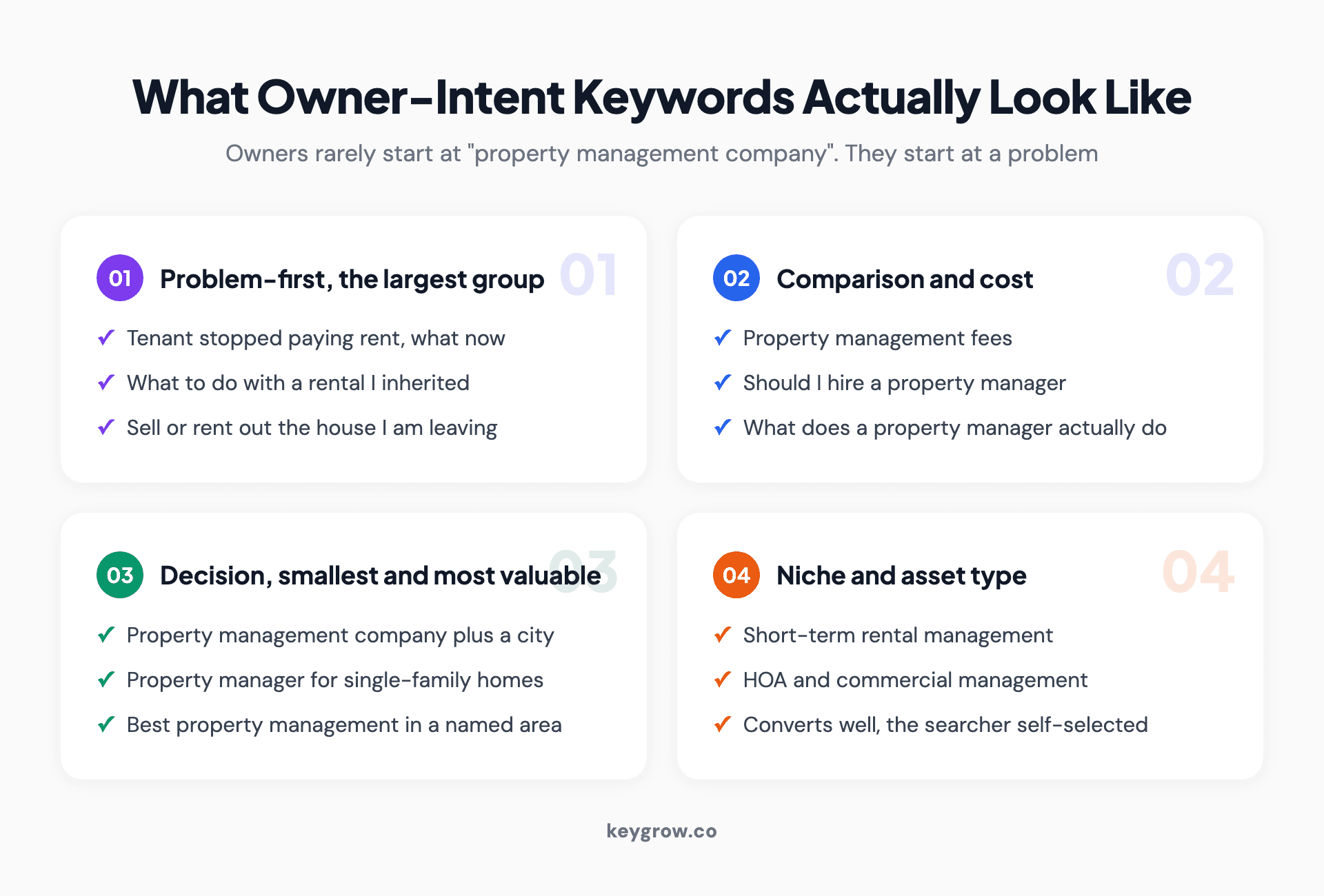
Four categories of owner-intent keyword: problem-first searches which are the largest group, comparison and cost searches, decision searches which are smallest and most valuable, and niche asset-type searches.
Your website is serving two audiences and losing both
Most property management sites try to be a leasing portal and a sales site at the same time, on the same navigation. It goes badly for both.
Tenants need listings, applications, maintenance requests and rent payment. Those are urgent, high-traffic and operational. Owners need proof that you will protect an asset, and evidence of what you charge and how you work.
When one site serves both without separating them, the owner lands on a homepage dominated by unit listings and concludes, reasonably, that this is a rental website. The structural fix is not subtle:
If that sounds like a rebuild rather than an SEO task, it often is, and the right site structure is usually the higher-return half of the work. Our property management page covers how we approach the split.
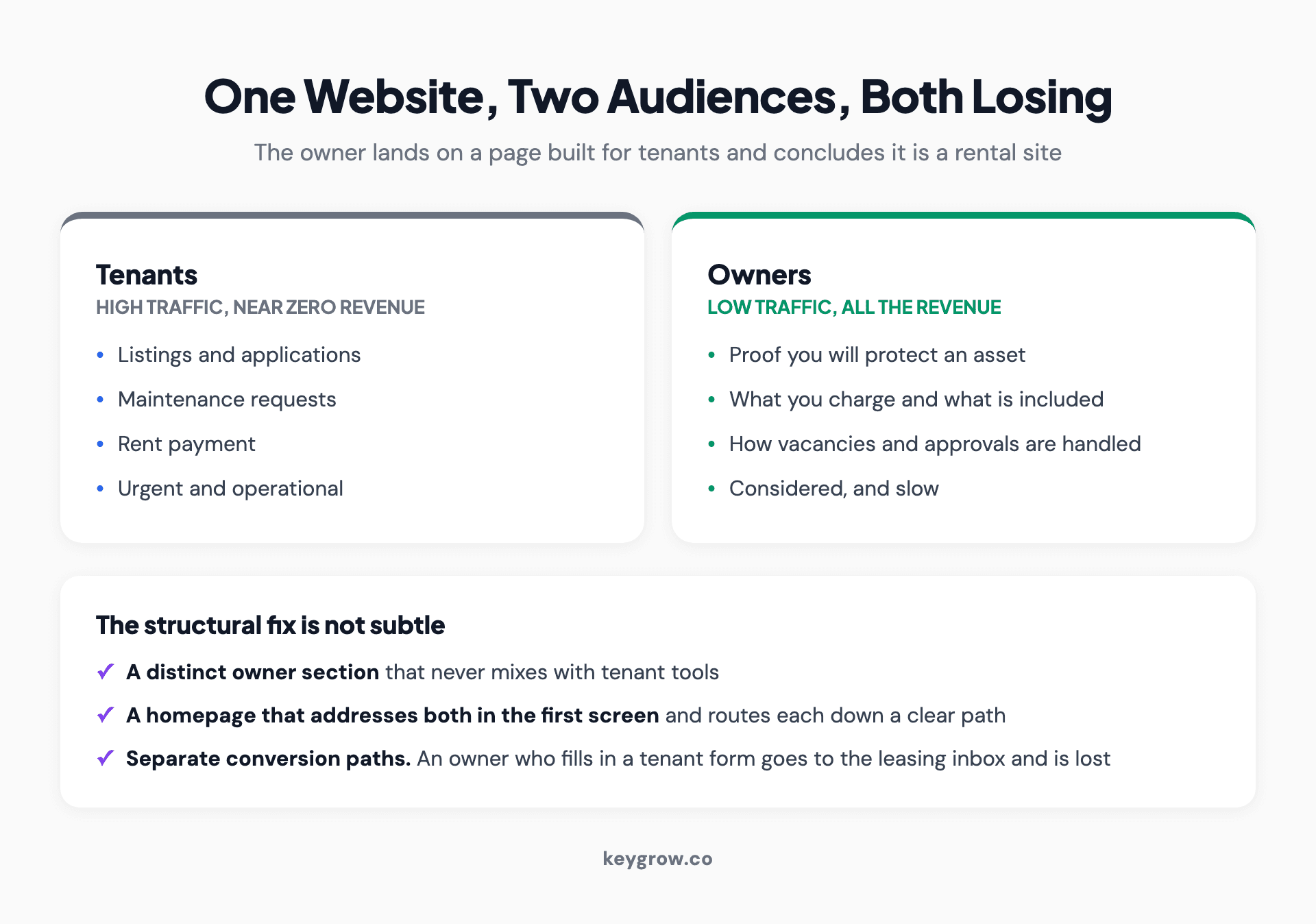
One website serving two audiences: tenants bringing high traffic and near zero revenue, owners bringing low traffic and all of the revenue, with the structural fixes that separate them.
Publish your fees
The single most contrarian recommendation on this page, and the one that separates the companies winning owner leads from the ones collecting form fills.
Almost nobody in this industry publishes pricing. Owners searching "property management fees" are therefore reading generic market-range articles written by software companies, which put the all-in first-year cost at roughly 18 to 20 percent of gross rent per Home365, then arriving at your site and finding nothing. They have to call to learn the most basic fact about working with you, and most will not.
Publishing a range does three things. It ranks for a set of high-intent commercial keywords nobody local is competing for. It screens out the owners who were never going to accept your rate, before they take an hour of your time. And it reads as confidence in a market where opacity is the norm.
The objection is always that competitors will see it. They already know what you charge. Your competitors are not the constraint here. The owner who gave up and called someone else is.
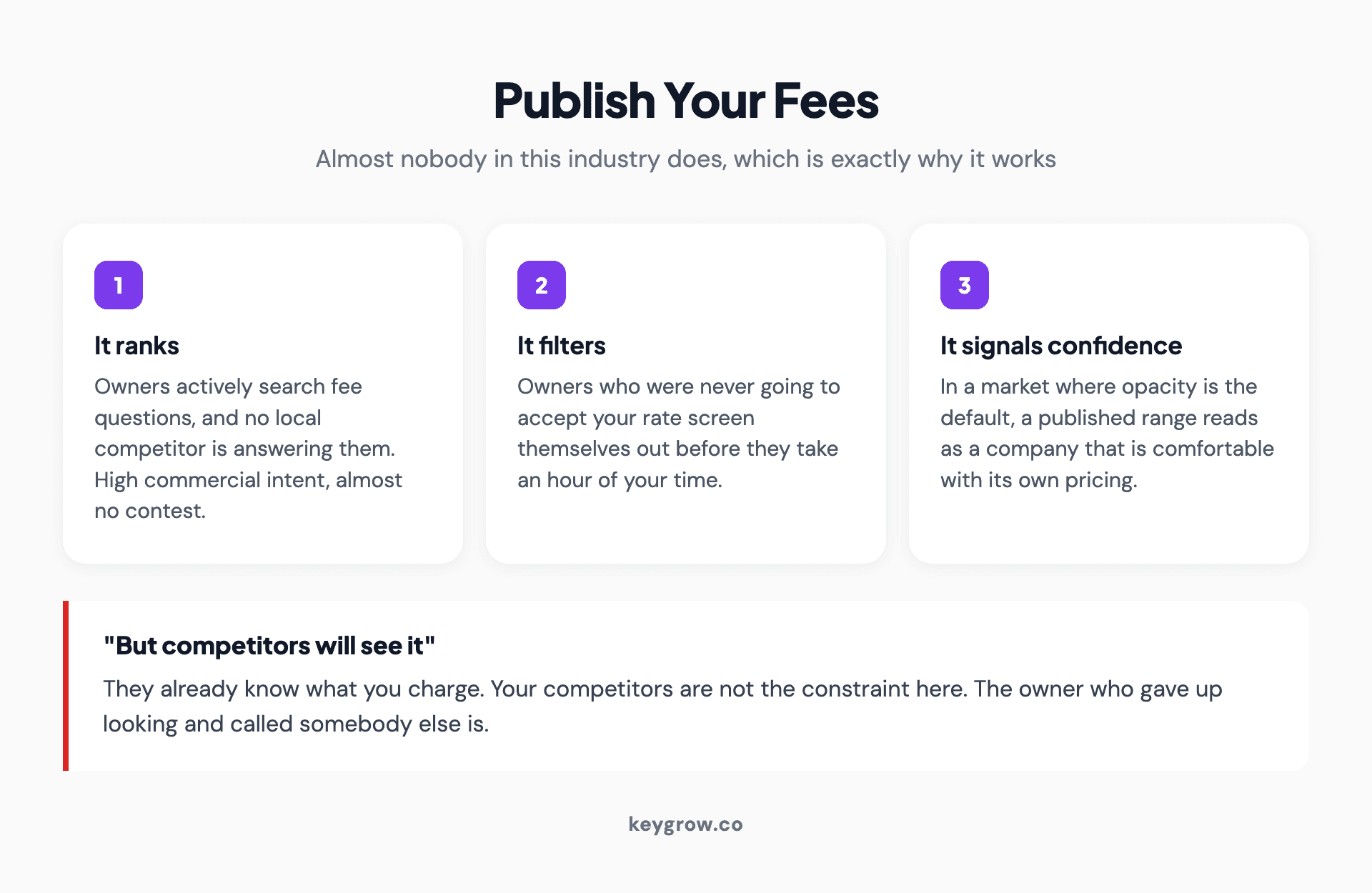
Three reasons publishing your management fees wins owner leads: it ranks for high-intent terms nobody local answers, it screens out owners who will not accept your rate, and it signals confidence in a market built on opacity.
The Google Business Profile details that matter here
Two specifics that are genuinely different for this industry.
The primary category decides which audience finds you. Property Management Company is the correct one for owner acquisition. Choosing Apartment Rental Agency or Real Estate Agency pulls you into a different set of searches, mostly tenant ones, and quietly changes who arrives.
Service areas and the address question. If you have a real office that owners visit, use it. If you manage across a metro from a small office, be honest about the address and set the service area to what you genuinely cover. Proximity still governs which searches you appear in, so a business on one edge of a metro will not show up for owner searches on the other side, regardless of how well the site is built. That mechanic is covered in ranking for near me searches.
Reviews are worth more here than in most industries, and they are also harder. Your reviews will be dominated by tenants, some of whom are unhappy for reasons that reflect well on you, such as enforcing the lease you were hired to enforce. Asking owners for reviews should be a standing process rather than an afterthought, because owner reviews are the ones prospective owners read.
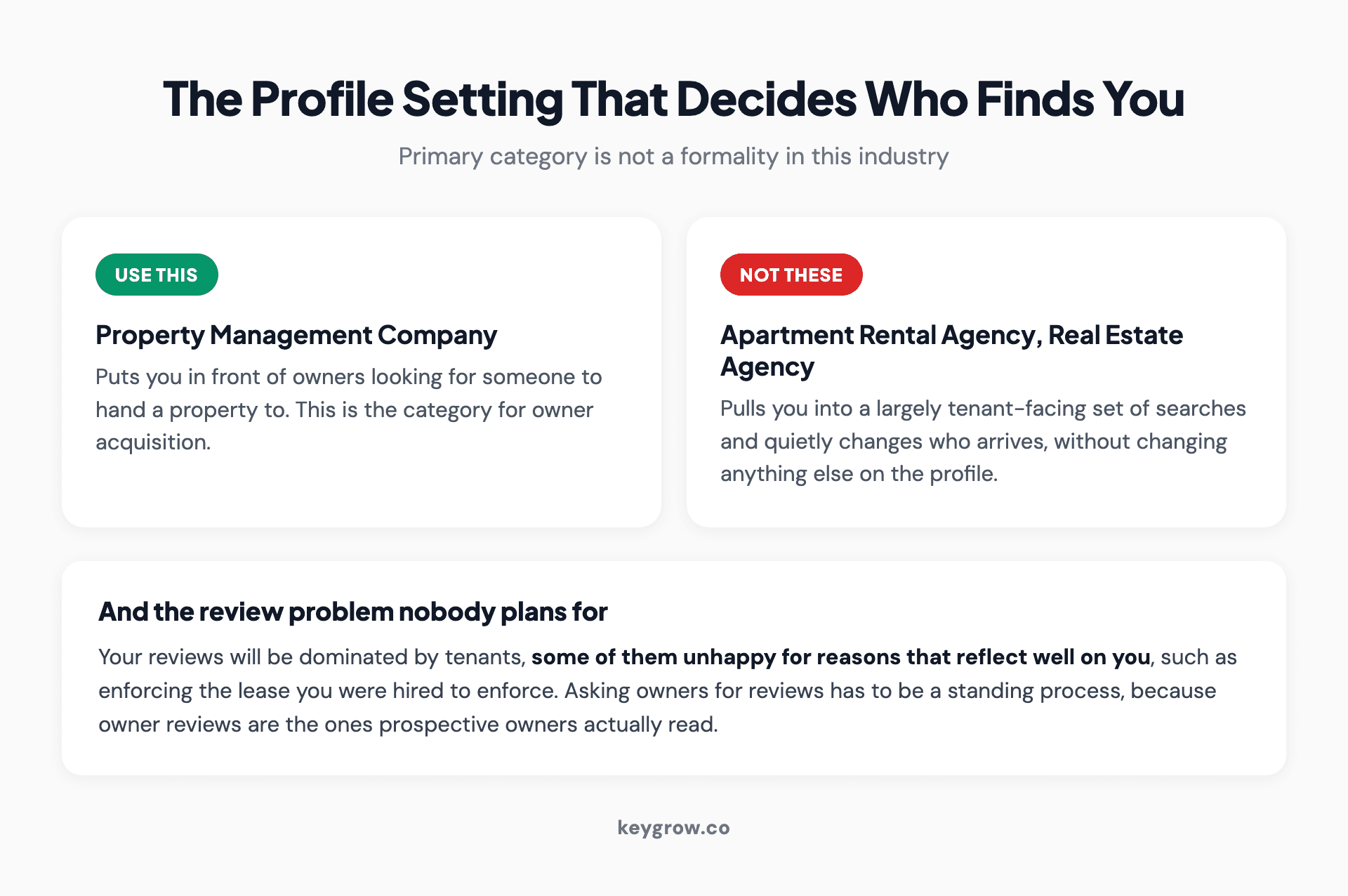
The Google Business Profile primary category decision for property managers: Property Management Company for owner acquisition against Apartment Rental Agency or Real Estate Agency which pull you into tenant searches.
Content that owners actually search
Write for the problem stage, where the volume and the trust are.
The questions owners genuinely ask: how much does a property manager cost, what do they actually do for the fee, how do I get out of a bad management contract, should I sell or keep renting, how long do vacancies take here, what are the rules on security deposits in this state.
That last category is the strongest and least used. Landlord-tenant law is local, changes regularly, and owners are genuinely confused by it. A clear, dated, correct page on deposit limits or notice requirements in your specific state earns links, gets cited, and reaches owners at the exact moment they are realizing this is harder than expected. It is also a natural fit for answer engine optimization, because it is the type of question people now ask an assistant rather than a search engine.
One caution: keep it accurate and dated, and say plainly that it is not legal advice. Publishing a confidently wrong summary of deposit law is worse than publishing nothing.

A set of house keys resting on a wooden table.
When you should not hire anyone for this
If you manage fewer than about fifty doors and you are growing through referrals, SEO is probably not your constraint. Your constraint is capacity, or systems, or the fact that nobody in your market knows you exist yet, and none of those are fixed by content.
The genuinely free work comes first, and you can do all of it yourself. Claim the Google Business Profile and set the primary category correctly. Build one honest owner-facing section with your fees on it. Ask every owner you already have for a review. That is most of the available result for a small portfolio, and an agency charging monthly to do exactly that is charging you for attention.
Hire when the doors are worth enough that a single new owner pays for a quarter of the work, when you are competing against companies that already do the basics well, or when you are trying to enter a neighboring market where nobody knows your name. At $7,000 to $12,000 of lifetime value per door, that math turns favorable faster here than in most industries, which is exactly why it is worth being precise about when it turns rather than assuming it already has. When that point arrives, the work belongs in our SEO service, billed month to month.

A person holding a house key in front of a doorway.
FAQs
Should property management SEO target owners or tenants?
Owners, in nearly every case. A signed owner is worth thousands in management fees over the life of the relationship, while a tenant produces revenue only through a placement fee the owner pays. Tenant search volume is also dominated by large listing portals that a local company will not out-rank.
What keywords should a property management company target?
Problem-first terms owners search before they are ready to hire, comparison terms like property management fees and whether to hire a manager, and decision terms pairing property management with a city or asset type. Volume on the decision terms is low and the value per visitor is very high.
How long does SEO take for a property management company?
Several months before meaningful movement, and longer in competitive metros. Profile and website fixes can show up sooner. Because each owner is worth thousands over the relationship, the payback period is usually shorter than the ranking timeline suggests.
Should we publish our management fees on the website?
Yes, at least as a range. Owners actively search fee questions, almost no local competitor answers them, and publishing filters out owners who were never going to pay your rate. The common objection that competitors will see it ignores that they already know.
What Google Business Profile category should a property manager use?
Property Management Company, if the goal is owner acquisition. Apartment Rental Agency and Real Estate Agency pull you into largely tenant-facing searches and change who finds you without changing anything else.
How do we get reviews from owners rather than tenants?
Ask deliberately and systematically, because tenant reviews will otherwise dominate by volume. Good moments include after a successful placement, after a difficult maintenance issue handled well, and at renewal. Owner reviews are the ones prospective owners actually read.
Is content marketing worth it for property management?
Yes, when it targets the problem stage rather than the decision stage. State-specific landlord-tenant questions on deposits, notice periods and eviction process are searched constantly, rarely answered well locally, and reach owners at the moment they start considering help.
Can a small property management company compete on SEO?
In owner-intent searches, yes. Those terms are low volume and lightly contested, which is exactly the situation a small local company can win. Competing for tenant rental searches against national portals is the fight not worth picking.
Where to point the next ninety days
Pick the audience first and be ruthless about it. If the goal is more doors, every page, every keyword and every profile setting should be pointed at owners, and the tenant experience should be efficient rather than optimized for search.
Then do the two things that cost nothing. Set the Google Business Profile primary category to Property Management Company. Put a fee range on the site.
After that, write for the problem stage rather than the decision stage, because the owner who is going to sign with you next year is, right now, searching for how to handle a tenant who stopped paying rent. Be the page that answers that properly and you will be on the shortlist before anyone types the term you thought you were targeting.


