


The most common complaint we hear about SEO for med spas is that the traffic went up and the calendar did not. That is not a ranking failure. It is usually a symptom of treating one business when you are actually running two.
A med spa sells recurring injectable appointments and one-off device treatments out of the same suite, under the same brand, to two different people with two completely different buying processes. The injectable patient books in ten minutes and returns four times a year. The laser patient researches for six weeks, compares three clinics, asks about financing, and books a consultation. One website structure cannot serve both, and the traffic report will look healthy the entire time it fails to.
So the useful version of this question is not how to rank. It is which of your two businesses you are ranking for, and whether the pages behind those rankings are built for how that patient decides.
A med spa is two businesses sharing a front desk
Split your service list into recurring and considered before you touch a keyword tool. Almost everything follows from that line.
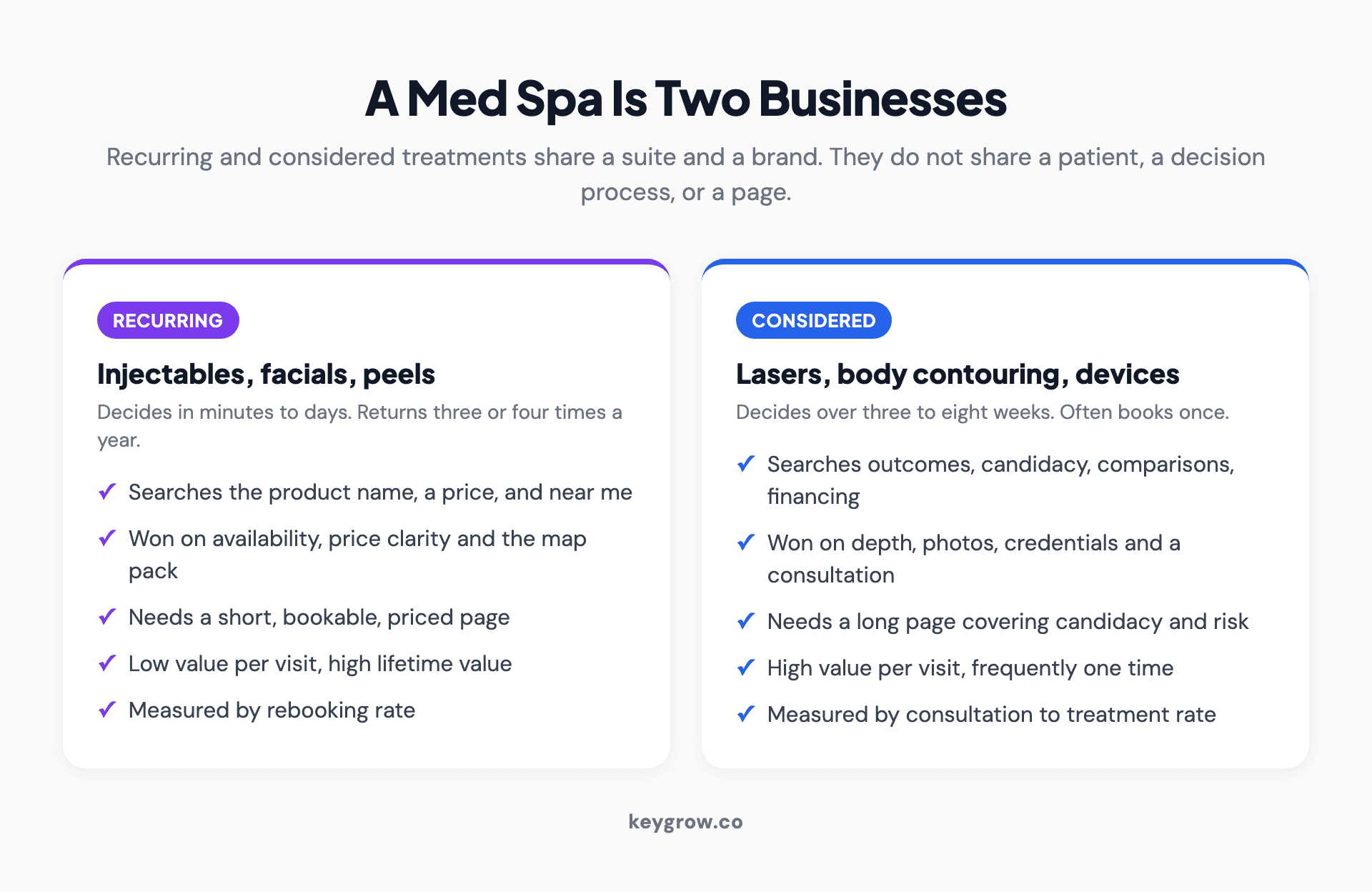
The two businesses inside a med spa: recurring injectable appointments and considered device treatments, and how differently each patient behaves.
| Recurring (injectables, facials, peels) | Considered (lasers, body contouring, devices) | |
|---|---|---|
| Decision time | Minutes to days | Three to eight weeks |
| What they search | Product name, price, "near me" | Outcome, candidacy, comparisons, financing |
| What wins them | Availability, price clarity, map pack | Depth, photos, provider credentials, a consultation |
| Page needed | Short, bookable, priced | Long, with candidacy and risk covered |
| Value | Low per visit, high lifetime | High per visit, often one time |
| Right metric | Rebooking rate | Consultation to treatment rate |
Most med spa websites are built entirely for the second column and wonder why the first column does not convert, or built entirely for the first and wonder why the expensive treatments never sell.
Get this split on paper. It decides your site architecture, your content calendar, and which rankings are actually worth paying for. If your clinic bills insurance as well as selling elective treatments, the insurance half follows different rules and we covered those in SEO for medical practices.
Patients search the product name, and you have to decide what to do about that
A large share of your highest-intent demand is people typing a branded drug or device name plus your city. This is the most valuable traffic you can get and the most constrained.
The constraint is real. Manufacturers set rules about how their brands may be used in advertising by providers, and prescription products carry promotional requirements that a generic service page does not. The FDA's rules on prescription drug advertising apply to promotional claims about those products, not only to the manufacturers who make them.
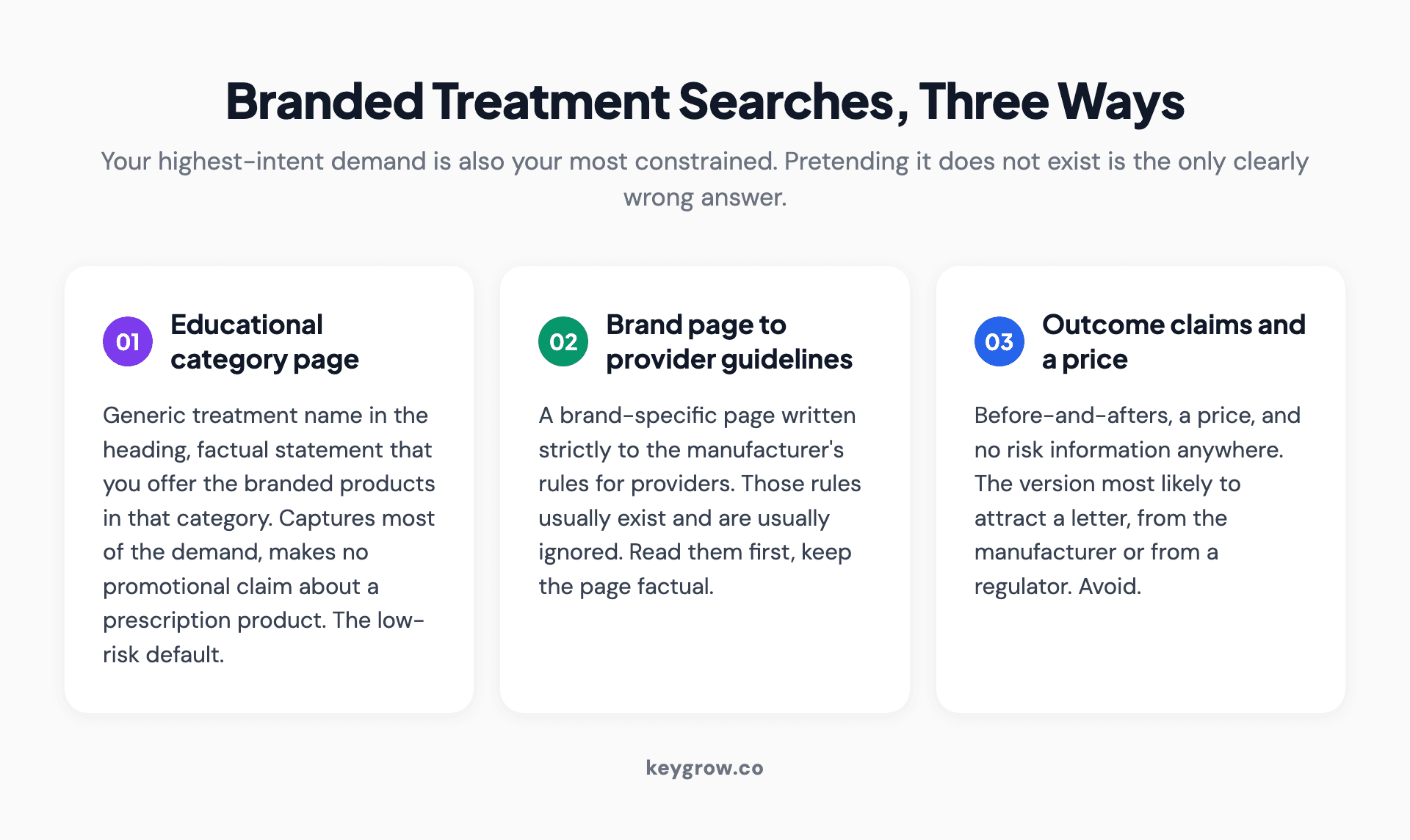
Three ways to handle branded treatment searches without making claims you cannot support.
There are three workable positions, and the wrong one is pretending the demand does not exist.
The safest is to publish an educational page about the treatment category, using the generic name in the heading and a factual statement that you offer the branded products in that category. You capture a good share of the branded search without making a promotional claim about a prescription product.
The middle position is a brand-specific page written strictly to the manufacturer's provider guidelines, which usually exist and are usually ignored. If you take this route, read them first and keep the page factual.
The one to avoid is a page making outcome claims about a prescription product, with before-and-afters and a price, and no risk information anywhere. That is the version most likely to attract a letter, from the manufacturer or from a regulator.
Build the treatment page around the decision, not the description
Almost every med spa treatment page describes the treatment. Almost none answer the questions that decide the booking.
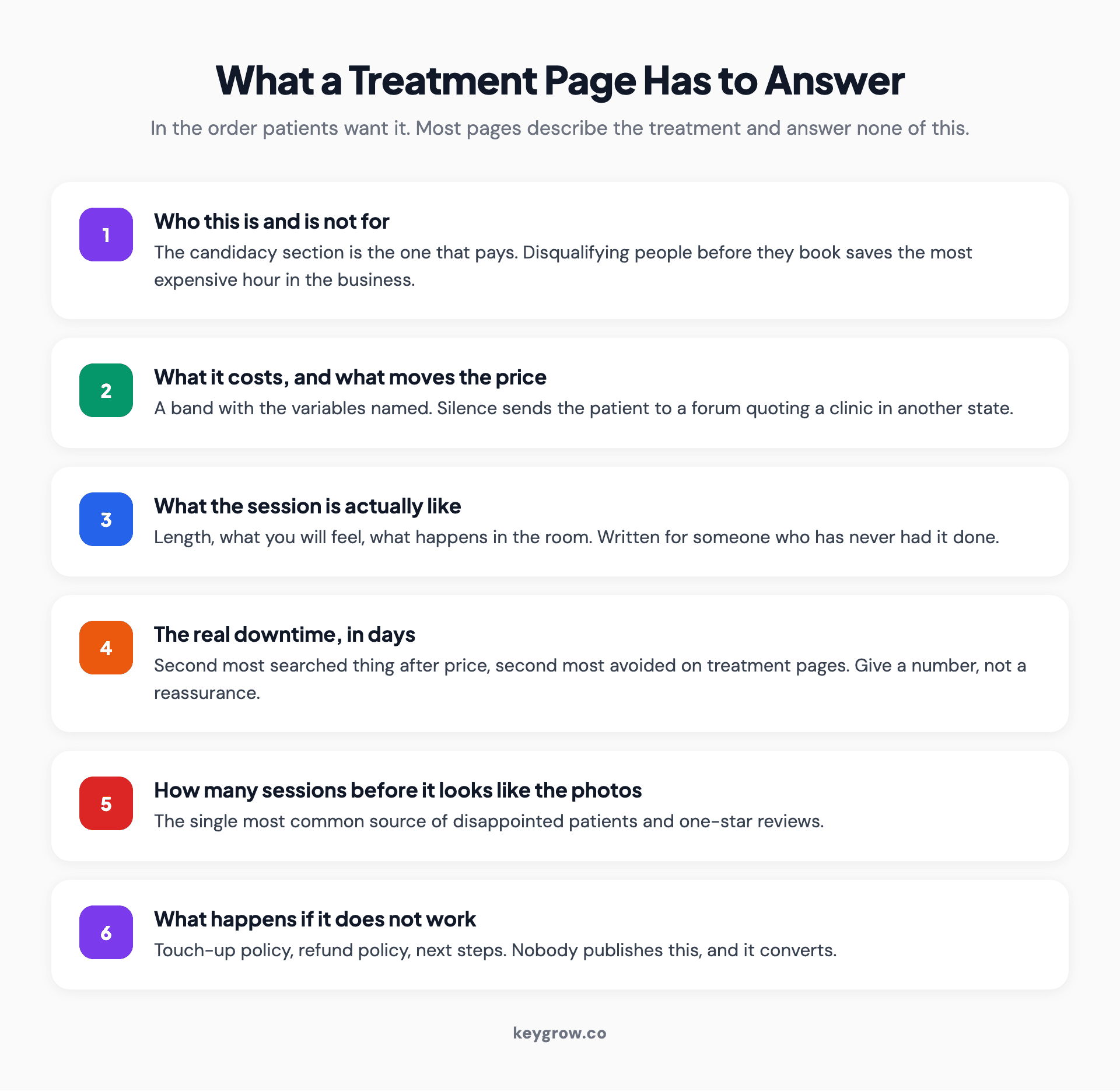
What a med spa treatment page has to answer, in the order patients want it, and the section that saves the most consultation time.
Here is what a considered-treatment page actually needs, in the order patients want it: who this is and is not for, what it costs and what changes the price, what the session is like, what the downtime really is, how many sessions before it looks like the photos, what it feels like, and what happens if it does not work.
The candidacy section is the one that pays. A page that says plainly "this does not work well on tanned skin" or "if you are within a year of pregnancy, wait" disqualifies people before they book a consultation, and a consultation slot spent on someone who was never a candidate is the most expensive hour in the business.
Downtime is the second most-searched thing after price and the second most-avoided on treatment pages. Answer it in a number of days, not a reassurance.
The gap between booked and attended is where the money leaks
For considered treatments, the site's job is a booked consultation that shows up. Form submissions are a proxy that lies, because the gap between submitting and attending is where most of the loss happens.
We rebuild pages against this metric rather than against traffic. A law firm went up 70 percent in conversion rate in 3 weeks, and a security company 95 percent in 4 weeks. Neither win came from more visitors. Both came from making one action obvious.

A patient consultation in a clinic office.
Three things move consultation show rates more than page design does. Let people book a real time slot rather than requesting a callback. Say what the consultation costs and whether it is credited against treatment, because the unanswered version of that question is why people abandon. And confirm by text, not only email.
If your consultations are booking but the treatment close rate is low, that is not a website problem and no amount of SEO fixes it. Look at the consultation itself.
Your injector is the brand, not your spa
This is the structural fact about aesthetics that other local industries do not have: patients are loyal to the person holding the syringe, not to the sign on the door.

A laser treatment being performed in a clinic.
That has three consequences for the website. Every provider needs a real page with credentials, training, years injecting, and their own photo, because a meaningful share of your branded search is people looking for that individual. Those pages will rank for the injector's name and pick up patients who heard about them from a friend. And review responses should name the provider, since that is the name the reader is checking.
It also creates a risk worth naming: when an injector leaves, they can take a client list built on your marketing spend. That is a contract question rather than an SEO one, but it should inform how much of the brand you build on one person's face.
Before and afters are your best asset and your biggest compliance risk
Nothing on your site converts like a genuine before and after gallery. Nothing on your site carries more exposure either.
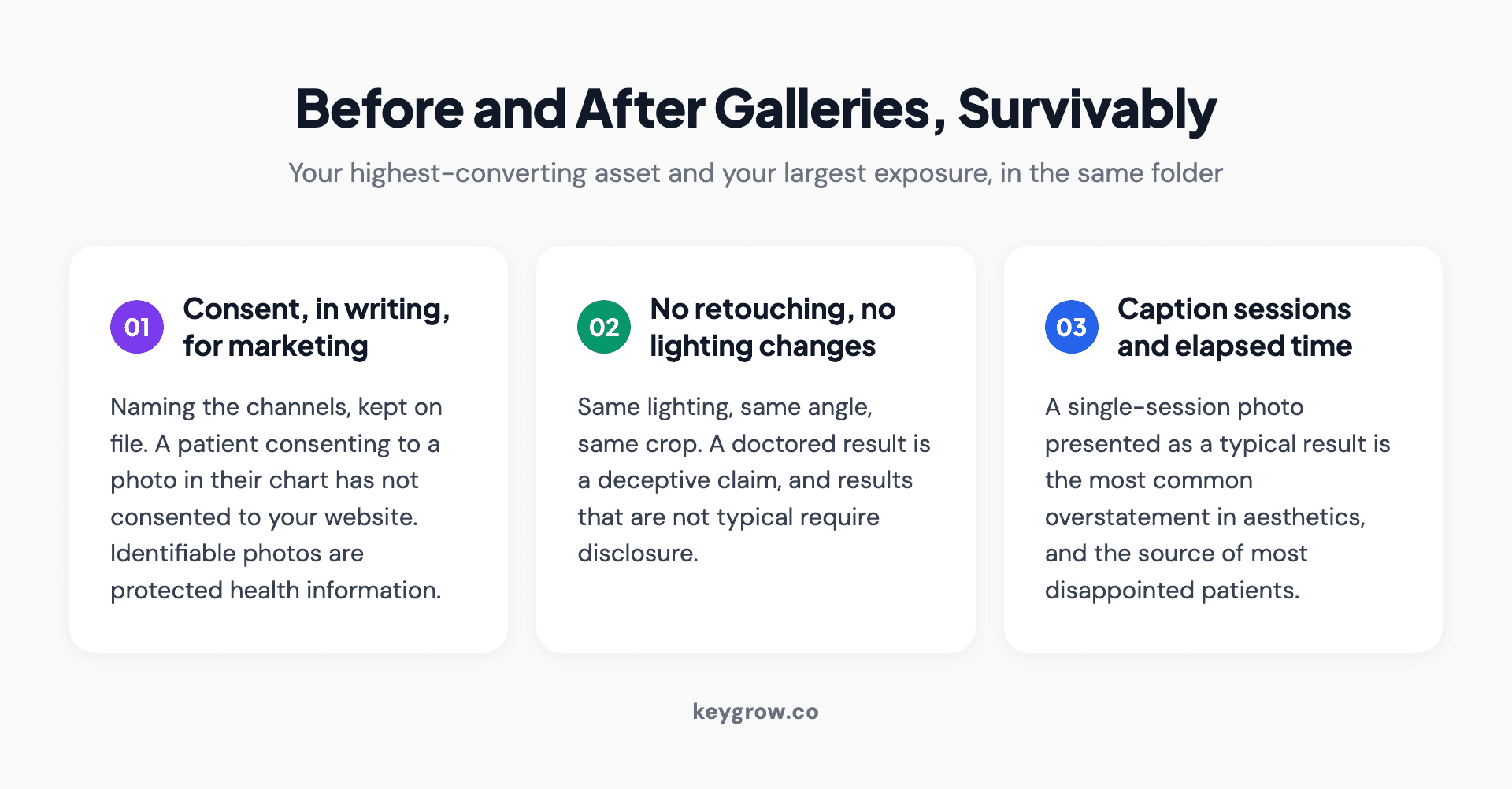
The three rules that make a med spa before and after gallery survivable: consent, no retouching, and captioned sessions.
Three rules make this survivable. Get written, specific consent for marketing use, naming the channels, and keep it on file. A patient consenting to their photo in the chart has not consented to it appearing on a website. Second, do not retouch, change lighting between shots, or crop differently, because a doctored result is a deceptive claim and the FTC's health guidance treats results that are not typical as requiring disclosure. Third, caption the number of sessions and the time elapsed. A single-session photo presented as a typical result is the most common overstatement in this category.
Patient photographs are also protected health information when they identify someone, so consent and storage practices need to satisfy privacy rules as well as advertising ones. Talk to your own counsel about your setup rather than copying another clinic's disclaimer.
The upside for search: a properly captioned gallery, with alt text describing the treatment and the outcome, is one of the few genuinely original assets a med spa can publish, and originality is what earns links and citations here.
The map pack, and the three kinds of competitor in it
Local visibility for aesthetics is more crowded than it was, for a straightforward reason. AmSpa's industry data puts the number of US med spas at roughly 10,500 in 2023, up from about 8,900 the year before, with average annual revenue of $1,398,833 in 2024.
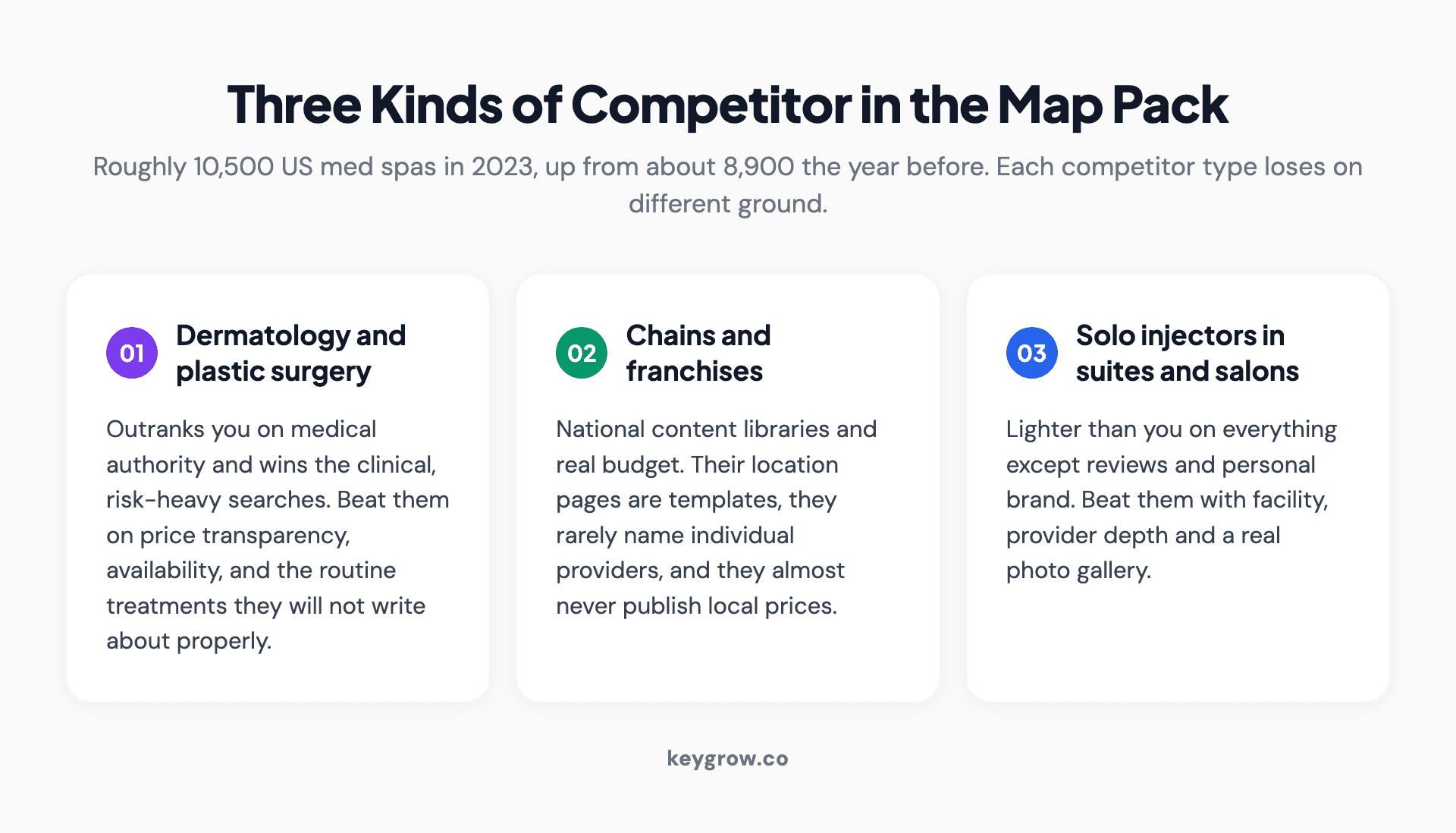
The three competitor types in a med spa map pack, and the ground each one cannot hold.
You are fighting three different opponents in those results, and each loses on different ground.
Dermatology and [plastic surgery practices](/industries/healthcare/plastic-surgeon/seo) outrank you on medical authority and will win the clinical, risk-heavy searches. You beat them on price transparency, availability, and treatments they consider too routine to write about properly.
Chains and franchises have national content libraries and real budget. Their location pages are templates, they rarely name individual providers, and they almost never publish local prices. That is your opening.
Solo injectors in suites and salons are lighter than you on everything except reviews and personal brand. You beat them with facility, provider depth and a real photo gallery.
Fix the profile before the website: category, services list, real photos of the actual space, and accurate hours. Our Google Business Profile guide has the field-by-field version, and the med spa SEO service page covers how we run this end to end.
Reviews when the treatment is something people do not discuss
Aesthetics has a review problem no other local business has: a satisfied patient often does not want anyone to know they were a patient.
That changes the ask. Do not ask at the moment of treatment. Ask at the follow-up, when the result has settled and the patient is pleased with how they look, and make it easy to write something that does not name the specific treatment. Plenty of your best reviews will say the staff were lovely and the results were great, without detail, and those still count.
Never post a reply that confirms what someone was treated for. Acknowledging a specific procedure in a public response discloses the patient's care, whatever they said first. Keep replies warm and non-specific, and take everything else to a phone call. The mechanics of building a steady flow are in our guide to getting more Google reviews.
Membership changes which keywords are worth having
If you run a membership or loyalty program, the arithmetic behind your keyword choices changes, and most med spa SEO advice never mentions it.
A patient acquired on a low-ticket, frequently searched term like a facial or a first-time injectable offer may be worth more over two years than one acquired on a high-ticket device search, because the first one comes back. Once you know your average membership length, some cheap terms become the most valuable ones you can rank for and some expensive ones stop being worth the effort.
Work out what a member is worth over eighteen months before you decide which pages to build. It routinely reverses the priority order people arrive with.
What to measure
The reason so many med spa SEO reports look good while the business does not is that they measure the wrong end of the funnel.
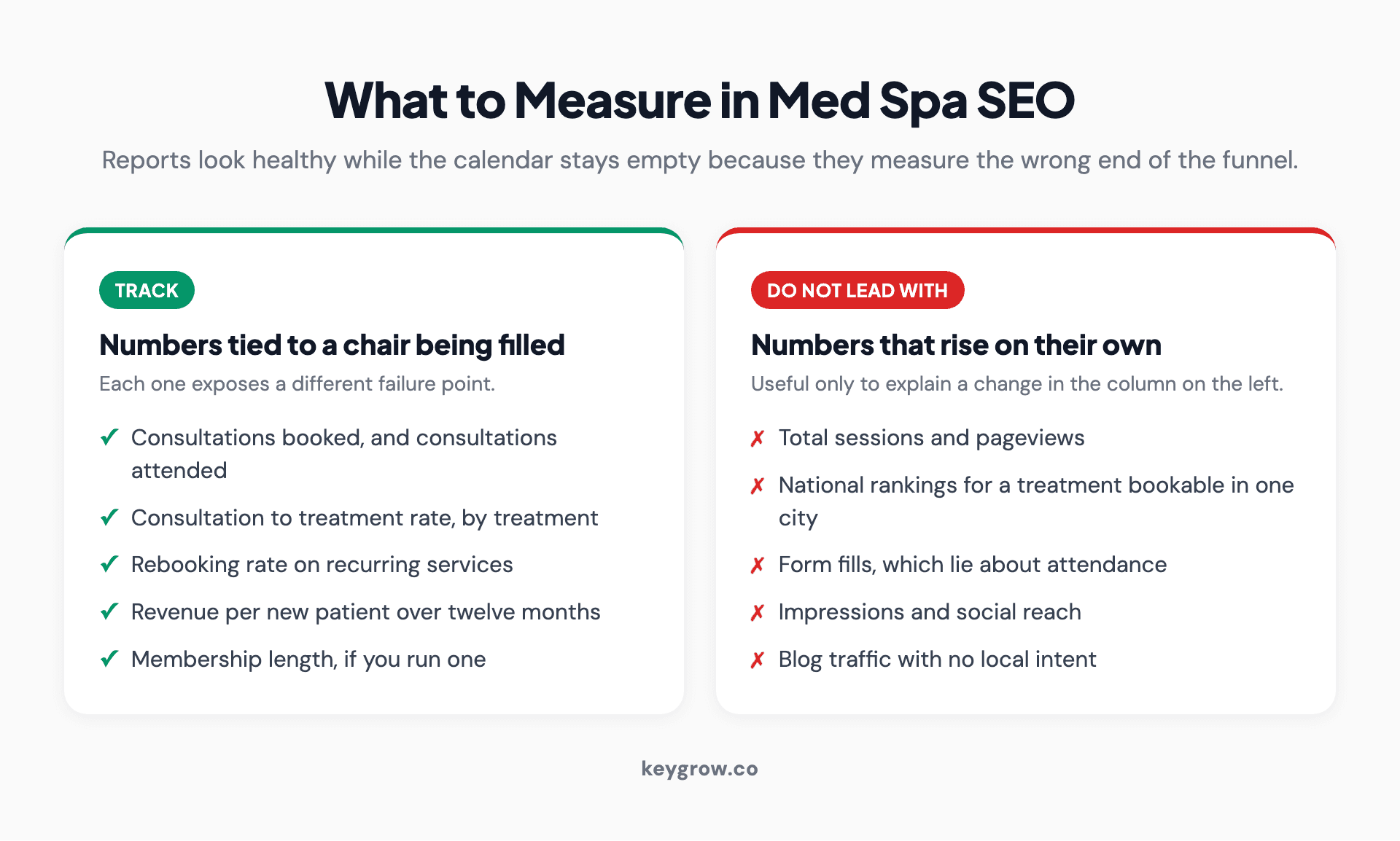
What to track in med spa SEO, and the metrics that rise while the calendar stays empty.
More traffic is the wrong fix for the wrong patients. Filtering beats volume, and it is not close. On a real estate client we took serious leads up 600 percent between December and January with no budget increase, purely by tightening who could reach the form. The same logic applies to a med spa treatment page that ranks nationally for a procedure only bookable in one city.
Track consultations booked, consultations attended, consultation-to-treatment rate by treatment, rebooking rate on recurring services, and revenue per new patient over twelve months. Watch total sessions only to explain a change in the numbers above.
Med spas that should not be buying SEO yet
Four situations where we would tell you to wait.
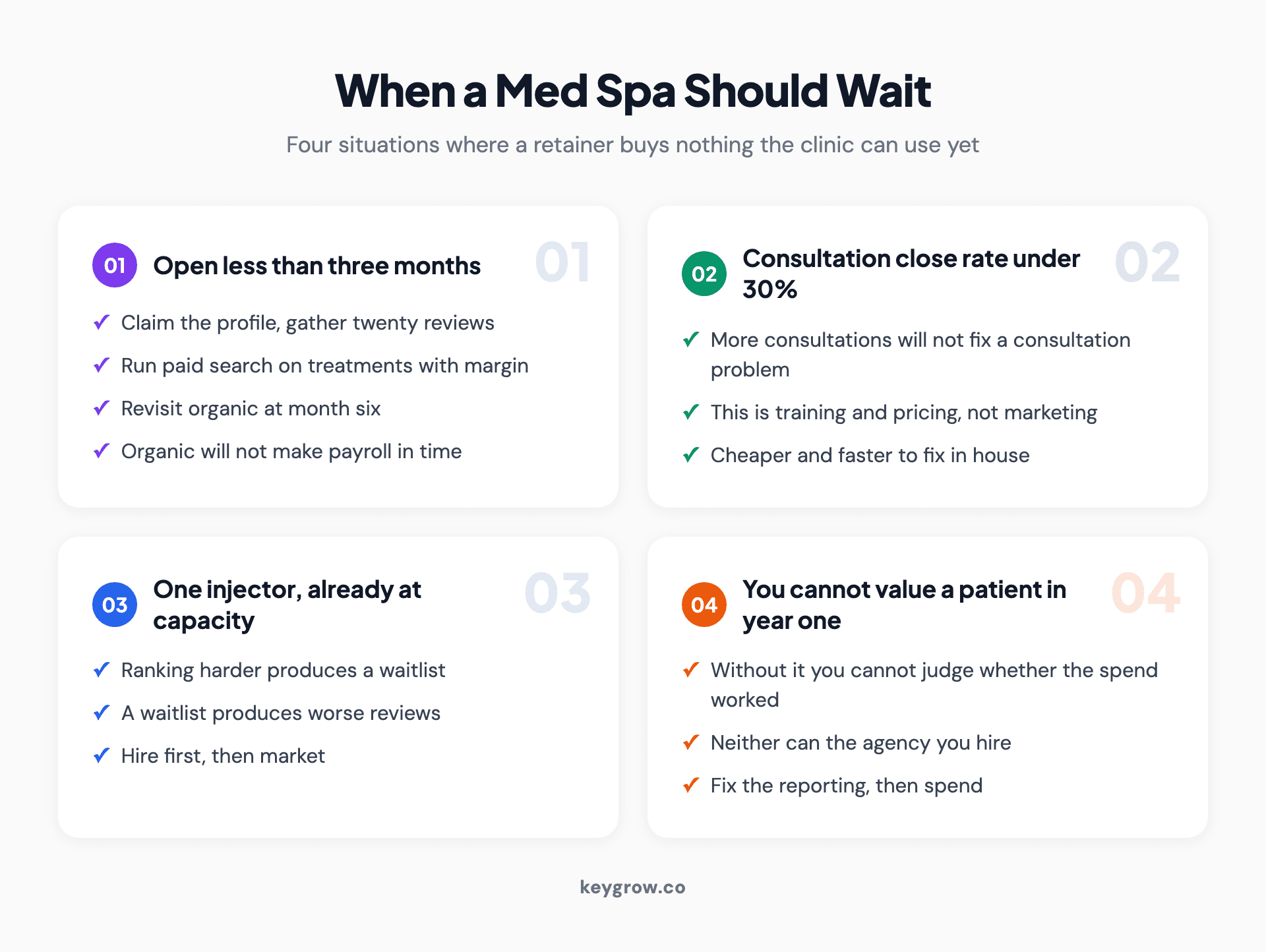
Four situations where a med spa should wait before buying SEO, and what to do instead in each.
You opened in the last three months. Get the profile claimed, get twenty reviews, run paid search for the treatments with margin, and revisit organic at month six. Organic will not produce a patient in time to make payroll.
Your consultation close rate is under thirty percent. More consultations will not fix a consultation problem. This is a training and pricing issue and it is cheaper to fix.
You have one injector at capacity. Ranking harder produces a waitlist and a worse experience. Hire first.
You cannot say what a patient is worth in year one. Without that number you cannot judge whether any of this worked, and neither can we. Get the reporting straight, then spend.
We turn away clinics in the first two situations regularly, because selling a retainer against a problem SEO does not touch is how agencies get fired at month five with everyone annoyed.
FAQs
When should a med spa expect to see results?
The profile and the map pack move first, often inside two months. Treatment page rankings usually take four to six months in an average market and longer in a dense metro. Meaningful compounding, where organic becomes a reliable share of new patients, is a nine to twelve month project. Anyone promising faster in aesthetics is quoting a less competitive city than yours.
Should a med spa have a separate page for every treatment?
Every treatment you actually want more of, yes. Treatments you offer occasionally can share a page. The test is whether you can write eight hundred useful words about candidacy, cost, downtime and results without padding. If you cannot, it belongs in a group page rather than alone.
Is SEO or paid search better for a med spa?
Paid search for the high-margin considered treatments where you need patients this quarter, organic for the recurring services and the educational searches that compound. New clinics should start with paid and the Google Business Profile. Established clinics with a full paid program usually get more from organic, because the cost per consultation stops rising.
Can a med spa advertise branded injectable treatments on its website?
You can state factually which products you offer. Making promotional claims about a prescription product brings requirements most treatment pages do not satisfy, and manufacturers set their own rules for how providers may use their brands. The low-risk approach is an educational page using the generic treatment category, with a factual mention of the brands you carry.
What are the rules for posting before and after photos?
Yes, and they are among the few genuinely original assets you can publish, which helps with links, image search and AI citations. They also carry the most risk. Get written marketing-specific consent, never retouch or change lighting between shots, and caption the number of sessions and elapsed time.
How do you get reviews when patients want privacy?
Enough that recent ones keep arriving, since consumers weight the last three months heavily. For aesthetics the harder problem is that satisfied patients often prefer not to say publicly that they were treated, so ask at the follow-up visit and accept reviews that praise the experience without naming a procedure.
Which med spa searches actually produce bookings?
Treatment plus city, treatment plus cost, and candidacy questions phrased the way patients ask them. Branded product searches carry the highest intent and the most constraints. Broad terms like med spa or aesthetics without a location produce national readers who cannot book with you.
Why is my med spa getting traffic but no bookings?
Usually one of three things: the pages ranking are educational and attract readers outside your service area, the treatment pages describe the procedure without answering cost, candidacy and downtime, or the booking step asks for a callback instead of offering a real appointment slot. Check which pages the traffic lands on before changing anything else.
Start with the calendar, not the keyword list
Open next month's schedule and find the gaps. If the gaps are in recurring appointments, your problem is rebooking and local visibility, and the work is the profile, the reviews and short bookable service pages. If the gaps are in the high-ticket device treatments, your problem is consultations, and the work is candidacy, price ranges, downtime and a real photo gallery.
Those are different projects, and we scope local SEO work around whichever one the booking data points at. Doing the wrong one well is the most common way a med spa spends a year on SEO and ends up with a better traffic chart and the same calendar.
If you want a second opinion on which of the two you are actually short on, send us the site and a month of booking data and we will tell you, including when the honest answer is that the website is fine and the bottleneck is somewhere else.