


Most advice on how to get more Google reviews is a list of twelve tactics. Here is the part the lists leave out: the total does not matter nearly as much as the date on the newest one.
Ask 1,002 US adults, as BrightLocal did in February 2026, and roughly three quarters of them will not look past the last three months. A third want to see something from the last two weeks. A profile with 180 reviews where the newest is from March reads worse than one with 40 that got three last week.
So the goal is not a number. It is a rate. Somewhere between one and four new reviews a month, forever, depending on how many customers you serve. Everything below is about building an ask that produces that rate without anyone having to remember to do it.
Stop counting the total. Start counting the last ninety days
Open your profile and ignore the review count entirely. Count how many arrived in the last ninety days, and look at the date on the newest one.
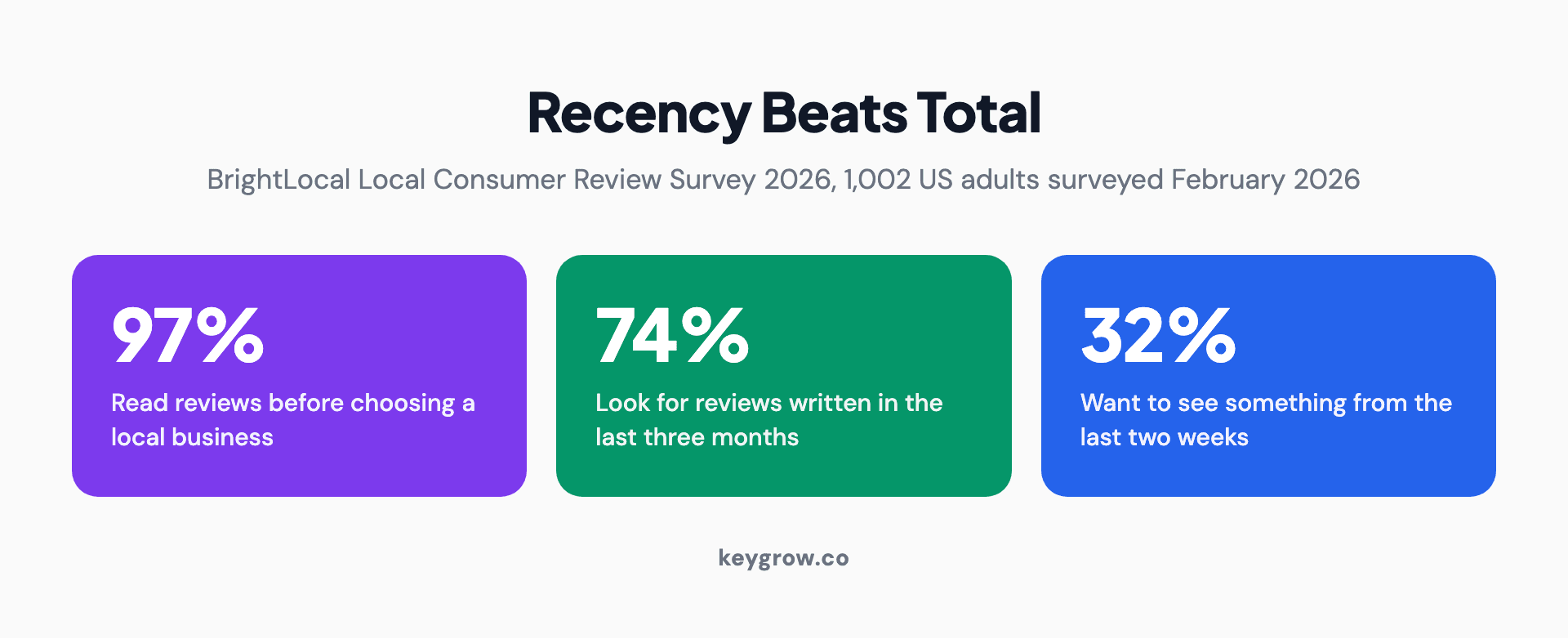
Why review recency beats review volume, based on BrightLocal's 2026 consumer survey.
That pair of numbers is the whole scoreboard. Total review count is the vanity metric of local marketing: it goes up forever, it never goes down, and it tells a business owner they are winning while their newest review quietly ages past the point anyone trusts it. BrightLocal's 2026 survey is where the recency numbers come from, and they have moved sharply in one year.
Write down today's two numbers. You will use them to size everything else.
Work out how many asks a month you actually need
Reviews are a conversion funnel with two steps: you ask, some fraction respond. So the arithmetic is short.
Decide the target first. A trailing ninety days that never drops below eight to ten reviews is a strong position for most local businesses, and it means roughly three a month.
Then measure your own conversion rate, because published ones are useless to you. For thirty days, log every ask and every review that lands. If sixty asks produced ten reviews, your rate is one in six.
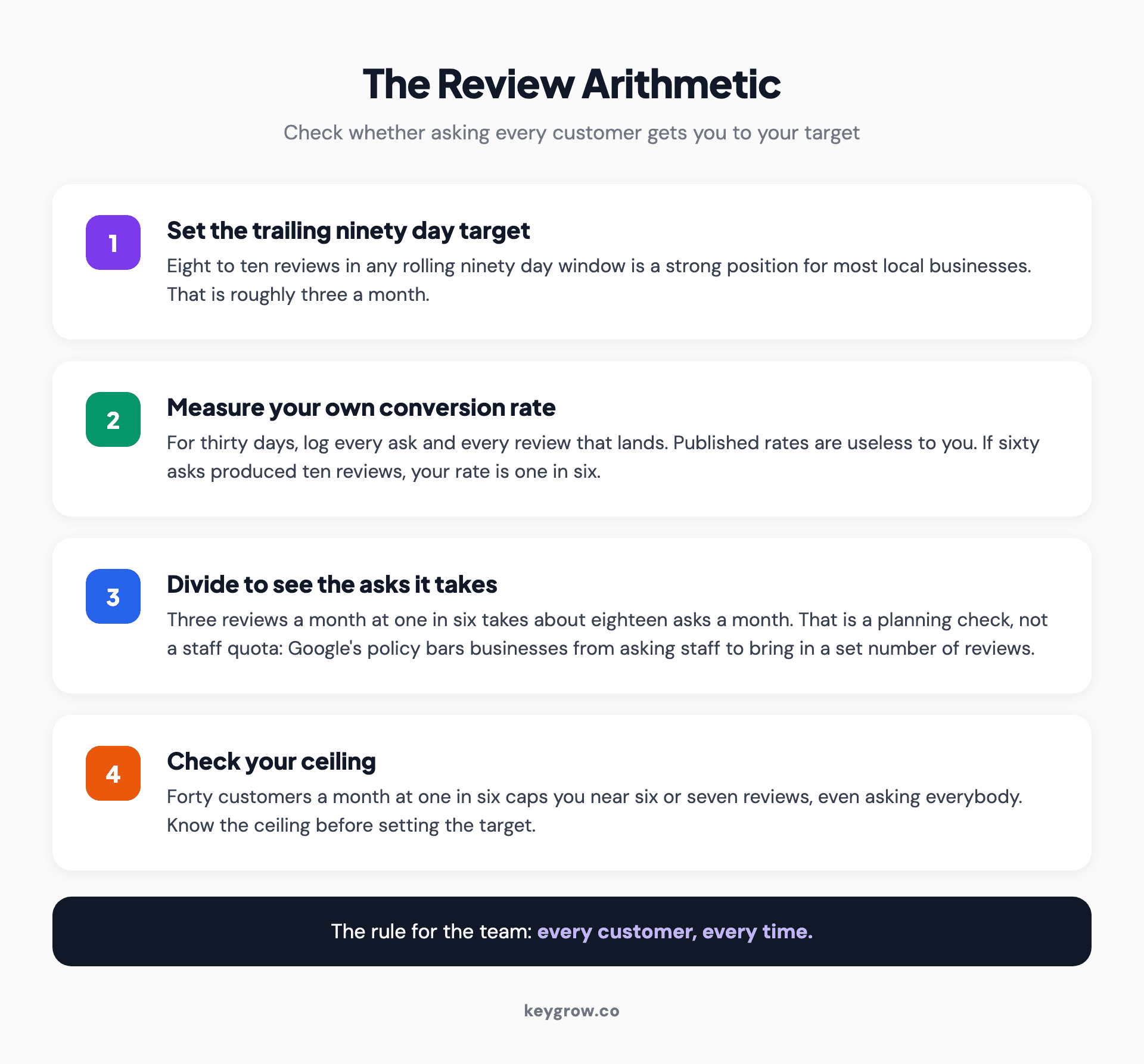
How to size a review program: pick a trailing ninety day target, measure your own ask-to-review rate, then divide to check whether asking every customer gets you there.
Now divide. Three reviews a month at one in six takes about eighteen asks a month, or four or five a week. Use that as a check on whether asking every customer gets you there, not as a quota for the front desk: since early 2026, Google's review policy bars businesses from asking staff to solicit a set number of reviews. The rule for the team is simpler. Every customer, every time.
If you serve forty customers a month and your rate is one in six, the ceiling is around six or seven reviews a month even if you ask everybody. Knowing your ceiling stops you setting a target the business cannot physically hit.
Ask at the moment of relief, not the moment of payment
The standard advice is to ask after a positive experience. That is too vague to act on. Find the specific moment the customer's problem stopped being a problem, and ask within a few minutes of it.
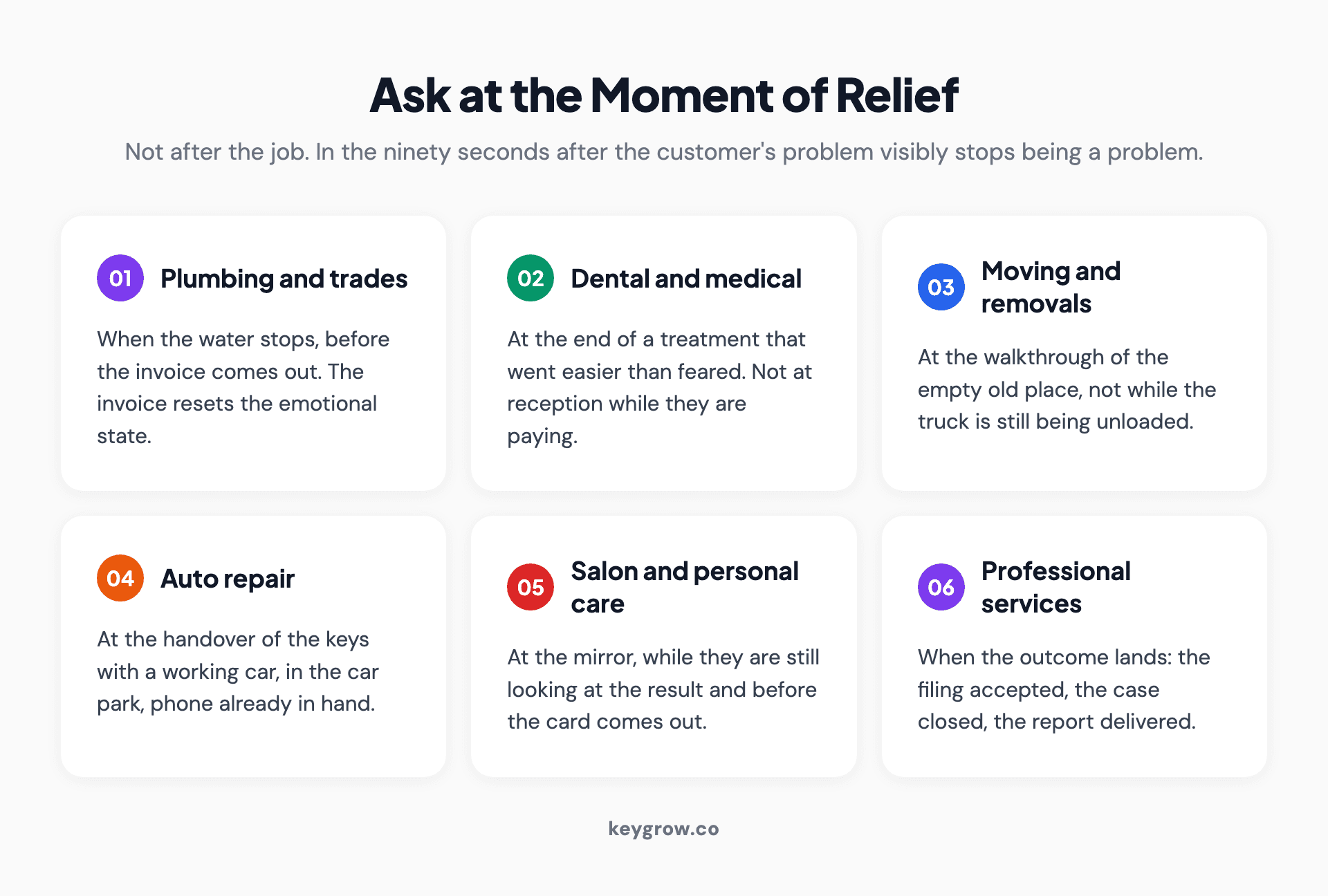
The moment to ask for a review in five different trades, and why the payment step is the wrong one.
For a plumber that is when the water stops and before the invoice comes out, because the invoice resets the emotional state. For a dentist it is at the end of a treatment that went easier than the patient feared, not at the reception desk while they are paying. For a moving company it is the walkthrough of the empty old place, not the unloading. For a repair shop it is the handover of the keys with a working car, in the car park, phone already in hand.
The gap between "after the job" and "in the ninety seconds after relief" is worth a large multiple in response rate. It costs nothing to move.
Who asks matters more than how you ask
An automated email from the business gets ignored. A request from the person who did the work does not.

A staff member working at a reception desk.
The technician, hygienist, stylist or crew lead has just spent an hour building a small relationship. When they say "would you leave us an honest review? It really helps us", the customer hears a person asking a favor. When the same words arrive from noreply@ four days later, the customer hears software.
This is also why review requests decay. Whoever owns the ask has to be someone who was in the room, and the system has to make it take under fifteen seconds for them, or it will not happen on a busy Thursday.
If your team is uncomfortable asking, the fix is a script of one sentence, said the same way every time, plus a card or a link the customer can use later. Nobody has to improvise, and nobody should push for the review on the spot: Google's policy now bars pressuring customers to review while they're still on the premises.
Pick one channel and make it boring
Businesses fail at this by running four half-built channels. Pick one primary, add one backup, and leave the rest.
| Channel | Response | Best for | The catch |
|---|---|---|---|
| Text with a direct link | Highest | Anyone with a mobile number on file | You need consent to text, and a short link |
| QR code at the counter | Good | Walk-in, retail, hospitality | Only works if someone points at it |
| Printed card handed over | Good | Trades, in-home service | Dies in a pocket unless the ask is verbal too |
| Lowest | Businesses with no phone number on file | Batch sends read as marketing | |
| In person, no link | Variable | High-trust, low-volume services | The customer has to find you later, and most will not |
The text-with-link route wins in almost every category, for the same reason it wins everywhere else: the customer is holding the device the review will be written on.
Get the link right, because the click is the whole funnel
Every extra step between the ask and the review box costs you responses.

A phone displaying a QR code at a payment counter.
Google generates a short review link from your Business Profile dashboard, under the option to ask for reviews. It opens the review box directly. Use that, not a link to your profile, and never a link to a page on your site that then links to Google. Our Google review link guide shows the exact clicks on a computer and a phone, plus the QR code Google makes for you.
Two practical things. Test the link on a phone that is signed into a personal account, because the flow differs from your desktop. And test it again after any big profile change, like a move or a merged listing.
If you use a QR code, print it large, put it where a person is already standing still, and put four words of context next to it. A bare QR code on a counter gets scanned by nobody.
The wording that works, and the wording that does not
Short, specific, and no more than one instruction.
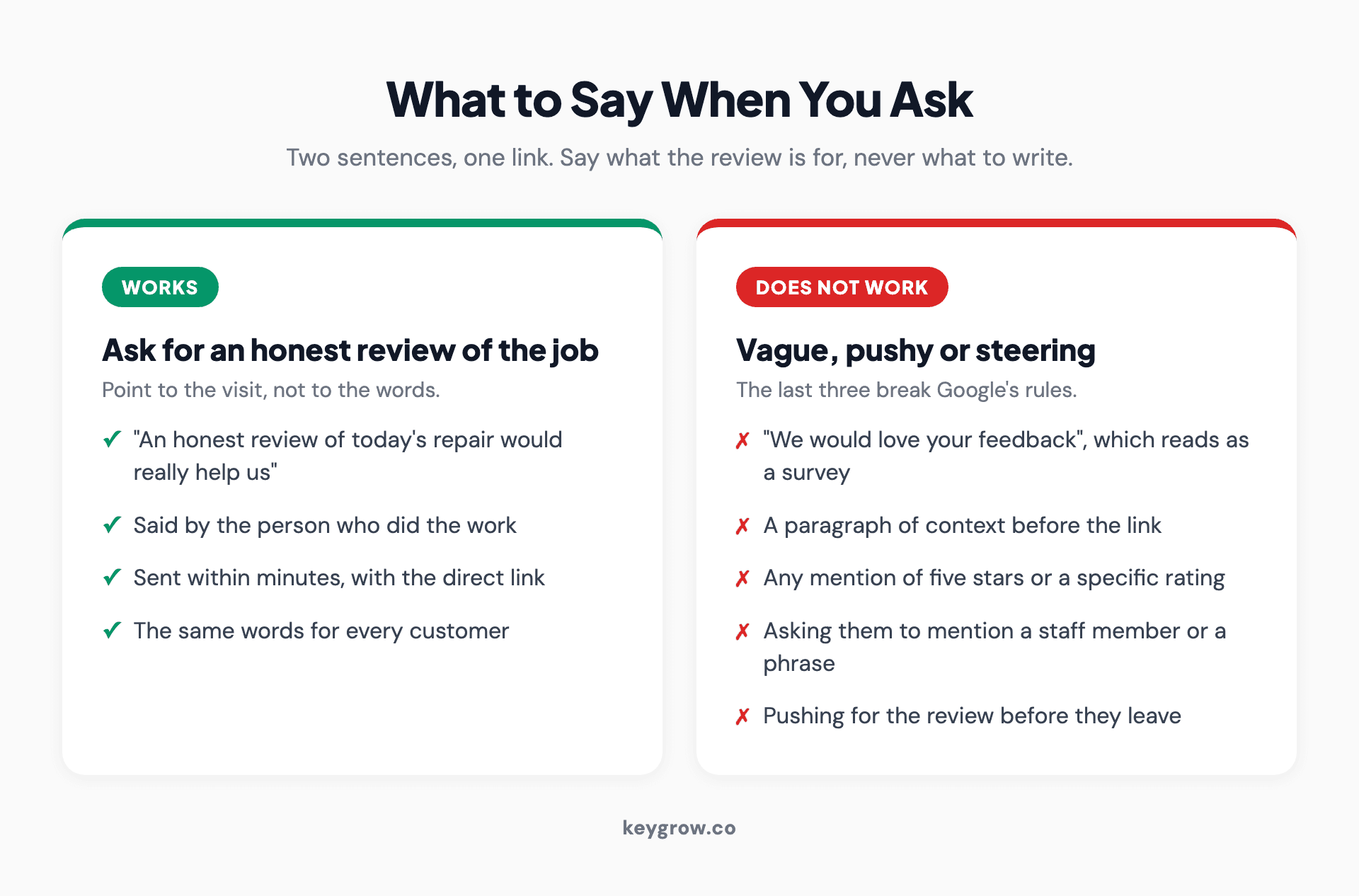
What to say when asking for a Google review, and the phrases that get the request ignored, removed or flagged under Google's review rules.
What works: say what the review is for, then stop. "If you have a minute, an honest review of today's repair would really help us" tells the customer what to review without telling them what to say, which matters now that Google bars asking for specific content in a review. The most common reason people abandon a review is not hostility, it is a blank box and no idea what to say.
What does not work: "we would love your feedback", which sounds like a survey, and anything that mentions five stars. Asking for a specific rating is the fastest way to get the review removed and, as of 2024, the fastest way into a category of conduct with federal penalties attached.
Keep the message to two sentences and one link. Anything longer reads as marketing and gets swiped away.
Two things that are now illegal, not just against policy
This is the section most review guides skip, and it changed in 2024.
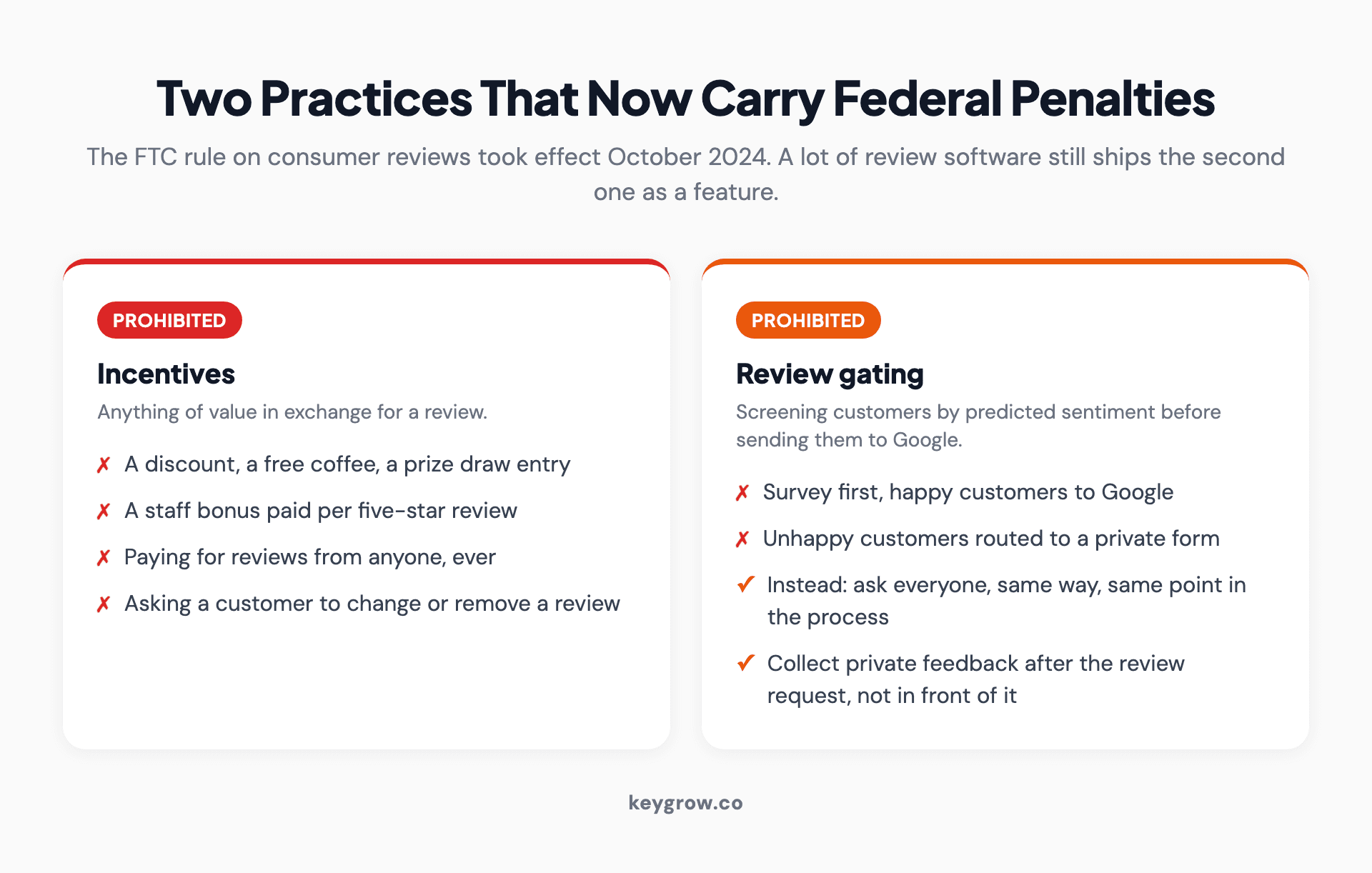
The two review practices that now carry federal penalties, and what to do instead.
Incentives. Offering anything of value in exchange for a review is prohibited by Google's review guidance and treated as fake and misleading content. That includes a discount, a free coffee, a prize draw entry and the staff bonus paid per five-star review, which is the version most businesses do not realize counts.
Review gating. Sending a satisfaction survey first, routing happy customers to Google and unhappy ones to a private complaint form, is the single most common compliance failure in local marketing, and a lot of review software still ships it as a feature. The FTC's rule on consumer reviews took effect in October 2024, and it treats suppressing negative reviews as a material misrepresentation of your reputation, with civil penalties running to tens of thousands of dollars per violation.
The compliant version is genuinely simple. Ask everyone, the same way, at the same point in the process. If you want private feedback as well, collect it after the review request, not as a filter in front of it.
Build it so it survives a busy week
Any review process that depends on somebody remembering will stop within a month. The ones that last have three properties.

Staff working through orders at a busy service counter.
It is attached to an existing step. The ask happens at a point in the job that already exists, so nobody has to add a task. Job closed in the system triggers the text.
It has an owner and a rule. One person owns the process, and the rule is that every finished job gets an ask, not that someone hits a weekly count. Put the share of jobs that got an ask, and the reviews that came back, on the same report as everything else.
It is reviewed monthly, not daily. Check the two numbers from the first section once a month. If the trailing ninety days is dropping, the asks stopped, and the fix is always upstream of the reviews.
A perfect rating is worse than you think
Aim for the reviews to be honest, not flawless. A 5.0 average with sixty reviews reads as filtered to a meaningful share of people, and a 4.6 with a couple of thoughtful negative reviews and good replies converts better.
Negative reviews also do something useful: they answer objections. A one-star saying you are expensive, with a reply explaining what the price includes, does more for a serious buyer than another "great service, highly recommend".
The exception is a review that is fake or from someone who was never a customer, which is a different problem with a different process. Our guide to removing a fake Google review covers the flag-and-escalate route and when to stop trying.
Replying is part of getting the next one
Replies are visible to every future reviewer, and they change how likely that person is to bother.
Keep them short, specific to the review, and free of marketing. Thank the person, mention the detail they mentioned, stop. On a negative review, acknowledge, do not argue the facts in public, and give a route to a human. We wrote out reply templates for each review type, from five-star thanks to fake and HIPAA-sensitive reviews. Whether any of that moves your ranking is a separate question, and we answered it with the data in responding to Google reviews.
Reviews and replies also feed the profile itself, which is doing more work than your website for local searches. If the profile is half-filled, fix that first: our Google Business Profile guide has the field-by-field version.
When a review program is the wrong project
Three situations where this is not your bottleneck.
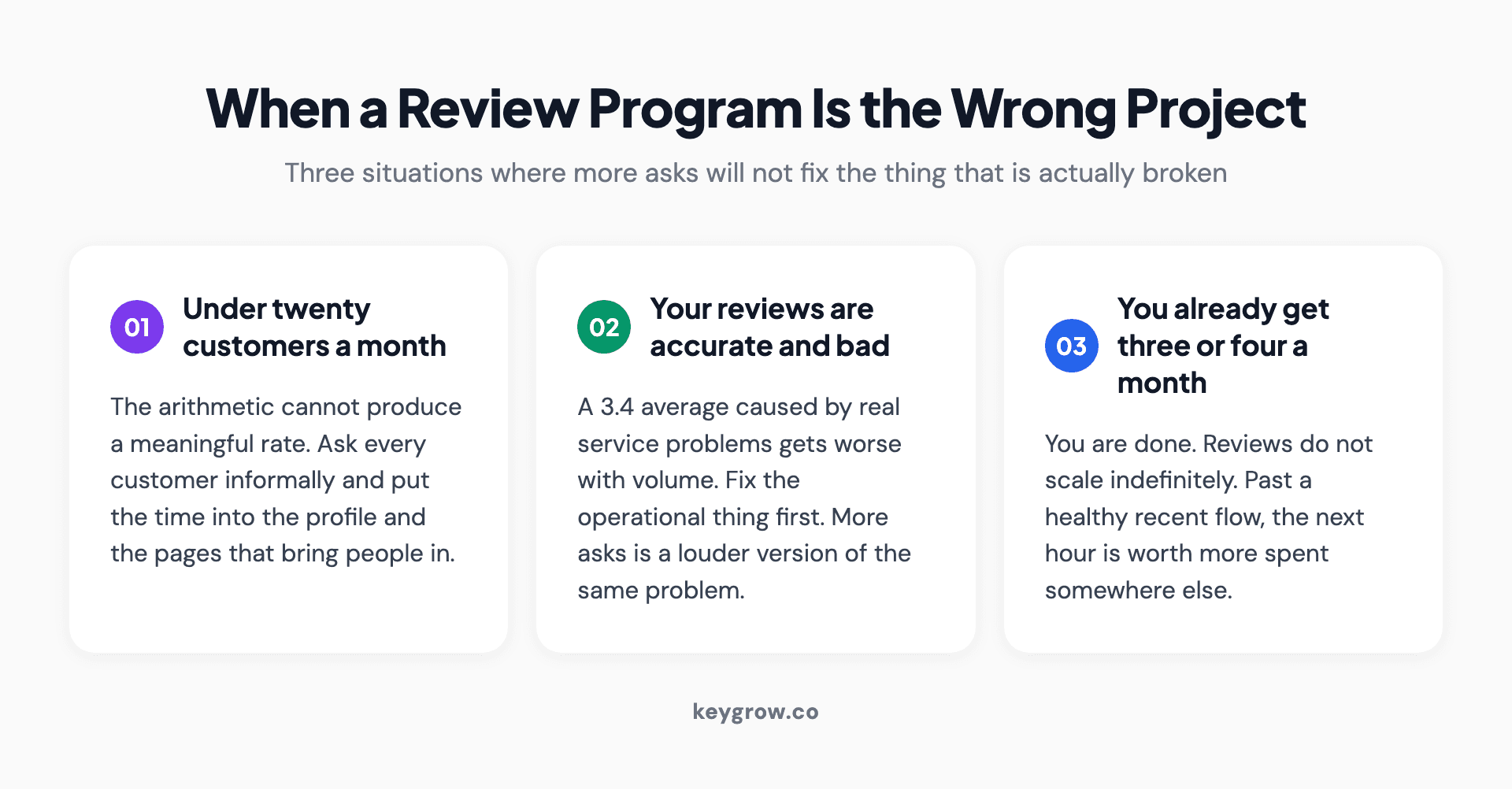
Three situations where a review program is the wrong project, and what to do instead.
You serve under twenty customers a month. The arithmetic will not produce a meaningful rate, and your time goes further on the profile itself and on the pages that bring people in. Ask every single customer, informally, and move on.
Your reviews are accurate and bad. If the average is 3.4 because the service has real problems, asking more people will surface more of the same. Fix the operational thing first. An agency that sells you a review program in this situation is selling you a louder version of your problem.
You already get three or four a month. You are done. Reviews are not a channel you scale indefinitely, and past a healthy recent flow, the return on the next hour goes to something else. Most businesses this applies to would be better off spending it on the profile categories, service pages, or local SEO generally.
FAQs
How often should new Google reviews come in?
Often enough that the last ninety days is never empty, which for most local businesses means eight to ten in any rolling ninety day window. Total count matters far less than recency, because most consumers are looking for reviews from the last three months. Thirty recent reviews beats two hundred that stopped two years ago.
Can I offer a discount for a Google review?
No. Offering anything of value in exchange for a review breaks Google's policy and can get the reviews removed and the profile penalized. It also falls under the FTC rule on consumer reviews that took effect in October 2024, which carries civil penalties. This includes prize draws and staff bonuses paid per five-star review.
Is it legal to only ask happy customers for reviews?
No. Filtering customers by predicted sentiment before sending them to Google is review gating, and the FTC treats it as misrepresenting your reputation. Ask everyone at the same point in the process. If you want private feedback too, collect it after the review request rather than as a screen in front of it.
What is the best way to ask for a Google review?
A text message containing the short review link, sent within minutes of the job finishing, by or on behalf of the person who did the work. It beats email, printed cards and QR codes in almost every category because the customer is already holding the device they will write the review on.
Why are my Google reviews not showing up?
Most commonly the automated filters caught something: a review left from the same network as the business, an account with no history, several reviews posted in a short burst, or text that looks templated. Reviews can also take a short time to appear. Batch-asking everyone on one afternoon is the most common self-inflicted cause.
Can I ask a batch of past customers for reviews at once?
Avoid it. Thirty requests sent on one afternoon produces a burst of reviews arriving together, which is the pattern automated filters are built to catch, and a share of them will be suppressed. Work backwards through your customer list slowly, a handful a week, and let the flow look like what it is.
How long does it take to build up Google reviews?
At a realistic ask rate, most local businesses reach a healthy trailing ninety days within two to three months. The rate is limited by how many customers you serve, so a business with forty customers a month cannot get there as fast as one with four hundred, no matter how good the process is.
Do Google reviews actually help rankings?
Yes, as one input among several. Review count, rating, recency and the words used in reviews all feed local ranking, and reviews mentioning a service and a location are particularly useful. They matter more for whether someone calls you after seeing the listing, which is the part that pays.
Your next twenty customers
Pick the moment in your process where the customer's problem is visibly solved. Write one sentence for your team to say at that moment. Get the short review link from your profile dashboard, put it in a text template, and give the ask to the person who did the work.
Then count two things once a month: how many reviews landed in the last ninety days, and the date on the newest one. That is the entire system, and it beats every list of twelve tactics because it survives a busy week.
If your profile is otherwise in bad shape, reviews will not carry it on their own. Send us the listing and we will tell you what is actually holding it back, including when the honest answer is that the reviews are fine and something else is the problem.