


Somebody left a one-star review from a name nobody at your company recognizes, describing an experience you are fairly sure never happened. You want it gone by lunchtime.
Here is the honest version of how to remove a fake Google review. You flag it, Google's systems decide, and you have no appeal to a human unless the first pass fails. Removal takes anywhere from a few days to a couple of weeks. Plenty of reviews that feel fake do not qualify for removal, because Google removes policy violations rather than opinions you disagree with. The fastest route to a good outcome is usually flagging and responding at the same time, rather than treating them as sequential steps.
What follows is the flagging process, the escalation path when it fails, and the part almost nobody covers: since October 2024 there is a federal rule with real penalties attached to this area, and it cuts both ways.
Before you flag: is this review actually removable?
Google removes content that breaks its policies. It does not remove reviews for being harsh, wrong, or commercially inconvenient. Sort yours into the right bucket first, because it changes what you do next.
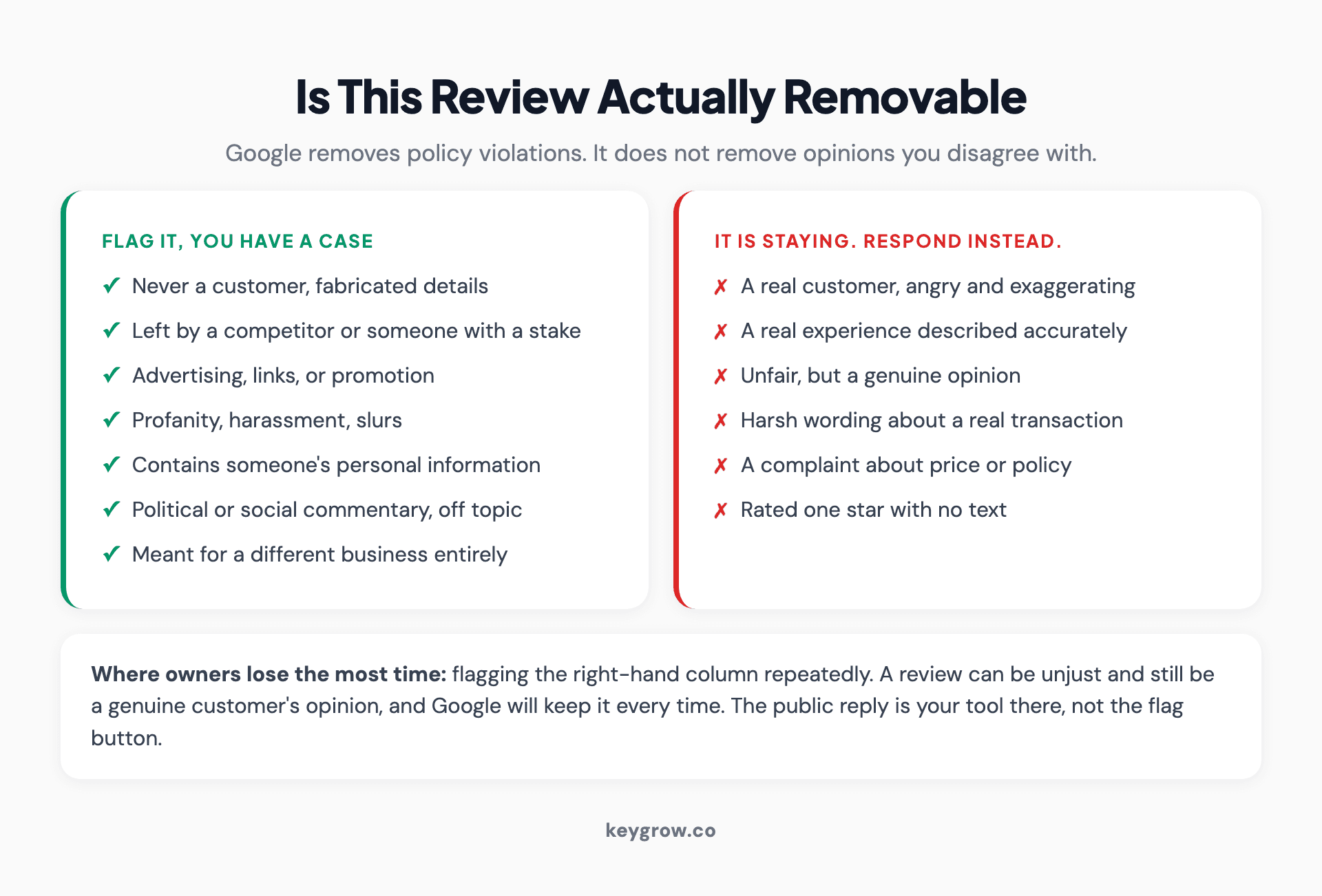
Decision flow for judging whether a Google review can be removed, separating clear policy violations such as spam and conflict of interest from harsh but legitimate opinions that will stay.
| What you are looking at | Removable? | What to do |
|---|---|---|
| Review from someone who was never a customer, with fabricated details | Usually yes, as fake engagement | Flag, then document |
| Left by a competitor or someone with a stake in your business | Yes, conflict of interest | Flag, note the connection in your escalation |
| Advertising, links, or promotion of another business | Yes, spam | Flag, these come down fastest |
| Profanity, harassment, slurs, or personal attacks | Yes, restricted content | Flag, this is the clearest category |
| Contains someone's personal information | Yes | Flag as personal information |
| Political or social commentary unrelated to your service | Yes, off topic | Flag as off topic |
| Meant for a different business | Yes | Flag as off topic and say so |
| A real customer, angry, exaggerating, and unfair | No | Respond publicly, do not flag |
| A real experience described accurately, badly for you | No | Respond, and fix the underlying issue |
That last pair is where most business owners lose time. A review can be unjust and still be a genuine customer's opinion, and Google will keep it every time. Flagging it repeatedly does nothing except cost you afternoons. The public response is your tool there, not the flag button.
Under Google's review policy, the categories that matter are content that is not based on a real experience, content posted for payment or incentive, contributions from multiple accounts at one person's direction, and reviews from anyone with a competitive or personal stake in the business. If you can put your review in one of those, you have a case.
What the automated filters already caught
Useful context before you set your expectations, because it explains why the review on your profile is harder to remove than you would think.
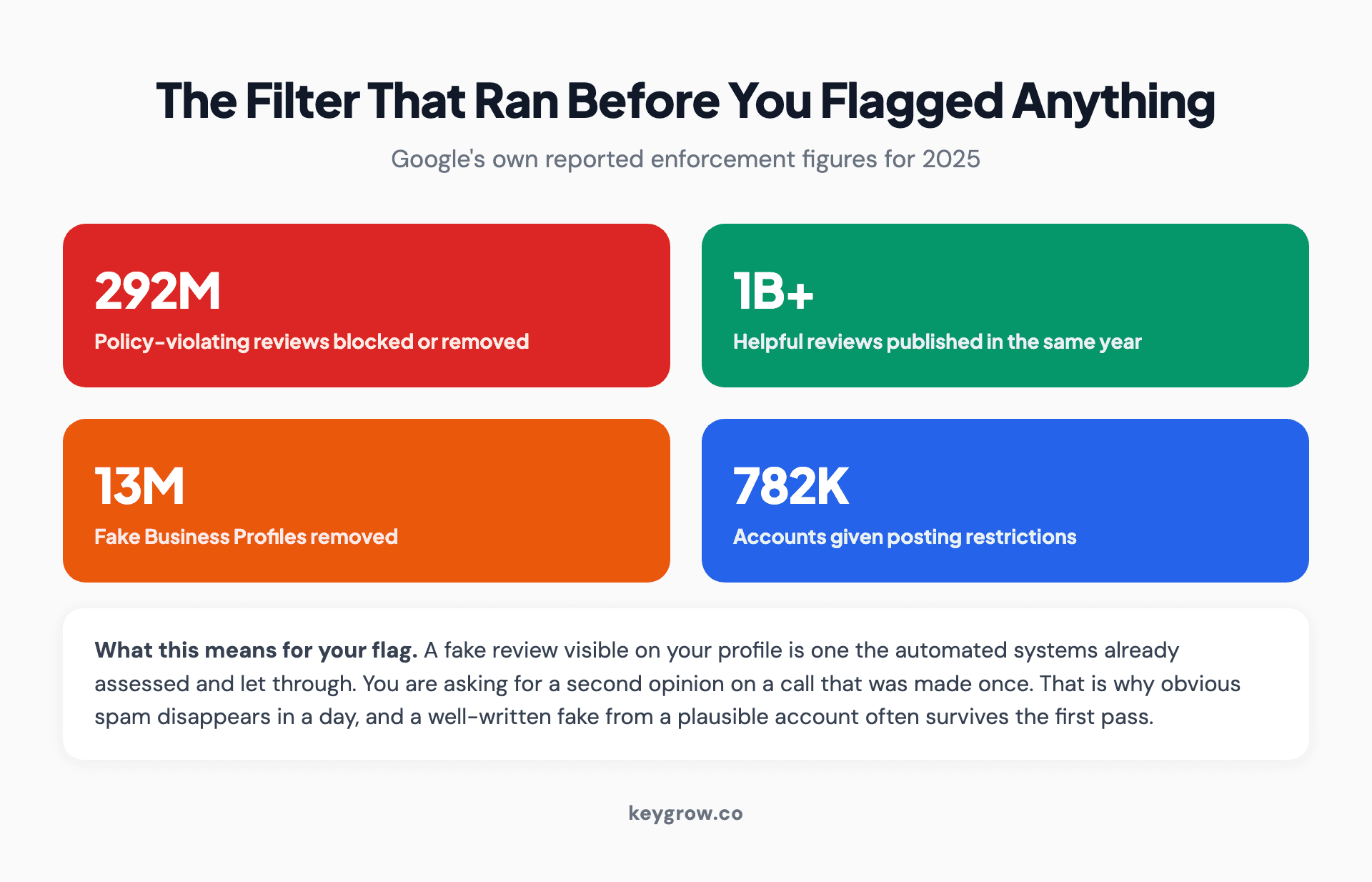
Statistics panel showing Google's 2025 enforcement figures for policy-violating reviews, fake business profiles, restricted accounts and blocked profile edits.
By Google's own numbers, 2025 saw more than 292 million policy-violating reviews blocked or removed, alongside over a billion helpful ones published. In the same year Google removed more than 13 million fake Business Profiles, placed posting restrictions on over 782,000 accounts, and blocked 79 million inaccurate profile edits.
Read that as a filter with a very high catch rate running before anything appears. The consequence for you is uncomfortable but worth knowing: a fake review that is visible on your profile is one the automated systems already looked at and let through. Your flag is asking for a second opinion on a call that was already made once. That is why obvious spam disappears in a day and a well-written fake from a plausible-looking account often survives the first review.
It also explains the volume of complaints about the process. Google is removing fakes at a scale no manual process could match, and the ones that get past it are, almost by definition, the difficult cases.
Flag it, in about five minutes
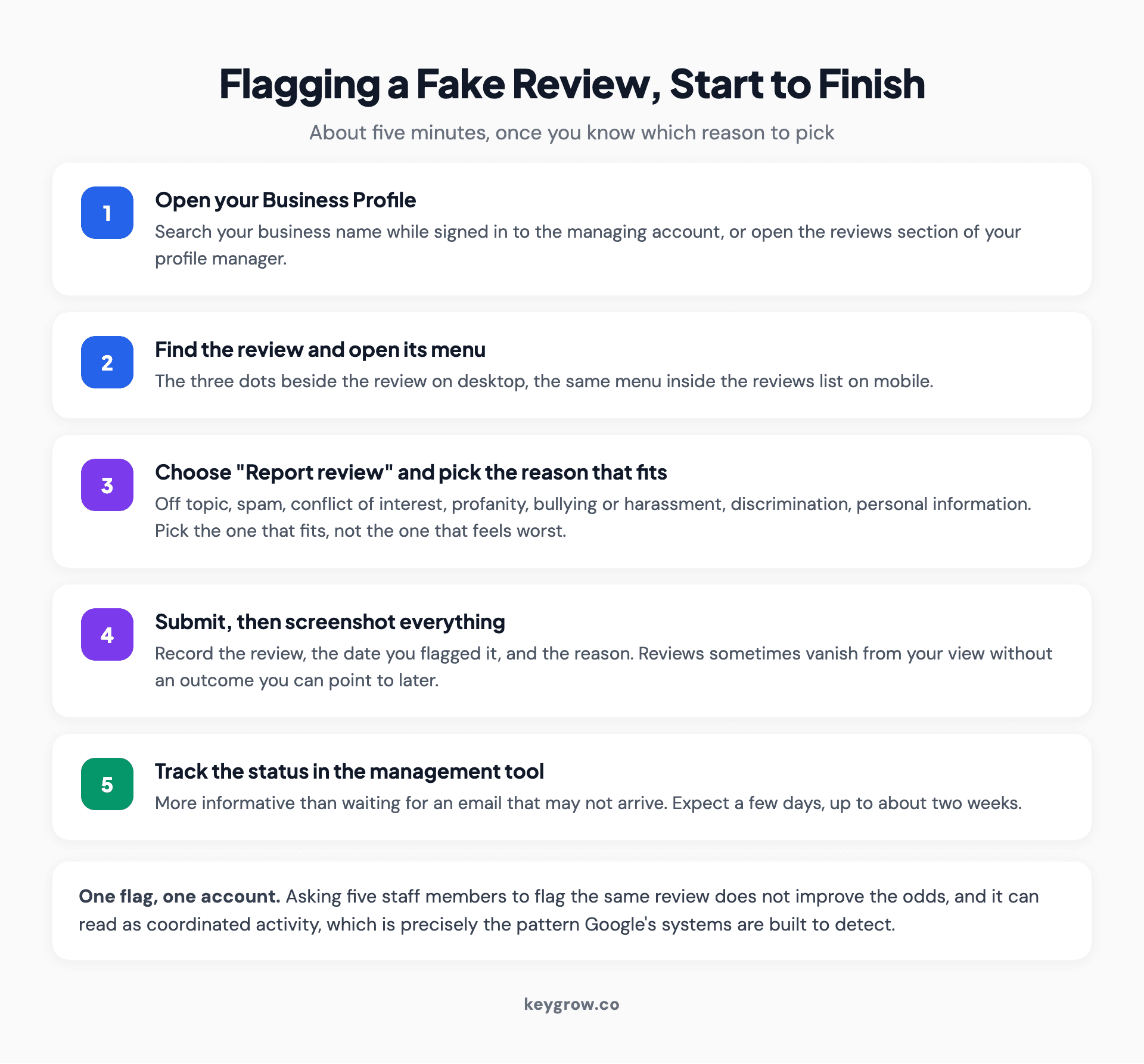
Numbered walkthrough of flagging a fake Google review, from opening the business profile through selecting a violation reason to saving the confirmation.
- Open your Business Profile. Search your business name while signed in to the account that manages the profile, or go to your profile manager and open the reviews section.
- Find the review and open its menu. On desktop, the three dots beside the review. On mobile, the same menu inside the reviews list.
- Choose "Report review" and pick a reason. The options map to the policy categories: off topic, spam, conflict of interest, profanity, bullying or harassment, discrimination or hate speech, personal information. Pick the one that fits best rather than the one that feels worst.
- Submit, and record it. Screenshot the review, note the date you flagged it and the reason you chose. You will need this if you escalate, and reviews sometimes vanish from your view without an outcome you can point to.
- Check the status. Google provides a management tool for tracking reported reviews and their status, which is more informative than waiting for an email.
One flag per review, from one account. Asking five staff members to flag the same review does not increase the odds and can look like coordinated activity, which is a category Google's systems are specifically built to detect.
Expect a few days for a decision, up to about two weeks in practice. If a decision comes back and the review stays, you are into escalation.
When flagging fails, escalate in this order
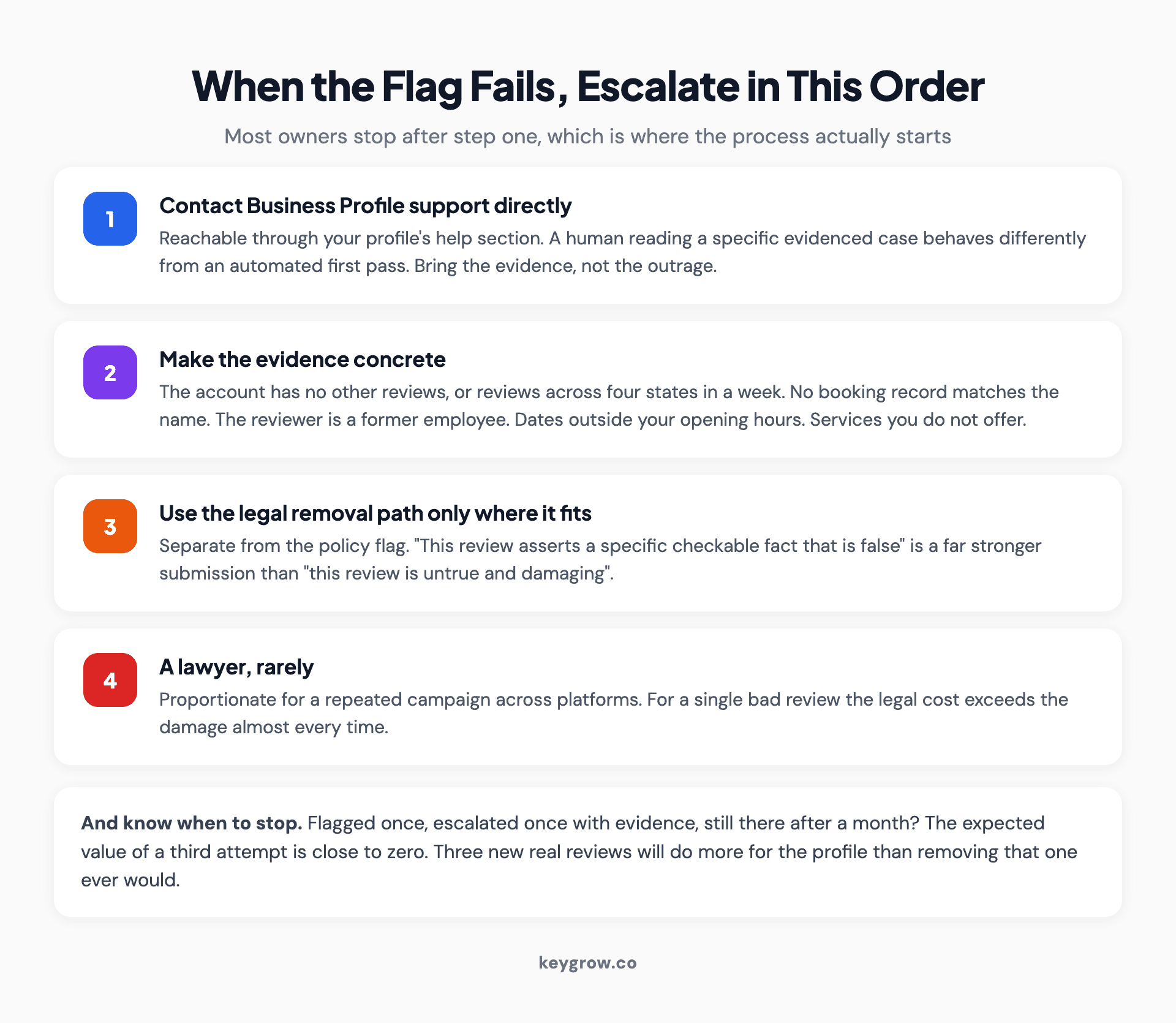
Escalation ladder for a fake Google review that survives flagging, from business profile support through the review management tool to legal removal requests.
Contact Business Profile support directly. This is the step most owners skip. Support is reachable through your profile's help section, and a human reading a specific, evidenced case behaves differently from an automated first pass. Bring the evidence, not the outrage.
Make the evidence concrete. The reviewer's account has no other reviews, or reviews for businesses across four states in one week. Your booking system has no record matching the name, and you can say that plainly without disclosing customer data. The reviewer is a former employee, or works for a competitor, and you can show the connection. Dates that do not match your opening hours. Details that do not match your services.
Use the legal removal path where it genuinely applies. If a review contains defamatory statements of fact rather than opinion, or discloses private information, Google's legal removal process is separate from the policy flag and takes documentation seriously. This is a real avenue and it is also the one people overuse. "The review is untrue and damaging" is a much weaker submission than "this review asserts we were cited by the health department on a specific date, which is a checkable factual claim and false."
Know when a lawyer is proportionate. Rarely. If the same person is posting repeatedly across platforms, or the review is part of a campaign, a demand letter sometimes ends it faster than any platform process. For a single bad review, the legal cost exceeds the damage almost every time.
Write the response before you know the outcome
Most flagged reviews stay up. Plan around that from the start rather than treating the response as a fallback.
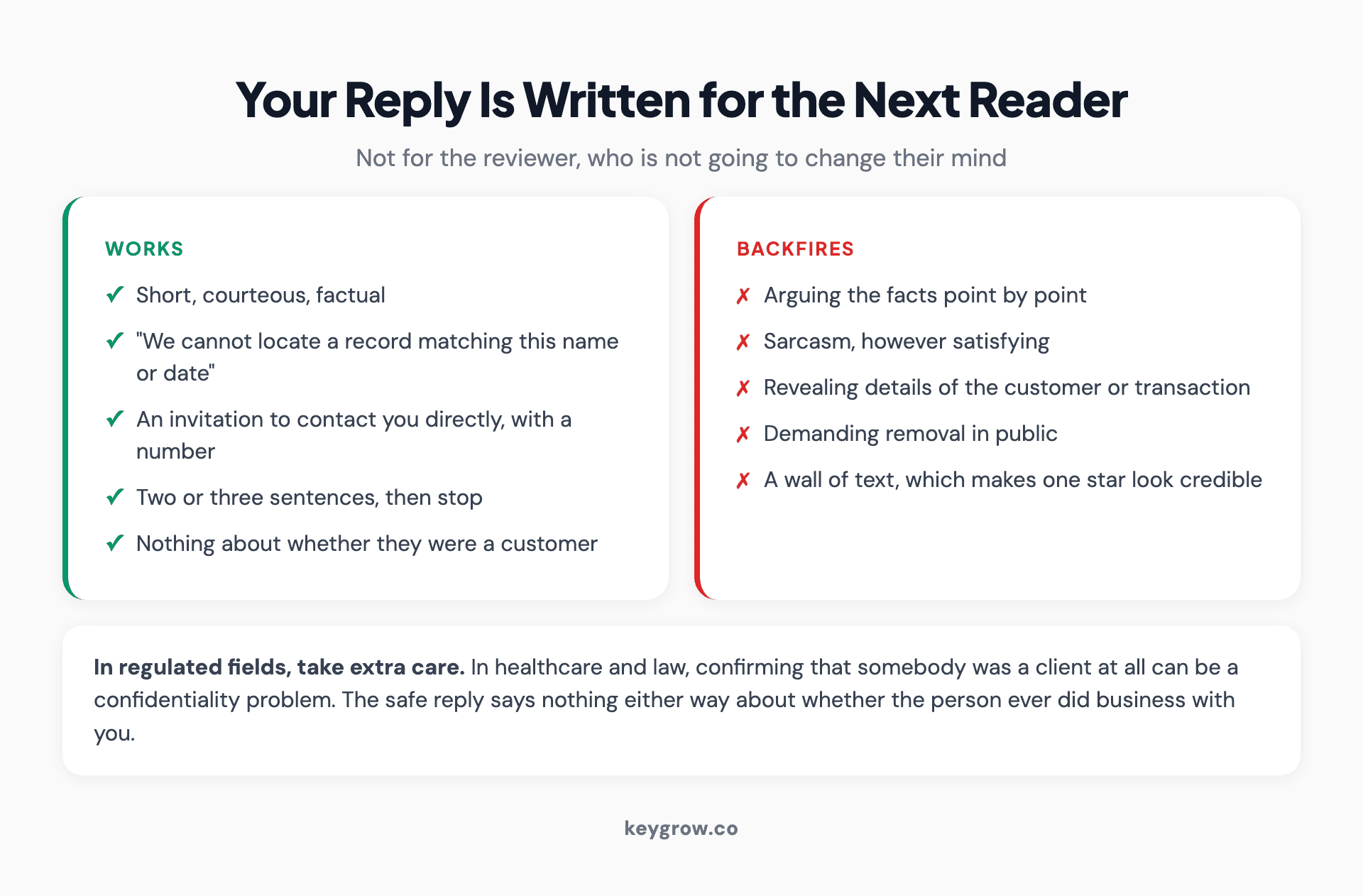
Comparison of an effective public response to a fake review against the common mistakes, including arguing, revealing customer details, and demanding removal in public.
The audience for your reply is not the reviewer. It is the next person reading your profile, who will weigh a calm, specific response against an unverifiable complaint and usually side with the business. That reader is the entire reason to respond.
What works: short, courteous, and factual. State that you cannot locate a record of this transaction, invite the person to contact you directly with details, and stop. Something close to: "We take every complaint seriously, and we cannot find a booking or service record matching this name or the date described. If we have missed something, please contact us at [number] so we can look into it." That reads as reasonable to a stranger, and it makes the point without an accusation.
What does not work: arguing the facts point by point, sarcasm, revealing anything about the customer or the transaction, demanding the review be taken down in public, or a wall of text. A long defensive reply makes a one-star review look more credible, not less. And in regulated fields, healthcare and law especially, confirming that somebody was a client at all can be a confidentiality problem, so the safe reply says nothing about whether they were. We covered the broader ranking question in our post on responding to Google reviews.
If a competitor is behind it, there is now a federal angle
This is the part missing from almost every guide on this subject, and it changed in October 2024.
The FTC's rule on consumer reviews and testimonials bans buying, selling, and writing fake reviews, including fake negative reviews written about a competitor. It gives the agency authority to seek civil penalties, and each individual review can count as a separate violation, so the exposure for a business that bought a batch of them is not small.
Practically, that gives you a second track that costs nothing. If you have evidence that a competitor bought or coordinated fake reviews about your business, you can report it to the FTC. This will not get your review removed next week, because the FTC does not moderate Google. What it does is create a real consequence for a practice that used to have none, and it changes the calculation for anyone thinking about buying reviews as a competitive tactic.
Keep the evidence you gathered for the Google escalation. It is the same evidence.
The tactic that puts you on the wrong side of all this
Worth stating plainly, because it is still being sold to local businesses as a service: screening customers before asking for a review is now a problem under both rulebooks.
The pitch usually sounds reasonable. Send everyone a survey, route the happy ones to Google and the unhappy ones to a private feedback form. It is often called review gating, and it feels like customer service.
Google's policy prohibits merchants from discouraging or prohibiting negative reviews and from selectively soliciting positive ones. The FTC rule separately addresses review suppression and reviews written by company insiders. So the tactic risks your profile on one side and carries civil penalty exposure on the other. Offering a discount, a free service, or an entry into a draw in exchange for a review has the same problem, in both directions.
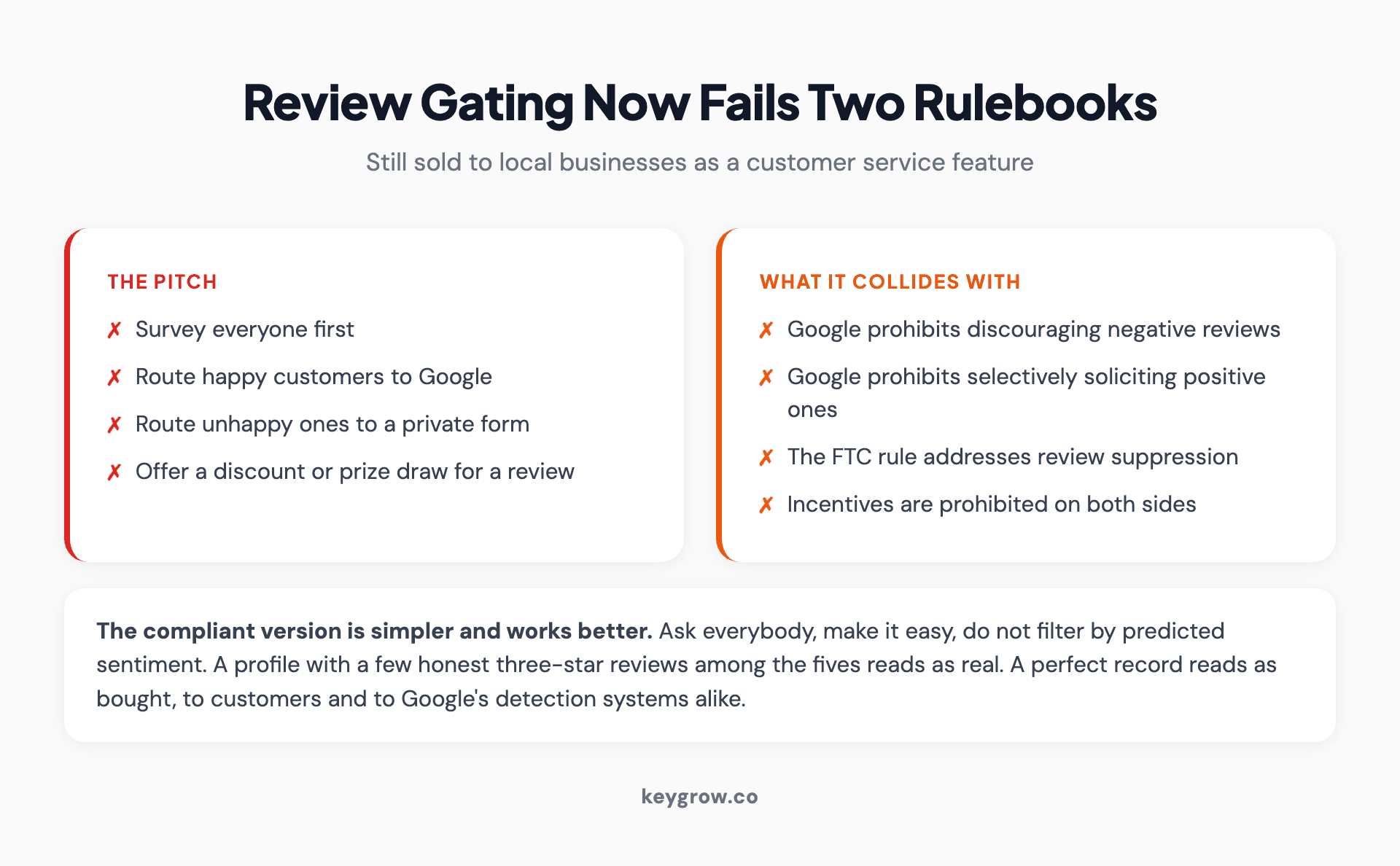
Warning cards explaining why review gating and incentivized reviews now carry both platform and federal risk, with the compliant alternative of asking every customer.
The compliant version is simple and works better anyway: ask everybody, make it easy, and do not filter by predicted sentiment. A profile with a handful of honest three-star reviews among the fives reads as real. A perfect record reads as bought, to customers and to Google's systems alike.
Make the next one matter less
The structural defense against fake reviews is volume, and it is the only part of this you fully control.

Two customers waiting at the counter of a small cafe while a staff member works behind it, the moment a review request naturally belongs to.
One fabricated one-star review lands very differently on a profile with 22 reviews than on a profile with 400. On the small profile it moves the visible average and sits near the top for months. On the large one it is a rounding error that scrolls away in a week. The businesses that panic about a single fake review are almost always the ones with thin review counts, and the fix is upstream of the incident.
So build the request into the job rather than leaving it to whoever remembers, which is the system we lay out in how to get more Google reviews. A text or email after the work is complete, with a direct link, sent by a system rather than a person. Consistency beats intensity here: a steady handful every month is worth more than a burst of thirty, which looks like exactly the kind of unusual pattern Google's systems flag.
Two related benefits, since you are doing the work anyway. Review volume and recency both feed local ranking, so this is not purely defensive. And active review profiles correlate with roughly three times the likelihood of being cited by AI assistants, which increasingly summarize local options before anybody opens a map. There is more on that side in our Google Business Profile guide.
When to stop trying
If you have flagged it once, escalated once with evidence, and it is still there after a month, stop. The expected value of a third attempt is close to zero and the time is better spent collecting three real reviews, which will do more for the profile than removing the one ever would.
The exception is a pattern. One fake review is noise. Six in a fortnight from accounts with no history is a campaign, and campaigns are both more removable and worth escalating hard, because coordinated activity is a category Google's systems act on decisively once a human sees the pattern laid out.
There is also a version of this where you do not need help from anyone. A single-location business that can flag a review, write a calm reply, and set up a review request text has the whole playbook. No agency has access to a faster removal path than the one you just read, whatever anyone selling review removal implies.
FAQs
How long does Google take to remove a fake review?
Usually a few days, and up to about two weeks. Obvious spam and profanity tend to come down fastest because they are unambiguous. A well-written fake from a plausible-looking account can take longer or survive the first pass entirely, since it already got past the automated filters once.
Can Google refuse to remove a review that is clearly fake?
Yes, and it happens often. Google removes content that violates its policies, and proving a review is fabricated is harder than it feels when you know your own customer records. If the first flag fails, escalate to Business Profile support with specific evidence rather than flagging again.
Is it illegal to write a fake Google review?
In the United States, the FTC's consumer reviews rule prohibits writing, buying, and selling fake reviews, including fake negative reviews about a competitor, and allows the agency to seek civil penalties. Each review can count as a separate violation. Platform terms of service also prohibit it independently of federal law.
Can I ask customers to remove a bad review?
You can contact a customer to resolve the underlying problem, and people do sometimes update or delete a review afterwards on their own. What you cannot do is pressure, pay, or offer anything of value in exchange for removal or for changing a rating. That crosses into the same territory as buying reviews.
Should I respond to a fake review or just flag it?
Do both, at the same time. Most flagged reviews stay up, and a calm public response is what the next visitor to your profile will read. Keep it short, state that you cannot find a matching record, and invite direct contact.
Can I turn off reviews on my Google Business Profile?
No. There is no setting to disable reviews, and there is no legitimate service that can do it for you. Anyone offering to remove reviews or disable them for a fee is either selling a process you can run yourself or something that violates Google's terms.
Does one bad review hurt local rankings?
A single review has minimal ranking effect. The larger risk is conversion, since people read the recent reviews before calling. Review volume and recency do feed local ranking, which is the practical argument for building a steady flow rather than trying to control individual entries.
The realistic plan
Flag it today with the right reason and a screenshot. Write a two-sentence public reply this afternoon. If nothing has changed in two weeks, escalate once to support with specific evidence, and if that fails, let it go.
Then spend the energy on the part that compounds. A business collecting reviews steadily every month stops caring about individual bad ones, because the arithmetic stops mattering. That is a better outcome than winning a removal, and it is entirely within your control.
If you want help setting up the request flow, or a look at whether your profile has a bigger problem than one review, that is a conversation our SEO team has often, and it usually ends with a short list you can run yourself.