


SEO for veterinarians works, and it reaches a smaller share of your growth than the average agency deck suggests. Start with the number that frames the whole decision: 83.4 percent of pet owners say they have a regular veterinarian, and only 69.4 percent actually took an animal in during the past calendar year.
That is a fourteen point gap, and none of it is a search problem. Those people already know your name. They have your number in their phone. They did not come.
So here is the honest scope. Organic search reaches pet owners who are new to your area, people who just got an animal, someone whose pet is sick right now, and clients quietly shopping for a second opinion. Four groups. They are worth real money and they are smaller than the growth pitch implies.
One more thing before the tactics. When we pulled keyword data for this page, the cost per click on "seo for veterinarians" was $153.40. That is what agencies pay to put a page like this in front of you. Read every pitch with that number in mind, including ours.
The fourteen point gap is a recall problem, not a ranking problem
The cheapest new appointment available to you belongs to someone who is already a client and has drifted.
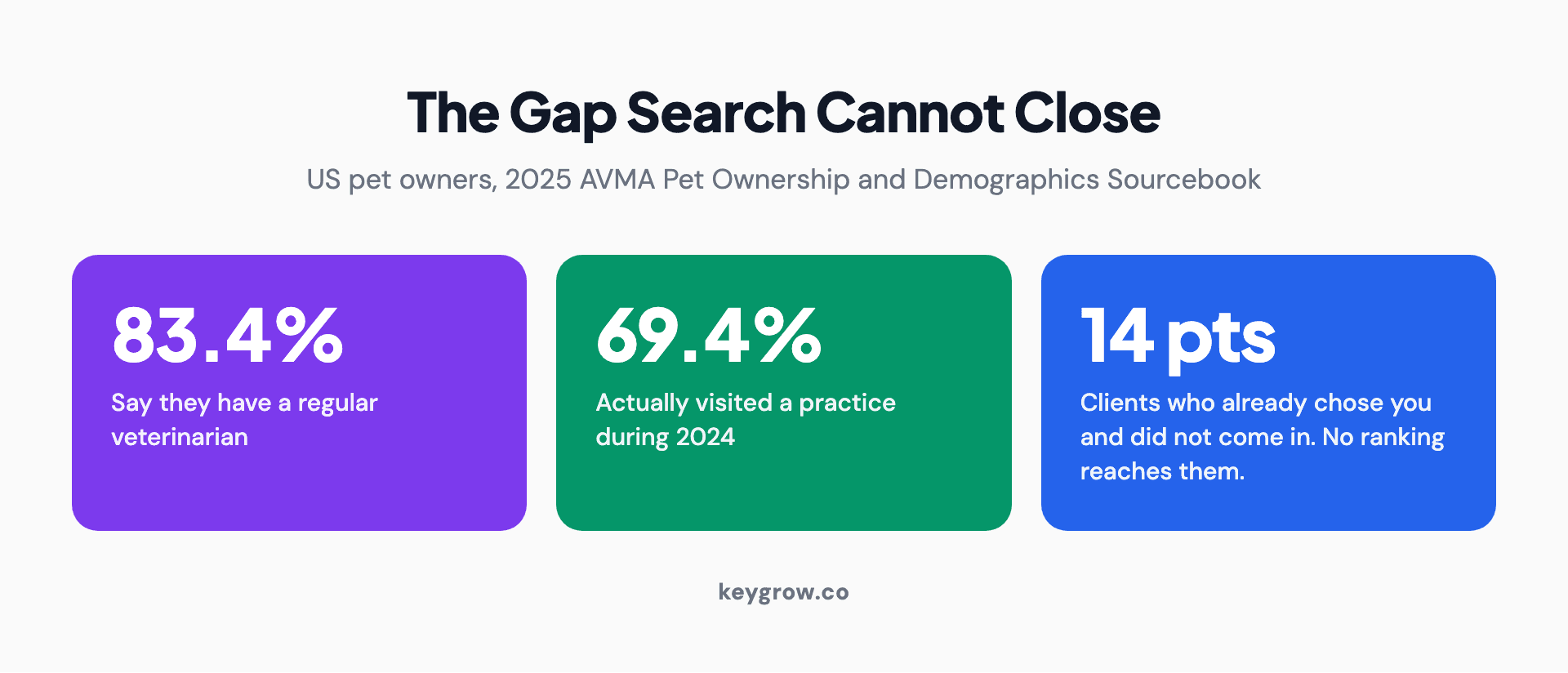
The gap between pet owners who have a regular veterinarian and those who actually visited one in the past year.
AVMA's sourcebook data puts the average last visit at around $200. If your practice has two thousand active client records and five percent of the lapsed ones come back after a reminder campaign, the arithmetic gets interesting quickly, and it costs a fraction of a year of retainer.
None of that is SEO. It is your practice management software, a recall list, and someone willing to make the calls. We say this on the way in because the alternative is you spending twelve months on organic growth while a bigger and cheaper number sits untouched in your database.
Do the recall work first, or at least alongside. Then build for search, which reaches the people your database cannot.
Which searches are genuinely available to you
Four populations search for a veterinarian, and they want different pages.
| Who is searching | What they type | What wins them |
|---|---|---|
| New to the area or new pet | "vet near me", "puppy first vaccinations" | Map pack position and a page about being a new client |
| Sick animal right now | "emergency vet open now", "dog ate chocolate" | Hours, phone, triage information, after-hours handoff |
| Shopping a specific procedure | "cat dental cleaning cost", "spay near me" | A page for that procedure, with a price range on it |
| Second opinion | "veterinary oncology", "vet that does exotics" | Depth on the specific capability |
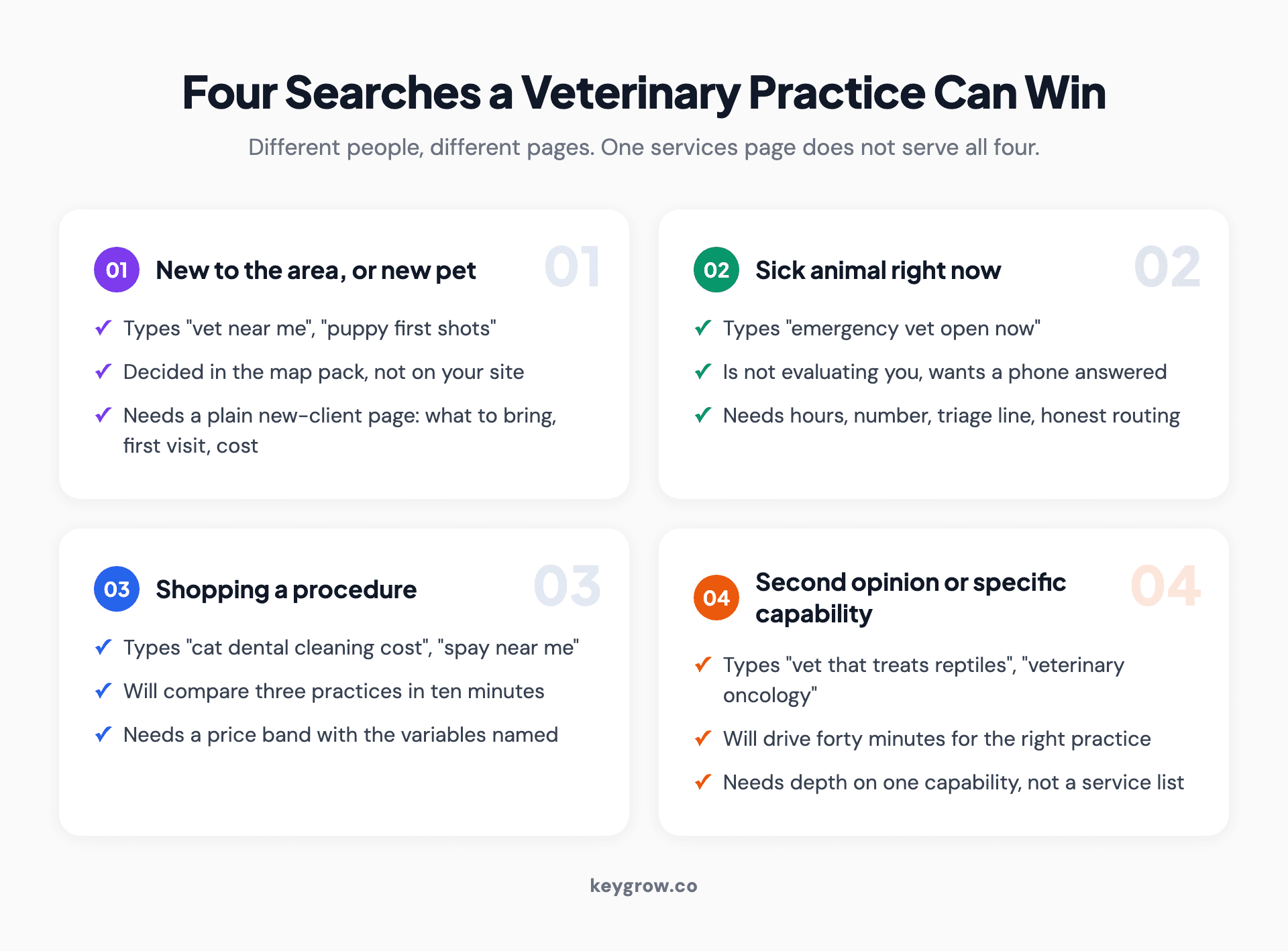
The four kinds of pet owner who search for a veterinarian and what each one needs from the page they land on.
The mistake is building one "Services" page that gestures at all four. A general practice page will not beat a page written specifically about rabbit dentistry for someone searching for rabbit dentistry, and rabbit dentistry is where the loyal, high-value, drives-forty-minutes client comes from.
Rank for the specific thing. The general thing takes care of itself once the profile is right.
Species is the segmentation that matters, not service
Most veterinary websites are organized by service. Wellness, surgery, dentistry, diagnostics. Pet owners do not search that way, because they do not have a pet in general.
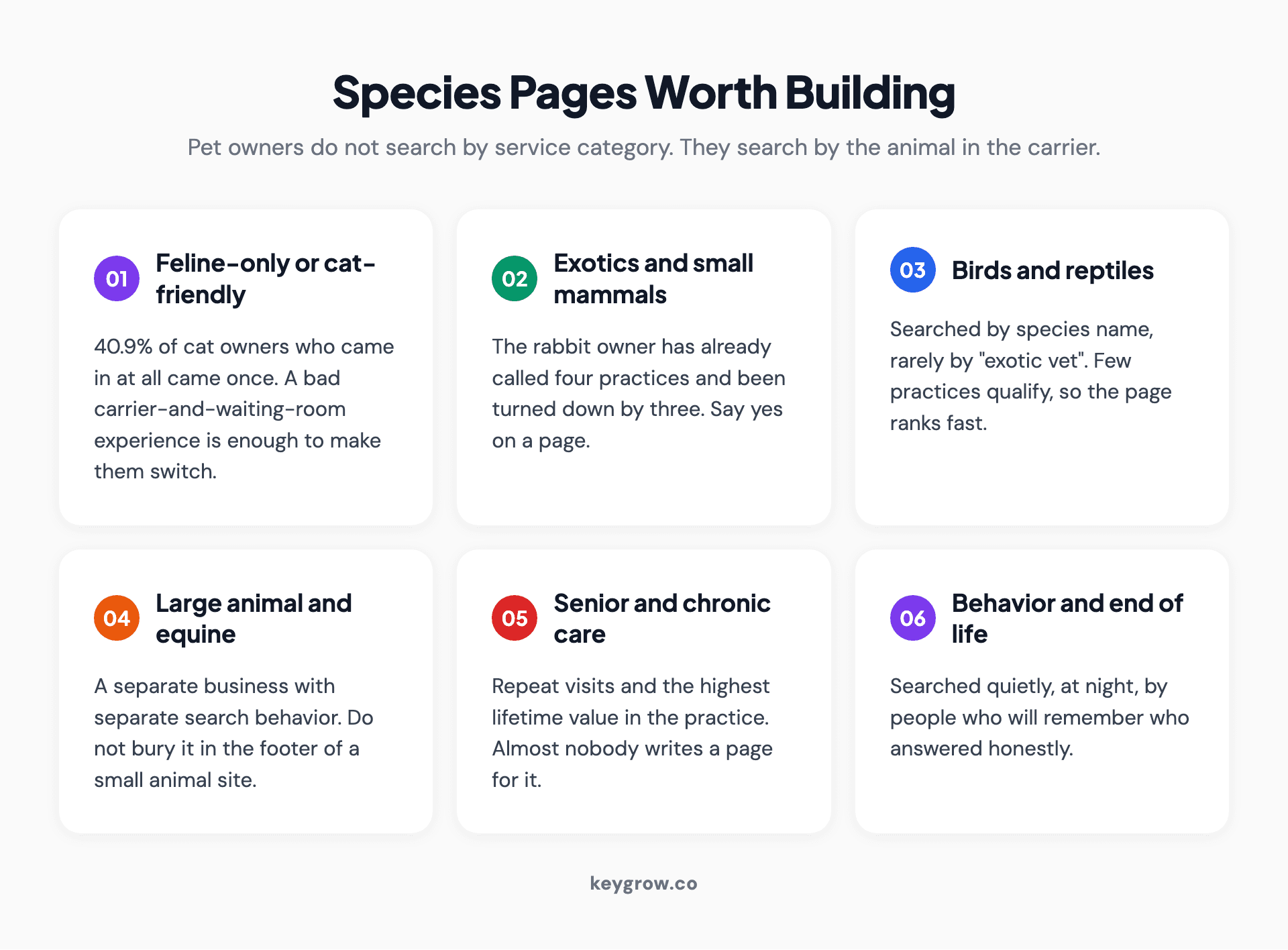
Species and capability pages worth building, and the search behavior behind each one.
Cat owners in particular behave differently. AVMA visit data shows 40.9 percent of cat owners who came in at all came in once, against 25.5 percent of dog owners, and cat owners are far more likely to have spent nothing on veterinary care at all. Someone searching for a cat-friendly or feline-only practice is telling you they have had a bad carrier-and-waiting-room experience and are willing to switch over it. That is a page.
Exotics is the clearest example. If you see rabbits, reptiles, birds or small mammals, that capability is worth its own page per species group, because the owner of a bearded dragon has usually called four practices already and been turned down by three.
Large animal and equine, if you do it, is a separate business with its own search behavior. Do not bury it in a footer.
Emergency and after hours is a separate build with different rules
Someone searching "emergency vet" at eleven at night is not evaluating you. They want a phone number that a person answers.
That page needs four things and nothing else: current hours in plain text, a phone number that works, a short triage line about what to do on the way, and honest routing if you are closed.
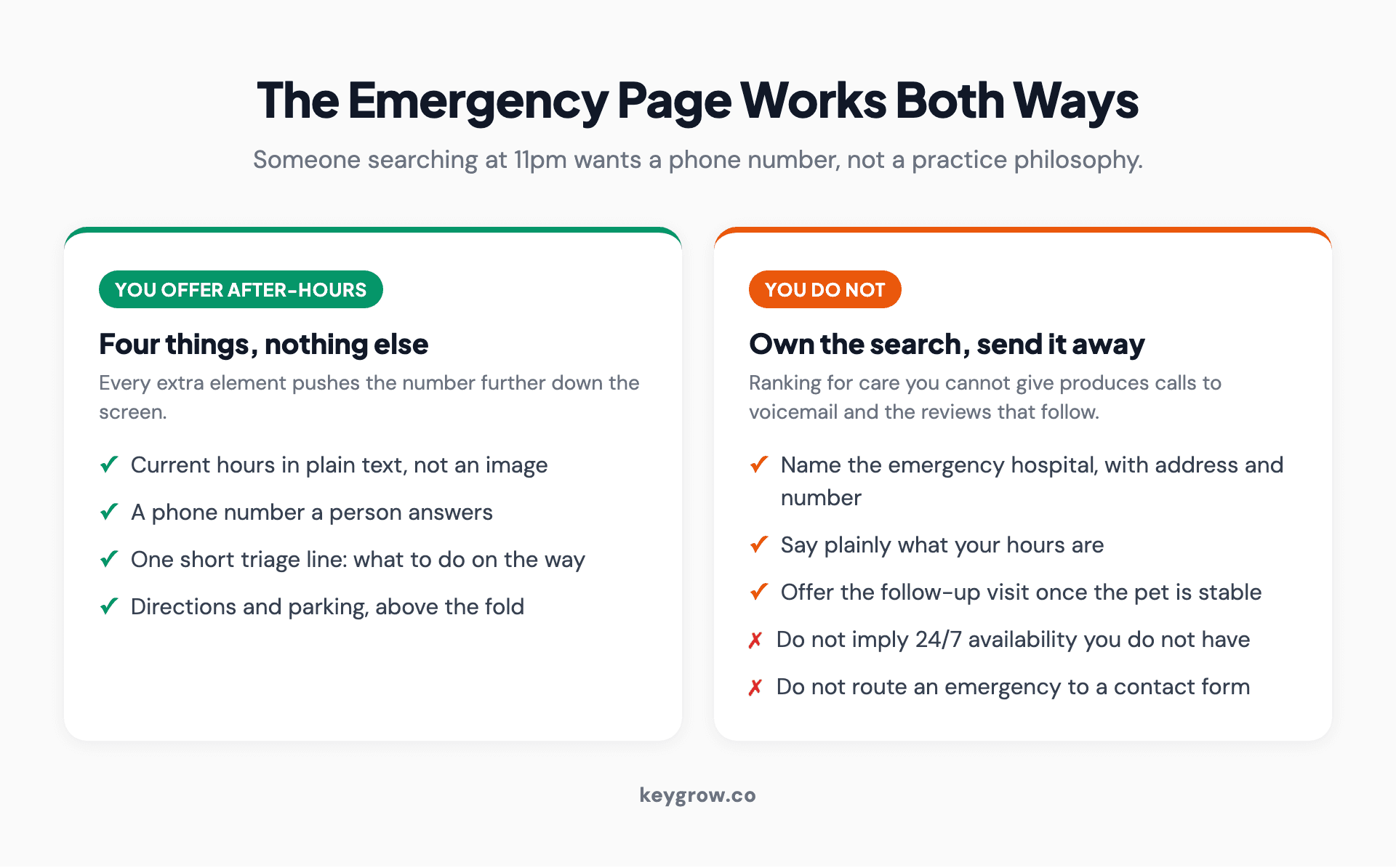
What an emergency veterinary page needs, and what to do with the search when the practice is closed.
Here is the part most practices get wrong. If you do not offer after-hours care, you should still own that search, and you should send it away properly. A page that says plainly which emergency hospital to drive to, with the address and the number, earns the thing that matters more than a click: the person remembers who told them the truth at midnight and books their follow-up with you.
Trying to capture emergency traffic you cannot serve produces one-star reviews from people who called and got voicemail. That is a worse outcome than not ranking.
The procedure and cost pages your competitors leave blank
Price is the search. Almost nobody in veterinary medicine answers it.
Look at what pet owners actually type: spay cost, neuter cost, dental cleaning cost, what an X-ray runs, whether a lump removal is worth it. Then look at how many practice websites in your city publish a number. Usually zero.

A veterinary surgical suite prepared for a procedure.
The objection is always the same: every case is different and a number will scare people. Both parts are true. A range with the variables named still beats silence, because the person searching is going to find a number somewhere, and if it is not on your site it will be a forum thread quoting a practice in another state with different costs.
Publish a band. Say what moves it: the animal's weight, whether bloodwork is included, whether it is laparoscopic, whether dental extractions are likely. In the same AVMA data, 16.4 percent of cat owners who skipped care named cost as the reason. The conversation is happening whether you join it or not.
This is also the page that gets cited when an AI assistant answers the cost question, which is increasingly where the question goes first.
What a veterinary Google Business Profile has to carry
For "vet near me", the profile decides it before your website is involved. The local pack takes roughly 42 percent of clicks on local searches, per Searchlab, and you are either in it or you are fighting over what is left.
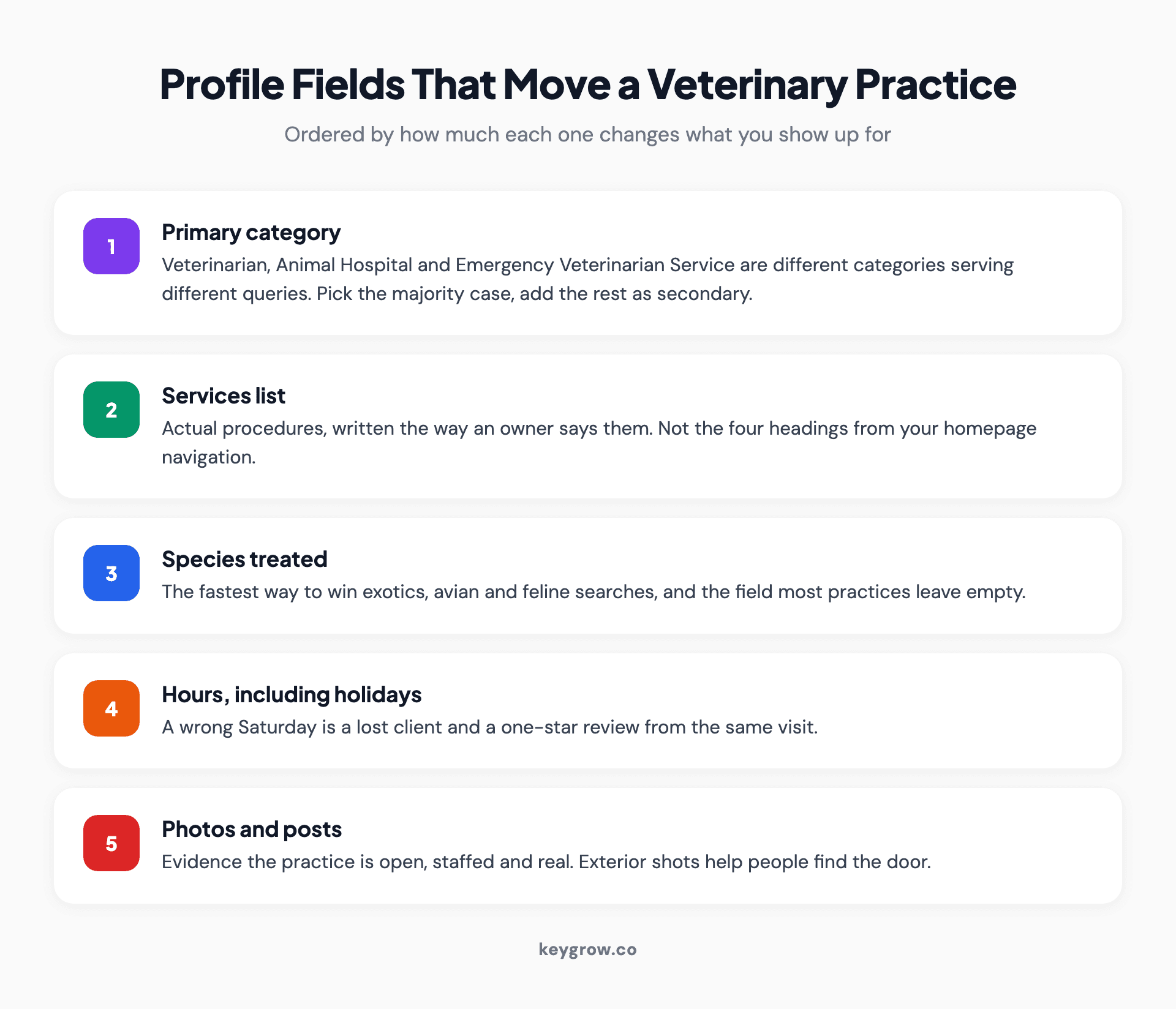
The Google Business Profile fields that matter most for a veterinary practice.
Primary category moves more than any other field you can edit, and it is worth being precise: "Veterinarian" and "Animal Hospital" and "Emergency Veterinarian Service" are different categories that surface for different queries. Pick the one that matches the majority of what you want, then add the others as secondary.
Fill the services list with actual procedures rather than the four categories on your homepage. Add species you treat. Set hours accurately, including holiday hours, because a wrong hours field on a Saturday morning is a lost client and a bad review in the same visit.
Our guide to Google Business Profile optimization goes field by field, and Google's local ranking guidance is the primary source worth reading once.
Reviews about an outcome the client could not evaluate
Veterinary reviews are unusual because the client cannot judge the medicine. They judge the wait, the bill, the front desk, and how they were treated on the worst day of their pet's life.

A veterinarian examining a kitten during a clinic visit.
That produces two patterns you have to plan for. The first is the price one-star, written by someone who is upset about a number rather than the care. The second is the grief review, written after a euthanasia, which can be either the warmest thing on your profile or the most painful, and neither is really about clinical quality.
Ask for reviews at the right moment, which is after a routine positive visit, not after a hard one. A card at checkout and a follow-up message a day later is the whole system. Do not incentivize anything, ever.
When you reply, never discuss the case. Not the diagnosis, not the treatment plan, not what the owner declined. Reply short, take it offline, offer a phone number. Our post on responding to Google reviews covers the mechanics, and in this field restraint is most of the skill.
Your content is health content, which changes who has to write it
Veterinary advice sits in the category search engines are most careful about, and the bar for who is allowed to be an authority is higher here than in most local industries.
Practically, that means a named veterinarian with credentials attached to the article, a real author page, and dates that show the content is maintained. A blog post about parvovirus signed by nobody competes badly against one signed by a DVM.

A veterinary practice laboratory bench with diagnostic equipment.
There is a trap in the general advice content, though. "Is my dog vomiting an emergency" is answered in the search results now, usually without a click, and often by an AI summary drawing on somebody else's page. Writing forty of those posts is a slow way to build traffic that never books an appointment, because most of the people reading them live nowhere near you.
Write the symptom content that ends at your door. "When a limping dog needs an X-ray, and what we check first" is local, useful, and points at a booking. "Ten facts about cat nutrition" is a hobby.
You are not competing with the practice down the road anymore
The single biggest change in veterinary local search over the last decade is who owns the other results.
A large share of practices in most metro areas are now part of corporate groups, and those groups have marketing departments, national content libraries, and location page templates rolled out across hundreds of sites. When you search your own city, some of what you are looking at is a system, not a competitor with a receptionist updating the website between calls.
That sounds discouraging and mostly is not. Templated location pages are shallow by design, they rarely name the individual veterinarians, and they almost never publish real prices or handle a species niche properly. The independent practice wins on exactly the things a template cannot do: named doctors with real bios, specific species capability, local partnerships, and an actual answer to the cost question.
Pick the ground where a template loses. Do not try to out-publish a content library.
The two link sources a practice actually has
Ignore most link building advice, which was written for businesses that can guest post their way to authority. A veterinary practice has two real sources.
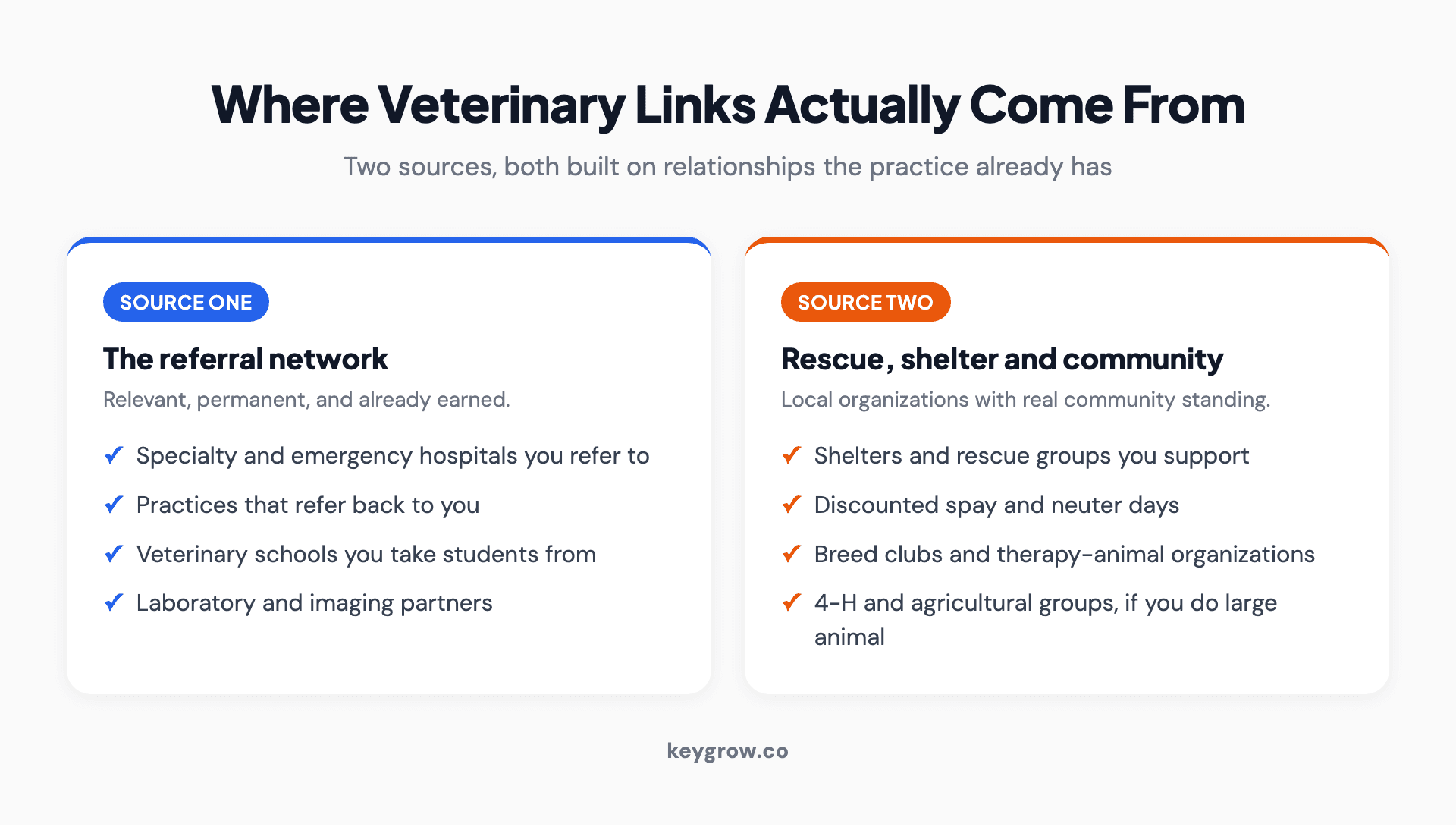
The two link sources a veterinary practice actually has: the referral network and the rescue and shelter world.
The referral network is the first. Specialty and emergency hospitals you refer to, and that refer back, have websites with referring-practice lists. So do the veterinary schools some of you teach at or take students from. These links are relevant, permanent, and already earned by a relationship you have.
The second is the rescue and shelter world. Sponsorship, discounted spay days, breed clubs, 4-H and agricultural groups if you do large animal, therapy-animal organizations. These produce local links from organizations that have real community standing, which is the same signal a local news mention carries.
That is genuinely most of it. Two dozen good links from those two categories will do more for a practice than a hundred directory submissions, and it takes a year of ordinary relationship maintenance rather than a campaign.
What to measure when the practice is already full
A lot of veterinary practices do not want more new clients. They want better-scheduled ones, and they are short on doctor hours.
If that is you, the metric is not traffic and it is not new client count. It is the mix. Are the new clients arriving through search the kind you want, in the species and services you have capacity for, at the price point that works? A page that produces forty calls for cheap vaccine clinics has made your problem worse.
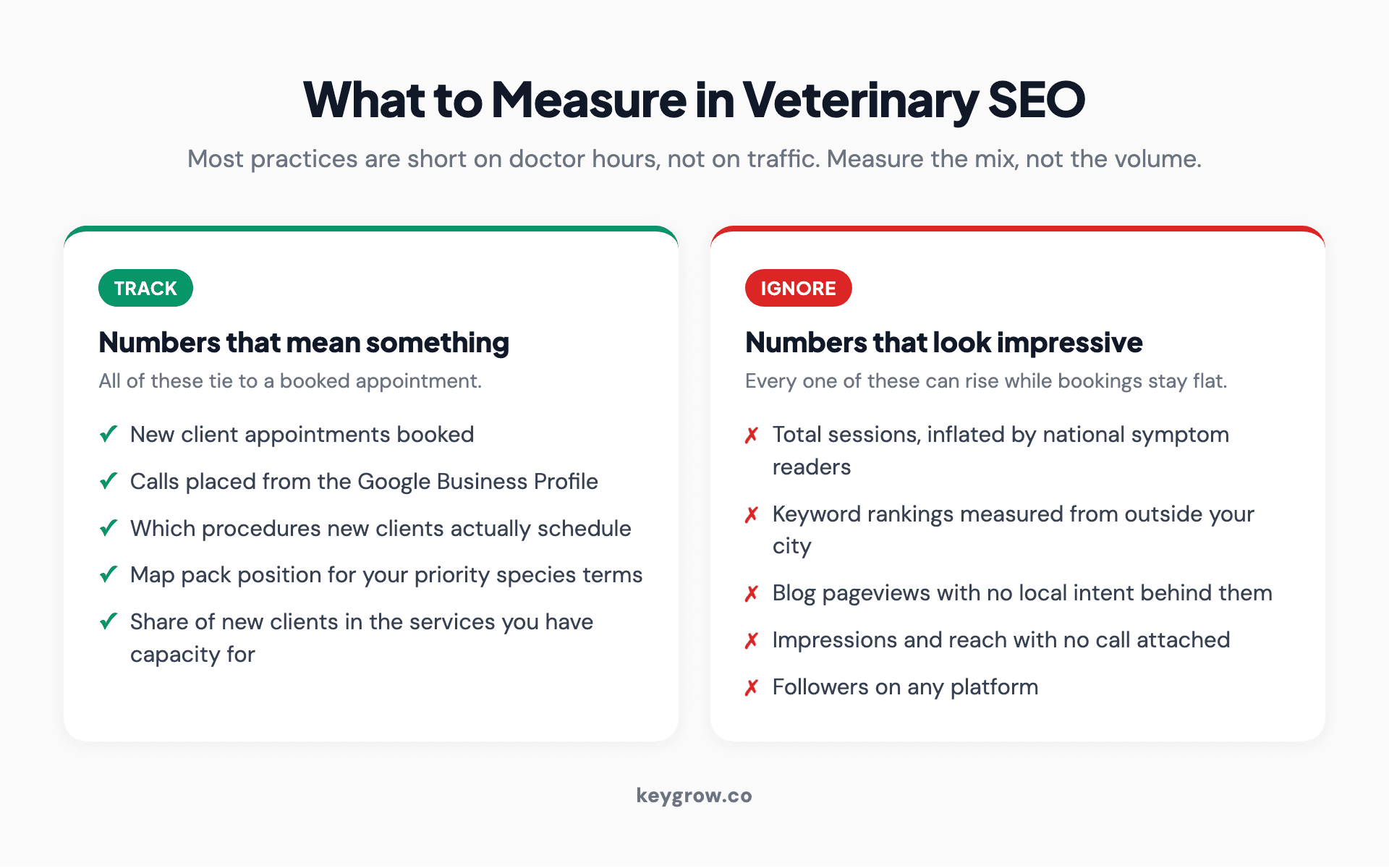
What to track in veterinary SEO, and the numbers that look impressive without meaning anything.
Track new client appointments booked, calls from the profile, and the procedures those clients actually schedule. Ignore total sessions, which will inflate the moment a symptom article picks up national readers who will never drive to you.
On timing: a doctor's practice in Dubai we worked with committed to a full year of organic work. Months one to three looked unremarkable. By month twelve, organic traffic was up 1,519 percent and the practice was fielding 130+ patient calls a month. That is the shape of it. Our post on how long local SEO takes has the month-by-month version.
Practices that should not be buying veterinary SEO
Four situations where the honest answer is no, or not yet.
You are at capacity and booked three weeks out. Fix scheduling, pricing and staffing first. More demand into a full calendar produces worse reviews, not more revenue.
Your recall list has never been worked. Go back to the fourteen point gap. That is cheaper and faster than anything on this page.
You are a single-doctor practice in a town with two other vets. You probably do not need an agency at all. Claim the profile, fill it in properly, get thirty honest reviews, write six real pages, and you will be fine. DIY is the right call more often than agencies admit, and a practice with more time than budget should spend the time.
You are about to sell. Organic work priced at a year of compounding will not show up in a valuation twelve months out.
We turn away practices in the first two situations regularly, because taking the retainer would be selling something the business does not need yet.
FAQs
How long does SEO for veterinarians take to work?
Profile and map pack improvements can show up in four to eight weeks. Website rankings for procedure and species pages usually take four to six months, and the compounding gets meaningful around month nine to twelve. Anyone promising page one in thirty days is either targeting terms nobody searches or planning something that will cost you later.
Is SEO or Google Ads better for a veterinary practice?
Ads for emergency and high-intent terms, organic for everything that repeats. Emergency searches convert immediately and are worth paying for, while procedure, cost and species pages compound and keep working after you stop spending. Most practices that can only pick one should start with the Google Business Profile, which is free.
What keywords should a veterinary practice target?
Procedure plus cost, species plus capability, and your city. Terms like cat dental cleaning cost, exotic vet, spay near me and emergency vet open now produce appointments. Broad terms like pet health and animal care produce readers who live nowhere near your practice.
Should a veterinary website publish prices?
Publish ranges with the variables named rather than exact figures. The cost question is being asked constantly and answered by forums, competitors and AI summaries whether you participate or not. A band with an explanation of what moves it builds more trust than silence and filters out price shoppers before they reach your front desk.
How many reviews does a veterinary practice need?
Thirty to fifty recent, genuine reviews puts most practices in a competitive position locally, and recency matters more than the total. A steady trickle of four or five a month beats two hundred that stopped three years ago. Never offer anything in exchange for one.
Can I do veterinary SEO myself?
Yes, for the parts that matter most. Claiming and completing the Google Business Profile, fixing hours, adding services and species, and asking clients for reviews are all inside a practice manager's reach and account for a large share of local visibility. Hire help when you need site architecture, procedure pages at volume, or technical work.
Do veterinary blog posts actually bring in clients?
Only the local ones. General pet care articles attract national readers who cannot book with you and inflate your traffic reports without adding appointments. Posts tied to a decision you are part of, like when a limp needs imaging or what a dental under anesthesia involves at your practice, do convert.
What is the biggest SEO mistake veterinary practices make?
Organizing the website by internal service categories instead of by what pet owners search for, which is species, procedure and price. The second biggest is chasing emergency traffic they cannot serve, which generates calls to voicemail and the reviews that follow.
Fix the gap before you chase the search
Work the recall list, because the fourteen point gap between clients who have you and clients who visited you is the cheapest growth in this business and it does not require a ranking.
Then build in this order: the Google Business Profile properly filled in, one page per species capability you want more of, one page per procedure with a real price range, and an honest after-hours page even if the honest answer is to send them elsewhere. Sign the clinical content with a veterinarian's name.
That is a year of work at a sensible pace, and it compounds. It is the same sequence we run in our local SEO work, in that order, for the same reason. If you want a second opinion on which part of it your practice actually needs, send us the site and we will tell you, including when the answer is that you do not need us yet.