


Your menu is the most valuable keyword research your restaurant will ever do, and on most restaurant websites it is locked inside a PDF where nothing can read it.
That single decision explains a large share of why SEO for restaurants underperforms. People do not search for "restaurant near me" nearly as often as the industry assumes. They search for a dish, a dietary need, an occasion, or a time of day, attached to a place. Birria tacos. Gluten free pizza. Somewhere for a business lunch. Brunch that takes reservations for eight. Every one of those is answerable by your menu, and every one of them is invisible if the menu is a file rather than a page.
So this guide is organized around that idea. Get the menu into HTML, get the profile right, and build a small number of pages that match how people actually decide where to eat. In that order, because the order matters more than the length of the list.
Your menu is the keyword research
Open your menu and read it as a list of search terms. Every dish name, every dietary label, every cuisine descriptor is something a person types when they want that specific thing tonight.
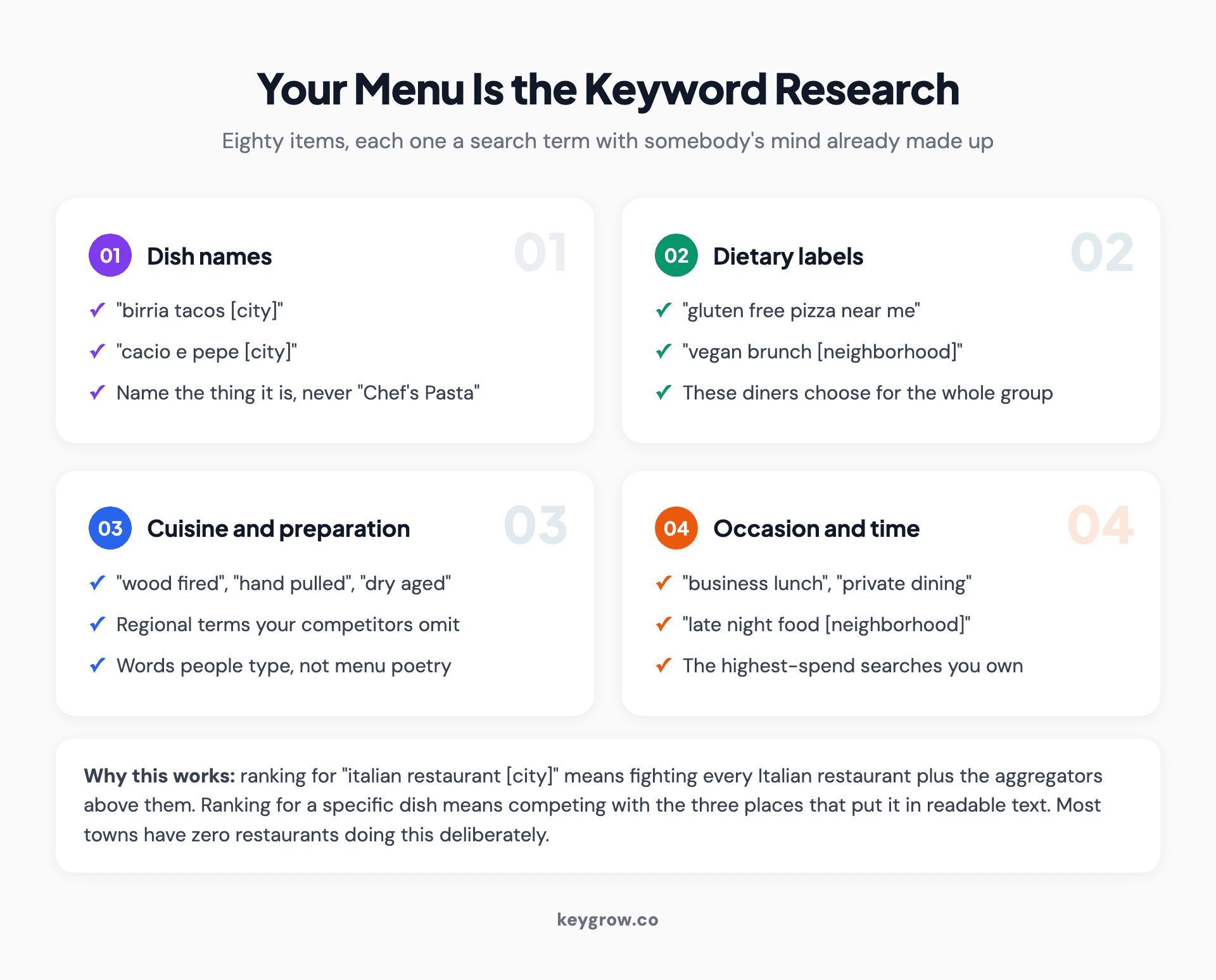
Illustration of a restaurant menu re-read as a keyword list, mapping dish names, dietary labels, cuisine terms and occasion words to the searches diners actually type.
This is the part that makes restaurant SEO different from every other local business. A plumber has maybe fifteen services. You have eighty items, and each one is a term with real intent behind it, because somebody searching for a specific dish has already decided what they want and is only choosing where.
Those searches are also far less competitive than the head term. Ranking for "italian restaurant [city]" means fighting every Italian restaurant plus the aggregator sites that sit above all of them. Ranking for "cacio e pepe [city]" means competing with the three places that actually put it in readable text on their website. Most towns have exactly zero restaurants that have done this deliberately.
Read it that way once and the strategy writes itself.
The practical move is to make every dish a piece of indexable text, with a real name, a real description, and where it matters, the dietary and preparation words people search alongside it. Not "Chef's Pasta". The thing it is.
The PDF menu is the most expensive file on your website
Replace it with an HTML page. This is the highest-value single change available to most restaurant sites, and it usually takes an afternoon.
A PDF, or worse an image of a menu, is close to unreadable for the systems that decide who gets found. Search engines extract very little from it. AI assistants, which increasingly answer "where can I get X near me" without anybody visiting a website, cannot quote from it at all. On a phone, which is where nearly all of this traffic comes from, a PDF menu is also a genuinely bad experience: pinch, zoom, drag, give up.
An HTML menu fixes all three at once. It gets indexed, it can be cited, it works on a phone, and it becomes eligible for structured data in a way a file never is. Keep the PDF if you want it for printing. Do not make it the only version.
The related mistake is hiding the menu behind a click-through, a splash screen, or a slow-loading interactive widget. If a person cannot see food within a few seconds of arriving, and a crawler cannot see it at all, the page is not doing its job regardless of where it ranks.
What a hungry person actually types
Sort your target searches by how the decision is being made, not by search volume. The volume sits at the top of this list and the intent sits at the bottom.
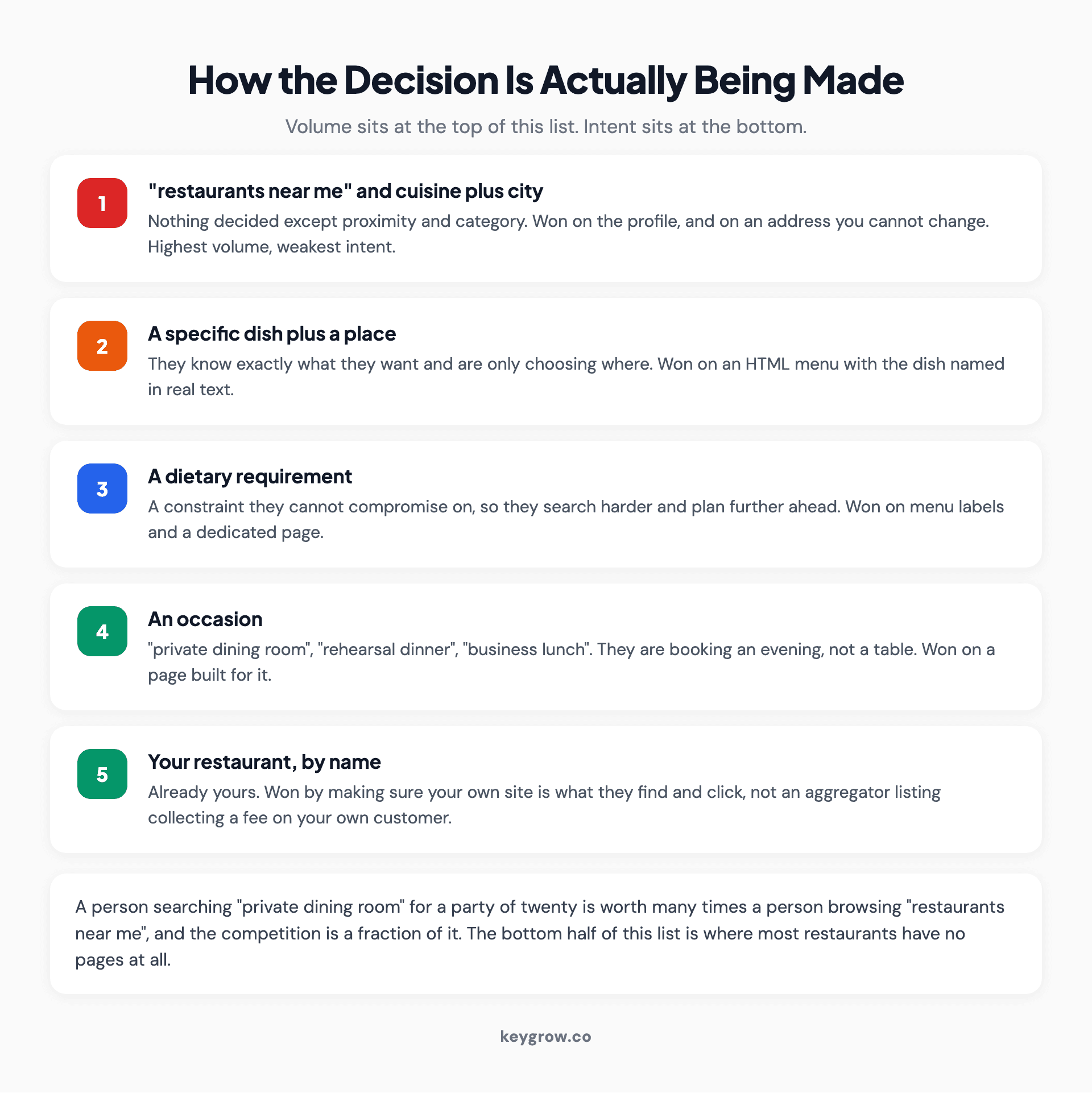
Table-free breakdown of restaurant search intent, from broad cuisine and near-me queries down to specific dish, dietary and occasion searches with the highest booking intent.
| Search type | Example | What they have decided | Where you win it |
|---|---|---|---|
| Cuisine plus place | "thai food [city]" | Category only | Profile, plus a strong homepage |
| Near me | "restaurants near me" | Nothing except proximity | Profile, and proximity you cannot change |
| Specific dish | "birria tacos [city]" | Exactly what they want | HTML menu with the dish named |
| Dietary need | "gluten free bakery [city]" | A constraint they cannot compromise on | Menu labels and a dedicated page |
| Occasion | "private dining room [city]" | The kind of evening, not the food | A page built for that occasion |
| Time of day | "late night food [neighborhood]" | When, more than what | Hours on the profile, plus a page |
| Booking mechanics | "[restaurant] reservations" | You, specifically | Your own site, if you have not ceded it |
The bottom half of that table is where most restaurants have no pages at all, and it is also where the customer is closest to walking in. A person searching "private dining room" for a party of twenty is worth many times a person browsing "restaurants near me", and the competition is a fraction.
The profile does more work than the website
For restaurants specifically, the Google Business Profile is not a supporting asset. It is often the whole transaction: somebody searches, reads reviews, looks at photos, checks hours, and calls or books without ever opening your website.
So treat it as the primary property, not a listing you completed once.
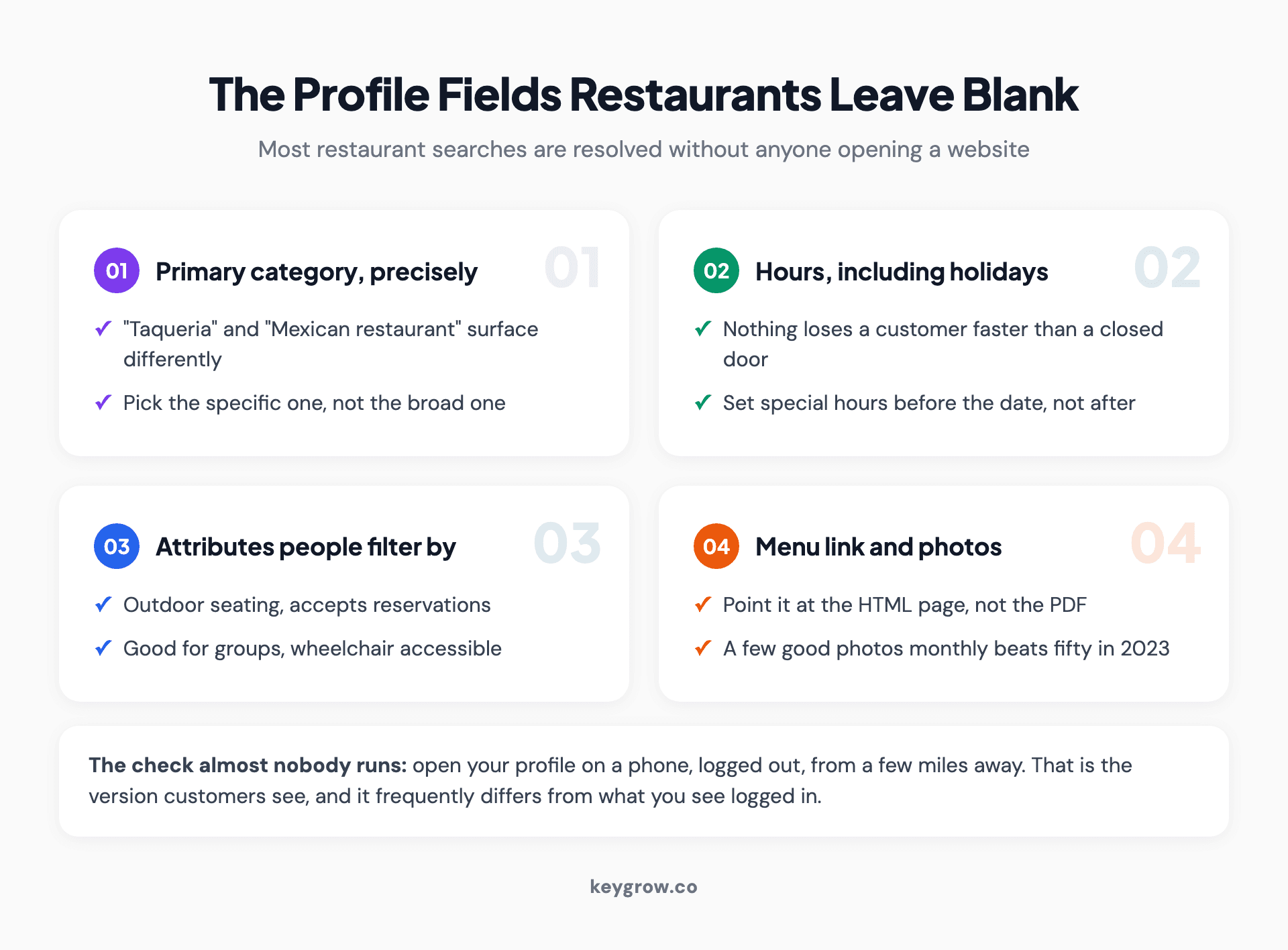
Checklist of Google Business Profile fields that matter for restaurants, covering primary category, holiday hours, menu link, filterable attributes and photo cadence.
Start with the fields. Correct primary category, and be specific, since "Mexican restaurant" and "Taqueria" surface differently. Real hours, updated for holidays, because nothing loses a customer faster than driving to a closed restaurant. Menu link pointing at the HTML page. Attributes filled in, including the ones people filter by: outdoor seating, accepts reservations, good for groups, wheelchair accessible.
Proximity is a large part of how the map results get decided, and your address is not something you can optimize. What you can control is everything else, and most restaurants leave half of it blank. Our Google Business Profile guide covers the full field list.
One thing worth doing that almost nobody does: check what your profile says on a phone, logged out, from a few miles away. That is the version customers see, and it frequently differs from what you see logged in.
Photos are a ranking input here in a way they are not elsewhere
Restaurants are the category where people decide with their eyes, and photo activity is a signal that the business is alive.

A restaurant dining room set for service in natural daylight, the kind of interior shot that helps diners recognize the space before they arrive.
Post consistently rather than in bursts. A handful of good photos every month beats fifty uploaded once in 2023. Shoot the food in daylight where you can, shoot the room, shoot the exterior so people recognize the door they are looking for, and let customer photos stay, because a profile with only professional photography reads as staged. The same daylight shoot can stock a week of Instagram and TikTok posts too, which our restaurant social media marketing plan maps out day by day.
There is a practical detail people miss. Your exterior photo is doing wayfinding, not marketing. Somebody standing on the street holding a phone needs to match what they see to your storefront. That photo should look like the building on an ordinary day, not a twilight architectural shot.
Reviews, and the recency problem
Review recency matters more for restaurants than for almost any other local business, because a review from two years ago describes a kitchen that has since changed hands twice.
A steady flow is the goal, and the mechanism has to be systematic. Asking at the table works when staff remember, which is sometimes. A QR code on the receipt or a follow-up from your booking system works whether or not anyone remembers.
What not to do, and it still gets sold: do not filter customers by predicted sentiment before asking, and do not offer a free dessert for a review. Both are prohibited by platform policy and by federal rules on consumer reviews, and a profile of nothing but five stars reads as purchased to customers and to detection systems alike. If a fake one does land, our guide to removing a fake Google review covers what is actually removable.
The pages worth building beyond the menu
Four page types, and most restaurants have none of them.
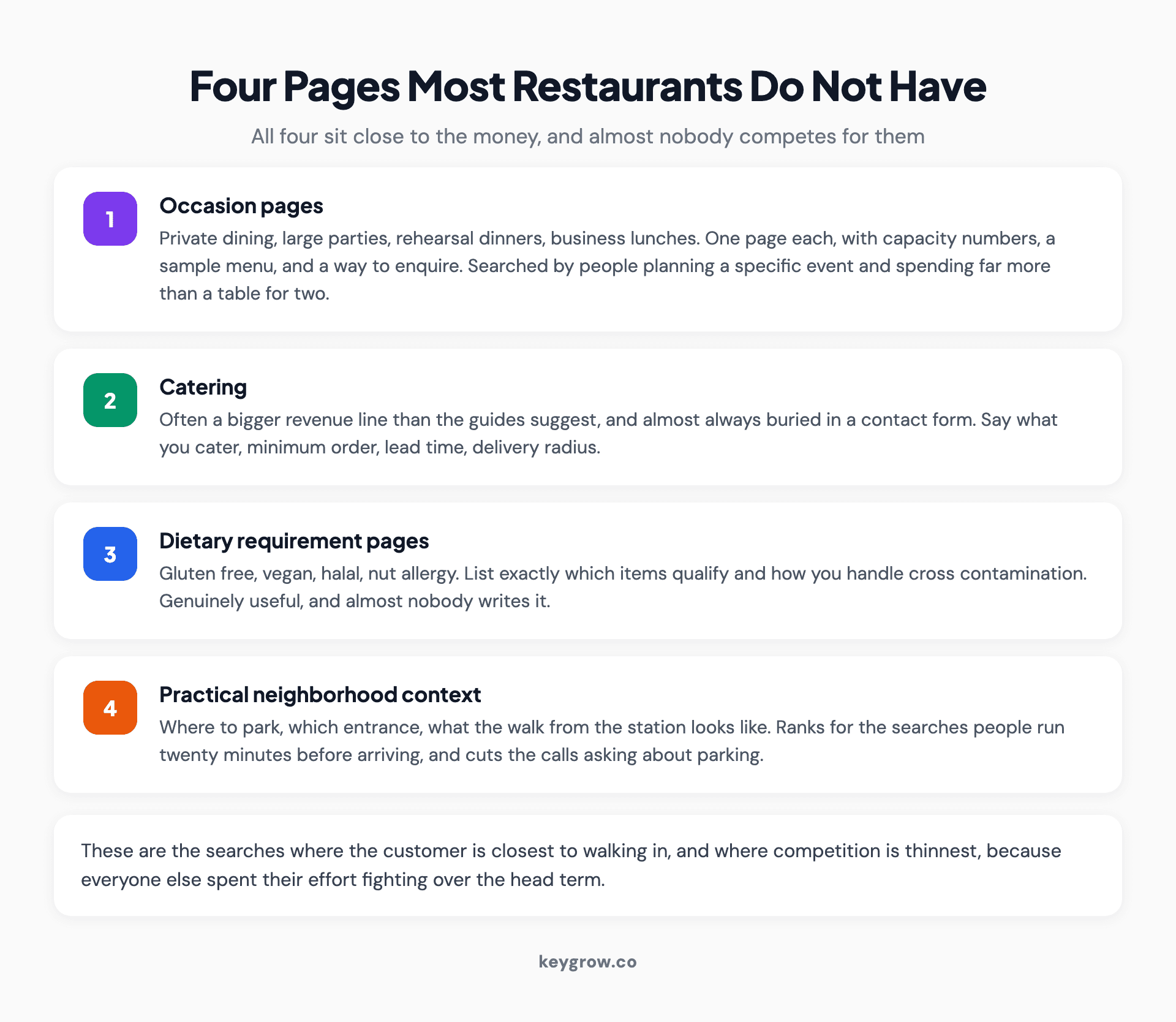
Four restaurant page types worth building beyond the menu: occasion and private dining pages, catering, dietary requirement pages, and practical neighborhood context.
Occasion pages. Private dining, large parties, rehearsal dinners, business lunches. These are searched with high intent by people planning a specific event and spending far more than a table for two. One page each, with capacity numbers, a sample menu, and a way to enquire.
Catering. Frequently a bigger revenue line than the guides suggest, and almost always buried in a contact form. If you cater, it deserves a page that says what you cater, minimum order, lead time, and delivery radius.
Dietary pages. Gluten free, vegan, halal, nut allergy. People with dietary constraints search harder, plan further ahead, and choose the restaurant for the whole group. A page that lists exactly which items qualify and how you handle cross contamination is genuinely useful and almost nobody writes it.
Neighborhood context. Not a thin location page, but the real thing: where to park, what is nearby, which entrance to use, what the walk from the station looks like. This ranks for the searches people run in the twenty minutes before they arrive, and it reduces the number of calls asking about parking.
Assistants are answering "where should we eat" now
A growing share of restaurant discovery never touches a results page. Somebody asks an assistant for somewhere nearby that does good ramen and takes bookings, and gets three names.
This makes the menu point sharper rather than changing the advice. An assistant can only recommend you for a dish it can read. It cannot open your PDF, cannot parse your menu image, and will not guess. The restaurants getting named in those answers are the ones whose dishes exist as text, whose hours are accurate, and whose reviews are recent enough to look current.
Two smaller things follow from it. Consistency across the web matters more than it did, because an assistant reconciling three different sets of hours will often just skip you. And an active review profile correlates with roughly three times the likelihood of being cited, which is another argument for the steady flow rather than the occasional push.
Marketplaces, and taking the repeat order back
Use the third-party delivery marketplaces for discovery. Work to move the second order onto your own channel. That is the entire strategy, and it has a number attached that you can calculate yourself.
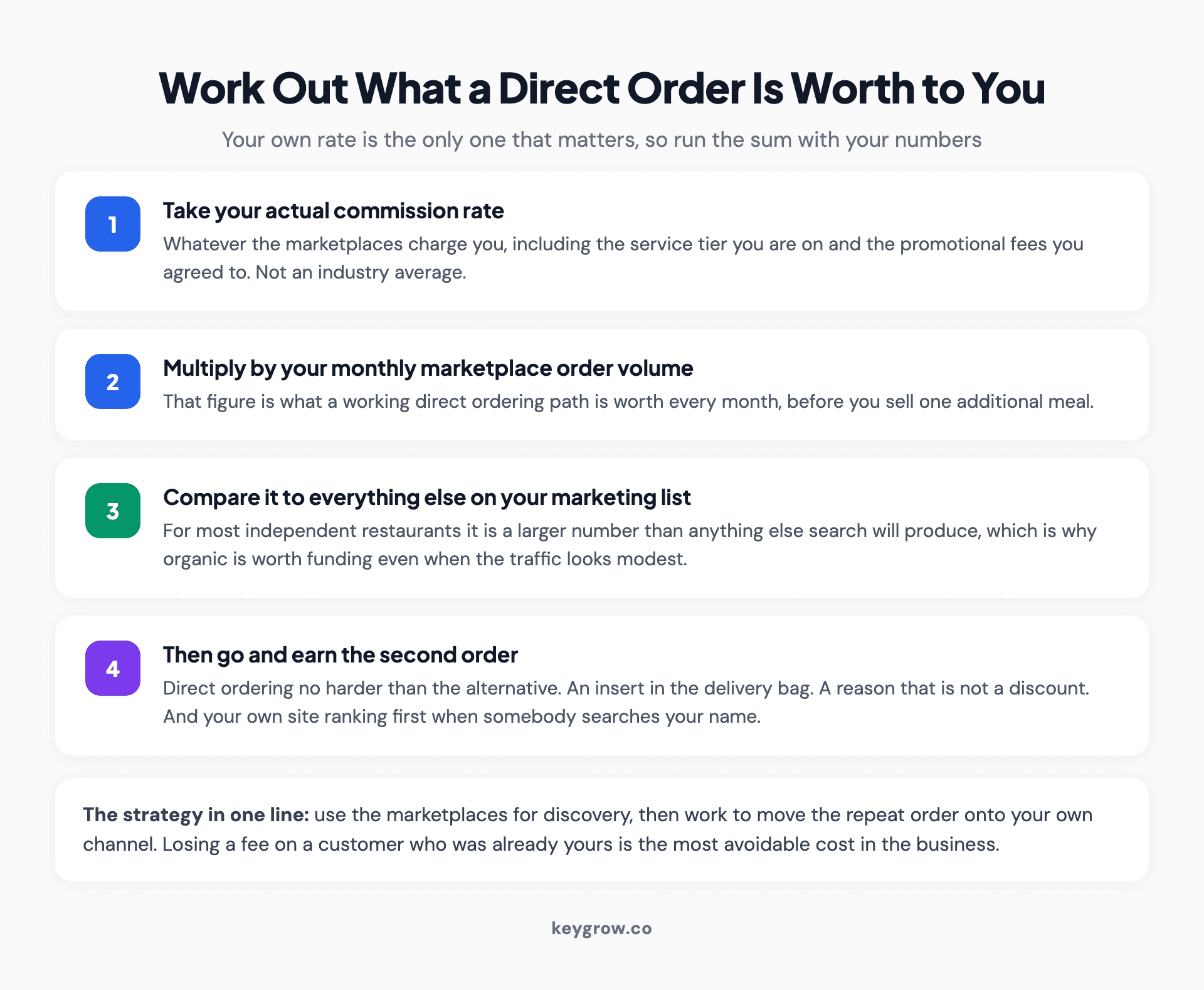
Worked arithmetic showing how a restaurant calculates the monthly value of moving repeat orders from commission-charging marketplaces onto its own direct ordering path.
Do the sum yourself, because your rate is the only one that matters.
Take your own commission rate, whatever the platforms charge you, and multiply it by your monthly marketplace order volume. That figure is what a direct ordering path is worth per month, before you have sold a single extra meal. For most independent restaurants it is a larger number than anything else SEO will produce, which is why organic search is worth funding here even when the traffic numbers look modest.
None of this is clever.
The mechanics are unglamorous. Make ordering directly from your site obviously possible and no harder than the alternative. Put an insert in the delivery bag. Give people a reason that is not a discount, like a loyalty punch or first access to specials. And make sure that when somebody searches your restaurant by name, your own site is what they find and click, rather than an aggregator listing sitting above you collecting a fee on a customer who was already yours.
Structured data that earns something
Restaurant schema is one of the few places where markup does visible work, because it feeds the panels and rich results people look at before choosing.
Mark up the basics properly: business type, address, phone, opening hours, price range, accepted payment, and the link to your menu page. Then add menu structure where you can, since the Menu schema type exists specifically to describe sections, dishes, descriptions, and prices in a form machines can read cleanly. Google's structured data documentation covers the required and recommended properties for local businesses.
Two caveats. Schema is not a ranking factor by itself, and anybody telling you it is has skipped a step. What it does is make your result more prominent and give AI systems clean data to quote, which is where its value sits now. And it only helps if the underlying information is accurate, so fixing wrong hours matters more than adding markup around them. If you would rather not hand-write JSON-LD, our schema markup generator builds the base object.
What to measure
Direct orders, reservations, and calls. Everything else is a diagnostic.
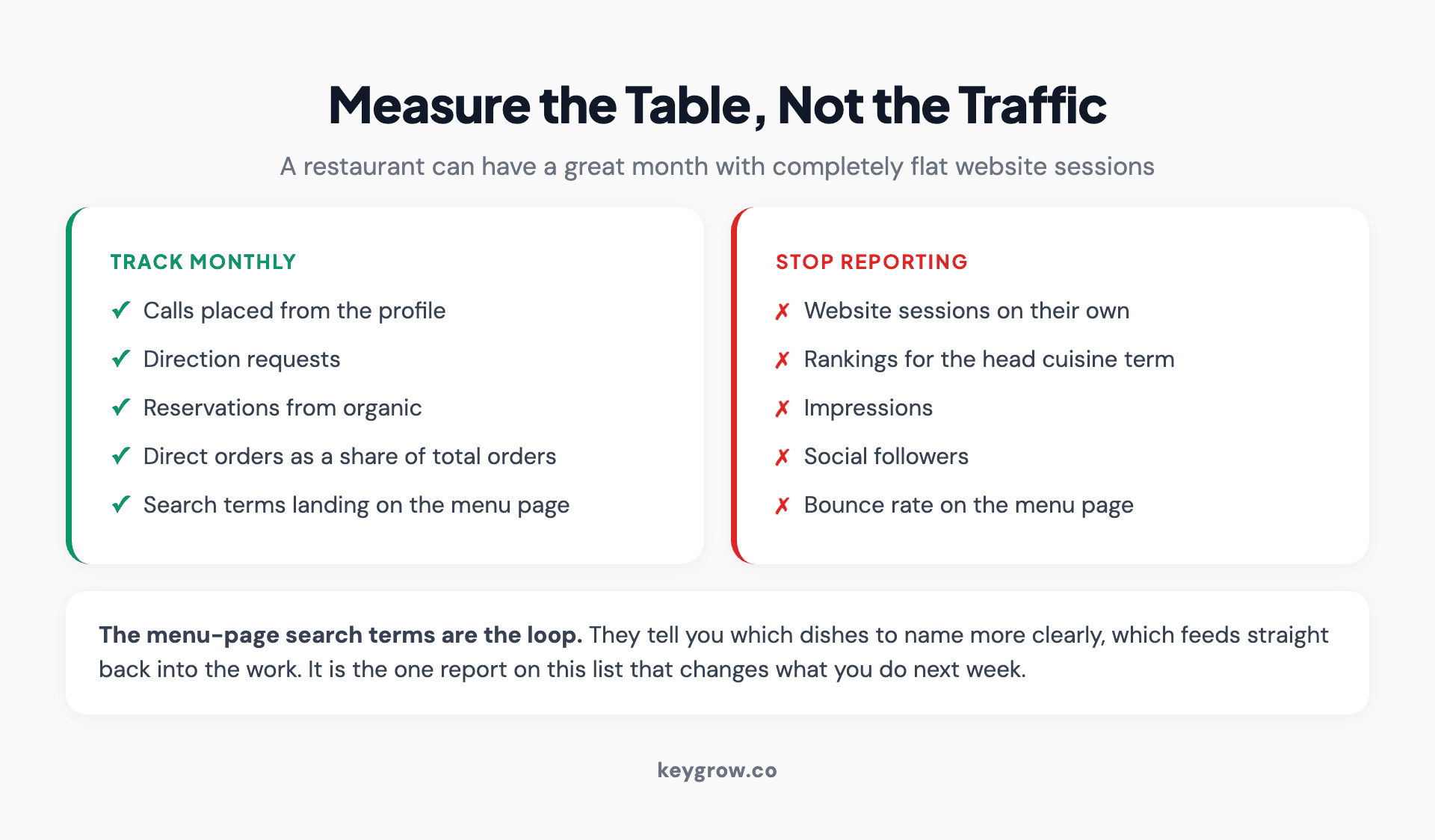
Restaurant SEO reporting hierarchy placing direct orders, reservations and profile calls above website sessions and head-term rankings.
The specific numbers worth tracking monthly: calls from the profile, direction requests, reservations from organic, direct online orders as a share of total orders, and the search terms bringing people to the menu page. That last one tells you which dishes to name more clearly, which is a loop the rest of this post feeds.
Two things to stop reporting. Website sessions on their own, since a restaurant can have a great month with flat sessions if the profile is doing the work. And keyword rankings for the head term, which move slowly, are heavily proximity-dependent, and rarely correlate with a busier Friday.
For a sense of what the timeline looks like: across local service clients we have worked with, the pattern is consistent but not fast. A phone repair shop reached 115+ monthly phone calls in 7 months, and a junk removal company 50+ in 6 months, in both cases from close to nothing. Restaurants tend to move somewhat faster because the profile carries more of the load, but the shape is the same. Months, not weeks. Our post on how long local SEO takes goes into the phases.
When a restaurant should not spend on SEO
Three cases, and I would say so rather than take the work.
A single location with no capacity problem. If you are turning people away on Friday and Saturday and comfortable the rest of the week, more discovery is not your constraint. Yield is. Spend on the slow nights, not on rankings.
A restaurant about to change concept. Content and profile signals built around your current menu become baggage the moment the concept moves. Wait until the thing is settled.
A business whose actual problem is the food or the service. SEO delivers more people to an experience. If the reviews describe a real problem, more traffic accelerates the damage. Fix the operation first, and the reviews will follow without a marketing budget.
There is also a genuine do-it-yourself case here, more than in most industries. Claiming and completing the profile, photographing the food, putting the menu into HTML, and setting up a review request are all things an owner or manager can do in a few weekends. That is most of the available value for a single location. Hire out when you have multiple sites, a catering line to build, or nobody with the hours.
FAQs
How long does SEO take for a restaurant?
Profile improvements can show up in weeks, because hours, categories, photos, and attributes feed the map results quickly. Website changes like an HTML menu and occasion pages typically take a few months to gain traction. Plan on three to six months for a meaningful change in discovery, and treat anything faster as a bonus rather than the expectation.
Should my restaurant menu be a PDF or a web page?
A web page, always. PDFs and menu images are poorly read by search engines and cannot be quoted by AI assistants, so you lose every search for a specific dish you serve. They are also a bad experience on a phone. Keep a PDF for printing if you want one, but the HTML version should be the primary menu.
Do restaurants need a website if the Google profile is good?
Yes, though the profile does more of the work than in other industries. The website is where direct ordering, reservations, catering enquiries, and occasion pages live, and those are the transactions that avoid third-party commission. A profile with no website behind it hands the highest-value bookings to somebody else.
What is the most important thing for restaurant local SEO?
The Google Business Profile, kept accurate and active. Correct primary category, real hours including holidays, current photos, complete attributes, and a steady flow of recent reviews. It outranks everything else because the majority of restaurant searches are resolved without anyone opening a website.
How do I rank for a specific dish?
Name it clearly in indexable text on your menu page, with a real description that uses the words people search. Add the dietary and preparation terms that go with it. Then support it with structured data and, if the dish is a signature item, a page or section of its own. Most competitors have their dish names locked inside a PDF, so the field is unusually open.
Are third-party delivery platforms bad for SEO?
They are not an SEO problem, they are a margin problem. Use them for discovery, then work to move repeat customers onto your own ordering path, since every order that comes direct avoids the commission. The SEO angle is making sure a search for your restaurant by name leads to your own site rather than an aggregator page.
How many reviews does a restaurant need?
There is no threshold, and recency matters more than the total. A restaurant with 60 reviews from the last year reads as more current than one with 300 that stop in 2023. Aim for a consistent monthly flow rather than a target number, and never filter who you ask.
Where the next month goes
If you do one thing this week, get the menu out of the PDF and onto a real page, with every dish named in text a person would search. Nothing else on this list has the same ratio of effort to result.
After that, in order: fix the profile fields you have never filled in, start a photo routine you can actually keep, build one occasion or catering page, and set up a review request that runs without anyone remembering. That is a month of work spread across a few afternoons, and it is more than most restaurants in your market have done.
If you want a look at which of those is your actual bottleneck, our SEO team does that kind of review, and for a single busy location the answer is often that you can do it yourself.