


Ask ten moving companies where their bookings come from and most will name a lead-selling platform before they name their own website. That answer is the whole problem.
SEO for moving companies is the work of ranking your own site and Google Business Profile for the searches people run while planning a move, so the booking arrives without a broker taking a cut and selling the same phone number to four of your competitors. Organic leads in this industry settle at roughly $5 to $20 once the work matures. Purchased leads run $6 to $150 depending on how many other movers got the same contact.
We wrote about Google Ads for moving companies separately. This is the organic half, and the honest position is that most movers should run both while the organic side matures.
Most movers do not have a visibility problem
They have a trust problem, and it changes what the SEO work is actually for.
Moving is one of the few home services where a meaningful share of customers arrive already suspicious. They have read about hostage loads, quotes that double on delivery day, and companies that vanish after taking a deposit. That skepticism is priced into every search they run.
So ranking is only half the job here. A mover who reaches position three and then presents a website with no license number, no named people, no photographs of actual crews, and no explanation of how a quote becomes a price will lose the booking to whoever sits below them and looks like a real company.
That reframing decides what you build. The pages that matter most for a mover are not the ones with the best keyword density. They are the ones that answer the question the customer is too polite to ask, which is whether you are going to do to them what the last company did to their friend.
What a moving lead actually costs, by channel
Movers are the most heavily brokered trade in home services, and the arithmetic explains why organic is worth the wait.
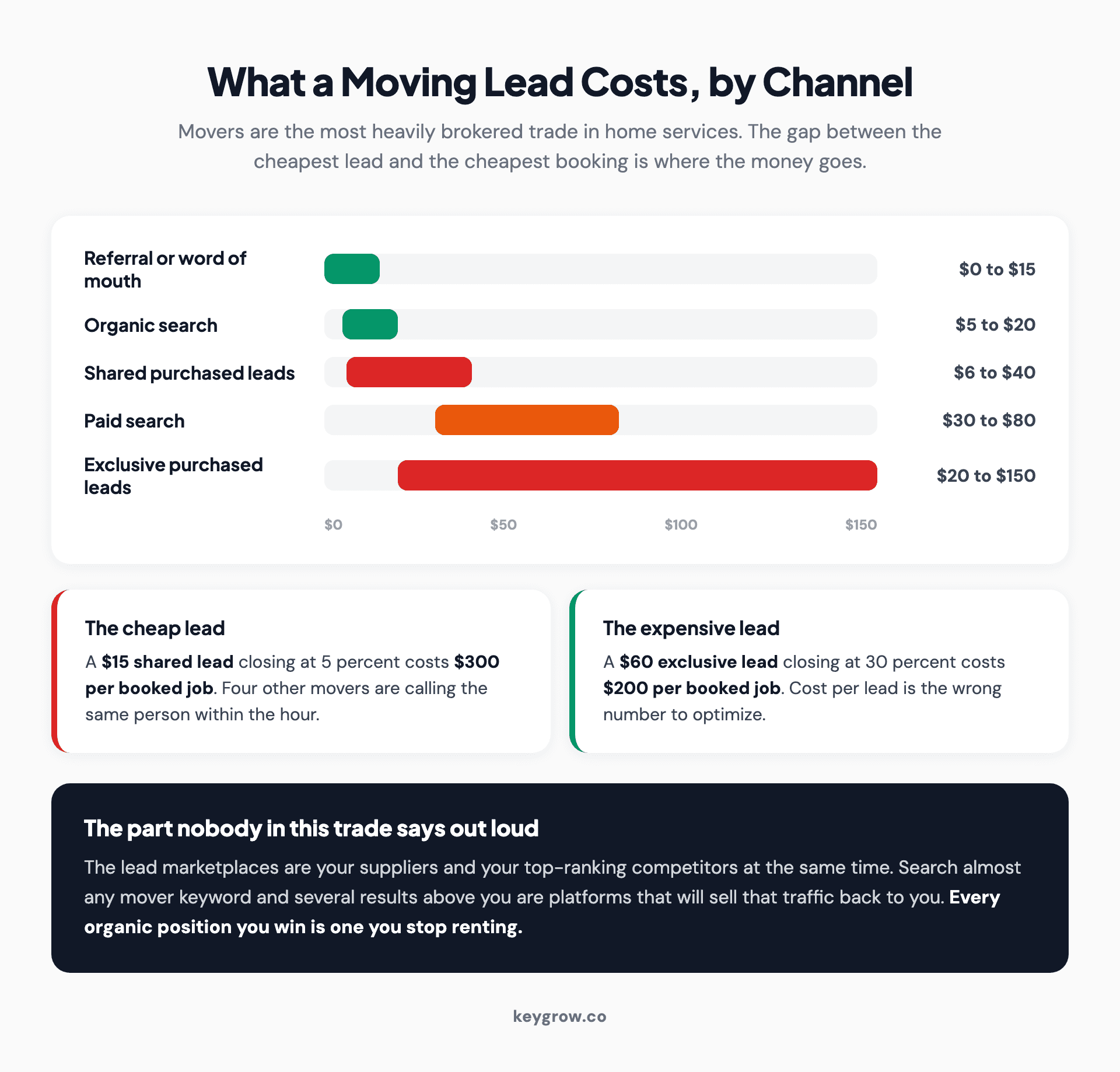
Cost per moving lead by channel, from shared and exclusive purchased leads through paid search to organic, with effective cost per booked job.
MoversTech benchmarks put shared leads at $6 to $40, exclusive leads at $20 to $100 and up to $150 in competitive metros, paid search at $30 to $80, and organic at $5 to $20. Referrals sit near zero.
Cost per lead is the wrong comparison though, and the same source makes the point better than we could. A $15 shared lead closing at 5 percent costs $300 per booked job. A $60 exclusive lead closing at 30 percent costs $200. The cheaper lead is the more expensive booking, because four other movers are calling the same person within the hour.
Organic changes the shape of that calculation rather than just the number. The person filling in your form found you, chose you, and is not simultaneously talking to three competitors who bought the same record. Close rates on inbound organic run higher for the same reason referrals do.
Here is the tension nobody in this industry says out loud. The lead marketplaces are your suppliers and your top-ranking competitors at the same time. Search almost any mover keyword and several of the results above you are platforms that will happily sell you back the traffic they just took. Every organic position you win is one you stop renting.

White moving truck parked outside a building on a residential street.
The route pages almost every mover builds backwards
This is the mistake we find on nearly every long-distance mover's site, and correcting it is the cheapest win available in the category.
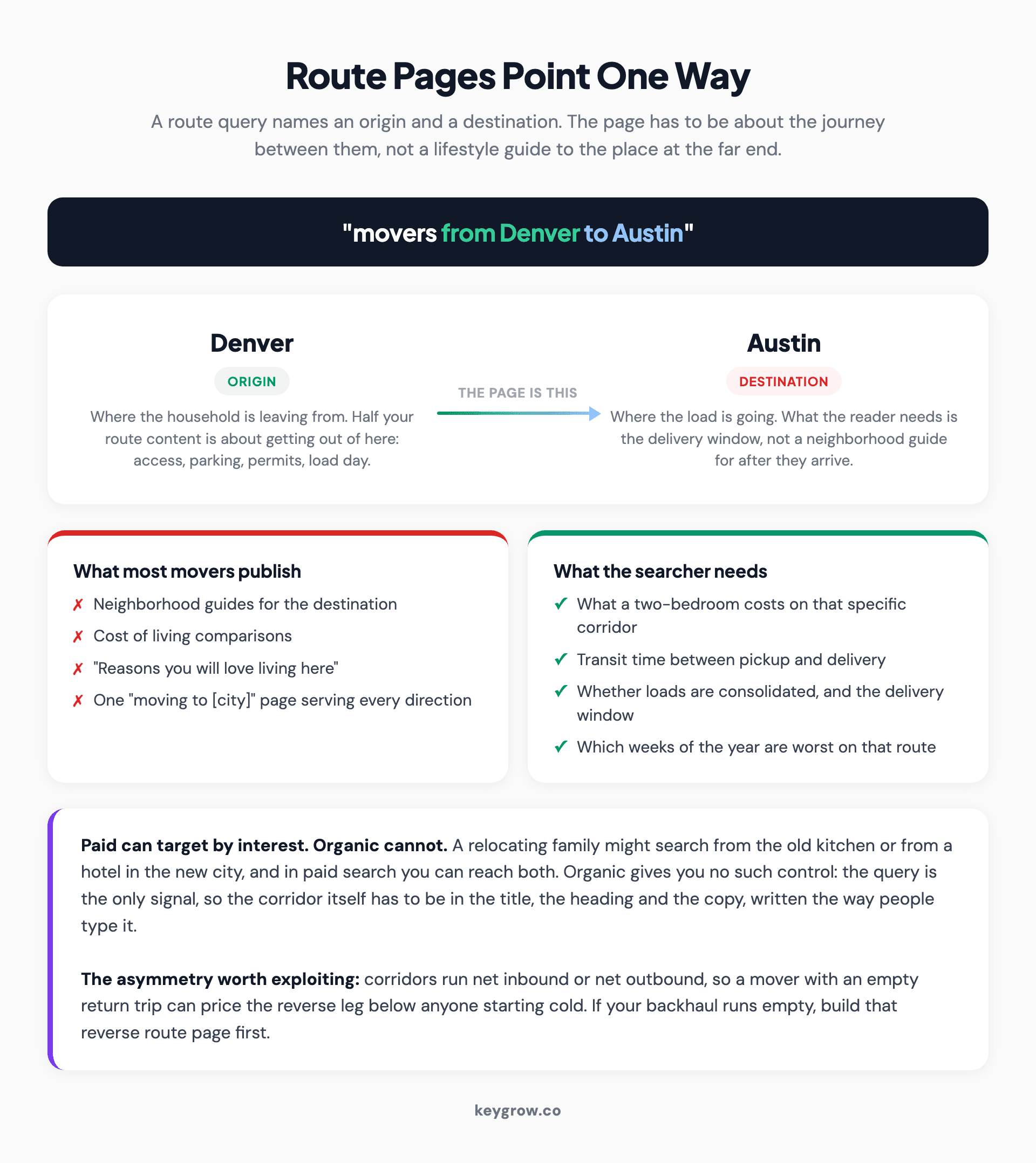
Diagram of directional route pages for movers, showing that the searcher is always in the origin city rather than the destination.
Long-distance searches are directional. People type "movers from Denver to Austin", not "movers between Denver and Austin". The phrase has an origin and a destination, and they are not interchangeable.
Most movers respond by building a page about the destination. Neighborhood guides for Austin, cost of living notes, reasons it is a lovely place to live. That content is written for somebody who has already arrived and is looking for a coffee shop.
The person running that search has not arrived. They are in the middle of a relocation, and what they want is the corridor: what the drive takes, what a two-bedroom costs on that specific route, how long between pickup and delivery, whether you consolidate loads and what that does to the delivery window, which weeks of the year are worst on that stretch. Every one of those facts is about the journey rather than either endpoint.
There is a difference here between paid and organic worth understanding, because it changes what you can rely on. In paid search you can reach the customer by presence or by interest, which matters because a family relocating might search from their old kitchen or from a hotel in the new city. We covered that setting in the Google Ads guide for movers. Organic gives you no such control. The query is the only signal you get, which means the corridor itself has to be in the page: in the title, in the heading, in the copy, written the way people type it.
There is a second layer worth understanding, which is that route demand is asymmetric. Corridors have net inbound and net outbound direction, and a mover with an empty return trip can price the reverse leg well below a competitor starting from scratch. If you know your backhaul is running empty, that reverse route is the page you should be building first, because you can win it on price and nobody else has a structural reason to fight you for it.
Build the pairs where the volume supports both. What does not work is one "moving to [city]" page expected to serve every direction at once. Route pages are as specific as the routes.
Local and long distance are two different SEO projects
They share a website and almost nothing else. Treating them as one campaign is why so many mover sites underperform on both.
| Local moves | Long distance | |
|---|---|---|
| Typical job value | Roughly $800 to $2,500 | Frequently above $5,000 |
| Search phrasing | "movers near me", "[city] moving company" | "movers from [city] to [city]" |
| Where they rank | Map pack, local organic | Organic only, no map pack |
| Planning window | One to two weeks | Thirty to sixty days |
| Page type that wins | Service and city pages | Directional route pages |
| Decision driver | Availability and price | Trust and delivery timing |
The single most consequential difference is the map pack. Local moving searches trigger it and long-distance route searches largely do not, which means your Google Business Profile carries the local business and your website carries the long-distance business. A mover chasing high-value interstate work by pouring everything into profile optimization is fixing the wrong asset.
The planning windows differ just as much. Somebody moving across town decides inside a fortnight. Somebody relocating across the country starts researching two months out, reads considerably more, and compares four or five companies properly. Long-distance content has to survive being read carefully, which is a higher bar than most mover websites currently clear.
Fix the profile before you touch the website
For local moving work, the Google Business Profile is the asset that ranks. The website supports it.
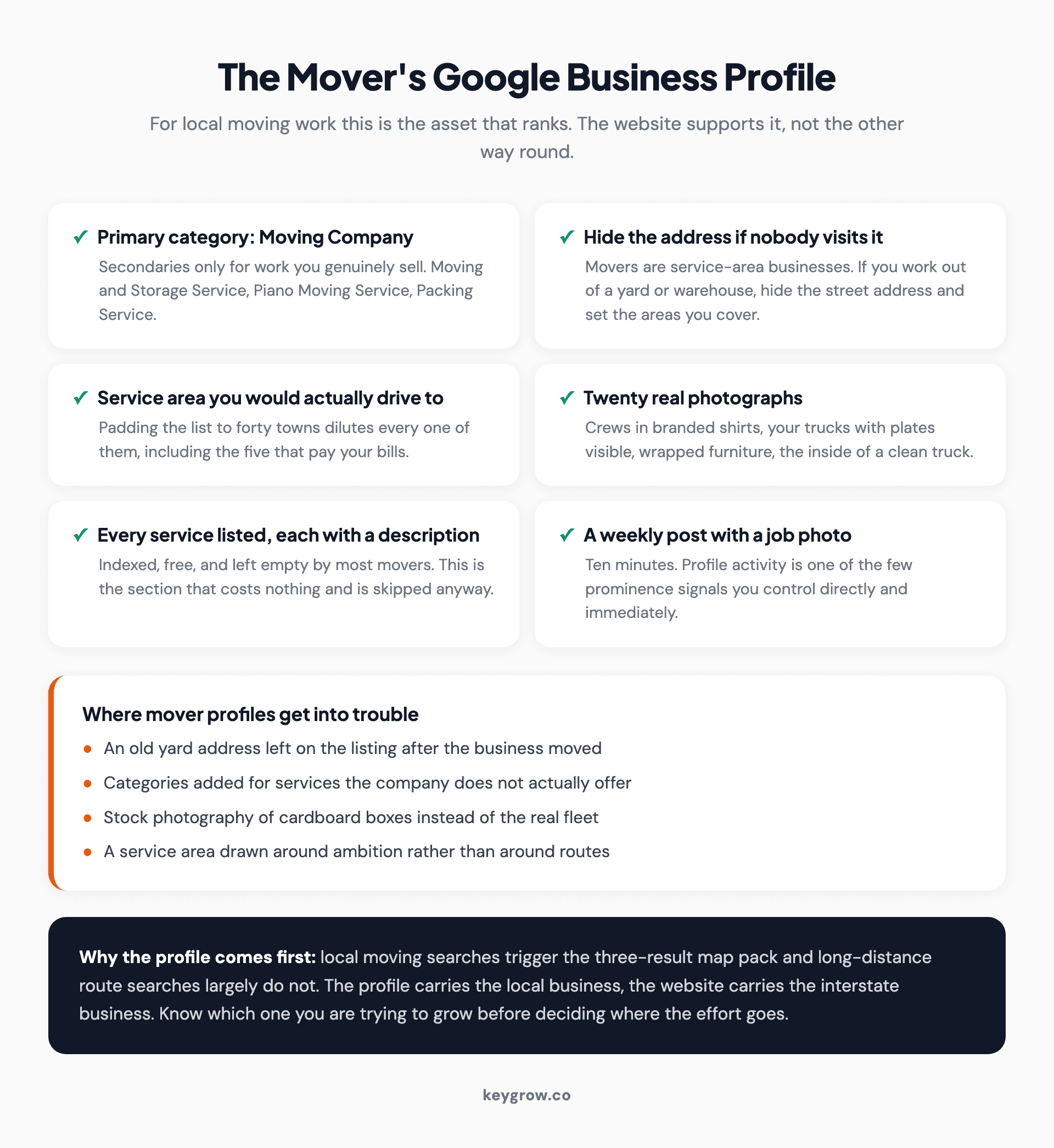
Google Business Profile setup checklist for a moving company, covering categories, service area, photos, services and posts.
Set the primary category to Moving Company, then add secondaries only for work you genuinely sell: Moving and Storage Service, Piano Moving Service, Packing Service. Every one you add that you do not actually do makes the profile less legible, not more visible.
Service area needs care in this trade. Movers are usually service-area businesses, and Google's service area guidance allows hiding the street address when you serve customers at their locations rather than yours. If you operate from a warehouse or yard nobody visits, hide the address and set the areas you cover. Padding that list out to forty towns you would only drive to on a good day dilutes every one of them.
Photographs are the part movers skip and should not. This is a category where customers are checking whether you are real. Crews in branded shirts, your actual trucks with the plates visible, a wrapped piece of furniture, the inside of a clean truck. Twenty real photographs beat a stock image of a cardboard box every time.
Fill in every service with its own description. That section is indexed, it is free, and most movers leave it empty. Post weekly with a photograph from a job you finished. It takes ten minutes and activity is one of the few signals you control directly.
Publish the things movers are told to hide
Here is where a moving company can build trust that competitors will not copy, because copying it means committing to something.
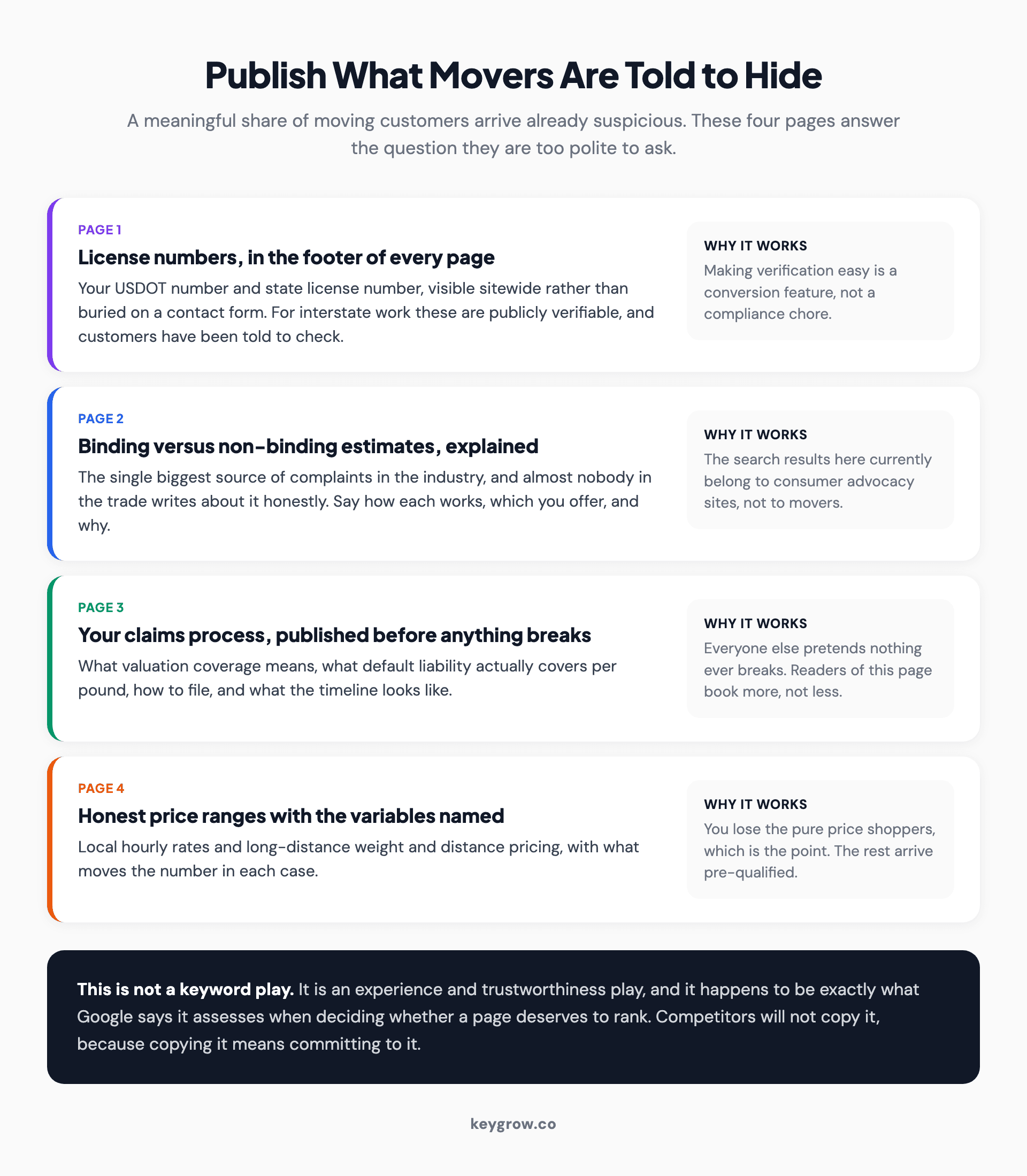
Four trust pages a moving company should publish: license numbers, binding versus non-binding estimates, the claims process, and honest price ranges.
Your USDOT number and your state license number belong in the footer of every page, not buried on a contact form. For interstate work the licensing detail is publicly verifiable, and a customer who has been warned to check it will check it. Making that easy is a conversion feature.
Explain binding against non-binding estimates in plain language, on their own page. This is the single biggest source of complaints in the industry and almost nobody in the trade writes about it honestly, which leaves the search results to consumer advocacy sites. A mover who explains how each type works, and which one they offer and why, gets both the search traffic and the credibility.
Publish your claims process before anything goes wrong. What happens if something breaks, what valuation coverage means, what the default liability actually covers per pound, how to file. Customers who read this page are more likely to book you, not less, because everyone else is pretending nothing ever breaks.
Then price. Publish real ranges with the variables explained, for both local hourly work and long-distance weight and distance pricing. You will lose some calls from people shopping purely on price, which is the point. The calls you keep are from people who already know roughly what this costs.
None of this is a keyword play. It is an experience and trustworthiness play, and it happens to be exactly what Google says it looks for when assessing whether a page deserves to rank.
The eight weeks before the move are where the content goes
Moving is one of the rare local services with a long, predictable planning window, and that window is where search demand lives.
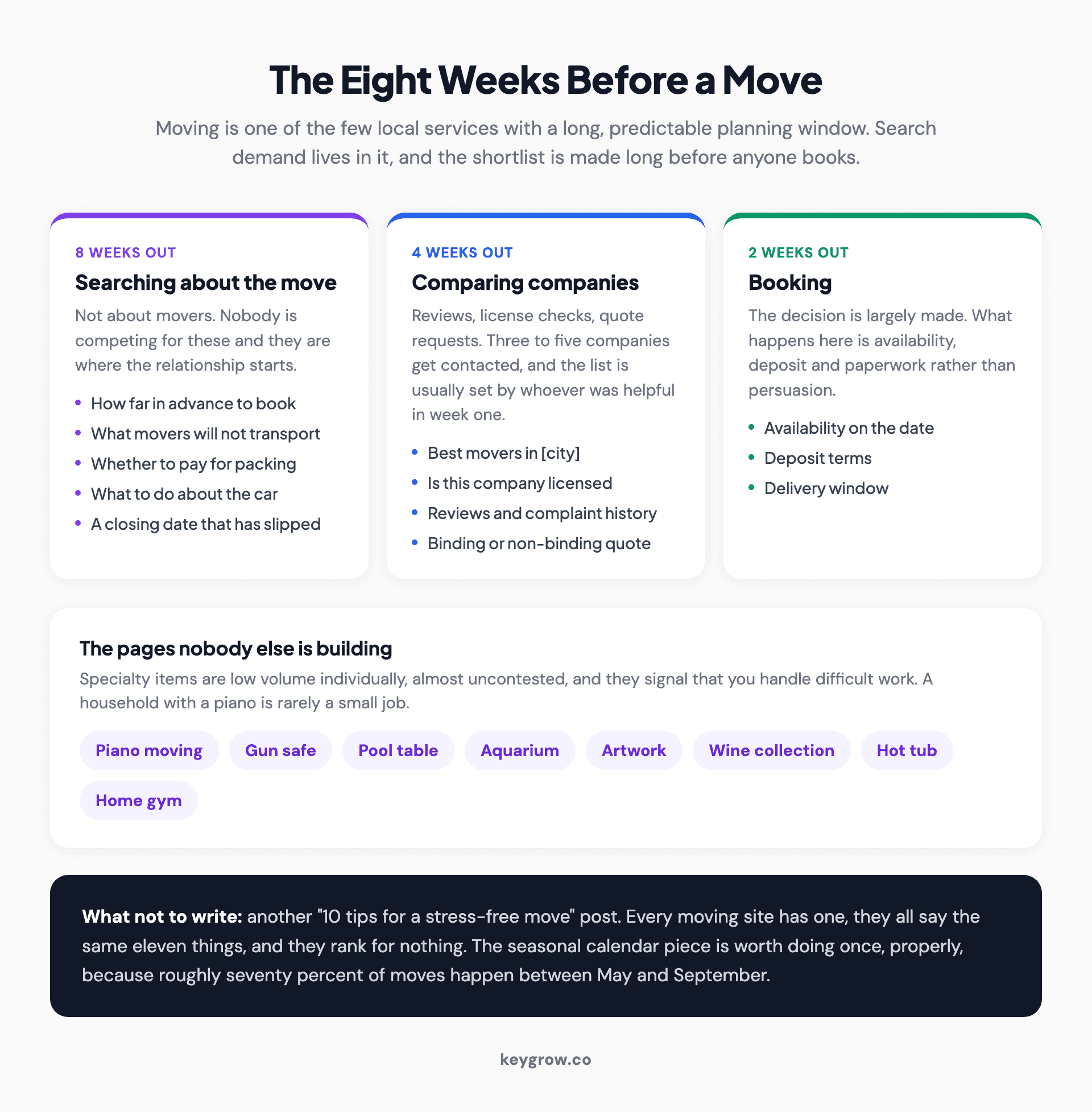
Timeline of what people search in the eight weeks before a move, from planning questions to the final decision on a mover.
Eight weeks out, people are running searches about the move itself, not about movers. How far in advance to book. What movers will not transport. Whether to pay for packing. How to move a piano, an aquarium, a gun safe, a hot tub. What to do about a car. How to handle a closing date that has slipped.
Four weeks out they start comparing companies and reading reviews. Two weeks out they book. By that point the shortlist is already made, usually by whoever was helpful during the first phase.
The specialty items deserve their own pages, and they are underserved. Piano, safe, pool table, aquarium, artwork, wine collection, hot tub. These are low volume individually, almost uncontested, and they signal that you handle difficult work. They also feed directly into higher-value bookings, because a household with a piano is rarely a small job.
What not to write: another "10 tips for a stress-free move" post. Every moving site has one, they all say the same eleven things, and they rank for nothing. The seasonal calendar piece is worth doing once, properly, because roughly seventy percent of moves happen between May and September and pricing genuinely changes with it.

Person carrying moving boxes through a living room during a household move.
Reviews in a category people expect to be scammed in
Reviews matter everywhere. In moving they are close to decisive, because the customer has been told to expect problems.
Ask on delivery day, in person, while the crew is still there and the relief of a job finished is fresh. A week later the customer is unpacking and has forgotten your name. Crews that ask on site collect several times what an automated email collects, and the difference is not close.
Recency does more work than volume here. A profile with sixty reviews where the most recent is from last week reads as an operating business. Two hundred reviews that stopped eighteen months ago reads as a company that either got worse or stopped existing, and customers in this category assume the worse option.
Respond to the bad ones properly. In moving, negative reviews are usually about damage or a delivery window, and the response is being read by the next twenty prospects rather than by the reviewer. A reply that acknowledges the problem, states what the claims process is, and does not argue about the details will do more for you than the review costs.
One thing to avoid entirely: buying reviews or having office staff post them. The moving industry is watched closely for this, review platforms filter aggressively, and a profile that gets penalized takes the local rankings with it.
Which links and citations actually exist for a moving company
The link sources in this trade are unglamorous and mostly local, which is good news because the national competition cannot get them either.
Real estate agents are the obvious one and the most underused. Agents publish moving resource pages for clients, and an agent who trusts your crews will link to you. Storage facilities, apartment complexes, property managers, and relocation departments at large local employers all maintain vendor lists. Get on them, and check whether the listing links back.
Then the ordinary ones: chamber of commerce, local sponsorships, industry association membership pages, and supplier or franchise directories if you belong to a network. Charity work involving trucks is a genuine link magnet in this trade, and it is also the kind of thing movers already do.
Citations need auditing more often in moving than in most trades, because these businesses relocate their own yards. An old address on thirty directory listings is the most common technical problem we find on mover websites, and it undermines exactly the local signal you are trying to build.
Structured data belongs on the same to-do list. LocalBusiness markup carrying your service area, hours and review data stops search engines and AI assistants from having to infer any of it, and Google's structured data reference sets out exactly which fields count.
What does moving company SEO cost, and how long does it take?
Retainers in this category typically fall between $500 and $5,000 a month. A single-metro mover with one truck fleet sits near the bottom half of that; an operator running interstate corridors and several branch cities sits at the top, because route research is genuinely more work than city pages.
The timeline is the part that gets misrepresented. Profile improvements can move local pack position inside a month or two. Service and route pages need a quarter or two before they hold anything. Dense metros take longer again. The compounding that makes the whole exercise worthwhile tends to land somewhere in months six to twelve.
| Period | What is happening | What you will see |
|---|---|---|
| Months 1 to 2 | Profile rebuild, technical fixes, page structure | Very little, occasional pack movement |
| Months 3 to 4 | Service, city and route pages indexed | First organic calls and form fills |
| Months 5 to 8 | Positions establish, reviews accumulate | Steady booking volume |
| Months 9 to 12 | Authority compounds on route terms | Cost per booking falls below purchased leads |

Twelve-month moving SEO calendar showing peak season from May to September and when the ranking work has to be done to harvest it.
There is a seasonal complication worth planning around. Peak season is May through September, and rankings established in February are the ones that harvest it. Starting SEO in June means paying through the busy months and collecting in the following spring.
On terms, we run month to month with no lock-in. That is not generosity, it is what happens when an agency is confident the results will keep the client without a contract doing it.
When a moving company should skip SEO
We turn away businesses we cannot help, and here is who should not be buying this yet.
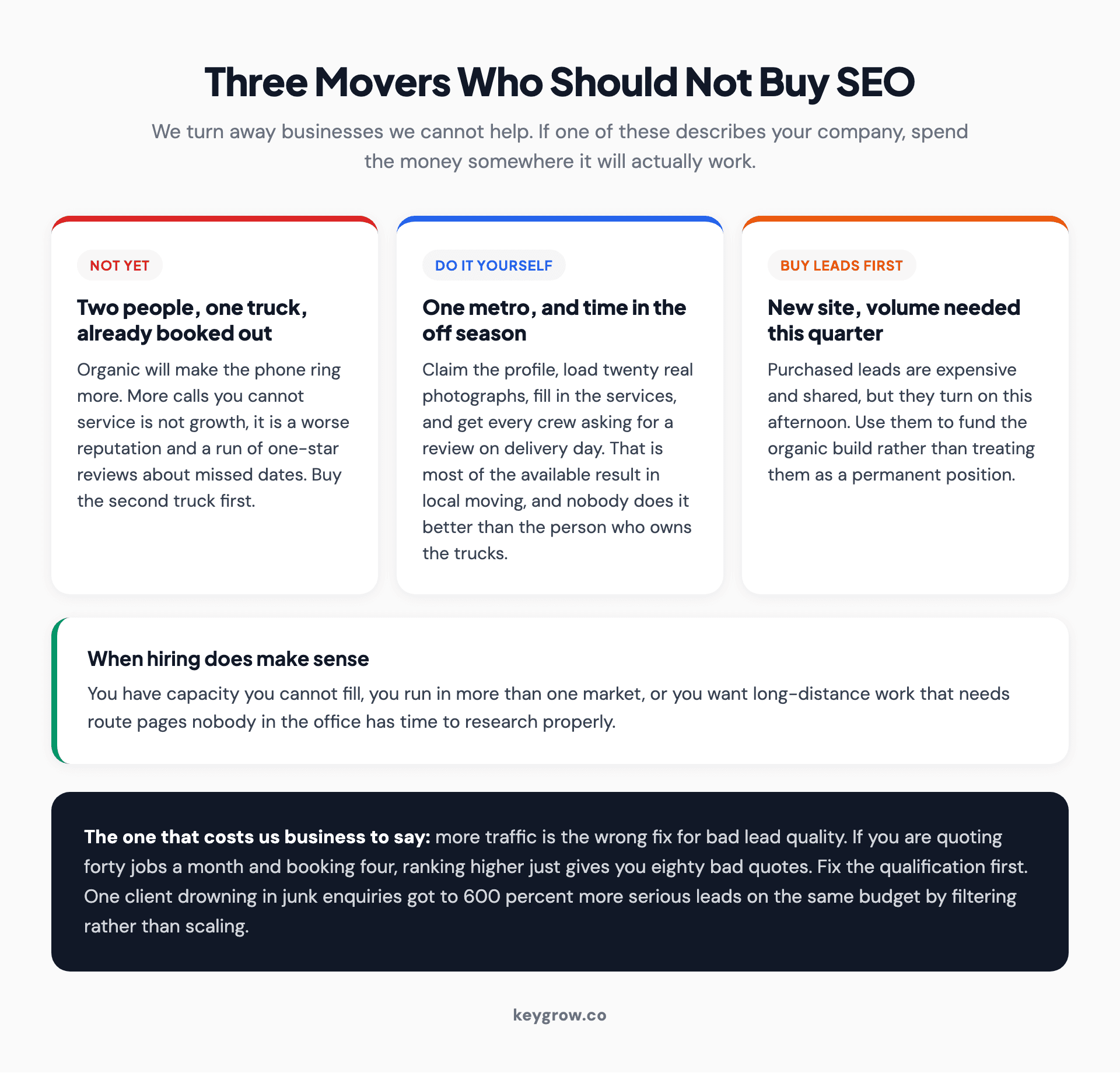
Three situations where a moving company should not buy SEO yet: no spare capacity, one metro with time to do it yourself, and a brand new site needing volume now.
Skip it if you are a two-person operation with one truck and you are already booked out. Organic will make the phone ring more, and more calls you cannot service is not growth, it is a worse reputation. Buy the second truck first.
Do it yourself if you run in one metro and have time in the off season. Claim the profile, load twenty real photographs, fill in the services, and get every crew asking for a review on delivery day. That sequence is most of the available result in local moving, it costs nothing, and no agency can do it better than the person who owns the trucks.
Buy leads instead, temporarily, if you need volume this quarter and your site is new. Purchased leads are expensive and shared, but they turn on immediately. Use them to fund the organic build rather than as a permanent position.

Stack of packed cardboard boxes sealed with tape, ready for a scheduled move.
And here is the one worth saying plainly, because it is our strongest opinion on this topic: more traffic is the wrong fix for bad lead quality. A cash home buyer client came to us drowning in junk enquiries, and the answer was not a bigger campaign. It was filtering. Tighter targeting and qualifying language in the copy itself took serious leads up 600 percent between December and January on the same budget. If your problem is that you are quoting forty jobs a month and booking four, ranking higher will simply give you eighty bad quotes. Fix the qualification first.
Hire when you have capacity you cannot fill, more than one market, or long-distance ambitions that need route pages nobody in the office has time to research. The same fundamentals we apply across SEO for home services apply here, and if you want to see the pattern in another trade, the SEO for roofers breakdown runs the same logic against a very different seasonality.
FAQs
What is SEO for moving companies?
SEO for moving companies is the practice of ranking a mover's website and Google Business Profile for the searches people run when planning a move. It covers profile optimization for local pack visibility, service and city pages, directional route pages for long-distance work, review generation, and content answering the questions people ask in the weeks before they book.
How long does SEO take to work for a moving company?
Profile changes can affect local pack position within one to two months. Website pages typically take three to six months to establish, and meaningful compounding appears between month six and month twelve. Because peak moving season runs May through September, work started in winter is what harvests the following summer.
Is SEO better than buying moving leads?
They solve different problems. Purchased leads produce calls immediately but are frequently shared with several competitors, which is why a cheap lead can produce an expensive booking. Organic leads cost less over time and close at higher rates because the customer chose you. The usual arrangement is both at once, with bought leads filling the calendar until the organic pages start carrying their share.
What keywords should a moving company target?
Start with the city and service combinations you actually serve, then add directional route phrases for long-distance work and specialty item pages for pianos, safes, pool tables and similar. Volume is a poor guide on its own in this trade, because a low-volume specialty search often precedes a much larger job than a generic local query.
Should movers build a separate page for every city they serve?
Build them only where you actually run jobs and can say something true that would be false about the next city over. Parking restrictions, walk-up buildings, elevator booking rules, permit requirements and housing stock all qualify. Swapping a place name into the same paragraphs produces a doorway page, which is a liability rather than an asset.
Do reviews affect a moving company's search rankings?
Yes, and the effect is larger here than in most trades because customers arrive expecting problems. How many reviews you have, how recent the newest one is, and whether you reply all feed local pack position. Asking on delivery day while the crew is still on site collects several times what an emailed request does a week later.
What should a moving company put on its website to build trust?
Your USDOT and state license numbers, a plain explanation of binding versus non-binding estimates, your damage claims process and valuation coverage options, real photographs of your crews and trucks, and honest price ranges. Movers face more customer skepticism than most trades, and pages that address it directly convert better than pages that avoid it.
Can a small moving company compete with national brands in search?
Yes, in local and regional results, because national operators run generic pages with no local specificity. A single-metro mover with a well-built profile, genuine local content, and recent reviews will consistently outrank a national listing for city searches. Competing nationally on broad terms is a different question, and usually not worth attempting.
The three pages that matter most
If a mover only ever builds three things properly, these are the three.
The Google Business Profile, completed to the last field, with real photographs and a review arriving most weeks. For local moving work this outranks everything else you could spend the time on.
A pricing and estimates page that explains binding against non-binding, says what drives the number, and gives honest ranges. It answers the question every visitor has and screens the calls you did not want.
One properly researched route page for your strongest long-distance corridor, written for the person leaving rather than the person arriving. Get that one right and the pattern is repeatable across every corridor you run.
Everything else in this post is worth doing. Those three are worth doing first. If you would rather hand the whole thing over, our SEO team builds this out for local service businesses, and we will tell you honestly if you are in the buy-a-second-truck-first category instead.