


It is the third week of July. Your crews are booked solid through the middle of next month, the phone is still ringing, and your Google Ads account is happily spending its full budget buying more leads you cannot serve.
That is the part of Google Ads for moving companies that no guide deals with. A moving company does not sell leads. It sells truck-days, and it only has so many of them. Demand swings hard between summer and winter while capacity barely moves at all, so the account has to do two opposite jobs at two times of year: filter for the best jobs when you are full, and fill the calendar when you are not.
Get that inversion right and the rest of the account is ordinary work. Get it wrong and you will spend your busiest months paying for calls you turn down, then go quiet in February when a click is cheap and a crew is idle.
Your constraint is trucks, not clicks
Work out how many jobs you can physically do in a week before you set a budget. Once you are at capacity, extra leads have negative value: they cost money and they burn office time.
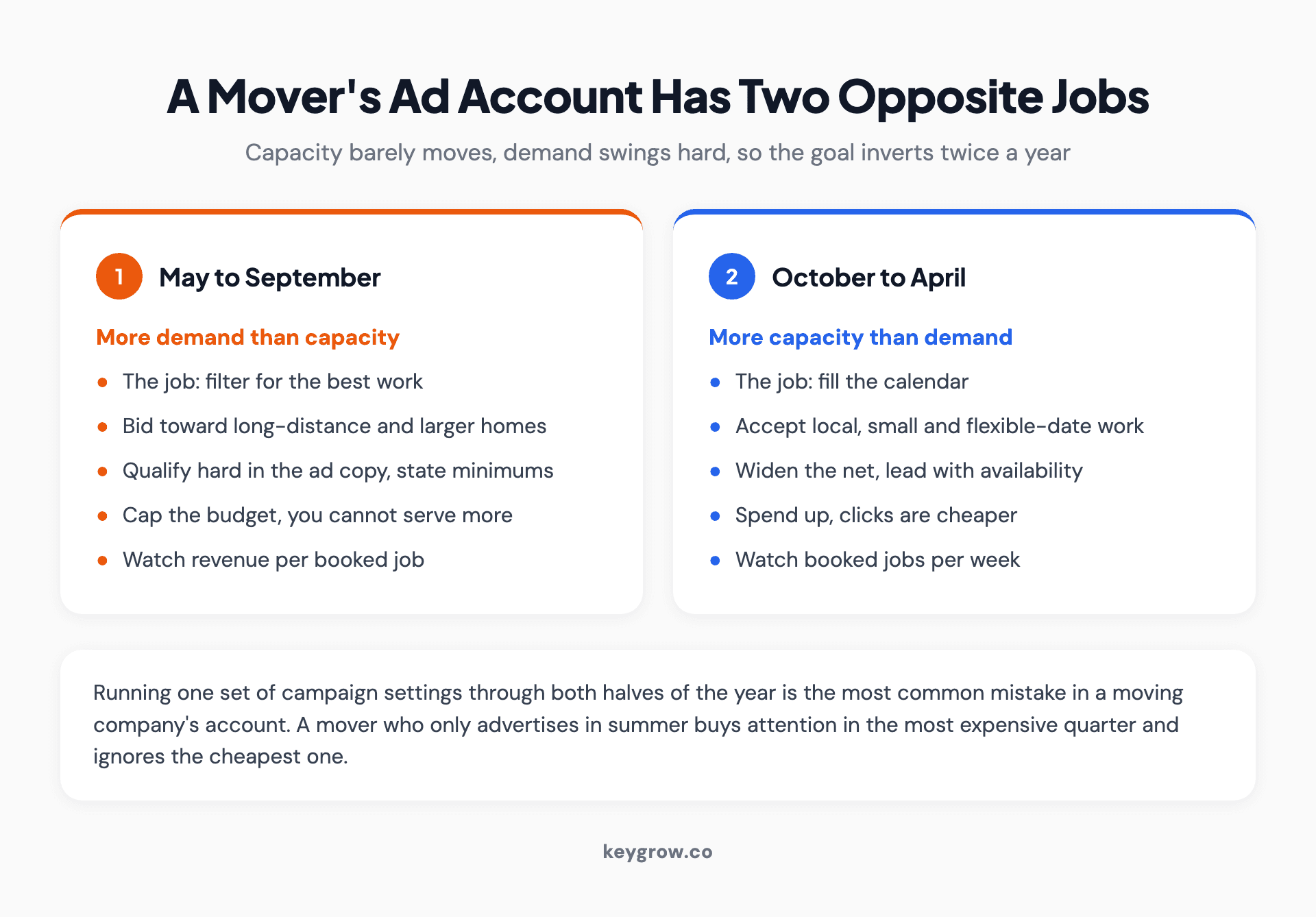
Two-panel comparison of a moving company's ad account goals: filter for the best jobs in peak season from May to September, and fill the calendar in the off season from October to April.
This is the difference between moving and most trades a PPC guide is written for. An accountant can take on another return. A software company can take another signup. A moving company with three trucks and two crews has a hard ceiling, and once you hit it every additional lead costs you a click fee plus fifteen minutes of someone's day to say no.
So the metric that should sit at the top of your reporting is not leads and not cost per lead. It is cost per booked job, measured against the revenue of the jobs you actually ran.
That reframe changes decisions immediately. A campaign producing 40 leads at $50 each looks better than one producing 15 leads at $90 each, right up until you notice the first campaign booked four small local jobs and the second booked six long-distance ones.
If your reports lead with clicks and impressions, you have no way to see that. Ask your agency for cost per booked job or work it out yourself with a Google Ads ROI calculator.
The account has two jobs, and they are opposites
Peak season is a filtering problem. Off season is a volume problem. Running the same campaign settings through both is the single most common mistake in a mover's account.
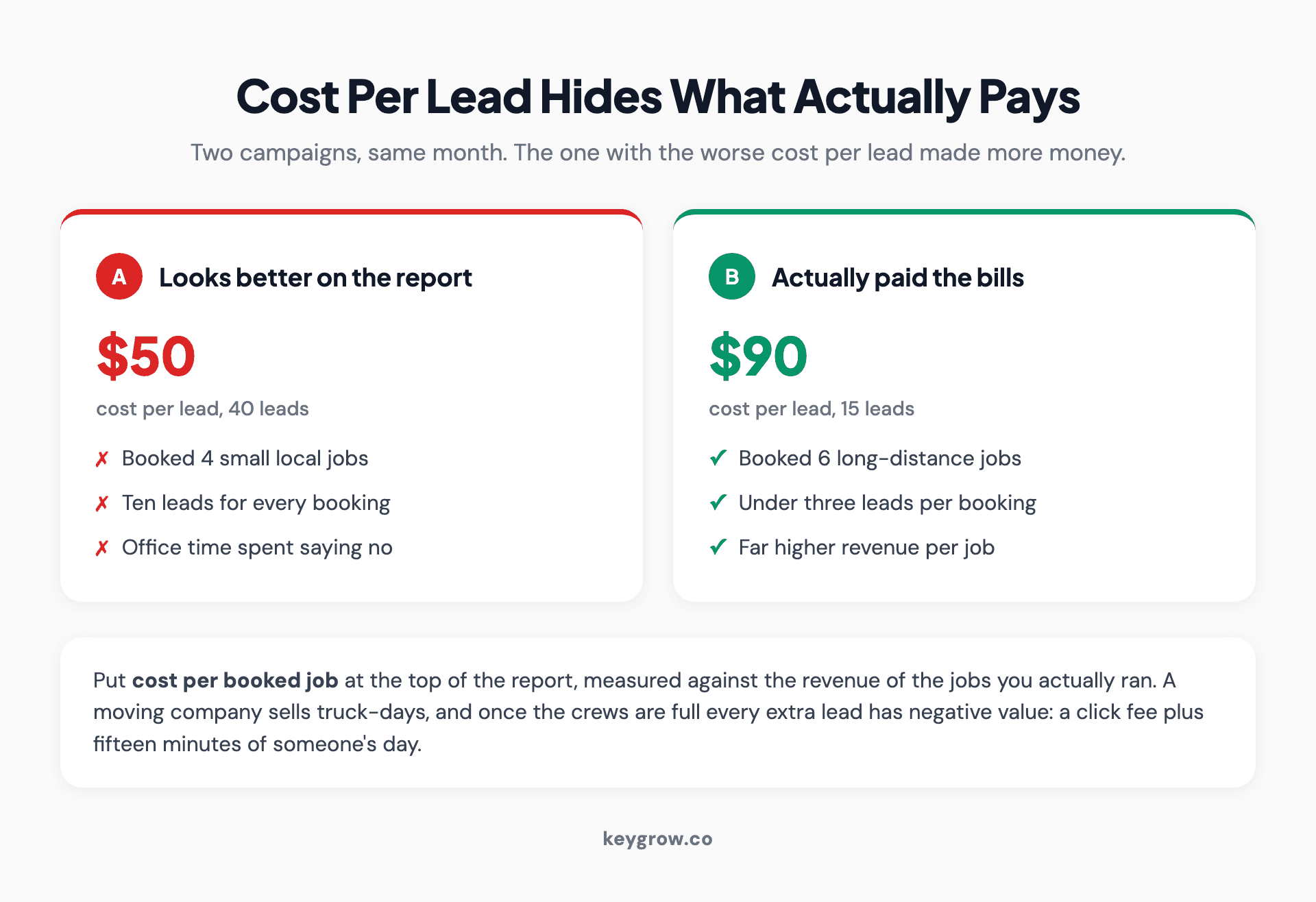
Comparison of two moving campaigns showing that the one with a $90 cost per lead booked six long-distance jobs while the $50 cost per lead campaign booked only four small local jobs.
Peak moving season runs roughly May through September. In moveBuddha's peak season analysis, most US moves fall inside that window, and peak rates run around 20 to 30 percent above off-season pricing.
| Peak season (May to September) | Off season (October to April) | |
|---|---|---|
| The problem | More demand than capacity | More capacity than demand |
| Account's job | Filter for the best jobs | Fill the calendar |
| Bid toward | Long-distance, full-service, large homes | Local, small, flexible-date jobs |
| Ad copy | Qualify hard, state minimums | Widen, lead with availability |
| Budget | Cap it, you cannot serve more anyway | Spend up, clicks are cheaper |
| Best metric | Revenue per booked job | Booked jobs per week |
The off-season half is where most movers leave money. Competition thins out, cost per click drops, and the jobs are still there, just smaller and less urgent. A mover who only advertises in summer is buying attention in the most expensive quarter of the year and ignoring the cheapest one.
None of this needs clever bidding tooling. It needs different budgets, different ad copy and a different definition of a good lead in each half of the year.
Local and long-distance are two businesses sharing one account
Separate them into different campaigns on day one. They have different job values, different sales cycles, different competitors and different geography, and a shared budget will always drift to the cheaper one.
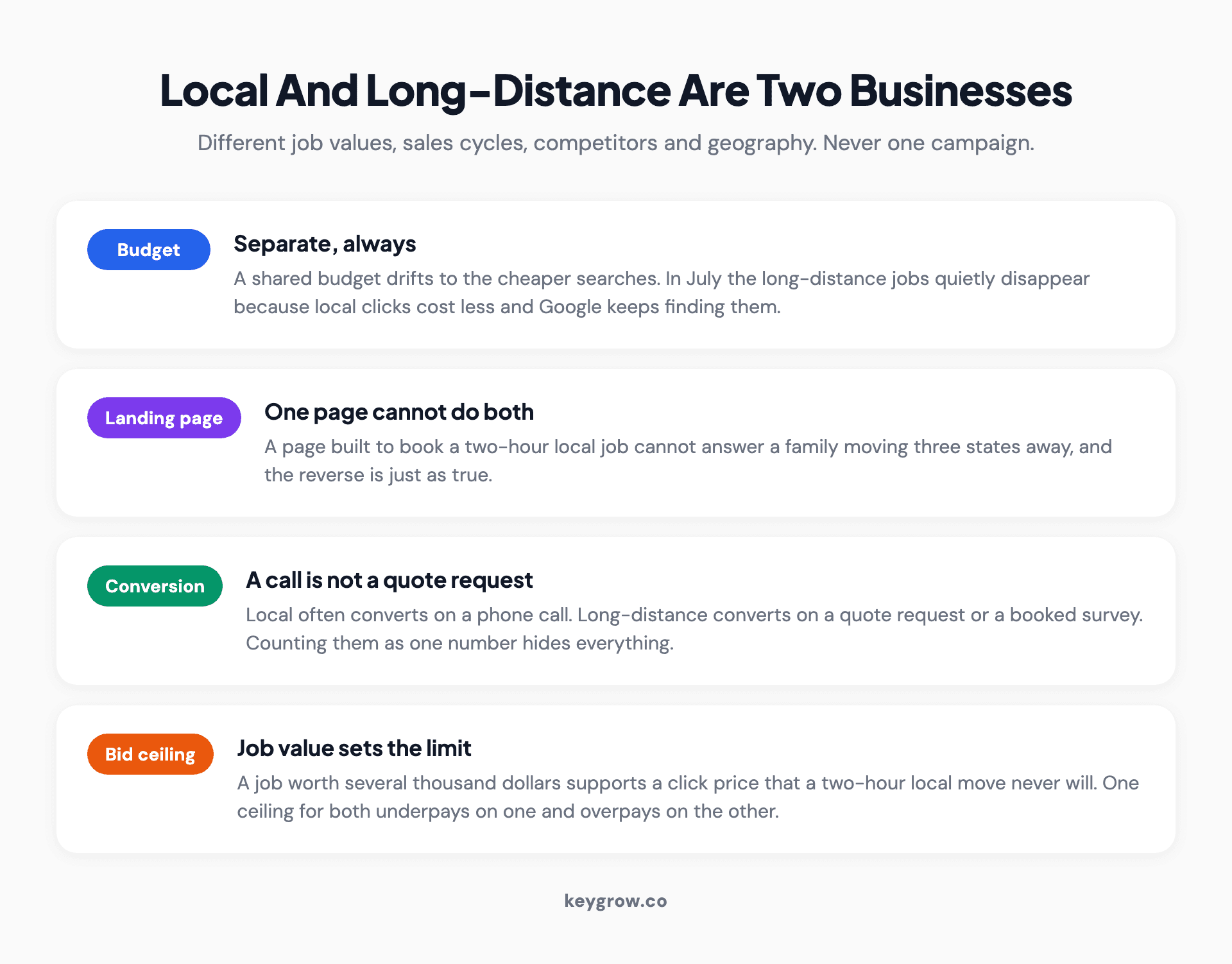
Four stacked rows explaining why local and long-distance moving campaigns need separate budgets, landing pages, conversion actions and bid ceilings.
A local move is often booked within days, priced hourly, and won on availability and price. A long-distance move is researched for weeks, priced by weight and distance, involves a written estimate, and is worth several times more. Those are not two keyword groups. They are two businesses.
What that means practically:
- Different budgets. The long-distance campaign should not compete with local searches for the same money, especially in July.
- Different landing pages. A page built to book a two-hour local job cannot answer a family moving three states away.
- Different conversion actions. Local can convert on a call. Long-distance usually converts on a quote request or a survey booking, and treating those as one number hides everything.
- Different bid ceilings. A job worth several thousand dollars supports a click price a local job never will.
Most accounts I see running poorly for movers have one campaign called something like "Moving" holding both, and the long-distance jobs quietly disappear because the local searches are cheaper and Google keeps finding them.
Where movers get location targeting exactly backwards
For long-distance work, the standard advice to target only people physically inside your service area is wrong. The customer is frequently sitting in the city they are moving to, not the one they are moving from.
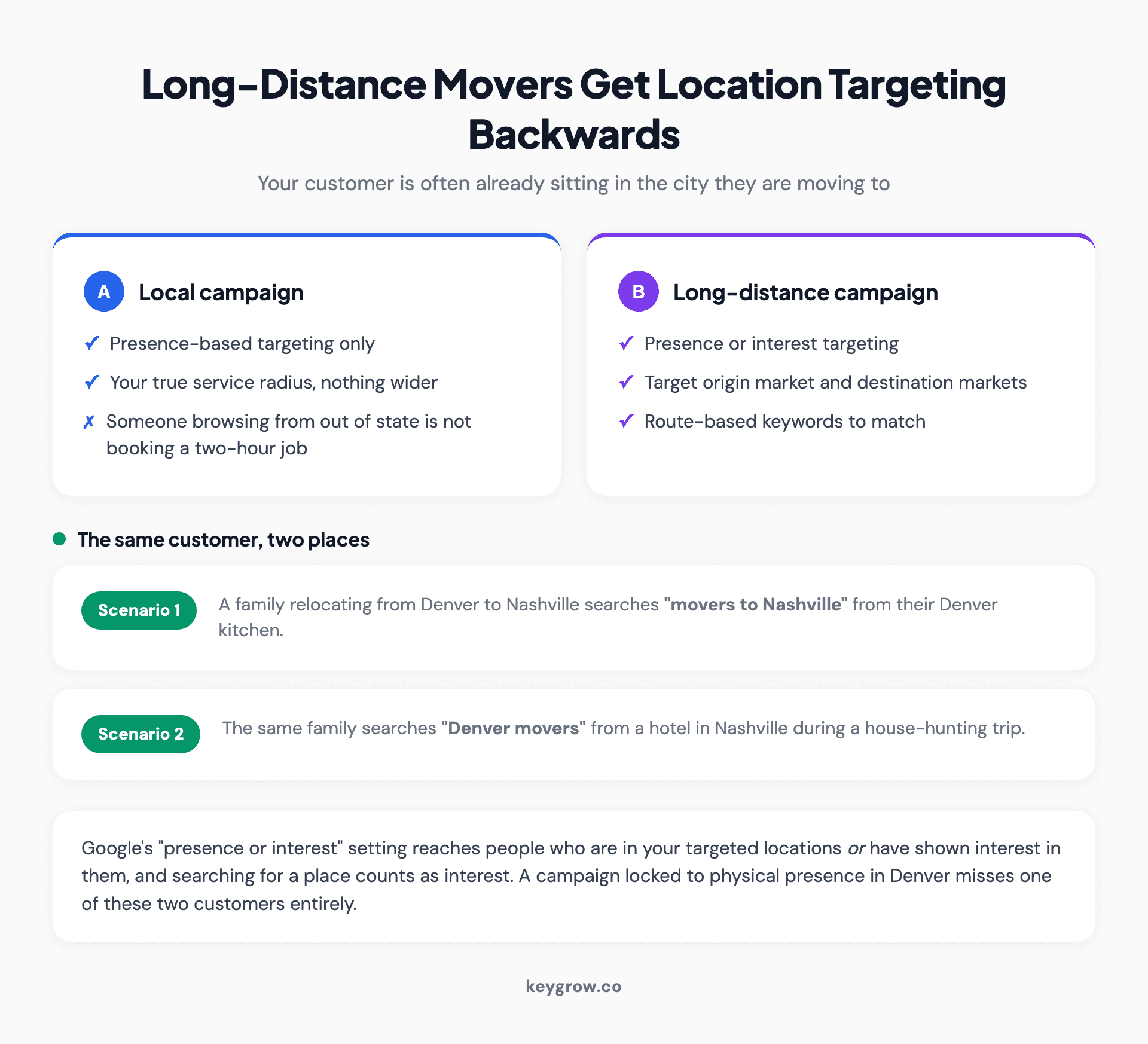
Diagram contrasting presence-based targeting for a local moving campaign against presence or interest targeting for long-distance, with two scenarios showing the same customer searching from two different cities.
This one is worth slowing down for, because it is a setting most accounts never look at.
Google's location targeting offers a "Presence or Interest" option that reaches people who are in your targeted locations or who have shown interest in them. Google's own example is someone searching for hotels in Madrid while sitting somewhere else entirely. Searching for a place counts as interest in it.
Now think about who is actually searching for a long-distance mover. A family relocating from Denver to Nashville might search "movers to Nashville" from their Denver kitchen, or search "Denver movers" from a hotel in Nashville during a house-hunting trip. Both are your customer. A campaign locked to physical presence in Denver will miss one of them.
So the settings split by campaign:
- Local campaign: presence-based targeting inside your true service radius. Someone browsing from out of state is not booking a two-hour local job.
- Long-distance campaign: presence or interest, targeting both your origin market and the destination markets you regularly serve, with route-based keywords to match.
Google also states plainly that location targeting uses a range of signals and that it does not promise complete accuracy, which is another reason to watch your location reports rather than trusting the setting and walking away. Our guide to PPC audience targeting covers how to read those reports.
Moving services is a Local Services Ads category
"Moving services" appears in Google's eligible categories for Local Services Ads. Two of the three highest-ranking guides on this topic do not mention it at all.

A moving truck on an open road between cities, the long-distance half of a mover's business.
That matters because the format appears above the paid search block, comes with the Google Verified badge, and is billed per lead rather than per click. For an industry where the customer's first worry is whether you are a real company, a verification badge from Google is doing genuine work.
It is not automatically the better channel. Lead prices in competitive metros are not cheap, you have less control over what a lead is, and verification takes time, so this is not something to start in June for the summer. But it belongs in the plan, and a mover comparing paid search against buying leads from third-party lead sellers should be comparing all three, not two.
Our write-up on Local Services Ads goes through the lead credit process and the channel's weak points.
One honest note on lead sellers while we are here. Some of the most detailed guides on moving company PPC are published by companies whose main business is selling moving leads. The advice is often fine. Just read the comparison section knowing who wrote it.
A lead is not a booking, and the gap is where the money goes
A mover cannot quote without knowing what is being moved. That gap between the first call and a price is where most moving leads die, and it is not a marketing problem, it is a response-time problem.
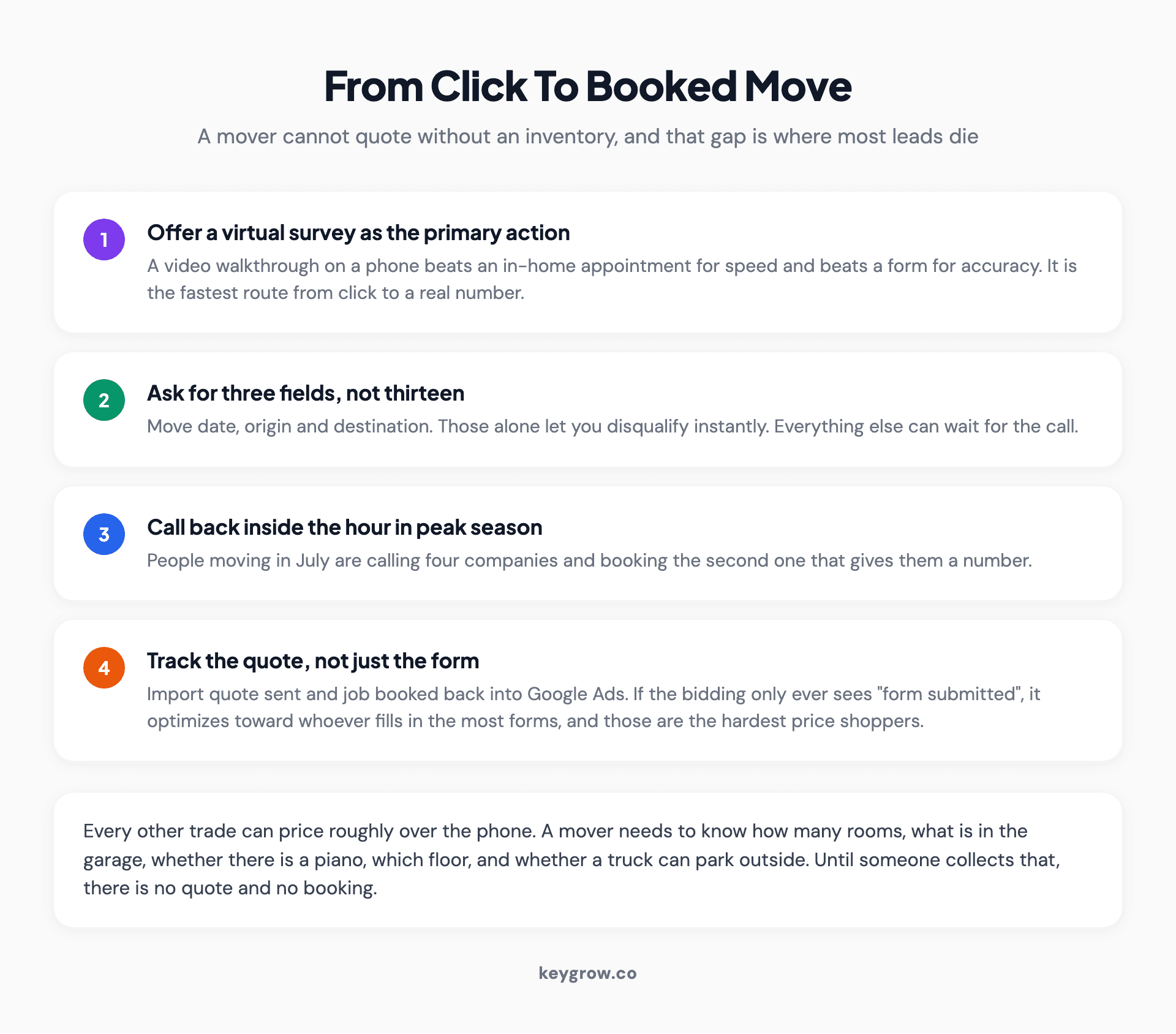
Four-step process from click to booked move: offer a virtual survey, ask for three form fields, call back within the hour in peak season, and track quotes rather than form fills.
Every other trade can price roughly over the phone. A mover needs an inventory: how many rooms, what is in the garage, is there a piano, what floor, is there an elevator, can a truck park outside. Until someone collects that, there is no quote, and until there is a quote, there is no booking.
Which means the thing that decides your conversion rate is how fast and how easily you get from the click to the inventory. Practical version:
- Offer a virtual survey as the primary action. A video walkthrough on a phone beats an in-home appointment for speed and beats a form for accuracy.
- Ask for the move date and origin plus destination in the form, and little else. Those three fields let you disqualify instantly. Everything else can wait for the call.
- Call back inside the hour during peak season. People moving in July are calling four companies and booking the second one that gives them a number.
- Track the quote, not just the form. Your conversion actions should include quote sent and job booked, imported back into Google Ads, so the bidding learns which clicks turn into work rather than which turn into forms.
That last point is where most mover accounts are flying blind. If Google only ever sees "form submitted", it will optimize toward whoever fills in forms, and the people who fill in the most forms are the ones shopping hardest on price.
Keywords, and the groups that quietly drain the budget
Bid by move type and route, not by the word "movers". The generic terms are the most expensive and the least qualified in the whole category.
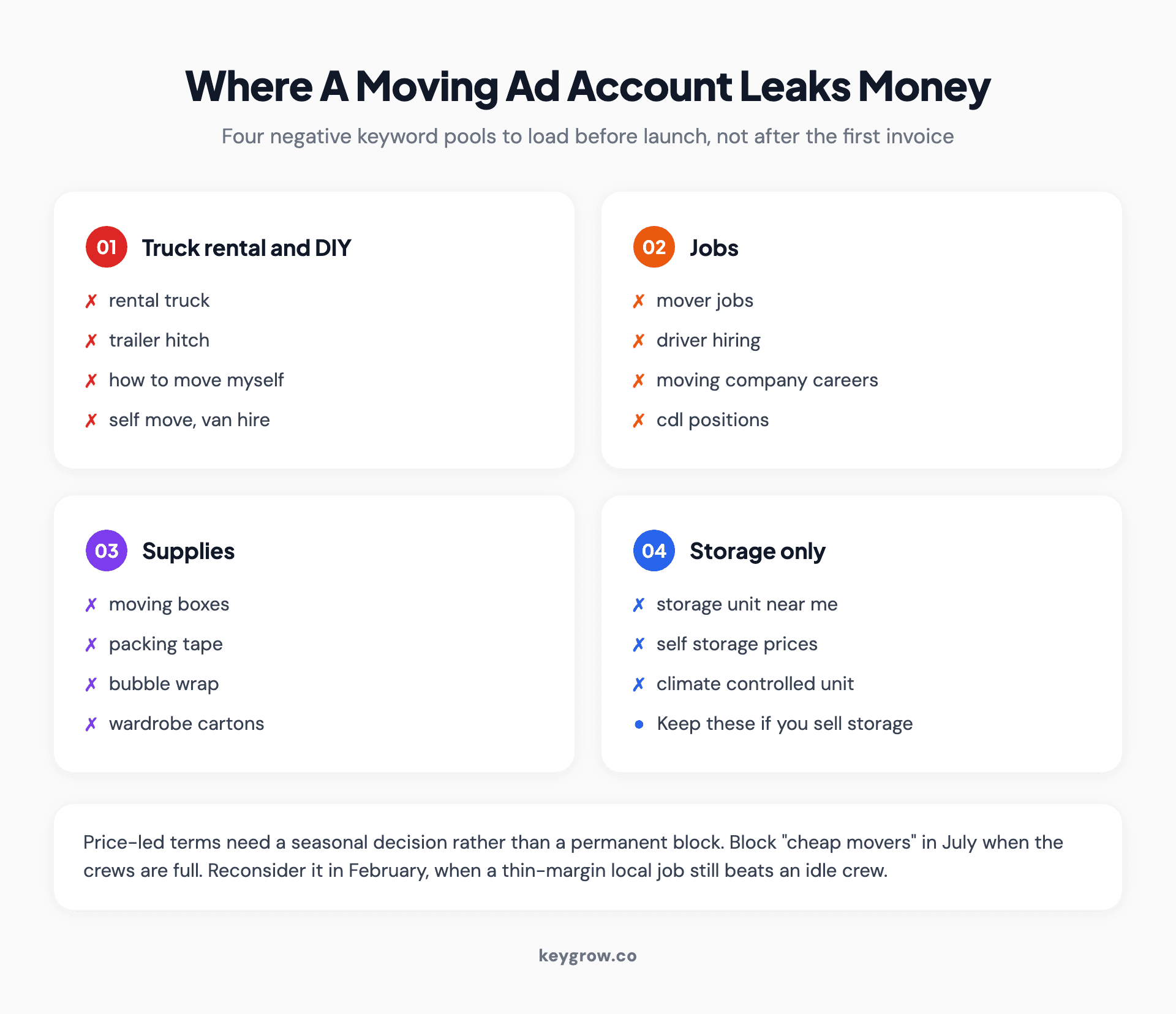
Four cards of negative keyword pools that drain a moving company's ad budget: truck rental and DIY, jobs, packing supplies, and storage-only searches.
| Keyword group | Example | Verdict |
|---|---|---|
| Route based | movers denver to nashville, long distance movers to texas | Highest value, lowest competition |
| Service qualified | full service movers, packing and moving service, piano movers | Strong, pre-qualified by need |
| Property qualified | 3 bedroom house movers, apartment movers, office relocation | Strong, signals job size |
| Urgency | last minute movers, same day movers | Good in off season, expensive in July |
| Generic local | movers near me, moving company [city] | Necessary, cap it, watch the terms report |
| Price led | cheap movers, cheapest moving company | Usually a loss, especially at peak |
On the negative side, a moving account leaks into four pools more reliably than any other trade:
- Truck rental and DIY. Anyone searching for a rental truck, a trailer hitch, or how to move themselves is not hiring you.
- Jobs. "Mover jobs", "driver hiring", "moving company careers".
- Supplies. Boxes, packing tape, bubble wrap, wardrobe cartons.
- Storage only. Unless you sell storage, someone looking for a unit is not a moving job.
Add all four before launch. Then read the search terms report weekly for the first month, because this category throws up more genuinely strange queries than most. If you want the match-type detail, we wrote it up in negative keywords in Google Ads.
And a word on price-led terms. It is tempting to block "cheap movers" outright. In February, with a half-empty schedule, a cheap local job at a thin margin is still better than an idle crew. Block it in July. Reconsider it in winter. Very few settings in a mover's account should stay the same all year.
What the landing page has to prove
Your buyer has read the horror stories. The page is not competing on service quality, it is competing against the fear of a truck holding their belongings hostage.
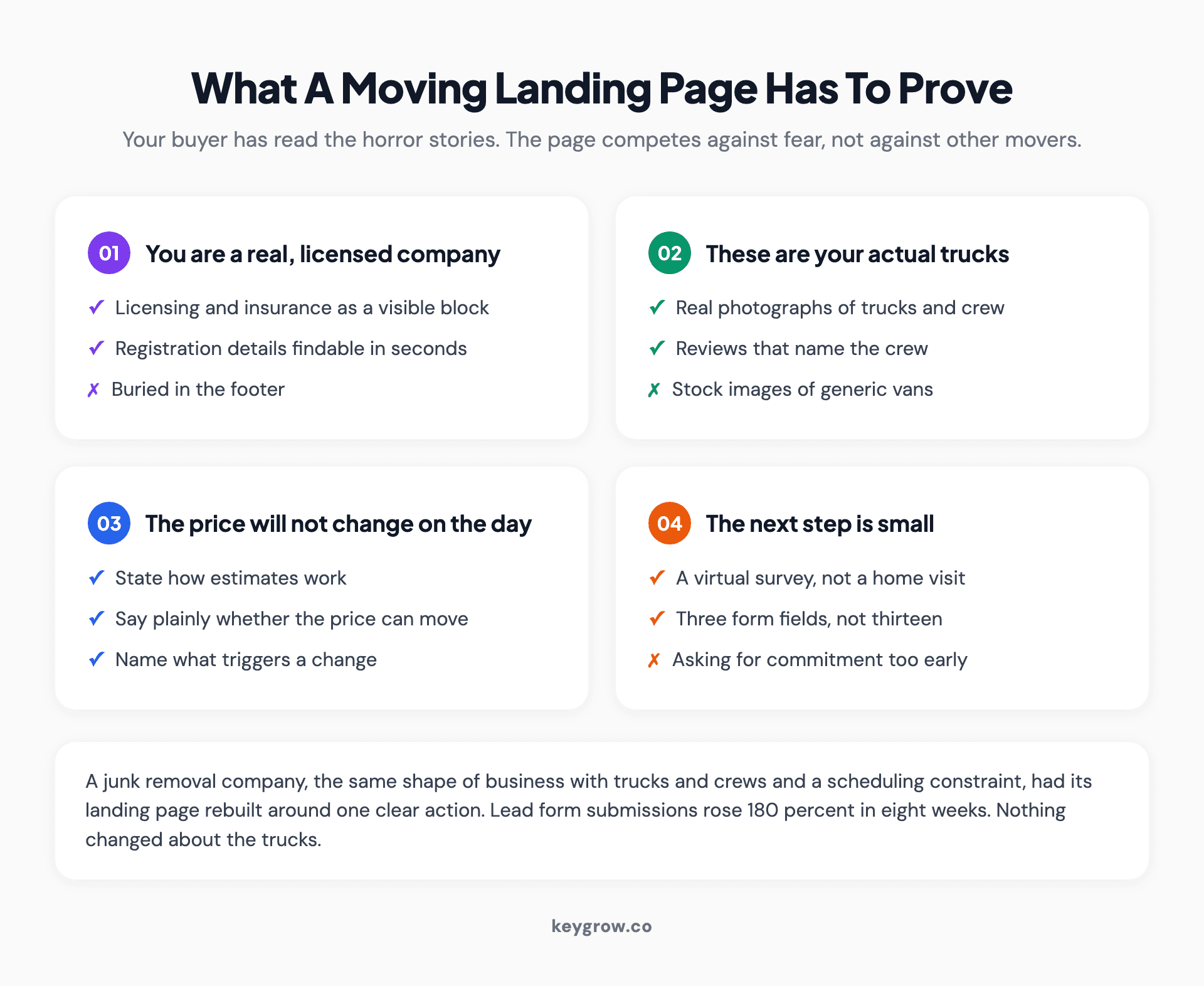
Four-card checklist of what a moving company landing page must prove: licensing and insurance, real photos of trucks and crew, price stability on move day, and a small next step.
That fear is specific to this industry and it changes what the page needs to carry. Licensing and insurance details, not as a footer line but as a visible block. Real photographs of your trucks and crew rather than stock images. Reviews that mention the crew by name. A clear statement of how estimates work and whether the price can change on move day. If you handle interstate work, your federal registration details should be findable in seconds, because a cautious customer will go and check them.
Then make the next step small. A moving company we worked with in junk removal, which is the same shape of business with trucks and crews and a scheduling constraint, had their landing page rebuilt around one clear action and lead form submissions went up 180 percent in eight weeks. Nothing changed about the trucks. The page just stopped asking for a commitment before it had earned one.
Here is the opinion I will defend: more traffic is almost never the fix for a moving company's lead problem. Filtering is. Every other business can absorb a bad lead by working a bit harder, but you cannot, because the ceiling is physical. Three trucks is three trucks. If your crews are busy and your leads are poor, buying more clicks makes both problems worse at once, and the fix is tighter match types, real negatives and qualifying language in the ads themselves.
When a moving company should not run Google Ads
Some movers should not be in this auction, and it is worth saying so plainly.
If you are booked out and profitable on referrals, do not start. You would be paying to displace work you already have. Fix pricing first. That is a nicer problem.
If you have one truck, the numbers are tight. Peak clicks in a competitive metro are not cheap, and one truck cannot absorb a bad month. Local Services Ads and a well-kept Google Business Profile are usually the better first spend.
If summer calls go to voicemail, that is the thing to fix first. This category is won on response time far more than on ad copy.
And if booked jobs and form fills currently look the same in your reporting, put the first month into measurement instead. Clean data on a small campaign beats guesswork on a big one.
FAQs
How much should a moving company spend on Google Ads?
Set the budget from your capacity, not from a benchmark. Work out how many jobs you can run in a week, how many quotes it takes to book one, and how many clicks it takes to get a quote. That gives you a spend that fills the calendar without buying leads you cannot serve, and it will be a different number in July than in February.
Are Google Ads or bought moving leads better?
They solve different problems. Bought leads are usually shared with several other movers, so you compete on response speed and price the moment it arrives. A Google Ads lead is yours alone and generally converts better, but you carry the cost of clicks that never convert. Most established movers run both and compare on cost per booked job rather than cost per lead.
Can moving companies run Google Local Services Ads?
Yes. "Moving services" is a listed Local Services Ads category, so movers can run them, carry the Google Verified badge and pay per lead instead of per click. Verification takes time, so start the process well before peak season rather than during it.
What is a good cost per lead for a moving company?
Cost per lead is the wrong target on its own, because a long-distance job can be worth many times a local one. Track cost per booked job and revenue per booked job separately for local and long-distance campaigns. A high cost per lead on long-distance work is often the most profitable line in the account.
Should I pause Google Ads in the winter?
Usually not. Competition thins out and clicks get cheaper in the off season, and that is exactly when a crew sitting idle costs you money. Change the goal instead: widen keywords, accept smaller and more flexible jobs, and let the budget work harder per click than it can in July.
How do I stop getting leads from people who just want a truck rental?
Negative keywords, added before launch rather than after. Block rental, trailer, DIY, self-move and the related terms, then read the search terms report weekly for the first month. This category attracts more off-target searches than most, and the search terms report is the only place you will see them.
Which keywords work best for long-distance movers?
Route-based terms, meaning origin and destination together, such as "movers from Denver to Nashville". They have far less competition than generic terms and the intent is unmistakable. Pair them with a long-distance campaign set to presence or interest targeting, since the searcher is often already in the destination city.
If you remember one thing
Your account should not run the same way in July as it does in February, because your business does not.
In the busy half, buy fewer and better jobs: long-distance, larger homes, full service, with qualifying language in the ads and a capped budget. In the quiet half, buy volume: local, small, flexible, with a wider net and cheaper clicks. Split local and long-distance from the start, get the location settings right for each, and measure everything against booked jobs instead of form fills.
If your account is spending its budget and your calendar still has gaps, our home services marketing team will look at the numbers with you, including the possibility that paid search is not what is wrong. Our PPC management page covers how we work if you want the detail first. For the organic half of the same problem, including route pages and the map pack, see our guide to SEO for moving companies.