


Most advice about Google Ads for electricians is built around emergencies: exposed wiring, a dead panel, a burning smell at midnight. That advice is not wrong about the searches. It is wrong about the money.
Emergency electrical work is the most contested, most expensive traffic in the trade, and it buys you a service call worth a couple of hundred dollars. Panel upgrades, generator installs, EV charger work and rewires are searched calmly, by people who are comparing three companies over a couple of weeks, and they are worth ten to fifty times more.
The uncomfortable part is that Google's own model of your trade pushes you toward the cheap half.
Google classifies your trade as an emergency service
This is not a metaphor. In Google's screening requirements for Local Services Ads, the electrician category is described as an urgent category "because consumers often call electricians for time-sensitive, urgent needs, such as exposed wiring and critical electronic failures." For that reason, electricians get an extra level of screening including background checks on service professionals.
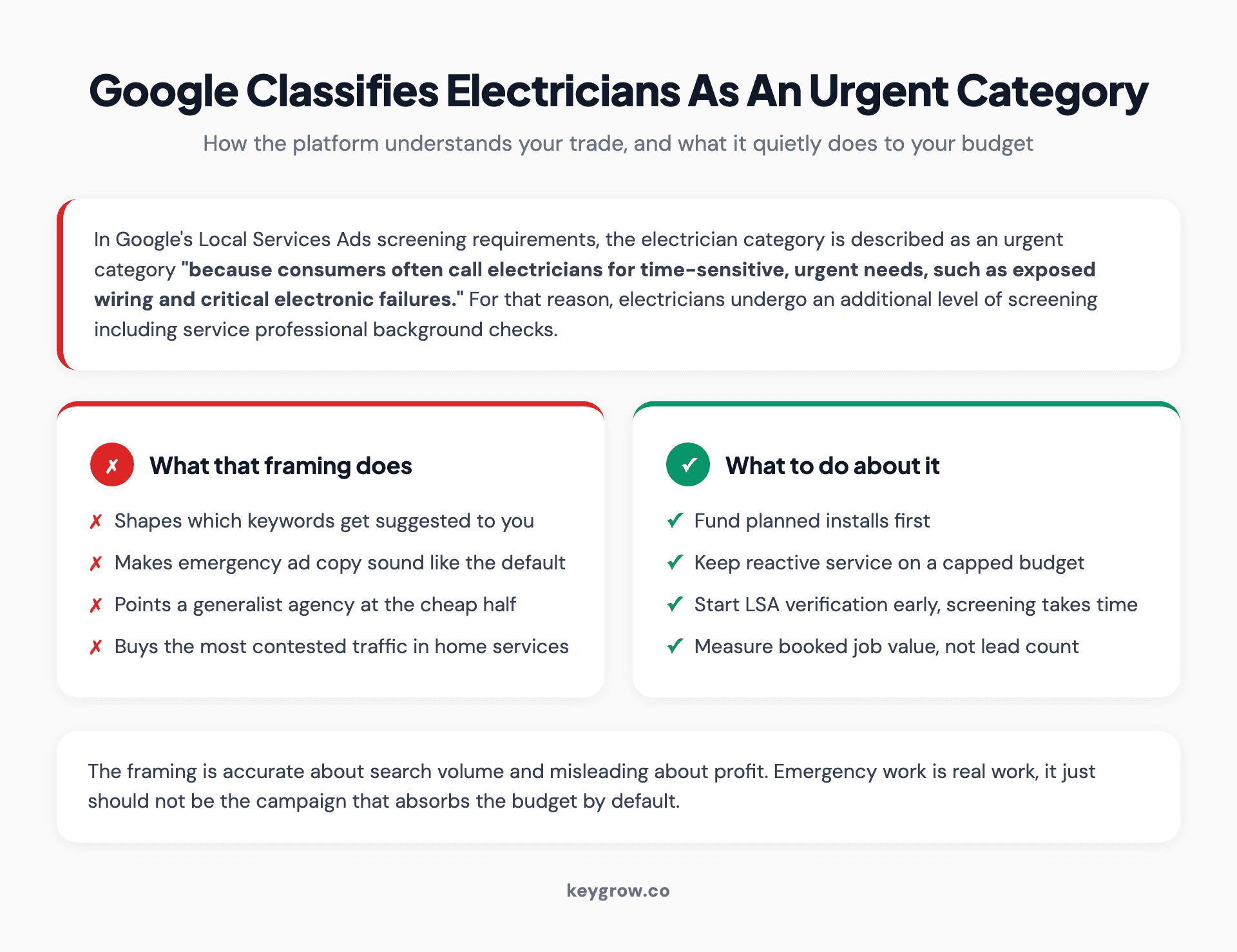
Explanation that Google treats the electrician category as urgent in Local Services Ads screening, with a comparison of what that framing does to a budget and what to do instead.
Read that as a statement about how the platform understands your business, because that is what it is. The default framing of an electrician, from the platform down through every trades marketing guide, is the person you call when something is on fire.
That framing is accurate about search volume and misleading about profit. It quietly shapes which keywords get suggested to you, which ad copy sounds right, and where a generalist agency will point your budget.
Electricians pay the second-highest click price in home services
At $12.18 per click, electrical work costs more per click than plumbing, roofing or heating. The conversion rate is good enough that it still works. It just means every click has to be pointed at something worth having.
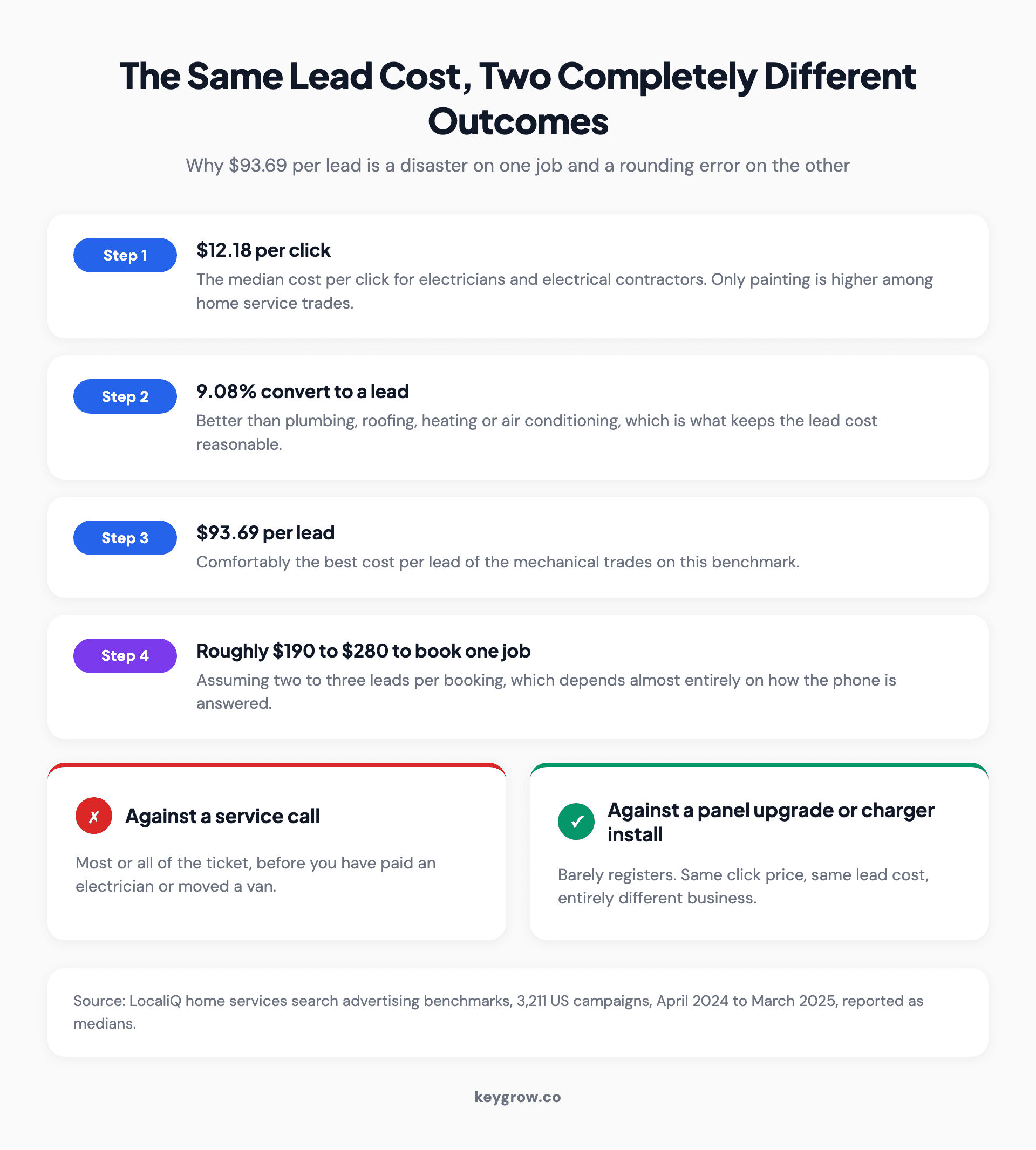
Four-step breakdown from $12.18 per click through a 9.08 percent conversion rate to $93.69 per lead and roughly $190 to $280 to book one electrical job, contrasted against a service call and a panel upgrade.
Here is the trade-by-trade picture from LocaliQ's home services benchmarks, drawn from 3,211 US home services search campaigns between April 2024 and March 2025, reported as medians:
| Trade | Cost per click | Conversion rate | Cost per lead |
|---|---|---|---|
| Painting | $13.74 | 10.80% | $138.38 |
| **Electricians** | **$12.18** | **9.08%** | **$93.69** |
| Roofing and gutters | $10.70 | 3.70% | $228.15 |
| Plumbing | $10.49 | 7.63% | $129.02 |
| Heating and furnaces | $9.30 | 7.48% | $129.02 |
| Air conditioning | $9.68 | 6.56% | $127.74 |
| Handyman | $7.10 | 13.45% | $54.05 |
Only painters pay more per click. But electricians convert better than plumbers, roofers, heating or air conditioning firms, which drops the cost per lead to $93.69, comfortably the best of the mechanical trades on this list.
So the click is expensive and the lead is reasonable. Now do the arithmetic that decides everything:
- $93.69 to generate one lead
- Not every lead books, so call it two to three leads per booked job depending on how you answer the phone
- Somewhere between $190 and $280 to book one job
Against a service call, that is most or all of the ticket, before you have paid an electrician or moved a van. Against a panel upgrade or a charger install, it barely registers.
Same click price. Same lead cost. Completely different business outcome, decided entirely by which job the caller turns out to need.
You cannot fix this in the keyword list
Here is where electrical splits from the trade next door. In plumbing, the search term usually tells you what the job is. In electrical, "electrician near me" is a $180 outlet repair and a $9,000 panel upgrade wearing the same words.
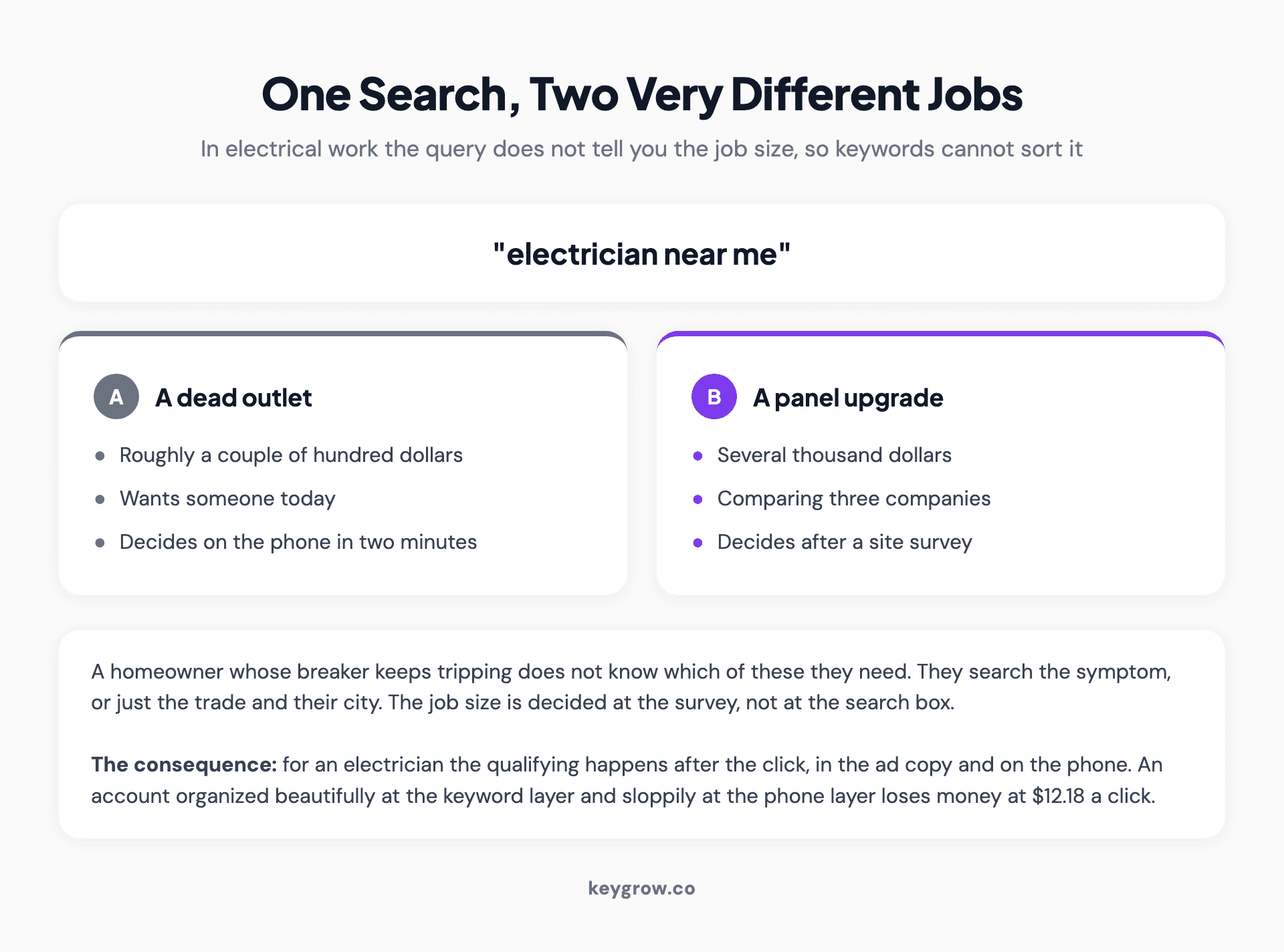
Diagram showing the search electrician near me splitting into two very different jobs: a dead outlet worth a couple of hundred dollars and a panel upgrade worth several thousand.
We argued in our plumbing guide that the negative keyword list is effectively the campaign, because plumbing searches sort themselves into hire-me and help-me-do-it-myself, and filtering is most of the work. Electrical does not sort that cleanly.
A homeowner whose breaker keeps tripping does not know whether they need a $200 repair or a new panel. They search the symptom. Sometimes they search nothing more specific than the trade and their city. The job size gets decided at the survey, not at the search box, which means no amount of keyword work will separate the two in advance.
That has a blunt consequence. For an electrician, the qualifying happens after the click: in the ad copy, on the landing page, and above all on the phone. An account that is beautifully organized at the keyword layer and sloppy at the phone layer will lose money at $12.18 a click.
It also means the generic terms are not automatically waste. "Electrician near me" is genuinely ambiguous rather than genuinely bad. Cap it, watch it, but do not reflexively kill it, because some of your largest jobs will arrive through it.
Build campaigns for the work you actually want
Run separate campaigns for planned installs and reactive service, and fund the planned side first. The searches are lower volume and the buyers take longer, which is exactly why they are cheaper to reach and less contested.
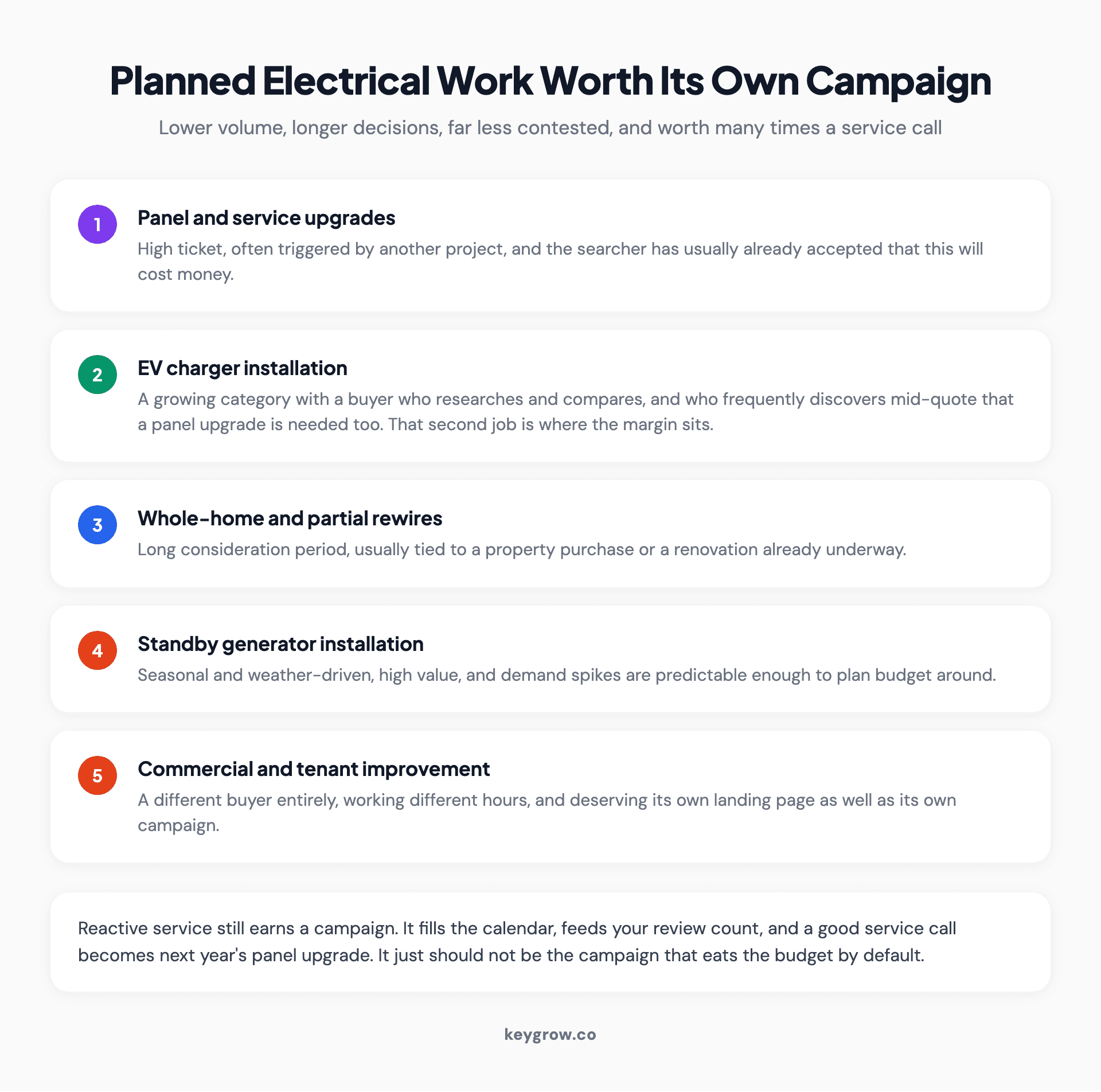
Five types of planned electrical work worth their own campaign: panel upgrades, EV charger installation, rewires, standby generators and commercial work.
The planned work worth its own campaign:
- Electrical panel upgrades and service upgrades. High ticket, often triggered by another project, and the searcher is usually already resigned to spending money.
- EV charger installation. A growing category with a buyer who researches, compares and frequently discovers mid-quote that they need a panel upgrade too. That second job is where the margin sits.
- Whole-home or partial rewires. Long consideration, often tied to a property purchase or renovation.
- Standby generator installation. Seasonal, weather-driven, and high value.
- Commercial and tenant improvement work. Different buyer entirely, different hours, usually worth a dedicated campaign and its own landing page.
Reactive service still deserves a campaign. It fills the calendar, it feeds your review count, and a good service call turns into the panel upgrade a year later. It just should not be the campaign that eats the budget by default, which is what happens when everything runs together.
One practical note on charger work: keep the ad copy and the landing page about the installation, the electrical assessment and the permit, and stay away from naming vehicle makes or charger brands. It narrows your reach and buys you problems you do not need.
Qualify in the ad, then qualify on the phone
Since the keyword cannot tell you the job size, the ad has to start the sorting and the phone has to finish it.
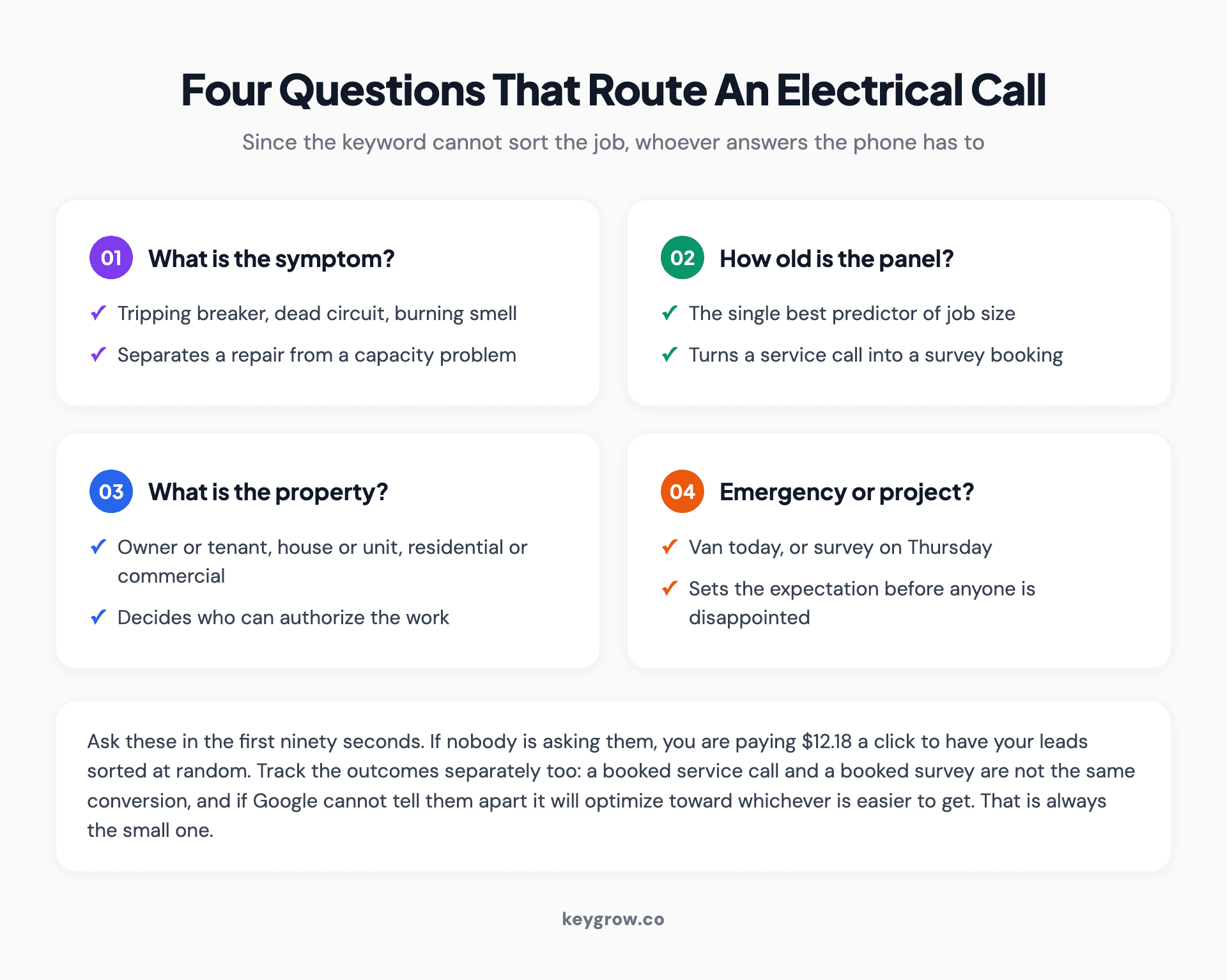
Four questions that route an incoming electrical call: what the symptom is, how old the panel is, what the property is, and whether it is an emergency or a project.
In the ad copy, that means saying things most electricians leave out. Name the high-value services explicitly rather than listing "residential and commercial electrical". State a service call fee if you charge one, because it filters out price shoppers before they cost you a click-through. Say whether you are licensed and insured, and say it in the ad, not just the footer of the site.
On the phone, the difference between a good and bad electrical account is almost entirely here. Whoever answers should be establishing, in the first ninety seconds: what the symptom is, how old the panel is, what the property is, and whether this is an emergency or a project. Those four questions route the call, set the expectation and decide whether you send a van today or book a survey for Thursday.
If nobody is asking them, you are paying $12.18 a click to have your leads sorted at random.
Track it accordingly. Your conversion actions should distinguish a booked service call from a booked survey or estimate, and the estimate value should be imported back into Google Ads once you know it. Otherwise the bidding optimizes toward whichever call is easiest to get, and the easiest call is always the small one. Our guide to measuring lead value from PPC covers the offline import side of that.
The negatives that matter, and the ones that do not
Block the searches that are not about hiring anyone. Do not go much further than that, because over-filtering an electrical account cuts off the ambiguous searches that produce your best jobs.
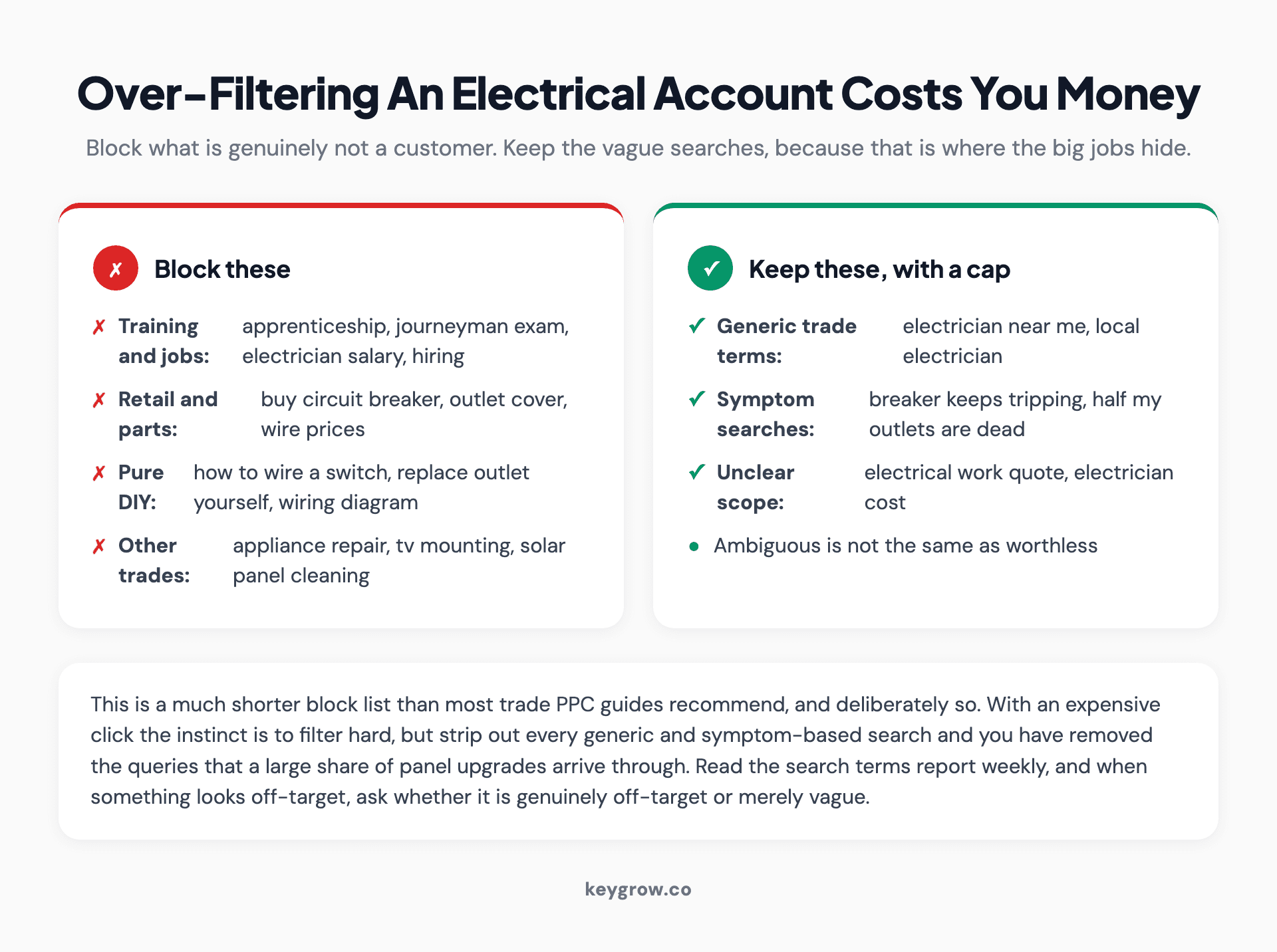
Two-column comparison of search terms an electrician should block, such as training and retail queries, against ambiguous terms worth keeping with a capped budget.
The genuine waste falls into four groups:
| Group | Examples | Why |
|---|---|---|
| Training and jobs | electrician apprenticeship, journeyman exam, electrician salary, hiring | Never a customer |
| Retail and parts | buy circuit breaker, outlet cover, extension lead, wire prices | Wants a shop |
| Pure DIY | how to wire a switch, replace outlet yourself, diagram | Wants a tutorial |
| Unrelated trades | appliance repair, tv mounting, solar panel cleaning | Different job |
That is a much shorter list than you will find in most trade PPC guides, and deliberately so. The temptation with an expensive click is to filter aggressively, and in electrical that instinct costs you money. If you strip out every generic and symptom-based search, you have removed the queries that half your panel upgrades come through.
Read the search terms report weekly for the first month, and when you find an off-target query, ask whether it is genuinely off-target or just vague. Vague is fine. Vague is where the big jobs hide. The negative keyword mechanics are the same as any account, but the judgment call is different here.
What the landing page has to carry
The page has one job the ad cannot do: make a stranger comfortable letting a person into their home to work on something that can burn the house down.

An electrician in a high-visibility shirt working on a residential electrical panel with a screwdriver.
That means the license number visible rather than buried, the insurance stated, and real photographs of your actual team in branded shirts and vans. It means reviews that mention the specific work, not just star counts. It means being explicit about how pricing works, whether there is a call-out fee, and whether the estimate is free for planned work even if diagnosis is not.
And it means separate pages for separate jobs. Someone researching a charger installation and someone with a dead outlet need different pages, different headlines and different calls to action. Sending both to a general services page is the single most common reason an electrical account underperforms at these click prices.
A security services client of ours had this problem in a different trade. Their page left visitors to work out the next step alone, and once it was rebuilt around one clear action the conversion rate climbed 95 percent in four weeks on identical traffic.
While we are on the subject of who you hire to run this: an agency that does not know what a panel upgrade is worth will optimize your account toward the cheapest cost per lead it can find, and the cheapest lead in an electrical account is almost always the least profitable job. Industry knowledge is not a nice-to-have in this trade, it is the difference between an account that looks efficient and one that makes money.
The upgrade work is cheaper to win organically
Panel upgrades, EV chargers and generators have a research window attached, and that window is where organic beats paid on cost per job.
Somebody with a dead outlet clicks an ad. Somebody deciding whether their panel can take a car charger reads for six weeks first, and an ad served in week one is paying for a click that will not convert until week seven, if it converts at all. A page that answers the sizing and permit question is still there in week six, and it cost nothing to serve. We laid out that whole side in SEO for electricians.
The split most established contractors land on: ads carry the urgent residential terms where the click price is painful but the job closes the same day, and content carries the high-ticket planned work.
When an electrician should not run Google Ads
Some electricians should keep their money, and it is worth being direct about which.
If you are a one-van operation booked three weeks out, do not start. At $12.18 a click you would be paying a premium to generate work you cannot reach, and the callbacks you fail to return will cost you reviews. Claim your Google Business Profile, get the review count up, and revisit when you add a second van.
If you only do small service calls and have no intention of quoting planned work, the arithmetic above is against you. The lead cost is too close to the ticket. Local Services Ads, where you pay per lead rather than per click, are usually the better first channel for that shape of business. We covered where that channel works and where it disappoints in our piece on Local Services Ads.
Unanswered daytime calls should be fixed before any budget goes live. Buyers in this trade overwhelmingly pick up the phone rather than complete a form, so a ring-out at these click prices costs you twice.
Finally, if your reporting cannot connect an ad to the job that came out of it, put month one into conversion tracking. In a trade where jobs range from a couple of hundred dollars to five figures, running unmeasured is not a small gap, it is the whole problem.
FAQs
How much do Google Ads cost for electricians?
The median cost per click for electricians and electrical contractors is $12.18, with a 9.08 percent conversion rate producing a median cost per lead of $93.69, according to LocaliQ's benchmarks from 3,211 US home services campaigns. Only painting has a higher cost per click among home service trades, though electricians convert better than plumbers, roofers or heating firms.
Are Google Ads worth it for a small electrical business?
It depends on whether you quote planned work. If you sell panel upgrades, charger installs, generators or rewires, a lead cost around $93.69 is easily justified. If you only do small service calls, the lead cost eats most of the ticket and Local Services Ads or a well-maintained Google Business Profile will usually serve you better.
What are the best keywords for electricians?
Planned, high-value services rather than the trade name: electrical panel upgrade, EV charger installation, whole house rewire, generator installation, and commercial electrical work in your city. Keep generic terms like electrician near me running with a capped budget, because they are ambiguous rather than worthless and a meaningful share of large jobs arrive through them.
Should electricians use Local Services Ads or Search Ads?
Both, for different work. Local Services Ads charge per lead, sit above the search ads and suit reactive service calls. Search Ads give you the control needed to target planned installs with specific pages and messaging. Note that Google treats electricians as an urgent category and applies extra screening including background checks, so start verification well before you need the ads live.
Why is my electrical cost per click so high?
Because you are in one of the more expensive trades. Emergency-intent electrical searches attract heavy competition, and the platform's default framing of the category is urgent work. The fix is rarely to chase a lower cost per click. It is to make sure the clicks you buy are attached to jobs worth several thousand dollars rather than a couple of hundred.
How do I get more panel upgrade and EV charger jobs from Google Ads?
Give each one its own campaign, its own landing page and its own budget, separate from reactive service. These searches are lower volume, less contested and made by people who are comparing options over days rather than minutes, so they need a page that answers cost, timeline and permitting rather than an emergency phone number.
Should I bid on emergency electrical keywords?
Yes, but with a capped budget and clear eyes about what you are buying. Emergency terms are the most competitive in the trade and typically produce the lowest-value jobs. They are worth running for calendar fill, review volume and the follow-on work a good service call generates, but they should not be the campaign that absorbs your budget by default.
Where the money actually is
The default setup for an electrician's account, the one Google's category model and most trade marketing advice both point at, is emergency-first. It is the most expensive traffic in home services and it buys the smallest jobs you do.
Turn it around. Fund the planned work first, because it is cheaper to reach and worth far more. Keep reactive service running with a capped budget, since it fills gaps and feeds future upgrades. Accept that generic searches are ambiguous rather than useless, and do the sorting where it can actually be done, in the ad copy and on the phone. Then measure booked job value rather than lead count, because in a trade where jobs range from $180 to five figures, lead count tells you almost nothing.
Booking plenty of small jobs and wondering where the big ones went is a specific problem, and our home services team will work through the job-value side of your account with you. Details of how we run PPC management are on the service page.