


Three electricians in the same county. One runs two vans doing panel swaps and outlet work for homeowners. One does almost nothing but EV chargers, service upgrades and generator installs. One bids tenant improvement work for general contractors and has not taken a residential call in four years.
All three have the same website: a homepage, a services list, an about page, a contact form.
That is the actual problem with SEO for electricians, and it is upstream of anything to do with keywords. Two of those three businesses have a real organic opportunity and one of them mostly does not. Until you know which one you are running, every hour spent on content is a coin flip.
So this post starts with the split, spends most of its length on the searches almost nobody in the trade has written for, and is honest about the part of your revenue that search will never touch.
First decide which of these three businesses you are
Residential service, residential upgrade work, and commercial contracting are three different companies with three different search patterns. Pick the one that pays your bills before you write a word.
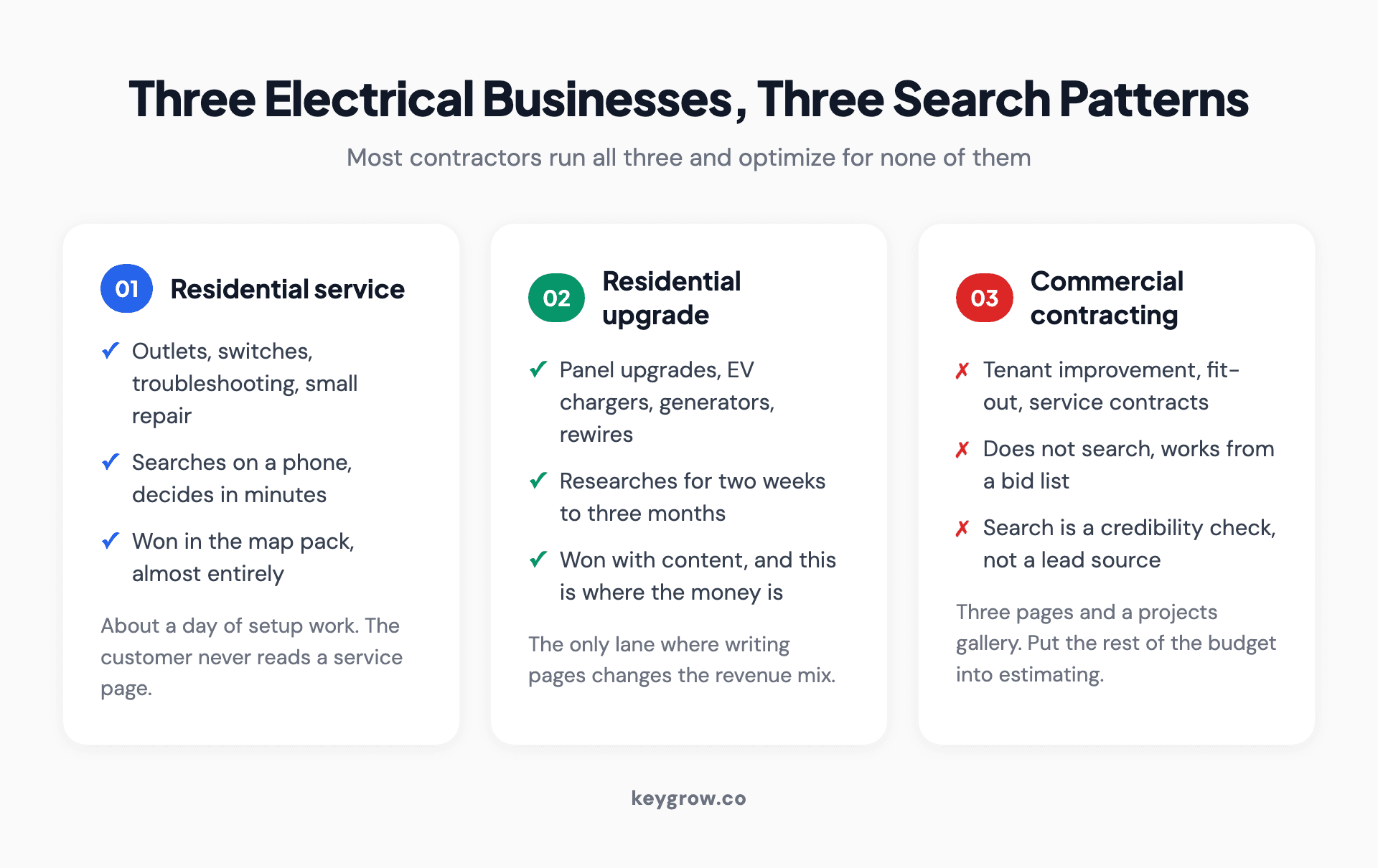
Three types of electrical business shown side by side with their search behavior, average ticket size and how customers actually find them.
| Residential service | Residential upgrade | Commercial | |
|---|---|---|---|
| Typical job | Outlet, switch, troubleshooting, small repair | Panel upgrade, EV charger, generator, rewire | Tenant improvement, fit-out, service contract |
| How they search | "electrician near me", at speed, on a phone | Weeks of research: cost, permits, rebates, sizing | They do not search, they call a list |
| Decision time | Minutes | Two weeks to three months | Bid process |
| Where SEO wins | Map pack, almost entirely | Content, and this is where the money is | Rarely |
Most electricians do all three and optimize for none. If your revenue is 70% upgrade work, building a page for "outlet repair" is not a bad page, it is a page pointed at the wrong business.
Commercial work is not won in search, and pretending otherwise burns the budget
If most of your revenue comes from general contractors and property managers, organic search is a credibility check, not a lead source. Build three pages and stop.
Somebody has to say this. Commercial electrical work moves through bid lists, prequalification packets, and relationships with two or three GCs who already know your foreman by name. A project manager filling a subcontractor slot is not typing "commercial electrician [city]" into Google. They are pulling from a list, and you get on that list by bidding, by delivering, and by being reachable.
What search does do for a commercial contractor is confirm you exist when somebody looks you up after your name comes off that list. That is worth exactly three pages: what you do, what you have built, and who to call. Add a projects page with real photographs and the size of the job in square feet or service amps, because that is what a PM checks.
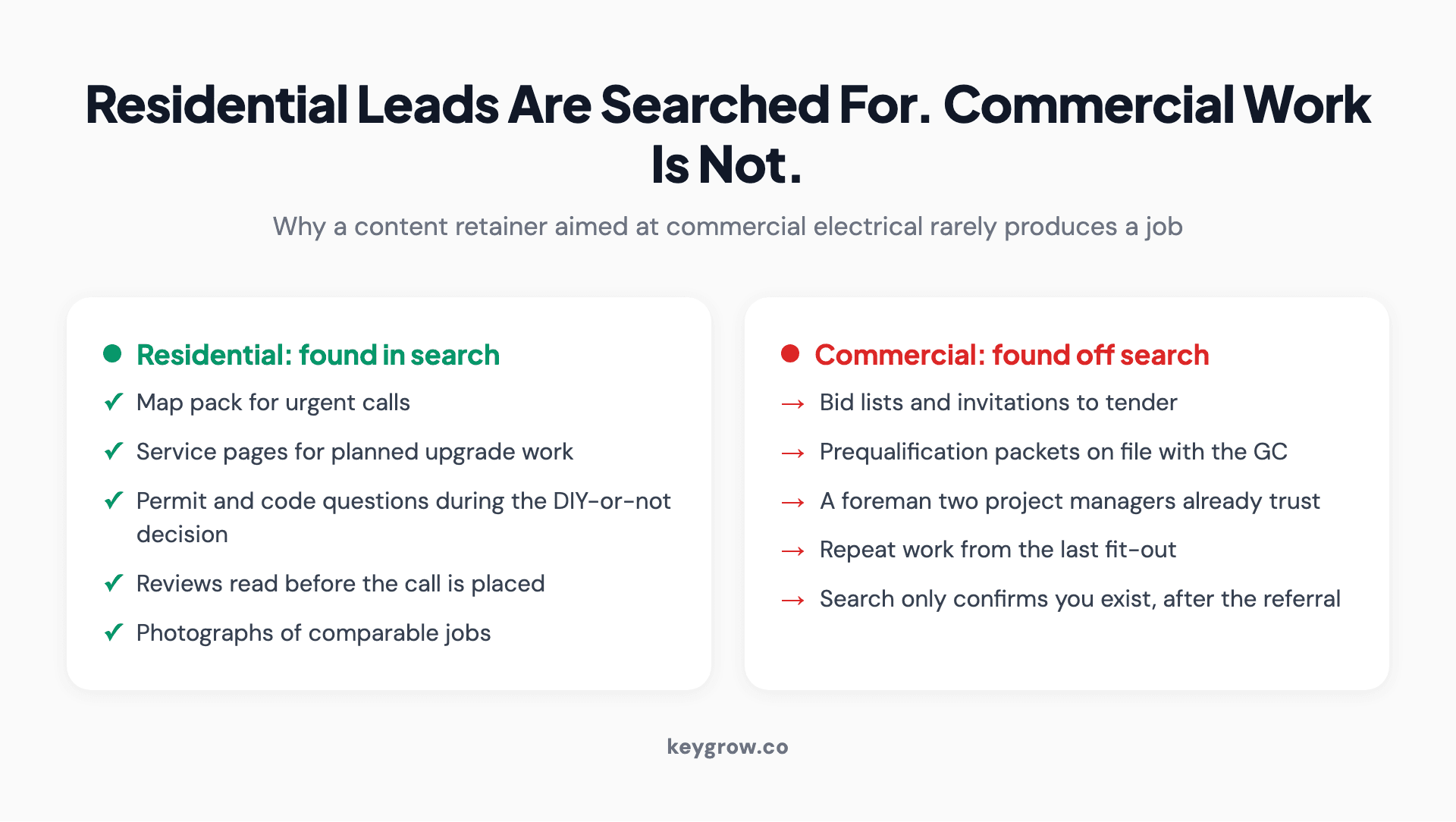
Comparison of where residential electrical leads come from against where commercial electrical work actually originates.
If you are 90% commercial and somebody is selling you a monthly content package, ask them which commercial job it produced last quarter. Ask specifically.
The electrification searches almost nobody has written for
Panel upgrades, EV chargers, generators and heat pump circuits are high-ticket jobs with a research period attached, and the content around them is thin almost everywhere.
This is the whole argument for organic in this trade right now. The BLS outlook puts electrician employment growth at 9 percent from 2025 to 2035 against 3 percent for all occupations, and the reason is sitting in people's driveways and utility rooms. Homes built for a 100 amp service are being asked to run a car charger, an induction range and a heat pump.

A home EV charge point mounted on a brick wall with the cable plugged into a car.
Here is what that does to search behavior. A blown breaker is a five minute decision. A service upgrade is a six week decision, and during those six weeks the homeowner reads. They want to know whether their panel can take it, what a permit involves, what the utility has to approve, what rebates exist, and what the whole thing costs before they let anyone in the house.
Almost none of that is being answered by electricians. It is being answered by manufacturer blogs, by national comparison sites, and increasingly by an AI summary that pulled from both.
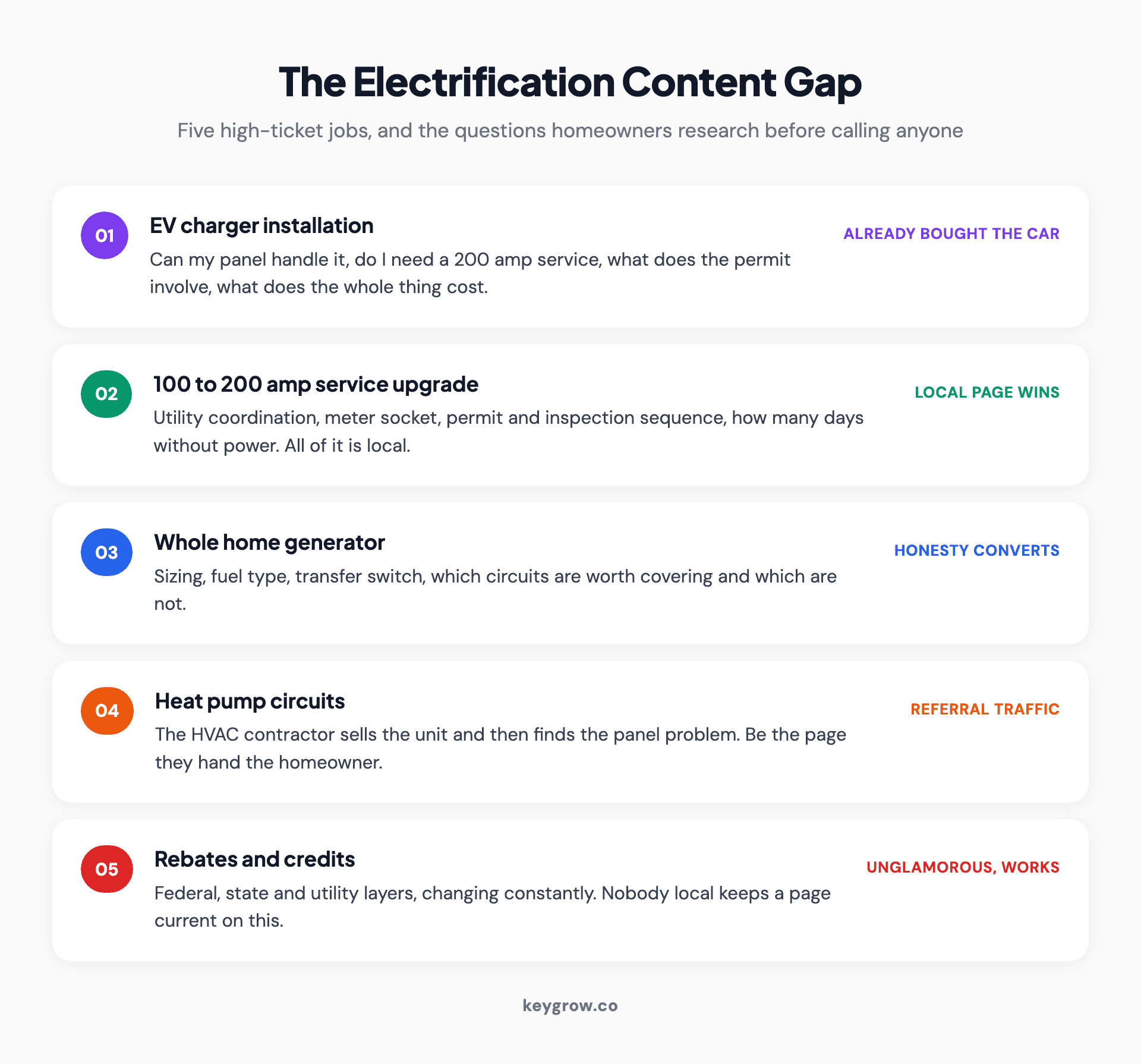
The electrification content gap showing five high-ticket electrical jobs and the specific questions homeowners research before hiring.
The pages worth building, in order:
- Can my panel handle an EV charger? The single highest-intent question in the trade right now. Somebody asking it has already bought the car.
- What a 100 to 200 amp service upgrade involves in [your city]. Local, because the utility coordination and permit process genuinely differ by jurisdiction. This is the page a national site cannot write.
- Whole home generator sizing, honestly. Including the part where you tell somebody a smaller unit covering four circuits is the right call, which is the paragraph that earns the job.
- What a heat pump needs from your electrical system. The HVAC contractor sells the heat pump and then discovers the panel problem. Be the page they send the homeowner to.
- Rebates and credits in your state, updated. Energy Star's credit list covers the federal side; the state and utility layer changes constantly and nobody local is maintaining a page on it.
That last one is unglamorous and it works, because it is the only page on the topic somebody actually keeps current.
Permit and code questions bring you the best qualified traffic there is
Somebody searching whether a job needs a permit has just discovered they cannot do it themselves. That is the most pre-qualified reader you will ever get.
Homeowners start almost every electrical project intending to do it themselves. They watch a video, buy the parts, and then hit the question that stops them: does this need a permit, does it need an inspection, will it fail at closing if it was not done right.
The trade's instinct is to avoid this content because it sounds like helping people avoid hiring you. The opposite happens. The person reading "do I need a permit to add a subpanel" is not going to pull a permit and do it themselves. They are calculating whether the DIY route still makes sense, and the answer they arrive at is usually no.
Pages worth having:
- Which jobs need a permit in your jurisdiction, and which genuinely do not
- What an inspection actually checks, and what makes one fail
- Why unpermitted work becomes a problem at sale, not at install
- What happens if a previous owner's work was never inspected
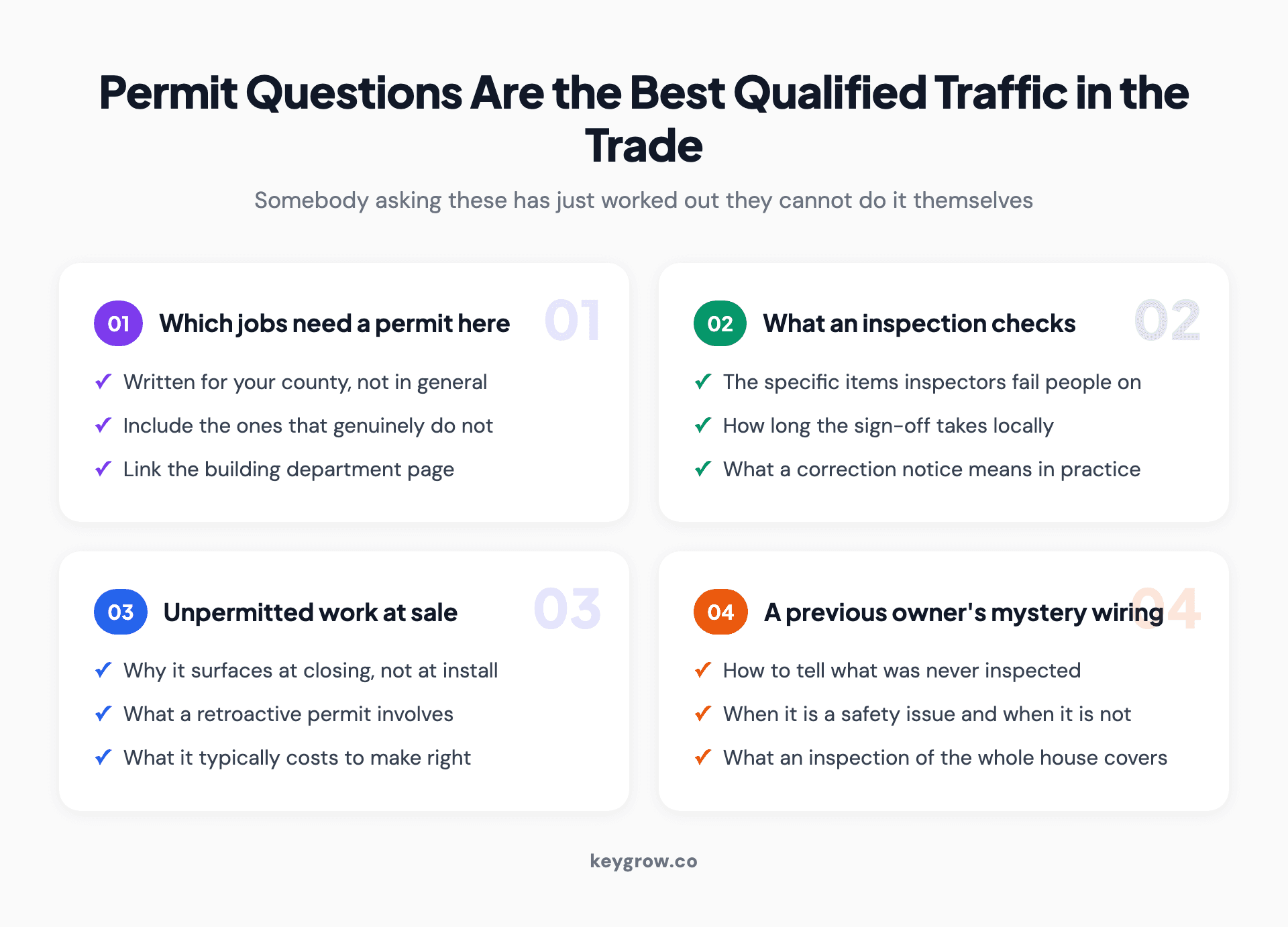
Four permit and inspection questions homeowners search before hiring an electrician, each one worth its own page.
Write these for your county, not in general. A national article on permits is useless to somebody who needs to know what their own building department requires, and that specificity is the entire reason your page can outrank a much larger site.
What the emergency half actually needs, and it is not much
Urgent residential calls are decided in the map pack, not on your website. Get the profile right and stop optimizing the rest of the site for that customer.
Somebody with a dead outlet and a tripping breaker is going to tap the first or second result on the map, not read a service page. Which means the emergency side of the business needs about a day of work:
- The profile claimed, categories set to Electrician as primary, service area drawn around where you actually drive
- Real hours, and emergency availability marked if you genuinely offer it
- Photos of vans, crews and finished work, not stock images
- Services listed individually rather than as one "electrical services" entry
- A number that rings a person during the hours you published
That is most of it. The mistake is spending months building emergency content when the emergency customer never reads content. Put the effort into the upgrade side, where the reading actually happens.
One page per job, ordered by what the job is worth
Build service pages in descending order of average ticket, not in the order they appear on your invoice template.
Most electrician websites list twelve services on one page with a paragraph each. That page ranks for nothing, because twelve intents flattened into one page satisfies none of them. Split it, and build the pages in the order that pays.
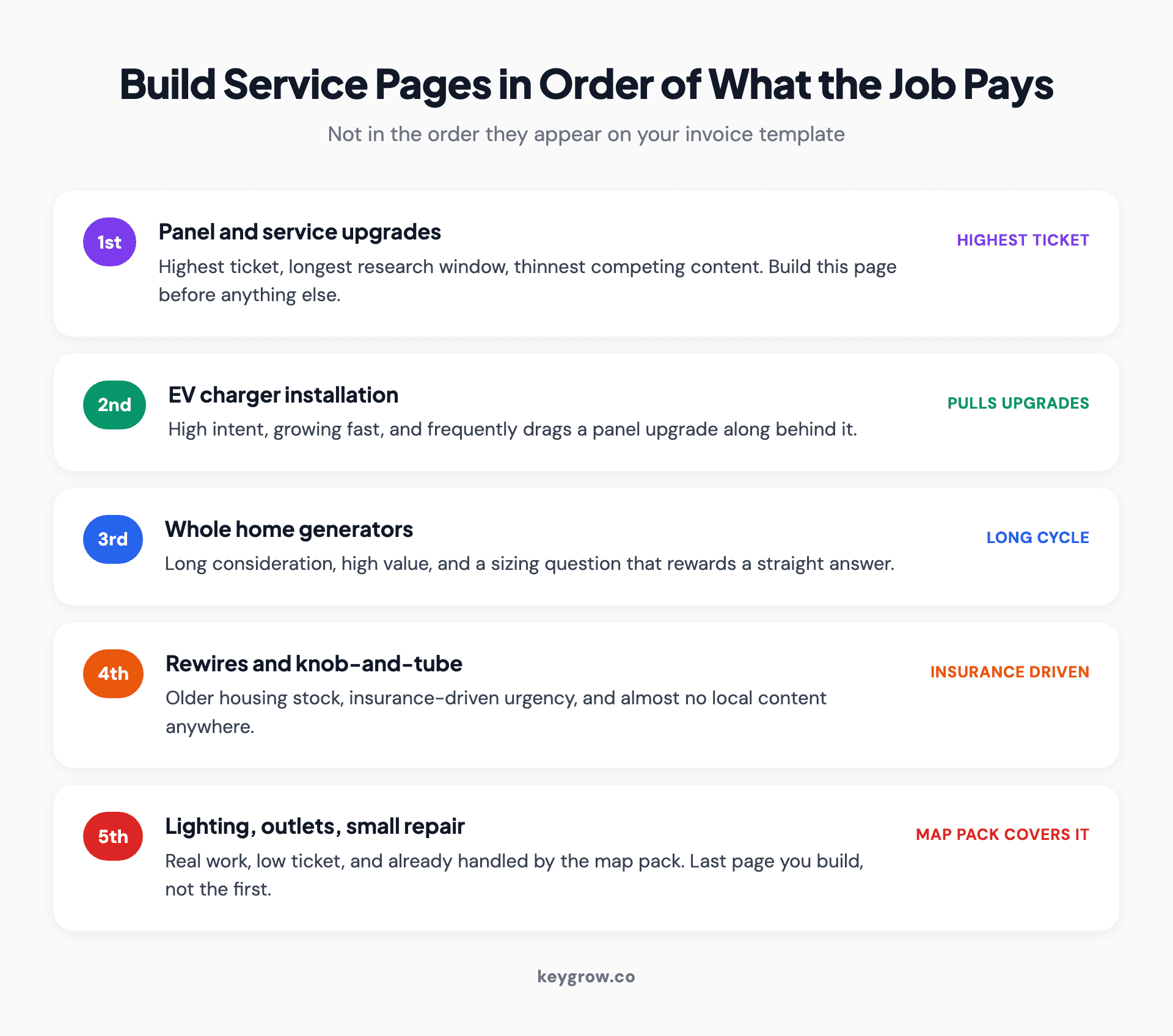
Electrical service pages ranked by average ticket size, showing which pages to build first and what each one has to answer.
Each page needs five things: what the job actually involves, a real price range with the variables that move it, how long it takes, what the permit and inspection situation is, and photographs of your own work. That is it. Not a thousand words of preamble about the importance of electrical safety.
The price range is the part people skip and it is the part that converts. You do not have to publish a fixed number. "Panel upgrades in this area typically run between X and Y, and here are the four things that push a job to the top of that range" is more useful than silence, and it filters out the caller who was hoping for $400.
Photographs are proof here in a way they are not in other trades
Electrical work is unusually photogenic in the before-and-after sense, and almost nobody in the trade uses it.
A rebuilt panel next to the tangle it replaced is a sales document. A homeowner cannot evaluate your work, but they can absolutely see the difference between the two photographs, and they will assume the second one costs more and is worth it.

The inside of a finished electrical panel with breakers and labelled circuits.
Every job worth over a thousand dollars should generate four photos: the original condition, the work in progress, the finished install, and the label schedule. That last one matters more than it sounds. A hand-labeled, legible panel directory reads as care to a person who has spent ten years guessing which breaker runs the garage.
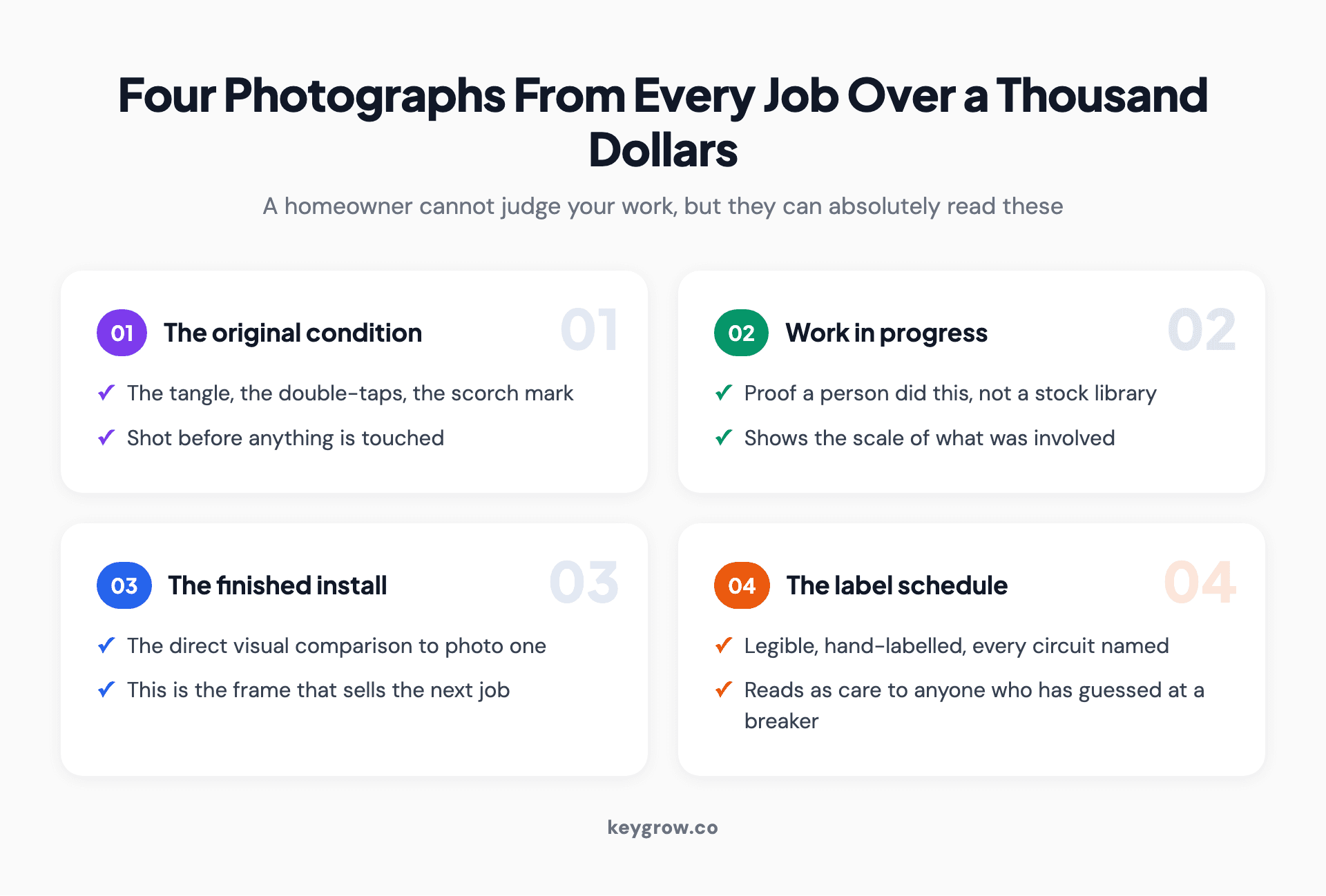
The four photographs every electrical job over a thousand dollars should produce, and what each one proves to a homeowner.
Put them on the service page, not in a gallery. A gallery is a page nobody visits. Six photographs inside the panel upgrade page, each with a caption saying what was wrong and what was done, is the highest-converting thing you can add to an electrician's website.
Reviews when the customer never sees the work
Ask at the moment the customer understands what they got, which is usually during the walkthrough, not three days later by text.
Electrical work has a review problem the other trades do not. When a plumber leaves, the drain works. When a roofer leaves, the roof looks new. When an electrician leaves, the light switch works the same way it did before it broke, and the customer's honest impression is that somebody was here for two hours and now things are normal again.
So the review has to be asked for at the point where the value is visible. Walk them to the panel. Show them the labeling. Point at the double-tapped breaker you removed and say plainly what it was doing. Then ask. The review you get will describe the work rather than saying "great service", which is worth considerably more to the next reader.
The other thing worth doing is responding to every review with a sentence about the actual job. "Glad the generator transfer test went smoothly" tells the next person you install generators, in a place a search engine reads.
Links an electrical contractor can actually get
Supply house pages, GC subcontractor listings, apprenticeship and trade school programs, and municipal contractor lists. Skip everything else.
Link building advice written for software companies is useless here. The links available to an electrical contractor are real-world relationships written down:
- Your supply house often has a "contractors we serve" or preferred installer page. Ask.
- Manufacturer installer directories, for generator, charger and panel brands you are certified on. These are usually free and usually not claimed.
- General contractors you subcontract for list their trade partners. Ask the three you work with most.
- Local trade schools and apprenticeship programs link to employers who take apprentices.
- Chambers, BBB, and your city or county's licensed contractor list.
- Local news, when there is an actual reason. A crew doing generator work after a regional outage is a story a local outlet will run.
Six to ten of these, all genuinely relevant and locally rooted, will outperform fifty directory submissions. Volume is not the metric that matters at this scale.
How long it takes, and the number that hides the truth
Expect the profile to move in six to eight weeks and the upgrade content to start producing somewhere between month four and month eight. Track booked jobs and average ticket by source, not calls.
Here is the opinion, and it is the one I will defend hardest: vanity-metric reporting is the biggest scam in this industry. A report opening with impressions and clicks is a report designed to look like work. Traffic went up 60 percent means nothing if the extra 60 percent were people looking for the number of a different electrician.
What we actually watch on local service accounts is the call count and what happens after the call. Three of our local clients landed in the same place: a phone repair shop at 115 or more monthly calls in seven months, a real estate office at 90 or more in seven months, and a junk removal company at 50 or more in six months. None of them had meaningful inbound calls before the work started. Those are the numbers a business owner can act on.
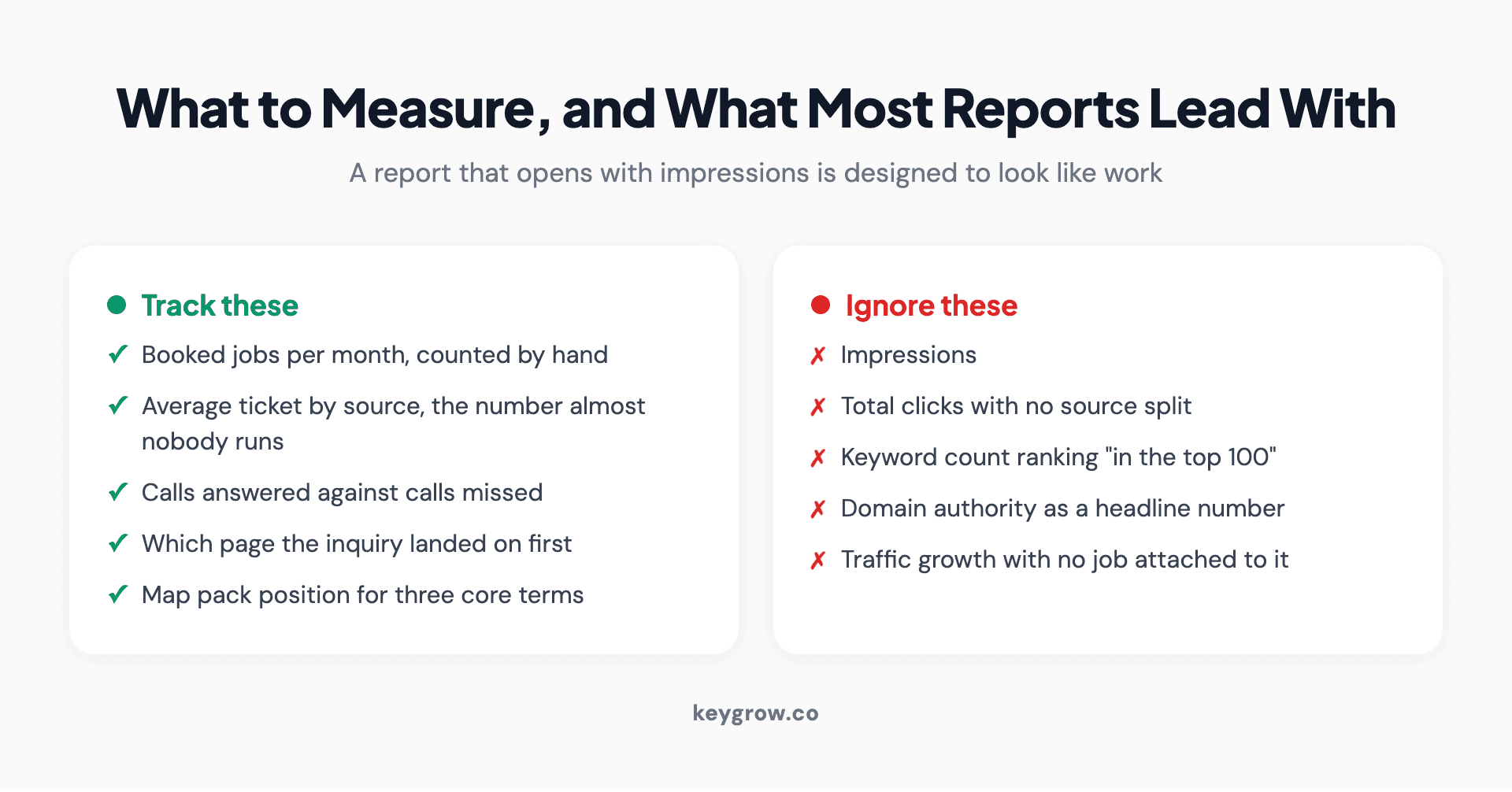
Metrics worth tracking for an electrical contractor against the vanity metrics that appear on most agency reports.
The one measurement specific to this trade: track average ticket by source. Map pack calls and upgrade-page inquiries do not produce the same job. If your profile brings twenty calls a month averaging $310 and your panel upgrade page brings four averaging $2,800, you now know exactly where the next content hour goes. Most electricians have never run that number and are surprised by it.
Electricians who should not be buying SEO yet
If you are booked eight weeks out, running one van solo, or getting all the work you can handle from two general contractors, do not hire anybody. Fix the profile yourself and get back to work.
The honest version: a solo electrician with a full calendar does not have a marketing problem, they have a capacity problem, and SEO makes a capacity problem worse. More inbound calls you cannot service turns into unreturned voicemails and the reviews that follow those.
Spend on search when you are adding a van, when you are trying to shift the mix toward electrician SEO services aimed at upgrade work, or when a large chunk of your revenue currently depends on one or two GCs and that keeps you awake. That last one is the best reason of the three, and the one most contractors wait too long to act on.
If you are doing it yourself, the order is: claim and complete the profile, ask ten recent customers for reviews, write the panel upgrade and EV charger pages, then stop and see what happens for three months. Our SEO service exists for the point after that, and the first conversation is us telling you whether you have reached it.
If you sit closer to general contracting
Electricians doing whole-house rewires, additions and new construction are running project work rather than service work, and the content that suits it is different: documented finished jobs, published cost bands, permit and feasibility pages. SEO for contractors covers that pattern across the trades.
FAQs
How long does SEO take for an electrical contractor?
Google Business Profile improvements usually show inside six to eight weeks. Service and content pages take longer, generally four to eight months before they produce steady inquiries, and longer in a metro with established competitors. Anything promising first page in thirty days is either chasing terms nobody searches or doing something that will cost you later.
Should an electrician spend on SEO or Google Ads first?
Ads first if you need calls this month and have capacity to fill right now, and we covered that side in detail in Google Ads for electricians. Organic first if your goal is to shift the work mix toward panel upgrades, EV chargers and generators, because those buyers research for weeks before they call and ads reach them at the wrong moment. Most established contractors end up running both, with ads covering the emergency terms and content covering the planned work.
What keywords should an electrician target?
Start with the job types that pay best rather than the ones with the most volume. Panel upgrade, EV charger installation, whole home generator and rewiring terms combined with your city convert far better than broad electrician searches, and they are much less contested. Add permit and code questions for your specific county, which almost nobody local writes for.
Do I need a separate page for every town I serve?
Only for towns where you genuinely work and can say something specific: the permit office, the utility, jobs you have done there, drive time. A page that swaps the town name into the same paragraph is the pattern that gets a site filtered rather than ranked. Three real town pages beat twenty generated ones.
How much does electrician SEO cost?
Small local contractors typically see monthly retainers in the several-hundred to low-four-figure range depending on market size and how much content the plan includes. Below that range the economics only work if somebody is producing generic pages at volume, which is the thing that stopped working. Doing the profile and four service pages yourself costs a couple of weekends and captures a real share of the available return.
Does the licensing information on my site matter for SEO?
It matters for conversion more than for ranking, and both are worth having. Publish the license number, the state or municipal board that issued it, insurance status, and any manufacturer certifications. Homeowners about to spend four figures do check, and it is one of the few credibility signals in this trade that can be verified by a stranger in ten seconds.
What about AI answers and ChatGPT for local electrical searches?
They are already answering the research questions, which is the half of this trade's search that matters most. Assistants pull from pages that state a plain answer near the top and back it with something checkable, which is the same structure that works for a homeowner skimming on a phone. The permit pages and the panel sizing pages are exactly the format those systems quote. Our AEO work is mostly an extension of the same discipline.
Pick the lane first
The one decision that determines whether any of this pays: know whether you are optimizing for the panel upgrade or the tripped breaker, because the answers are not the same.
If it is upgrade work, your next four pages are panel capacity, EV charger installation, generator sizing and local permits, and your profile is a supporting act. If it is emergency service, your profile is the whole strategy and four pages will do. If it is commercial, build the credibility pages and put the money into estimating instead.
Whichever lane, the same test applies at ninety days: count booked jobs and their average value, not sessions. If those two numbers have not moved, something is pointed in the wrong direction, and a chart showing more impressions is not the answer to why.
We work month-to-month with no lock-in, and we turn down contractors who are already at capacity. If you want a second opinion on which lane you are actually in, start here.