


$200.34. That is the average cost per lead for door and window companies running Google search ads, according to LocaliQ's home services benchmarks, built from more than 3,200 campaigns that ran between April 2024 and March 2025. The home services average was $90.92. Of the 16 trades in the study, only roofing and gutters paid more.
So lead generation for window and door contractors is mostly two questions. Where else can leads come from at a lower price? And how fast do you book the in-home measure once one arrives?
The second matters more than most owners think. Researchers writing in Harvard Business Review audited 2,241 US companies and found the average reply to a web lead took 42 hours. In a related study, firms that tried to reach the customer within an hour were nearly seven times as likely to qualify the lead as firms that waited an hour longer.
Here are seven channels ranked by speed to first lead and cost, plus what $3,000 of search ads buys at benchmark rates.
Seven lead channels, ranked by speed and cost
Local Services Ads and search ads bring the first lead fastest. Your Google Business Profile and past customers cost the least per signed job but take months to build.
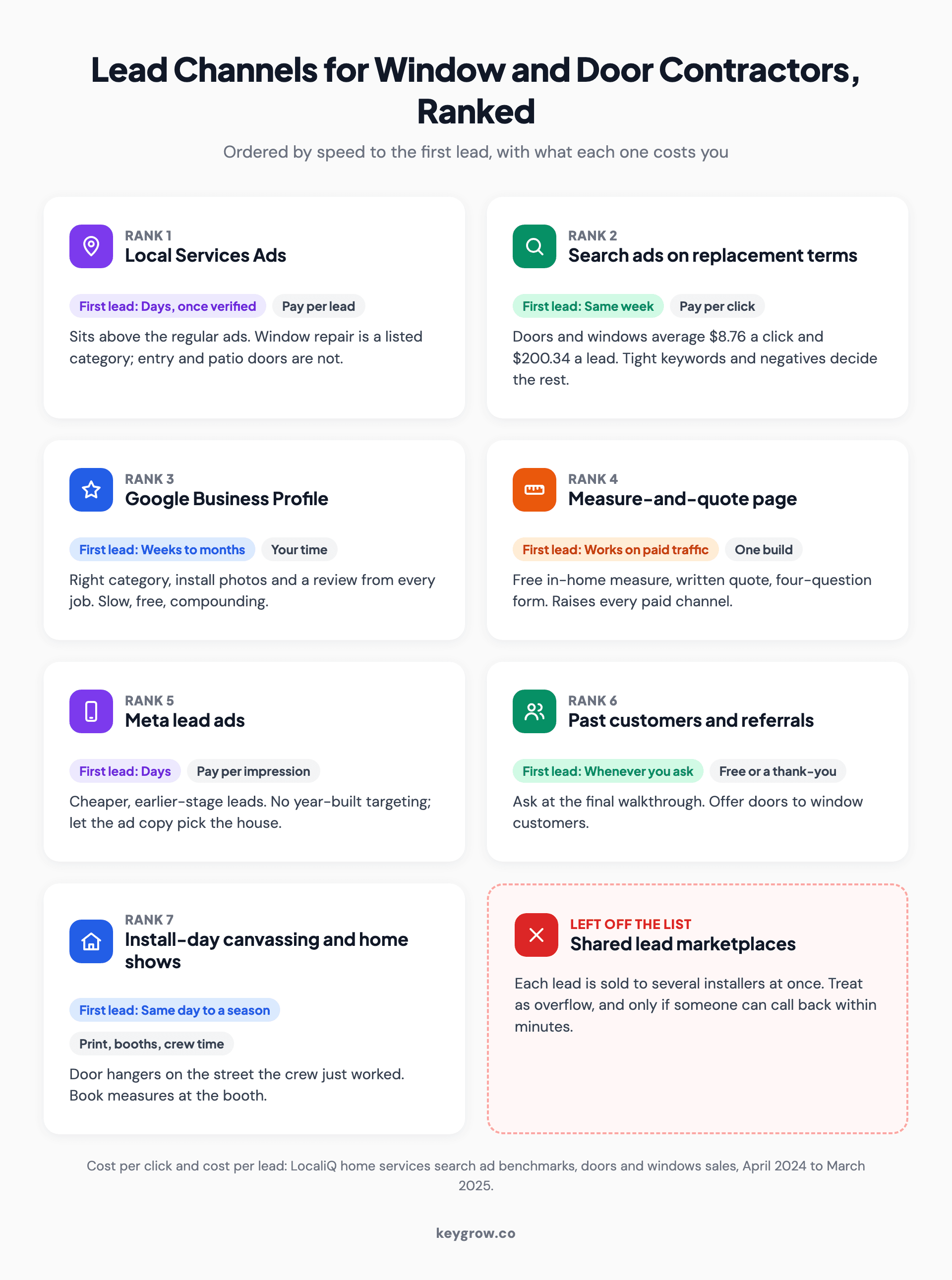
Ranked icon grid of seven lead channels for window and door contractors, ordered by speed to first lead: Local Services Ads, search ads on replacement terms, Google Business Profile, a measure-and-quote page, Meta lead ads, past customers and referrals, and install-day canvassing and home shows, each with its cost model.
| Rank | Channel | First lead | What you pay | Lead quality |
|---|---|---|---|---|
| 1 | Local Services Ads | Days, once verified | A price per lead, set by Google for your market and job type | High intent, mostly calls |
| 2 | Search ads on replacement terms | Same week | Per click: $8.76 average CPC, $200.34 per lead for doors and windows (LocaliQ) | High, if the keyword list is tight |
| 3 | Google Business Profile | Weeks to months | Your time, no media cost | High and local |
| 4 | Measure-and-quote page | Works on traffic from 1, 2 and 5 | One build | Raises every paid channel |
| 5 | Meta lead ads | Days | Per impression, cheaper leads | Early stage, needs a filter question |
| 6 | Past customers and referrals | Whenever you ask | Free, or a small thank-you | The warmest you will get |
| 7 | Install-day canvassing and home shows | Same day to a full season | Printing, booth fees, crew time | Slow to close |
Shared lead marketplaces are missing on purpose. A shared lead is sold to several installers at once, so you pay to enter a race that starts when the homeowner hits submit. Treat them as overflow, if at all.
1. Local Services Ads, if your trade has a category
Local Services Ads bill you for each lead instead of each click, and they sit above the regular ads. Window companies can usually join. Door-only installers often can't.
Google's US category list for Local Services includes window repair services, siding services, general contractor and garage door services. It has no entry door or patio door category. Most replacement window companies enroll under window repair (read the job types Google shows during sign-up before you assume replacement is covered). A company that only installs doors has to qualify as a general contractor or skip the channel. The same eligibility question comes up in Local Services Ads for paving companies.
Google screens the business before the Google Verified badge appears, and the checks vary by trade and state. After that, leads come in as calls and messages. An unanswered call is a homeowner who will try the next company on the list, so route the LSA number to a phone a person picks up during business hours.
2. Search ads on replacement terms
Bid on replacement and installation phrases with a city, a cost or a product attached. Exclude everything else, and send the clicks to a page that books a measure.
"Windows" is also an operating system, a car part, a cleaning trade and an aisle in the blinds store.
"Doors" is a band. A broad campaign will pay $8.76 a click for every one of them.
| Buy | Exclude as negatives |
|---|---|
| window replacement [city] | software, laptop, update |
| replacement windows cost | cleaning, washing, tint |
| window installation near me | car, auto, windshield |
| patio door replacement | blinds, shades, screens |
| entry door installation [city] | DIY, how to install, parts, jobs |
Costs are climbing. LocaliQ found door and window click prices rose more than 46 percent year over year, and only 4.41 percent of clicks became leads, against 7.33 percent across home services. A loose keyword list makes both numbers worse.
If you would rather hand the keywords and bids to someone else, that is what our Google Ads management for contractors covers. Price the site visit too, not only the lead; our post on the estimate cost behind contractor Google Ads shows that math.

Hammer and power drill resting on a window sill during a window repair job.
What $3,000 a month buys
Here is the arithmetic at LocaliQ's door and window averages. The booking and close rates are illustrative, so swap in your own.
| Step | At benchmark | With a 5-minute callback |
|---|---|---|
| Clicks at $8.76 | 342 | 342 |
| Leads at 4.41% | 15 | 15 |
| Book a measure | 9 (60%) | 12 (80%) |
| Signed at 1 in 3 | 3 jobs | 4 jobs |
| Cost per measure | $333 | $250 |
| Media cost per signed job | $1,000 | $750 |
The bid did not change. The callback did.
Moving the booking rate from 60 to 80 percent cut the media cost per job by a quarter, which is a bigger saving than most bid strategies will find you.
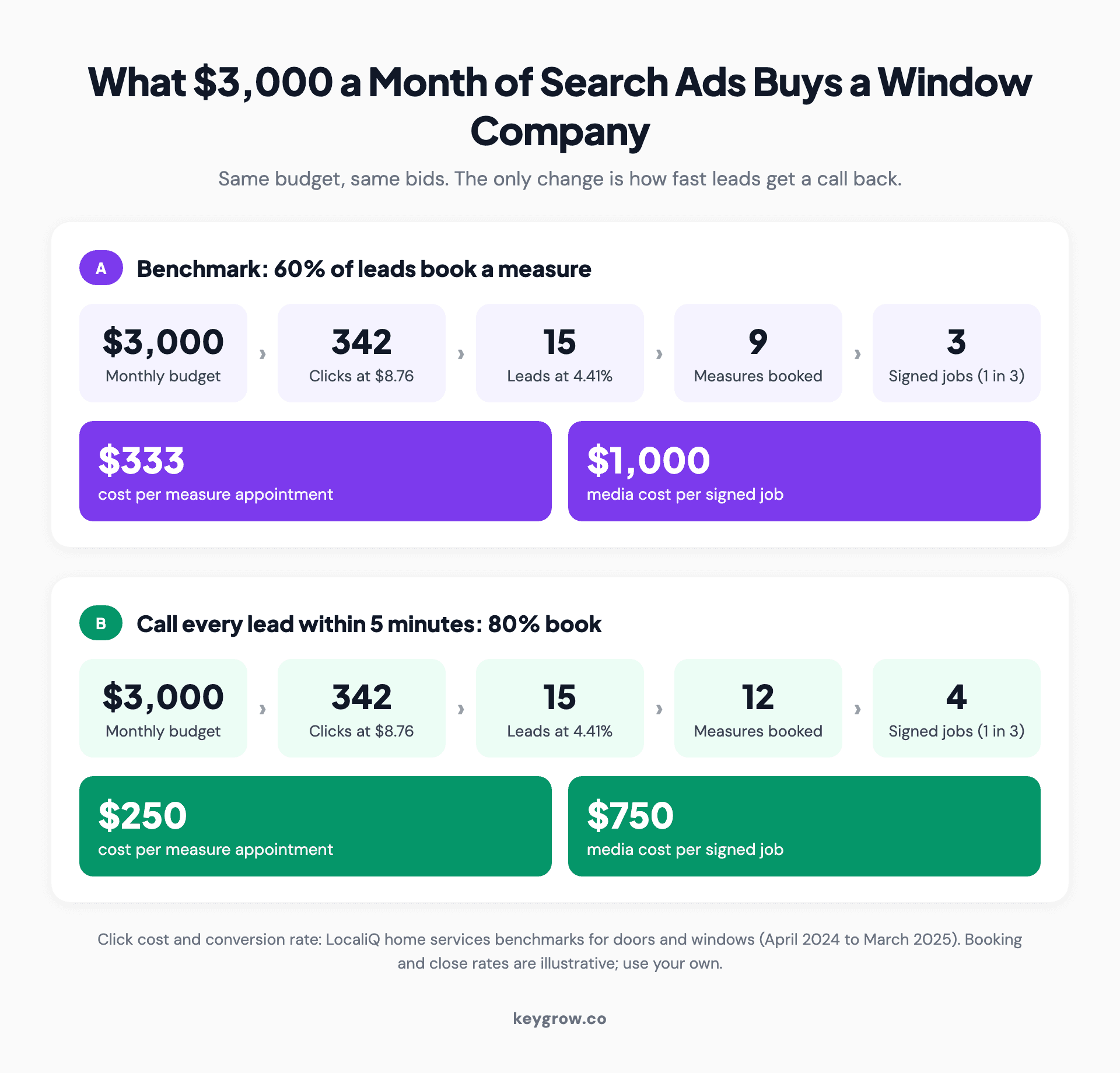
Flow diagram of a $3,000 monthly search budget for a window company at benchmark rates: 342 clicks, 15 leads, 9 booked measures and 3 signed jobs, compared with 12 measures and 4 jobs when every lead gets a call within five minutes.
3. Google Business Profile: free, slow, and it compounds
Your profile is the cheapest lead source you control, and it mostly comes down to the right category and a steady trickle of reviews.
Choose a primary category for installed work, such as window installation service, rather than a supplier category that says showroom. Add secondary categories for the door work you do. Then fill the photo section with finished installs, outside and in, because a homeowner weighing a five-figure quote wants to see houses like theirs.
Reviews work best as a habit. Ask at the final walkthrough, while the homeowner is standing at the new window. Our guide to Google Business Profile setup for contractors covers the service-area settings and where your license number goes.
The profile is one piece of local search. Service pages for each product and the towns you install in carry the rest. If you would rather have someone else run the profile and those pages, our SEO for remodeling contractors is built around that mix.
4. Build the quote page around a measure
Every paid click should land on a page that offers a free in-home measure and a written quote. Not your homepage.
Sending ad traffic to a homepage is the most expensive default in paid search. A paid visitor wants one answer: can you come out, and when? A mobile car detailing client of ours was paying around $100 per booking with ads pointed at the homepage. A dedicated booking page and a rebuilt campaign took it to $22 between August and December 2022 (the detailing case study).
Different trade, same mechanism.
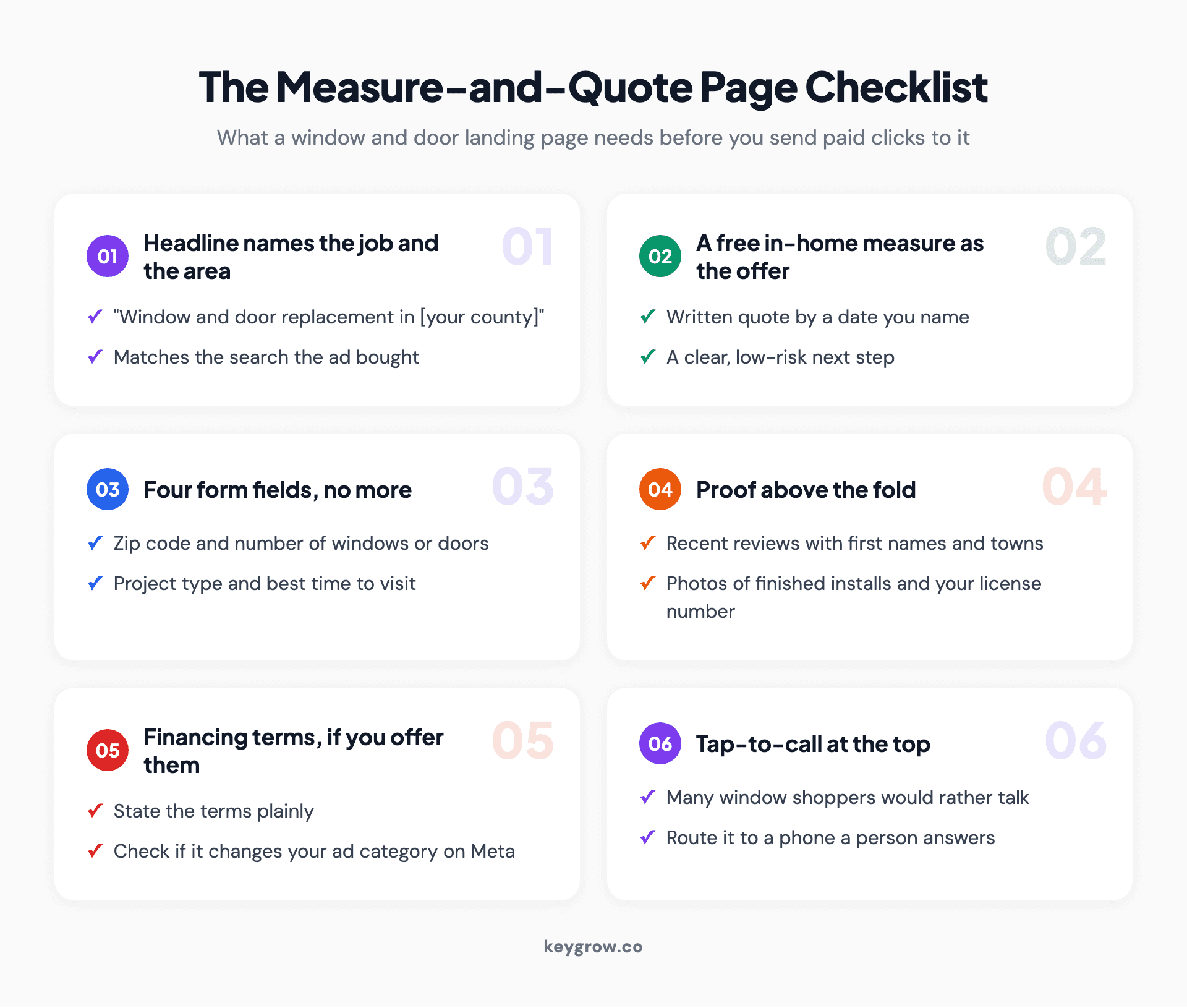
Checklist of what a window and door measure-and-quote page needs: a headline naming the service and area, a free in-home measure offer, a four-question form, proof from reviews and install photos, financing terms if offered, and a tap-to-call button.
The form should ask for a zip code, how many windows or doors, the project type (replacement, new opening or repair) and the best time to visit. That is enough to route the lead and prepare the measure. Put a tap-to-call button at the top, because plenty of window shoppers would rather talk. If you would rather not build it yourself, our landing page design services cover this kind of page.
5. Meta lead ads: target the area, let the ad pick the house
Meta can deliver cheap, early-stage window leads, but it will not target by the age of a house, and special ad categories remove zip code targeting entirely.
The audience is easy to describe. NAHB's analysis of 2024 Census survey data puts the median owner-occupied home at 42 years old, and about 47 percent of them were built before 1980.
Those are the houses your ads are for.
Meta has no filter for the year a house was built. And if your campaign falls under a special ad category (housing, or financial products and services when the ad leads with financing), Meta's developer documentation spells out the limits: age is fixed at 18 to 65+, every location must cover at least a 15-mile radius in the US, zip codes are not supported, and lookalike audiences are off. Whether your window ad needs a category is a policy call, so check with whoever handles compliance before planning around zip codes.
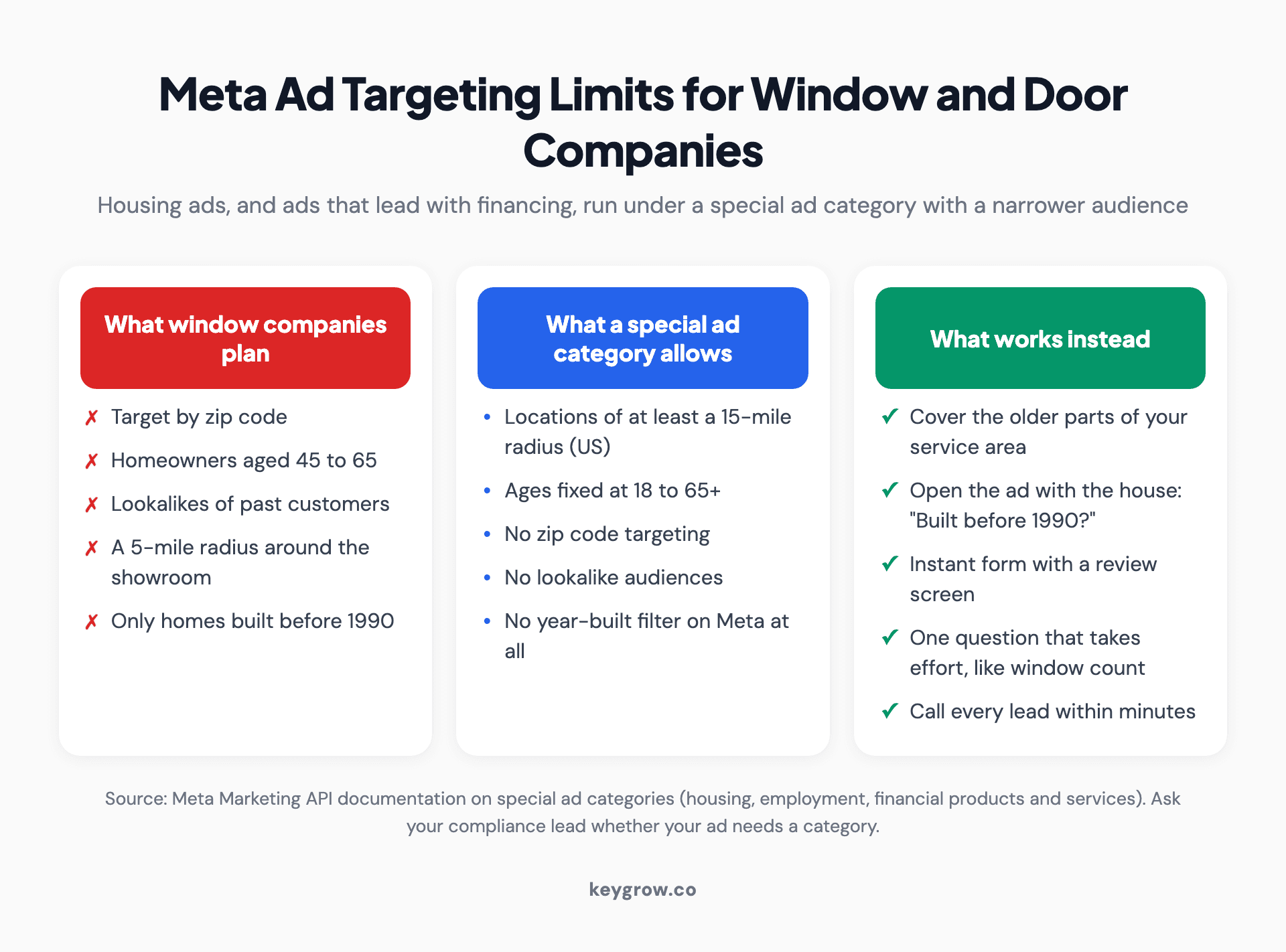
Comparison cards showing what window and door companies usually plan for Meta ads, such as zip code targeting, homeowners aged 45 to 65, lookalikes of past customers and a 5-mile radius, against what a Meta special ad category allows (a 15-mile minimum radius, ages 18 to 65+, no zip codes, no lookalikes) and what works instead, such as ad copy that names older homes and a qualifying form question.
So let the creative do the targeting. Cover the older parts of your service area and open with the house: "Built before 1990? Your windows may be the originals." Use an instant form with a review screen and one question that costs effort to answer, such as how many windows need replacing. Our guide to Facebook lead ads that filter covers the form setup in detail.
6. Past customers and referrals
Your installed base is the warmest lead source you have. Ask for the referral at the final walkthrough, and offer doors to the people who bought windows.
Doors are an easy second sale. The 2025 Remodeling Impact Report from the National Association of Realtors estimates that a new steel front door recovers 100 percent of its cost at resale, a fiberglass front door 80 percent and new vinyl windows 74 percent. A homeowner who just spent on windows will listen to that.
Keep the ask simple: a card with the crew lead's name, a text a week after install, and a thank-you for any referral that books a measure, where your state allows one.
7. Install-day canvassing and home shows
A finished install is an ad the whole street can see. Door hangers on the day the crew leaves cost almost nothing; home shows cost more and close slower.
In a subdivision, houses on the same street were often built in the same year with the same windows, so they tend to wear out together. Before the crew leaves, put a yard sign in with the owner's permission and hang 20 cards on the doors either side. Name the job ("we just replaced the windows at the white house on the corner") so neighbors know which house to look at.

Black front door with a welcome mat on a covered wooden porch.
Home shows bring volume, mostly early research. Take a calendar to the booth and book measures there; a name on a clipboard will be cold by Monday.
Plan the year around spring and fall
Replacement interest bunches into spring and early fall in most US markets, when homeowners feel drafts or heat and want the work done before the weather turns. Check your own market by looking up "window replacement" for your state in Google Trends.
Raise search and LSA budgets three to four weeks before your busy season, since a campaign coming back from a quiet spell needs data before its bids settle. Spend the slow months on reviews and past-customer texts. A measure booked in February for an April install still counts.
When you do not need an agency
If you run one crew and you are booked eight weeks out, you do not need paid ads, and you certainly do not need us. Claim your Google Business Profile, get a review from every job, and ask every customer for a referral. Start buying leads when the backlog drops low enough that a new lead could actually be installed this season.
FAQs
How do window and door contractors get leads?
The fastest sources are Google Local Services Ads and search ads on replacement terms such as window replacement plus a city. The cheapest over time are a well-run Google Business Profile and referrals from past customers. Most companies need one fast channel and one slow, compounding one.
How much does a window replacement lead cost?
LocaliQ's 2025 home services benchmarks put the average cost per lead for doors and windows search ads at $200.34, with an average click cost of $8.76. Local Services Ads price each lead by market and job type, so the only reliable number is your own after a month of running them.
Are shared window leads worth buying?
Sometimes, as overflow. A shared lead goes to several companies at once, so it only pays if your office can call within minutes and you track how many turn into booked measures. If they do not book, stop buying them.
What is a good offer for window replacement ads?
A free in-home measure with a written quote by a stated date tends to beat a percentage discount, because it gives the homeowner a clear, low-risk next step. Financing terms help on large jobs, but check whether a financing ad changes your ad category on Meta.
Can window companies target older homes on Facebook?
Not directly. Meta offers no filter for the year a house was built, and campaigns in a special ad category lose zip code targeting and must cover at least a 15-mile radius. Use the ad copy and a qualifying form question to attract owners of older homes instead.
Book the measure before the quote goes cold
Every channel above ends with a homeowner waiting to hear back. Send an automatic text within a minute. Call within five minutes. Offer two specific measure slots. Follow up on day one, three and seven if nobody answers.
That routine costs nothing, and at door and window lead prices, every booked measure you keep is worth a couple of hundred dollars of media. If you want help setting up the channels that feed it, start with a quote and we can talk through which two to run first.