


Every contractor lead has a second price tag, and it never appears in Google Ads.
The first price is what you paid for the click. The second is what it costs to produce the estimate: the drive out, the measure, the takeoff, writing the proposal, and the two follow-up calls. That is several hours of skilled time, usually the owner's, and it is the single largest cost in a contracting sales process. Google reports the first number and has no idea the second one exists.
Which is why the standard advice, get more leads and lower your cost per lead, quietly makes most contractor accounts worse. More leads means more site visits, and site visits are the constrained resource. Google Ads for contractors works when it produces fewer, better-qualified estimate appointments. It fails when it produces a full calendar of free consultations for people who were never going to sign.
Price the estimate, then price the lead
Run the numbers with your own figures. The result usually surprises people who have only ever looked at cost per lead.
Start with the benchmark. Home and home improvement runs an $8.33 average cost per click, an 8.05 percent conversion rate and a $90.92 cost per lead in WordStream's 2026 benchmarks.
Now add the part that is missing. The assumptions below are illustrative, not benchmarks, so substitute your own:
| Step | Figure | Where it lands |
|---|---|---|
| Leads generated | 20 | $1,818 in media at $90.92 each |
| Warrant a site visit | 12 (60%) | 8 filtered out, ideally on the phone |
| Estimating time each | 3.5 hours | 42 hours total |
| Signed, at one in three | 4 jobs | |
| **Media per signed job** | **$455** | The number Google can see |
| **Estimating per signed job** | **10.5 hours** | The number it cannot |
Ten hours of skilled labor per signed job. Price that at whatever an hour of your time is genuinely worth and it usually exceeds the media cost by a wide margin.
That changes what a good campaign looks like. If you cut leads from 20 to 14 but raise the share warranting a site visit from 60 to 80 percent, you get roughly the same number of signed jobs on less media and about the same estimating hours, with the estimates going to better prospects. Your cost per lead went up. Your business got better.
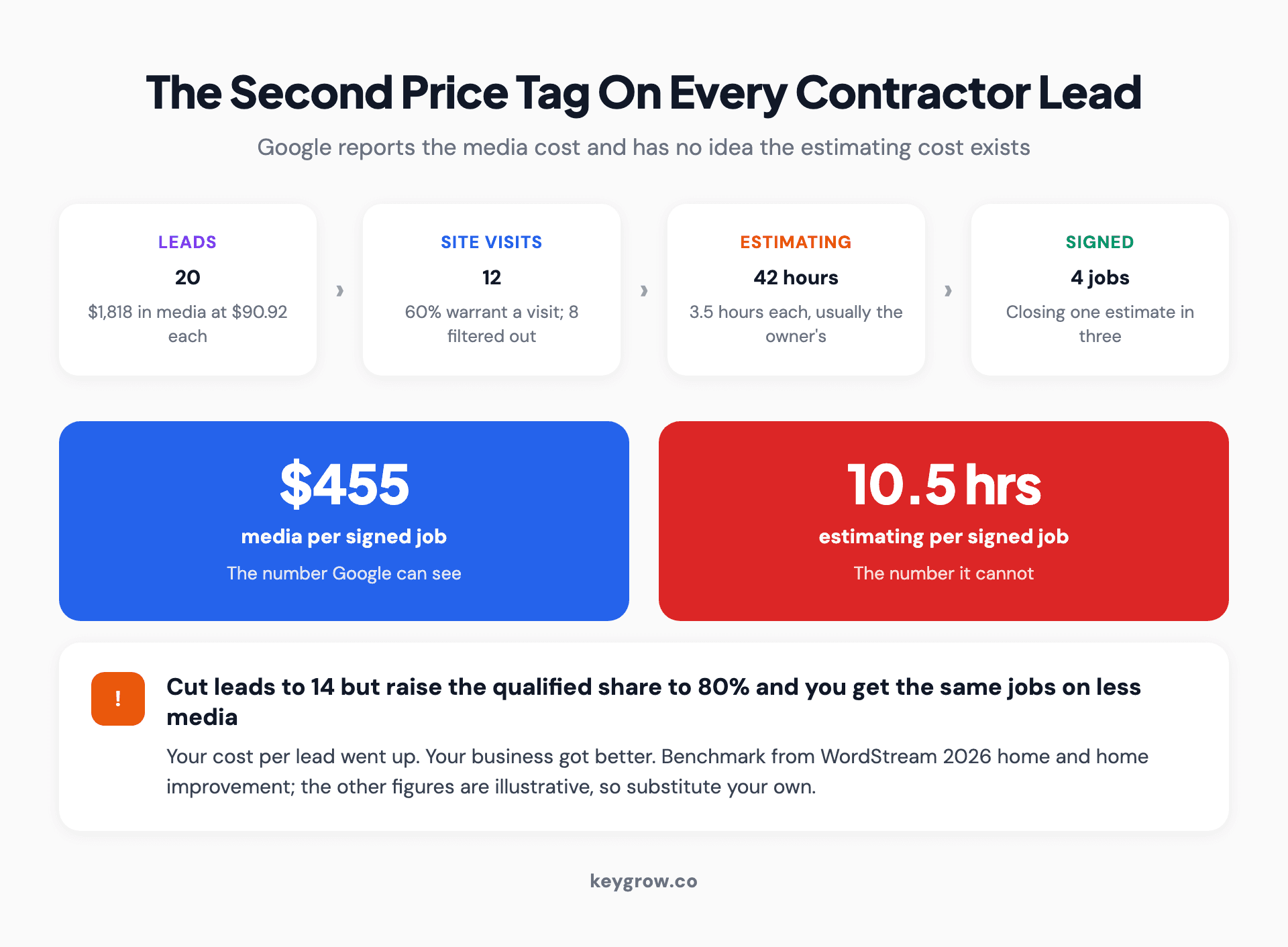
A four-stage flow from 20 leads through 12 site visits and 42 hours of estimating to 4 signed jobs, ending in two figures: $455 of media per signed job and 10.5 hours of estimating per signed job.
More traffic is the wrong fix for bad lead quality, and contracting is the clearest example of it in local marketing. We had a real estate investor client drowning in junk inquiries, and the fix was not more volume but filtering: negative keywords, tighter match types, and qualifying language in the ads themselves. Their count of serious inquiries rose 600 percent over a single month, on an unchanged budget. The mechanism transfers directly to a contractor account, where the cost of an unqualified inquiry is not the click, it is the Tuesday afternoon.
The word contractor is doing too much work
Before any strategy, deal with the keyword itself, because "contractor" is one of the most overloaded words you can buy.
It means at least five different things to a search engine: a general contractor who builds and remodels, a trade contractor in roofing or electrical, a government or defense contractor, an independent contractor in the employment sense, and someone researching how to become licensed as one.
Bid on it broadly and you will pay $8.33 a click for people looking for a contractor licensing exam, a 1099 tax form, or a job. This is not a small leak. On a generic contractor campaign it is frequently the majority of spend before anyone builds a negative list.
Two rules follow. Never run "contractor" on broad match. And build the negative list before launch rather than after the first monthly report, because at these click prices a month of learning is expensive tuition.
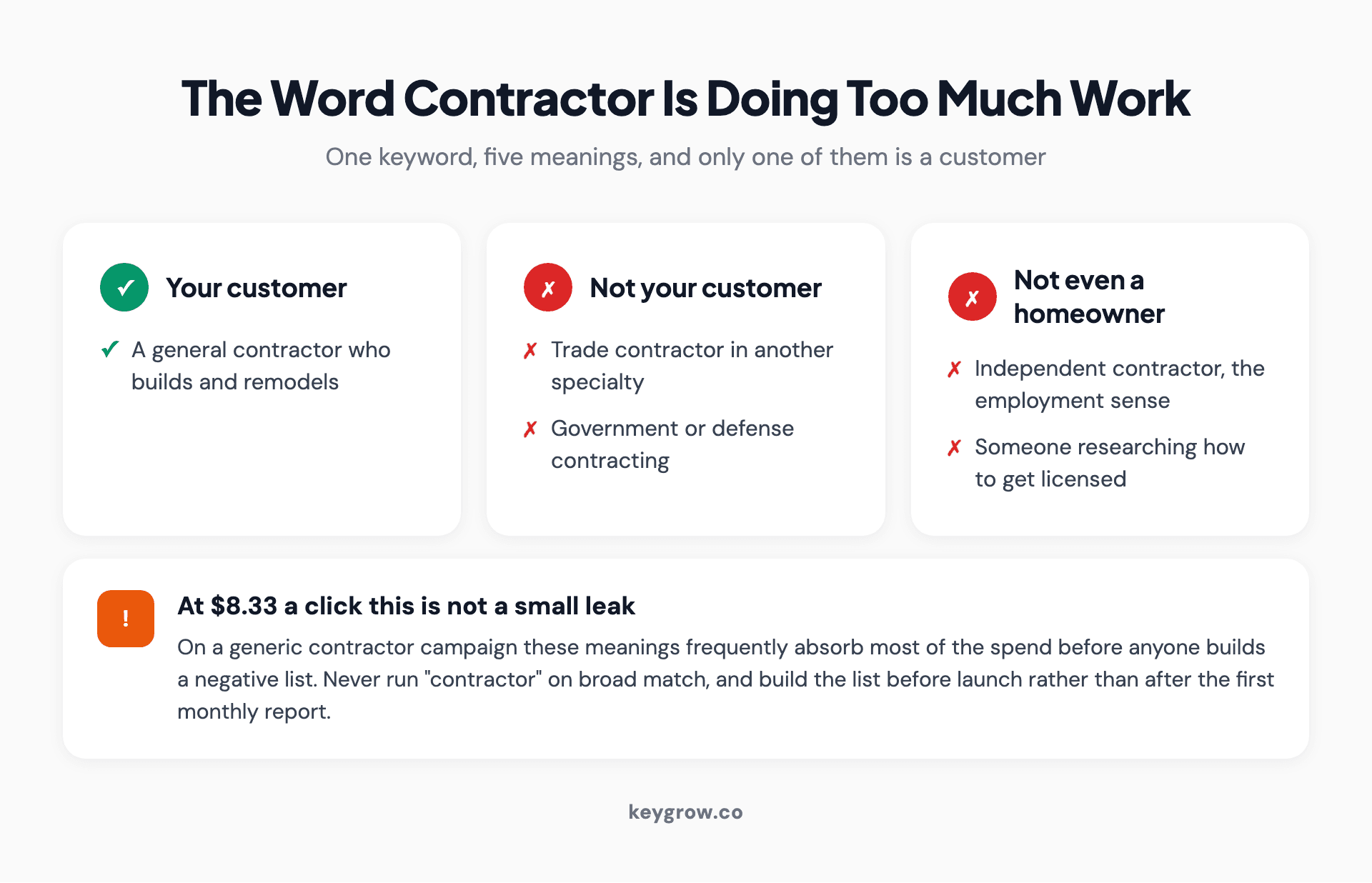
Three cards separating the five meanings of the word contractor, showing that only the general contractor who builds and remodels is a customer.
Publish a minimum project size
State the smallest project you take, in the ad and on the page. It is the single most useful change available to a contractor account and almost nobody makes it.
The objection is immediate: it will reduce inquiries. It will. That is the entire point, because the inquiries it removes are the ones that would have consumed a site visit and then balked at the number.
"Kitchen and whole-home remodels from $40,000" costs you the people with a $6,000 budget, who were never going to become a job, and who would have taken four hours to discover that. It also does something less obvious: it signals to the right buyer that you work at their level. A homeowner planning a $90,000 renovation is actively looking for signals that you are not a handyman with a website.
If a hard number feels too blunt, the softer versions still work: name the project types you specialize in, state a typical project range, or say "full renovations only, we do not take single-room repairs." Any of these does more filtering than the ad copy most contractors run, which says "free estimates" and invites exactly the traffic you cannot afford.
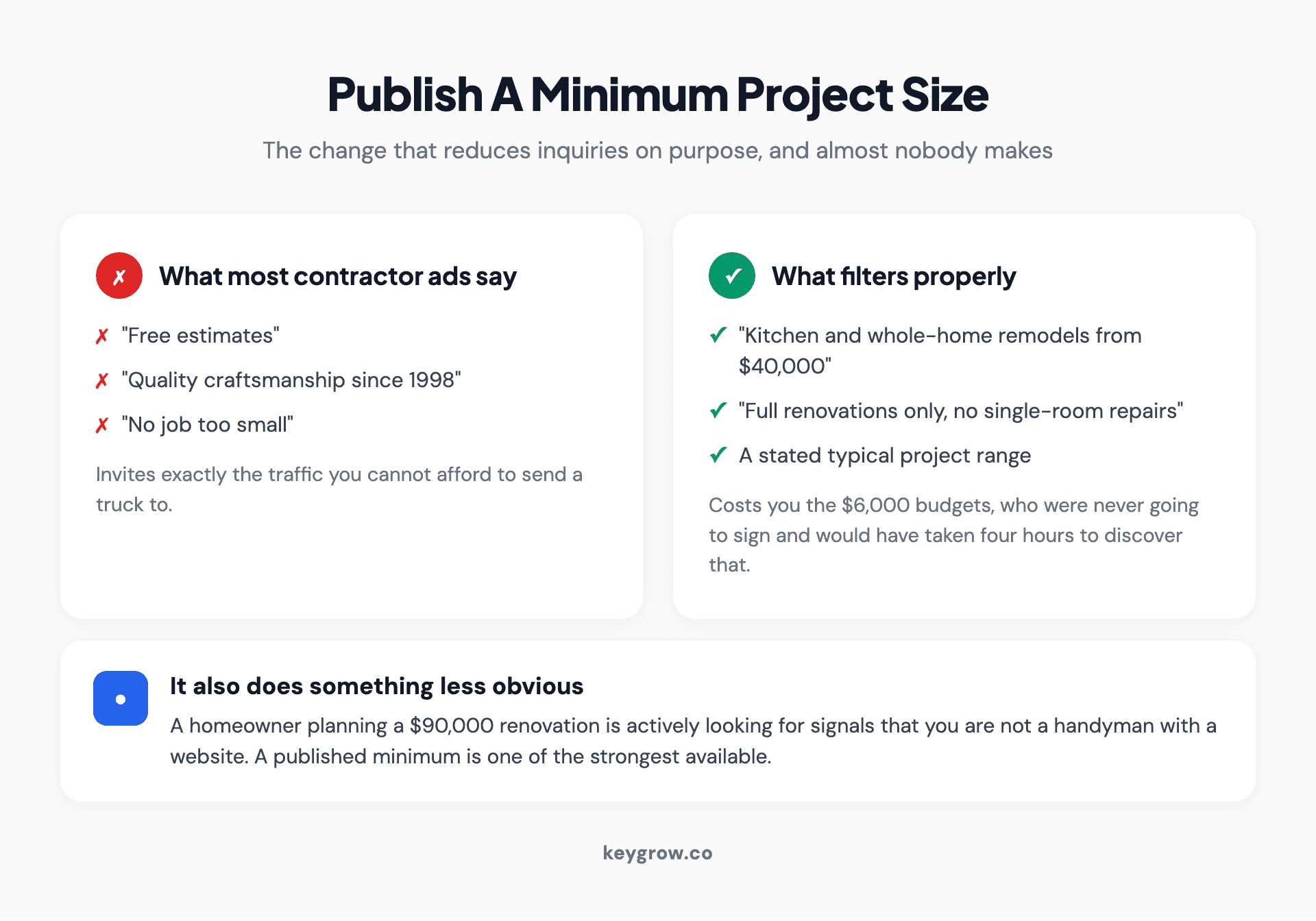
Two-column card layout contrasting typical contractor ad copy such as free estimates against copy that filters properly, including a published minimum project size.
Buy the project, not the trade
Structure the account around the jobs you want, each with its own campaign, budget and page. "General contractor" as a catch-all campaign is where budgets go to die.
The project-level searches worth their own campaign:
- Kitchen remodel and bathroom remodel, the two highest-volume remodeling categories, each with a defined scope a searcher already has in mind.
- Home addition and second story addition, lower volume, much higher value, and far less contested.
- Whole home renovation and gut renovation, long consideration and the largest tickets you will see.
- Basement finishing, garage conversion, ADU builder, which are specific enough that the searcher is usually well past the browsing stage.
- Commercial build out and tenant improvement, a different buyer entirely, different hours, and worth separating so a residential budget never absorbs it.
Each of these deserves a page about that project, not a general services page. The searcher typed "kitchen remodel contractor" and should land on kitchens, with kitchen photos, a kitchen price range and kitchen timelines.
Where a project-level search is genuinely unavailable, "general contractor near me" is still worth running, but capped and watched, because it is the ambiguous term in this account rather than the worthless one.
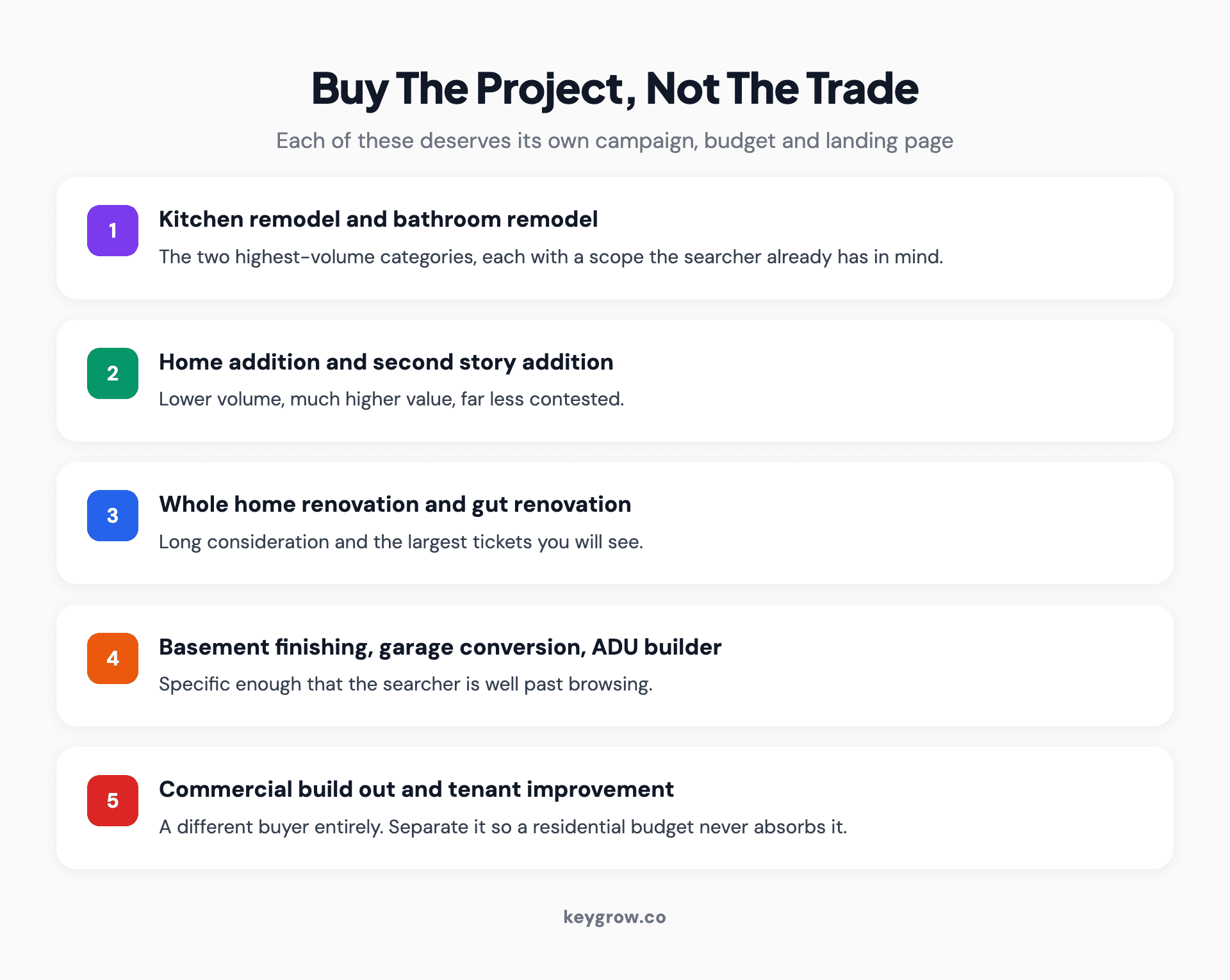
Five numbered cards listing the project-level contractor searches worth their own campaign, from kitchen and bathroom remodels through to commercial build out.
The searches that look right and are not
Four groups drain contractor budgets, and three of them look plausible in a keyword tool.
| Group | Examples | Why it fails |
|---|---|---|
| Career and licensing | contractor license, contractor exam, how to become a contractor, contractor insurance | Not a customer, high volume |
| Employment sense | independent contractor, 1099 contractor, contractor agreement, contractor rates | Wrong meaning of the word entirely |
| Materials and DIY | cabinet prices, how to tile, drywall cost per sheet, permit requirements | Wants to do it themselves |
| Cost research, very early | how much does a kitchen remodel cost, average remodel cost | Months from a decision, rarely converts on first visit |
That last group is the argument. Cost research terms convert badly and they are genuinely early, but they are also the exact moment a homeowner forms a shortlist. If you run them at all, run them in a separate campaign with a small budget, point them at a genuinely useful cost guide rather than a contact form, and judge them on assisted conversions over months instead of last-click leads. If you cannot commit to measuring them that way, block them and spend the money on project-level searches. Our negative keyword method covers the mechanics of building the list.

Two construction workers in high-visibility vests and hard hats on a concrete deck laid with rebar and coiled cable.
Speed decides more than price
Homeowners contact three to four contractors and hire based on who responds, who shows up, and who follows through. Price matters less than contractors believe, and responsiveness matters far more.
At an $8.33 click, an inquiry that sits until Thursday is an expensive way to lose to whoever called back in twenty minutes. This is where most contractor accounts actually fail, and no bidding change will fix it.
The practical version:
- Call back the same day, ideally within the hour, even if only to book the site visit.
- Schedule the visit on that first call. Momentum decays fast in this category.
- Send the written estimate when you said you would. A large share of contractors do not, which is a low bar and a real advantage.
- Follow up twice. Most signed jobs in remodeling come after at least one follow-up, not on the first proposal.
If the phone is not being answered during working hours, pause the campaign and fix that first. It is not a marketing problem but it will destroy a marketing budget.
Local Services Ads are a real alternative here
General contractor is a Local Services Ads vertical, which matters because LSA charges per lead rather than per click and puts a Google-screened badge on the listing.
According to Google's screening requirements, a general contractor is described as a service provider who provides material and builds services necessary for building construction, and the listed requirements include a business background check, an owner background check, and both general liability and professional liability insurance.
The badge is worth more in this category than in most, because a homeowner letting a crew into their house for three months is buying trust before anything else. Run both formats where you can: LSA for the trust signal and the pay-per-lead economics, search ads for the control to target specific project types with specific pages. Where that channel earns its place, and where it falls short, is set out in our Local Services Ads review.
Start verification early. Background checks and insurance verification take time, and discovering that in spring when you wanted to be live is a familiar and avoidable mistake.
What the page has to prove for a $40,000 decision
A homeowner about to spend a year's savings and live in a construction site for three months needs more than a gallery.
Put these above the fold or close to it: your license number and insurance, real photographs of completed projects in that same category, and a project price range so people can self-select. Then, further down, the parts nobody else includes: how long a project like theirs typically takes, what the payment schedule looks like, who is actually on site day to day, and what happens when something goes wrong mid-project.
That last one is the trust move. Every homeowner has heard the horror story. A contractor who addresses it directly, in writing, before being asked, separates themselves from everyone still leading with "quality craftsmanship since 1998."
Reviews matter more here than in nearly any other trade, and reviews that mention the specific project type matter most. There is more on the page-versus-site question in our note on ad landing pages.
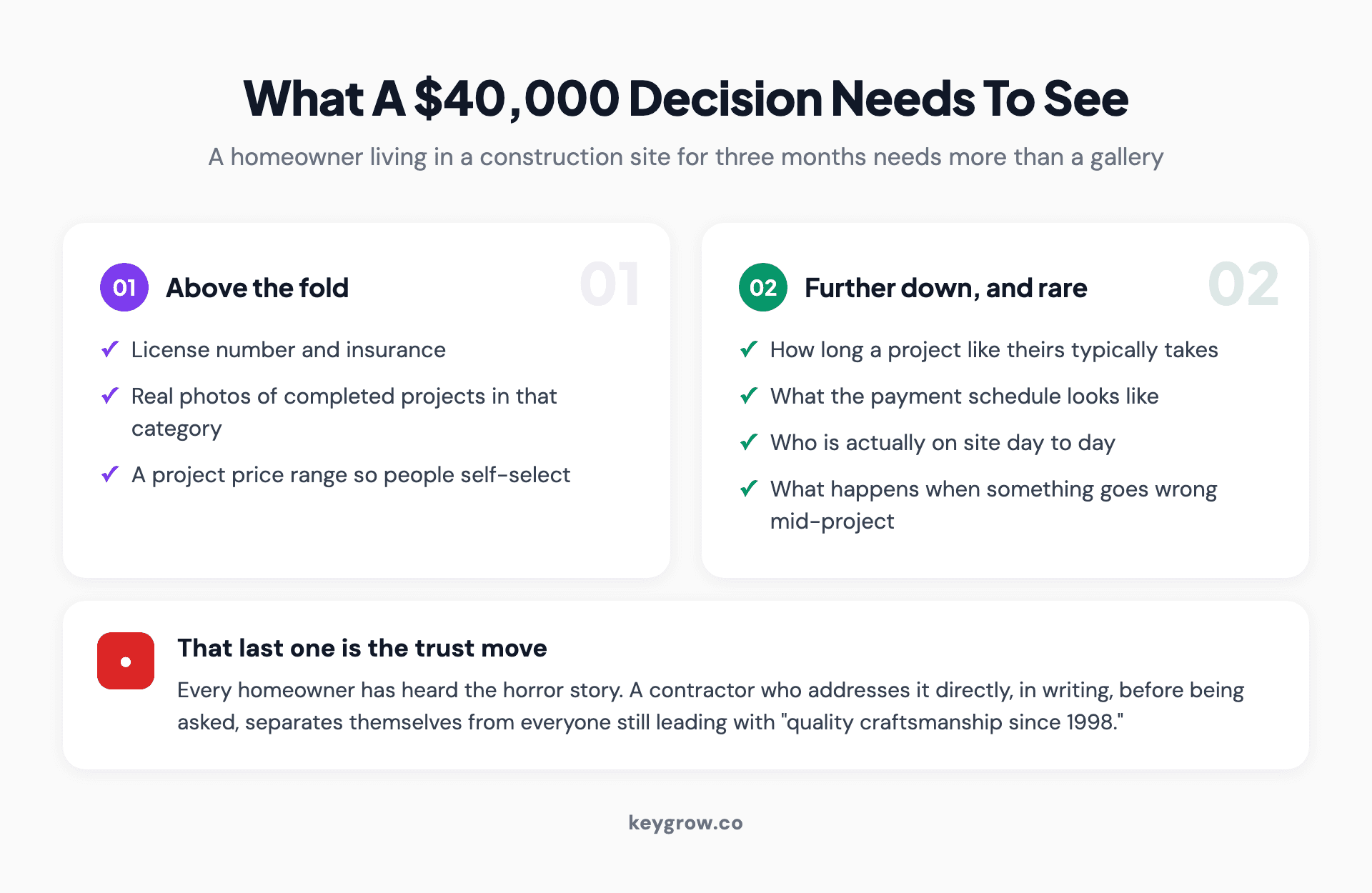
Two-column card layout of what a contractor landing page must show for a $40,000 decision, from license and insurance above the fold to payment schedules and what happens when something goes wrong.
Count signed contracts and estimating hours
Report two things monthly and the account will run itself into shape: cost per signed contract, and hours of estimating per signed contract.
The first is standard and most contractors already track something like it. The second is the one nobody measures, and it is the one that tells you whether your lead quality is improving. If estimating hours per signed job are falling, your filtering is working even if your cost per lead went up.
Beyond that, feed contract values back into Google Ads where you can, so bidding optimizes toward the project types that actually sign rather than toward the cheapest inquiry. A bathroom refresh and a whole-home renovation should not be the same conversion. The offline import mechanics are in our guide to lead value from PPC, and the budget calculator will do the forward version of the arithmetic at the top of this article.
Give it a full quarter before drawing conclusions. Remodeling decisions run months, and a January inquiry frequently signs in April.
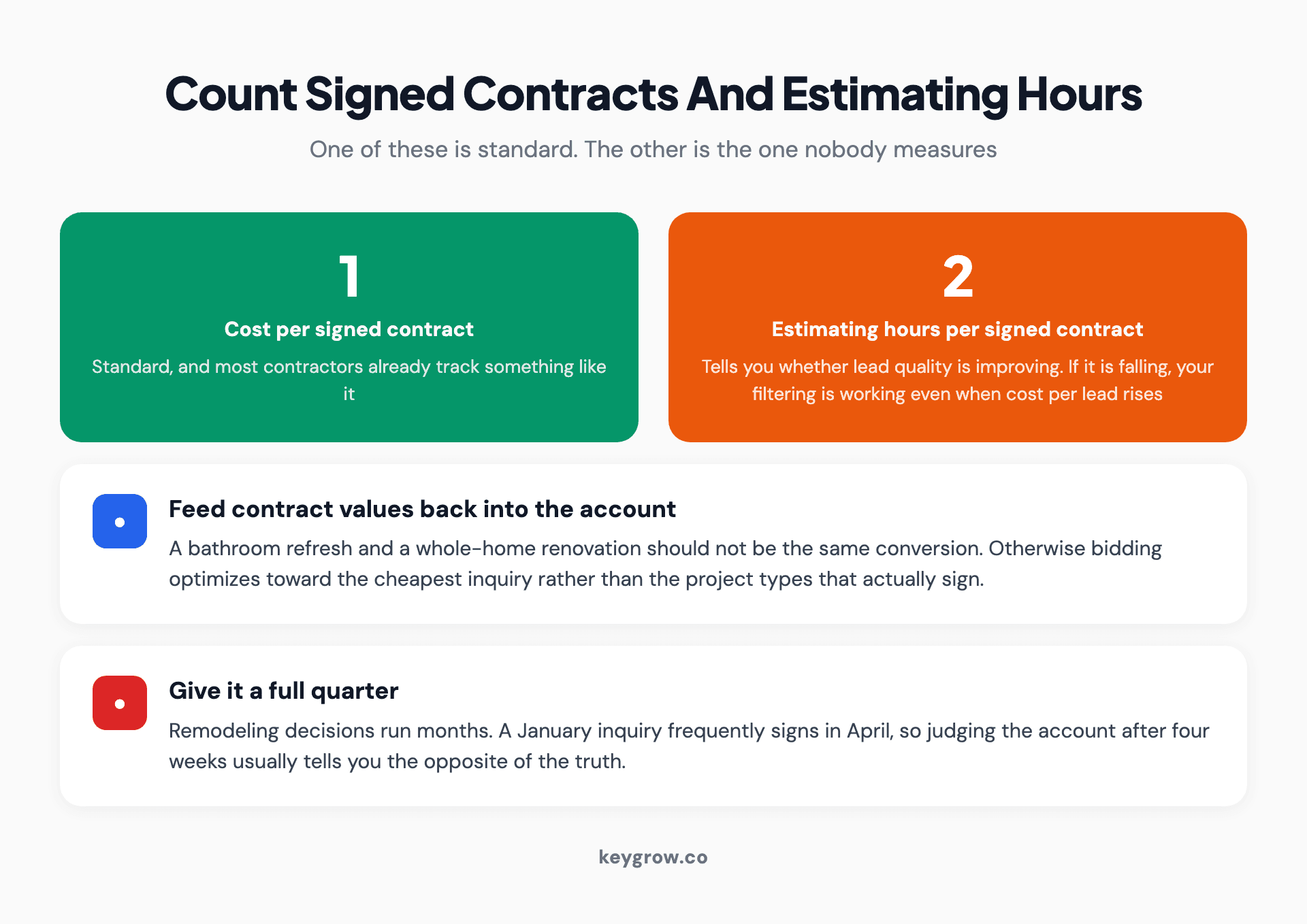
Two stat cards naming the metrics a contractor should report monthly: cost per signed contract and estimating hours per signed contract.
The nine months before anyone is ready to click
Paid search is affordable in the last two weeks of a renovation decision and ruinous before that. The inspiration, cost and feasibility stages run for months, and the only economic way to reach them is content that stays up. We laid that out in SEO for contractors, including why a contractor's finished jobs are the pages that do the work.
FAQs
How much do Google Ads cost for contractors?
Home and home improvement runs an average cost per click of $8.33 with a cost per lead around $90.92, according to WordStream's 2026 benchmarks. The more useful figure is cost per signed contract, which depends on how many leads warrant a site visit and how many estimates you close. Most contractors land somewhere between $400 and $700 in media per signed job.
Are Google Ads worth it for a general contractor?
Yes, when the account is built for qualification rather than volume, because a single remodeling job is worth many thousands of dollars. It is a poor fit if you cannot answer inquiries the same day, or if your estimating capacity is already full, since more leads then just consume site visits you cannot spare.
What keywords should contractors avoid?
Anything using the other meanings of the word: contractor license, contractor exam, how to become a contractor, independent contractor, 1099 contractor, and contractor agreement. Also block materials and DIY searches like cabinet prices or how to tile. These carry high volume and no buying intent, and on a broad match campaign they frequently absorb most of the budget.
Should contractors use Local Services Ads or search ads?
Both, for different reasons. General contractor is a Local Services Ads vertical, where you pay per lead and carry a Google-screened badge, which matters in a category where trust decides the sale. Search ads give you the control to target specific project types with matching landing pages. Start LSA verification early, since background checks and insurance verification take time.
Should I put my minimum project size in the ad?
Yes. It will reduce your inquiry count, which is the point, because the inquiries it removes are the ones that would have consumed a site visit before revealing a budget you cannot work with. It also signals to larger prospects that you operate at their level, which matters more than most contractors expect.
How long before Google Ads produce jobs for a contractor?
Allow a full quarter. Remodeling decisions run for months, homeowners typically contact three or four contractors, and a January inquiry commonly signs in April. Judging the account after four weeks will usually tell you the opposite of the truth.
Why are my contractor leads such poor quality?
Almost always match type and negative keywords. Broad match on the word contractor pulls in job seekers, licensing researchers and DIY homeowners at full price. The second cause is ad copy that says "free estimates" without qualifying anything, which reliably attracts the people least able to pay for the work.
Fewer leads, better jobs
If you take one thing from this: your constrained resource is not budget, it is estimating capacity. Every hour spent measuring a kitchen for someone with a $6,000 budget is an hour not spent on a $60,000 project, and no bidding strategy recovers it.
So aim the account at qualification rather than volume. Publish a minimum. Buy project-level searches instead of the trade name. Block the licensing, employment and DIY meanings of the word contractor before you spend a dollar. Answer the phone the same day. Then measure signed contracts and estimating hours instead of leads, and let the cost per lead go wherever it goes.
If you would rather have that built and run against signed contracts, our home services team does this work and our PPC management is month to month, cancel anytime.