


A restaurant social week that fills tables is smaller than most owners think. One photo session on your slowest day. Four posts: a dish in motion on Tuesday, a social-only special on Wednesday, the weekend pitch on Thursday, a guest's photo on Saturday. Stories from the pass on Friday night. Replies to messages before lunch and before dinner. Thirty minutes on Sunday counting what came in.
That is restaurant social media marketing built for covers, and the whole week takes under three hours. The sample week below answers "what should we be posting?" because every slot has one job you can count: a dish ordered, a table booked, a walk-in on a Friday. A post that can't be counted doesn't get a slot.
Social media for restaurants needs its own playbook because the decision is fast. Someone picks tonight's dinner this afternoon and Saturday's table on Thursday. For other trades, our checklist for social media for local business covers the general rules.
A sample week you can run in under three hours
Shoot once, post four times, add Stories during service, answer messages every day and count on Sunday. Each slot drives one result you can check.
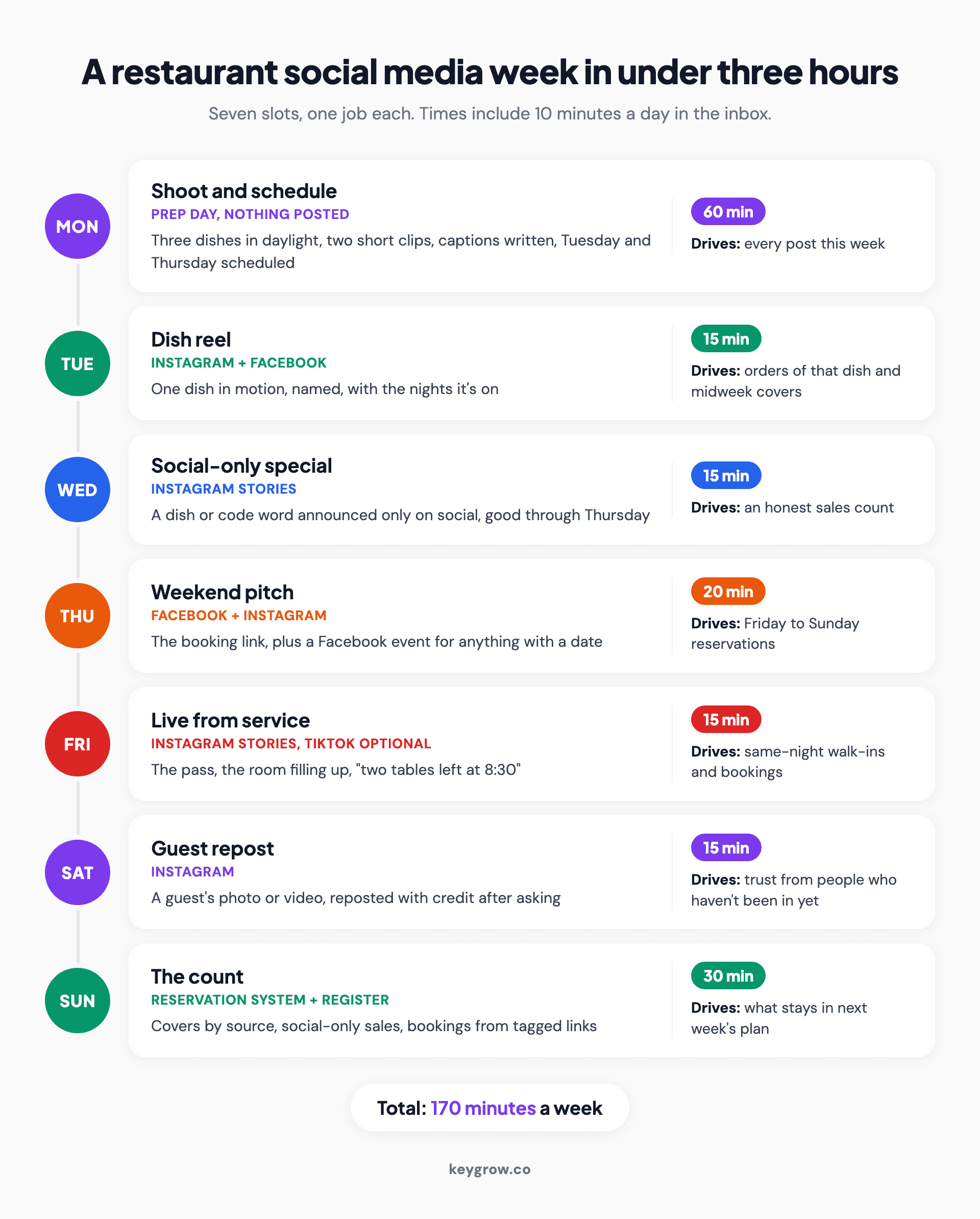
Timeline of a sample restaurant social media week from Monday to Sunday: a Monday shoot, a Tuesday dish reel, a Wednesday social-only special, a Thursday weekend post, Friday Stories during service, a Saturday guest repost and a Sunday count, with the minutes and the result each day should drive.
The times include ten minutes a day in your inbox, five before lunch service and five before dinner.
| Day | Platform | Post type | Time | What it should drive |
|---|---|---|---|---|
| Monday | None, it's prep day | Shoot three dishes in daylight plus two short clips, write captions, schedule Tuesday and Thursday | 60 min | Every post this week |
| Tuesday | Instagram and Facebook | Reel: one dish in motion, named, with the nights it's on | 15 min | Orders of that dish and midweek covers |
| Wednesday | Instagram Stories | A dish or code word announced only on social, good through Thursday | 15 min | A sales count you can trust |
| Thursday | Facebook and Instagram | The weekend post with your booking link, plus a Facebook event for anything with a date | 20 min | Friday to Sunday reservations |
| Friday | Instagram Stories, and TikTok if you use it | Live from service: the pass, the room, "two tables left at 8:30" | 15 min | Same-night walk-ins and bookings |
| Saturday | A guest's photo or video, reposted with credit | 15 min | Trust from people who haven't been in yet | |
| Sunday | Your reservation system and register | The count: covers by source, social-only sales, bookings from tagged links | 30 min | Next week's plan |
That's 170 minutes.
Monday carries the load because one session in good light beats seven rushed phone shots in the middle of service. Schedule Tuesday and Thursday while you're at it, so they go out whether or not anyone remembers.
Shoot by the same window at the same hour every Monday and the feed looks consistent without a brand guide. One plate per shot. Overhead for flat dishes, a lower angle for anything tall.
Thursday gets the weekend post because people picking a place for Saturday dinner decide before Saturday. Friday's Stories catch the ones who decide at 6 p.m.
Move the days to fit your week. If you close Tuesdays, slide everything a day. Keep the order, though: shoot, show the dish, run something countable, pitch the weekend, show the room, thank guests, count.
Give every job an owner
The owner or GM runs Monday and Sunday. A shift lead posts during service, and whoever takes bookings records where each guest heard about you.

Two cooks at the pass plating a salad during service, the kitchen side of a restaurant social media week, where someone has to flag which dishes are limited before anyone promotes them.
An account that belongs to "whoever has a minute" belongs to nobody.
Split it four ways. The owner or GM takes the Monday shoot and the Sunday count, since you set the specials and you see the numbers. A shift lead, or a server who likes filming, handles Friday Stories and Saturday reposts. Make it the same person every week, with posting access and a short list of what not to film.
Whoever answers the phone asks "How did you hear about us?" and writes the answer down for walk-ins and phone bookings. The kitchen lead says on Monday which dish is limited that week, before anyone promotes it. And because Meta's own business app can schedule posts, Stories and reels for both Facebook and Instagram, the Monday session doesn't depend on anyone being online Tuesday.
Pick two platforms, not five
Most independent restaurants need Instagram plus Facebook. Add TikTok only if someone on staff enjoys filming. Choose by who already eats with you.
The audience is there.
In the NRA's 2026 report, 78 percent of adults said social media is a good way to learn about restaurants in their area, including 75 percent of baby boomers. Where they look depends on age. Pew Research Center's 2025 survey found 80 percent of adults 18 to 29 use Instagram, against 19 percent of those 65 and older, while Facebook is used by a majority of every age group.
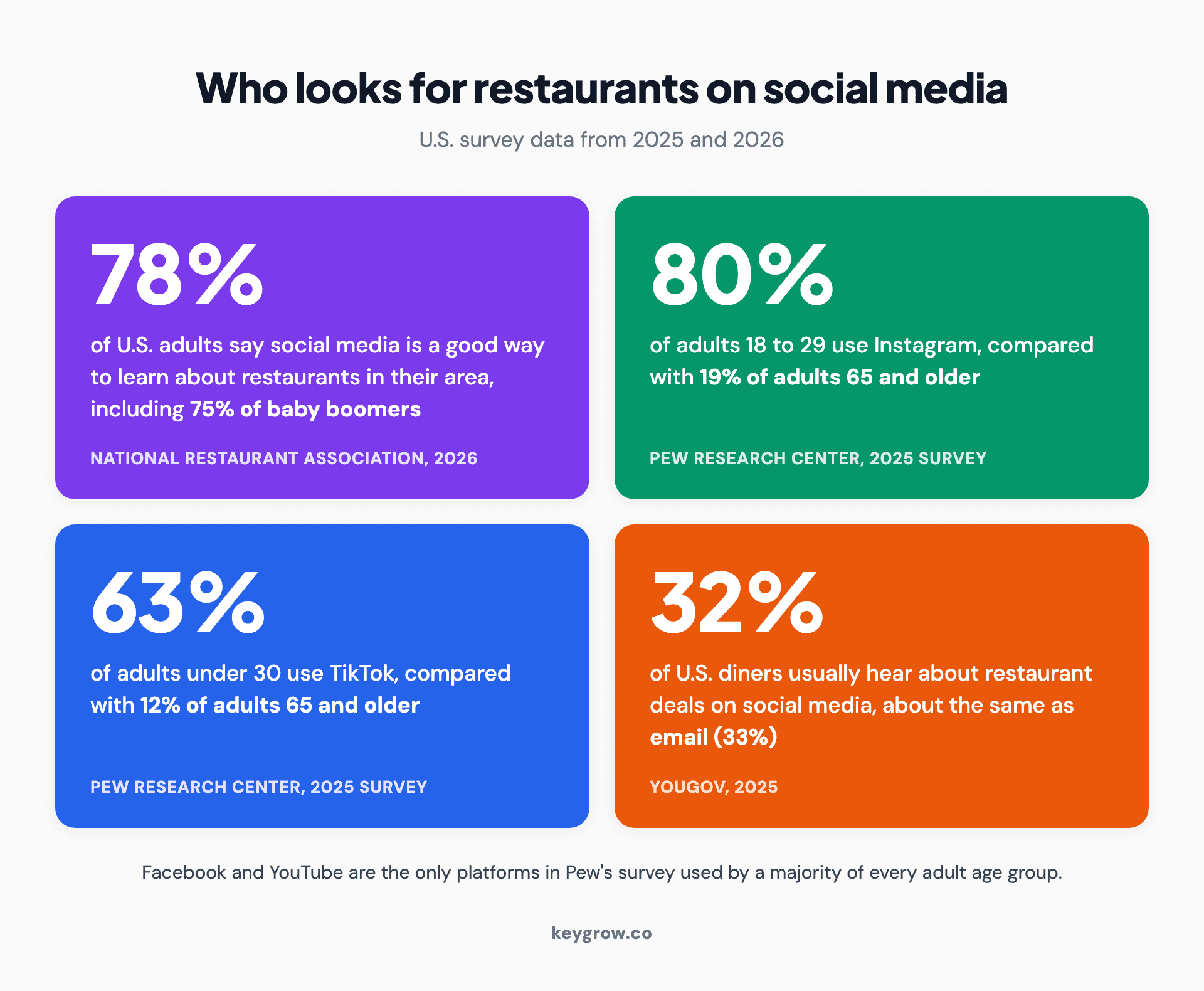
Stat strip of who looks for restaurants on social media: 78 percent of U.S. adults say social media is a good way to learn about restaurants in their area, 80 percent of adults 18 to 29 use Instagram, 63 percent of adults under 30 use TikTok, and 32 percent of U.S. diners usually hear about restaurant deals on social media.
| Platform | Use it for | What's new or easy to miss in 2026 |
|---|---|---|
| Dish reels, Stories during service, guest reposts | One profile action button, such as Reserve or Order food, through a partner account you already have. Up to five links in your bio. Reels over 3 minutes aren't recommended to new audiences. | |
| Events, weekend posts, regulars over 40 | Meta's March 2026 guidelines favor original content and push re-uploads of other people's posts down. | |
| TikTok | Dish clips and kitchen moments, if someone enjoys filming | A Local Feed tab, added in February 2026. Business accounts must use the Commercial Music Library. |
Fix each profile before the first post: current hours, your address, a bio that says what you serve, the booking link and the action button. A great reel that leads to a profile with last winter's hours loses the table anyway.
The Local Feed is the biggest change for restaurants this year. TikTok's announcement describes a new tab on the home screen for local content, restaurants included, where posts are shown "based on location, the topic of the content, and when the content was posted." Tag your restaurant as the location on every post. TikTok's creator guide says a location tag lets viewers see the address, reviews and other posts using the same tag, and you get one location per post.
Your Monday photos have one more home, and it isn't a social app. A weekly Google Business Profile post reaches people who are already looking at your listing. Where the feature is available, Google lets you add one link per social platform to your profile and may show event or deal posts from those linked accounts. It doesn't track clicks on those links, which matters when you start counting.
Six kinds of post that put people in seats
Show the dish moving, tonight's special, the people cooking, the full room, dated events and guests' own posts. Each answers a diner's question.
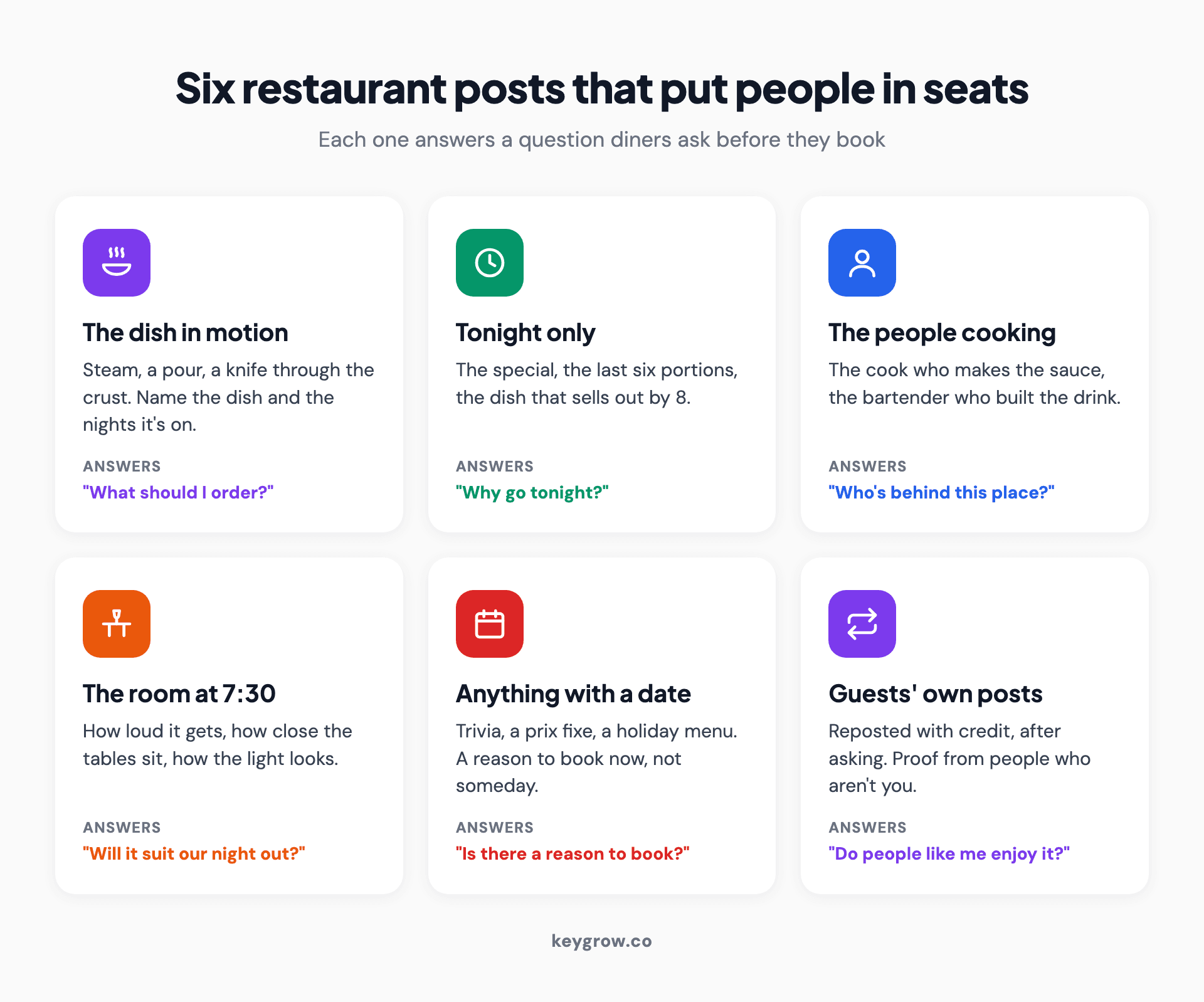
Icon grid of six restaurant social media post types that drive visits: the dish in motion, tonight only specials, the people cooking, the room at dinner time, events with a date, and guest posts reposted with credit.
The habit that matters most in social media marketing for restaurants: every post names the dish, the night and how to book. "Braised short rib, Thursday to Saturday, book through the link in our bio" does more work than "Come see us this weekend."
Deals belong in the mix as well. In YouGov's 2025 dining survey of more than 1,300 U.S. diners, 32 percent said they usually hear about restaurant promotions on social media, about the same as email at 33 percent. A Wednesday offer with a Thursday deadline gives those people a reason to come now.
The room post is the one owners skip.
Someone choosing between you and the place down the street wants to know how loud it gets at 7:30 and whether the tables sit close together. Fifteen seconds of a full dining room answers that better than any caption.
Answer the practical questions before they land in your inbox: parking, the patio, the gluten free options, a table for eight. A Story highlight for each one answers them before anyone has to ask.
For guest content, use Instagram's Repost button. Instagram's help center says reposts appear in a dedicated tab on your profile and only work when the original creator allows them. Ask the guest anyway. And don't download someone's video and re-upload it to Facebook as your own. Meta's March 2026 guidelines call re-uploading posts "the Page or Profile had no role in creating" unoriginal, and unoriginal posts get pushed down.
Post before the decision, not after it
Lunch posts go up mid-morning and dinner posts by mid-afternoon. Push the weekend on Thursday, then let your own insights adjust the clock.

A server walking through a full dining room during a busy lunch service, the crowd a mid-morning post is meant to reach before people decide where to eat.
A post works when it lands while someone is still deciding. A reel about tonight's special posted at 9 p.m. is, at best, a reminder for next week. TikTok's Local Feed weighs when a post went up, so same-day posts about same-day food have an edge there.
After a month, trust your own numbers over anyone's chart, this one included. Instagram shows the times your followers are most active once you pass 100 followers. TikTok shows when your viewers were most active over the last seven days, along with where it estimates they are. Move your posting times to match.
To test a new format without wearing out your regulars, use Instagram's trial reels, which go to non-followers first. Your followers won't see a trial in Feed or the Reels tab unless you choose to share it with them later.
Connect every post to a cover
Use three counters: a source question in your reservation system, a dish or code word announced only on social, and tagged links in your bio.
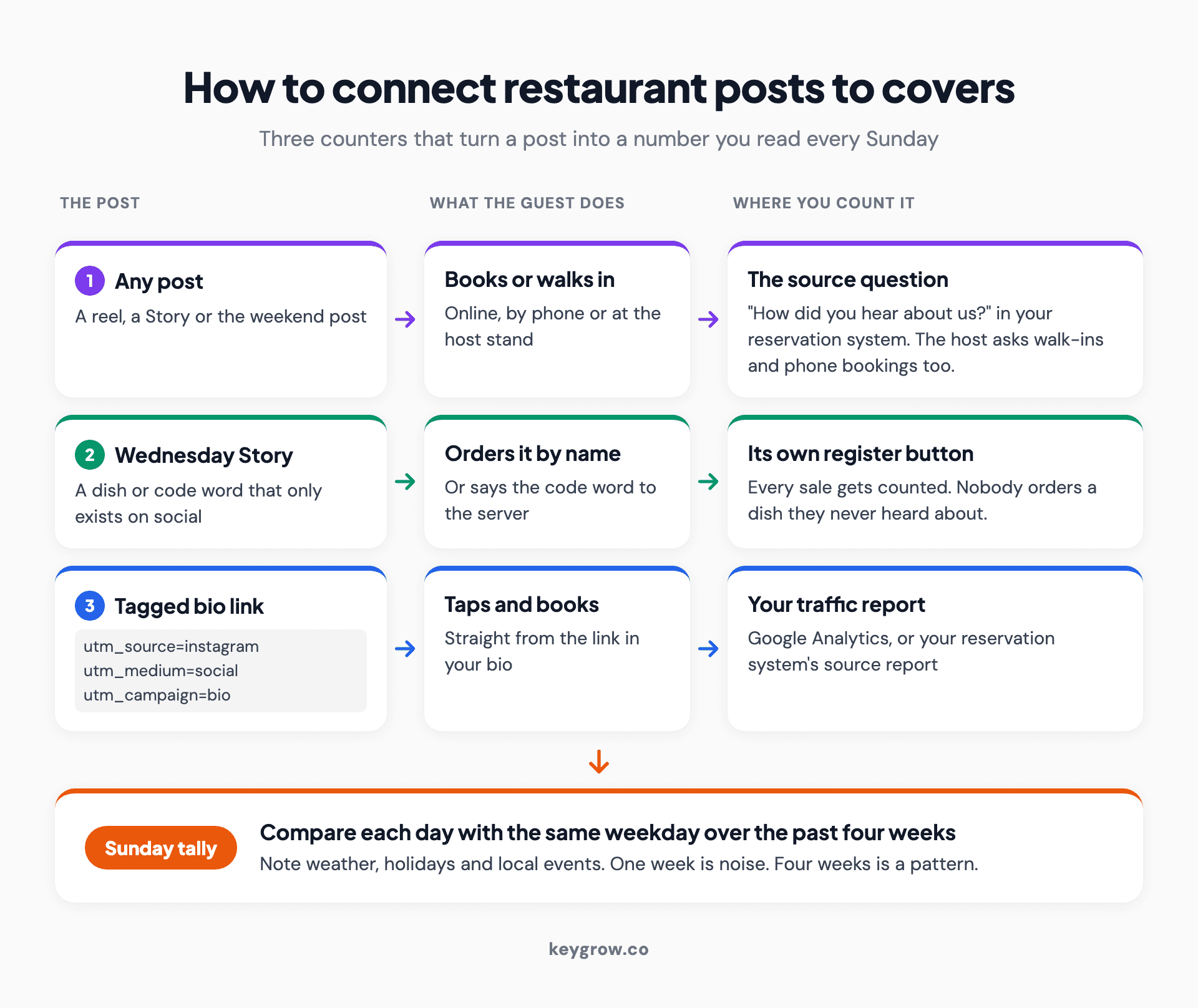
Flow diagram of three ways to connect restaurant social media posts to covers: a how-did-you-hear question recorded in the reservation system, a social-only dish or code word rung under its own register button, and tagged bio links read in Google Analytics, all feeding a Sunday tally compared with the same weekday over four weeks.
1. The source question. Add "How did you hear about us?" to your booking form, or a tag on the guest record if your reservation system offers one. Keep the answers short: Instagram, Facebook, TikTok, Google, a friend, walked by. Your host asks walk-ins and phone bookings the same question. Low-tech, yes. It also catches the guests analytics never sees.
2. The social-only dish or code word. Wednesday's Story announces something people can only know about from social: an off-menu sandwich ordered by name, or a code word for dessert on the house. Give it its own button on the register so every sale gets counted. Nobody orders a dish they've never heard of, so each sale traces back to a post, or to someone who saw one.
3. Tagged bio links. Point your bio link at your booking page with tags Google Analytics can read, such as ?utm_source=instagram&utm_medium=social&utm_campaign=bio. Google's guidance is to always set source, medium and campaign, to use one source name per platform, and to stick to lowercase because the values are case sensitive.
If the booking page lives on your own site, Analytics shows which platform sent each visit. If it lives on your reservation system's site, check whether that system records the source. Your Google profile won't help here, since Google doesn't track clicks on its social links.
The Sunday tally. Write down four numbers each week: covers by source, sales of the social-only item, bookings from tagged links, and messages that turned into reservations. Compare each day with the same weekday over the past four weeks, never with yesterday, and note the weather, holidays and anything happening nearby.
Here's a made-up example of how it reads. Say your last four Thursdays averaged 58 covers. This Thursday you do 66, the register shows 11 of the off-menu sandwich, and six bookings list Instagram as the source.
One week proves nothing. Four weeks with the same shape is a pattern you can plan around.
Instagram's insights add an early signal, including Story link taps and profile activity such as website clicks. Treat those as a hint. The cover count is the result.
Boost what already worked
Put money only behind a post that already brought covers. Show it to people a short drive away, with a fixed budget and a deadline.
The Sunday count tells you which post has earned a boost. If Tuesday's short rib reel moved short rib sales without a cent behind it, paying to show it to more neighbors is a fair test. Boosting a post that did nothing buys more of nothing.
Keep the test small and countable. Show it only to people within a short drive, end it at the offer's deadline, and give the boosted version its own code word so you can tell paid covers from free ones. On Instagram, only professional accounts can boost, so switch from a personal account first. Full ad campaigns are a different job, with their own costs and tracking.
Likes don't pay rent
Report covers, bookings and orders first. Likes, followers and views come last, because none of them has ever shown up in the register.
Our position: vanity-metric reporting is the biggest scam in restaurant marketing on social media, and restaurants can afford it less than almost anyone. In its February 2026 release, the National Restaurant Association said 42 percent of operators reported their restaurant was not profitable last year. A monthly report that opens with impressions describes attention you can't deposit.

A server taking a card payment from three guests at a cafe table, the kind of result a restaurant social media report should lead with instead of likes.
Follower counts are also the one number on the report anyone can buy. The FTC's 2024 rule prohibits selling or buying fake followers and views generated by bots or hijacked accounts. A number that has to be policed by a federal agency is a poor way to judge a dinner service.
Check where your real followers live. Instagram lists your followers' top locations once you have 100 of them. If your city isn't near the top, a big follower number isn't a big number of diners.
So ask whoever runs your accounts, agency, freelancer or staff, for the cover count first. If the report opens with reach, ask why.
Creators, music and other ways to get burned
Comp creators in exchange for honest, disclosed posts. Use licensed music, film your own footage, ask before filming guests and never buy followers.
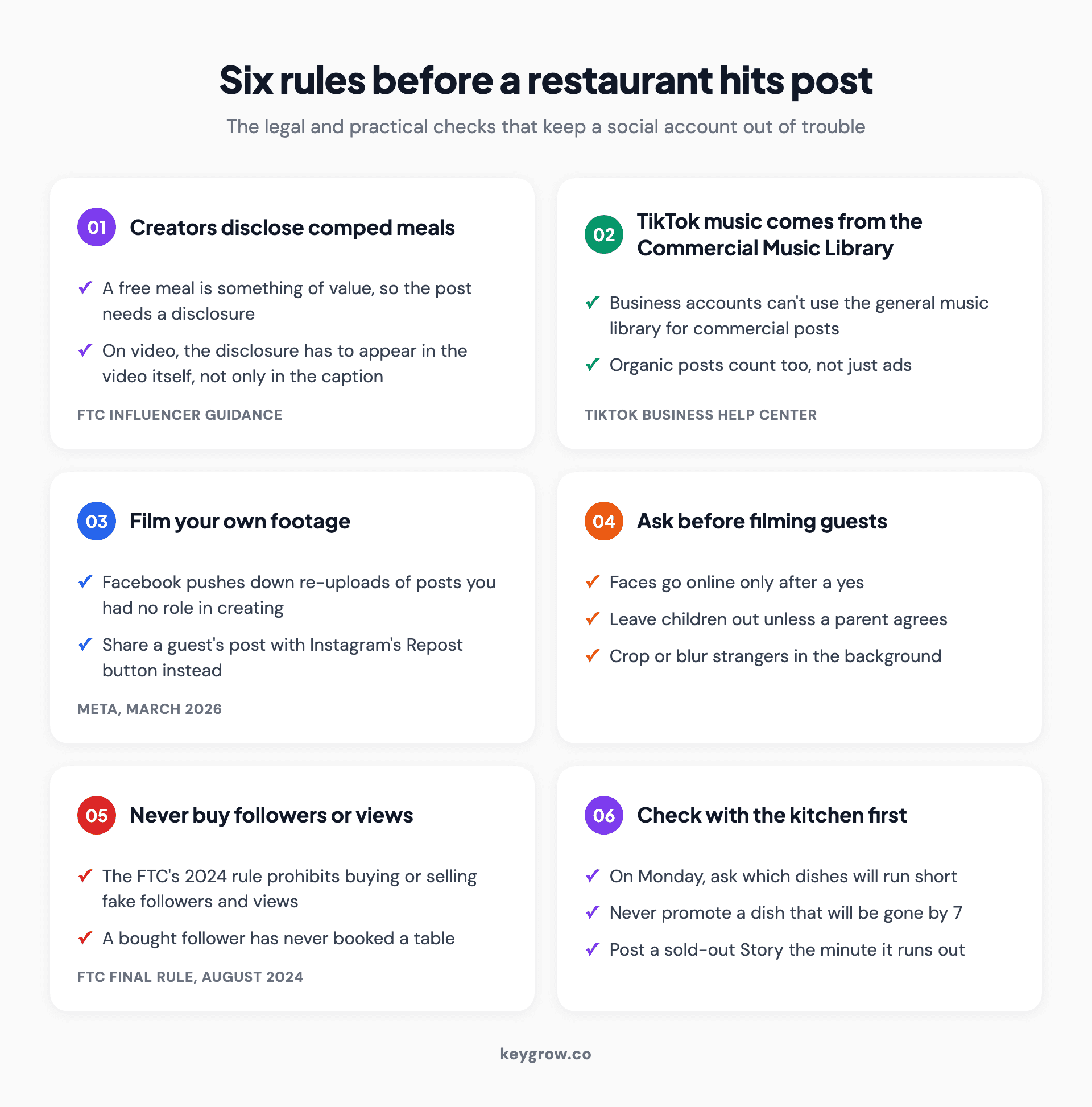
Checklist of six rules before a restaurant posts on social media: creators disclose comped meals in the video, TikTok business accounts use the Commercial Music Library, film your own footage, ask before filming guests, never buy followers or views, and check with the kitchen before promoting a dish.
Local creators can fill a slow night if you structure the trade. Offer a meal, not a fee, to people whose followers live near you, and give each creator their own code word or dish so you can count what their post brings. Judge them on covers.
In the FTC's eyes, that meal is something of value. Its guidance for influencers says anyone who gets free or discounted products and then posts about the brand has to disclose it, and on video the disclosure belongs in the video itself, not only in the description. Tell creators up front. It protects you as well.
Music is the easy thing to get wrong on TikTok. TikTok's business help center says businesses can't use the general music library for commercial content, organic posts included, and points them to the Commercial Music Library instead. That trending song is off limits for a business account.
Two more habits keep you out of trouble. Ask guests before their faces go online, and leave children out unless a parent says yes. And check with the kitchen before promoting a dish, because pushing one that's gone by 7 teaches people to stop trusting your posts.
When more posting won't help
More posts won't help a room that's already full, and they make an unanswered inbox or an inconsistent kitchen worse. Fix those first.
Turning tables away on Friday and Saturday means attention isn't your problem. Seats are. Point the social week at your slow nights and leave the weekend alone.
An inbox nobody checks for hours turns a question about a table for six into a booking walking out the door. Run the minimum instead: correct hours, the menu, a working booking link, one pinned post and an instant reply that says when someone will get back to them.
Reviews that keep describing the same problem with the food or the service are a different warning. More reach just shows that problem to more people.
Fix the operation, then post.
You may not need anyone's help at all, either. A single location whose owner can spare three hours a week doesn't need an agency to run this plan. Hand it off when nobody has the hours, when you open a second location, or when you want paid social with proper tracking. Our breakdown of social media management pricing shows what that costs, and the search side, from your menu page to your Google profile, lives in our guide to SEO for restaurants.
FAQs
How often should a restaurant post on social media?
Four feed posts or reels a week, plus Stories on your busiest nights, is enough for most single locations. Pick a number you can keep up for months, since a steady schedule beats a burst that stops in week three. Fast replies to messages matter more than a fifth post.
What is the best social media platform for restaurants?
Instagram, for most restaurants, with Facebook alongside it. Pew Research Center found 80 percent of adults under 30 use Instagram, and Facebook is used by a majority of every age group. Add TikTok only if someone on your team enjoys making videos.
Is TikTok worth it for a restaurant in 2026?
It can be, especially if your guests skew under 40 and someone likes filming. TikTok added a Local Feed tab in February 2026 that shows nearby restaurants and businesses based on location, topic and how recently a post went up. Business accounts have to use TikTok's Commercial Music Library rather than the general one.
How do I know if social media is bringing in customers?
Count three things: the source guests give in your reservation system, sales of a dish or code word you only mention on social, and bookings from tagged bio links. Compare each day with the same weekday over the previous four weeks. Likes and views won't tell you this.
How much does restaurant social media marketing cost?
Doing it yourself costs time, a little under three hours a week for a plan like this one, plus any money you put behind posts. Hiring help adds a monthly fee that varies widely with how much content and inbox work you hand over. Judge either option by the covers it brings, not the number of posts.
Should restaurants pay influencers?
Start with local creators and a comped meal rather than cash. Under FTC guidance a free meal is something of value, so the creator has to disclose it, in the video itself for video posts. Give each creator a code word or dish so you can count the covers their post brings.
Count covers, not likes
Run the sample week as your restaurant social media plan for four weeks before you judge it. Keep the Sunday count in one place and share it with whoever films, so they see which posts filled tables. Then drop the post type that never moved a number and give its slot to the one that did.
If you'd rather hand the week to a team that reports in covers and bookings, our social media management is month-to-month, and we'll tell you if three hours of your own time would do the job.