


Two people search for you on the same Tuesday. One types "wasp nest removal near me" because there is a nest above their front door and they want it gone this afternoon. The other types "quarterly pest control [city]" because they have decided to stop dealing with this ad hoc and want somebody on a schedule.
Almost every guide to SEO for pest control companies optimizes for the first person. That is the wrong customer to build a business around, and it is the one with the shortest relationship you will ever have.
The second search is worth several times more over three years, gets a fraction of the attention, and is far less competitive. This post is organized around winning that one, with the emergency search handled properly along the way, because you do want both. The difference is which one you design the website around.
Two customers, and only one of them is a business
Run the arithmetic with your own numbers before you write a single page.
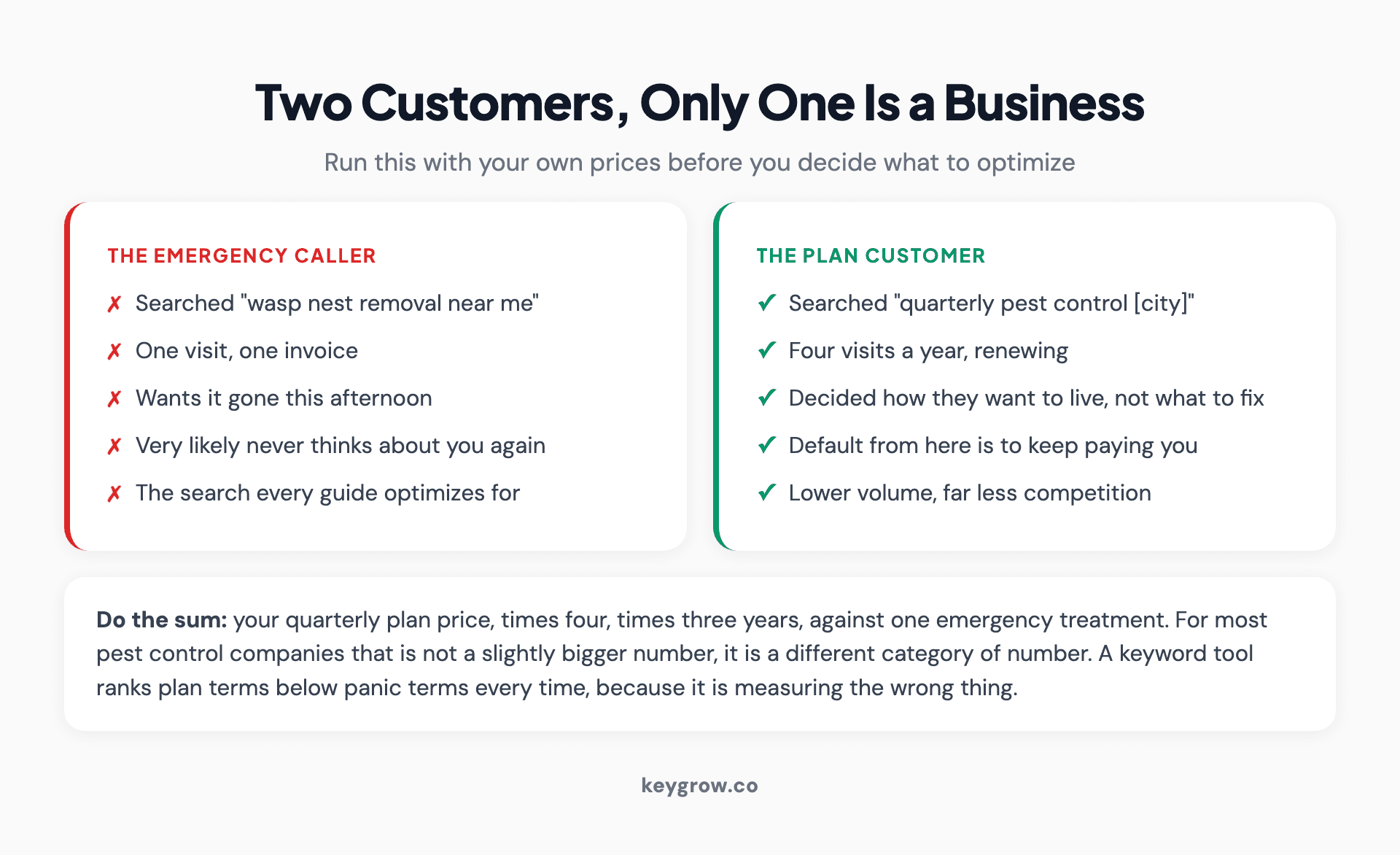
Comparison of a one-time emergency pest control customer against a recurring plan customer, showing the difference in visits, revenue and relationship length over three years.
Take your average one-time treatment price. Then take your quarterly plan price, multiply it by four, and multiply that by three years. For most pest control companies the second figure is not slightly larger, it is a different category of number, and it arrives with a renewal rate attached rather than a one-off invoice.
One is a transaction. The other is a subscription.
That gap is the whole argument for how to prioritize. The emergency caller has a problem and will pay to make it stop, then very likely never think about you again unless something else appears. The plan customer has made a decision about how they want to live, and their default from here is to keep paying you.
Which means the search terms that lead to plans deserve the pages, the internal links, and the effort, even though they have lower search volume. A keyword tool will rank them below the panic searches every time. That ranking is measuring the wrong thing.
The searches that produce plans
Plan buyers search differently from emergency callers. They use words like ongoing, monthly, quarterly, plan, service, prevention, and inspection, and they compare before they call.
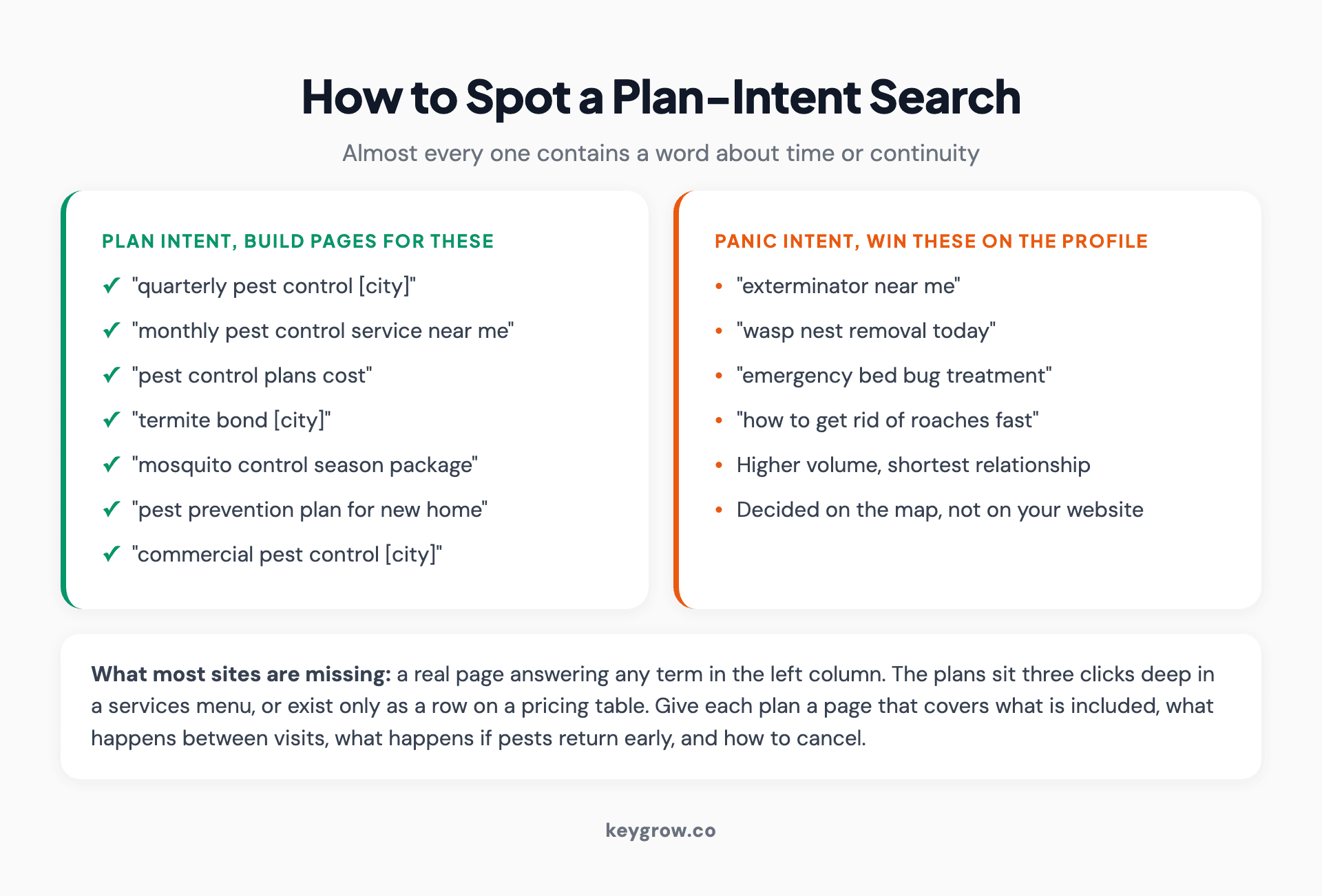
Two keyword groups for pest control, separating urgent one-time emergency searches from recurring plan, prevention and inspection searches with far higher long-term value.
| Plan-intent search shape | What they are buying |
|---|---|
| "quarterly pest control [city]" | An ongoing arrangement |
| "monthly pest control service near me" | A schedule, not a visit |
| "pest control plans cost" | A comparison they will act on |
| "termite bond [city]" | A long-term protection contract |
| "mosquito control season package" | A season of coverage |
| "pest prevention plan for new home" | A relationship starting from day one |
| "commercial pest control [city]" | A contract with a renewal cycle |
Two things stand out about that list. Almost every term includes a word about time or continuity, which is what makes them easy to identify. And most pest control websites have no page that specifically answers any of them, because the plans are buried three clicks deep in a services menu or only mentioned on a pricing table.
The fix is a page per plan, written as a page rather than a price row. What is included, how often somebody comes, what happens between visits, what it costs, what happens if pests come back before the next visit, how to cancel. The last two matter more than most companies realize, because they are the objections that stop somebody signing.
The panic search still matters, and here is all it needs
Emergency searches are worth winning. They just need less than the guides suggest.

A close-up of a gloved hand operating a sprayer nozzle during a perimeter treatment.
Somebody with wasps over their door is not reading. They are looking for a business that is open, close, well-reviewed, and answerable by phone in the next ten seconds. That transaction happens almost entirely on the Google Business Profile, and per Google's local ranking factors, the map results come down to relevance, distance, and prominence. Distance you cannot change. The other two you can.
So for the emergency half of your business the checklist is short: correct categories, accurate hours, a phone number that a human answers during those hours, current reviews, and a service page for each urgent pest that loads fast on a phone and puts the number above the fold.
What you do not need is a 2,000-word article about the biology of the wasp. Nobody with a nest above their door is reading it, and it will not rank for the search that matters anyway.
Seasonality is a build calendar, not a content theme
Pest demand swings hard through the year, and search demand swings with it. The mistake is treating that as something to write about rather than something to schedule around.
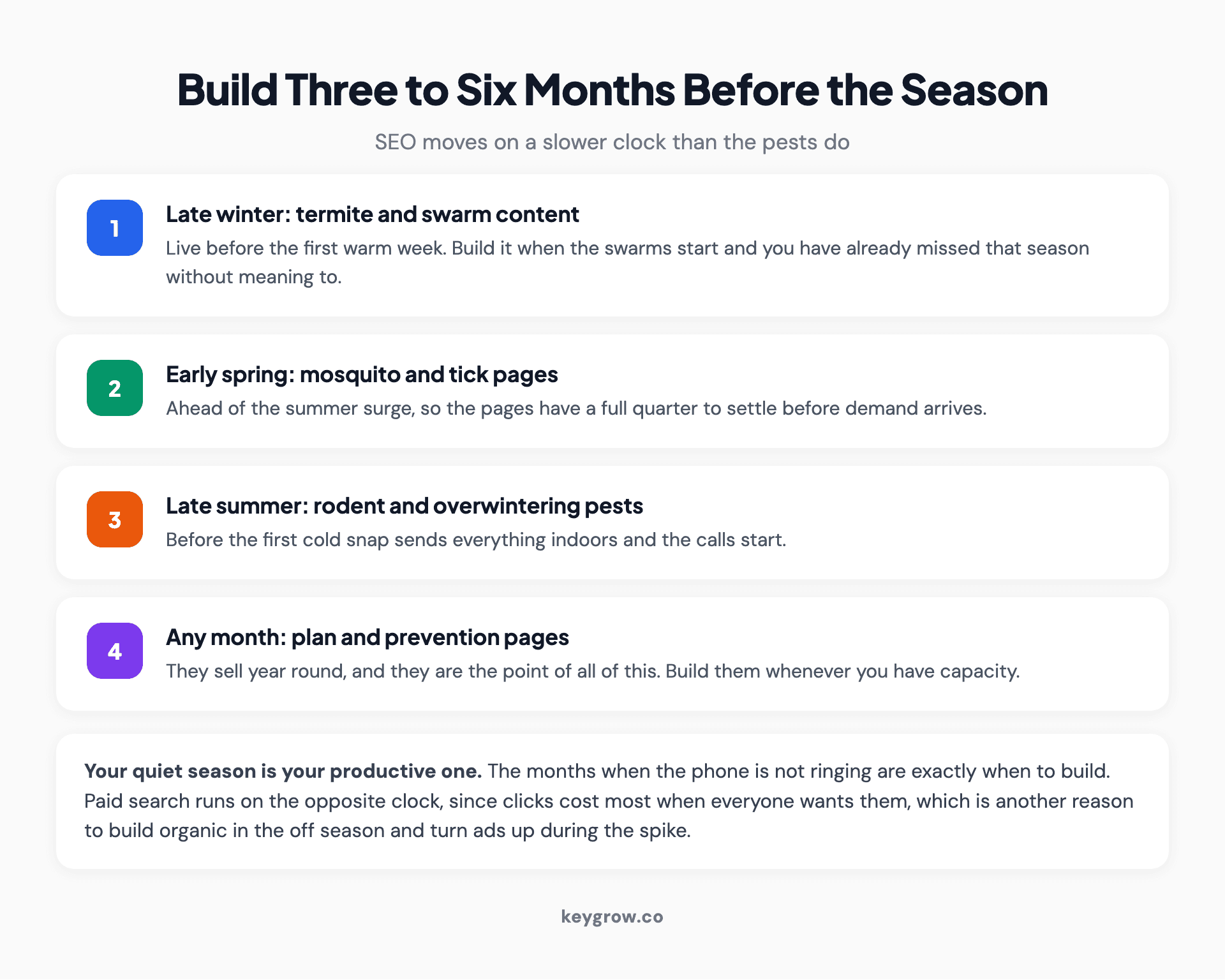
Twelve month planning calendar for pest control SEO showing when to build pages for each seasonal pest, three to six months ahead of the demand spike.
Now the timing problem.
Here is the part that trips companies up. SEO takes three to six months to move. Termite swarm season, mosquito season, and rodent season all arrive on a schedule you can predict a year out. If you build the termite page when the swarms start, you have missed that season entirely and you are really building for next year without meaning to.
So work backwards from each spike:
- Termite and swarm content goes live in late winter, before the first warm week.
- Mosquito and tick pages get built in early spring, ahead of the summer surge.
- Rodent and overwintering pest pages get built in late summer, before the first cold snap sends everything indoors.
- Plan and prevention pages get built whenever you have capacity, because they sell year round and are the point of all this.
The pleasant consequence is that your quiet season is your most productive one. The months when the phone is not ringing are exactly when you should be building, and the companies that understand this arrive at every peak with pages that have had a full quarter to settle.
Paid search runs on the opposite clock, since clicks get most expensive exactly when everyone wants them. Which is another reason to treat organic as the thing you build in the off season and paid as the thing you turn up during the spike.
Build one page per pest, not one per service
Your services are treatment and prevention. Your customers search by pest. Structure the site the way they think, not the way you invoice.
Every pest you treat deserves its own page: ants, termites, bed bugs, roaches, rodents, wasps and hornets, mosquitoes, spiders, fleas, whatever is common in your area. Each one is a distinct search with distinct anxiety attached, and a page that says "we handle general pest control" answers none of them specifically.
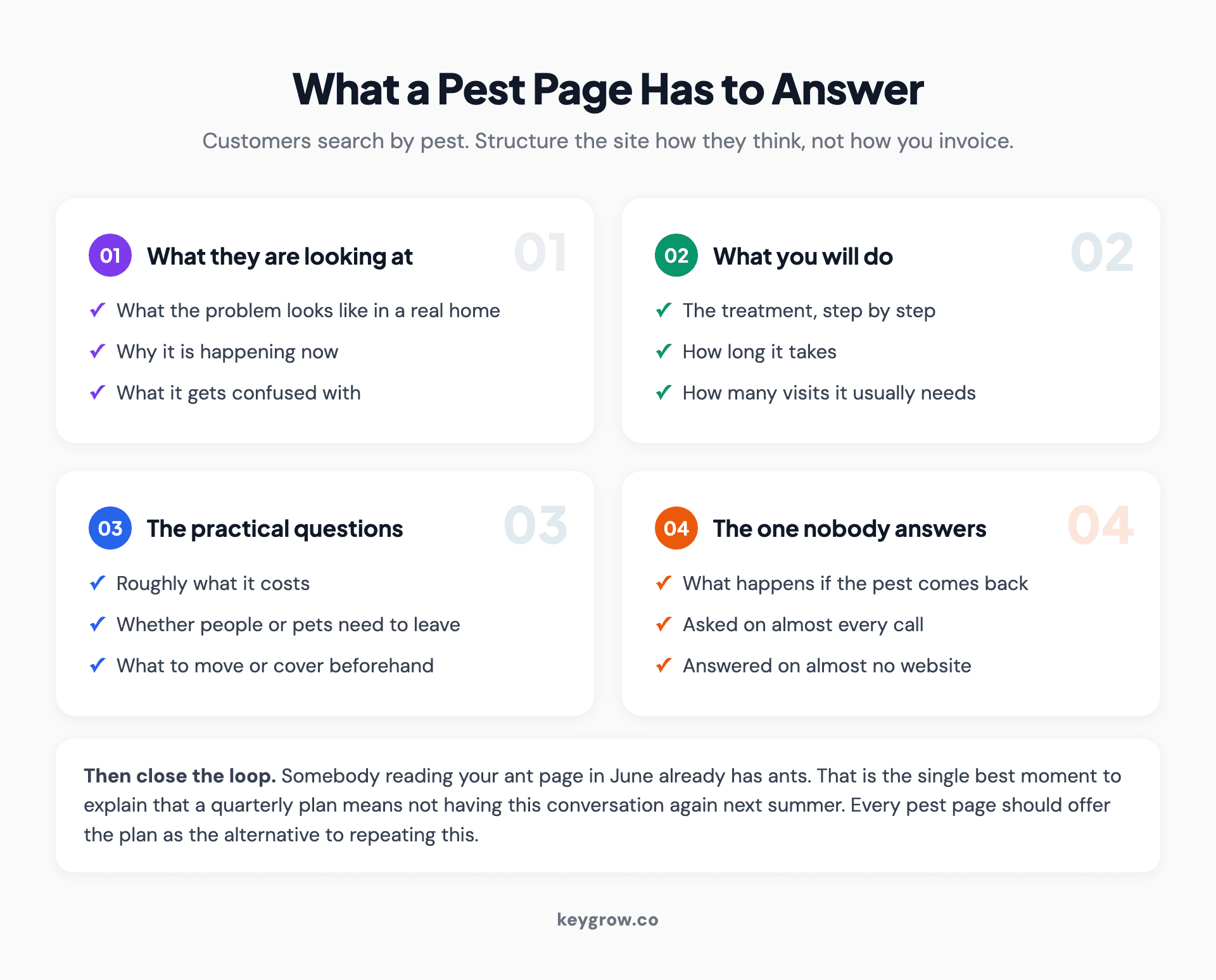
Anatomy of a pest control service page listing what each pest page must answer, including what the problem looks like, treatment steps, cost, preparation and what happens if the pest returns.
What each pest page needs, and most do not have: what the problem actually looks like in a home, why it is happening, what your treatment involves step by step, how long it takes, roughly what it costs, whether people or pets need to leave, and what happens if the pest returns. That last question is asked on almost every call and answered on almost no website.
Then, and this is the part that connects back to the thesis, every pest page should offer the plan as the alternative to repeating this. Somebody reading your ant page in June already has ants. That is the single best moment to explain that a quarterly plan means not having this conversation again next summer.
For a multi-town service area, add a page per town on top of that, with genuinely local content: which pests are common there, local construction types that matter, actual response times. Copying one page and swapping the town name produces pages that rank for nothing, which we have written about at more length in the context of local landing pages.
The identification content that is worth writing
Here is a case where pest control breaks a rule that holds in most trades.
In plumbing, informational content about fixing things yourself attracts people who are trying to avoid hiring you. We made that argument in our post on SEO for plumbers, and it holds up. Pest control is the exception, and it is worth understanding why.
Somebody searching "what does a termite look like" or "bed bug bites or flea bites" is not trying to do it themselves. They are trying to find out how frightened to be. Identification content answers that question, and the honest answer frequently is "that is a termite and you need a professional today". The reader arrives anxious and uncertain, and leaves knowing they have a problem you solve. That is a very different funnel from someone learning to change a washer.
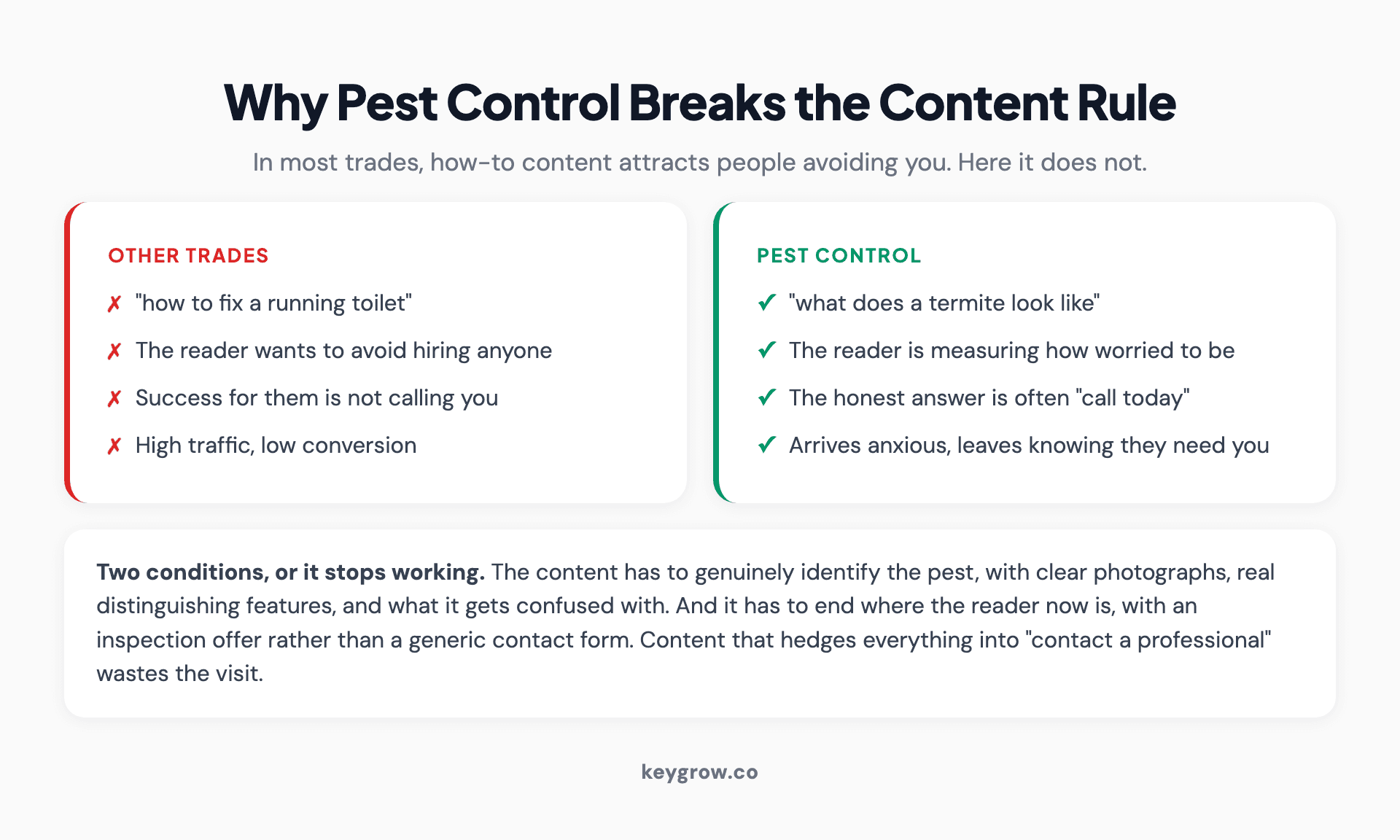
Comparison showing why pest identification content converts where plumbing how-to content does not, because the searcher is measuring how worried to be rather than trying to fix it themselves.
So identification content earns its place here, with two conditions. It has to be genuinely useful, with clear photographs, real distinguishing features, and an honest account of what people confuse it with. And it has to end where the reader now is, with an inspection offer rather than a generic contact form. Content that hedges everything into "contact a professional" without helping them identify anything wastes the visit.
The related content worth writing is prevention: what actually keeps this pest out, honestly, including the things a homeowner can do without paying anyone. The EPA's guidance on reducing pesticide use and controlling common pests is a reasonable anchor for that kind of page, and being straight about what a homeowner can handle alone is the fastest way to be believed about what they cannot.
Reviews when the customer would rather not discuss it
Pest control has a review problem no other trade has, which is that a chunk of your customers are quietly embarrassed about why they called you.
Nobody minds telling the internet their furnace broke. Plenty of people mind telling the internet they had bed bugs. So the request has to be easier and lower stakes than in other industries. Make it possible to review the service without naming the pest, and never write a review request that asks them to describe the problem.
The rest is standard.
Everything else is standard and still worth doing properly. Ask every customer, through a system rather than a technician's memory, so the flow is steady rather than lumpy. Review volume and recency both feed prominence, which is one of the three factors Google names. And respond to reviews without ever confirming what the treatment was for, which matters more here than the equivalent caution in most trades.
If a competitor or a disgruntled former employee leaves something fabricated, our guide to removing a fake Google review covers what qualifies and what does not.
Commercial accounts are a different website problem
If you serve restaurants, warehouses, food processing, property management, or healthcare, that is a separate business with a separate buyer, and it usually shares a website with the residential side to the detriment of both.
They are not the same buyer at all.
The commercial buyer is a facilities manager or an owner with a compliance obligation. They are searching for documentation, certification, scheduling reliability, and whether you can produce a report an inspector will accept. They are not persuaded by the same page that reassures a homeowner about ants in the kitchen.
Give it its own section: commercial pest control as a hub, then a page per industry you serve. Talk about service documentation, reporting, after-hours scheduling, and the standards relevant to that sector. The search volume is low and the contract values make that irrelevant.
What to measure when the value shows up in year two
Report plan signups. Everything else is upstream of that.
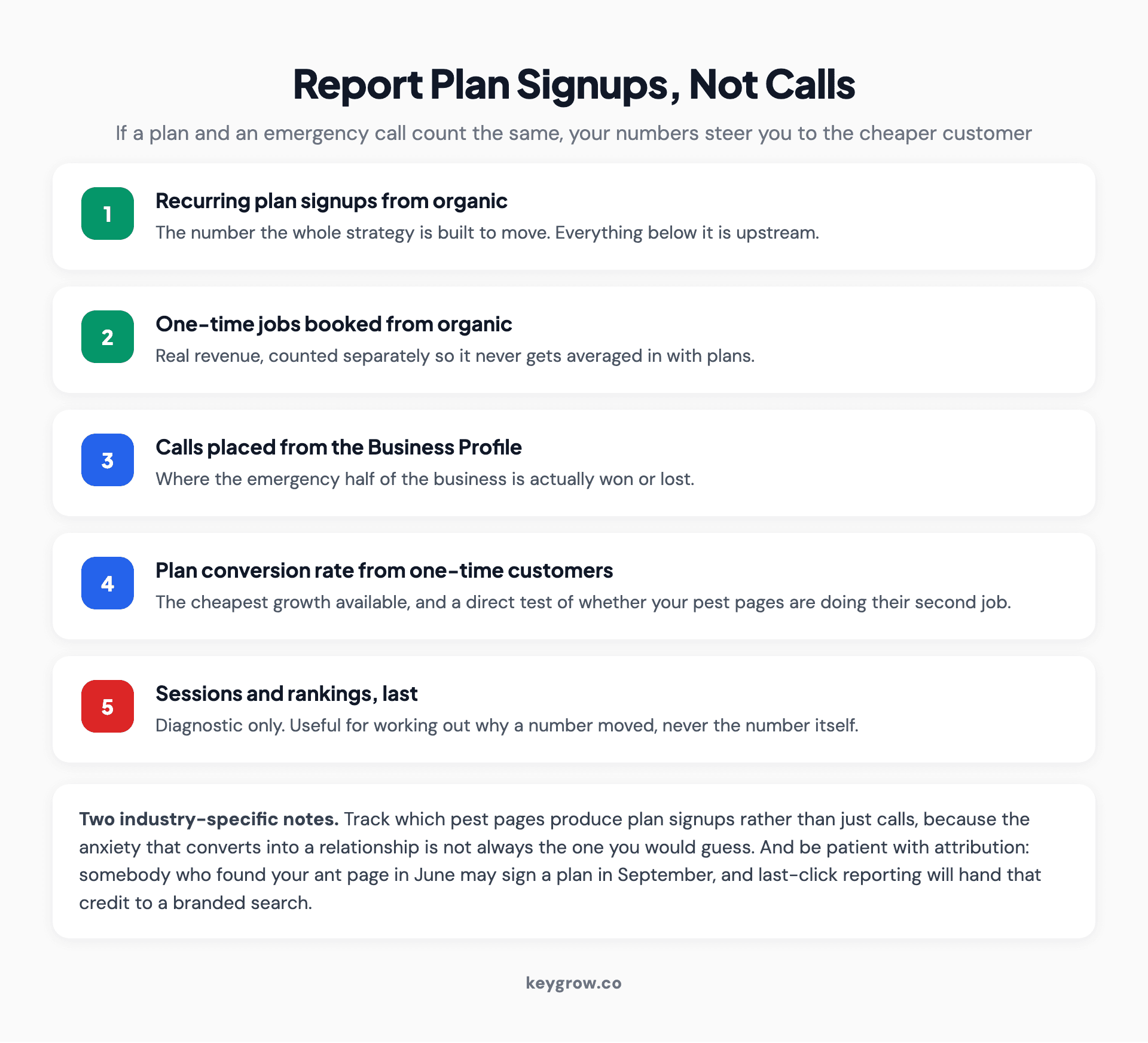
Pest control SEO measurement hierarchy putting recurring plan signups and plan retention above one-time job bookings, calls and rankings.
The order worth reporting: recurring plan signups from organic, one-time jobs booked from organic, calls from the Business Profile, plan conversion rate from one-time customers, and only then sessions and rankings. If your reporting treats a plan signup and an emergency call as the same conversion, the numbers will steer you toward the cheaper customer.
Two industry-specific notes. Track which pest pages produce plan signups rather than just calls, because that tells you which anxiety converts into a relationship, and it is not always the one you would guess. And be patient with attribution, since somebody who found your ant page in June may sign a plan in September, and last-click reporting will credit that to a branded search.
Adding structured data for your business and services helps the profile and rich results side of this, though it is a supporting move rather than the thing that changes the numbers.
Which pest control companies should not buy SEO
Three, and I would say so instead of taking the work.
Companies without the capacity to take on recurring routes. If your technicians are already at capacity through the season, more leads is not the constraint. Pricing and scheduling are, and both are cheaper to fix.
Anyone who needs work within the next eight weeks. Organic will not do it, particularly if you are heading into a peak. Paid search will, at the price the season sets. That is the right tool for that timeline and no honest agency should argue otherwise.
A single-technician operation in one town. You can genuinely do this yourself. Claim and complete the profile, build a page per pest over a few weekends, set up a review request, and you will have most of the available value in a small market. Bring in help when you add trucks, towns, or a commercial line, not before.
There is also a version of the timeline question worth being blunt about. Expect three to six months before organic produces meaningful volume, and closer to a year before the plan side compounds, since the plan customer takes longer to decide. Anyone promising faster in a competitive market is either targeting phrases nobody searches or about to do something to your domain you will regret. There is more on the timeline in our post on how long local SEO takes.
FAQs
How long does SEO take for a pest control company?
Three to six months for organic to produce a meaningful number of calls, and around a year before the recurring plan side compounds, because plan buyers take longer to decide than emergency callers. Profile improvements can move the map results faster than that, sometimes within weeks.
What keywords should a pest control company target?
Start with plan-intent terms like quarterly pest control, monthly pest control service, termite bond, and mosquito season packages, because they lead to recurring revenue. Then cover a page per pest you treat, plus urgent terms for the pests people call about in a panic. Sort by customer lifetime value rather than search volume.
Is pest control SEO worth it compared to paid ads?
They solve different problems. Paid search wins the peak season when you need volume immediately, at prices that rise with demand. Organic is built in the off season and keeps producing without per-click cost. Most established companies run both, with ads turned up during spikes and organic carrying the plan-intent searches year round.
Should a pest control website have a page for every pest?
Yes. Customers search by pest, not by service category, and each pest carries different questions and different anxiety. A general pest control page answers none of them specifically. Each page should cover what the problem looks like, what treatment involves, rough cost, and what happens if the pest returns.
Does identification content actually bring in customers?
For pest control, more than it does in other trades. Somebody searching what a termite looks like is trying to work out how worried to be, not trying to fix it themselves, and the honest answer often leads directly to booking an inspection. It works when the content genuinely helps them identify the pest rather than deflecting to a contact form.
How do I get reviews when customers are embarrassed?
Make it possible to leave a review without naming the pest, and never ask them to describe the problem in the request. Send the request through an automated system rather than relying on technicians, so the flow stays steady. When you respond, do not confirm what the treatment was for.
What should a pest control company spend on SEO?
It depends on how many towns you serve and whether you have a commercial line. The more useful test is against your cost per acquisition from paid search during peak season, which is when pest control clicks are most expensive. If organic can produce plan signups below that number within a year, it is worth funding.
Start in the off season
The single highest-value thing on this list is building a real page for each plan you sell, written to answer the objections that stop somebody signing, rather than a row on a pricing table. Everything else supports that.
After it, in order: a page per pest, the profile fields you have never completed, a review request that runs itself, and identification content built three to six months ahead of the season it belongs to. If you are reading this in a quiet month, that is not bad timing, it is the correct timing.
If you want a view on whether your site is currently built for the emergency call or the plan, that is the kind of look our SEO team takes, and for a single-truck operation in one town the answer is usually that you can do this yourself.