

SEO for landscaping companies has a problem no other trade has quite so badly: the phone rings for about five months of the year, and the rankings that make it ring have to be earned in the months when nobody is calling. Start in March and you have already missed the season you were trying to win.
That is the whole planning constraint. The tactics below are ordinary local SEO, done well. The thing that decides whether they work is when you start, and which jobs you point them at.
The calendar is the constraint, not the algorithm
Search demand for landscaping is not a gentle curve. It is close to a switch.
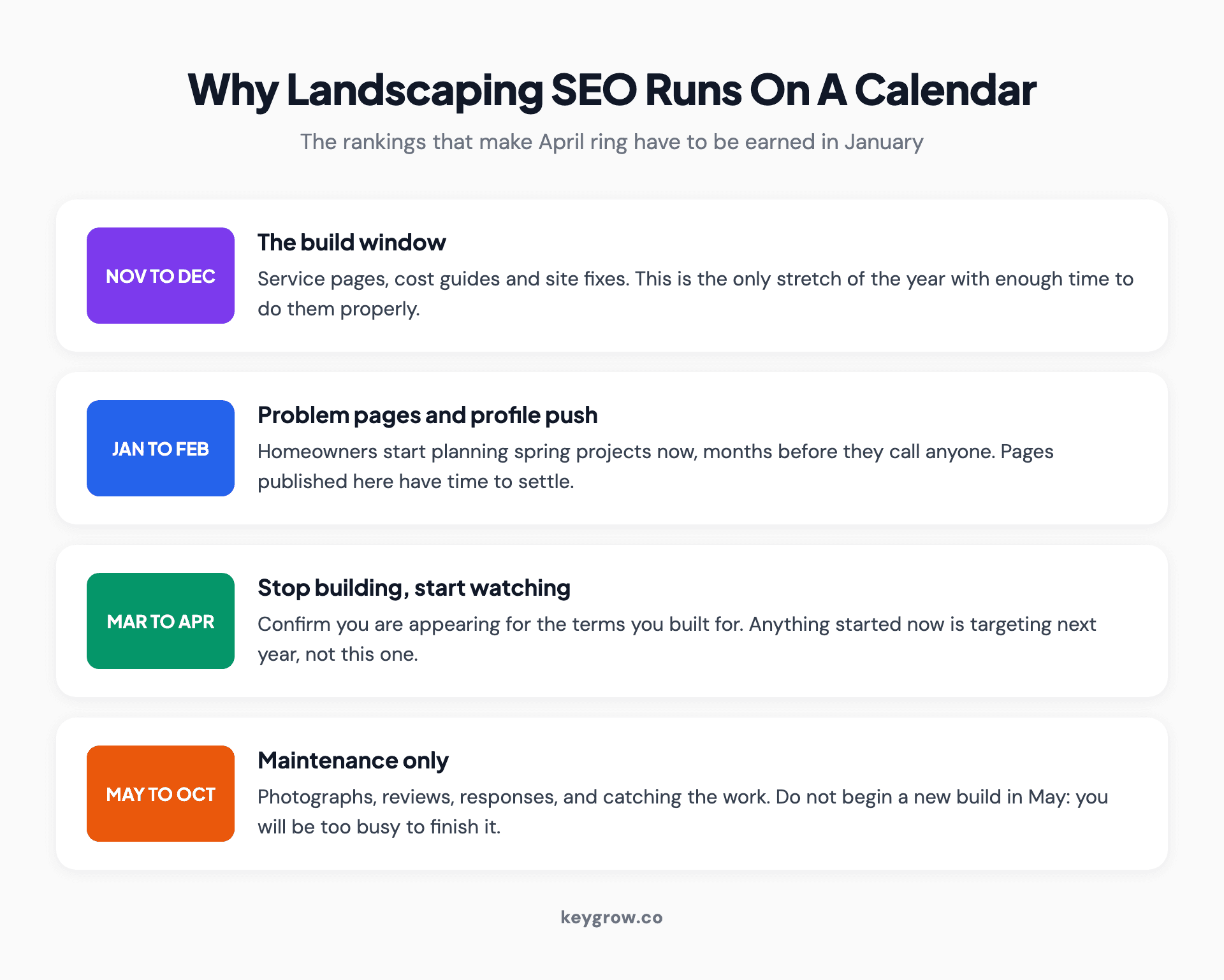
Four-phase annual calendar for landscaping SEO: build service pages November to December, publish problem and city pages January to February, monitor March to April, and run maintenance only May to October.
Pull your own market up in Google Trends and compare "landscaping" against something aseasonal like "plumber". The landscaping line climbs from February, spikes through spring, holds through summer, and falls off a cliff in November. In northern markets the trough is deep enough that some firms stop trading and sell snow removal instead.
The employment data shows the same shape from the other side. The BLS handbook records about 1,299,200 grounds maintenance jobs in 2025, with the plain note that these workers are busier in spring, summer and fall, and that some of the jobs are seasonal outright.
The consequence for search work is awkward and not complicated. Nothing you publish this month is going to hold a position for another three to six. So the pages that need to be ranking in April have to exist, be indexed, and have started earning their position by January at the latest. The quiet months are not downtime, they are the build.
The firms that get this right treat November through February as the content season and March through October as the maintenance season. The ones that get it wrong call an agency in May, sign up, and then judge the results against a summer that was already lost when they signed.
Which jobs do you actually want more of?
Answer this before you look at a single keyword, because the highest-volume terms in this industry lead to the least valuable work.
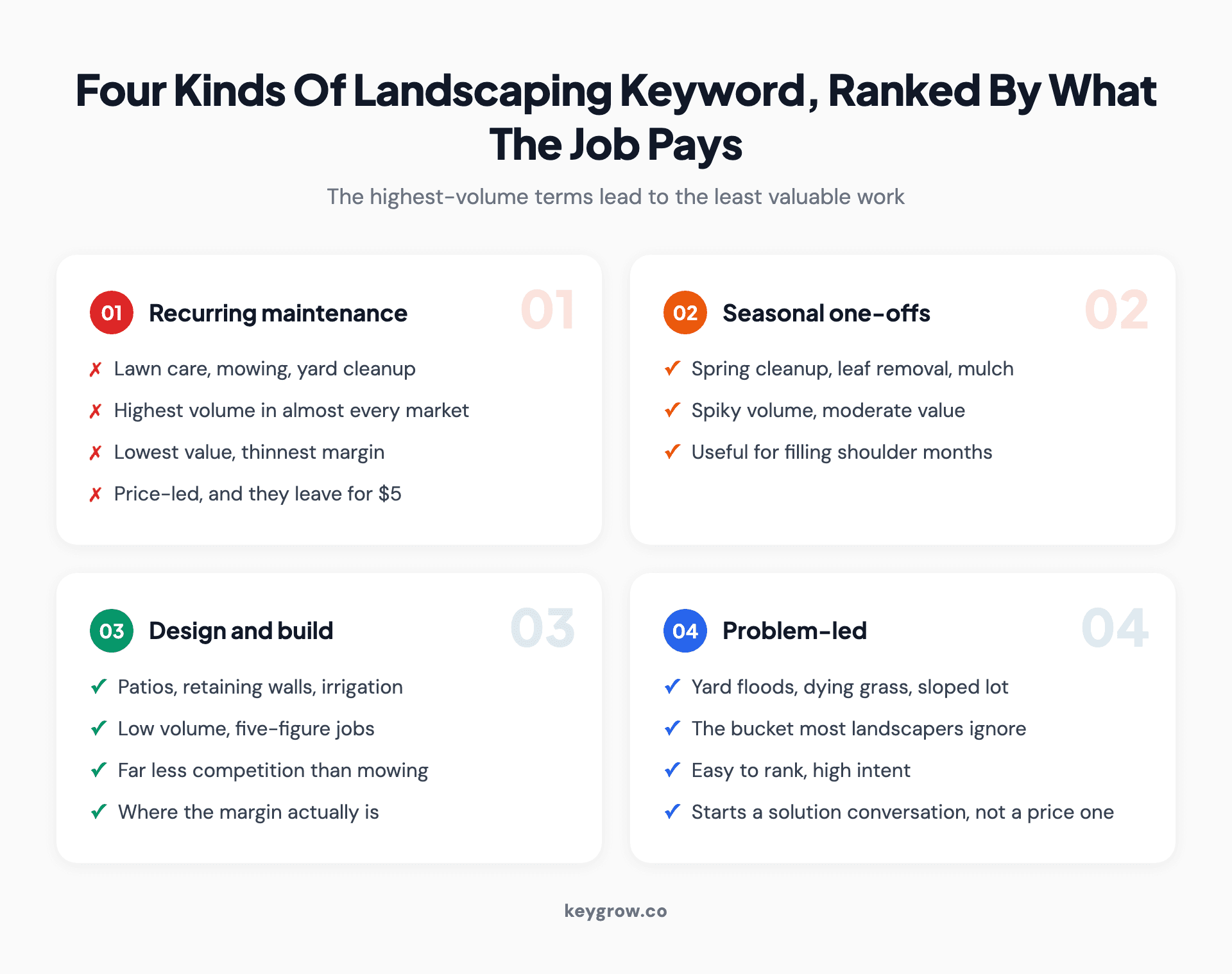
Four cards ranking landscaping keyword types by job value: recurring maintenance, seasonal one-offs, design and build, and problem-led searches.
A recurring mow is worth perhaps forty to eighty dollars a visit at thin margin, and the customer is price-shopping. A season of maintenance on contract is worth a few thousand and is predictable. A design and build project, a patio, a retaining wall, an irrigation system, runs into five figures and carries the margin that actually funds a business.
Now look at search volume. "Lawn mowing near me" outvolumes "landscape design" by a wide margin in almost every market. Chase the big number and you will succeed: your phone will ring constantly with people who want the cheapest possible mow and will leave the moment somebody quotes five dollars less.
We have watched the identical mistake play out on the paid side, where nobody is ever short of traffic. One cash home buyer had a pipeline stuffed with people who were never going to transact. Nothing was added. Terms were narrowed, the ad copy started disqualifying people on purpose, and a negative keyword list did the rest. The count of serious leads multiplied by seven over one December-to-January stretch, on a budget that never moved. Landscaping has no negative keyword field, so the equivalent decision is simply declining to write the mowing page.
Pick your mix deliberately. If you want design and build work, your keyword list should be dominated by terms that only somebody planning a project would type, and you should accept far lower volume in exchange for the job being worth thirty times as much.
Building the keyword list by job value
Group your terms into three buckets and resource them accordingly.
| Bucket | Example terms | Volume | Value per job | Competition |
|---|---|---|---|---|
| Recurring maintenance | lawn care, lawn mowing, yard cleanup, weekly mowing | High | Low | Very high, price-led |
| Seasonal one-offs | spring cleanup, leaf removal, mulch delivery, aeration | Medium, spiky | Medium | Moderate |
| Design and build | landscape design, patio installation, retaining wall, irrigation system | Low | High | Low to moderate |
| Problem-led | drainage problem, lawn full of weeds, dying grass, sloped yard | Low | Varies, often high | Low |
The fourth row is the one most landscapers ignore and the one I would build first. Somebody searching how to fix a yard that floods every spring has a problem, a budget, and no idea who to call. That page is easier to rank than "landscaping" and it produces a conversation about a solution rather than a price.
Add your city to these where it reads naturally, and do not build a separate page for every suburb. That is covered further down, and it is where landscaping sites most often go wrong.
The pages that make the phone ring
One page per service, written like an estimate rather than a brochure.
A page that says you offer patio installation is not a page. A page that explains what paver types cost in your climate, how long a typical job takes, what the site prep involves, what happens if there is a slope, and what a homeowner should expect to pay, is a page. It will rank, and more importantly it will pre-qualify the caller so the estimate visit is not wasted.

Landscaper kneeling to lay paving stones on a garden path.
Build them in this order: your highest-margin service, your second highest, then the problem-led pages, then the seasonal ones, then maintenance last. That order is deliberately the inverse of search volume.
The detail that separates a landscaping service page from every other trade's is the visual proof, and it is sitting on your phone already.
Your photos are the asset nobody else in local search has
Most trades have nothing to show. A plumber cannot photograph a fixed pipe in a way that makes anyone feel anything. You transform the front of somebody's house, and you have the before and after on a camera roll going back years.
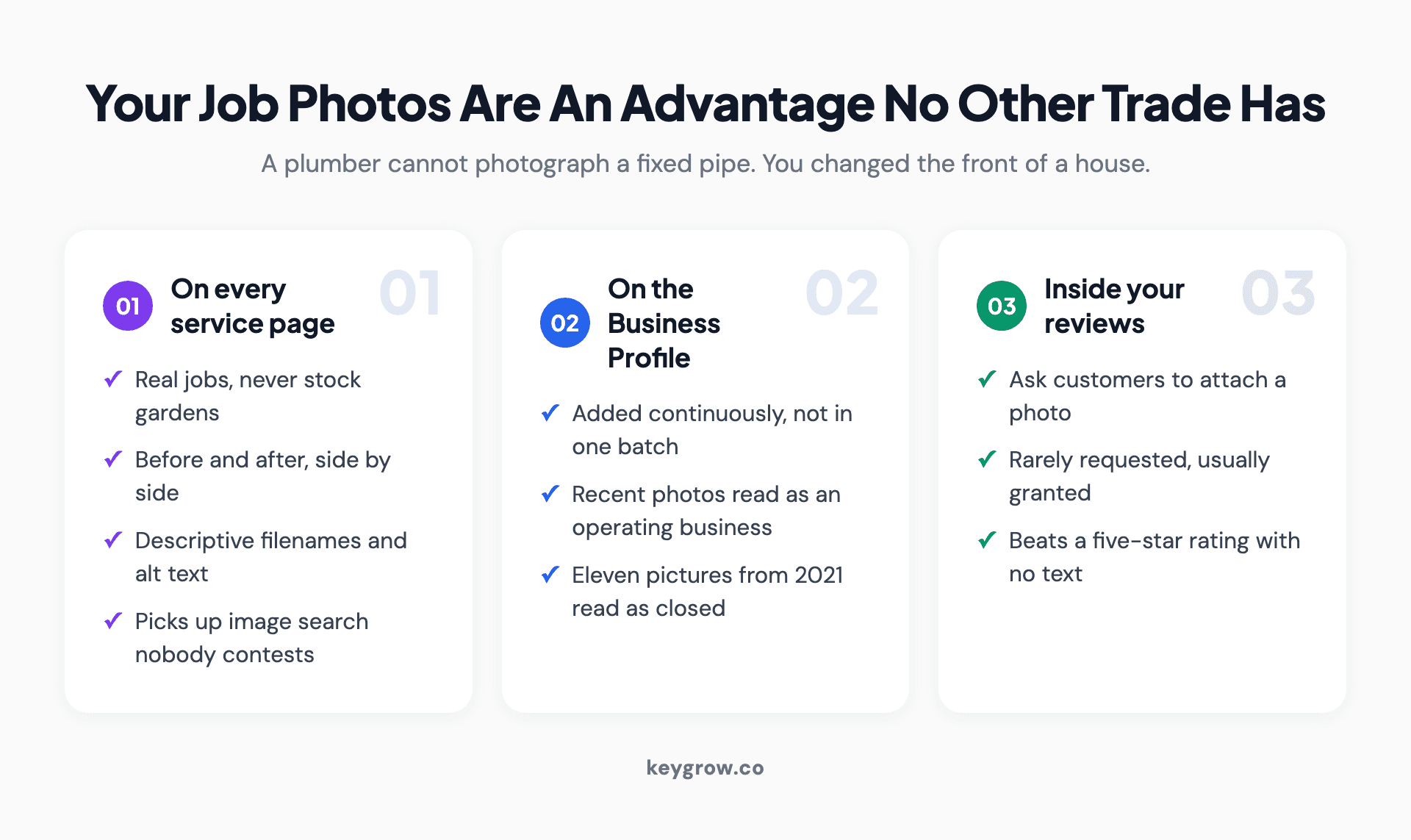
Three-column guide to using job photographs in landscaping SEO: on service pages, on the Google Business Profile, and inside customer reviews.
Use it properly. Every service page should carry real project photographs from your own jobs, not stock images of gardens in another country. Name the file after the job. Write alt text that describes what was done. Put the before and the after next to each other, because that pairing is the single most persuasive thing on your entire website and it costs nothing.
The same photos go on your Google Business Profile, and they should go up continuously rather than in one batch when the profile was set up. A profile with recent photographs reads as an operating business. One with eleven photos from 2021 reads as a business that might have stopped.
There is a technical benefit too, which is that image-heavy pages with descriptive filenames and alt text pick up image search traffic that competitors ignore entirely. Homeowners browse for ideas before they search for contractors, and the browsing happens in image results.
The Business Profile field landscapers get wrong
Your primary category decides which searches you are eligible for, and this industry has several that look interchangeable and are not.
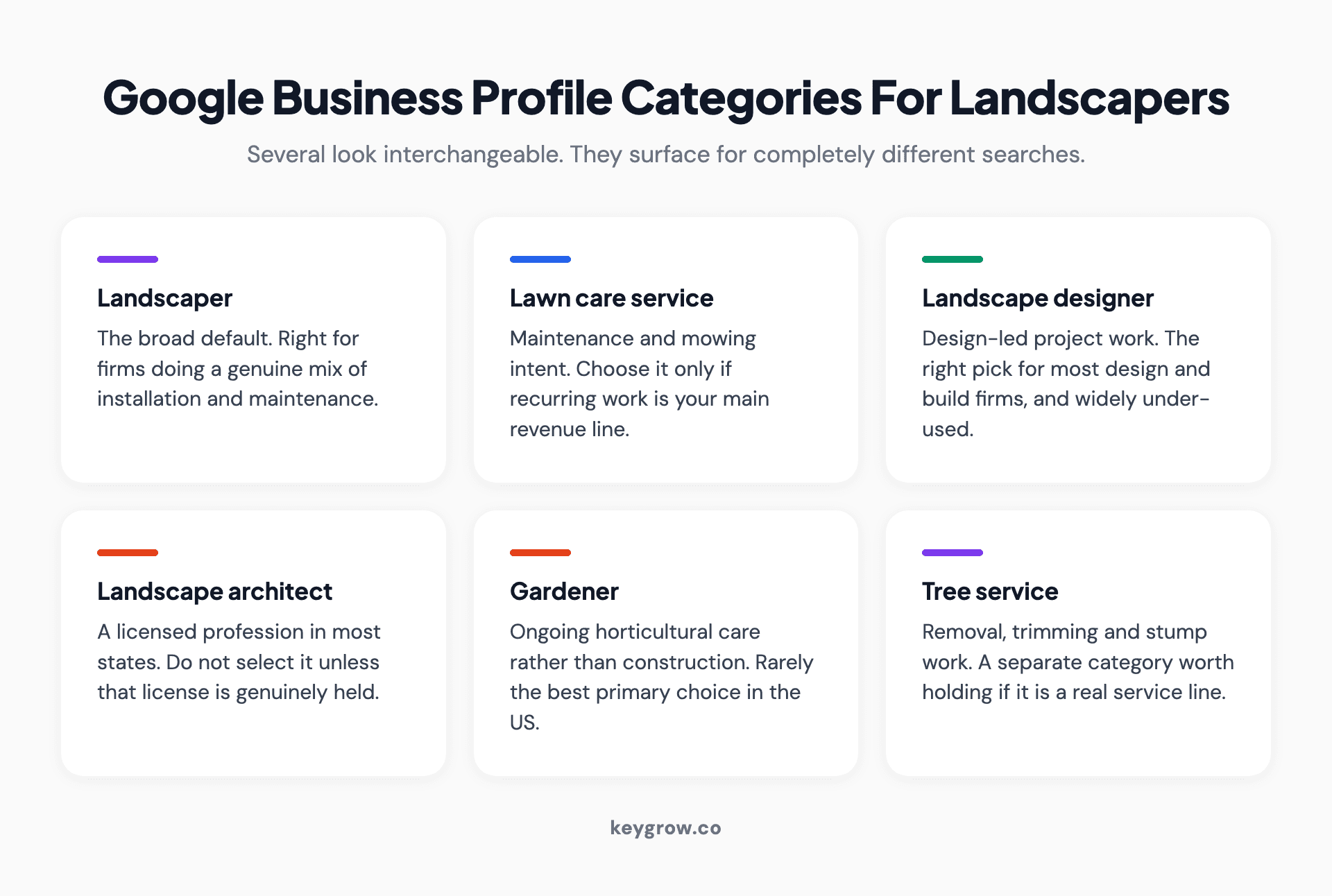
Six Google Business Profile categories available to landscaping businesses, with guidance on when each is the right primary choice.
Landscaper, Lawn care service, Landscape designer, Landscape architect, Gardener and Tree service are different categories that surface for different queries. A firm doing mostly design and build that has chosen Lawn care service is competing for mowing searches and invisible for the work it wants. A maintenance firm listed as Landscape architect has the opposite problem.
Pick the category that matches your highest-value revenue line, not the one that describes everything you do. Secondary slots come next, filled with what you really sell and nothing aspirational, then leave the rest empty. Our local SEO checklist goes through the rest of the profile fields in order of what they actually change.
List your services individually inside the profile as well, with descriptions. Most landscapers leave this empty, and it is one of the few places where filling in a form is genuinely worth the twenty minutes.
Reviews, and the seasonal wrinkle
Reviews arrive in summer, because that is when the work happens. Then they stop, and by February your most recent review is five months old at exactly the moment homeowners start planning spring projects.

Hands pressing a fresh roll of turf into soil at the edge of a lawn.
Two habits fix this. Ask at the end of every job, in person, before the crew leaves, because the gap between the work and the ask is the strongest predictor of whether a review appears. And hold a few back deliberately: if you finish thirty jobs in August, do not chase all thirty at once. A steady trickle through the autumn keeps the profile looking alive into the planning season.
Photographs in reviews are worth asking for and rarely requested. A customer review with a picture of their new patio does more than a five-star rating with no text, and people are usually pleased to be asked.
Service areas, not a page for every suburb
Almost every landscaper is a service area business: your customers do not come to you, you drive to them.
That means hiding your address if you work out of a yard or your home, setting service areas as the regions you genuinely cover, and resisting the strong temptation to create a page for each of the forty towns you would drive to.
Build a city page when you have really worked in that city and can say something specific: the soil, the covenants in a particular development, the drainage problem common to houses built there in a certain decade, the town's own rules on tree removal or water use. Those pages rank and convert. A page that says "landscaping services in Fairview" with the town name swapped in is a doorway page, and it is the most common self-inflicted wound in trade SEO. Our guide for contractors covers the same trap from the general building side.
Three real city pages beat thirty generated ones, every time, and they take less total effort.
What to publish, and what to skip
The content advice given to landscapers is usually "start a blog", which is how you end up with four posts about the history of topiary.
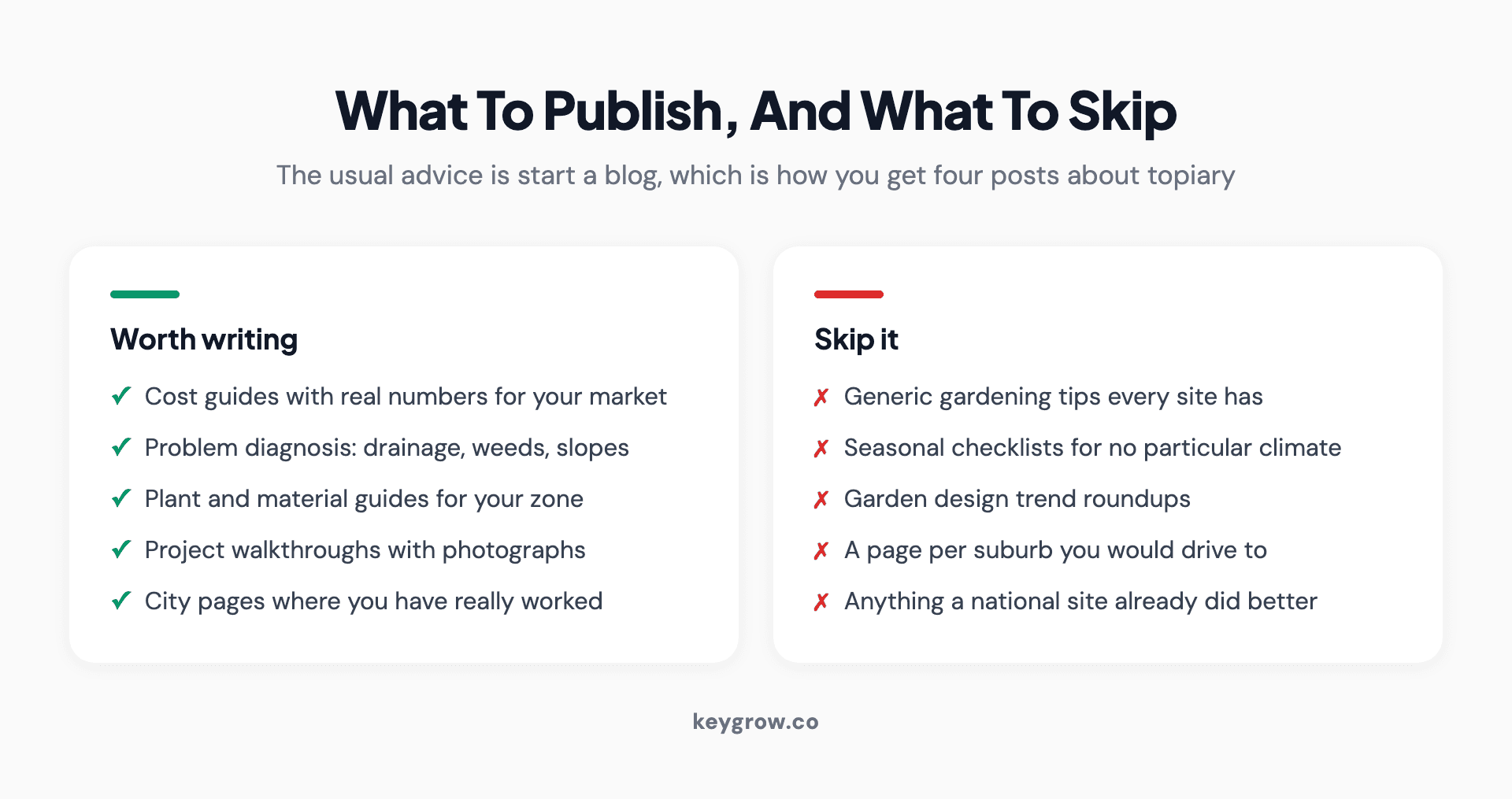
Two-column comparison of landscaping content worth writing, such as cost guides and problem diagnosis pages, against content to skip, such as generic gardening tips and a page per suburb.
Publish these: cost guides for your actual services in your actual market, because price is the question everybody has and almost nobody answers. Problem diagnosis pages, matching the problem-led keywords above. Plant and material guides specific to your hardiness zone, which are genuinely useful and impossible for a national site to do well. Project walkthroughs of jobs you completed, with the photographs, the timeline and the decisions.
Skip these: generic gardening tips that every site in the country already has, seasonal checklists written for no particular climate, and anything about garden design trends. None of them are searched by people who are about to hire someone.
The cost guide is the one to write first. It is uncomfortable to publish numbers, which is exactly why the competition has not, and it filters out the callers who were never going to afford you.
Measuring it when your season distorts everything
Year-on-year is the only comparison that means anything here, and it is the one nobody makes.
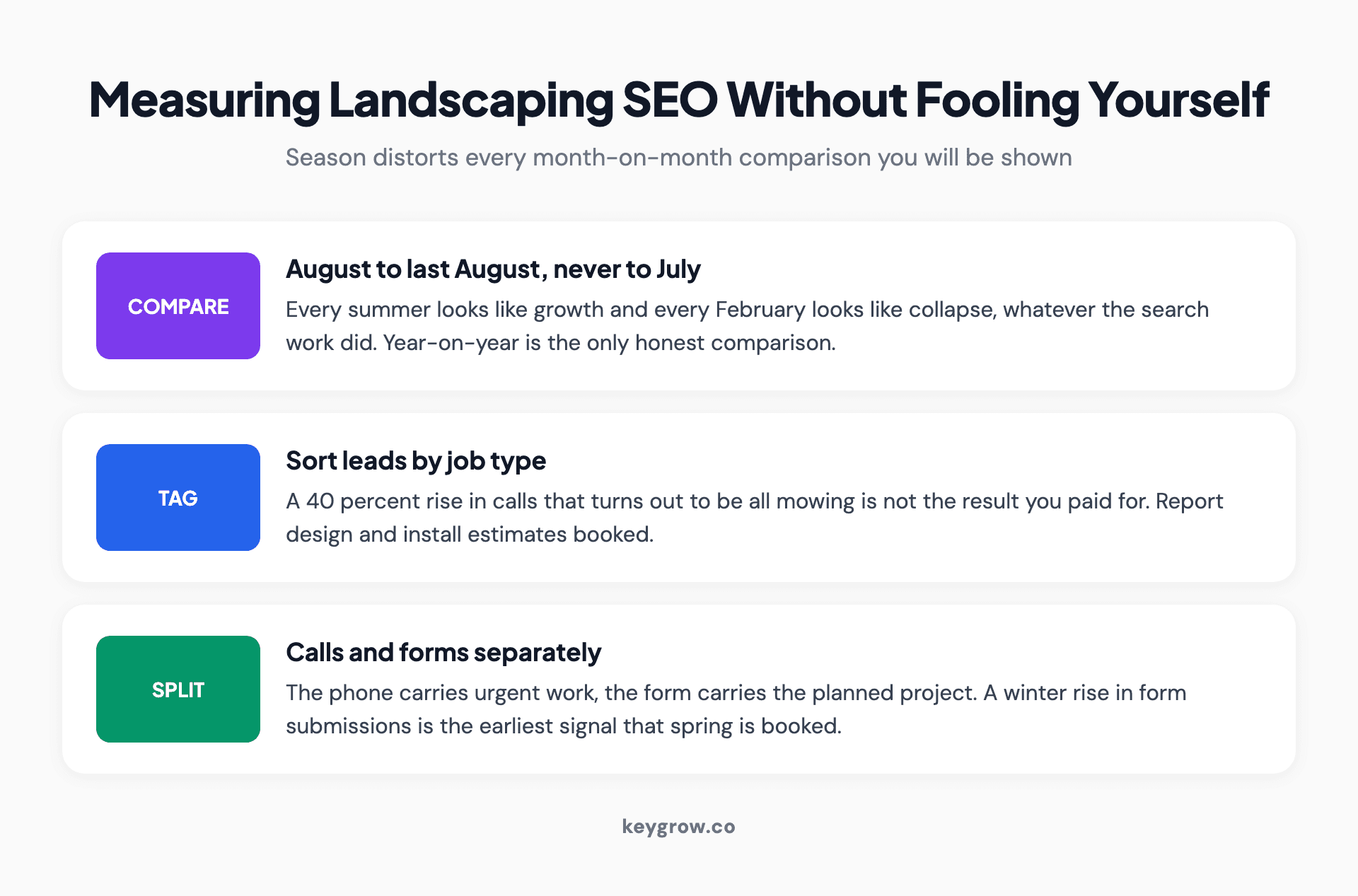
Three-step approach to measuring landscaping SEO: compare year on year rather than month to month, tag leads by job type, and track calls separately from form submissions.
August against July will always look like growth and February against January will always look like collapse, regardless of what the search work did. Compare August to last August. If you have no last August, note that you are flying blind for a year and take a careful baseline now rather than pretending a summer number proves something.
Then tag leads by job type, because a 40 percent rise in calls that turns out to be all mowing inquiries is not the result you paid for. The number worth putting at the top of a report is design and install estimates booked, followed by average job value, followed by the proportion of callers who already knew what they wanted before they rang. That last one moves when the cost guide and the service pages are doing their job, and it shows up as shorter estimate visits and higher close rates long before it shows up in rankings.
Track calls separately from forms. In this industry the phone carries the urgent work and the form carries the planned project, which means a rise in form submissions during winter is the early signal that spring is booked. It is the most useful leading indicator a landscaping business has, and almost nobody watches it.
The twelve month version
| Months | What the search work is |
|---|---|
| November to December | Build and publish the service pages and cost guides. Fix the site. This is the year's real content window |
| January to February | Problem-led pages and city pages. Push the Business Profile hard, because planning searches start now |
| March to April | Stop building, start monitoring. Make sure you are appearing for the terms you built for |
| May to August | Maintenance only. Photographs, reviews, responding, and capturing the jobs as they come |
| September to October | Autumn services push, then the post-season review of what actually produced calls |
The one rule inside that table: do not start a new build in May. You will be too busy to finish it, and it will not rank in time to matter.
When SEO is not your problem
Plenty of landscaping businesses do not need this.
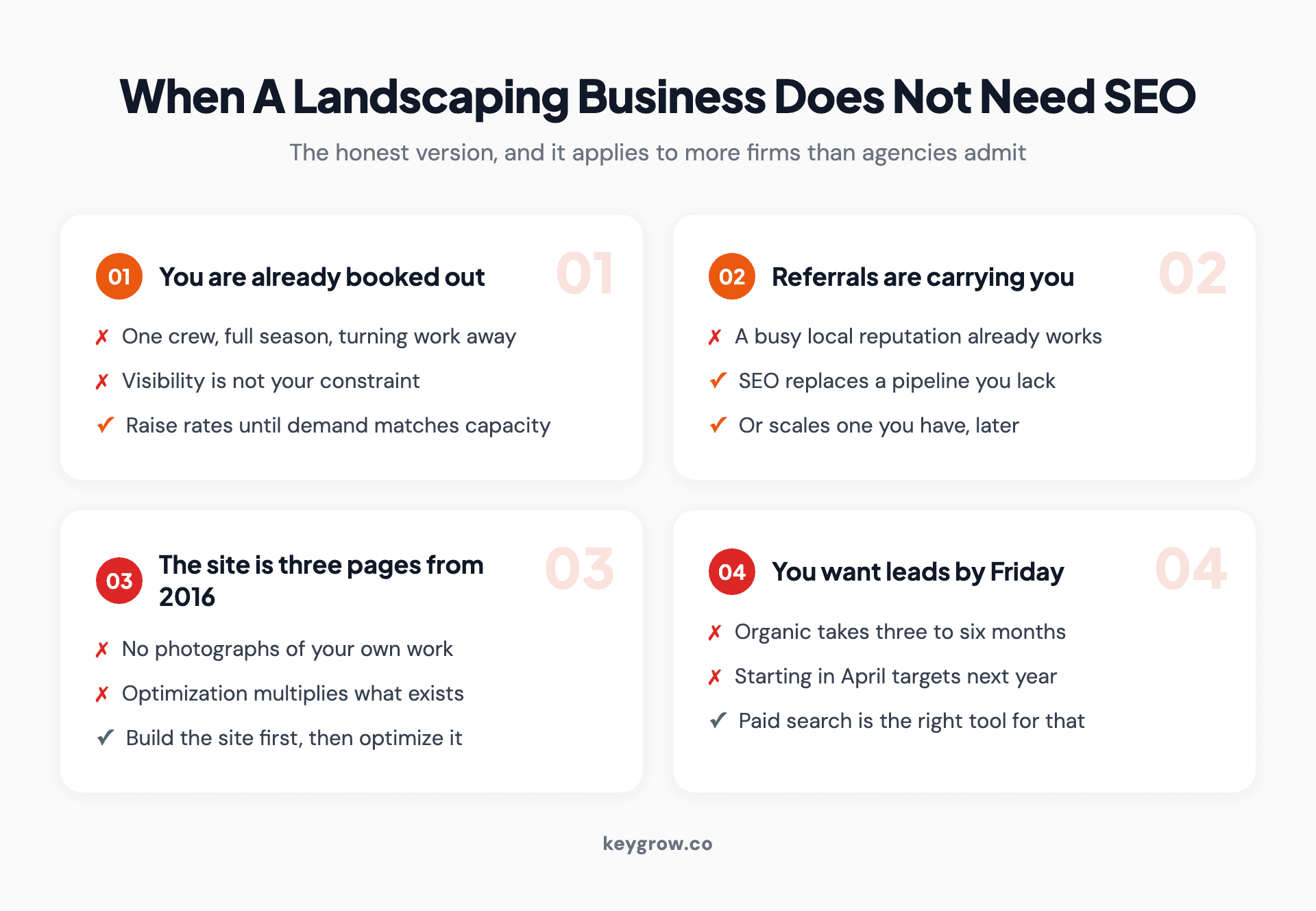
Four situations where a landscaping business does not need SEO: already booked out, carried by referrals, running a site with no photographs, or needing leads this week.
If you are a one-crew operation, booked out through the season already, and turning work away, search visibility is not your constraint. Your constraint is pricing or capacity, and the honest advice is to raise your rates until demand matches what you can deliver, then revisit this when you can actually take the work.
If you are winning enough through referral and a busy local reputation, the same applies. SEO is how you replace a referral pipeline you do not have, or scale past the one you do.
And if your website is three pages made in 2016 with no photographs of your own work, the fix is a website, not a search campaign. Optimization multiplies what is there. Multiplying nothing gives you nothing, a bit faster.
FAQs
How long does SEO take for a landscaping company?
Three to six months to see meaningful ranking movement, which is why the work has to start in the off season. A build started in November has a fair chance of being in position for the spring search wave. One started in April is effectively targeting next year, and any agency that tells you otherwise in March is selling.
Should I target lawn care keywords or design keywords?
It depends entirely on which jobs pay for your business. Lawn care terms carry far more volume and bring price-sensitive one-off customers. Design and build terms are lower volume, much less competitive, and each conversion is worth many times more. Most established landscapers should weight toward design, installation and problem-led terms.
Do I need a page for every town I serve?
No, and building them is one of the most common ways landscaping sites get themselves into trouble. Create a page only where you have done real work and can write something specific about that area, such as its soil, its drainage, or its local rules. A handful of genuine city pages outperform dozens of templated ones.
What should I do during the busy season?
Almost nothing new. Keep taking job photographs, keep asking for reviews, respond to everything that comes in, and post occasionally to the Business Profile. The building work belongs in the quiet months, when you have the time to do it properly.
Is Google Business Profile more important than my website for a landscaper?
For getting found in the map pack, yes, and it is the first thing to fix. The website is what converts the visit and what wins the organic results below the map, particularly for design and build searches where people research before they call. You need both, and the profile is quicker.
How do I compete with the big national lawn care brands?
Do not compete on their terms. National brands win high-volume maintenance searches through budget. They cannot write a page about drainage in your specific neighborhood, show photographs of a retaining wall three streets away, or carry forty local reviews mentioning your crew by name. Specificity is the advantage, and it is not available to them at any price.
What is the single fastest improvement most landscapers can make?
Adding real project photographs, with before and after pairs, to the service pages and the Business Profile. Most landscaping sites use stock imagery while the owner has hundreds of better pictures on their phone. It takes an evening and it changes both conversion rate and how established the business looks.
January is when April gets decided
Work backwards from your season. Write down the month your phone historically starts ringing, subtract four months, and that is when the pages you want ranking need to be live.
For most of the country that means the build happens over winter: the high-margin service pages first, then the problem-led pages, then the cost guide nobody else will publish, then a small number of real city pages. Photographs on all of them. Reviews trickling in throughout.
If you are reading this in June, do the photographs and the reviews now, keep the list, and start the build in November. That is not a delay tactic, it is the shape of the year. We do this work for landscaping companies on that timetable, and the first question we ask is which jobs you want more of rather than which keywords you want to rank for. Tell us your season and we will tell you what the build window looks like from here.


