


If you run Google Ads as a home builder, the single most useful thing you can know before writing a single ad is which industry benchmark your campaign actually belongs to. Home builders straddle two of them, and the two behave nothing alike. One gives you cheap clicks that mostly do not convert. The other gives you clicks that cost more than twice as much and convert twice as often. Same trade, same keyword list, completely different math, and picking the wrong mental model is why most builder accounts feel expensive without ever being obviously broken.
That is the short answer. The rest of this is how to tell which one you are in, what the keywords cost, and why your conversion tracking is probably reporting a number that cannot tell you anything useful.
Home builders sit between two benchmarks, and they behave nothing alike
WordStream's 2026 benchmarks cover 13,474 US search advertising campaigns between April 1, 2025 and March 31, 2026. Two of the industry rows matter to a builder, and looking at them side by side is more instructive than any amount of advice about ad copy.
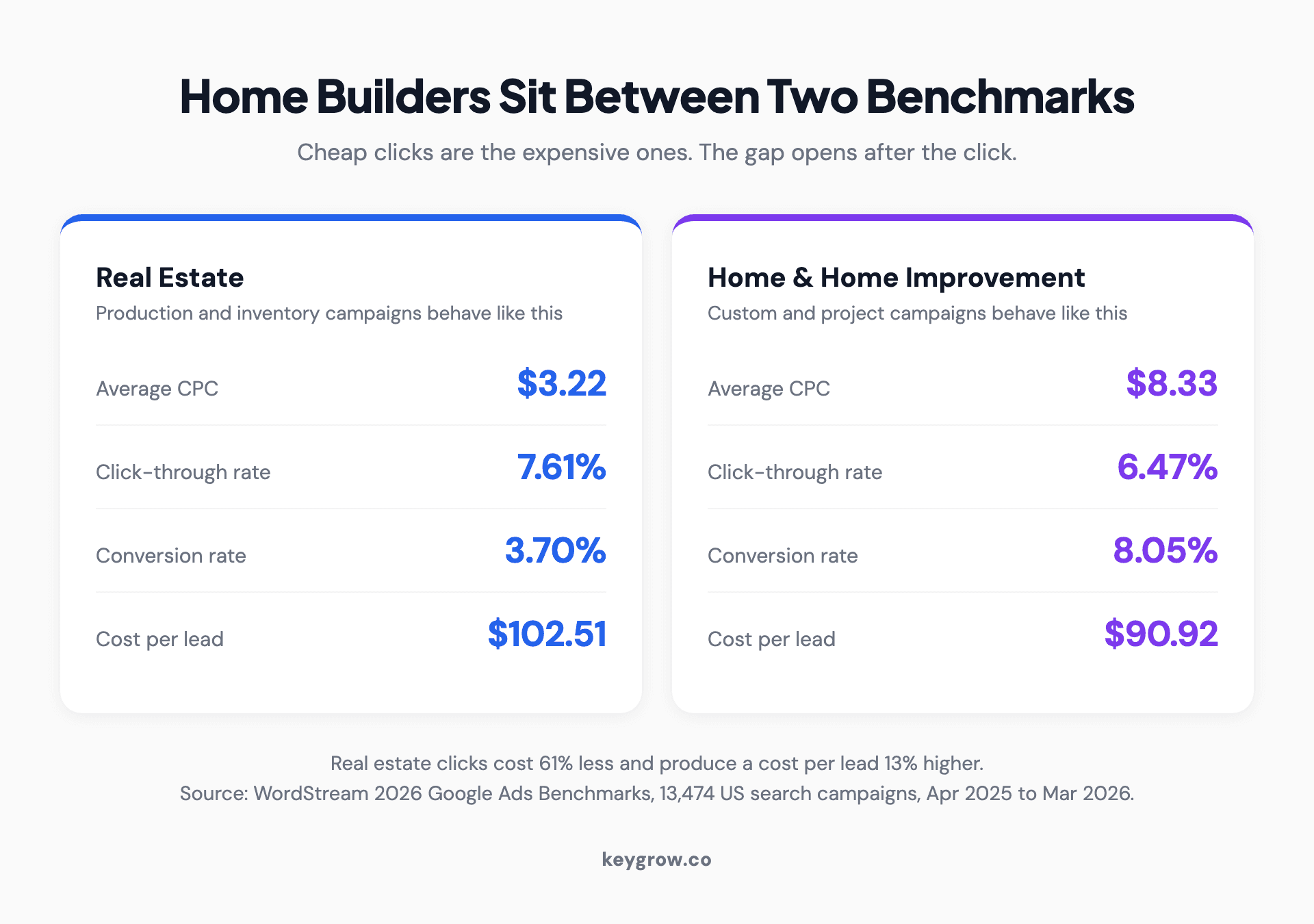
Side by side comparison of Google Ads benchmarks for Real Estate and Home and Home Improvement showing cost per click, click through rate, conversion rate and cost per lead.
| Metric | Real Estate | Home & Home Improvement |
|---|---|---|
| Average CPC | $3.22 | $8.33 |
| Average CTR | 7.61% | 6.47% |
| Conversion rate | 3.70% | 8.05% |
| Cost per lead | $102.51 | $90.92 |
Read that table twice, because the interesting part is not the click price. Real estate clicks cost 61% less than home improvement clicks and produce a cost per lead that is 13% higher. The cheap channel is the expensive one. Everything that happens between the click and the form is doing the damage, and in real estate that gap is enormous: fewer than four visitors in a hundred do anything at all.
There is a second detail worth having. Real estate posted the largest year over year CPC rise of any industry in that dataset, up 27.27%. Builder Designs puts the move from $2.53 to $3.22 and notes that within real estate, the homes-for-sale-by-agent subcategory rose 78.9% while its click-through rate fell 39.2%. That is their own analysis rather than a third-party figure, so treat the subcategory number as directional. The direction is not in dispute though: builders are paying more each year for clicks that convert less often.
Which of the two you resemble
Nothing about your business license decides this. What decides it is whether the person clicking is shopping for a house or commissioning one.
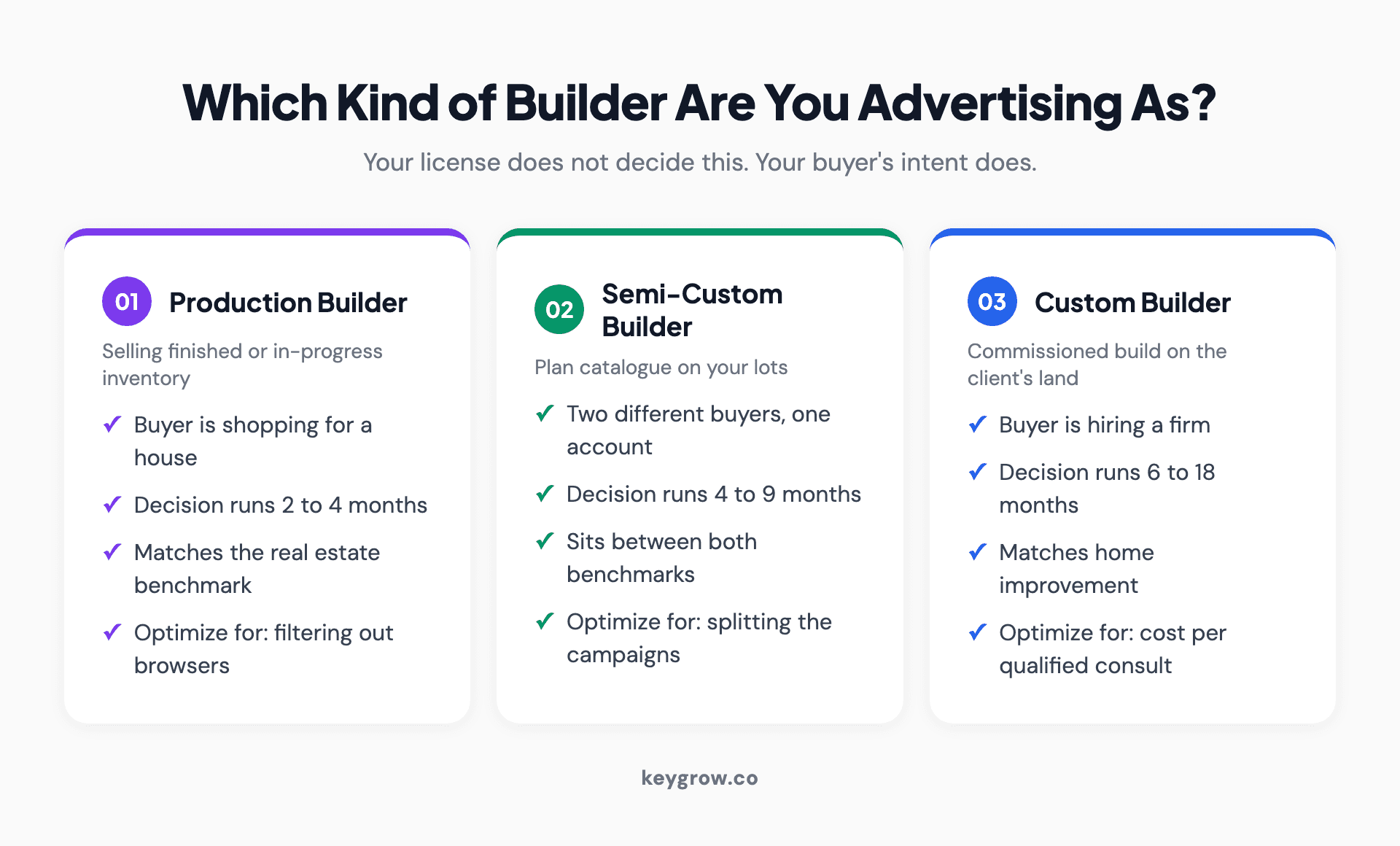
Three cards comparing production builders, semi custom builders and custom builders across buyer intent, decision length, benchmark match and the metric each should optimize for.
Production builders selling from available inventory are running a real estate campaign whether or not they think of it that way. The searcher is browsing. They want to see photos, floor plans and a price, and they will look at nine other communities the same evening. Expect cheap clicks, a conversion rate closer to 3% or 4% than 8%, and a lot of traffic that was never going to buy from anyone this year. Your job is filtering, and your realistic cost per lead sits north of $100.
Custom builders are running a home improvement campaign. The searcher has land, or a lot, or a very specific renovation-scale project in mind, and they are looking for a firm rather than a house. Clicks cost more because the competition is contractors with real project values behind them. Conversion is meaningfully better because the person searching has a job to commission. Your cost per lead can land under $100 and still be attached to a six-figure contract.
Semi-custom builders get the worst of both unless they separate the campaigns. If you sell from a plan catalogue on your own lots, you have two distinct buyers arriving through the same account, and blending them produces an average that describes neither. Split them at the campaign level, give them separate budgets, and stop comparing their cost per lead to each other.
What builder keywords cost right now
Published ranges for builder and construction keywords generally run from around $3 to $18 per click depending on the term and the market, which lines up with the two benchmarks above sitting at $3.22 and $8.33. The spread inside your own account will be just as wide, and it maps closely to intent.
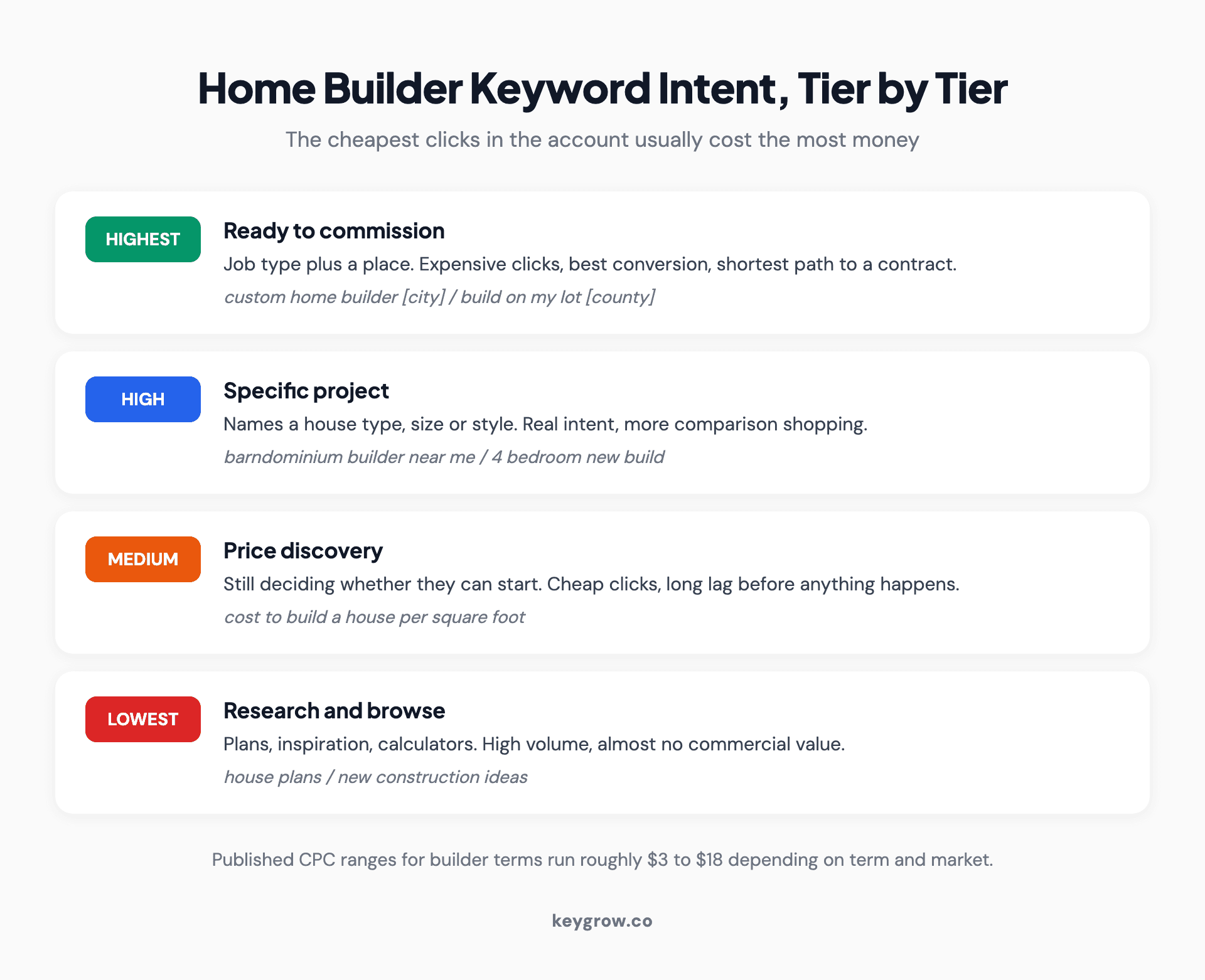
Four tiers of home builder search intent from ready to commission down to research and browse, with example queries and what each tier is worth.
The pattern holds almost everywhere. Terms naming a job type and a place cost the most and convert the best. Terms naming a house type are cheaper and browsier. Terms naming a price point attract people early in the process who are still deciding whether they can afford to start at all.
A practical consequence: the cheapest clicks in your account are usually the ones costing you the most money, because they arrive in volume and convert at rates that make the arithmetic collapse. If you are optimizing toward a lower average CPC, you are optimizing toward the real estate column of that table, and the real estate column has the worse cost per lead.
The searches that quietly eat a builder's budget
This vertical has a problem most trades do not. An enormous share of the search volume around building terms comes from people who want a job, not a house.
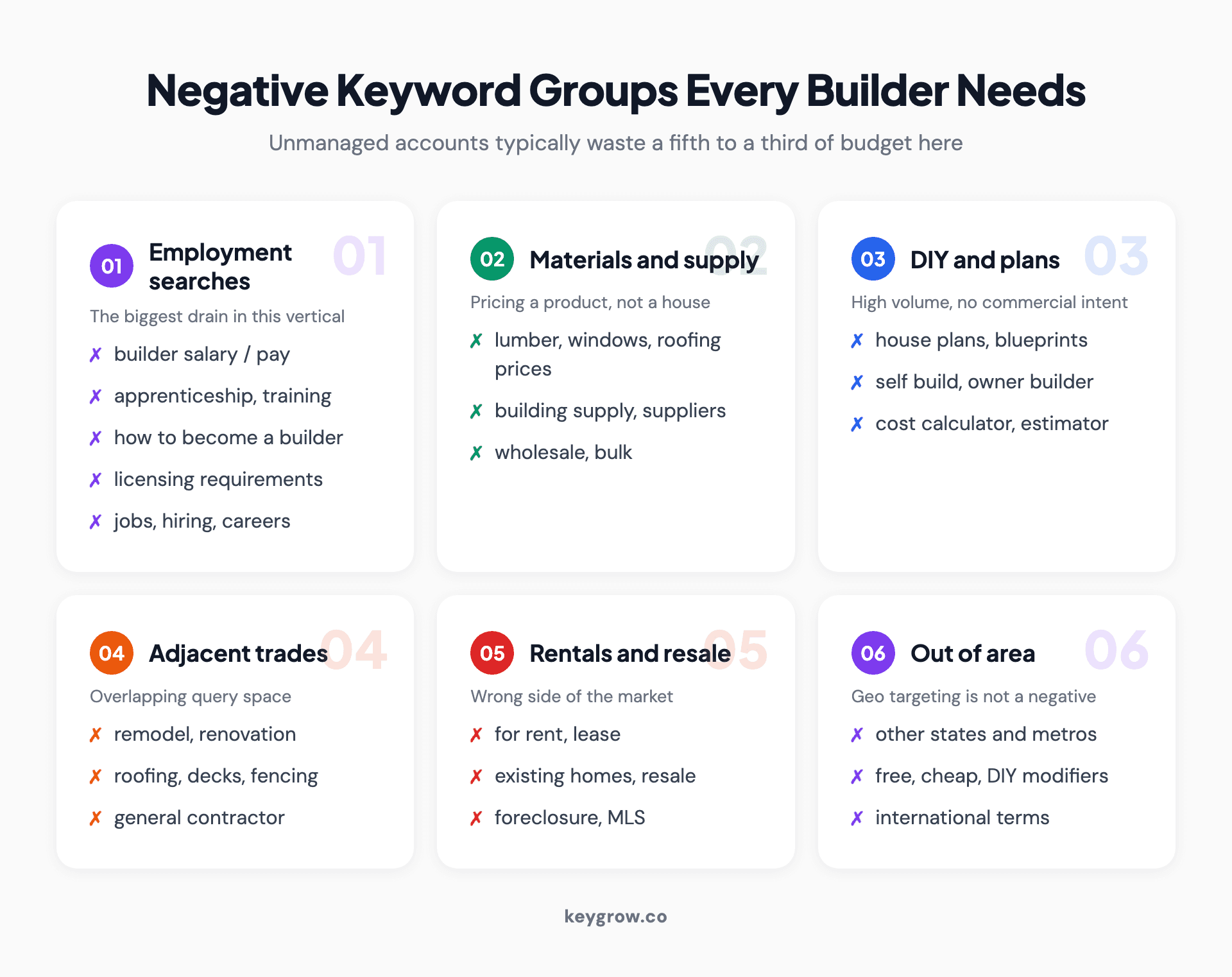
Checklist of negative keyword groups for home builder Google Ads covering employment searches, DIY and materials queries, unrelated trades and out of area terms.
Employment queries are the big one. Searches around builder salaries, apprenticeships, licensing requirements and how to become a builder run at serious volume, and broad or phrase match will happily serve your ad against a good number of them. The click looks identical in your reporting. The person is applying for work.
The other drains, in rough order of how much they cost the accounts we audit:
- Materials and supply searches. Someone pricing lumber or windows is not commissioning a house.
- Do-it-yourself and plan searches. House plan downloads, self-build guides, cost calculators. High volume, no commercial intent for you.
- Adjacent trades. Remodelers, roofers, deck builders and general contractors all overlap in the query space if your match types are loose.
- Rentals and existing homes. For a production builder in particular, resale and rental language will creep in constantly.
- Out-of-area terms. Location targeting is not a negative keyword. Someone in your service radius can still search for a builder three states away.
Adding negatives is not a one-time setup task. Pull the search terms report weekly for the first two months, then monthly. In unmanaged accounts, the wasted portion of spend typically sits somewhere between a fifth and a third of the budget, and in this vertical it is at the higher end of that because of the employment queries.
Campaign types that earn their place
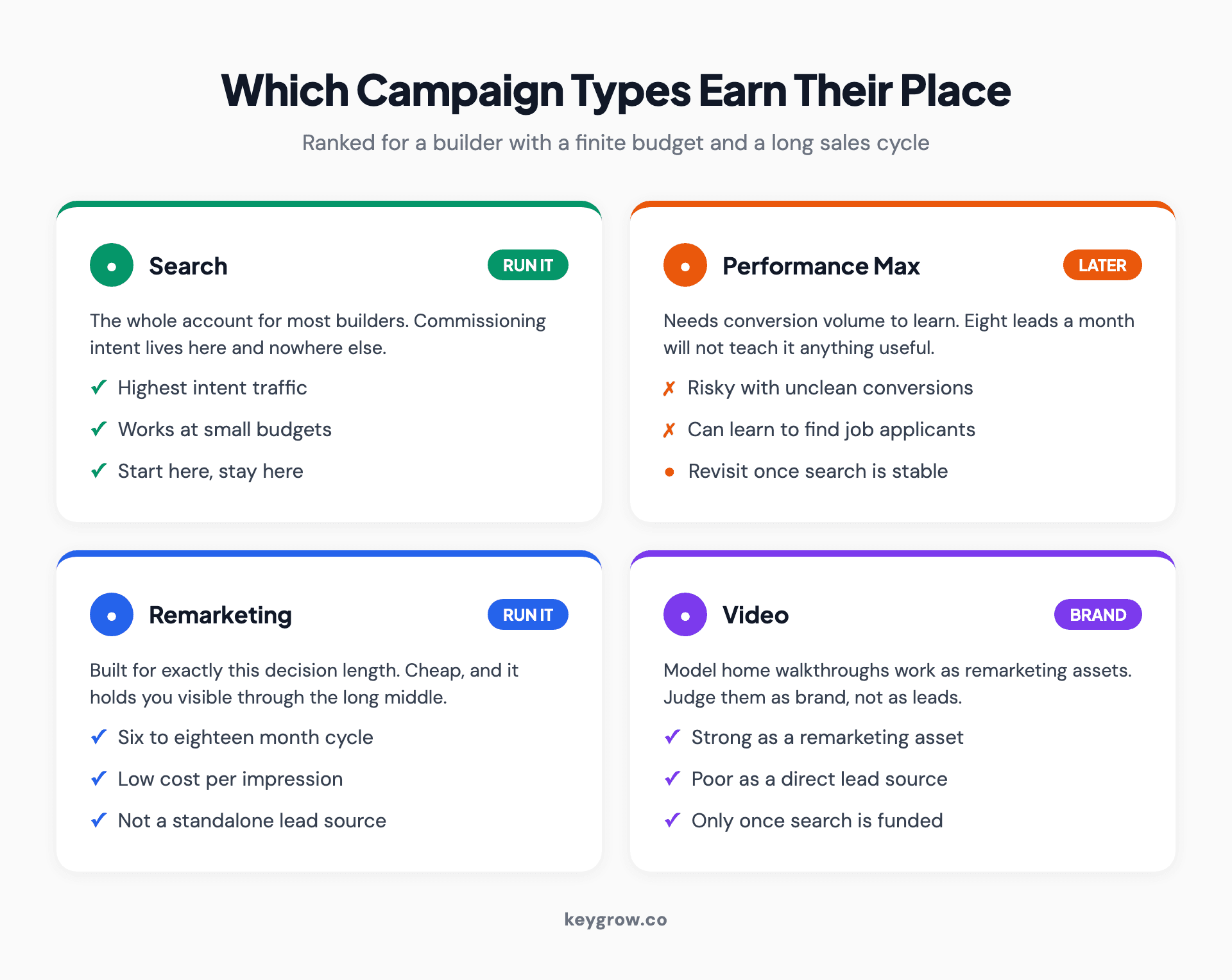
Four cards rating Google Ads campaign types for home builders: search, Performance Max, remarketing and video, with a verdict and a reason for each.
Search is the whole account for most builders. It is where commissioning intent lives. If you have a limited budget, spend all of it here and revisit the rest when search is producing reliably.
Performance Max is a maybe, and only later. It needs conversion volume to learn from, and a builder generating eight leads a month is not going to give it any. Worse, in a category where a lead can be a job applicant, feeding a machine learning system your unfiltered conversion signal teaches it to find more of the wrong people. Get search stable and your conversion actions clean first.
Remarketing is genuinely useful here and underused. A six to eighteen month decision cycle is exactly the situation display remarketing was built for. It is cheap, it is not going to generate leads on its own, and it keeps you visible during the long middle of the decision where most builders vanish.
Video is a brand play. Model home walkthroughs perform well as remarketing assets. They are not a lead source and should not be judged as one.
Your conversion tracking cannot see the sale
This is the part almost nobody writes about, and it is the reason good builder campaigns get killed.
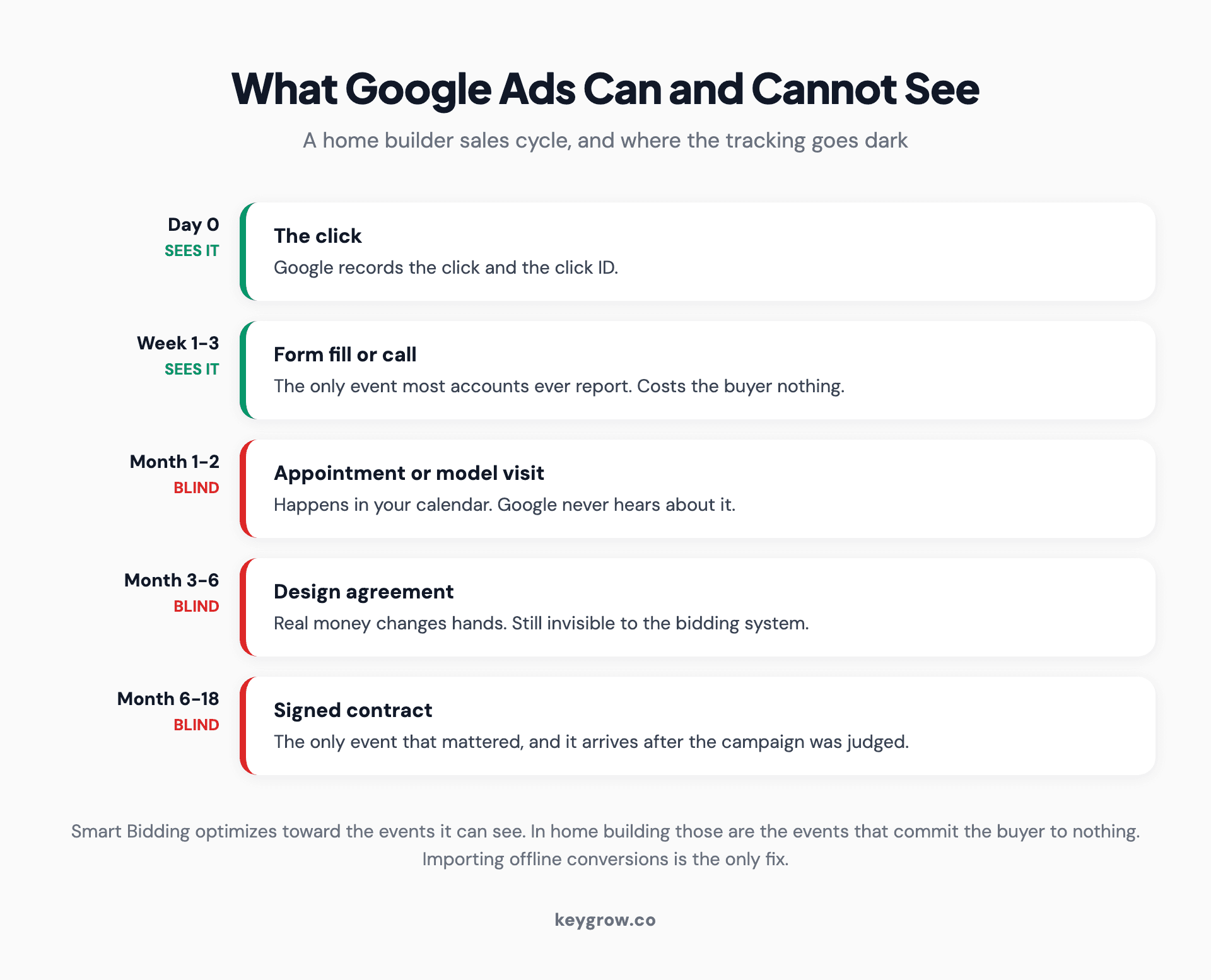
Timeline showing a home builder sales cycle from first click through inquiry, appointment, design agreement, contract and close, marked with where Google Ads conversion tracking can and cannot see.
A custom home is a six to eighteen month decision. Even a production sale from an inventory home usually takes a couple of months from first search to signed contract. Google Ads conversion windows are configurable but finite, and Smart Bidding learns from whatever signal you feed it, which in practice is a form fill that happened within a few weeks of the click.
So the system optimizes toward form fills. Form fills are not contracts. The two are not even strongly correlated in this vertical, because the easiest form to fill is the one from somebody who is eighteen months out and comparison shopping for entertainment.
Here is the opinion, and it is the one I would argue hardest for: in home building, cost per lead is a vanity metric. It has the appearance of a business number and it measures an event that costs you nothing and commits the buyer to nothing. A builder proudly reporting $60 leads while a competitor reports $130 leads may simply be buying browsers while the competitor buys buyers. The number that matters is cost per signed contract, and it arrives so late that most accounts never connect it back to a campaign at all.
What to do about it, in order of effort:
- Track more than the form. Phone calls with a minimum duration, brochure downloads, appointment bookings and model home visit requests are all separate conversion actions with different values. Give them different values.
- Assign values that reflect reality. If an appointment request is worth ten times a brochure download to your sales team, say so in the conversion settings. Smart Bidding will act on it.
- Import offline conversions. This is the fix. When a lead becomes an appointment, then a design agreement, then a contract, push that back into Google Ads against the original click ID. Your CRM can do it, and it is the only way the bidding system ever learns which clicks became houses.
- Judge campaigns on a lag. Do not evaluate a builder campaign on 30 days of data. Look at a rolling quarter minimum, and hold judgment on contract quality for two.
The landing page decides more than the ad does
Look again at that conversion rate gap: 3.70% against 8.05%. Most of that difference happens after the click.
We rebuilt a landing page for a real estate service client and their conversion rate rose 85% in four weeks. No change to the ads, no change to the budget, no new keywords. The page had been asking visitors to do three things at once, and the rebuild asked them to do one.
For a builder, the page needs to answer the questions a buyer will not phone to ask:
- Where you build. Named communities, counties or a radius. Not "the greater metro area".
- What you cost. A starting price, a price per square foot range, or a typical project range. Builders hate this. Buyers filter on it anyway, and withholding it just means the filtering happens without you.
- What the process looks like. A six to eighteen month commitment needs a visible map of what happens between signing and moving in.
- Proof at the right scale. Photographs of finished homes you actually built, with location and specification. Stock renderings actively hurt here.
- One action. Book a consultation, or request a brochure, or schedule a model visit. Pick the one that matches the campaign and let the others live on the site rather than the landing page.
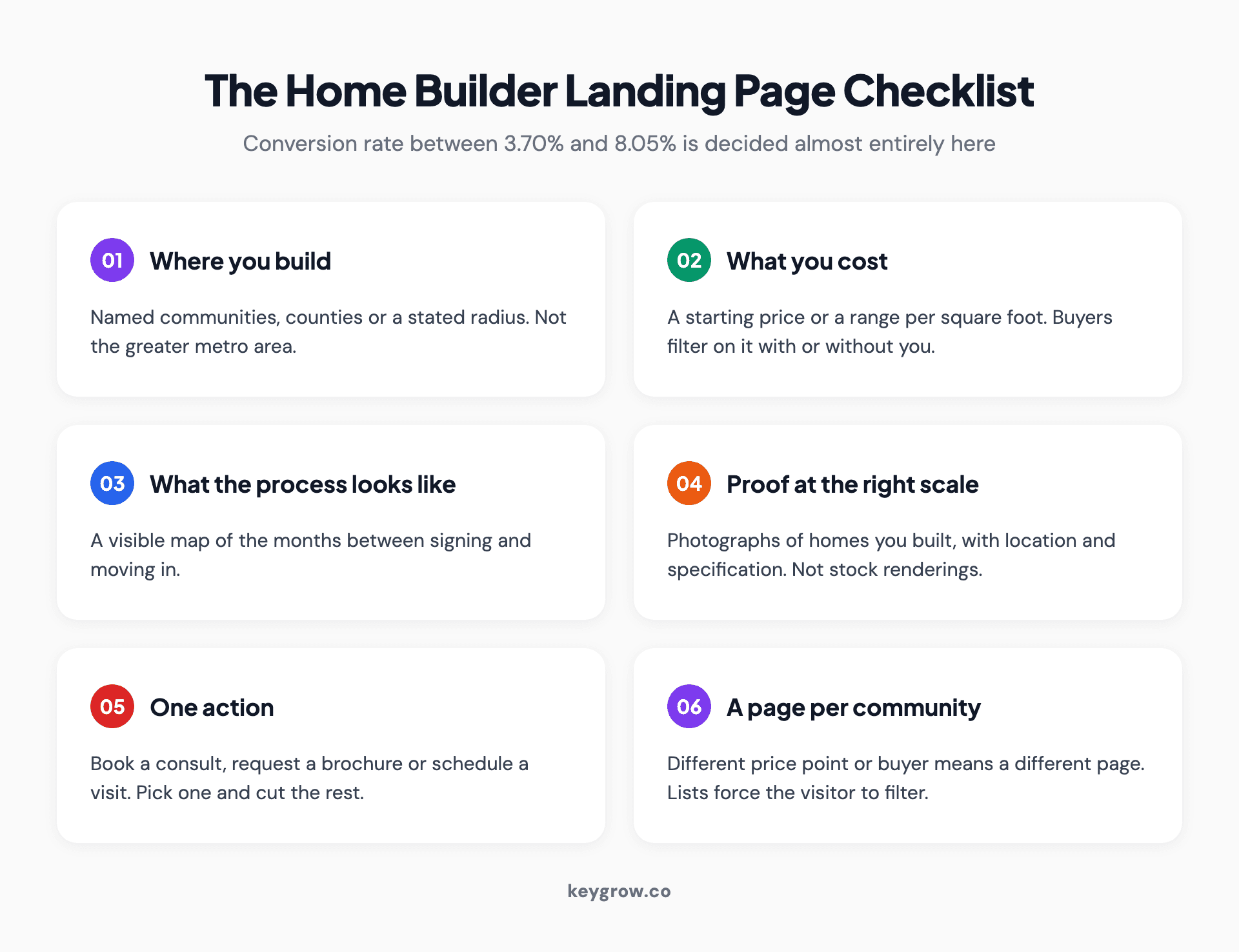
Checklist of what a home builder Google Ads landing page must include: service area, price range, process timeline, real project photography and a single call to action.
If your ads currently point at your homepage, fix that before you touch anything else in the account. The homepage is built for people who already know who you are, and the ad traffic does not.
What a workable budget looks like
Published guidance for builder campaigns tends to land between roughly $2,500 and $5,000 a month for a meaningful test, with lower ranges quoted for very local single-market builders. Rather than repeat someone else's number, work it out from your own arithmetic.

Timber framing of a new house under construction against a blue sky, the stage at which most builder marketing budgets are already committed.
Take the cost per lead you should expect from the benchmark you resemble, call it $90 for a custom builder and $105 for a production builder. Decide how many leads a month your sales process needs to produce one contract. If it is fifteen, your monthly budget floor is fifteen times your expected cost per lead, and anything below that is not a test, it is a sample too small to read.
That floor is usually the uncomfortable part of this conversation. At $8.33 a click, a $1,000 monthly budget buys around 120 clicks. At an 8% conversion rate that is roughly ten leads, and ten leads a month is barely enough to tell a good week from a bad one. Builders running $500 or $800 a month are not getting a cheap version of the channel. They are paying for data they cannot act on.
When a builder should not run Google Ads
I would rather say this plainly than have you find out with three months of spend.
Do not start if your backlog is full. If you are booked eighteen months out and turning work away, ads will generate leads you cannot service and reviews from people you disappointed. Spend the money on the website and the photography instead, so the channel is ready when the backlog thins.
Do not start without a landing page. Sending builder traffic to a homepage at $8 a click is the most expensive way to learn this lesson, and everybody learns it eventually.
Do not start if nobody answers the phone. In home building the inquiry-to-appointment step is almost entirely a speed problem. If leads sit until Monday, buy the CRM and the response process before you buy the clicks.
Reconsider if your service radius is tiny. A builder working one small town may find the monthly search volume too low to spend a real budget against. In that case local SEO, your Google Business Profile and referral relationships will do more per dollar, and we would tell you so rather than take the account.
If you are running ads already and want a second opinion on whether the account is buying browsers or buyers, our PPC management team will audit it and tell you which of those two columns you are actually in.
FAQs
How much does Google Ads cost for a home builder?
Expect somewhere between $3 and $18 per click depending on the term and the market. The two industry benchmarks builders fall between are $3.22 per click for real estate and $8.33 for home and home improvement, with cost per lead of $102.51 and $90.92 respectively. A meaningful monthly budget is usually your target lead volume multiplied by your expected cost per lead, which for most builders lands between $2,500 and $5,000.
Is Google Ads worth it for home builders?
It is worth it when you have capacity to fill, a landing page built for the campaign and a way to respond to inquiries quickly. It is not worth it if your backlog is already full, if traffic points at your homepage, or if your budget is small enough that you get fewer than ten leads a month. The channel works, but it is unforgiving of the three things above.
What is a good conversion rate for home builder Google Ads?
It depends on which buyer you are attracting. Production and inventory-led campaigns behave like real estate, where the benchmark conversion rate is 3.70%. Custom and project-led campaigns behave like home improvement, where it is 8.05%. If you are running both through one campaign, your blended number describes neither and should be split before you judge it.
Which keywords should home builders avoid?
Employment searches are the biggest drain in this vertical, covering builder salaries, apprenticeships, licensing and how to become a builder. Add materials and supply queries, do-it-yourself and house plan searches, adjacent trades like remodeling and roofing, rental and resale language, and any out-of-area terms. Review the search terms report weekly for the first two months.
How long before Google Ads produces results for a builder?
Leads usually start within the first two or three weeks. Contracts take considerably longer, because a custom home is a six to eighteen month decision and even inventory sales run a couple of months. Judge the campaign on a rolling quarter of lead data and hold judgment on lead quality for at least two quarters.
Should home builders use Performance Max?
Not at the start. Performance Max needs conversion volume to learn from, and most builders do not generate enough. It is also risky in a category where job applicants can register as conversions, because the system will learn to find more of them. Get search campaigns stable and your conversion actions clean, then test it.
How do I track whether Google Ads actually produced a sale?
Import offline conversions. Track the click ID with the lead, follow it through your CRM to appointment, agreement and contract, then push those events back into Google Ads. Without that, the bidding system only ever sees form fills, and form fills in this category are a poor predictor of who signs.
Do home builders need a separate landing page for each community?
If the communities have different price points, locations or buyers, yes. A page that lists six communities forces the visitor to filter, and filtering is where conversion rate goes to die. One campaign, one community, one page, one action is the structure that consistently performs best.
Before you spend another dollar
Work out which column you are in. If your buyers are shopping for a house, you are in the real estate benchmark and your problem is filtering: negatives, match types and a page that qualifies hard. If your buyers are commissioning a project, you are in the home improvement benchmark and your problem is cost control on clicks that genuinely convert.
Then fix the measurement, because everything else follows from it. Until offline conversions are flowing back into the account, you are optimizing toward form fills, and in home building the cheapest form fills come from the people least likely to ever sign anything.
If you want that second column built properly, take a look at what our Google Ads management actually covers, or read our breakdown of landing pages versus your website before your next campaign goes live. The organic half of the same problem, including what happens to your community and spec home pages over time, is covered in SEO for home builders.