


Entity SEO is the work of getting search engines to recognize your business as one specific, real thing (with a name, a place, a type and facts they can confirm) instead of a string of words that happens to match a search.
So what is entity SEO when it's your business on the line? Take a made-up plumbing company in Austin called Pike & Daughter. When someone searches that name, Google isn't hunting for pages that contain the words "Pike," "Daughter" and "plumbing." It's working out which business the searcher means, then showing what it knows about that one business: a plumber, at one address, with one phone number, these hours, this website, these reviews.
Google assembled that picture by comparing sources. The company's website. Its Business Profile. A few dozen directory and review listings, plus its social pages. When those agree, Google can show the business with confidence in the map results, in the panel that appears when someone searches the name, and in an AI answer. When three directories still list the address Pike & Daughter left two years ago, Google is looking at two versions of the same company and has to guess which one is current.
That's the discipline in one example. Keywords tell Google what someone wants. Entities tell Google who you are, and whether it can trust its own facts about you.
What counts as an entity?
An entity is any specific thing Google can identify and keep facts about: a business, person, place, product or idea, apart from its name.
A Google patent filing defines it as "a thing or concept that is singular, unique, well-defined and distinguishable." Distinguishable is the word that matters for a business. Names get shared. Search "Summit Dental" and you'll find unrelated practices in at least six states. What separates one of them from the rest is the bundle of facts attached to it: the address, the phone number, the website, the dentists who work there.
Around any local business, several entities sit at once:
- The business itself
- Each location, if there's more than one
- The people customers search for by name, like the owner, the attorneys or the dentists
- The services and products
- The towns and neighborhoods it serves

A smiling business owner in a red shirt inside his premises, one of the people Google can connect to a business entity.
Google files these by ID rather than by spelling. Its Natural Language API, a Google Cloud product that sits outside Search, shows the idea plainly. In Google's own documentation example, a sentence that mentions Marvin Gaye comes back with an entity carrying a machine ID (/m/012z8_) and a link to his Wikipedia page. Every mention, however it's written, can point at that one record.
Your business wants the same treatment: one record, with every mention pointing at it.
The signals that tell Google it's the same business everywhere
Google trusts a business entity when the same facts appear everywhere it looks: one name, address, phone number, category and website.
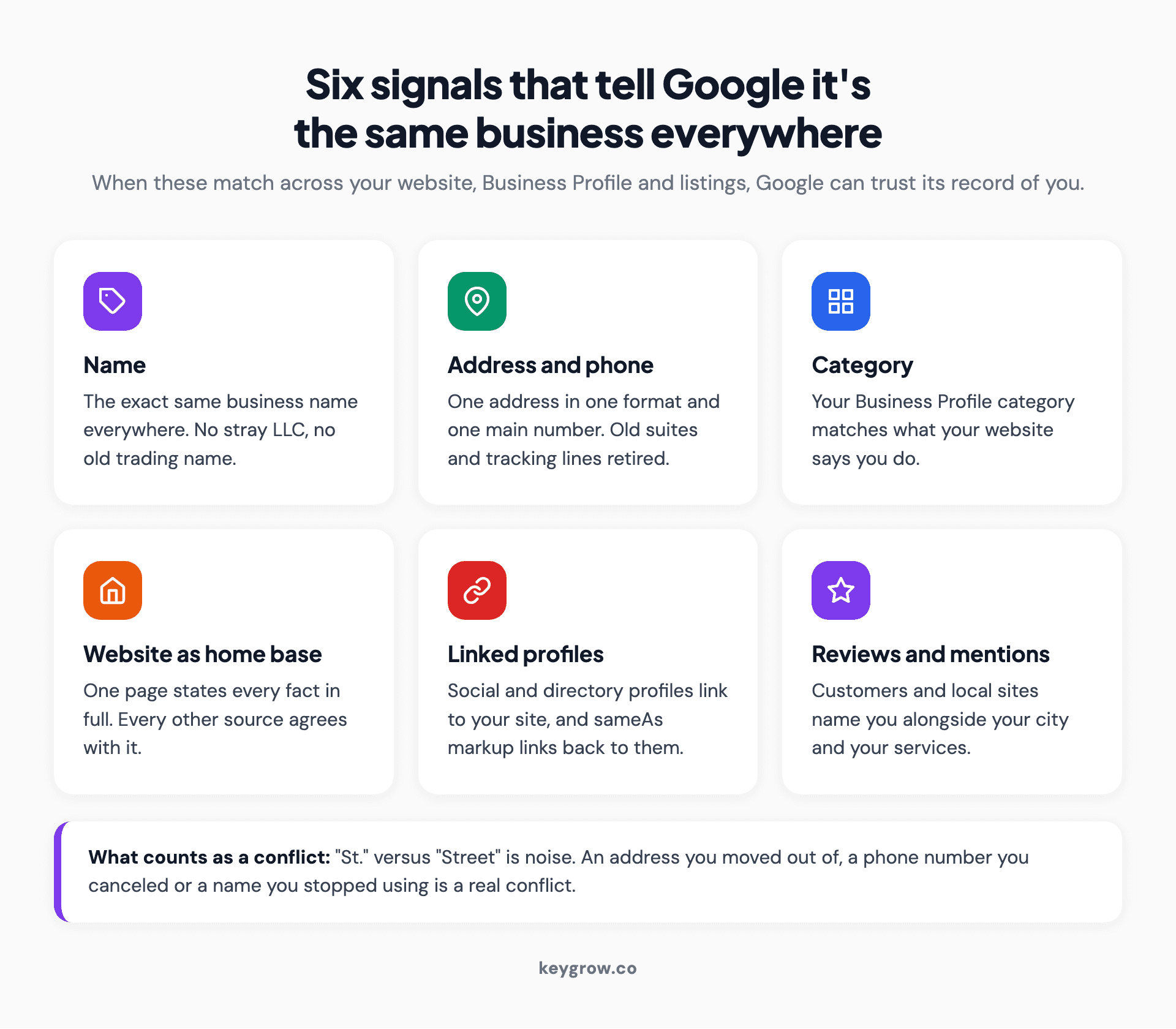
Icon grid of six signals that tell Google a business is the same entity everywhere: name, address and phone, category, website as home base, linked profiles, and reviews and mentions.
The first few are what people call NAP: name, address, phone. They need to match in substance, not punctuation. "St." versus "Street" is noise. A suite number you moved out of in 2021 is a real conflict, and so is a call tracking number you canceled, or "Pike and Daughter Plumbing LLC" on one site when your sign and website say "Pike & Daughter."
Category is the one owners forget. If your Business Profile says "Plumber" and half your website is about kitchen remodels, Google is getting two answers to the question of what you do.
Your website is the home base. One page, usually the homepage or About page, should state every fact in full, and everything else should agree with it. Profiles elsewhere (Facebook, LinkedIn, review sites, trade directories) should link back to it, and your schema markup can list them in return. Schema.org's sameAs property exists for exactly that job: a URL that "unambiguously indicates the item's identity."
Reviews and mentions are the outside confirmation. Google's Business Profile help says prominence is partly based on how many websites link to your business and how many reviews you have. The same page puts the bigger point on record: businesses with complete and accurate information are more likely to show up in local results, and a profile with wrong information might not show up for relevant searches at all.
How Google builds the record
Google gathers facts from public sources, licensed data and the business itself, keeps what agrees, and stores it as one Knowledge Graph entity.
The Knowledge Graph is Google's database of things and the facts that connect them. It launched in May 2012 under the line "things, not strings," holding more than 500 million objects and 3.5 billion facts. By May 2020, Google said it had grown to more than 500 billion facts about five billion entities. You'll see a much bigger figure quoted around the industry, 1.6 trillion facts about 54 billion entities, but it traces back to SEO commentators rather than to anything Google published, so treat it with care.
Google's Knowledge Panel help page describes three kinds of source: public sources, licensed data such as sports scores and weather forecasts, and facts that content owners send in, including edits suggested on panels they've claimed. For a local business, the Business Profile is the piece of that system you control directly.
Your own pages get read for clues too. When "Pike & Daughter" sits on a page next to "water heater," "drain cleaning" and an Austin address, the words around the name tell Google which entity it refers to. A business name that only appears inside a logo image gives it far less to work with than the same name written in plain text, repeated in your headings and footer.
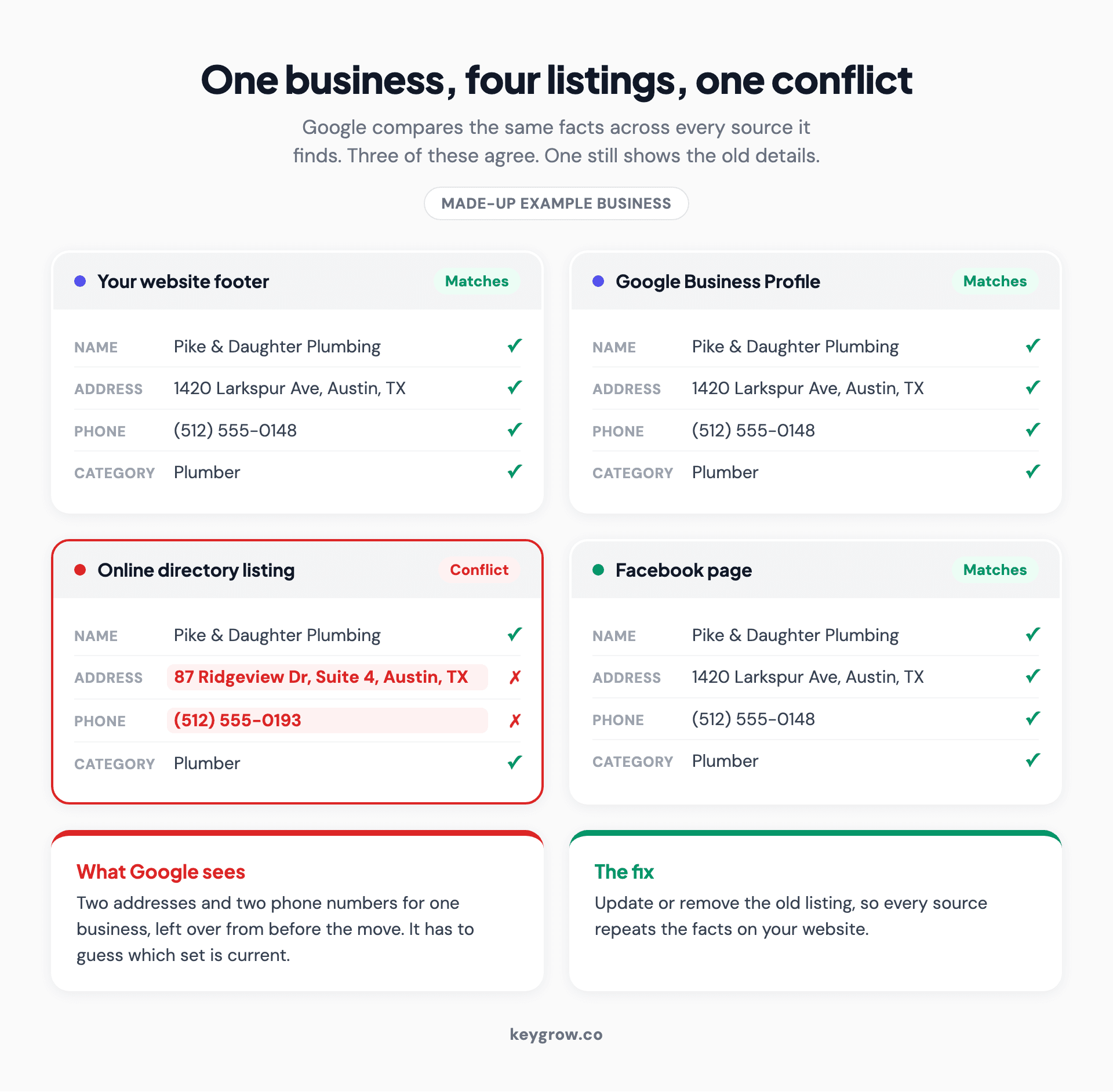
Annotated example of one made-up plumbing business across four listings: the website, Google Business Profile and Facebook page agree, while a directory listing still shows an old address and phone number.
Matching is where local businesses lose ground without knowing it. Google lines up the name, address, phone, website and category from each source. Four that agree make the record stronger. One that disagrees forces a choice, and Google may choose the stale version.
Almost every conflict we find has a history behind it. A move. A new phone system. A rebrand, or a partner who left and took their name off the door. Each change leaves old facts on sites the owner forgot existed.
Keywords and entities do different jobs
Keywords show what people type. Entities tell Google which real thing a page or profile is about. You need both.
| Keywords | Entities | |
|---|---|---|
| What it is | The words someone types into search | The real thing those words point to |
| Example | "emergency plumber austin" | One plumbing company, one address, one phone number |
| What Google does with it | Matches it to pages that fit the intent | Checks facts about it across many sources |
| What you work on | Pages that answer the search | Facts that agree everywhere they appear |
| Sign it's working | Rankings and clicks for the phrase | A correct panel on name searches, more calls |
Plenty of entity SEO advice implies keywords stopped mattering. They didn't. Someone still types "water heater repair near me," and you still need a page that answers it. Entity work decides whether Google is confident you're a real plumber in that area when it picks who to show.
Where does your entity show up?
Your entity record feeds the map results, the panel shown when someone searches your name, and AI answers in Google and in assistants.
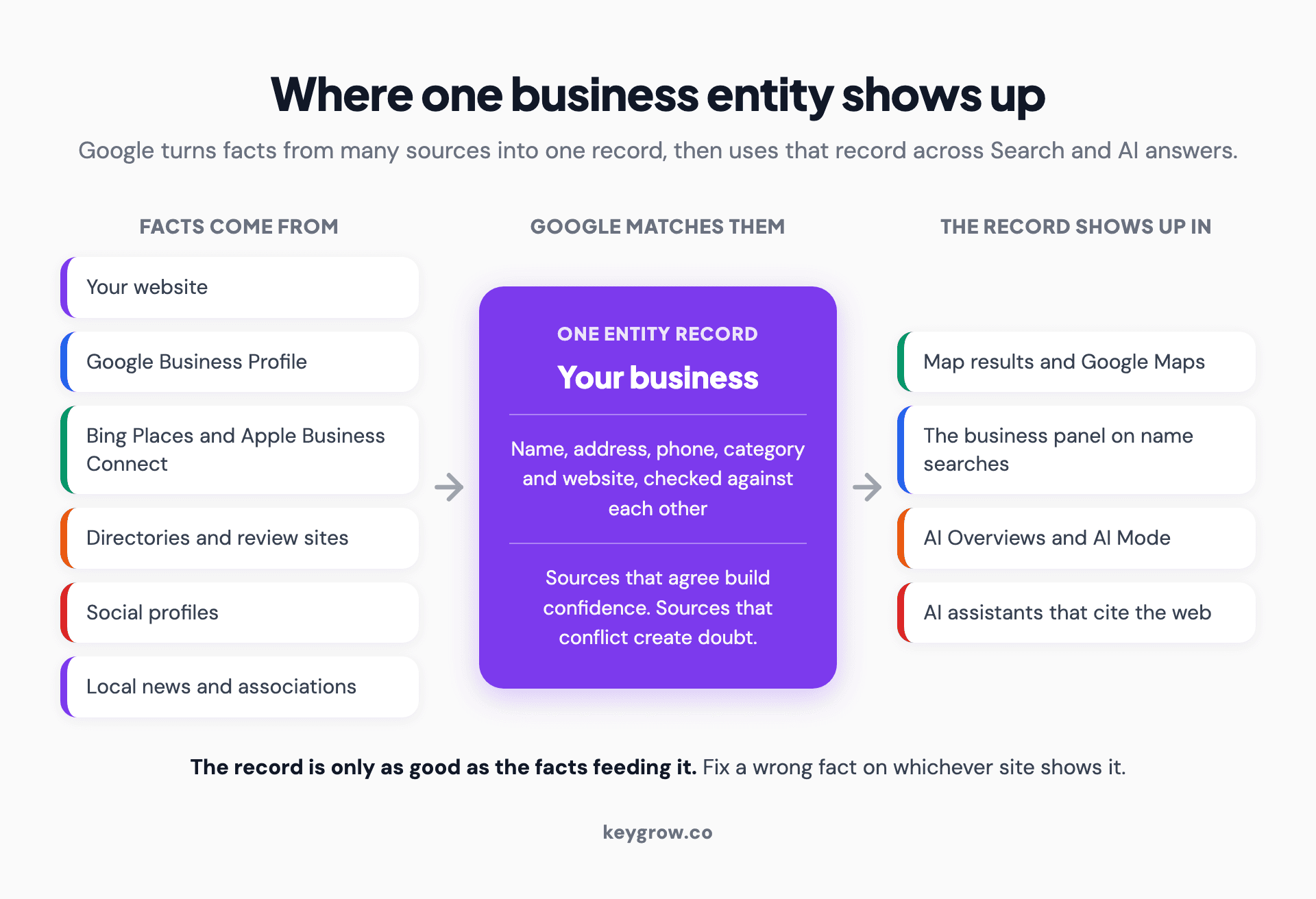
Flow diagram showing how facts from a website, Business Profile, listings, reviews and local mentions become one Google entity record that appears in map results, branded search panels, AI Overviews and AI Mode, and AI assistants.
Start with the map. Google's help page names three things behind local rankings: relevance, distance, and how well known the business is. A record full of contradictions makes the first and the last harder for it to judge.
Then the panel. When someone searches your business name, the Business Profile panel that appears is the local version of a knowledge panel. If that panel shows the wrong hours, that's your entity data talking.
AI Overviews and AI Mode come next, and Google is unusually direct about them. Its documentation says there are no additional requirements or special optimizations needed to appear in either. The ordinary SEO basics apply, entity hygiene included.
Assistants are where this gets sharper. The question changed from "how do I rank" to "how do I become the source," and the numbers back that up. AirOps found that ChatGPT cited only 15 percent of the 548,534 pages it retrieved across 15,000 prompts, in a study published in March 2026. Getting retrieved is the easy part. A business whose facts disagree from site to site is an easy one to leave out of the answer. Our guide to AI search optimization covers how those systems pick their sources.
What entity SEO is not
Entity SEO is not a schema plugin, a Wikipedia page or a separate AI trick. Most of it is making your facts agree.
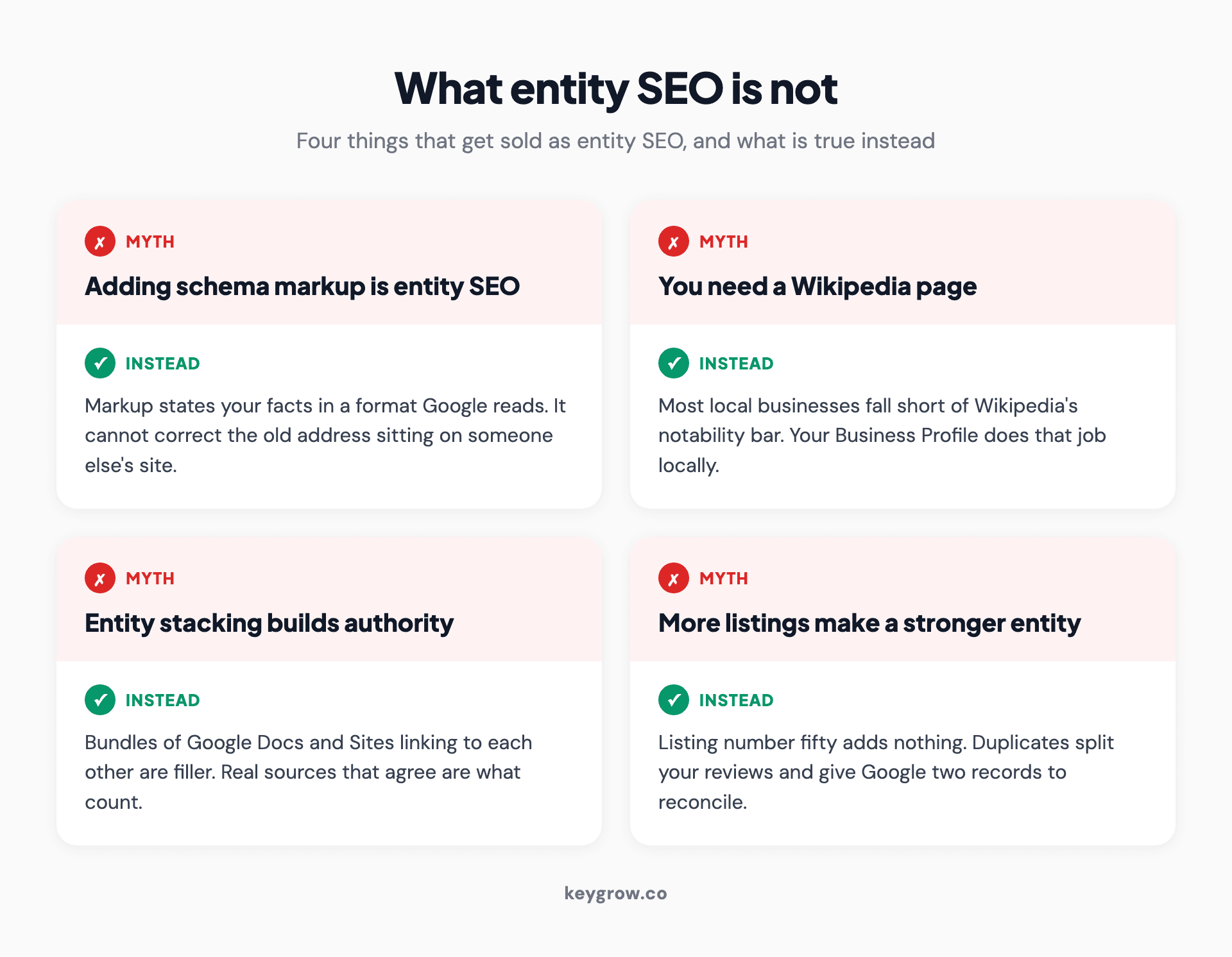
Four cards correcting common entity SEO myths: schema markup alone, getting a Wikipedia page, entity stacking bundles, and adding more directory listings.
Not schema markup on its own
Markup states your facts in a format machines read directly, and Google's structured data docs say organization markup can help it "disambiguate your organization in search results." That's useful. But Google's guidelines also say correct markup is no promise that anything will show up in results, and no markup on your site can correct the old address on somebody else's.
Not a Wikipedia page
Wikipedia's notability guideline for companies asks for significant coverage in reliable, independent sources. Most plumbers, dentists and law firms don't have that, and articles that fall short get deleted. For a local business, the Business Profile does the job a Wikipedia entry does for a national brand.
Not entity stacking
Some agencies sell bundles of Google Docs, Sheets and Sites that all link to each other and call it entity building. You are paying for a filing cabinet nobody opens.
Not more listings
Listing number fifty adds nothing. Duplicates do real damage, though: two profiles for one business split the reviews and hand Google two records to reconcile.
How to do entity SEO for a local business
Pick one set of facts, publish it on your website first, make every profile match, mark it up, then build pages for each service.
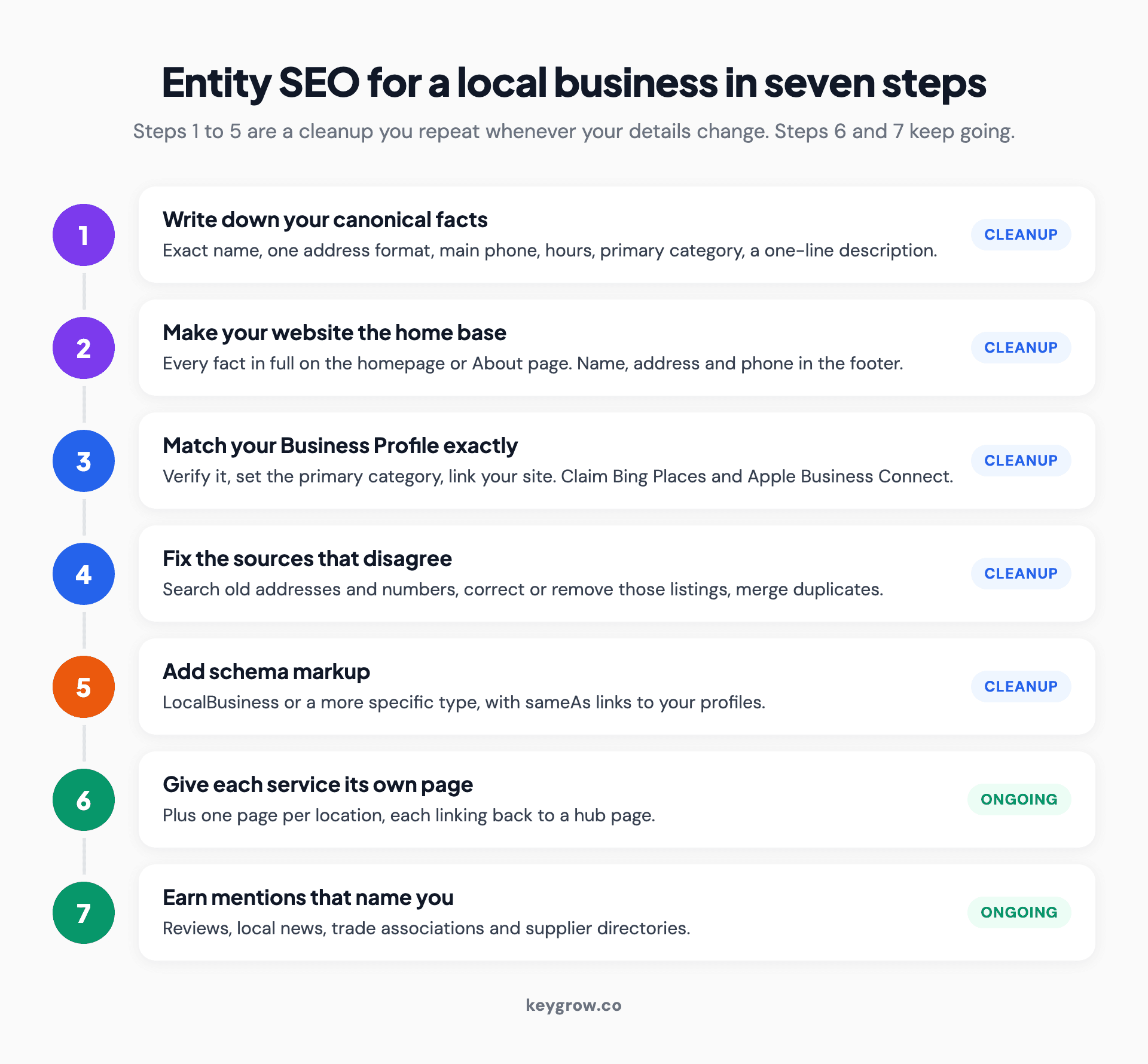
Numbered seven-step checklist for entity SEO at a local business, from writing down canonical facts to earning mentions that name the business.
- Write down your canonical facts. The exact business name, the address in one format, one main phone number, your hours, your primary category and a one-sentence description of what you do. It sounds trivial. It's also the step everyone skips, which is how a business ends up with four spellings of itself.
- Make your website the home base. Put the full set of facts on your homepage or About page, along with the owner's name, the year you opened and the areas you serve. Repeat the name, address and phone in the footer.
- Match your Business Profile to it exactly. Verify the profile, set the primary category and link it to your site. Then claim Bing Places and Apple Business Connect so the same facts reach Bing and Apple Maps.
- Fix the sources that disagree. Search your old address and old phone number, find the listings still using them, and correct or remove them. Merge duplicates. Our guide to local citations covers where that hour is best spent.
- Add schema markup. Use LocalBusiness, or a more specific type, on your homepage with sameAs links to the profiles from step 3. Our walkthrough of local business schema markup has the exact properties.
- Give each service its own page. One page per service, and one per location if you have several, each linking back to a hub. That structure tells Google what the business does, not only where it is. A content pillar strategy applies the same logic to a blog.
- Earn mentions that name you. Reviews that mention the job and the town. A story in the local paper. Your trade association's member list. A supplier's dealer or installer directory. Each is another source that agrees.
Steps one to five are a cleanup you do once, then repeat whenever your details change. Steps six and seven don't finish, and they're where most of the ranking work lives.
One more step applies if people are what you sell. When patients or clients search your dentists, attorneys or agents by name, give each of them a bio page that uses the same name and credentials as their state licensing listing, and link out to their professional profiles from it. That hands Google one person tied to one business, instead of several near-matches to sort out.
How to check whether Google knows who you are
Search your exact business name, then add your city. A Business Profile panel with correct facts means Google has a confident record of you.

A laptop open to the Google search page with a phone resting on the keyboard, ready to search a business by name.
Three more checks take about ten minutes:
- Search your phone number. Every result should be you, with your current name and address.
- Search your old address, if you've moved. Anything still listing you there is a conflict to fix.
- Ask an assistant. Type "What is [business name] in [city], and what do they do?" into ChatGPT or Gemini. Wrong hours or an old address in the answer usually trace back to a stale listing somewhere.
Then judge the result by your phone, not by the panel. A correct panel only means Google is sure who you are. What counts is what people do next, and your Business Profile's performance report tracks it: taps on the call button, direction requests, website clicks and the search terms people used to find you. If those climb in the months after a cleanup, compared with the same months a year earlier (seasons move these numbers too), the work is paying off. Nobody pays rent with a knowledge panel.
When you can skip most of this
A single-location business with a verified Business Profile, consistent details and a decent website already has the entity basics covered.
Spend your next free hour asking customers for reviews instead.
You don't need an entity SEO tool, a Wikidata entry, a knowledge panel or an agency for this part. An owner with an afternoon can run the checks above, fix what's wrong and set a reminder to look again after any move or phone change. We'd rather you do that than pay anyone, us included, to do it for you.
Outside help starts to earn its fee in a few situations: several locations, a recent move or rebrand, a name you share with other businesses nearby, or ten years of old listings nobody has looked at. That's when the cleanup outgrows an afternoon and belongs inside a proper SEO program.
FAQs
What is an entity in SEO?
An entity is a specific thing a search engine can identify and store facts about, such as a business, a person, a place or a product. A Google patent filing describes it as a thing or concept that is singular, unique, well-defined and distinguishable. Because the entity exists apart from the words that name it, different spellings can all point to the same record.
Is entity SEO the same as semantic SEO?
Not quite, though they overlap. Semantic SEO is the broader practice of writing for meaning and topics instead of exact phrases. Entity SEO is the part that makes specific things, like your business, your people and your locations, identifiable and consistent across the web.
Does schema markup count as entity SEO?
It is one part of it. LocalBusiness and Organization markup state your facts in a format Google reads directly, and Google says organization markup can help it tell your business apart from others. Markup cannot fix an old address on another site, though, and Google says correct markup still may not appear in results.
How do I get my business into Google's Knowledge Graph?
Start with a verified Google Business Profile, then make your website and other listings match it exactly. Google says Knowledge Graph facts come from public sources, licensed data and content owners, so the work is making your public facts agree. The brand-style knowledge panel usually leans on sources like Wikipedia, which require independent coverage, and you do not need one to appear in local results.
Does entity SEO matter for AI search?
Yes, but not as a separate trick. Google says there are no additional requirements or special optimizations for AI Overviews or AI Mode beyond normal SEO best practices. What helps in assistants is the same thing that helps in Google: facts about your business that are easy to find and agree from source to source.
Make your facts easy to confirm
Every search system you care about, the map and the chat window included, is asking two questions about your business: is this the same company everywhere, and are these facts current? Make both answers obvious. Write the facts down once, publish them on your own site, and hold every profile to that page.
After that, put your effort where customers come from. If you want a straight answer on whether your listings need work at all, our SEO team will give you one, and we work month-to-month.