

To rank nationally in SEO, you compete for organic results across the entire country, which means there is no local shortcut to lean on. You win on topical authority, content depth, backlinks, and technical strength, and you win it over months, not weeks. National SEO is the same craft as local SEO with the training wheels removed.
That last part is the bit people underestimate. Local SEO has a built-in advantage: a map pack you can climb with a Google Business Profile and reviews. National SEO has none of that. You are up against the whole web for every query, and the data on how hard that is should set your expectations before you spend a dollar. Here is the honest playbook.
National SEO versus local SEO: why national is harder
National SEO targets searchers across a whole country with no geographic filter, while local SEO targets a city or service area. National is harder because you lose the map pack and the Business Profile, the two levers that make local rankings reachable quickly.
When someone searches a local term, Google shows a map pack of three nearby businesses, and a good Google Business Profile can get you into it without competing with the entire internet. National queries have no such box. You are in the open organic results against every site in your industry, which is a far larger field.
| National SEO | Local SEO |
|---|---|
| Competes country-wide in organic results | Competes within a city or service area |
| No map pack or Business Profile lever | Map pack and Business Profile do heavy lifting |
| Won on authority, content, links, tech | Won on proximity, reviews, profile completeness |
| Slower, compounding, broader payoff | Faster, narrower, location-bound |
The difficulty shows in the numbers. Ahrefs found that 96.55 percent of pages in its index get zero traffic from Google, and in a separate study of new pages only 1.74 percent ranked in the top 10 within a year (Ahrefs notes a fairer figure is closer to 6.11 percent once empty and non-English pages are set aside). Nationally, you are trying to join the small minority of pages that get seen at all. That is doable, but only with the right mechanism behind it.
Build topical authority, not a pile of keywords
The core mechanism for national rankings is topical authority: covering a subject so thoroughly that Google treats your site as a credible source on it. You build it by mapping a topic and publishing connected content across all of it, not by chasing single keywords.
A list of target keywords is not a strategy. A topical map is. The idea is to pick a core topic you can genuinely own, break it into every subtopic a searcher might ask about, and publish a connected web of pages covering them, linked together so authority flows across the cluster. That structure is what tells Google you are a source on the subject rather than a site with one lucky page.
This is involved enough that we gave it its own guides. Start with what topical maps are for the concept, then the build guide for the steps. For national ambitions, this is not optional. It is the engine.
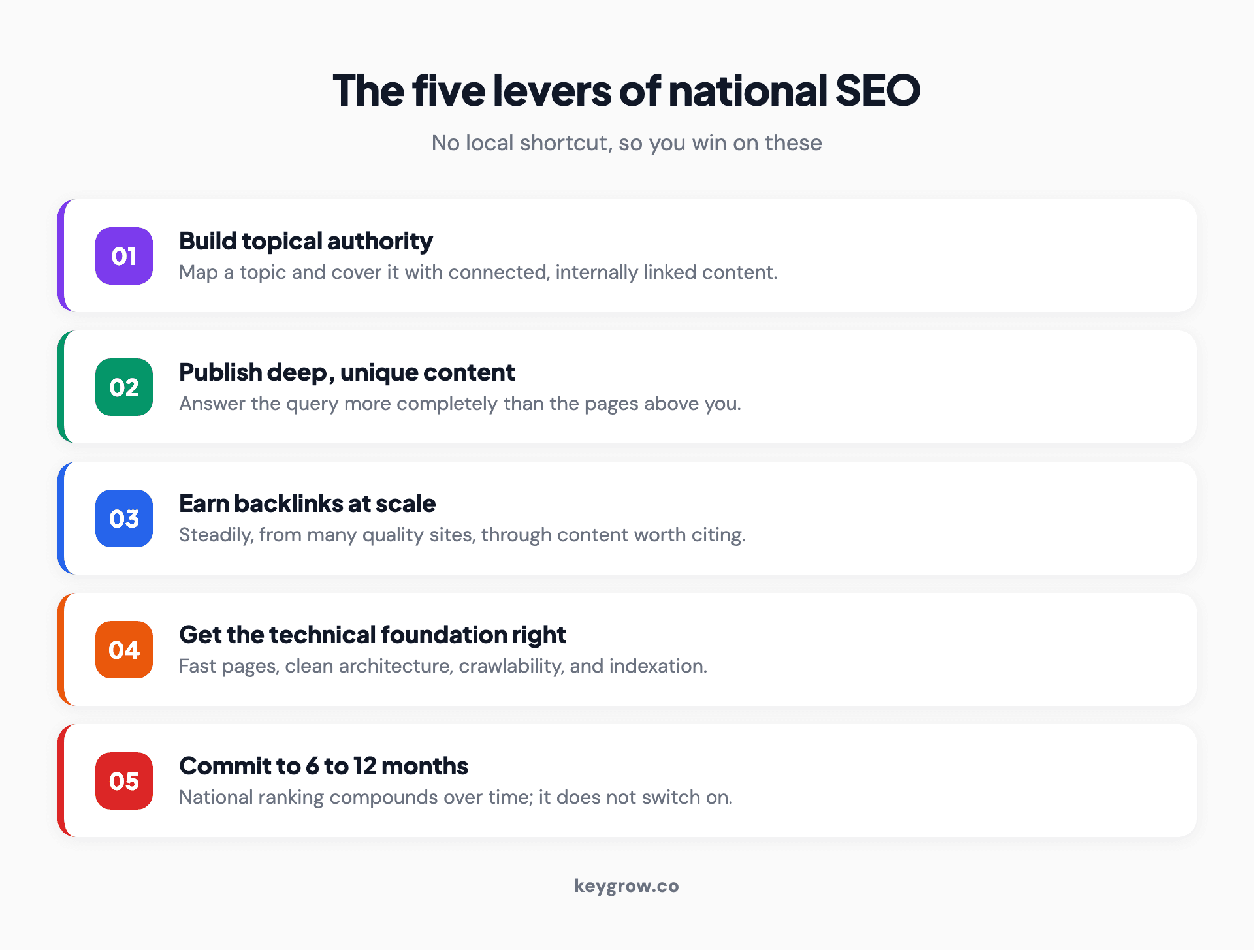
Infographic of the five levers of national SEO shown as a numbered list: build topical authority with a topical map, publish deep and genuinely unique content, earn backlinks at national scale, get the technical foundation right, and commit to a six to twelve month timeline.
Publish content with real depth and a reason to exist
National content has to be deep and genuinely original, because you are competing against every other page on the topic. Thin or recycled content usually does not rank at all.
Depth here does not mean padding word count. It means answering the question more completely and more usefully than the pages above you, with original detail, real examples, and an angle competitors missed. The pages that win nationally tend to be the most genuinely useful, not the longest. If your page says what ten others already say, Google has no reason to add it, which is the whole argument in our piece on why unique content matters.
A useful test before you publish: would this page deserve to outrank the current number one? If the honest answer is no, it will not, and writing it anyway just adds to the 96.55 percent of pages getting no traffic.
Earn backlinks at national scale
Backlinks remain one of the strongest signals for competitive national rankings. The pages at the top have markedly more links from more sites, and they keep earning them over time.
The correlation is consistent across studies. Backlinko found the number one result has an average of 3.8 times more backlinks than positions two through ten, and three times more referring domains, the count of unique websites linking to you. Ahrefs' backlink growth study adds the time dimension: most number one pages keep gaining new referring domains at roughly 5 to 14.5 percent a month, with top-three results adding more than lower-ranked pages.
The takeaway is that link building is a habit, not a campaign. Earn links by publishing things worth citing, original data, genuinely useful tools and guides, and by doing digital PR that gets real publications to reference you. Buying links is the fast path to a penalty, not a ranking. At national difficulty, the link gap is often the real gap between you and page one.
Get the technical foundation right
None of the above ranks if Google cannot crawl, render, and trust your site. A national site needs a clean technical foundation: fast pages, a logical architecture, mobile-first readiness, and no crawl or indexation problems.
At scale, small technical issues multiply. A crawl trap, a slow template, or a messy URL structure that was a minor annoyance on a 20-page site becomes a real drag on a 2,000-page one. The fundamentals to lock down are Core Web Vitals and speed, a flat and logical site architecture, correct indexation, and clean internal linking so authority reaches your important pages. This is exactly what a technical SEO audit is for, and on a national site it is worth running regularly rather than once.
There is also the click to think about, not just the rank. Backlinko's click-through data shows the number one organic result earns about 27.6 percent of clicks and the top three together take 54.4 percent. Ranking fourth nationally is not a near-miss. It is a different traffic universe, which is why national SEO aims for the top few spots or it does not pay off.
How long does national SEO take?
National SEO realistically takes six to twelve months to show meaningful results, and often longer for competitive terms. The pages already at the top have years of age and authority behind them, and catching them is a compounding process, not a quick push.
The data is sobering and useful. Ahrefs found the average number one page is about five years old, and 72.9 percent of top-10 pages are more than three years old, while only 13.7 percent are under a year. You are out-aging and out-earning pages that have been compounding trust for years.
Here is the opinion we will stake out: SEO is a compounding asset, not a campaign, and national SEO is the most compounding version of it. It looks unimpressive for the first quarter and embarrassingly good after a year. The businesses that quit at month three pay for the hardest part and leave right before the payout. We watched a doctor's practice in Dubai commit to a full year, look flat through month three, and finish at 1,519 percent organic traffic growth with 130+ patient calls a month. Same site, no shortcuts, just consistent content, technical fixes, and authority building. Anyone promising national page one in 30 days is selling you a keyword nobody searches or a penalty waiting to happen.
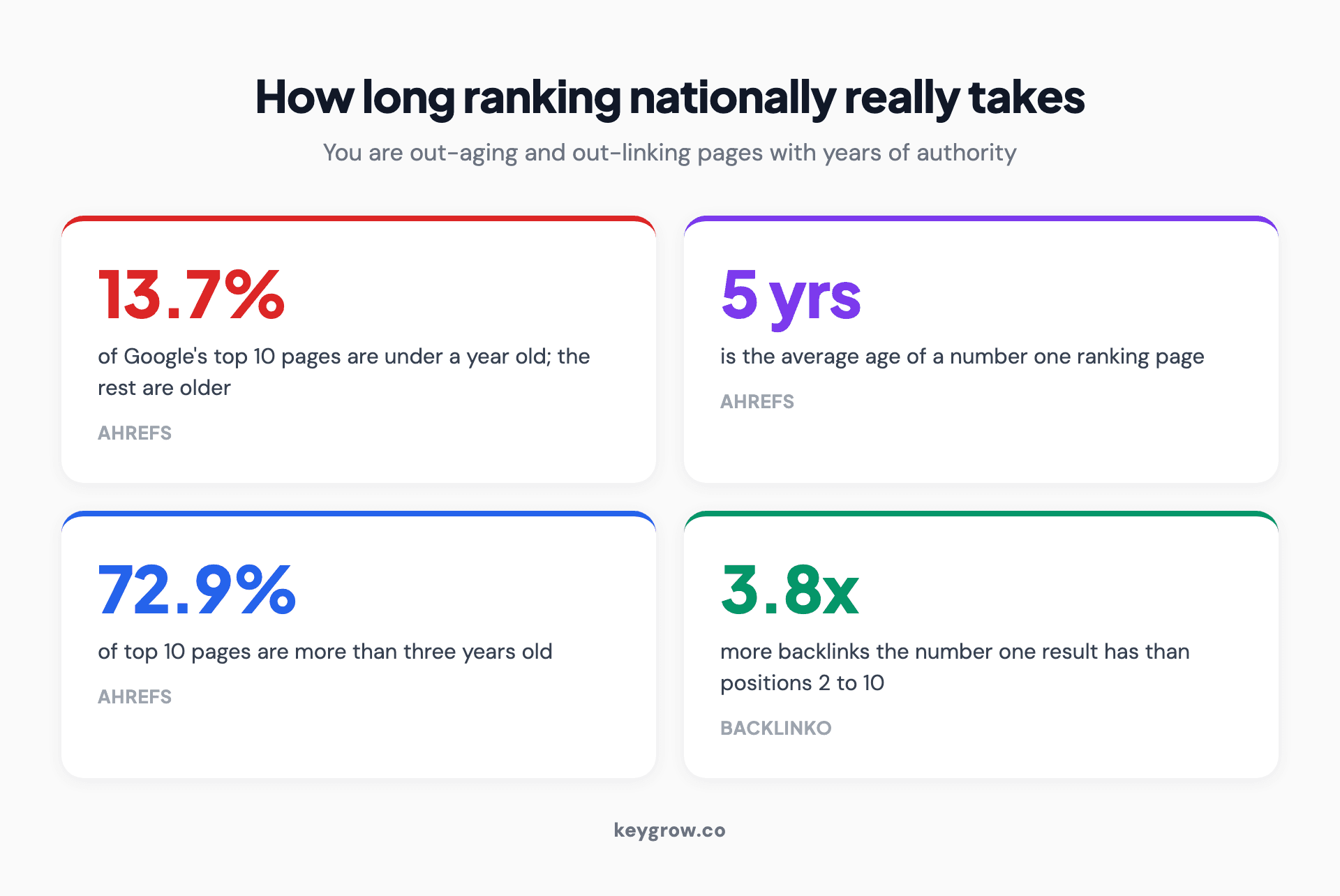
Infographic on how long national SEO really takes, showing four statistics: only 1.74 percent of new pages rank in the top 10 within a year, the average number one page is about five years old, 72.9 percent of top 10 pages are more than three years old, and the number one result has 3.8 times more backlinks than positions two through ten.
When you should not go national
Going national is the wrong move for most local service businesses. If your customers are within driving distance, you will earn far more by dominating local search than by burning budget competing nationally against the whole industry.
This is the honest part the agencies selling national packages skip. A plumber, a dentist, or a law firm serving one metro does not need to rank nationally, and usually cannot afford to. Their highest return is owning the map pack and local results, where the Business Profile and reviews do heavy lifting that does not exist nationally. Spending on national content and links there is paying tournament prices to compete in a race your customers are not even watching.
Go national when your product or service genuinely serves the whole country: an online store that ships everywhere, a software product, a national brand. Even then, you can often run the basics yourself at first, keyword and topic research, on-page work, and content, and bring in help when link building and scale become the bottleneck. Hire for the part that is genuinely hard and slow, not for the part you could learn in a weekend.
FAQs
What is the difference between national SEO and local SEO?
National SEO targets searchers across a whole country in the regular organic results, with no geographic filter. Local SEO targets a city or service area and leans heavily on the map pack and your Google Business Profile. National is broader and slower because it has no local shortcut, so you compete against the entire web on authority and content.
How long does it take to rank nationally in Google?
Usually six to twelve months for meaningful results, and longer for competitive terms. Ahrefs found the average number one page is about five years old and only 1.74 percent of new pages reach the top 10 within a year. You are catching pages with years of compounding authority, so patience is part of the strategy, not a sign it is failing.
Can I do national SEO myself, or do I need an agency?
You can do the early work yourself: keyword and topic research, on-page optimization, and content. The parts that usually need help at national scale are link building, digital PR, and managing a large content operation. Start in-house to learn the fundamentals, then bring in help for the slow, hard parts that move competitive rankings.
What are the most important ranking factors for national SEO?
Topical authority from deep, connected content, backlinks from many quality sites, content that genuinely answers the query better than competitors, and a clean technical foundation. Backlinko found the number one result has 3.8 times more backlinks than positions two through ten, so the link gap is often what separates page one from page two nationally.
How much does a national SEO campaign cost?
It varies widely by industry and competition, which is why we do not quote a flat number. National SEO costs more than local because it needs more content and far more link building to compete. Be skeptical of cheap fixed-price national packages, since real national link building and content cannot be done at bargain rates without cutting corners that backfire.
Is national SEO harder than local SEO?
Yes, meaningfully. Local SEO gives you the map pack and Business Profile, which let a small business rank near competitors quickly. National SEO removes both, so you compete on authority, content, and links against the whole industry. The skills overlap, but the difficulty and timeline are a different level.
Should a local service business invest in national SEO?
Usually not. If your customers are within driving distance, dominating local search delivers a far better return than competing nationally. National SEO makes sense when you genuinely serve the whole country, such as an online store, a software product, or a national brand. For a single-metro business, local is where the money is.
How does AI search affect national rankings?
Answer engines and AI Overviews pull from pages they can crawl that genuinely cover a topic, which rewards the same topical authority and depth national SEO already requires. Becoming the thorough, citable source on your subject is now how you earn both the top organic spot and the AI citation, so the strategies are converging rather than competing.
The short version
Ranking nationally means winning organic search with no local shortcut, so you compete on topical authority, deep content, backlinks, and technical strength against the whole web. It is harder and slower than local SEO by design: the average number one page is five years old, and only a small fraction of new pages crack the top 10 in a year. Build a topical map, publish content worth ranking, earn links steadily, and keep the site technically clean.
Most importantly, be honest about whether you should be doing this at all. If your customers are local, dominate local first. If you genuinely serve the country and want a national strategy that is not just an expensive list of keywords, that is what our SEO team builds. Tell us your target and we will tell you if national is the right race.


