

You do not need a daily dashboard, a paid rank tracker, or a 30-tab spreadsheet. So what weekly SEO metrics should you measure? Five numbers. Impressions and clicks in Google Search Console, rankings for your top money keywords, crawl and indexing health, Core Web Vitals, and organic conversions on your key pages. That is the whole list. Everything else is a monthly job or a vanity number that will waste your Monday morning.
A weekly check is not there to judge progress. It is there to catch a problem before it becomes a quarter-long crater. Progress in SEO compounds over months, so a week is too short a window to mean much on the upside. A week is the right window for spotting a page that fell out of the index, a crawl error that is spreading, or a conversion that quietly broke. Think of the weekly look as a smoke alarm, not a report card.
Below is each metric, what counts as a real change versus normal noise, and a 10-minute routine you can actually keep. I have also added an honest section on which metrics to ignore weekly, plus one on how AI Overviews have broken the click-through-rate benchmarks that most guides still quote.
The five weekly SEO metrics worth measuring
Track impressions and clicks, top-keyword rankings, crawl and indexing errors, Core Web Vitals, and organic conversions. Four of those five are free. And four of them work as early warnings rather than scorecards.
The free Google stack, Search Console plus Analytics, covers four of the five. A rank tracker covers the fifth, though you can approximate that one by hand if your keyword list is short. So this is barely about buying tools. It is about building a 10-minute habit and keeping it.
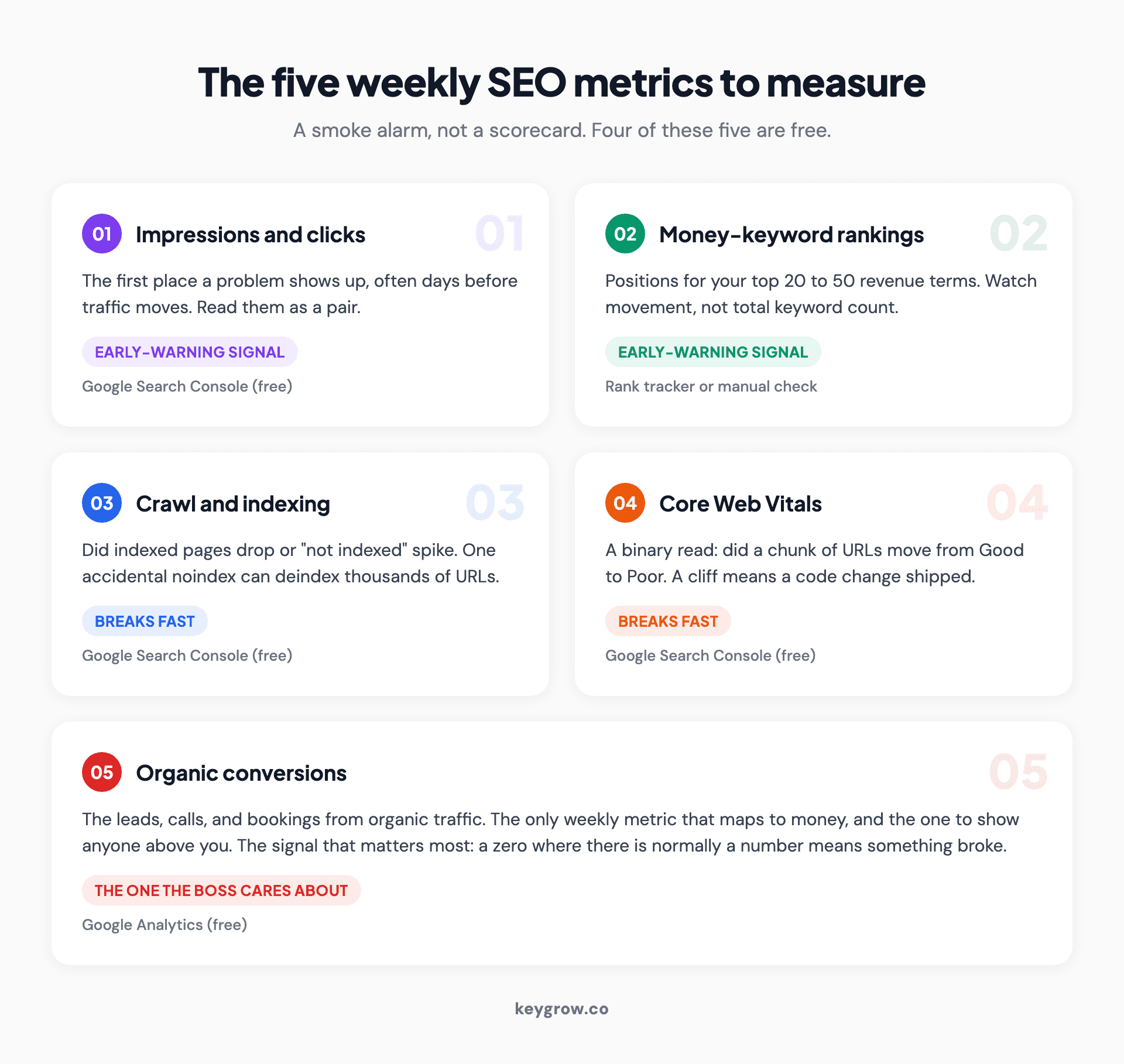
Five-card infographic of the weekly SEO metrics to measure: impressions and clicks, top-keyword rankings, crawl and indexing health, Core Web Vitals, and organic conversions, each labelled as an early-warning signal
One idea runs through the whole post: a weekly metric is useful only if you know its threshold. A 3 percent dip in clicks is weather. A 40 percent dip is a fire. Most guides list the same five metrics and forget to tell you which is which, so you end up either ignoring everything or panicking at everything. I will give a plain rule for each.
Why weekly checks are for spotting problems, not judging progress
Weekly SEO checks exist to catch breakages early, not to measure whether SEO is working. Whether the strategy is working is a monthly and quarterly question, because organic results compound on a timeline that a single week cannot show.
Our strongest organic case study, a doctor's practice in Dubai, took 12 months to reach 1,519 percent organic traffic growth and 130-plus patient calls a month. Months one through three looked unimpressive on the surface. If that client had judged the work by week-four numbers, they would have quit before the compounding started and paid for the hard part without collecting the payout. We unpack the full timeline in our post on why SEO takes so long, and the lesson maps straight onto your weekly routine. Short windows are for diagnosing. Long windows are for judging.

Marketing performance dashboard with bar graphs and metrics on a screen, representing long-term SEO progress tracking
So the weekly question is never "is my SEO working yet." The weekly question is "did anything break this week." Pages drop out of the index. A developer ships a noindex tag by accident. A core update lands. A conversion form silently stops firing. Those are the failures a weekly glance catches in minutes, while a monthly-only cadence lets them rot for three or four weeks before anyone notices. If you want the full progress-tracking framework, separate from this firefighting routine, we cover it in how to track SEO.
Impressions and clicks in Search Console are your earliest warning signal
Impressions and clicks in Google Search Console are the first place a problem shows up, often days before rankings or traffic move. Impressions tell you how often you appeared in results; clicks tell you how often that appearance earned a visit.
Read them together. Impressions trending up while clicks stay flat usually means you are surfacing on more queries but not winning the click, which points at titles, snippets, or a SERP feature eating your visibility. Both falling together is the real alarm, because that suggests pages losing positions or dropping out of the index entirely.
The threshold for a real change. Set the report to Last 28 days, compared to the previous period, and look at the week-over-week shape rather than any single day. A swing under roughly 10 percent on either line is noise, the normal breathing of a SERP. A sustained drop of 25 percent or more across several days is worth investigating the same day. One caveat trips people up constantly. The most recent two days are always incomplete.
Search Console performance data is not live, so the freshest days look artificially low. Per Search Engine Land, the Performance report lags by hours up to roughly two days. Never panic over a cliff on the last day or two of the chart. It almost always fills back in.
Rankings for your top 20 to 50 money keywords
Track positions for the 20 to 50 keywords that actually drive revenue, and watch the direction over time rather than the raw count of keywords you rank for. Total keyword count is a vanity metric. Movement on the terms that pay rent is the signal.
Pick the keywords a paying customer would type before buying, like "emergency plumber [city]" or "junk removal near me". Skip the long tail of informational phrases for the weekly check. You want to know if "DUI lawyer Phoenix" slipped from position 3 to position 8, not whether you picked up 40 new rankings for questions nobody buys from.
The threshold for a real change. Single-position wobble is noise, full stop. A keyword bouncing between position 4 and position 6 week to week is the SERP doing what SERPs do. What deserves attention is a money keyword that drops out of the top 10 and stays there for more than a week, or several related terms sliding together, which is the signature of a content quality re-evaluation rather than one bad day. A page leaving page one is a same-week investigation. A page sliding from 2 to 3 is a note, not an emergency.
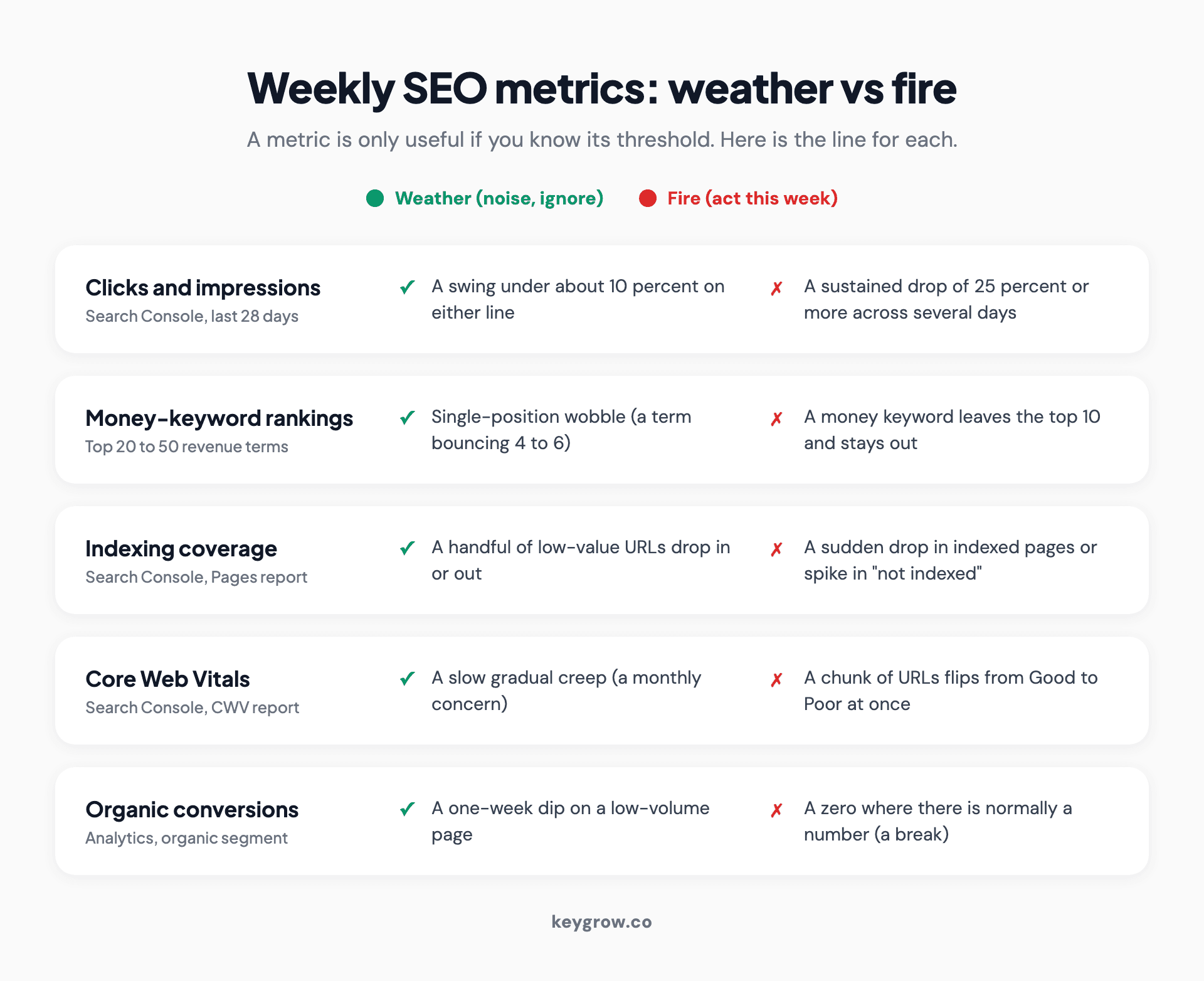
Numbered infographic explaining the noise versus real-change threshold for each weekly SEO metric, from a 10 percent click swing being weather to a money keyword leaving page one being a fire
Crawl errors, indexing, and Core Web Vitals: the stuff that breaks fast
Crawl errors, indexing coverage, and Core Web Vitals are the technical metrics that can break overnight and erase rankings with no algorithm update involved. Unlike rankings, these are pass-or-fail, so the weekly read is simpler.
Open the Pages report in Search Console. You are looking for one thing. Did the count of indexed pages drop suddenly, or did the "not indexed" count spike. A batch of pages flipping to Crawled, currently not indexed, or to Excluded by noindex tag is the classic signature of a shipped mistake, usually a staging setting that went live or a botched redirect. One accidental noindex on a template can deindex thousands of URLs at once, so this check is the single most valuable 30 seconds in the whole routine.
For Core Web Vitals, the weekly read is binary. Did a chunk of URLs move from Good to Needs improvement or Poor. A gradual creep is a monthly concern. A cliff usually means a code change or a bloated image batch shipped this week. If you are unsure what a healthy technical baseline looks like, how to conduct a technical SEO site audit covers the crawl-and-index checks in order, including the deeper passes that do not belong in a weekly glance.
Here is the honest part. If your indexing count dropped because of an accidental noindex or a missing batch of redirects, that is a same-day developer fix, not a six-month retainer. This is the moment to not panic-hire an agency. Some firms will sell a "recovery" package for a problem your own Search Console diagnosed in 60 seconds.
Organic conversions on your key pages
Organic conversions are the leads, calls, bookings, and sales that come from organic traffic, and they are the only weekly metric that maps to money. That makes them the one number worth showing anyone above you. Rankings and clicks are inputs. Conversions are the output that pays for the work.
In Google Analytics, segment to organic traffic and watch conversions on your money pages, like the contact form, the booking flow, or the call button. The most useful weekly signal here is rarely "conversions went up." It is "conversions went to zero on a page that normally converts." That pattern almost always means something broke. A form stopped submitting, a tracking tag fell off after a deploy, a phone number changed. A silent conversion break can cost a month of leads while every other metric looks fine, which is why it earns a weekly look.
Here is where I will plant my one strong opinion. Vanity-metric reporting is the industry's biggest scam. Impressions, clicks, and "engagement" do not pay rent. If an agency's weekly report opens with impressions and never reaches cost per lead, ask why. The metric that matters is the booked job, and we make that case in full in how to make SEO reporting impactful.
The threshold for a real change. Weekly conversion counts are noisy on low-volume sites, so do not over-read a one-week dip on a page that gets 12 leads a month. The signal you act on instantly is a zero where there is normally a number, because that is a break, not a trend.
Which SEO metrics you should ignore weekly (and check monthly instead)
Some metrics genuinely mislead you at a weekly cadence because they move too slowly, or too randomly, to read over seven days. Checking them weekly tends to create false alarms one week and false confidence the next.
Ignore these on the weekly pass:
The rule of thumb is simple. If a metric cannot plausibly change in a week for a reason you can act on, it does not belong in the weekly routine. Put it in the monthly review, where slow-moving trends finally have enough data behind them to mean something.
How AI Overviews changed what your weekly numbers actually mean
AI Overviews have broken the click-through-rate benchmarks that older SEO guides still quote, so a flat or falling click rate on stable rankings is now often the AI Overview eating your click, not your page underperforming. This is the biggest reason to read your weekly numbers differently in 2026.
The numbers are stark. Click-through rate for the number-one position fell to 27.6 percent in 2026, down from 39.8 percent before AI Overviews, a 30.6 percent drop. That sits on top of 21.7 million Search Console impressions tracked from March 2024 to March 2026, per Visionary Marketing. When an AI Overview actually appears on a query, the same study found position-one click-through rate drops to 19.2 percent against 39.8 percent with no AI Overview shown. Same rank, roughly half the clicks.
So what does this mean for your weekly read. If your impressions are steady or rising and your clicks are flat or down, do not assume the page got worse. Check whether an AI Overview now sits on those queries. The old "good CTR" benchmarks are obsolete, so a click rate that looks weak against a 2022 chart may be perfectly normal for a query Google now answers itself. The defensive move is to become the cited source inside those answers rather than fight for a click that no longer exists. We cover the mechanics in AI search optimization.
One weekly input is worth adding because of this shift. Did you ship and index fresh content this week. AI systems cite pages roughly 25 percent fresher than regular search results, so publishing and confirming indexing has become a leading indicator of future AI visibility, well beyond classic ranking.
A 10-minute weekly SEO routine you can actually keep
Here is the full routine in order, built to run in about 10 minutes with two free tools. The order matters. Check the things that break fast first, and leave the slow movers for last.

Person reviewing spreadsheets and charts at a desk during a focused weekly SEO check routine
1. Search Console, Performance (2 min). Last 28 days, compare to previous period. Glance at the clicks and impressions shape. Ignore the last two days (reporting lag). Flag any sustained drop over 25 percent.
2. Search Console, Pages report (1 min). Did indexed pages drop or "not indexed" spike. This is the most valuable check in the routine; a sudden drop is a same-day fix.
3. Search Console, Core Web Vitals (1 min). Did a chunk of URLs move from Good to Poor. A cliff means something shipped this week.
4. Rank check on money keywords (3 min). Your 20 to 50 revenue terms. Note any that left the top 10 and stayed there. Ignore single-position wobble.
5. Analytics, organic conversions (2 min). Segment to organic, check conversions on money pages. A zero where there is normally a number is a break, investigate now.
6. Did we ship and index fresh content (1 min). Confirm this week's new pages are indexed. A leading indicator for both search and AI visibility.
That is it. No daily rank obsession, no paid dashboard required. The discipline is doing it every week, same day, and resisting the urge to act on noise. If a check trips a real threshold, dig in. Otherwise you close the tabs and get back to the work that moves the long-run line.
If you would rather hand the routine off, our SEO service runs exactly this monitoring and reports on conversions, not impressions, on a month-to-month basis you can cancel anytime. And if you are a single-location business with more time than money, the honest call is to run the 10-minute routine yourself first. You do not need us to read six free numbers once a week.
What to take away
Weekly SEO metrics are a smoke alarm, not a scorecard. Watch impressions and clicks, money-keyword rankings, crawl and indexing health, Core Web Vitals, and organic conversions, and learn the threshold for each so you can tell weather from fire. Ignore the slow-moving vanity numbers until the monthly review. Read your click rate against AI Overview reality rather than old benchmarks. And judge actual progress over months, not weeks. Do that, and a 10-minute habit will catch the problems that would otherwise cost you a quarter.
FAQs
Should I check my SEO rankings every day?
No. Daily rank checking creates false alarms because single-position wobble is normal SERP noise, not real movement. A weekly check on your top 20 to 50 money keywords is plenty for spotting genuine drops, and watching daily mostly trains you to panic over nothing. Save the energy for the threshold that matters: a keyword that leaves the top 10 and stays there.
How often should I check Google Search Console?
Once a week covers it for most sites. A weekly glance at the Performance report, the Pages (indexing) report, and Core Web Vitals catches the fast-breaking problems early without drowning you in noise. Check more often only when you have just shipped a migration, a redesign, or a big batch of new pages, when something is more likely to break.
Why did my impressions go up but my traffic stayed flat?
Rising impressions with flat clicks usually means you are appearing on more searches but not winning the visit. The common causes are weak titles or snippets, a SERP feature like an AI Overview sitting above you, or appearing for queries where you rank too low to earn clicks. Check whether an AI Overview now covers those queries before assuming your page got worse.
What is a good organic click-through rate in 2026?
Lower than the old benchmarks, and it depends heavily on whether an AI Overview appears. Click-through rate for the number-one position fell to 27.6 percent in 2026 from 39.8 percent before AI Overviews, and drops to about 19.2 percent on queries where an AI Overview shows. Judge your CTR against 2026 reality, not a 2022 chart, and expect lower numbers on informational queries Google now answers itself.
Why does Google Search Console data look a few days behind?
Because it is. The Performance report is not real-time and normally lags by hours up to roughly two days, so the most recent days on the chart look artificially low until the data fills in. Never panic over a cliff on the last day or two; compare full weeks instead, and read the latest days as incomplete rather than alarming.
Which weekly SEO metrics are most likely to mislead me?
Domain authority, total backlink count, total keyword count, and total organic traffic read as a weekly verdict. These move too slowly or too randomly to mean anything over seven days, so checking them weekly produces false alarms and false confidence. Move them to the monthly review, where slow trends finally have enough data to be real.
How long before weekly SEO metrics actually start moving?
The early signals (impressions, indexing, fresh content) can move within weeks, but real ranking and conversion progress takes months. Our strongest organic case took 12 months to reach 1,519 percent traffic growth, with the first quarter looking unimpressive. Use weekly numbers to confirm nothing is broken, and judge whether the strategy is working on a quarterly horizon, not a weekly one.
What free tools do I need to track weekly SEO metrics?
Two: Google Search Console and Google Analytics. Search Console gives you impressions, clicks, indexing health, and Core Web Vitals; Analytics gives you organic conversions. That covers four of the five weekly metrics for free. The only thing they do not do well is daily rank tracking, which you can approximate by hand on a short keyword list or add a paid tracker for if your list is long.


