

Picture a Monday status call. There are fourteen tabs open in a dashboard, every arrow is green, and impressions are "up and to the right." Then the CFO asks one question: did we get more customers? Silence. The number nobody put on the screen is the only one that mattered.
That gap is the whole problem, and it tells you how to make SEO reporting impactful: report what changed, why it changed, what it is worth in money, and what to do next. A report that does not change a decision is not an asset. It is a recurring cost with a nice color scheme. Strip out the decoration, lead with outcomes the search results page cannot erase, and turn every metric movement into a recommendation a stakeholder can act on by Monday.
This is the part most guides skip. They tell you to "tie SEO to revenue" and "end with actionable recommendations," then show you neither the arithmetic nor a single example of a good recommendation. We will fix both, plus give you a diagnostic table for when traffic drops and you have no idea why.

Two colleagues reviewing analytics on a laptop together during a meeting in a neutral office setting
Why does a beautiful SEO report still get ignored?
Because it answers questions nobody asked. A 15-tab dashboard tracking impressions, average position across 4,000 keywords, and domain authority looks like rigor. To the person paying for it, it reads as noise, because none of those numbers tells them whether the channel made or lost money this month.
Vanity-metric reporting is the marketing industry's most common sleight of hand. Impressions, raw clicks, and "engagement" do not pay rent. When a report opens with impressions instead of cost per lead and booked revenue, it is usually hiding the fact that the outcomes did not move. If your agency leads with a vanity number, that is a fair thing to ask about.
Here is the reality. A report is a decision document, not a scoreboard. Its job is to move a budget, kill a losing initiative, double down on a winner, or explain a swing the boss already noticed. Everything that does not serve one of those four jobs is filler. The fix is not a prettier dashboard. It is a ruthless edit down to what changes a decision, then a clear answer to "so what do we do."
Outcome, diagnostic, or vanity: a tier list for every metric in your report
Every SEO metric belongs in one of three tiers, and most reports mislabel them. Outcome metrics measure business results. Diagnostic metrics explain why outcomes moved. Vanity metrics make the report look busy and answer nothing. Sort your metrics into these tiers and your report writes itself.
Outcome metrics (lead with these). Qualified organic leads, form fills and calls from organic, lead quality or MQL rate, lead-to-customer conversion rate, and assisted or closed revenue influenced by organic. These are what the business actually buys. In HubSpot's 2026 marketing report, marketers ranked lead quality (39 percent) and lead-to-customer conversion rate (34 percent) as the metrics that matter most, ahead of raw ROI and customer acquisition cost. They also named website, blog, and SEO the number one channel for return on investment. Put outcomes at the top of page one, every time.
Diagnostic metrics (use to explain movement). Keyword rankings for commercial terms, organic click-through rate, indexation and crawl status, Core Web Vitals, and top landing-page performance. These do not prove success on their own. They explain why an outcome moved. A ranking that climbed from position 8 to 3 is not the win. It is the reason the win happened. Report diagnostics in service of an outcome, never as the headline.
Vanity metrics (cut or bury in an appendix). Total impressions, total keywords ranked for, raw sessions with no intent filter, bounce rate in isolation, and domain authority treated as a goal. Domain authority is a third-party model, not a Google metric, and chasing it as a target is how teams waste quarters. These belong in an appendix at most, and often nowhere.
The line is simple. If a number cannot justify a decision on its own, it is not allowed on page one.
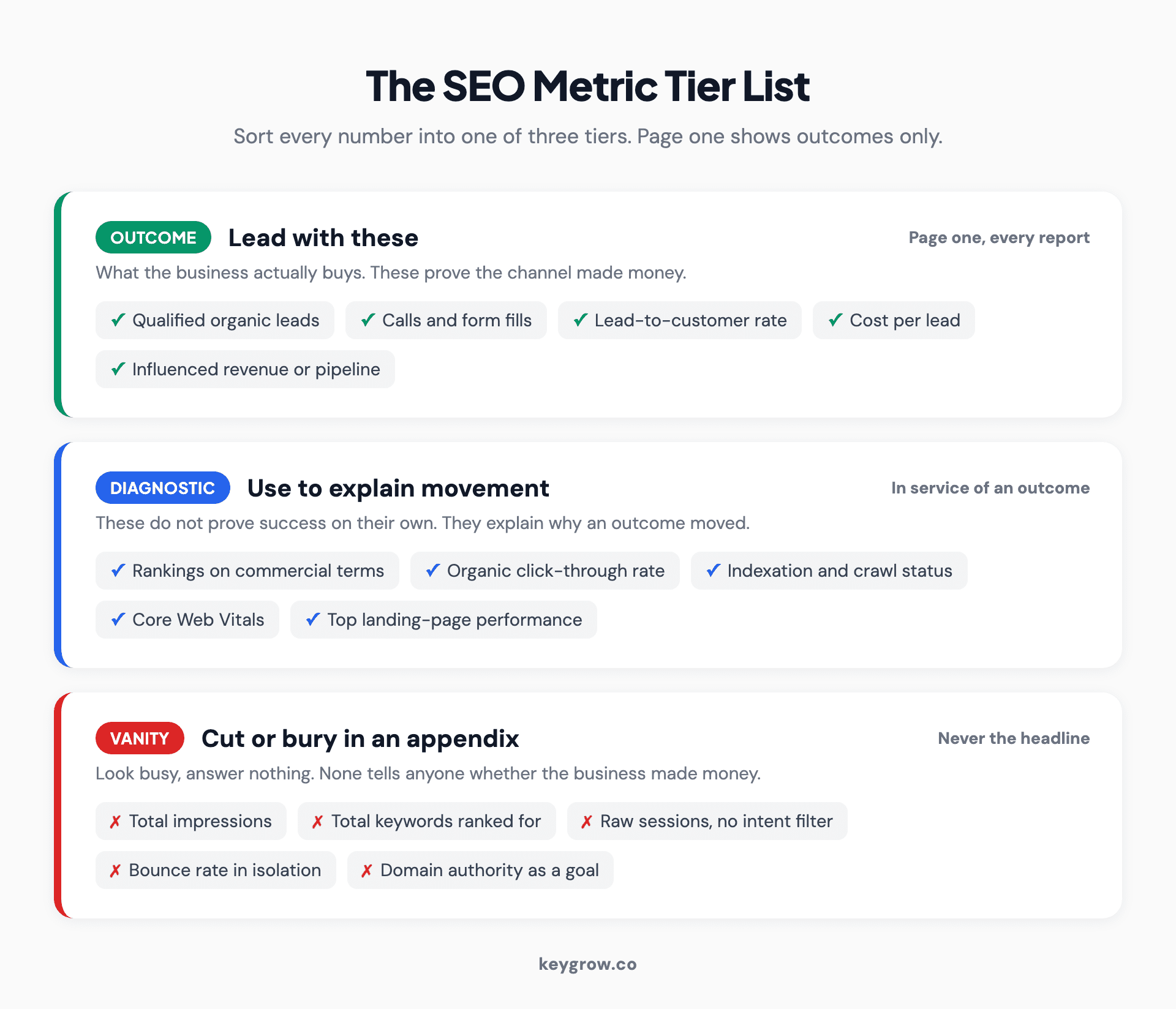
SEO metric tier list showing outcome metrics like qualified leads and revenue at the top, diagnostic metrics like rankings and click-through rate in the middle, and vanity metrics like impressions and domain authority at the bottom, with a rule that page one shows outcomes only
Are rankings and impressions actually lying to you in 2026?
Not lying exactly, but they no longer mean what your report assumes. A ranking used to map cleanly to clicks. That link broke. Reporting a ranking win as a traffic win in 2026 is how good work gets buried under a flat traffic line nobody can explain.
The search results page underneath your ranking has become unstable. Per the Semrush study, AI Overviews appeared for 15.69 percent of queries in November 2025, down from a July 2025 peak of 24.61 percent. The surface your position sits on changes month to month, so the same rank can produce wildly different click volume.
Clicks are leaking out of the open web entirely. The 2024 zero-click study from SparkToro found that for every 1,000 US Google searches, only about 360 clicks reached the open web (374 in the EU), with the majority of searches ending without a click. And the same ranking earns fewer clicks than it used to: a GrowthSRC study of 200,000 keywords found position 1 organic click-through rate dropped roughly 32 percent year over year, largely attributed to AI Overviews.
The picture gets sharper in controlled conditions. In a randomized field experiment reported by Search Engine Journal, AI Overviews cut organic clicks on triggered queries by 38 percent, and zero-click searches rose from 54 percent to 72 percent when an AI Overview was shown. So a ranking win can be entirely real and produce no traffic gain, because the click was answered on the page.
What this means for your report: stop treating "we rank for more keywords" as a result. Rankings move to diagnostic tier. The headline is what the search results page cannot quietly take away, which is leads, calls, and revenue. If you want to keep visibility honest in the AI era, you also need to track presence inside AI answers, not just blue links, which is its own discipline covered in our guide to AI search monitoring.
How do you turn a ranking change into a dollar figure?
You chain the funnel and put real numbers on each step. Every guide tells you to tie SEO to revenue. Almost none of them show the arithmetic, so here it is, worked end to end on a single keyword cluster.
Say a cluster of commercial terms moved from an average position of 8 to position 3 over a quarter. The cluster gets 10,000 monthly searches. Use a published click-through-rate curve as your input. Backlinko's four-million-result study puts position 1 near 27.6 percent, and a First Page Sage benchmark puts position 3 around 10 percent and position 8 around 2 percent. The exact curve varies, so use your own Search Console click-through rate for those positions where you have it, and treat published curves as a fallback.
Here is the chain:
That is the sentence a CFO reads. Not "rankings improved." Instead: "This query cluster moved from page one bottom to top three, which is worth an estimated 9,600 dollars a month in influenced revenue at our current conversion and close rates."
Two honesty notes. First, plug in your real conversion and close rates from your CRM, not optimistic defaults; the model is only as good as those inputs. Second, label it "estimated influenced revenue," not "revenue SEO generated," because attribution is rarely that clean. We dig into the full calculation, including cost per lead and payback, in our walkthrough on measuring SEO ROI.
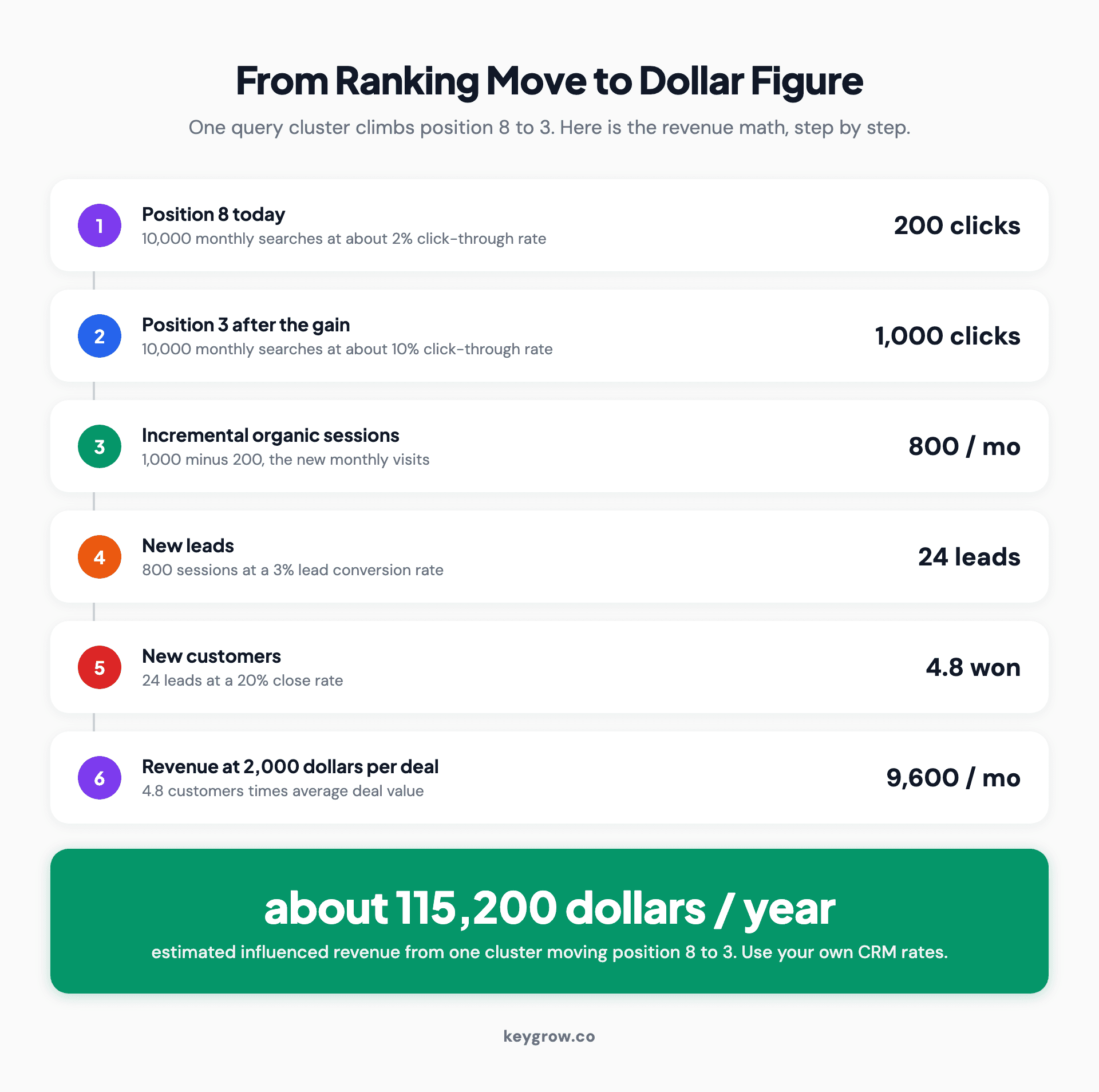
a six-step revenue math flow turning a ranking move from position 8 to position 3 into incremental sessions, leads, customers, and an estimated 9,600 dollars in monthly influenced revenue for an SEO report
What changed, and why: a diagnostic table that beats "investigate further"
When a metric swings, the report should name the likely cause and the next move, not say "we will look into it." Every competitor guide tells you to investigate. None of them teaches the order to ask the questions in. Here is a trigger-to-cause-to-action table you can lift straight into a report.
| What you see | Likely cause | What to do next |
|---|---|---|
| Clicks fell but position held | A new search-results feature (AI Overview, snippet) or a stale title that lost the click | Rewrite the title and meta to match intent, then re-test. Track AI Overview presence on the query. |
| Position dropped on many pages at once, same week | An algorithm update or a technical regression site-wide | Check the update timeline against the date. If it lines up, audit content quality. If not, check for a broken deploy, robots change, or canonical error. |
| Traffic down but conversions flat or up | Lost low-intent traffic; the valuable visits stayed | Confirm with landing-page segmentation. Often this is fine, not a fire. Do not over-react to a vanity drop. |
| One page lost rankings while neighbors held | Content decay, a lost backlink, or a competitor refresh | Compare against the current top result, refresh the content, and check the backlink profile for that URL. |
| Impressions up, clicks flat | You are surfacing for broader, lower-intent queries | Check the queries in Search Console. If they are off-target, this is noise, not progress. |
| Traffic up, leads down | A tracking break or a traffic-quality shift | Test conversion tracking first (it breaks more often than anyone admits), then check which queries and pages drove the new traffic. |
The discipline behind the table is sequencing. When something moves, ask in this order: Is it seasonal (compare year over year, not month over month)? Is it an algorithm update (check the dates against a tracker)? Is it technical (crawl, index, canonical, redirect, page speed)? Is it competitive (did someone overtake you on the target query)? Working that sequence turns "traffic dropped 15 percent" from a panic into a paragraph. For the underlying setup that makes this diagnosis possible, see how to track SEO properly.
So what do we do next? Writing recommendations a stakeholder can act on
A recommendation is a specific action, an owner, and an expected outcome. "Continue optimizing content" is not a recommendation. It is a stall. The single biggest upgrade to most reports is replacing vague closers with three concrete next moves.
Compare these two:
The strong version names the page, the current number, the benchmark, the action, the owner, and the expected result. A stakeholder can approve or reject it in ten seconds. That is the test of a recommendation: can the reader make a decision about it without a follow-up meeting.
Keep the action list short. Three to five recommendations, ranked by expected impact, beats a wall of twenty. If everything is a priority, nothing is. And tie each one back to an outcome metric, so the reader sees not just what you want to do but what it is worth.

Person writing concise notes in a notebook beside a laptop, turning data into next steps
How do you report honestly when attribution is messy?
You report a range and a method, not a single confident number you cannot defend. Attribution is genuinely hard, and pretending otherwise is how reports lose credibility the first time someone checks. Per a Firework roundup, only 36 percent of marketers say they can accurately measure ROI, and 47 percent struggle to measure it across multiple channels. So the honest move is to show your work, not to overclaim.
Three practical methods, in order of effort:
Last non-direct click plus an assisted view. Report organic as the last non-direct touch for the clean number, then show assisted conversions separately so the reader sees organic's role in journeys that closed on another channel. Two views, clearly labeled, beat one number pretending to be the whole truth.
CRM source-field hygiene. Most attribution problems are data-entry problems. If your lead form does not capture source, or sales overwrites it, no model will save you. Fix the source field at the point of capture before you trust any channel report.
Holdout or geo tests for the big decisions. When a budget call is large enough to matter, pause or scale SEO investment in one region and compare against a matched control region. It is the closest thing to a clean read on incremental contribution, and it sidesteps the attribution-model argument entirely.
State the limitation in the report itself. A line like "organic influenced an estimated 18 to 24 leads this month under last-non-direct attribution; assisted view suggests the higher end" is more trustworthy than a single number with a false decimal place. If you want a fuller treatment of proving the channel actually works, our post on knowing your SEO is working goes deeper.
What to cut: shrinking a 15-tab dashboard to one screen
Most reports need subtraction, not addition. The goal is one executive screen that earns its place, with everything else demoted to an appendix the reader opens only when a number on the main screen prompts a question. Anyone can add a section. Knowing which fourteen tabs to delete is the harder job.
The one-screen executive view holds five things and no more: qualified organic leads (with the prior-period comparison), estimated influenced revenue or pipeline, cost per lead from organic, the one biggest change this period with its cause, and the top three recommended actions. That is the report. Everything else is the appendix.
What goes in the appendix: the full ranking table, impressions, indexation status, Core Web Vitals, the keyword-by-keyword breakdown, and the technical backlog. Available on request, not on page one.
The shortlist changes by business model:
That last point is worth sitting with. We have three local-service clients we measure almost entirely on the phone: a phone repair shop that reached 115-plus monthly calls in 7 months, a real estate office at 90-plus in 7 months, and a junk removal company at 50-plus in 6 months. None of those reports needs an impressions chart. The outcome is the call, the call is countable, and the report is one screen.
When a fancy report is not worth building
Sometimes the honest answer is that you do not need the report at all. If you are a single-location business with a handful of service pages and one clear conversion (a call or a form), a monthly screenshot of your calls from organic and your top three Google Business Profile actions is enough. Building a multi-tab dashboard for that is theater. Spend the time on the work instead.
The same goes for frequency. A brand-new SEO program watched weekly will mostly show you noise, because organic compounds on a multi-month curve. The early months often look unremarkable while the work accrues, and the real movement shows up later. Watching month two week by week generates anxiety and zero useful decisions. Match the cadence to how the channel actually moves.
This is also the honest case for not hiring an agency at all yet. If your reporting needs fit on a sticky note, you can run them yourself. Bring in help when the opportunity cost of your time beats the fee, not before.
A reporting cadence and template that matches how SEO moves
Match the report to the rhythm of the channel and the attention span of the reader. SEO compounds over months, so a weekly report mostly reports weather, while a quarterly one reviews the climate. The right answer is usually layered.
The monthly template, in order: outcomes first (leads, revenue, cost per lead with prior-period comparison), then the one big change and its diagnosis, then three ranked recommendations, then an appendix for anyone who wants the diagnostics. That order is the whole method. Outcomes earn attention, the diagnosis earns trust, the recommendations earn the next month's budget, and the appendix keeps the analysts honest.
One more practical note on trust over time: if your reports are consistent month to month in format and definitions, the reader learns to read them in seconds. Change what a metric means between reports and you reset that trust every time. For the buyer side of this, how to tell whether the reports you are receiving are honest, see our guide to spotting an SEO company that is working.
FAQs
What metrics should an SEO report include?
Lead with outcome metrics: qualified organic leads, conversion rate, cost per lead, and estimated influenced revenue or pipeline. Support them with diagnostic metrics (commercial rankings, click-through rate, indexation) that explain why outcomes moved. Push vanity metrics like total impressions and domain authority to an appendix or cut them. The test is whether a number can justify a decision on its own.
What are vanity metrics in SEO and which ones should I stop reporting?
Vanity metrics look impressive but do not inform a decision. The usual suspects are total impressions, total keywords ranked for, raw sessions with no intent filter, bounce rate in isolation, and domain authority treated as a goal rather than a third-party estimate. They are fine as background context in an appendix but should never lead a report, because they do not tell anyone whether the business made money.
How do you measure the ROI of SEO?
Chain the funnel with real numbers: incremental organic sessions times conversion rate equals leads, leads times close rate equals customers, customers times average deal value equals influenced revenue, then compare against your SEO cost. Use your own CRM conversion and close rates, not defaults, and label the output "estimated influenced revenue" because attribution is rarely perfectly clean. Per Firework, only 36 percent of marketers say they can measure ROI accurately, so showing your method matters as much as the number.
How often should you send an SEO report?
Layer it. Keep a weekly internal pulse for anything broken (indexation, tracking, a ranking cliff), send a monthly one-screen report to stakeholders with outcomes and recommendations, and run a quarterly strategy review for budget decisions. SEO compounds over months, so weekly stakeholder reports mostly show noise. Match the cadence to how the channel actually moves.
How do you explain a drop in organic traffic to a client or executive?
Diagnose before you report, using a fixed sequence: is it seasonal (compare year over year), an algorithm update (check the dates), technical (crawl, index, canonical, redirects), or competitive (did someone overtake you). Then state the likely cause and the next action in one paragraph. If conversions held while traffic fell, you likely lost low-intent visits, which is often fine, not a fire.
Are keyword rankings still a useful metric in 2026 with AI Overviews?
Yes, but only as a diagnostic, not a headline. A GrowthSRC study of 200,000 keywords found position 1 click-through rate fell roughly 32 percent year over year, largely from AI Overviews, so the same ranking now buys fewer clicks. Report rankings to explain why an outcome moved, and put leads, calls, and revenue at the top instead, because those are what the search-results page cannot quietly take away.
Report like it is a decision memo, not a scoreboard
The shift is small to describe and hard to do: stop building a record of activity and start building a document that drives a decision. Put outcomes on page one, demote rankings and impressions to the diagnostic and vanity tiers where they belong, do the revenue arithmetic so a dollar figure is on the screen, and end with three actions someone can approve on Monday. In a year where the same ranking buys fewer clicks, the only reporting that survives is reporting on outcomes the search results page cannot erase.
If your current report opens with impressions and ends with "continue monitoring," it is decoration. If you want a second set of eyes on what your SEO reporting should actually say, get in touch and we will tell you straight, including whether you need an agency at all.


