

Here is the number you came for, before the context. How much does enterprise SEO cost? For a genuine enterprise program, the kind that covers a large multi-location brand, a site with tens or hundreds of thousands of URLs, or a six-figure organic channel in a competitive market, you are usually looking at 20,000 to 60,000 dollars a month with an agency, or roughly 400,000 to 600,000 dollars a year to run it fully in-house, plus an SEO platform license that runs 36,000 to over 100,000 dollars a year on top of either. Most large brands land somewhere in that band. The exact figure depends on how big and how international your site is, how hard your competitors are fighting, and whether you buy a team, an agency, software, or some mix of all three.
That is the short answer. The rest of this guide is the detail behind it: what actually pushes the price up, the line item most pricing guides quietly leave out (the platform license), and the three-year math that decides whether you build a team, hire an agency, or both.
One thing to settle first. This is the enterprise lane only. If you run a single-location business, a startup, or a mid-market company, the numbers above will look insane, because they are not for you. For standard and small-business pricing, where retainers run a few hundred to a few thousand a month, read our companion piece on how much Google SEO costs. The two posts are a deliberate pair. This one stays strictly at enterprise scale, so the figures will only make sense if that is genuinely where you sit.
How much does enterprise SEO cost? (the short answer up front)
Enterprise SEO costs 20,000 to 60,000 dollars a month with a specialist agency, around 400,000 to 600,000 dollars a year to staff in-house, and a further 36,000 to 100,000-plus dollars a year for the platform license most programs need. The spread is driven by site size, competition, and how many markets you operate in.
Those three buckets, agency fee, in-house payroll, and platform license, are the whole cost picture. Almost every pricing guide covers the first two and skips the third, which is why budgets blow up six months in when finance discovers the software contract nobody flagged.
To put the agency number in market context, the marketing research firm First Page Sage found that 55 percent of enterprise-level companies invest more than 20,000 dollars per month in SEO. So a five-figure-a-month retainer is not the high end of enterprise pricing. It is the floor for the majority of large companies that take organic seriously.

An enterprise marketing team planning organic search work together around a table, the kind of coordination that drives enterprise SEO cost.
The reason the band is so wide is that "enterprise" describes wildly different problems. A national retailer with 300,000 product pages, a SaaS company fighting for ten brutally competitive head terms, and a franchise with 800 location pages all qualify as enterprise, and all three need very different amounts of work. The next section defines the line properly.
What actually counts as enterprise SEO, and why it costs more than standard SEO
Enterprise SEO is organic search work for large, complex sites where scale itself is the hard part: tens of thousands of pages, multiple teams and stakeholders, strict brand and legal sign-off, and often several markets or languages. It costs more because the work shifts from writing good pages to managing systems that produce thousands of good pages reliably.
Standard SEO is mostly about doing the right things on a manageable set of pages. Enterprise SEO is about doing the right things at a scale where you cannot touch every page by hand, so you are building templates, internal-linking logic, and crawl rules that have to behave correctly across hundreds of thousands of URLs at once. One broken template can deindex a whole product category overnight. That risk is part of what you are paying to manage.
Three things make enterprise fundamentally more expensive than standard work:
This is also why the channel rewards patience at scale. SEO is ongoing work, not a one-time project, and at enterprise size the compounding is bigger but the lead time is longer, because shipping anything takes coordination a small site never deals with.
What drives the price up: site size, multi-location, international, and competition
Four factors move an enterprise SEO quote up or down: the number of pages on your site, how many physical locations you optimize for, how many countries and languages you operate in, and how aggressively your competitors invest. Each one multiplies the work, and they stack.
Here is roughly how each factor pushes the monthly figure, holding the others steady:
| Cost driver | Lower end of enterprise | Upper end of enterprise |
|---|---|---|
| Site size | 5,000 to 20,000 pages | 100,000-plus pages, faceted navigation |
| Locations | A few dozen location pages | 500-plus location or store pages |
| International | One country, one language | Multiple countries, hreflang, localized content |
| Competition | Established category, few serious rivals | Several well-funded brands fighting the same terms |
| Approval layers | Marketing signs off | Brand, legal, and dev all gate every change |
The single biggest multiplier is usually international. The moment you go from one market to five, you are not doing five times the work, you are doing more, because hreflang, localized content, country-level technical config, and per-market link building each carry their own overhead. B2B research from the agency Directive puts enterprise retainers for B2B teams at 7,000 to over 60,000 dollars a month, and that range is so wide precisely because it spans single-market programs at the bottom and sprawling multi-country ones at the top.
Competition is the factor people underestimate. If three well-funded brands all want the same head terms, the cost of competing is not set by you. It is set by whatever the most aggressive player in your category is willing to spend on content, links, and digital PR. You either match that pace or you cede the terms. There is no cheap way to win a category that someone else is funding hard, which is part of why SEO matters so much for B2B markets where a single deal can be worth six figures.
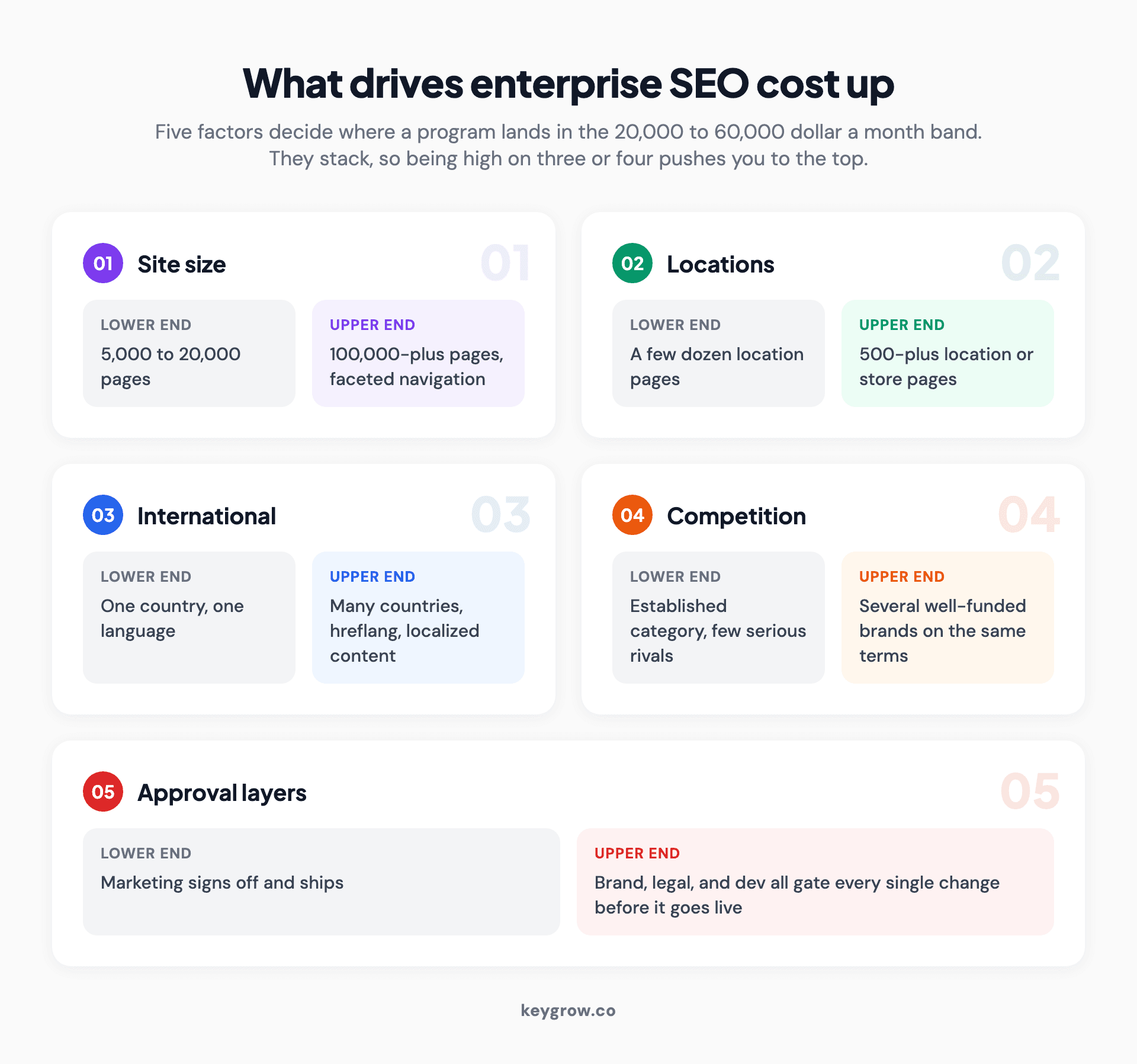
Five factors that drive enterprise SEO cost up: site size, number of locations, international markets, competitive intensity, and internal approval layers, each shown as a card with its lower-end and upper-end range.
If your situation is high on one driver and low on the rest, you are probably at the bottom of the enterprise band. If you are high on three or four, you are at the top, and a 20,000-a-month quote is the starting point, not the ceiling.
The four ways enterprise SEO is priced (retainer, hourly, per-project, performance)
Enterprise SEO is priced four ways: a monthly retainer, an hourly rate, a fixed per-project fee, or a performance model tied to results. The monthly retainer is by far the most common at enterprise scale, because the work is continuous and the relationship is long. The other three show up in specific situations.
Each model fits a different need, and knowing which is which keeps you from overpaying:
Here is the one strong opinion I will put a number behind. Twelve-month lock-in contracts at enterprise scale are a confession, not a commitment. If an agency needs you legally bound for a year to keep the account, the results are not doing the holding. We run month-to-month and cancel anytime for exactly this reason: our strongest organic case, a doctor's practice in Dubai, grew organic traffic 1,519 percent over twelve months, and it stayed with us every one of those months because the numbers earned it, not because a clause forced it. Scale up the budget and the principle holds even harder. The more you are spending, the less you should accept being trapped.
In-house vs agency vs platform: the real three-year math
Over three years, an in-house enterprise SEO team typically costs the most in raw payroll, a specialist agency costs less and starts faster, and an SEO platform is not an alternative to either, it is a tool both of them need. The honest comparison is not in-house versus agency versus platform. It is in-house plus platform versus agency plus platform.
This is where most guides quietly mislead you by treating the platform as optional. It is not. A serious enterprise SEO operation, in-house or agency, runs on enterprise software. What you are actually choosing is who operates that software and owns the strategy around it.
The in-house number is bigger than people expect. A fully loaded enterprise SEO team, several specialists plus a director, lands around 420,000 to 606,000 dollars a year according to TripleDart. A big part of that is leadership: the average SEO Director salary in the US is 153,515 dollars a year, with top earners around 245,533 dollars, per Glassdoor data. Add managers, technical specialists, and content people and you are well into half a million before software.
Here is the three-year picture, with the platform license folded in honestly:
| Model | Year 1 | Three-year total | Starts producing |
|---|---|---|---|
| In-house team plus platform | 460,000 to 700,000 dollars | 1.4 to 2.1 million dollars | 4 to 8 months (hiring, ramp) |
| Specialist agency plus platform | 280,000 to 800,000 dollars | 850,000 to 2.4 million dollars | 1 to 3 months |
| Platform license alone (DIY) | 36,000 to 100,000-plus dollars | 110,000 to 320,000-plus dollars | Only as fast as your own team works |
A few honest notes on that table. In-house gives you full control and institutional knowledge that compounds, but you carry hiring risk, ramp time, and the cost of replacing anyone who leaves. An agency starts faster and brings cross-account pattern recognition, but you are renting attention shared with other clients. Platform-alone only works if you already have skilled people to operate it, otherwise you have bought a very expensive dashboard nobody reads.
Most large brands end up hybrid: a lean in-house team that owns strategy and stakeholder relationships, an agency for specialist execution and surge capacity, and a shared platform license underneath both. The right split depends on how much revenue rides on organic, which is the number that should anchor the whole build-versus-buy call.
What an enterprise SEO platform license actually costs (the line item most guides skip)
An enterprise SEO platform license runs from around 36,000 dollars a year at the low end to well over 100,000 dollars a year for a full implementation across a large organization. This is a separate line item from your team or agency fee, and it is the cost almost every pricing guide forgets to mention. Budget for it from day one.
These are the platforms built for scale: the kind that crawl hundreds of thousands of URLs, run log-file analysis, track tens of thousands of keywords, and feed reporting up to a C-suite. The big names in this category are Conductor, BrightEdge, seoClarity, and Botify, and full implementations of platforms like these often exceed 100,000 dollars annually, by Stackmatix's accounting of enterprise platform costs.
The real-world figure is usually below that headline, though. Procurement data from Vendr puts BrightEdge's median annual contract value at 51,294 dollars a year. So a more typical enterprise platform spend is in the 40,000 to 60,000 dollar range, with the six-figure numbers reserved for the largest, multi-market deployments.
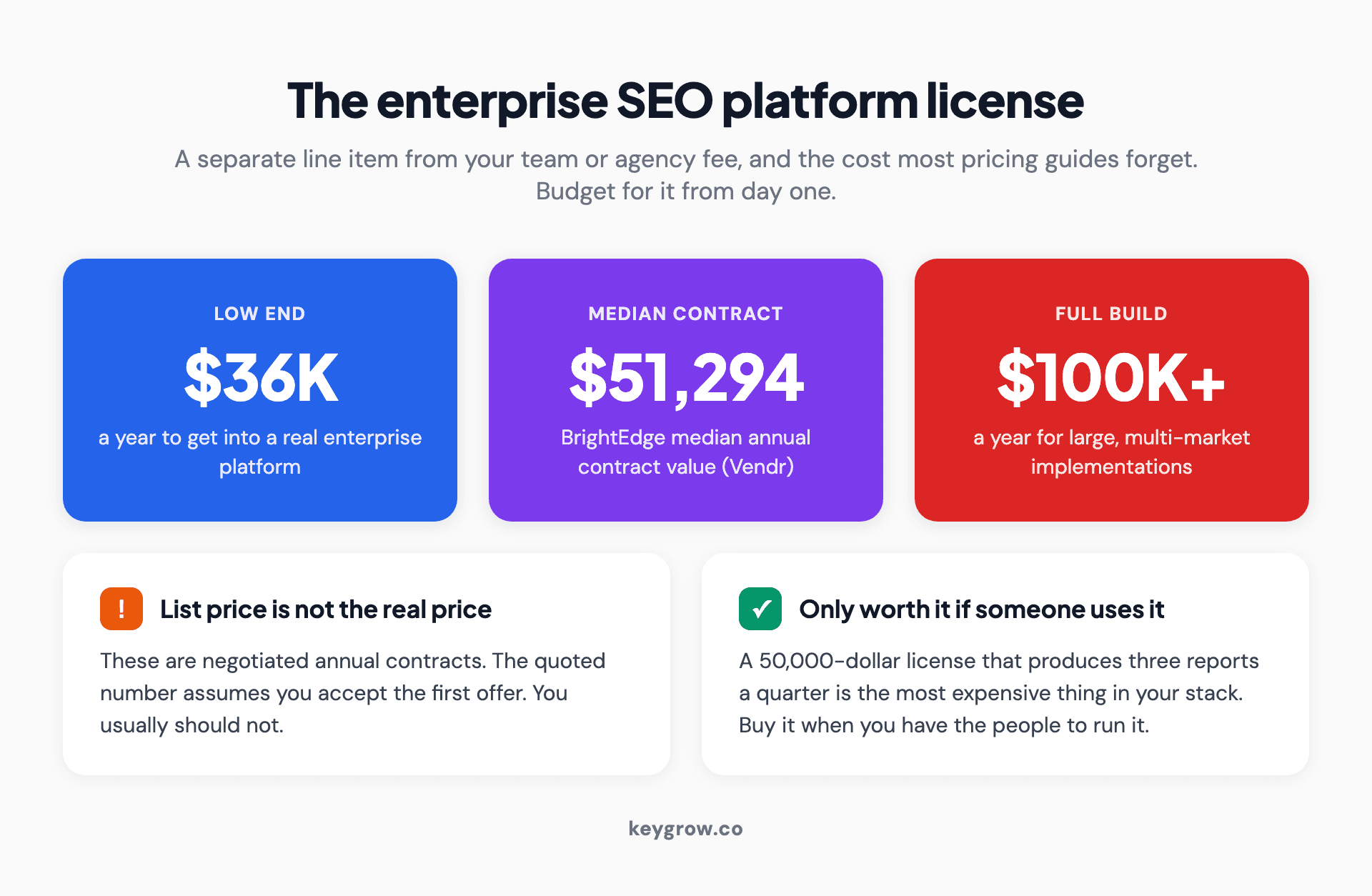
Enterprise SEO platform license cost shown as a stat strip: roughly 36,000 dollars a year at the low end, a 51,294 dollar median annual contract value, and over 100,000 dollars a year for full large-scale implementations.
Two things to know before you sign. First, the list price is rarely the real price. These are negotiated annual contracts, and the quoted number assumes you accept their first offer; you usually should not. Second, the platform is only worth its price if someone is genuinely using it daily. A 50,000-dollar license that produces three reports a quarter is the most expensive thing in your stack per unit of value. Buy the platform when you have the people to run it, not before.
When enterprise SEO is overkill, and what to buy instead
Enterprise SEO is overkill when your site is small enough to manage by hand, when you operate in one market with modest competition, or when your growth ceiling is lower than the six-figure annual cost. In those cases you do not need an enterprise program, you need standard SEO done well, and spending at the enterprise level is just burning budget on capacity you will never use.
This is the honest part, and it is where we lose some prospective clients on purpose. If any of these describe you, do not buy enterprise SEO:
Here is when you genuinely do need it. You qualify for enterprise SEO when your site is large and templated, when the cost of getting a change shipped is itself a major drag on growth, when you operate across multiple markets, and when a single percentage point of organic share is worth more than the entire program. If that is you, the spend is justified. If it is not, an enterprise vendor that tries to sell it to you anyway is selling, not consulting, and that is the clearest red flag in this whole category. An agency that will not tell you when you are too small for what they sell is one to walk away from.
How to tell if a six-figure enterprise SEO program is actually working
A six-figure enterprise SEO program is working when organic revenue and qualified pipeline are growing faster than the cost of the program, not when rankings or traffic charts go up. At enterprise scale the only metric that survives a board meeting is money, so the reporting has to lead with revenue, cost per acquisition, and share of category, with rankings as supporting detail.
Vanity-metric reporting is the industry's biggest scam, and it gets worse the bigger the budget. Impressions and "engagement" do not pay for a half-million-dollar team. If your enterprise report opens with a chart of total impressions trending up and to the right, ask why the revenue number is not on the first slide.
Here is what a real enterprise SEO report should put first:
And patience is part of the deal. Enterprise SEO compounds slowly and then steeply. The first two quarters of a serious program often look unimpressive while technical foundations and content systems get built, and the payoff arrives later. Anyone promising six-figure returns in ninety days at enterprise scale is either targeting terms nobody searches or about to do something that gets your domain in trouble. If the early months look flat but the leading indicators (crawl health, indexation, non-brand impressions) are climbing, the program is on track. Our guide to measuring SEO ROI breaks down exactly which leading indicators predict the revenue that follows.
FAQs
Why is enterprise SEO so much more expensive than regular SEO?
Enterprise SEO costs more because scale itself is the hard part. You are managing tens or hundreds of thousands of pages, multiple stakeholders, legal and brand approval on every change, and often several markets at once. Most of the cost is coordination and technical complexity, not the SEO tasks themselves, and a serious program also needs an enterprise software license that regular SEO does not.
What is a typical monthly retainer for enterprise SEO in 2026?
A typical enterprise SEO retainer runs 20,000 to 60,000 dollars a month, though B2B programs can start around 7,000 a month at the smaller end. First Page Sage found that 55 percent of enterprise companies invest more than 20,000 dollars a month in SEO, so a five-figure monthly fee is the norm rather than the exception at this scale.
Is it cheaper to build an in-house enterprise SEO team or hire an agency?
An agency is usually cheaper in the first one to three years and starts producing faster, while an in-house team costs more in raw payroll but builds institutional knowledge over time. A fully loaded in-house team runs roughly 420,000 to 606,000 dollars a year before software. Many large brands run a hybrid: a lean in-house team for strategy plus an agency for specialist execution.
How much does an enterprise SEO platform like BrightEdge or Conductor cost?
Enterprise SEO platforms run from around 36,000 dollars a year to over 100,000 dollars a year for full implementations. BrightEdge's median annual contract value is 51,294 dollars according to procurement data, so a typical enterprise platform spend sits in the 40,000 to 60,000 dollar range. This is a separate line item from your team or agency fee, and the list price is almost always negotiable.
How long before a six-figure enterprise SEO program pays for itself?
Most enterprise SEO programs take two to four quarters before the foundational work translates into measurable revenue, and longer to fully pay back at six-figure spend. The first two quarters often look flat while technical and content systems get built. Track leading indicators like crawl health, indexation, and non-brand impressions early, because those climb before the revenue does.
Does a bigger website always mean a bigger SEO budget?
Usually, but not always. Page count is one of the biggest cost drivers because large templated sites need crawl management, internal-linking logic, and technical work that small sites do not. That said, a smaller site in a brutally competitive category can cost more than a huge site in a quiet one. Competition and international scope often matter as much as raw page count.
Is enterprise SEO worth it for a large multi-location brand?
It is worth it when a single percentage point of organic share is worth more than the full annual cost of the program, and when getting changes shipped across your site is itself slowing growth. For a large multi-location brand with hundreds of location pages and real competition, that math usually clears. If your addressable organic revenue is below the cost of the program, it is not worth it, and standard SEO will serve you better.
What should be included in an enterprise SEO contract?
A solid enterprise SEO contract should name the scope of work, the team assigned, reporting cadence, and the metrics you will be judged on (revenue and pipeline, not impressions). It should clarify who owns the platform license and any content or links created. Be wary of twelve-month lock-ins; a confident vendor will work month-to-month, because results, not a clause, should keep the account.
Where this leaves you
Enterprise SEO costs 20,000 to 60,000 dollars a month with an agency, 400,000 to 600,000 a year in-house, and 36,000 to over 100,000 a year for the platform either way needs. The figure inside that band depends on your site size, your markets, and how hard your category is fought. The platform license is the line item to budget for now, before finance finds it later.
What decides it is not the price tag. It is whether your addressable organic revenue clears the cost of the program. If it does, build the hybrid most large brands settle into. If it does not, buy standard SEO done well and revisit the enterprise question when you have outgrown it.
If you want a straight read on which side of that line you fall, that is the conversation we are good at. We are month-to-month, and we will tell you honestly when an enterprise program is overkill for where you are. Get started here and we will look at the numbers with you.


