

The median landing page converts at 6.6 percent. That figure comes from the Unbounce benchmark report, which looked at 41,000 pages and 464 million visitors, and it is the first thing most people look up when they start on landing page conversion rate optimization.
It is also close to useless on its own.
Conversion rate is a ratio. You can move it by fixing the page, or by changing who arrives at it, and most advice on the subject only covers the first half. That is why so many teams spend a quarter rewriting headlines and testing button colors while the actual leak sits in their traffic.
What follows is the order we work in, why that order exists, and the point at which optimizing the page stops paying.
What counts as a good landing page conversion rate
A good rate is anything above the median for your industry and your offer type. Across all industries that median is 6.6 percent, but the spread between verticals is wider than the spread between a good page and a bad one.
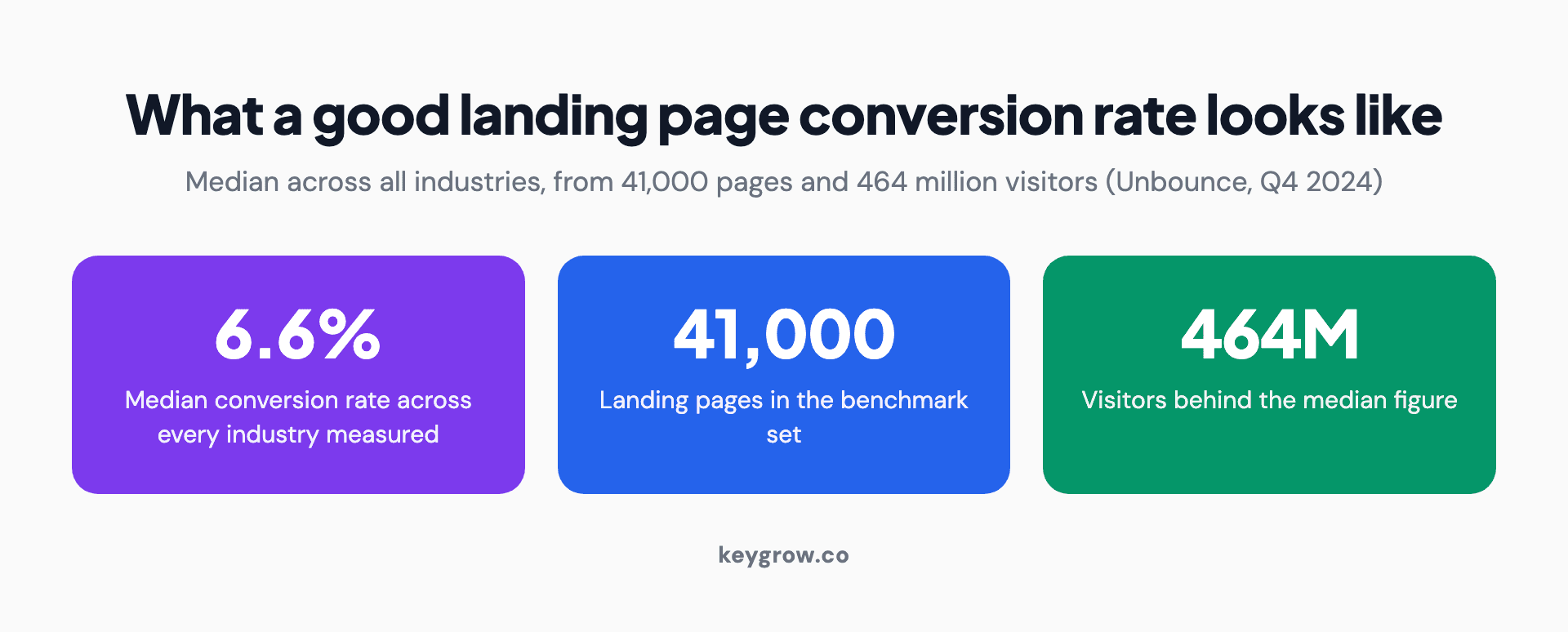
Stat panel showing the median landing page conversion rate of 6.6 percent, drawn from 41,000 pages and 464 million visitors.
Here is the shape of it:
| Offer type | Typical median | Top quartile |
|---|---|---|
| Lead form, local service | 8 to 10% | 15%+ |
| Lead form, professional services | 6 to 9% | 13%+ |
| Free trial or demo signup | 4 to 8% | 12%+ |
| Ecommerce product page | 2 to 4% | 6%+ |
| High-ticket consultation | 2 to 5% | 8%+ |
Two pages can both report 9 percent and mean completely different things. A page counting newsletter signups and a page counting booked consultations are not in the same business. Before you benchmark yourself against anyone, write down what your page counts as a conversion, then compare only against pages counting the same thing.
Calculate it in a way that will not mislead you
Conversions divided by sessions, times 100. The formula is not the hard part. The denominator is.
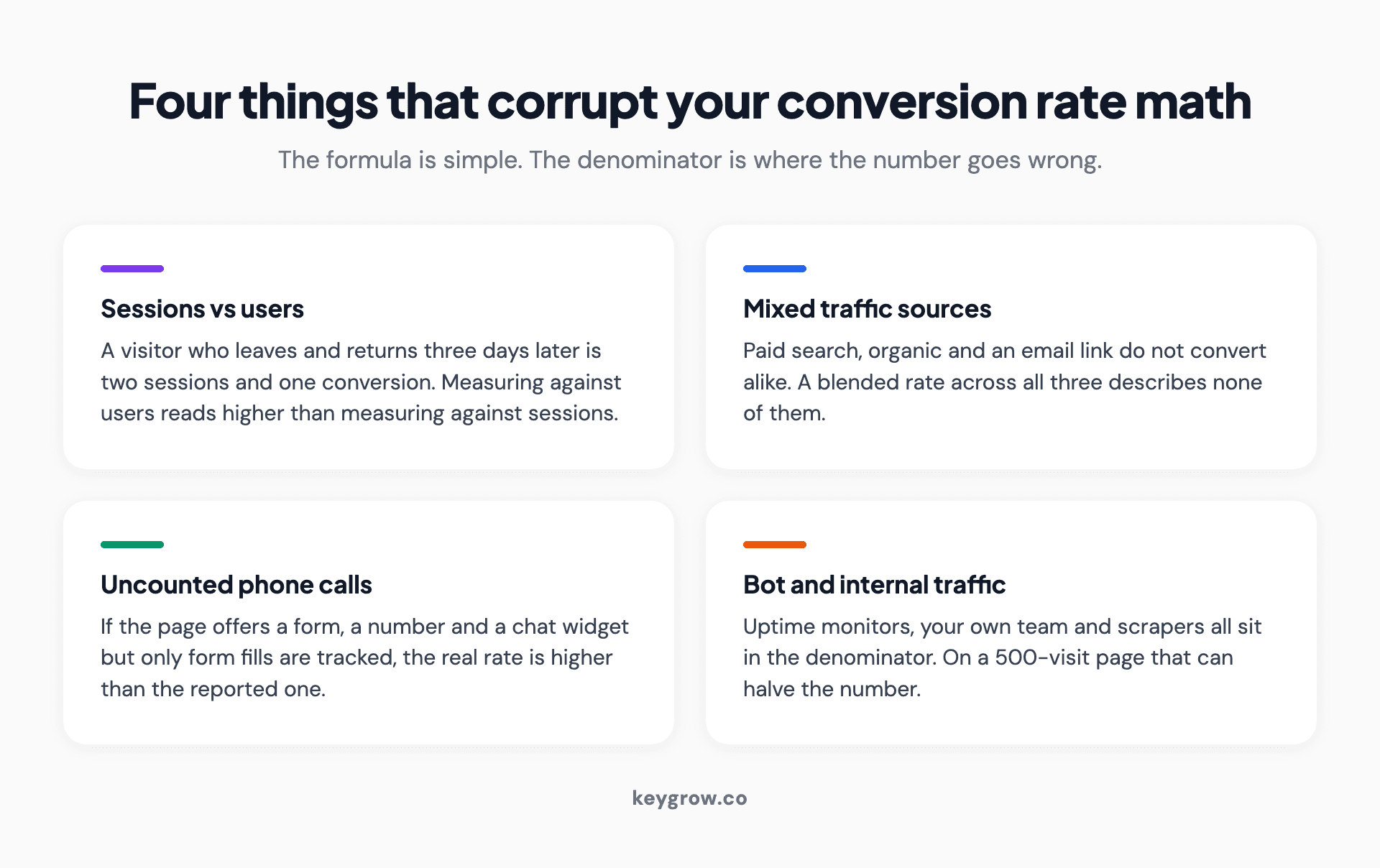
Four-card grid of the things that corrupt conversion rate math: sessions versus users, mixed traffic sources, uncounted phone calls, and bot traffic.
Four things quietly corrupt that number:
Sessions versus users. A visitor who arrives Monday, leaves, and converts Thursday is two sessions and one conversion. Measure against users and your rate goes up. Measure against sessions and it goes down. Neither is wrong, but comparing one to the other is.
Mixed traffic sources. Paid search, organic, and a link in an email newsletter do not convert alike. A blended rate across all three tells you almost nothing about any of them. Segment by source before you draw a conclusion, and read it again after you segment by device.
Multiple conversion actions. If the page has a form, a phone number, and a chat widget, and you only count form fills, your real rate is higher than your reported one. Phone calls are the usual missing piece for local businesses, which is why call tracking belongs in the setup before the optimization.
Bot and internal traffic. Uptime monitors, your own team, and scraper traffic all land in the denominator. On a page getting 500 visits a month, a few hundred bot sessions cut your reported rate in half.
Fix things in this order, not all at once
Most landing page conversion rate optimization advice arrives as a flat list of twenty ideas. The list is fine. The flatness is the problem, because the items are not equal and some of them cannot work until an earlier one is fixed.
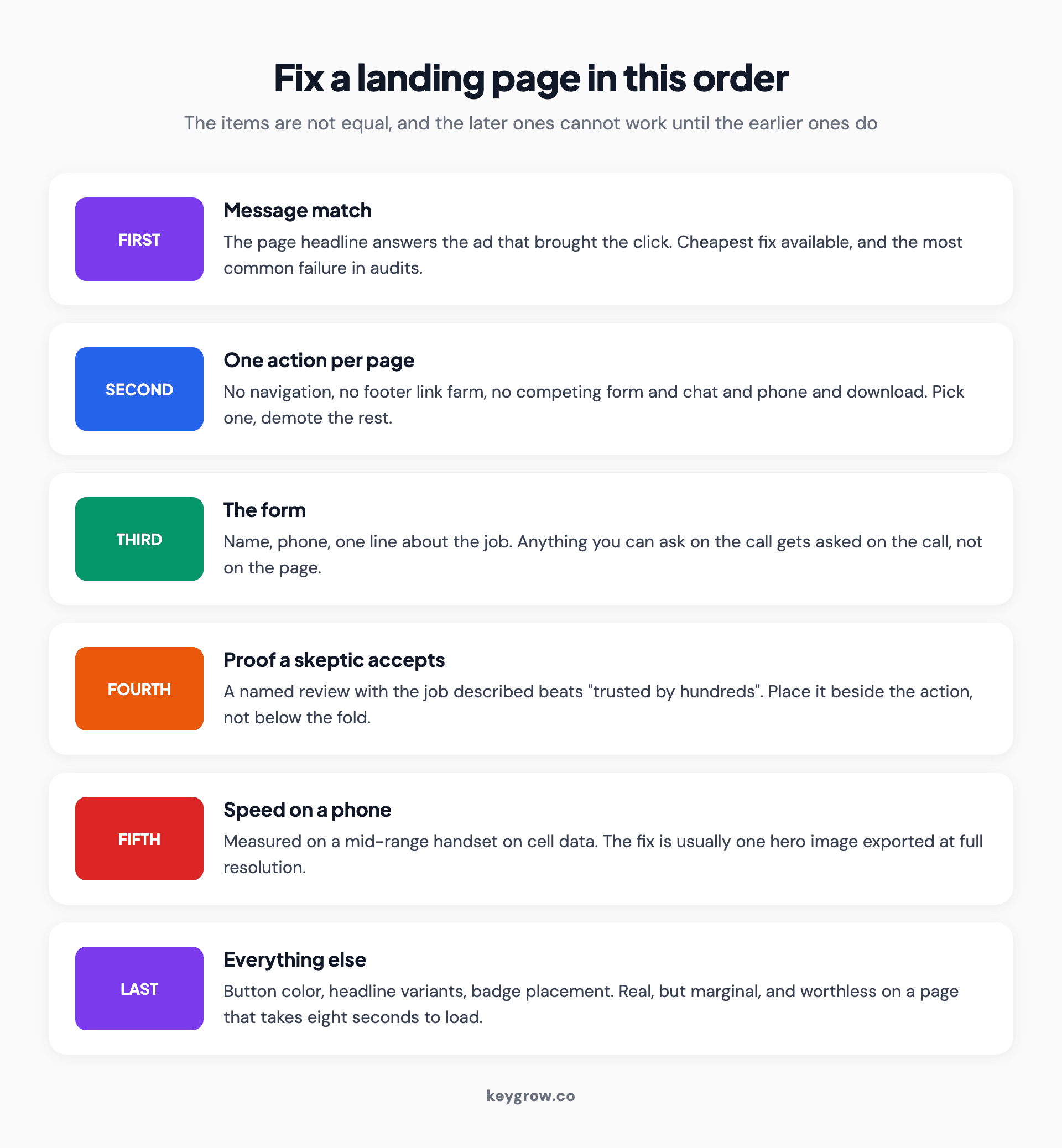
Six-step ordered list for fixing a landing page: message match, one action, the form, proof, phone speed, then everything else.
Work top down. Stop when the numbers stop moving.
1. Message match
Does the page say what the ad said? Someone who clicked an ad for emergency drain cleaning should land on a page whose headline says emergency drain cleaning, not one that says Quality Plumbing Since 1998.
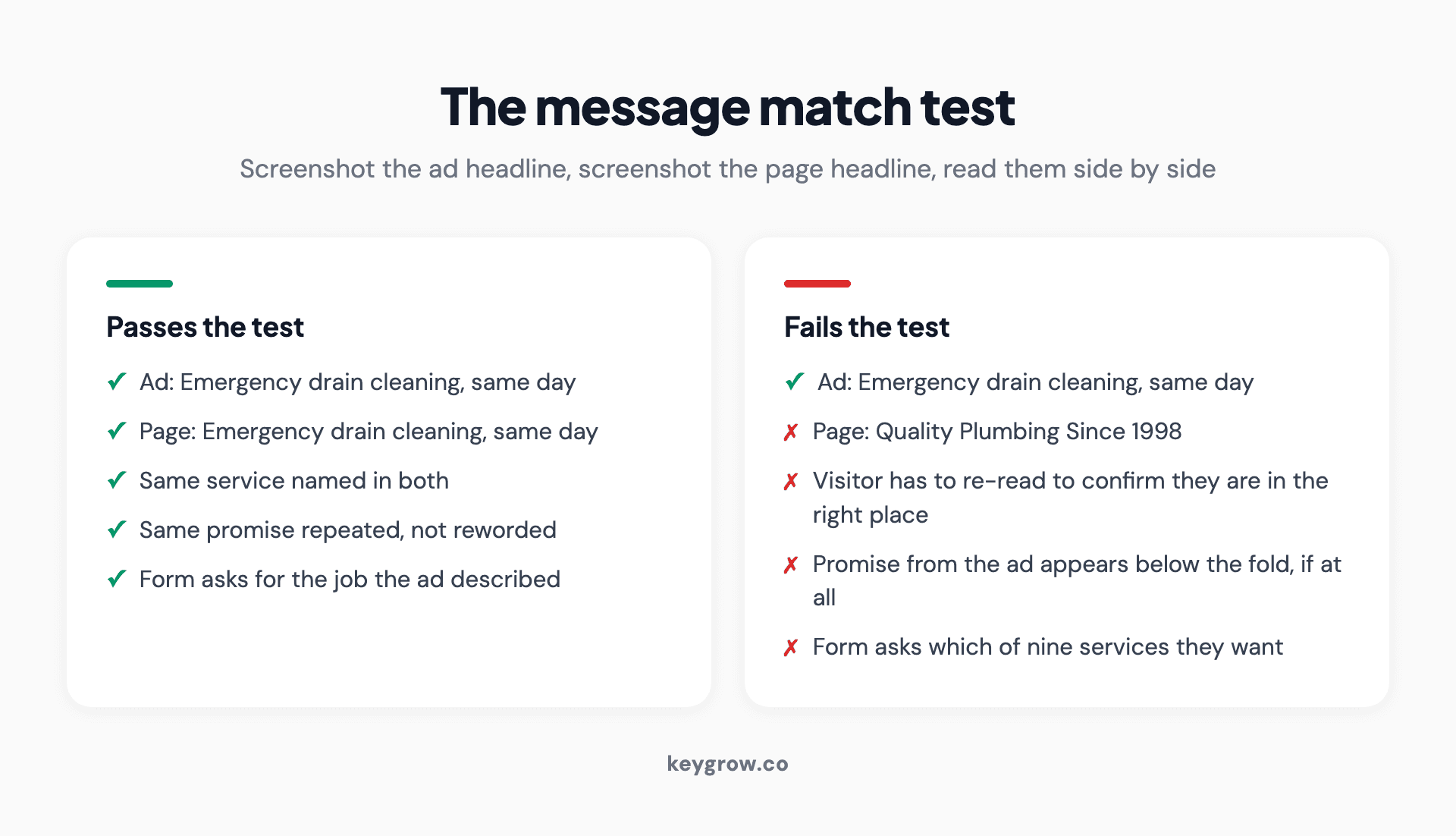
Side-by-side comparison of a landing page that passes the message match test against one that fails it.
It sits first because nothing below it can compensate for getting it wrong, and because it costs an afternoon. It is also the most common failure we see in audits, usually because the ad copy was rewritten at some point and the page was not.
Check it the crude way. Open the ad, screenshot the headline, open the page, screenshot the headline, and put them side by side. If a stranger could not tell they belonged together, you found your first fix.
2. One action per page
A landing page should ask for one thing. Every additional choice you offer splits the visitor's attention and costs you some fraction of them.
That means no site navigation, no footer link farm, no "learn more about our history" detour. Unbounce's own analysis found pages with a single link converted meaningfully better than pages with several, and the effect held across their whole dataset.
The most common version of this mistake is a page with a form and a phone number and a chat bubble and a download, all competing. Pick the one that matters most to your business, make it the obvious action, and demote the rest.
3. The form
Every field is a small tax. Ask for what you need to have the first conversation, and nothing that belongs in the second one.
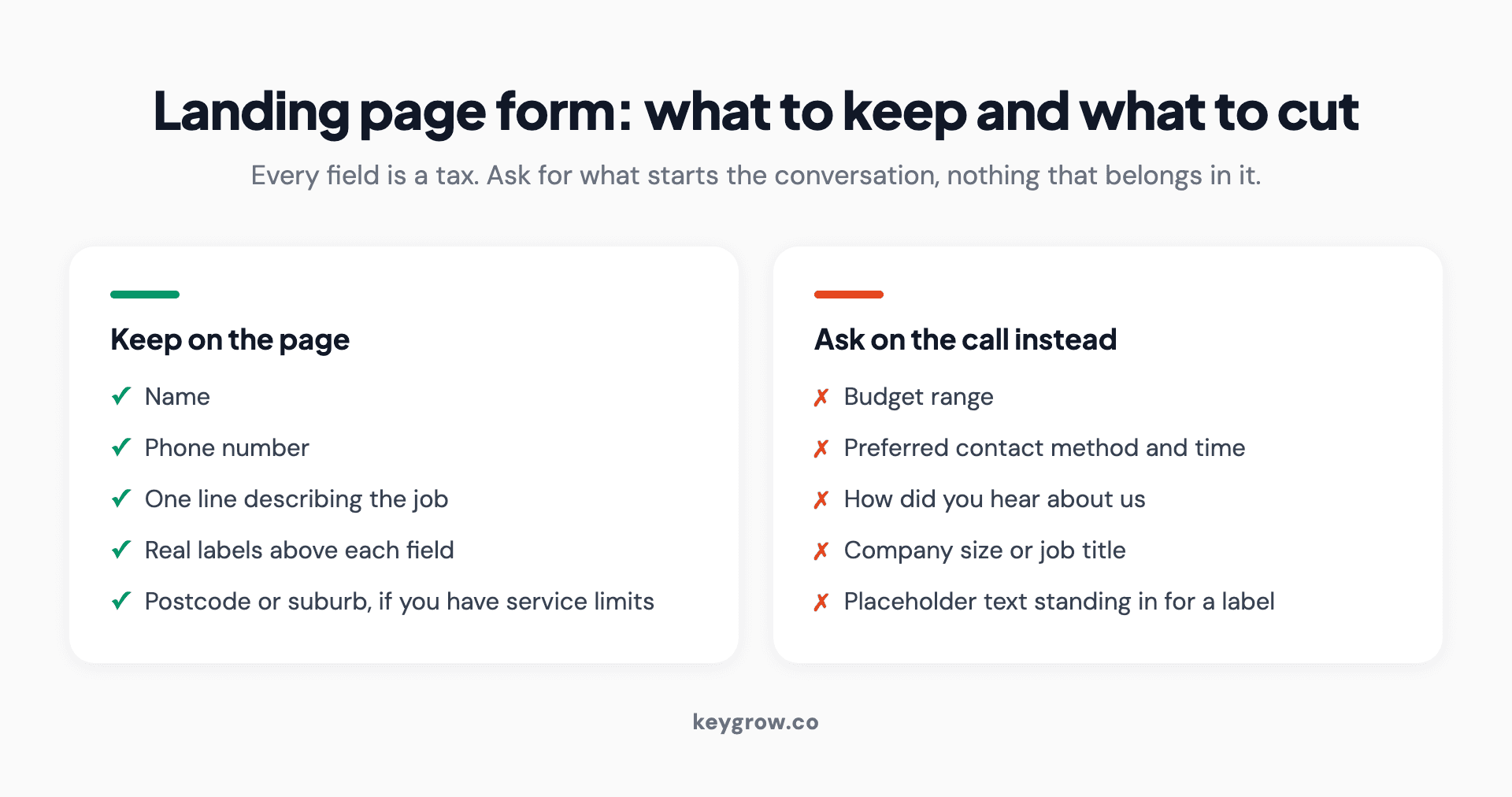
Two-column list of landing page form fields worth keeping against the ones better asked on the phone call.
For a local service business, that is usually name, phone, and a one-line description of the job. Not budget, not preferred contact method, not how they heard about you. You can ask on the call.
The Nielsen Norman Group has documented for years that placeholder text used as a label hurts completion, because the label vanishes the moment someone starts typing and they lose track of what the field wanted. Use real labels above the fields.
4. Proof a skeptic would accept
Generic proof does nothing. "Trusted by hundreds of customers" reads as filler because it is unfalsifiable.
Specific proof works: a named review with the job described, a photo of actual work, a license number, a count that could be checked. The test is whether a doubtful reader could verify it if they wanted to.
Put it next to the action, not in a section further down. Proof placed below the fold is proof most visitors never reach.
5. Speed, on phones specifically
Speed matters less than message match and more than design polish, and the only speed number worth watching is the one on a mid-range phone on mobile data.
The published figure from Think with Google puts the penalty at a 32 percent rise in bounce probability once a page takes three seconds instead of one. On most pages we audit, the fix is not code. It is one hero image exported at full resolution.
6. Everything else
Button color, headline variants, hero imagery, trust badge placement. These are real and they do matter, but they matter at the margin, and running them first is how teams end up with a page that loads in eight seconds and has a beautifully tested button.
The test you cannot run on 400 visitors a month
Almost no optimization guide deals with this honestly, and it is the exact constraint most businesses reading one are under.

A marketer presenting results to colleagues at a whiteboard during a marketing team meeting.
A/B testing needs traffic. Not a lot in absolute terms, but more than a typical local business landing page gets. To detect a realistic improvement, say 8 percent to 10 percent, at normal confidence levels, you need roughly 3,000 to 4,000 visitors per variant. At 400 visitors a month split across two variants, that test finishes in about eighteen months, by which time your ads, your market, and probably your offer have all changed.
Running it anyway is worse than not running it. You get a result that looks like a winner, it is noise, you roll it out, and now you have a false belief guiding the next three decisions.
What to do instead when you do not have test traffic
Low traffic does not mean you cannot optimize. It means you cannot optimize by split testing, so you use methods that work at small numbers.
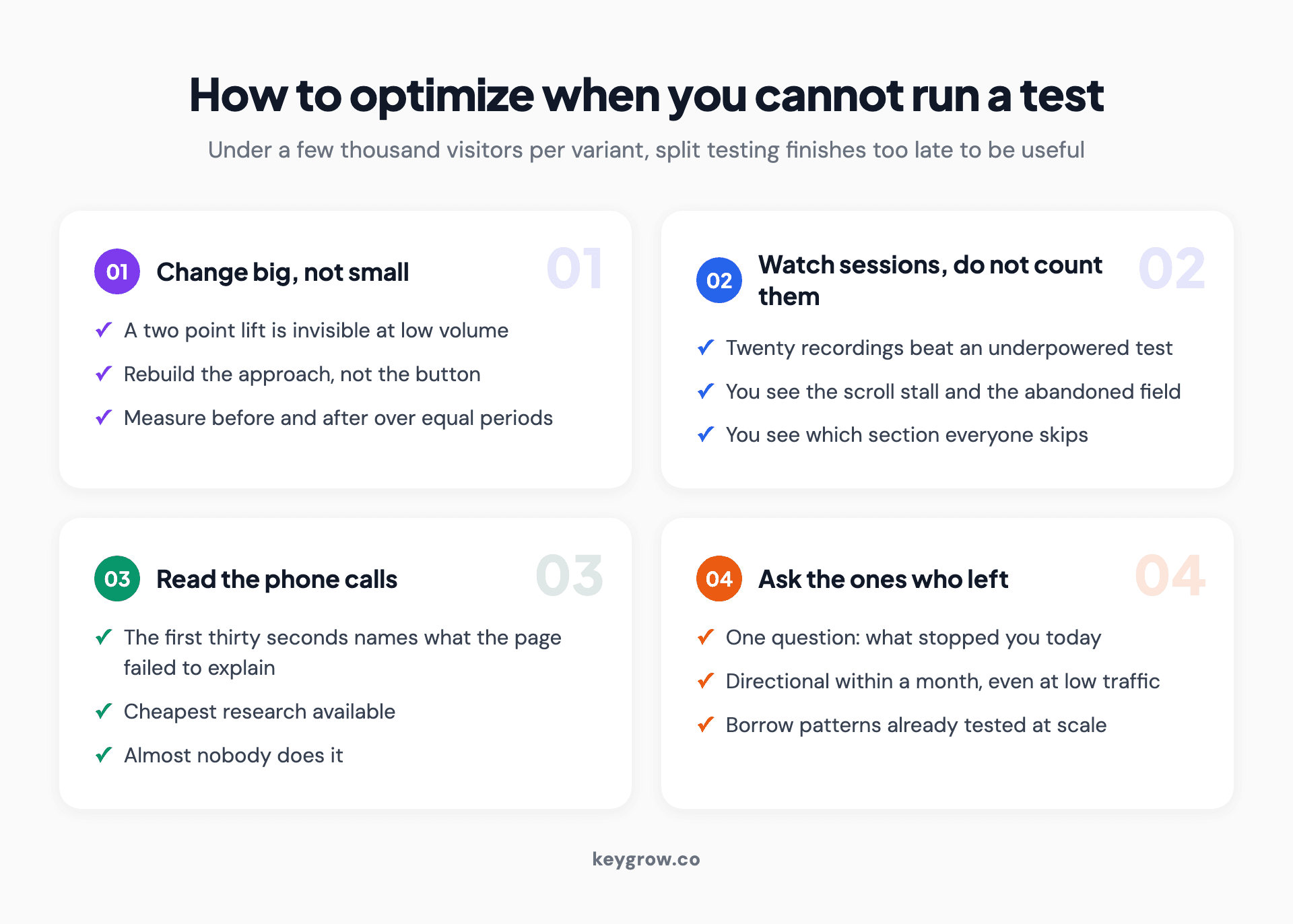
Four methods for improving a landing page without A/B testing: make big changes, watch session recordings, read phone calls, and survey people who left.
Make big changes, not small ones. A 2 percent lift is invisible at low volume. A rebuilt page that doubles the rate is not. Change the whole approach and measure before and after over equal periods.
Watch sessions instead of counting them. Twenty session recordings will tell you more than a underpowered test. You will see the scroll stall, the form field people abandon, the section everyone skips.
Read the calls. If your page generates phone calls, the first thirty seconds of each one tells you what the page failed to explain. This is the cheapest research in marketing and almost nobody does it.
Ask the people who did not convert. A one-question exit survey ("what stopped you from booking today?") on a low-traffic page collects enough answers in a month to be directional.
Borrow tested patterns. You do not have to discover that labels beat placeholders. Someone with a million sessions already did.
When the page is not the problem
Sometimes the page is fine and the visitors are wrong. The same page can read as a 2 percent page against loose keyword matching and an 11 percent page against the phrases that actually describe what you sell, without a word of it changing.
Broad targeting with no negative keyword list is a standing donation to the ad platform. In unmanaged accounts the share of budget going to queries the owner would never have chosen deliberately usually lands somewhere between a fifth and a third. That money does not show up as a targeting failure in your reporting. It shows up as a low conversion rate, which is why so many businesses respond by rebuilding a page that was never broken.
So pull the query report before you pull up the page builder. If you are reading phrases you would not pay a cent for, you have found something bigger than a headline problem, and no amount of copywriting will out-run it.
A worked example: 180 visitors, 4 leads
Numbers make this concrete. Take a plumbing page getting 180 visitors a month from search ads and producing 4 leads. That is 2.2 percent, well under where a local service lead form should sit.

A hand-sketched website wireframe on paper beside a pen, used to plan a landing page layout before building it.
The temptation is to redesign. Here is what the order above turns up instead.
Segment first. Of the 180 sessions, 41 came from a broad keyword about water heater prices, and none of them converted. Removing that group leaves 139 sessions and 4 leads, or 2.9 percent. Nothing changed on the page and the picture already looks different.
Now check message match. The ads promise same-day service. The page headline names the company. Fixing that alone typically moves a page like this by more than any button test will.
Then count the asks. This page has a form, a phone number in the header, a chat widget, and a link to an about page. Four destinations for one visitor. Two of those get demoted.
Then the form: nine fields, including budget range and preferred contact time. Cut to three.
None of that is a redesign, and none of it needed a test to justify. On a page at this volume, a split test would have taken over a year to tell you which of the four mattered most, and by then you would have made all four changes anyway.
How fast optimization shows up
Faster than SEO, slower than people expect from a button change.

A small team collaborating around a whiteboard while planning a landing page rebuild.
Our landing page rebuilds tend to show measurable movement in three to eight weeks. An estate planning law firm saw conversion rate rise 70 percent in three weeks after we rebuilt their page around a single booking action. A junk removal company's site rebuild took eight weeks to register a 180 percent increase in lead form submissions. Neither involved a new traffic source. Same ads, same budget, different page.
The variable is traffic volume, not the size of the change. A page with 5,000 monthly visitors confirms a result in days. A page with 300 needs a full month before the number means anything.
Mistakes that quietly cap your conversion rate
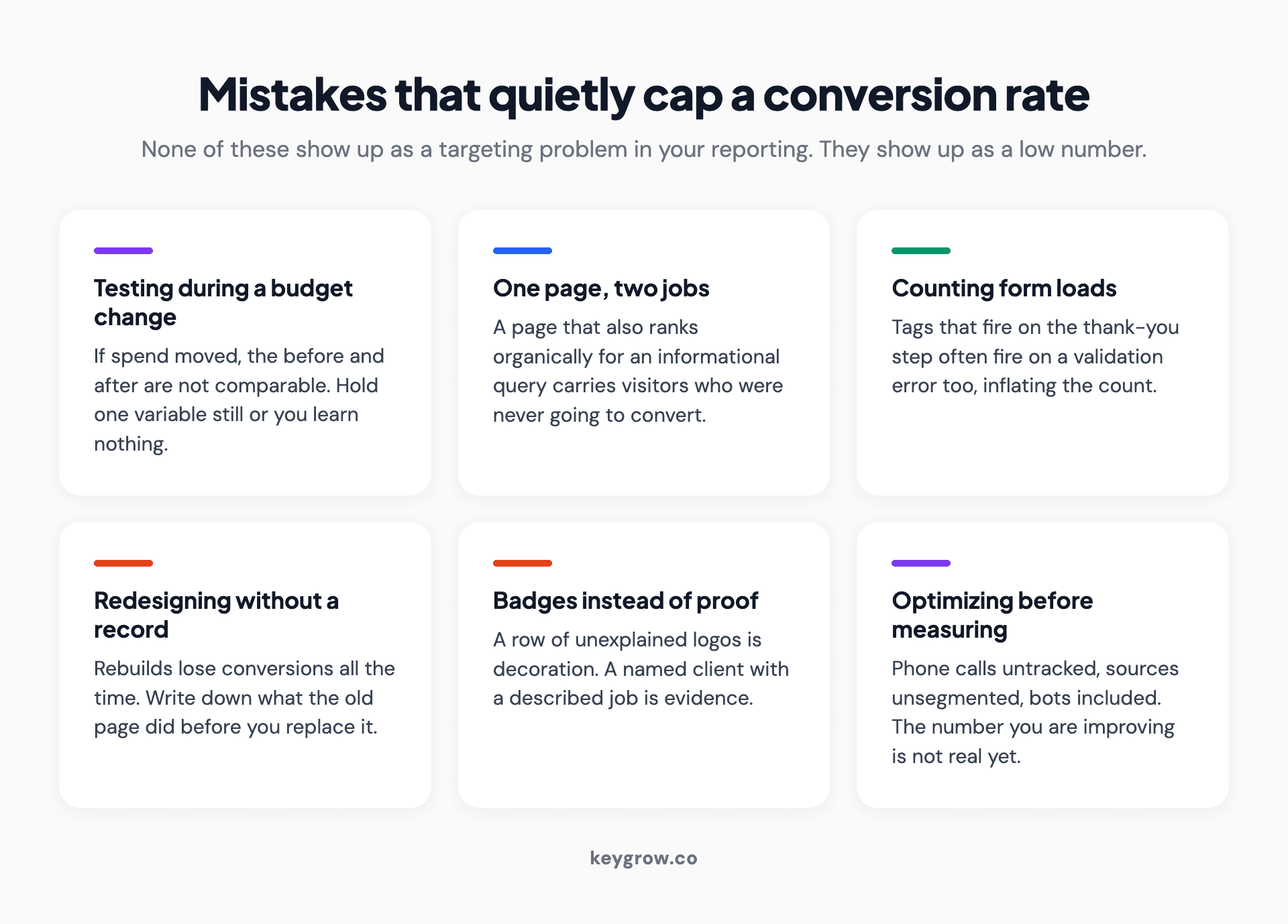
Six-card grid of mistakes that hold a landing page conversion rate down, from testing during a budget change to counting form loads as conversions.
When conversion rate optimization is not worth your time
If your page gets under about 200 visitors a month, your time is better spent on traffic than on the page. Optimization is multiplication, and multiplying a small number gives you a small number.
If you have never written down what a lead is worth to you, do that first. A 20 percent lift on a page selling a $300 job funds nothing. The same lift on a $6,000 job pays for the work several times over, and it tells you how much effort the page deserves.
And if the page is the only page, meaning your ads point at your homepage, you do not have a conversion rate problem yet. You have a landing page versus homepage problem, and that is a different and much larger fix.
FAQs
What is a good conversion rate for a landing page?
Above the median for your industry and offer type. Across all industries the median sits around 6.6 percent, with local service lead forms often running higher and ecommerce and high-ticket offers running lower. Compare yourself only to pages counting the same kind of conversion.
How do I calculate landing page conversion rate?
Divide conversions by sessions and multiply by 100. The accuracy depends on the denominator, so segment by traffic source and device, exclude internal and bot traffic, and make sure every conversion action on the page is being counted, including phone calls.
How long does landing page optimization take to show results?
In our own work, three to eight weeks for a rebuilt page to show a measurable change. Small tweaks on low-traffic pages can take months to produce a reliable reading, which is usually a sign the change was too small to be worth testing.
Can I do conversion rate optimization with low traffic?
Yes, but not with A/B testing. Under a few thousand visitors per variant, split tests take too long to finish and produce results that are mostly noise. Use session recordings, exit surveys, call reviews, and large before-and-after changes instead.
What is the single biggest factor in landing page conversion rate?
Message match between the ad or link that brought the visitor and the headline they land on. It is the cheapest fix available and the most common failure we find in audits, usually because the ads were updated and the page was not.
Should I optimize the page or fix my traffic first?
Check the traffic first. Pull your search terms report or referral breakdown, and if it is full of queries unrelated to what you sell, fix targeting before touching the page. A well-built page cannot rescue traffic that was never in the market.
How many form fields should a landing page have?
Only what you need to hold the first conversation, which for most service businesses is name, phone, and a short job description. Every extra field costs completions, and anything you can ask on the call should be asked on the call.
Where to start on Monday
Open your page on your phone, on cell data, with the ad that sends traffic to it open in another tab. Read them together. Then time the load, count the form fields, and count the number of different things the page asks you to do.
Most pages fail at least two of those four checks, and fixing them takes an afternoon rather than a testing program. If the page still underperforms after that, the problem is upstream in the traffic, and our PPC management and web development teams handle both ends of that. You can get a page review if you would rather have someone else look at it first.


