


Google Ads for SaaS breaks in a way it does not break for a plumber, and the reason is timing. A plumber's ad produces a phone call, the call becomes a booked job that week, and the account can be judged on Friday. Your ad produces a free trial signup, which becomes a paying customer somewhere between three weeks and never, and by the time you know which one it was, Google has already spent four more months of budget optimizing toward the signup.
So the account learns to buy the thing you measured. In SaaS, the thing you can measure and the thing you actually want are separated by months and by kind, and almost every expensive mistake in this category traces back to that gap.
Two consequences follow, and they run in opposite directions from the usual advice. You are probably optimizing toward the wrong conversion. And you are probably bidding too low.
Work out the most you can pay, before you look at a single keyword
Most SaaS accounts are capped at a cost per trial that somebody picked because it sounded sensible. Do the arithmetic instead. It takes five minutes and it usually raises the number.
Illustrative figures for a self-serve product, so replace them with yours:
| Line | Figure |
|---|---|
| Monthly price | $99 |
| Average customer life | 26 months |
| Revenue per customer | $2,574 |
| Gross margin at 80 percent | $2,059 |
| Target ratio of lifetime value to acquisition cost, 3:1 | **Max CAC $686** |
| Trial to paid conversion, 20 percent | **Max cost per trial $137** |
| Payback on that CAC | 8.7 months |
A hundred and thirty seven dollars for a free trial signup. Most teams running this exact product would have capped target CPA at $50, lost the top of the auction, and concluded that Google Ads does not work for SaaS.
The number that decides this is not the price. It is the trial to paid rate multiplied by how long people stay. Improve either one and your maximum bid moves immediately, which is why churn work and pricing work are also paid search work, however unrelated they look on the org chart.
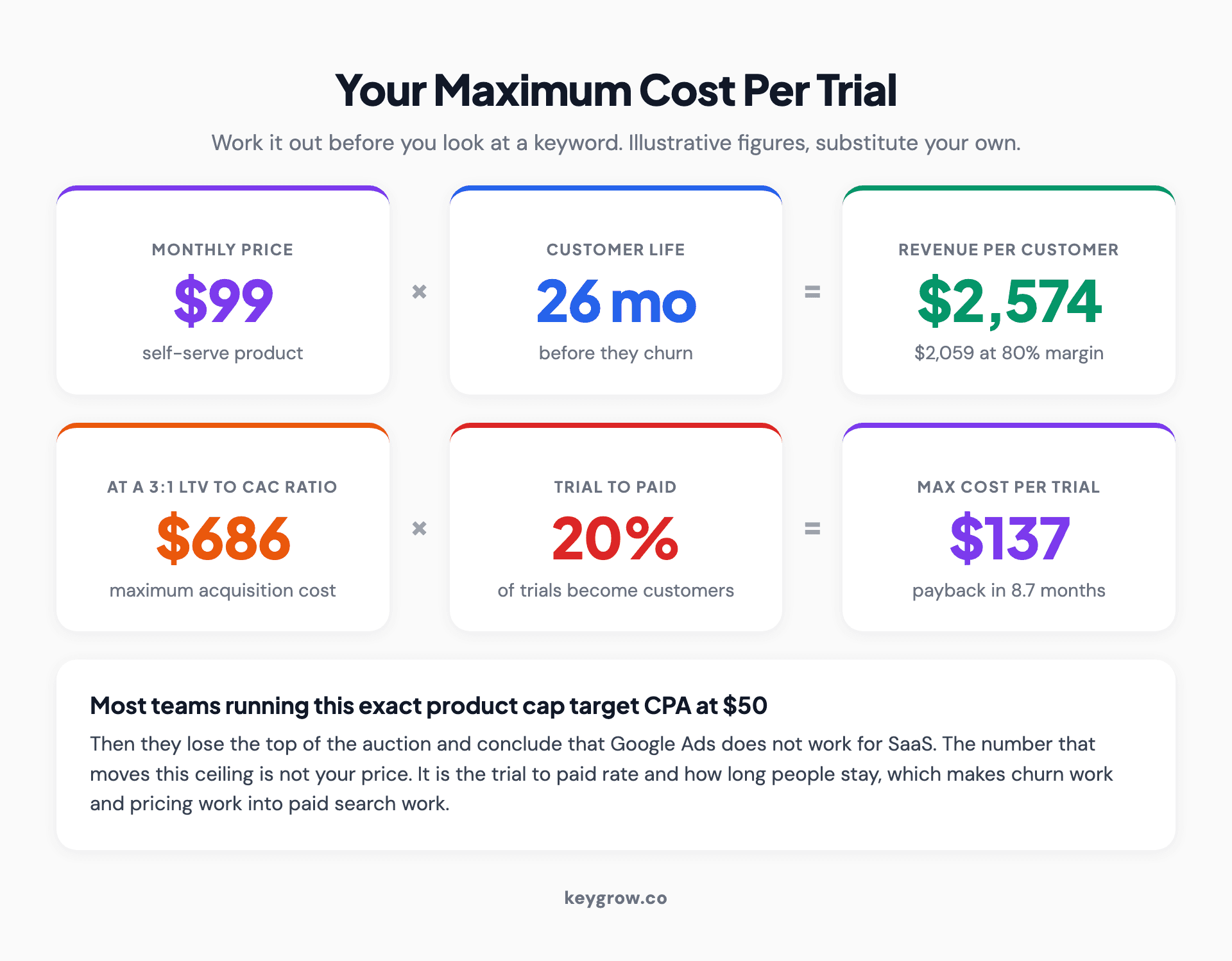
A seven-line calculation from a $99 monthly price through customer life, gross margin and a 3:1 ratio, ending in a maximum CAC of $686 and a maximum cost per trial of $137.
Payback period sets the ceiling, and it moved
The reason you cannot judge a SaaS ads account on a monthly ROAS number is that the money comes back over a year or more.
The numbers here have got worse, and it is worth knowing by how much. Benchmarkit's 2025 report puts median CAC payback for private B2B SaaS at 18 months for 2024, against 14 months the year before. The split by contract value is the part that matters for an ads account: companies with average contract values above $100,000 ran a median payback of 24 months, while those at $5,000 or below ran 9 months.
That spread is the single most useful thing in this article, because it means two SaaS companies can be running identical-looking Google Ads accounts while one of them can afford to pay twenty times more per lead.
| Your contract value | Median payback | What it means for the account |
|---|---|---|
| Under $5,000 a year | 9 months | Judge in quarters, cost per trial matters, volume is available |
| $5,000 to $100,000 | Between the two | Pipeline stage import is where the gains sit |
| Over $100,000 a year | 24 months | Judge in years, a $3,000 cost per demo can be perfectly rational |
If you are in the top band and reporting monthly cost per lead to your board, you are describing an eleventh of the buying cycle and calling it performance. That is vanity-metric reporting with a spreadsheet attached, and it is how good campaigns get killed at month four.
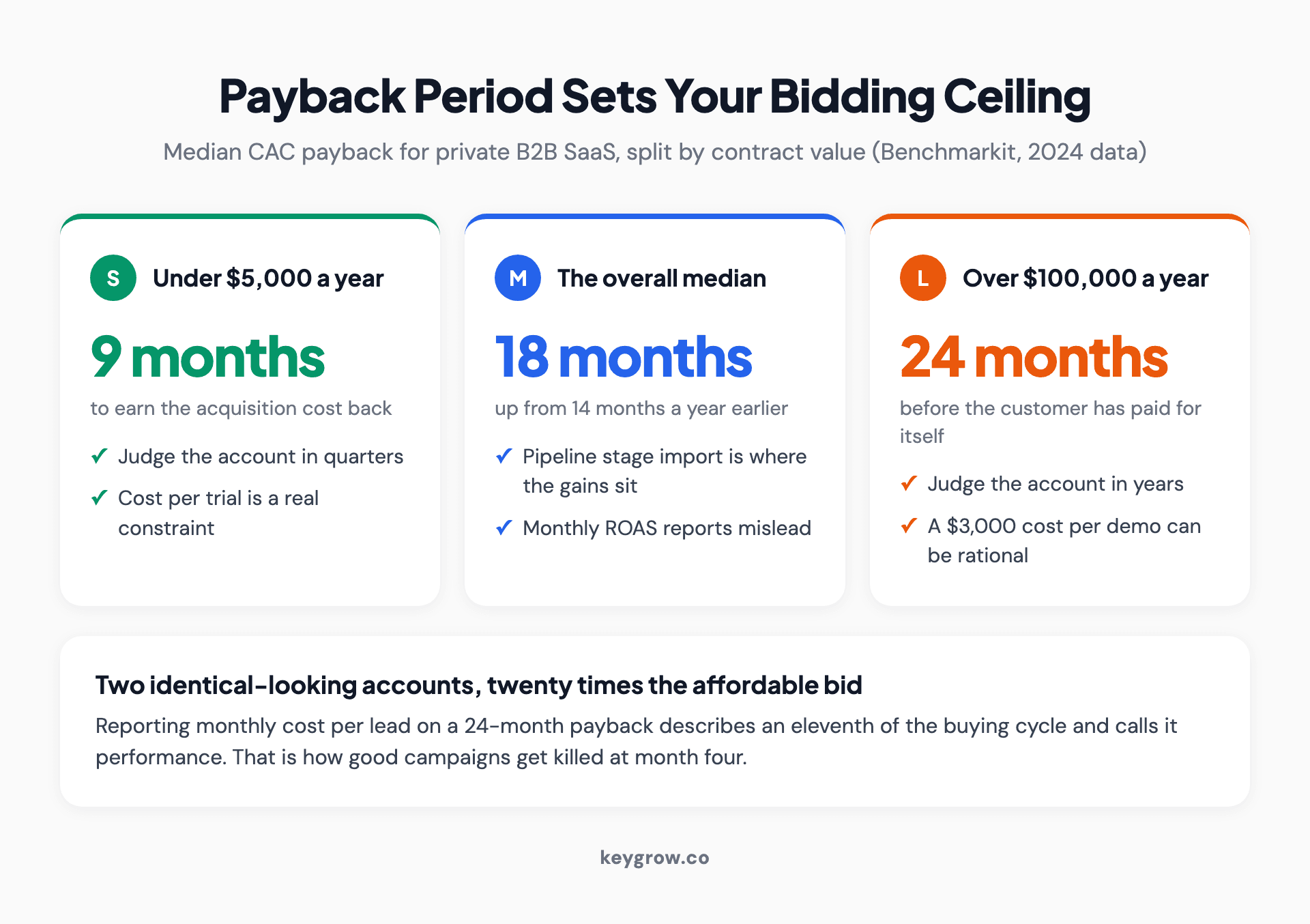
Three contract-value bands showing median SaaS CAC payback of 9 months under $5,000, 18 months at the median, and 24 months above $100,000, with what each means for judging an ads account.
Your best-converting traffic is frequently your worst customers
Here is the part that makes SaaS genuinely different from every other category we run ads in.
The people most likely to sign up for a free trial are the people with the least to lose by signing up. Students. Job seekers researching a tool they will use somewhere else. Competitors. Agencies evaluating twelve products in an afternoon. Someone who needs the thing once and will cancel on day 29.
Your actual buyer, the operations manager at a 200-person company, converts on a trial page at a lower rate than any of them, because they have to think about procurement, security review and whether they can be bothered.
Which means conversion rate optimization, done naively, selects against your customer. Every field you remove from the form, every friction point you sand down, tilts the mix further toward people who were never going to pay. This is not an argument for a bad form. It is an argument for measuring further down.

Two people working side by side on laptops at a shared desk.
Feed Google the deepest stage that still has volume
The fix is to stop giving the bidding algorithm the signup and start giving it something closer to money. The complication nobody mentions is that you cannot always go as deep as you would like.
Automated bidding wants roughly 30 conversions in 30 days to work properly. If closed-won deals happen four times a month, you cannot bid to closed-won. So the rule is not "import revenue", it is: pick the deepest stage in your funnel that still produces about 30 events a month, and feed that one.
For most SaaS companies that ladder looks like this:
| Stage | Typical monthly volume | Use it for bidding when |
|---|---|---|
| Trial signup or form fill | Hundreds | Nothing better clears volume, and only with values attached |
| Qualified lead, human-verified | 40 to 150 | The usual right answer for self-serve and mid-market |
| Sales-accepted or opportunity | 20 to 60 | You have a sales team and reasonable deal flow |
| Closed won, with revenue | 2 to 20 | Only for high-volume ecommerce-like SaaS, otherwise as a secondary |
Anything below your chosen stage gets set to secondary so it still reports without steering the bidding. That single settings change fixes more SaaS accounts than any keyword work.
One operational note, because it caught people out this year. Google migrated offline conversion imports and enhanced conversions for leads to the Data Manager API on June 15, 2026, per Google's migration notice, and blocked the legacy Google Ads API path. If your CRM integration was built before that and nobody has looked at it since, check that uploads are still arriving before you trust a single number in the account.
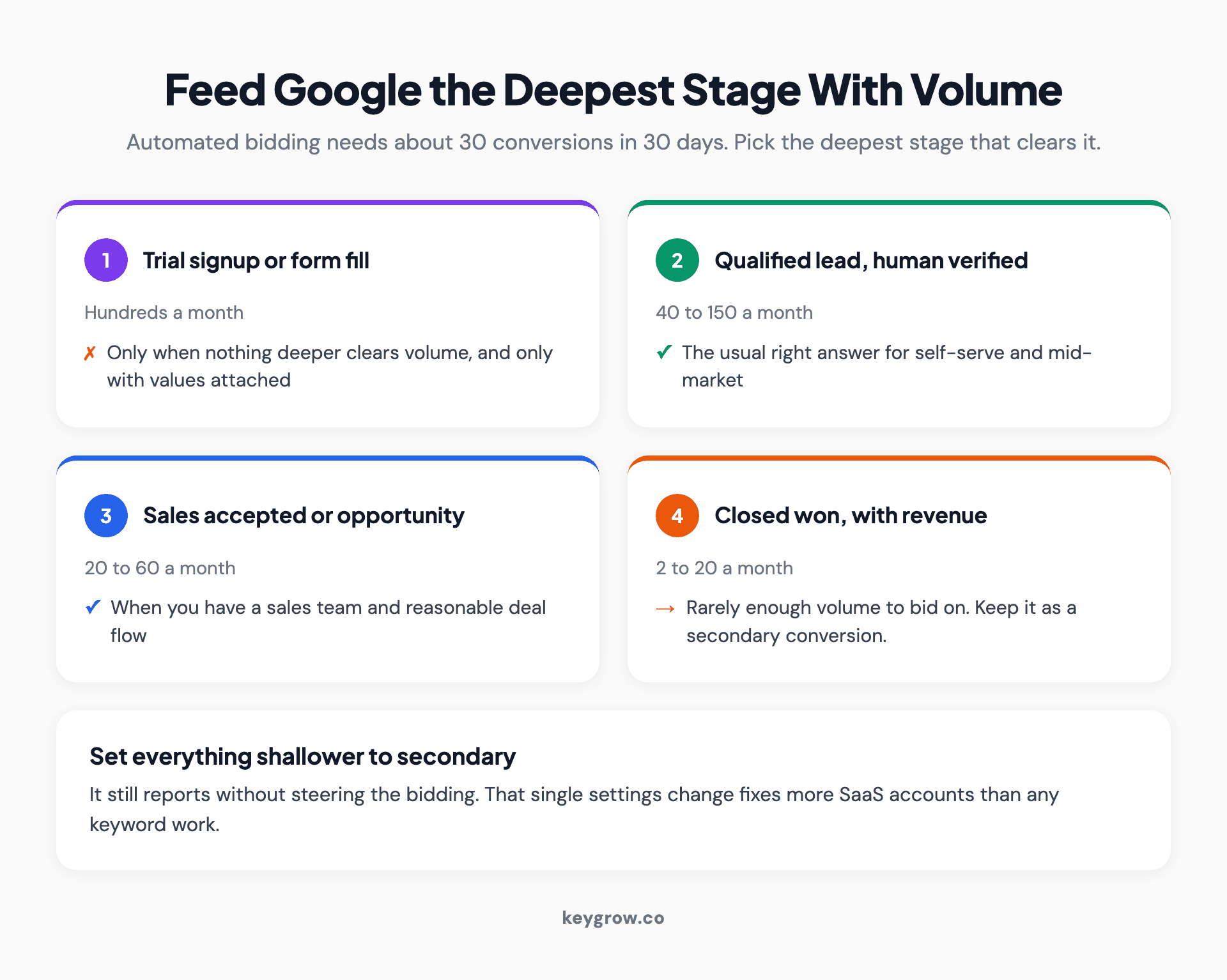
A four-rung ladder of SaaS conversion stages from trial signup to closed won, showing which stage to feed automated bidding based on monthly volume.
Which searches are worth buying
SaaS keyword lists tend to be built from the product and should be built from the moment somebody decides to switch.
The four groups that reliably pay:
Category terms with a qualifier. Not "project management software" on its own, which attracts everyone from students to enterprise procurement, but "project management software for construction" or "for agencies". The qualifier does the filtering the bid cannot.
Alternative and comparison searches. Someone typing a competitor's name plus "alternative", or two products plus "vs", is mid-switch. This is the highest-intent inventory in the category, and it needs a real comparison page rather than a homepage. Where the legal lines actually sit is covered in our note on bidding on competitor brand terms.
Job-to-be-done searches. "How to track billable hours across contractors", "SOC 2 evidence collection tool". Lower volume, much higher fit, and usually cheaper because your competitors are all bidding on the category noun.
Integration and migration terms. "Import from X", "migrate off Y", "connects to Z". These people have a live problem and a deadline.
And the groups that quietly drain the budget:
| Group | Examples | Why it fails |
|---|---|---|
| Free and open source | free X, open source alternative, X free forever | Self-selected non-buyers, and they convert on trials at a high rate |
| Learning and careers | X tutorial, X certification, X jobs, how to become a | Not a customer, high volume |
| Support and login | X login, X down, X customer service | Usually existing users of somebody's product |
| Bare category nouns | software, platform, tool, system | Every intent at once at the highest price |
Our method for building the block list before launch, rather than after the first invoice, is in negative keywords in Google Ads.
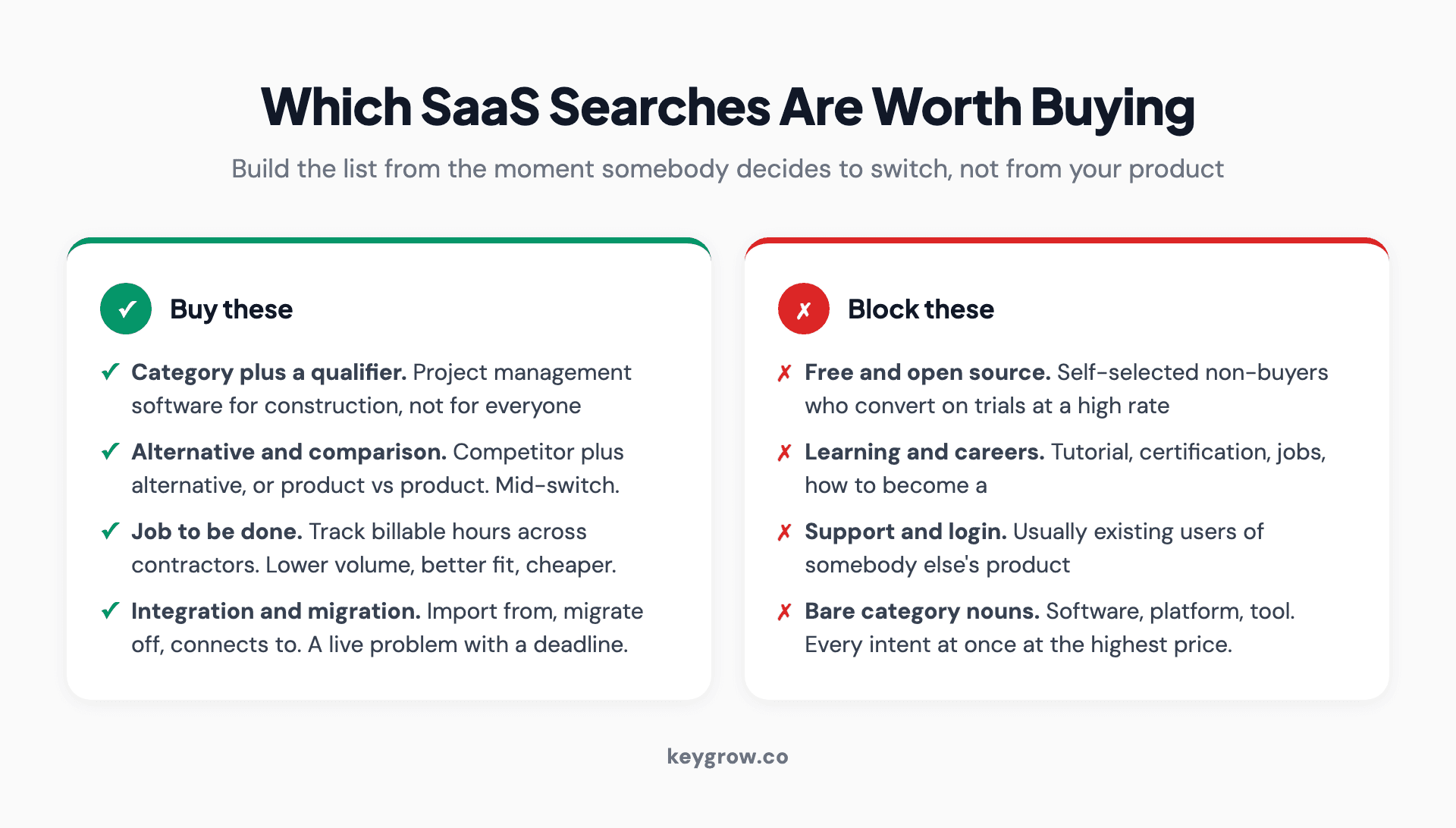
Two columns of SaaS search types: four groups worth buying including qualified category terms and alternative searches, against four groups that drain budget including free, tutorial and login searches.
The trial page is where the qualification happens
Since the mix of people arriving is the problem, the page is where you fix it rather than at the bid.
Three things that work, in rough order of effect:
- Show the price. Hiding pricing behind "contact sales" on a self-serve product converts fewer buyers and more tire-kickers, because the people willing to book a call to find out a price are disproportionately people who are not going to pay it. If your pricing is genuinely bespoke, publish a starting-from figure and a range.
- Ask for a work email and the company. Two fields, both of which filter, neither of which feels like an interrogation. Personal-domain signups convert to paid at a fraction of the rate in most B2B products.
- Match the page to the search. Somebody who searched for a comparison should land on the comparison, not the homepage carousel. Somebody who searched for the integration should land on the integration page with a screenshot of it working.
Landing page work moves faster than most people expect it to. Across our own rebuilds the pattern has been consistent: a law firm at plus 70 percent conversion rate in three weeks, a security company at plus 95 percent in four. The mechanics are the same in software, and the honest note is that in SaaS you should watch trial-to-paid alongside the signup rate, because a rebuild that lifts signups while lowering the paid rate has moved nothing.
There is more on the page-versus-homepage question in ad landing pages.
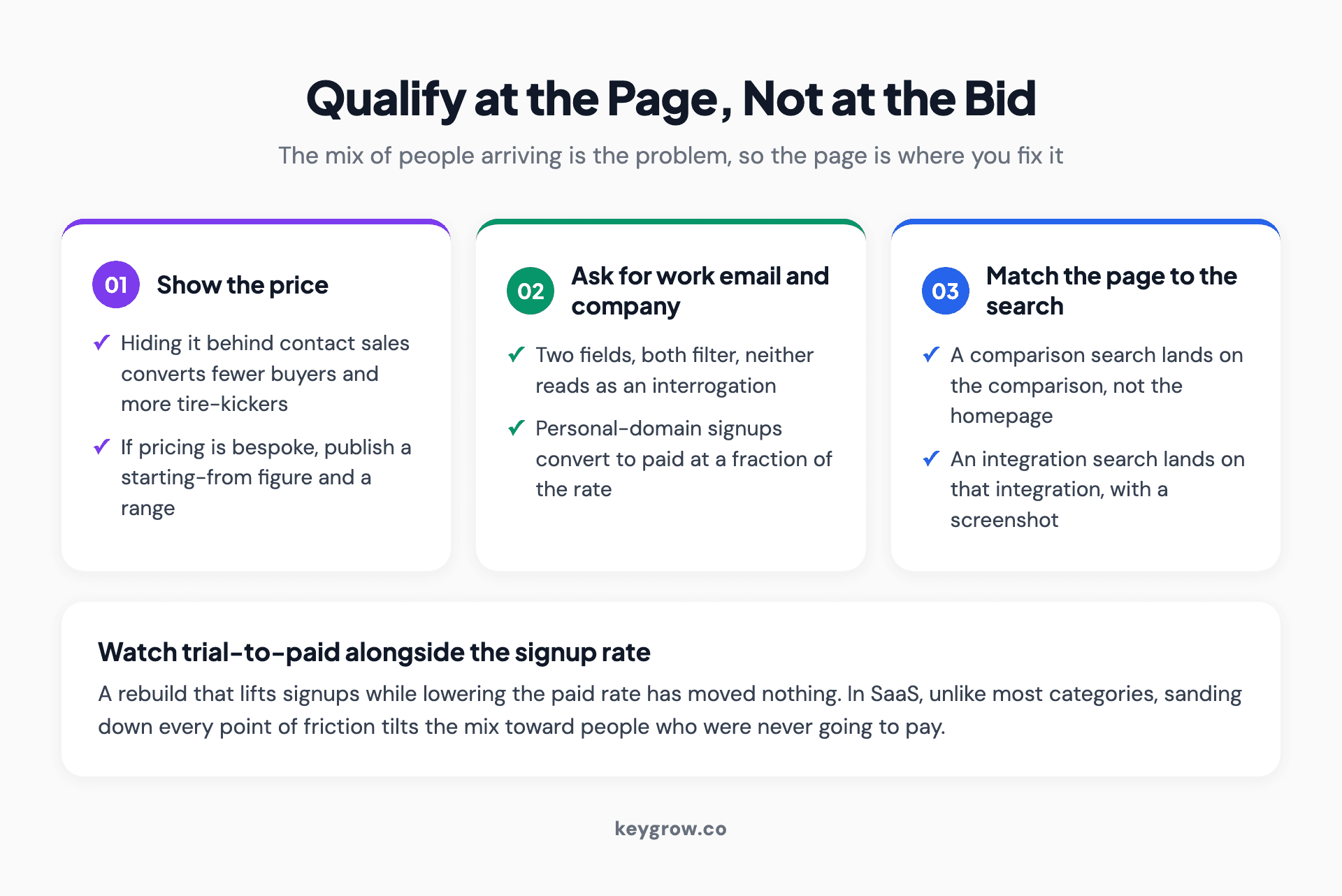
Three numbered cards on qualifying trial traffic at the page: publish the price, ask for a work email and company, and match the page to the search that produced the click.
When SaaS should not run Google Ads
Three situations, and we turn away businesses in all three.
Your price is low and your payback is long. A $19 a month product with a nine-month average life has roughly $137 of gross-margin lifetime value. At a $12 click and a 5 percent landing page conversion rate, a single trial costs $240. There is no bidding strategy that rescues that. Content, community, integrations and partnerships are the channels that work at that price point.
Nobody is searching for what you built. If you have created a genuinely new category, search volume for it does not exist yet, and paid search only harvests demand that already has a name. You can buy adjacent problem searches, but if the adjacent term does not describe what your buyer types, you are paying to educate strangers. That is a job for other channels.
You cannot connect a signup to a customer. If your CRM does not record which trials became paying accounts, and nobody will build that link in the next month, do not start. You will spend three months optimizing toward a number that does not mean anything, and the data you generate will not be worth having.
The honest test is the second one plus your own patience. If you cannot commit to a full quarter before judging, and to a year for anything with an enterprise contract value, spend the money somewhere with a faster feedback loop.
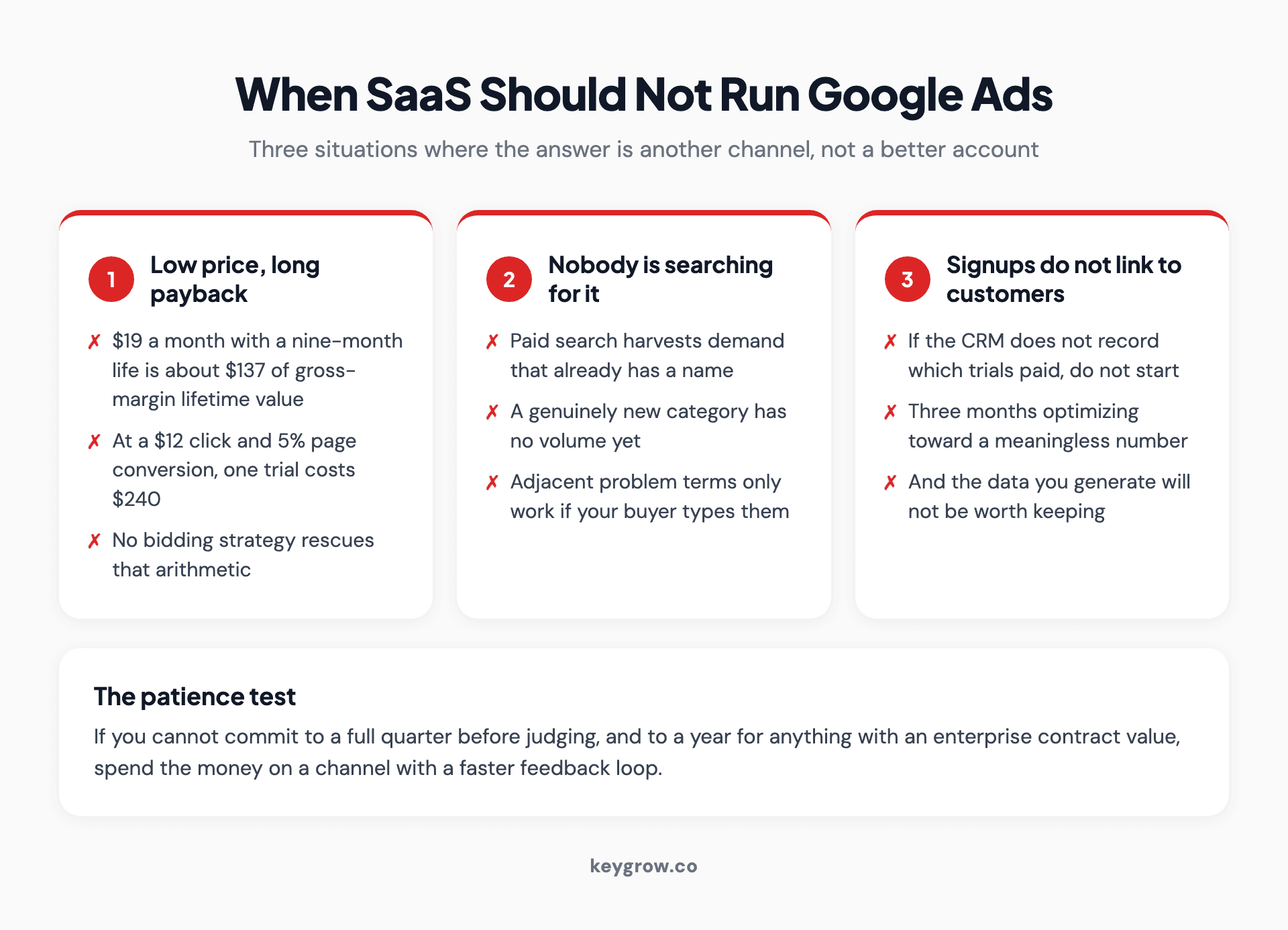
Three red-flagged cards describing when a SaaS company should not run Google Ads: a low price with a long payback, no existing search demand, and no link between signups and paying customers.
What to report, and to whom
Different audiences need different numbers, and running one report for all of them is how these programs get cancelled.
- Weekly, for the person running the account: cost per qualified lead, search terms reviewed, and the share of spend on non-qualified traffic.
- Monthly, for marketing: cost per opportunity, pipeline created by campaign, trial-to-paid rate split by source.
- Quarterly, for the board: CAC by channel, payback period, and cohort retention for customers acquired through paid.
The last line is the one that survives scrutiny. If customers acquired through paid search retain worse than customers from other channels, your keyword mix is buying the wrong people and no amount of bid tuning will fix it.
Our guide to measuring lead value from PPC covers the mechanics of getting revenue back into the account, and the ROI calculator will run the forward version of the model at the top of this piece.
FAQs
Do Google Ads work for SaaS companies?
They work well where an existing category has search demand and the contract value supports the click prices, which in practice means most B2B software above roughly $50 a month. They work badly for low-priced self-serve products with long payback periods, and for genuinely new categories nobody is searching for yet. The deciding number is your maximum cost per trial, calculated from lifetime value and trial-to-paid rate, not the click price.
What is a good cost per trial for SaaS?
There is no universal figure, because it is set by your own economics. Take gross-margin lifetime value, divide by three for a standard LTV to CAC ratio, then multiply by your trial-to-paid rate. A $99 a month product with a 26 month average life and a 20 percent trial-to-paid rate can afford roughly $137 per trial. Many teams running that product cap their bids at a third of that and lose the auction.
Should I optimize Google Ads for trial signups or qualified leads?
Pick the deepest funnel stage that still produces around 30 conversions in 30 days, since that is roughly what automated bidding needs to work properly. For most SaaS companies that means a human-verified qualified lead rather than the raw signup. Set everything shallower to secondary so it still reports without steering the bidding.
How do I stop free trial signups from students and competitors?
Filter at the page and in the keywords rather than at the bid. Block free, open source, tutorial, certification and jobs searches before launch, ask for a work email and company name on the form, and publish your pricing. Then import a qualified-lead conversion so the bidding stops treating a student signup as a win.
How long does it take Google Ads to work for a SaaS company?
Allow a full quarter for self-serve products and a year for anything with an enterprise contract value. Median CAC payback for private B2B SaaS was 18 months in 2024, and 24 months for companies with contract values above $100,000, so a four-week judgment on an enterprise account is reading about a twentieth of the cycle.
Should SaaS companies bid on competitor brand names?
Competitor alternative and comparison searches are among the highest-intent inventory in software, and using a trademark as a keyword is not restricted by Google's policy, though using it in ad text generally is. The economics only work if you send that traffic to a genuine comparison page rather than your homepage. Expect a lower click-through rate and a higher cost per click than your category terms.
What budget do I need for SaaS Google Ads?
Enough to produce around 30 conversions a month at your chosen funnel stage, which is what makes automated bidding work. Work backwards: if your qualified leads cost $200, that is a $6,000 monthly floor for the bidding to have anything to learn from. Below that, run a tighter keyword set on manual or maximize-clicks bidding and accept slower learning rather than spreading a small budget thin.
Bid to the payback, not to the month
The two mistakes in this category are the same mistake seen from opposite ends. Optimizing toward trial signups tells Google to buy you people who will never pay. Capping your bid at a number that felt comfortable tells Google not to buy you the people who would.
Both come from judging a twelve-month asset on a thirty-day report.
So do it in this order. Calculate your maximum cost per acquisition from lifetime value and your trial-to-paid rate. Divide by your trial-to-paid rate to get the cost per signup you can genuinely afford. Import the deepest funnel stage that clears about 30 events a month. Then leave it alone for a quarter.
If you want that built and run against pipeline rather than signups, our PPC management works month to month with no lock-in, and there is more about the software side of our work on the SaaS marketing page. If your price point puts you in the third situation above, we will say so rather than take the retainer.