


Most LinkedIn marketing for B2B fails in the same place, and it is not the content. It is the decision to build the program on the company page.
Company pages get a fraction of the reach that individual accounts do, for the straightforward reason that people follow people. A post from your founder reaching two thousand relevant professionals is a normal Tuesday. The same post from the company page reaching two hundred is also a normal Tuesday. If your strategy starts with a content calendar for the brand account, you have already capped the program before writing a word.
The version that works is narrower and less comfortable: one or two real people posting about one specific thing, consistently, for at least two quarters, with the company page playing a supporting role. Everything below is how to run that, what to measure when the results refuse to be attributed, and when to conclude that LinkedIn is not your channel.
The company page is the weakest asset you own
Say it plainly, because most agency proposals will not: the brand account is the lowest-performing surface on the platform, and it is where almost every program starts.
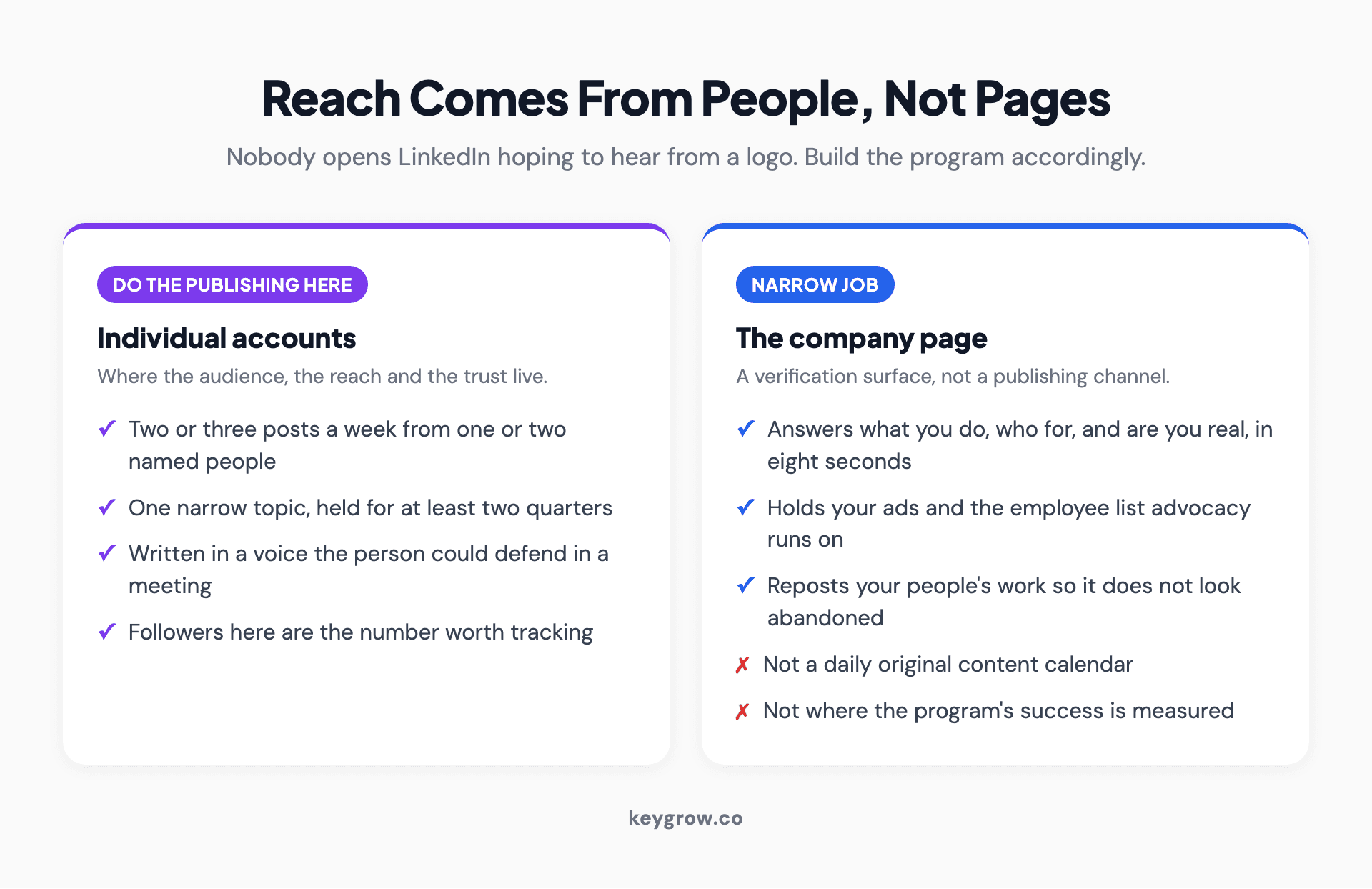
Why individual accounts out-reach company pages on LinkedIn, and what each one is actually for.
This is not a quirk of the algorithm to be worked around. It reflects how the feed is built and how people use the platform. Nobody opens LinkedIn hoping to hear from a logo.
The practical consequence is a budget one. If you are paying an agency to produce three brand posts a week and nothing else, you are buying the least effective unit of work available, and the reporting will be full of impressions because impressions are the only thing that will move.
Shift the same effort behind two named people and the numbers change without anything else changing.
What the company page is actually for
It still has a job. The job is just narrow, and treating it as a publishing channel is what wastes it.
The page is a verification surface. Someone who saw a post, got a cold email, or was handed your name in a meeting will look you up, and the page is what they find. It needs to answer three questions in about eight seconds: what you do, who you do it for, and whether you are a real company with real people.
So: a headline that names the service and the buyer rather than a positioning statement, a filled-out about section, current employee count, and a recent post so the page does not look abandoned. Reposting your people's content covers that last one at almost no cost.
Beyond that, the page matters because it is the container for your ads and for the employee list that makes advocacy possible. Those are real jobs. Publishing original brand content daily is not one of them.
What buyers actually do with the content
Two findings from the research LinkedIn and Edelman run together explain why this channel repays the awkwardness of putting a person's name on things.
The first is about trust. 73 percent of decision-makers say an organization's thought leadership is a more trustworthy basis for judging its capabilities than its marketing materials and product sheets, and 86 percent say they would be more likely to invite a consistent producer of it into an RFP. That is the whole argument for publishing something a competitor could not have written.

Colleagues reviewing work together around a laptop.
The second is more useful and almost never acted on. More than 40 percent of B2B deals stall on internal misalignment inside the buying group, driven by people in finance, legal, procurement and operations who never speak to your sales team. 71 percent of those hidden buyers say thought leadership does more than conventional marketing to demonstrate a vendor's value.
Read that as a brief. A large share of your content's real job is not persuading the person you are talking to. It is arming that person to defend the decision to four colleagues you will never meet, in a meeting you are not in.
Which tells you what to write: the objection handling, the pricing logic, the risk and implementation questions. The unglamorous material a champion can forward. Not the visionary post about where the industry is heading.
Pick one person, one topic, and ninety days
The most common failure after "start with the page" is spreading a thin effort across five accounts and four topics.

The ninety day setup for a B2B LinkedIn program: one person, one topic, one rhythm.
Choose the person by who has something to say and will actually show up, not by seniority. A head of delivery who talks about how projects go wrong will outperform a CEO who approves ghostwritten posts about industry trends.
Choose the topic narrowly enough that it sounds limiting. Not "B2B marketing" but "why enterprise RFPs stall in procurement". The narrow topic is what makes you findable and repeatable, and it is what makes the audience self-select.
Give it ninety days before judging anything, and expect the first thirty to look like nothing is happening. That is not a motivational line, it is the mechanics of an audience that has to be assembled before it can respond.
The posts that work are narrower than the advice suggests
Most LinkedIn content advice is about formats. The format matters much less than whether the post contains something the reader could not have written themselves.
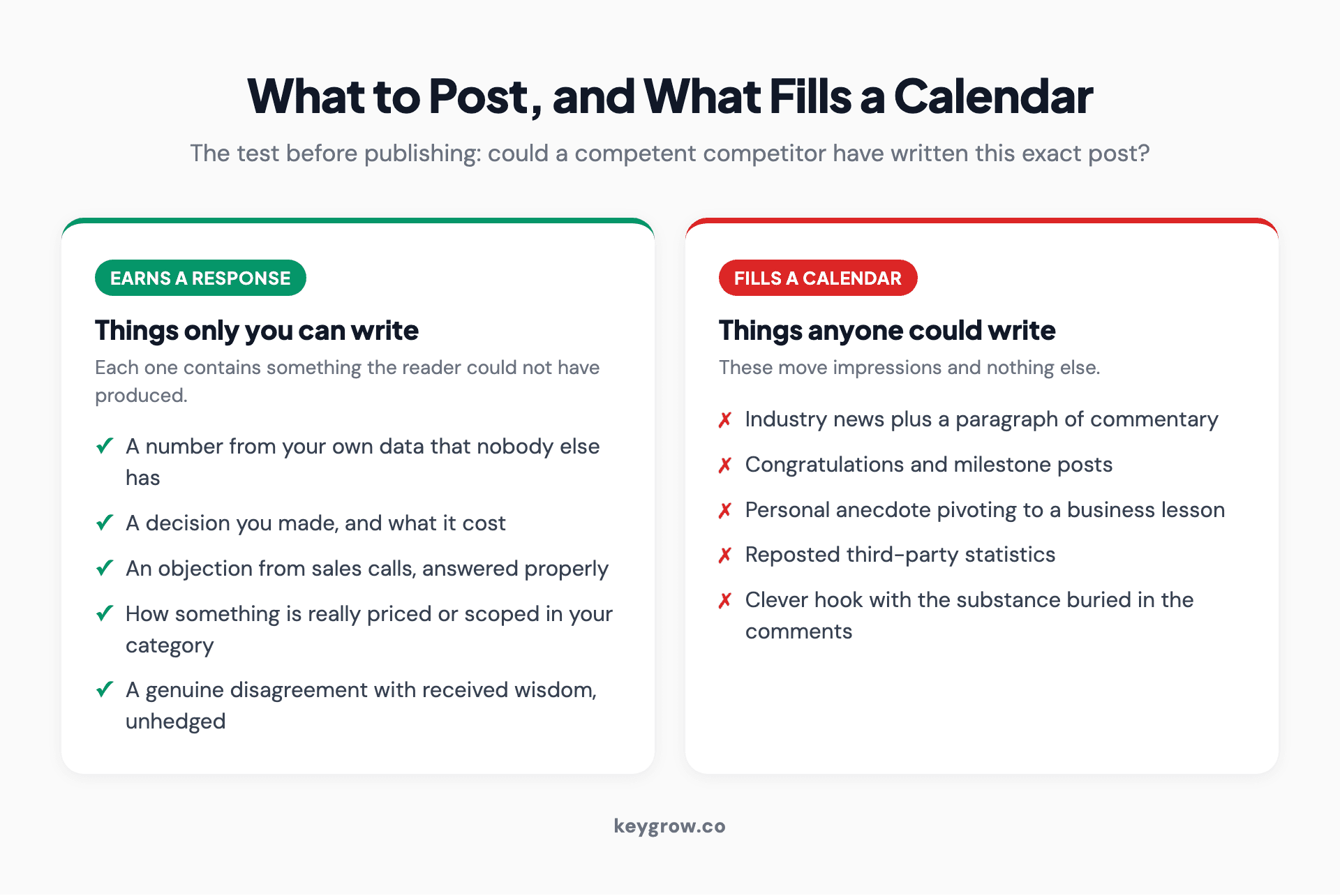
The five B2B LinkedIn post types that consistently earn a response, and the four that fill a calendar without doing anything.
Five things reliably work. A number from your own data that nobody else has. A decision you made and what it cost. A specific objection you hear in sales calls, answered properly. A walkthrough of how something is actually priced or scoped in your category. And a genuine disagreement with received wisdom in your field, stated without hedging.
Four things reliably fill a calendar and do nothing: industry news with a paragraph of commentary, congratulations posts, anything beginning with a personal anecdote that pivots to a business lesson, and reposted third-party statistics.
The test before publishing: could a competent competitor have written this exact post? If yes, it will perform like everyone else's.
LinkedIn became an AI retrieval surface, and that changes what to publish
This is the newest reason to take the platform seriously, and most strategy guides have not caught up.

A speaker presenting to an audience at a conference.
Semrush's citation study, covering more than 230,000 prompts and over 100 million citations, found LinkedIn cited in 14.3 percent of ChatGPT Search responses and 13.5 percent of Google AI Mode responses, behind only Reddit overall. Your posts are not just competing for feed attention. They are training data and retrieval fodder for the systems your buyers now ask before they search.
That changes what is worth writing. Posts phrased as answers to specific questions, containing concrete numbers and stated plainly, get retrieved. Clever hooks with the substance buried in the comments do not, because the substance is not in the indexed text.
It also means your people's posts can surface your company in an AI answer months later, in a context you will never see in analytics. If you are already thinking about answer engine optimization for your website, LinkedIn belongs in the same plan.
Write the post so it still makes sense stripped of the feed around it.
Employee advocacy fails for a reason nobody names
Advocacy programs are recommended everywhere and abandoned almost everywhere, usually blamed on lazy participation. That is not the reason.
The reason is that you are asking employees to spend personal credibility on company content. A person's feed is their professional reputation and, realistically, their next job search. Posting a branded graphic costs them something real and returns them nothing.

An audience seated at tables during a business presentation.
Programs that survive fix the exchange. Employees post about their own work rather than the company's marketing, in their own words, and the company gets mentioned incidentally. The person builds something they keep, which is the only durable incentive here.
Accept the trade honestly: the people who get good at this become more visible to recruiters. That is the cost of the channel, and pretending otherwise is why leadership teams quietly resent the program.
Never write posts and have staff publish them unedited. Readers notice, and the credibility you are borrowing is the whole asset.
Keep outbound off the account doing the publishing
If the same profile publishing your best content is also sending fifty connection requests a day with a pitch attached, the content program is subsidizing the outreach and paying for it in reputation.
The two activities want opposite things. Publishing wants an audience that trusts the account. Outbound wants volume and accepts a high ignore rate. Run them from the same profile and every reader of a good post has a reason to wonder whether they are being worked.
Separate them. Publishing from the people you want known, outbound from sales accounts, and let the content warm the outreach rather than the other way round. It also protects you if an account gets restricted for aggressive outreach, which happens more than vendors admit.
LinkedIn ads work above a deal size, and not below it
Paid LinkedIn is the most expensive per-click channel most B2B companies will use. It is worth it in a narrow band and wasteful outside it.
| Annual contract value | Verdict | Why |
|---|---|---|
| Under $5,000 | Almost never | Cost per qualified lead exceeds what the deal supports |
| $5,000 to $25,000 | Only with a strong offer | Needs high close rates and a real content asset behind it |
| $25,000 to $100,000 | Usually yes | Targeting precision justifies the cost per click |
| Above $100,000 | Yes, and often the best channel | One deal repays a quarter of spend |
The targeting is the product. Job title, company size, industry and seniority in combination is something no other platform sells at this quality, and it is the entire reason to pay a premium. LinkedIn's ad documentation is worth reading once for the objective types, since picking the wrong one is the most common setup error.
Two practical notes. Lead generation forms convert far better than sending traffic to a landing page, and produce lower-intent leads, so decide which problem you have first. And run paid behind content that already worked organically, because paying to distribute an untested asset is how budgets disappear.
If your deal size sits below the band, put the money into organic and into the B2B search work that compounds instead.
The attribution problem, and how to run the program anyway
Here is the honest part. LinkedIn influence mostly does not show up as LinkedIn traffic.
Someone reads three posts over five weeks, never clicks, then types your company name into Google and arrives as branded organic or direct. Your analytics credits search. The channel that did the work is invisible, and that is why good programs get cancelled at month six by a spreadsheet.
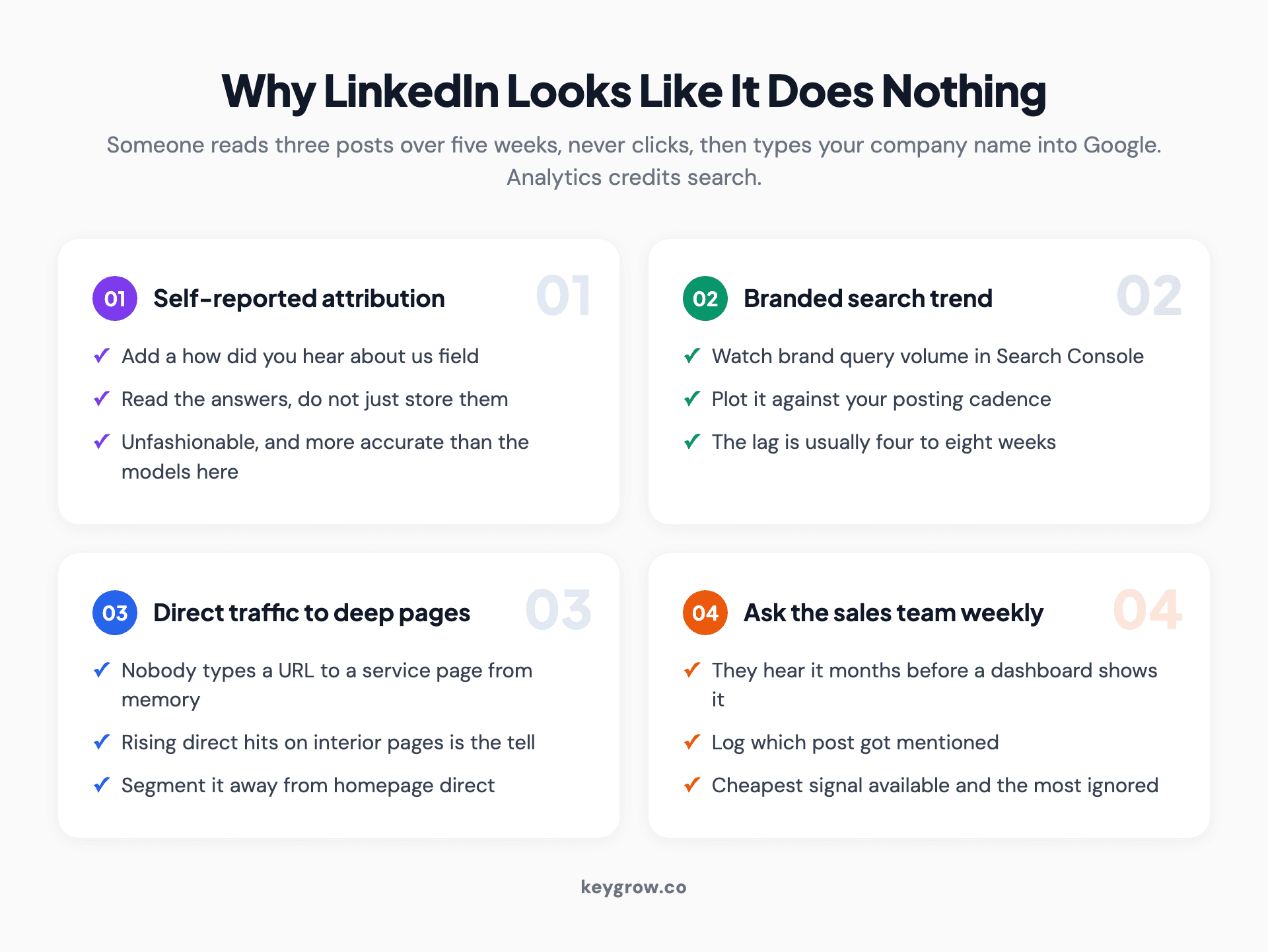
How LinkedIn influence shows up in analytics as branded search and direct traffic, and the four ways to see it anyway.
Four things make it visible enough to defend. Add a "how did you hear about us" field to your forms and read it, because self-reported attribution is unfashionable and more accurate than the models for this channel. Watch branded search volume in Search Console as a trend line against your posting cadence. Track direct traffic to deep pages, since nobody types a URL to a service page from memory. And ask your sales team, weekly, whether prospects mention the posts, because they will hear it long before the dashboard shows it.
None of that is precise. All of it beats crediting the channel with zero because the last click went elsewhere.
What to report monthly
Report the things a skeptical CFO would accept, not the things the platform gives you for free.
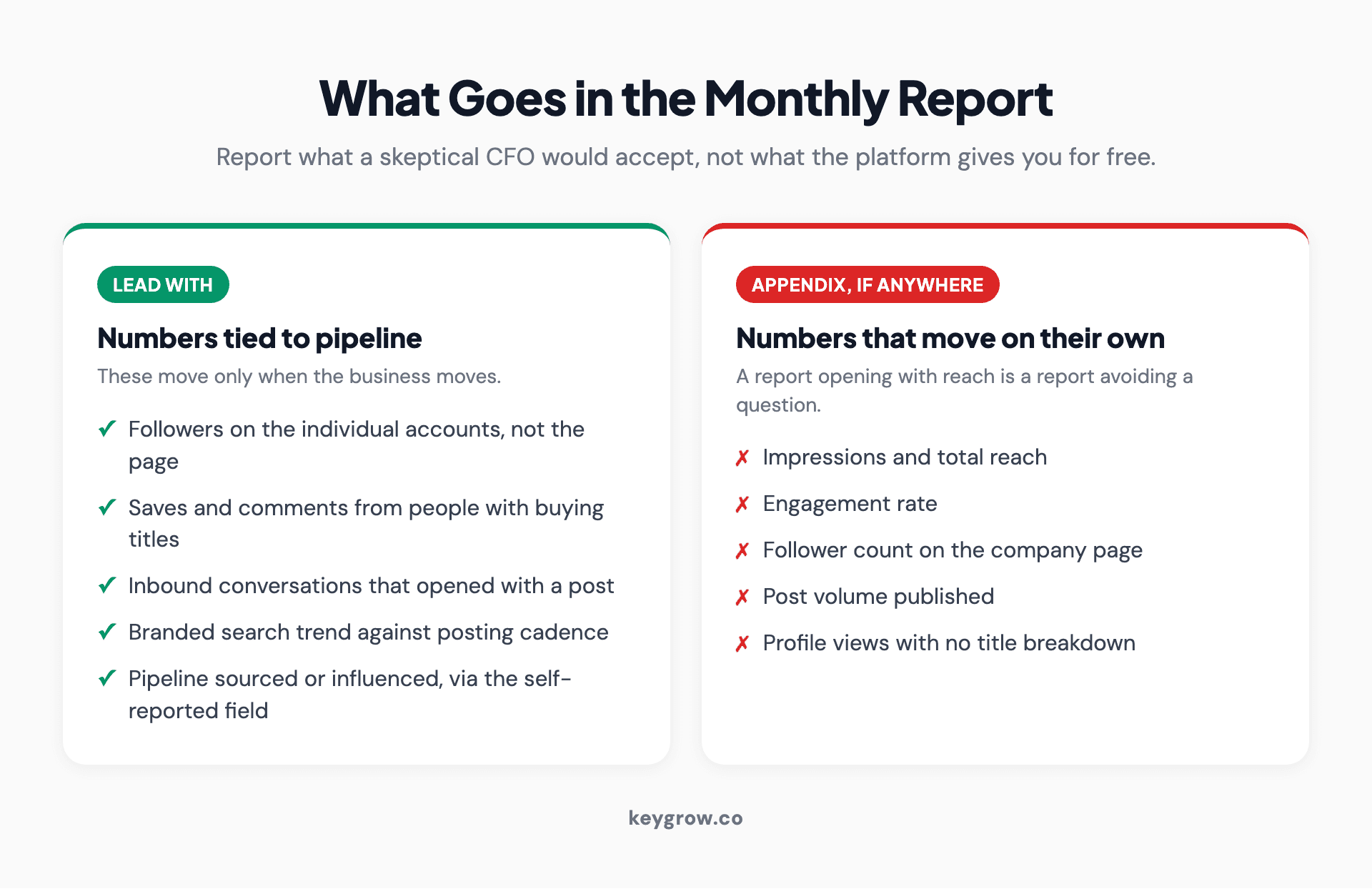
What to report monthly on a B2B LinkedIn program, and the platform metrics that move without the business moving.
Track followers on the individual accounts rather than the page, because that is where the audience is. Track saves and comments from people with buying titles, which is a far better quality signal than raw engagement. Track inbound conversations that started with a mention of a post. Track branded search trend. And track pipeline sourced or influenced, with the self-reported field doing the work.
Impressions and engagement rate belong in the appendix, if anywhere. They are the numbers agencies lead with precisely because they move without the business moving, and a report opening with reach is a report avoiding a question.
Which is also why we do not put anyone on a twelve month contract for this. A program that needs a lock-in to survive month six is a program nobody believes in, and we would rather be month to month and be judged on the pipeline conversation.
When LinkedIn is the wrong channel for your B2B business
There are four of these, and they are worth checking before anyone writes a content calendar.
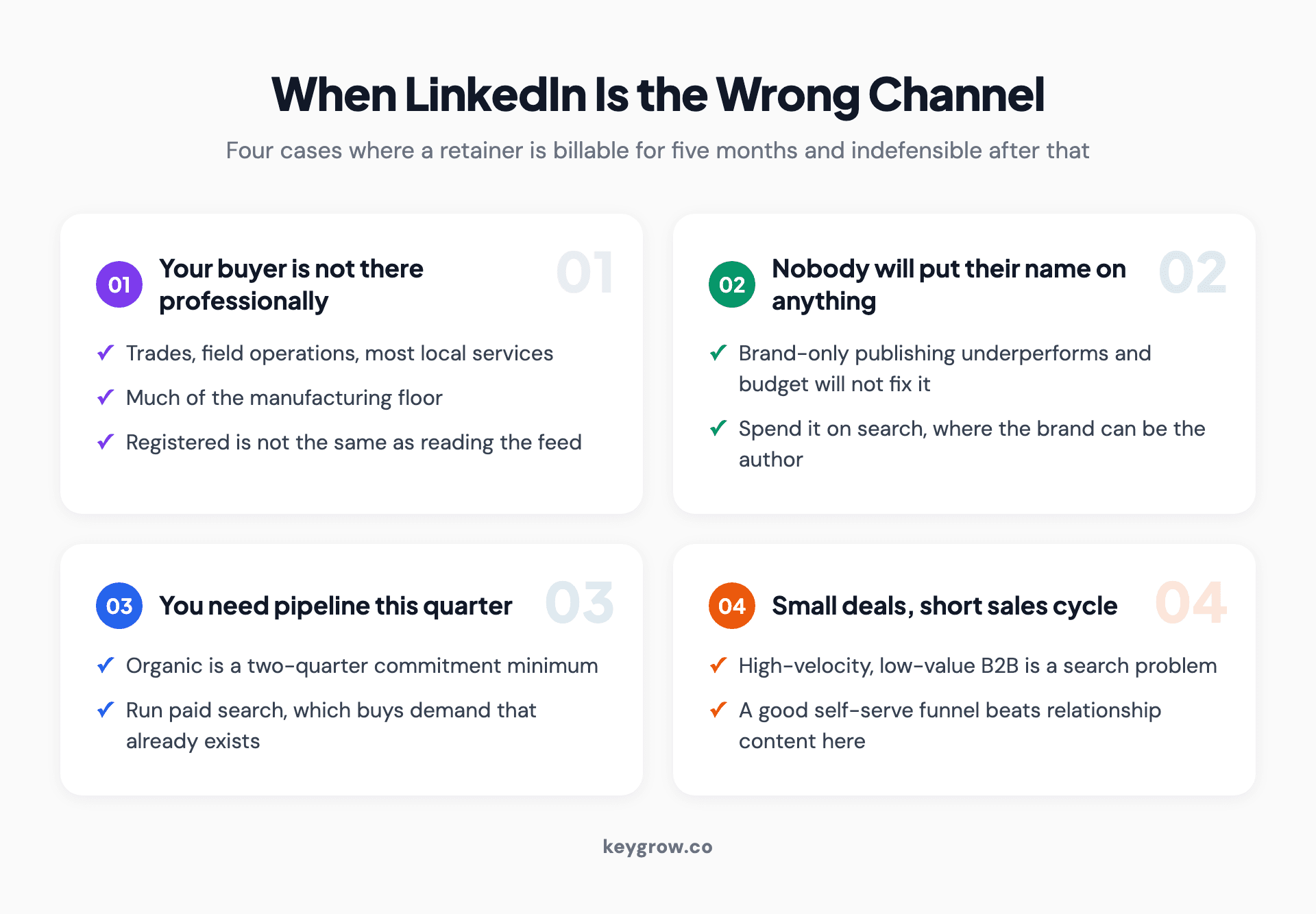
Four situations where LinkedIn is the wrong channel for a B2B company, and where to put the budget instead.
Your buyer is not on LinkedIn in a professional capacity. Trades, field operations, most local services, and a lot of manufacturing floor roles. Being technically registered is not the same as reading the feed.
Nobody in the company will put their name on anything. If leadership wants brand-only publishing, the program will underperform and no budget fixes it. Better to spend the money on search, where the brand can be the author.
You need pipeline this quarter. LinkedIn organic is a two-quarter commitment minimum. If the runway is shorter, run paid search, which buys demand that already exists rather than creating it. We went through that trade-off in detail in does PPC work for B2B.
Your deal size is small and your sales cycle is short. High-velocity, low-value B2B is usually better served by search and by a good self-serve funnel than by relationship-building content.
We turn away this work regularly, because a LinkedIn retainer sold to a company whose buyers are not on the platform is billable for about five months and indefensible after that. If LinkedIn is out for you, our scorecard of B2B lead channels ranks the alternatives by cost per meeting.
FAQs
How often should a B2B company post on LinkedIn?
Two to three times a week from the individual accounts carrying the program, sustained for at least two quarters. Consistency matters more than frequency, and a reliable two posts a week beats five in a burst and then silence. The company page needs only enough activity to look active.
Do LinkedIn company pages actually get any reach?
Very little compared with individual accounts, which is why building a program around one is the most common structural mistake. Treat the page as a verification surface for people checking you out, plus the container for your ads and employee list, and put the publishing effort behind named people.
How long before LinkedIn produces leads?
Expect ninety days before anything meaningful and six months before it is a channel you can plan around. The first month typically looks like nothing is happening, because an audience has to be assembled before it can respond. Programs cancelled at month three pay the whole cost and collect none of the return.
Are LinkedIn ads worth the cost for B2B?
They are worth it when your annual contract value is roughly $25,000 or above, where the targeting precision justifies a cost per click well above other platforms. Below about $5,000 the math rarely works. Run paid behind content that already performed organically rather than paying to distribute something untested.
Should executives use a ghostwriter for LinkedIn?
Editing and drafting from real interviews works. Publishing content the named person did not think, did not review and could not defend in a meeting does not, because readers detect it and the credibility being borrowed is the entire asset. If the executive will not spend twenty minutes a week on it, pick someone who will.
How do you measure LinkedIn if nobody clicks the links?
With self-reported attribution on your forms, branded search trend in Search Console, direct traffic to deep pages, and a weekly question to the sales team about whether prospects mention the content. None of it is precise. All of it beats the default, which credits the channel with zero because the last click happened somewhere else.
Is LinkedIn organic or paid better to start with?
Organic, almost always, and for a practical reason: paid distributes an asset and you do not yet know which of your assets deserve distribution. Three months of publishing tells you which topics land, and those become the ads. Starting with paid means paying to find out what a spreadsheet of organic results would have told you free.
Does posting on LinkedIn help with AI search visibility?
Yes, more than most channels. LinkedIn is among the most-cited domains in AI answers, appearing in around 14 percent of ChatGPT Search responses in recent analysis. Posts written as plain answers to specific questions, with concrete numbers in the text rather than in the comments, are the ones that get retrieved.
Ninety days, one person, one topic
Pick the person in your company who has something specific to say and will actually turn up. Pick a topic narrow enough that it feels restrictive. Post twice a week for ninety days, on questions your buyers ask, with numbers you own.
Leave the company page as a verification page and repost your people's work to it. Keep outbound on separate accounts. Add the self-reported attribution field before you start, so you can prove something at the end.
That is the whole program, and it costs a few hours a week rather than a retainer. If you want a second opinion on whether your buyers are actually on the platform, or help running the social side alongside search, tell us who you sell to and we will give you a straight answer, including when it is no.