


Most advice on SEO for SaaS still describes a machine that was built between 2018 and 2022: publish a large library of top-of-funnel explainers, rank for every question your buyer might ask on the way to a purchase, and let the volume compound into trials.
That machine worked. It also had one dependency nobody thought to write down, which is that a person with a question had to click a blue link to get an answer. That dependency is gone.

A laptop, notebook, phone and coffee arranged on a wooden desk, seen from above.
So the honest version of SaaS SEO in 2026 looks different. You still want organic to be a pipeline channel rather than an ad line item. But the shape of the content has to change, the keyword map gets rebuilt from the bottom of the funnel upward, and the number you report to your board stops being sessions.
What the old playbook assumed
The classic approach had three moves, in order. Build a glossary and a "what is" library to establish topical coverage. Write long-form guides for every problem your product solves. Then add product-led content near the bottom to convert the audience you attracted.
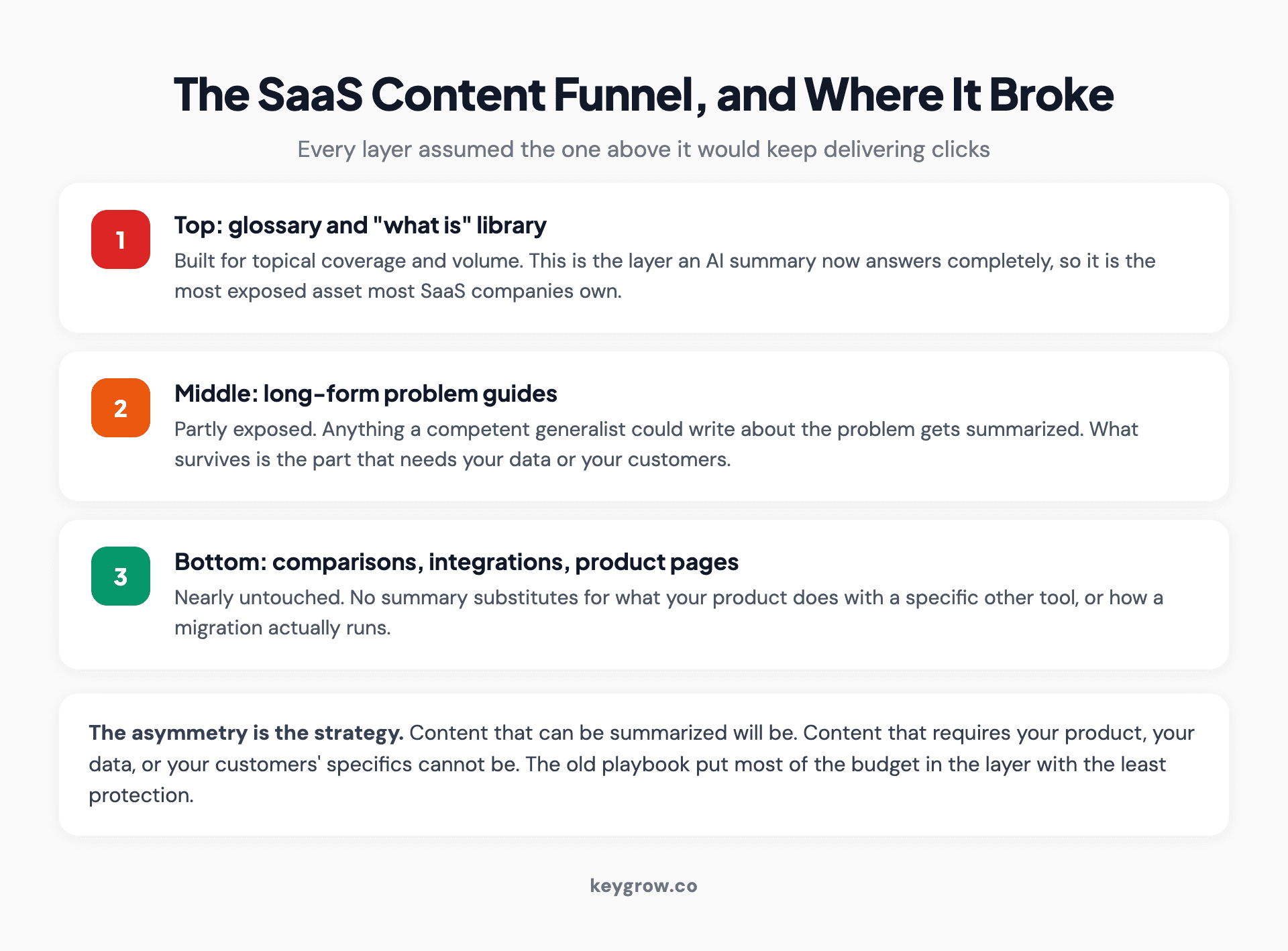
Diagram of the classic SaaS SEO funnel with a wide top-of-funnel content library narrowing through solution content to product pages, marked with where AI answers now intercept traffic.
Each step assumed the one above it delivered traffic. The glossary fed the guides, the guides fed the product pages, and the whole thing was justified by a traffic number that eventually turned into signups at some blended rate.
Two things broke that. The first is that the top of the funnel is exactly where answers get summarized now. The second is that your buyer changed where they start. Neither is a reason to stop doing SEO, but both are reasons to stop doing it the old way.
Where the clicks actually went
Informational queries lost the most, and those are the queries the standard SaaS content library was built to win.
The clearest measurement comes from Ahrefs' study of 300,000 keywords, split evenly between terms with an AI Overview and comparable informational terms without one. When an overview was present, the top-ranking page's clickthrough rate ran 34.5 percent lower. Not the tenth result. The page that won.
Sit with what that means for a content library. If your top performer is a 3,000-word explainer of a general business concept, it is the single most exposed asset you own, because it answers a question completely enough for a summary to replace it. Meanwhile the page about how your product handles a specific integration is nearly untouched, because no summary can substitute for it.
That asymmetry is the whole strategy. Content that can be summarized will be. Content that requires your product, your data, or your customers' specifics cannot be.
The traffic you keep is worth more than the traffic you lost
Here is the part that gets left out of the doom coverage. The visits that still arrive convert better than they used to.
Analysis compiled in a 2026 B2B SEO report found that traffic arriving from AI assistants converts at roughly three times the rate of other channels, including traditional search. The reason is intuitive: somebody who asked an assistant a question, read a summary, saw you cited, and then clicked through has already done the comparison step that used to happen across six of your blog posts.
So a SaaS company can genuinely see organic sessions fall 20 percent while organic pipeline stays flat or grows. If your reporting stops at sessions, that looks like a failure and somebody cuts the budget on the channel that is quietly working. This is why the measurement section further down is not an afterthought.
Rebuild the keyword map from the bottom up
Start with the terms a buyer types when they are choosing, not learning. Work upward only as far as the budget justifies.
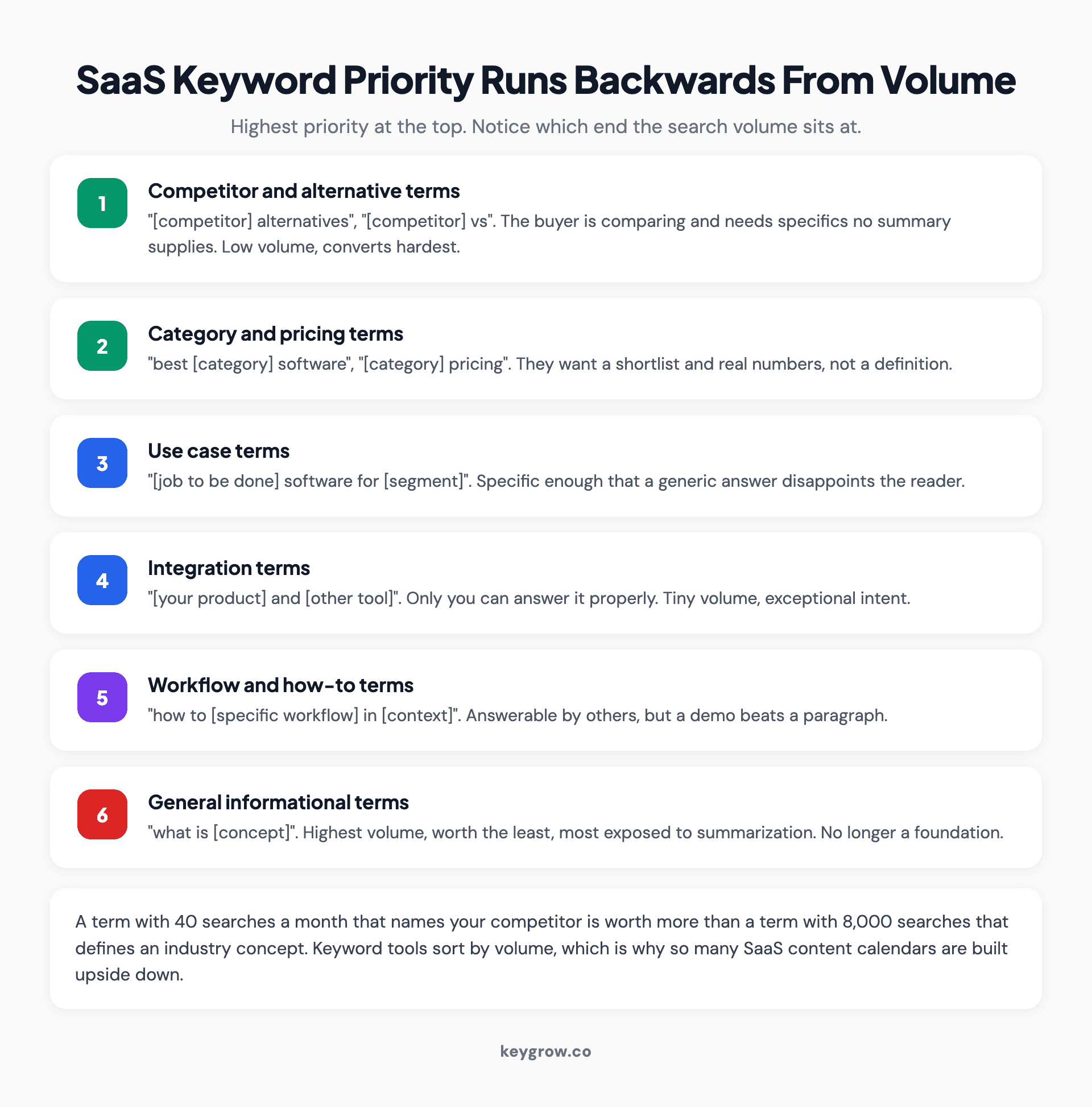
Inverted keyword priority pyramid for SaaS, placing brand and comparison terms at the top of the priority order, then use-case and integration terms, with general informational terms last.
The old order was volume-first, which put the glossary at the top. The order that survives looks like this:
| Tier | Query shape | Why it holds up | Typical volume |
|---|---|---|---|
| Competitor and alternative | "[competitor] alternatives", "[competitor] vs" | Buyer is comparing, needs specifics a summary cannot supply | Low, converts hardest |
| Category and pricing | "best [category] software", "[category] pricing" | Buyer wants a shortlist and real numbers | Medium |
| Use case | "[job to be done] software for [segment]" | Specific enough that generic answers disappoint | Low to medium |
| Integration | "[your product] and [other tool]" | Only you can answer it properly | Low, very high intent |
| Jobs and workflows | "how to [specific workflow] in [context]" | Answerable, but demos help | Medium |
| General informational | "what is [concept]" | Most exposed to summarization | High, worth least |
Notice that the volume column runs almost exactly backwards from the priority column. That is the uncomfortable part, and it is why keyword tools keep pointing SaaS teams at the wrong work. A term with 40 searches a month that names your competitor is worth more than a term with 8,000 searches that defines an industry concept.
The general informational tier is not worthless. It is just no longer the foundation. Write it when you have something genuinely better to say, and stop writing it to fill a content calendar.
Write the pages only you can write
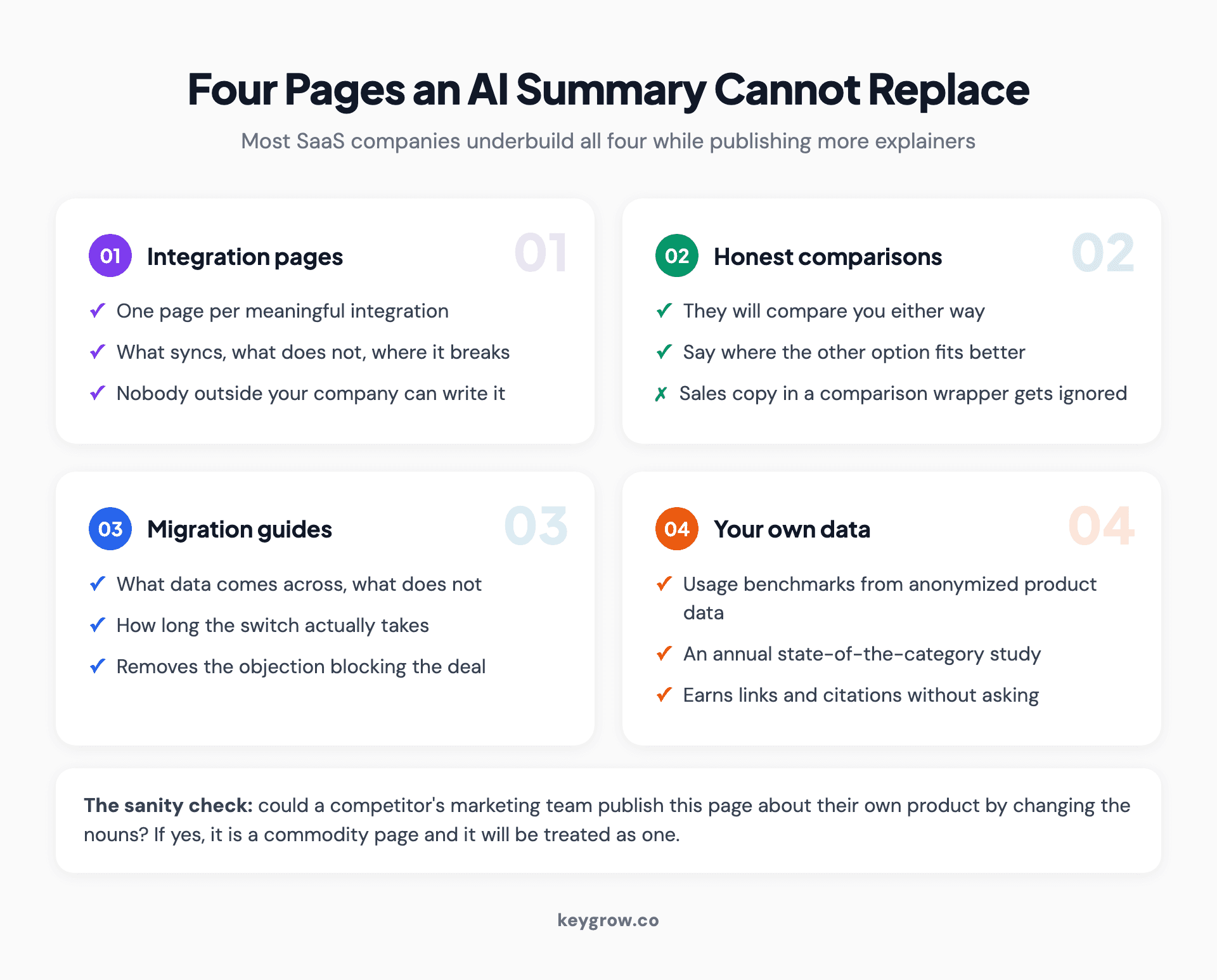
Four page types are close to summary-proof, and most SaaS companies underbuild all four.
Integration pages. One page per meaningful integration, describing what actually syncs, what does not, how the setup runs, and where it breaks. These rank for low-volume, extremely high-intent searches, and no third party can write them because nobody else knows the answer.
Comparison pages. The buyer is going to compare you either way. Doing it yourself, honestly, including where the other option is a better fit, is the version that earns trust and the version that gets cited. Comparison pages written as thinly disguised sales copy get ignored by readers and assistants alike.
Migration and switching guides. What it takes to move from a specific competing tool, what data comes across, what does not, how long it takes. High intent, and it removes the actual objection blocking the deal.
Your own data. Usage benchmarks, industry reports built from anonymized product data, an annual state-of-the-category study. This is the only content type that reliably earns links and citations without asking anyone, because it does not exist anywhere else.
If your team has capacity for exactly one initiative this quarter, it should be one of these four, not another explainer.
Four summary-proof SaaS page types shown as cards: integration pages, honest comparison pages, migration guides, and original product data reports.
A useful way to sanity check any planned page: could a competitor's marketing team write this page about their own product by changing the nouns? If yes, it is a commodity page and it will be treated as one. Integration pages fail that test in the right direction, because the answer depends on code you wrote. Where they sit in the site, and what to build before them, is covered in our post on SaaS website design.
Where your content actually lives matters more here than elsewhere
Put content on the main domain in subfolders. Subdomains for the blog, the docs, and the help center are the most common self-inflicted wound in SaaS SEO.

A laptop showing a dark software interface beside a coffee mug on a desk, representing product documentation and app routes on a SaaS domain.
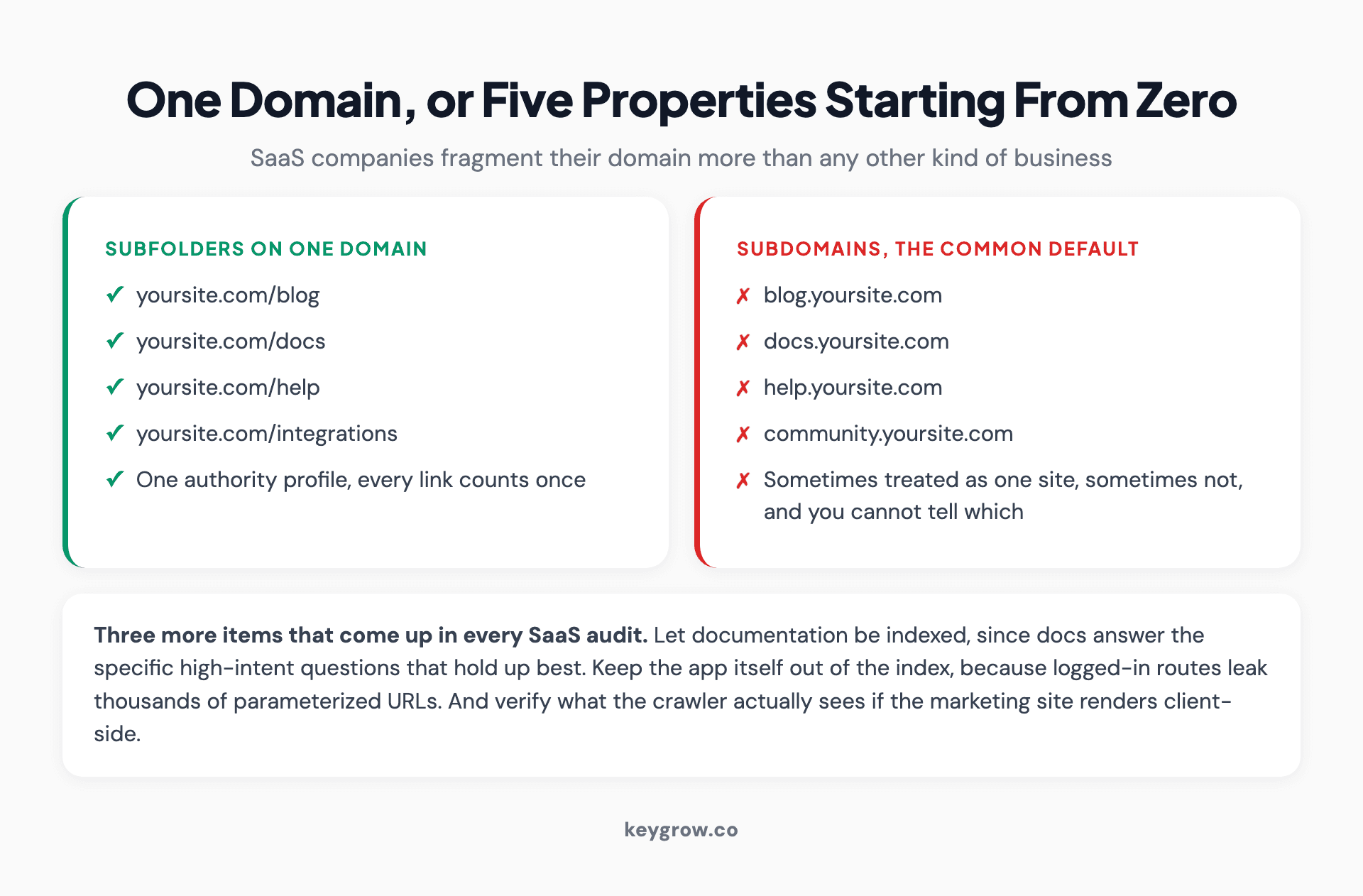
Site architecture comparison for SaaS showing content consolidated in subfolders on one domain against the same content scattered across blog, docs and help subdomains.
The reason is that authority accrues to a domain, and SaaS companies fragment their domain more than any other kind of business. A typical setup ends up with marketing on the root, the blog on one subdomain, documentation on a second, the help center on a third, the community on a fourth, and the app itself on a fifth. Five properties, each starting from scratch, each with a fraction of the links.
Google has said subdomains can be treated as part of the same site, and sometimes they are. The problem is that it is inconsistent, and you cannot tell from the outside which way yours is being handled. Subfolders remove the question entirely. If you are building new, put everything under one domain. If you already have the split, migrating the blog is usually the highest-value technical project available, and it is genuinely disruptive, so plan it properly rather than doing it on a Friday.
Three more technical items that come up repeatedly in SaaS audits:
- Documentation is a ranking asset and gets treated as an internal artifact. Docs answer exactly the specific, high-intent questions that hold up best against summarization. Let them be indexed, give them real titles, and link them from marketing pages.
- The app itself should generally not be indexed. Logged-in views, account pages, and app routes belong out of the index. Half the crawl budget problems in SaaS come from an app subdomain leaking thousands of parameterized URLs.
- Client-side rendering still causes problems. If the marketing site renders content only after JavaScript runs, verify what the crawler actually sees rather than assuming it works. This is less broken than it was five years ago and still not free.
Refresh before you publish
For most SaaS companies with an existing library, updating what is already there beats adding to it, and it is not close.
The arithmetic is simple. A page that already ranks in positions 8 to 20 has proven it can rank, has whatever links it has accumulated, and needs an editorial pass rather than a launch. A new page starts at zero and needs months. Given a fixed number of hours, the refresh wins on expected value most of the time.
What a real refresh involves, as opposed to changing the date in the title: check whether the query still means what it meant when you wrote the page, rewrite the opening so the answer sits at the top, replace stale numbers with current ones and cite them, cut the padding that was added to hit a word count, and add whatever your product now does that it did not do then.
This is also the cheapest way to reduce exposure to summarization. A 2021 explainer that opens with 400 words of preamble is both hard to cite and easy to replace. The same page, rewritten answer-first with current data and specifics only you have, is neither.
Programmatic pages, and where they get you in trouble
Templated pages work when each one carries genuinely different information and fail when they do not. That line is not about page count.
Good programmatic sets: one page per integration, per template, per supported location where the rules differ, per data set where the numbers differ. Each page answers a question a real person typed, and the answer is different on every page.
Bad programmatic sets: the same 600 words with a variable swapped, pages generated for keyword combinations nobody searches, and location pages for cities you have no connection to. These get built in a week, look like progress in a spreadsheet, and eventually get treated as the thin content they are.
The practical test: read three pages from the set side by side and ask whether they would still make sense if you deleted the templated parts. If not, the set is not ready.
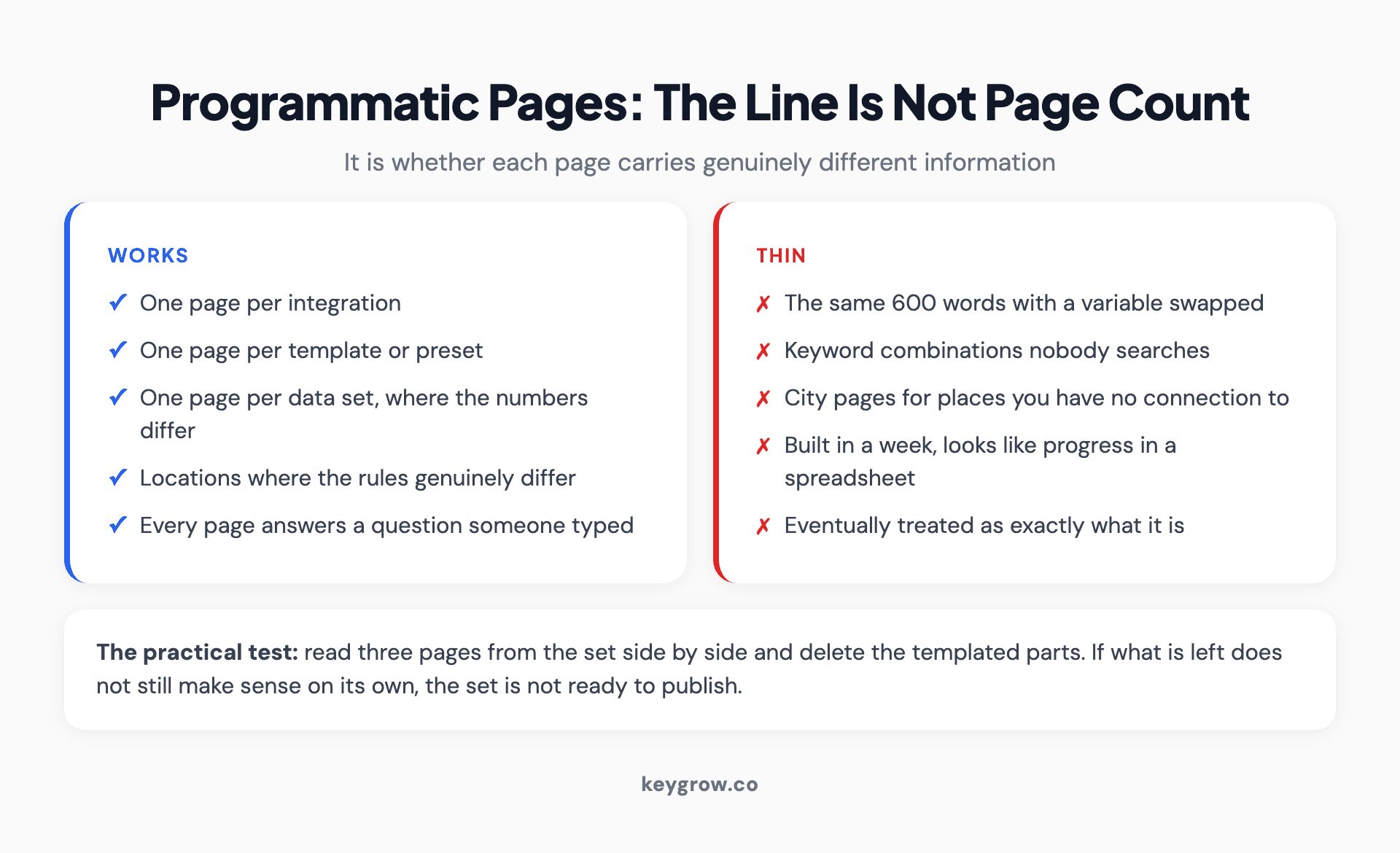
Two-column comparison of programmatic page sets that work, such as one page per integration or data set, against thin sets built from swapped variables and unsearched keyword combinations.
Getting cited, not just ranked
Ranking and being cited are separate outcomes now, and the overlap between them is smaller than most teams assume.
The habits that earn citations are specific. Put the direct answer within the first 100 words rather than after a 400-word preamble. Break sections into self-contained blocks that make sense lifted out on their own. Include real numbers and name their sources, because assistants preferentially surface content with verifiable specifics. Keep pages current, since AI systems favor fresher material than classic search does.
None of that conflicts with ranking well, which is the good news. It is mostly a structural discipline applied to content you were writing anyway. We go deeper on the mechanics in our guide to structuring a page for AEO, and on how the two disciplines differ in AEO versus traditional SEO.
Some numbers give the discipline shape. Assistants cite only around 15 percent of the pages they retrieve, so being retrieved is not the finish line. Roughly 44 percent of citations come from the first third of a page, which is the strongest argument there is for putting the answer at the top. And research into generative engine optimization found that adding relevant statistics raised visibility in AI answers by about 40 percent, with expert quotes worth roughly 37 percent.
One more thing worth knowing: a meaningful share of assistant search runs on indexes other than Google's, with ChatGPT results overlapping Bing's top results somewhere between 73 and 87 percent. If your team has never opened Bing Webmaster Tools, that is a gap with a fifteen-minute fix.
Free tools outperform most blog posts
A calculator, a generator, a checker, or a template that solves one narrow problem tends to outrank and outlast the article about the same subject.
The reasons stack up. Tools earn links without outreach because people cite the tool rather than describing it. They get bookmarked and returned to, which articles rarely do. They demonstrate competence in a way prose cannot. And they are hard to summarize away, because a summary of a calculator is not a substitute for using it.
The trap is building a tool nobody needs. The good ones come from a question your support team answers repeatedly, or a spreadsheet your customers keep rebuilding by hand. If you cannot name the specific person who would use it weekly, do not build it.
What to measure when sessions are the wrong number
Report pipeline contribution. Sessions are a diagnostic input, not a result, and treating them as the headline is how good channels get cut.
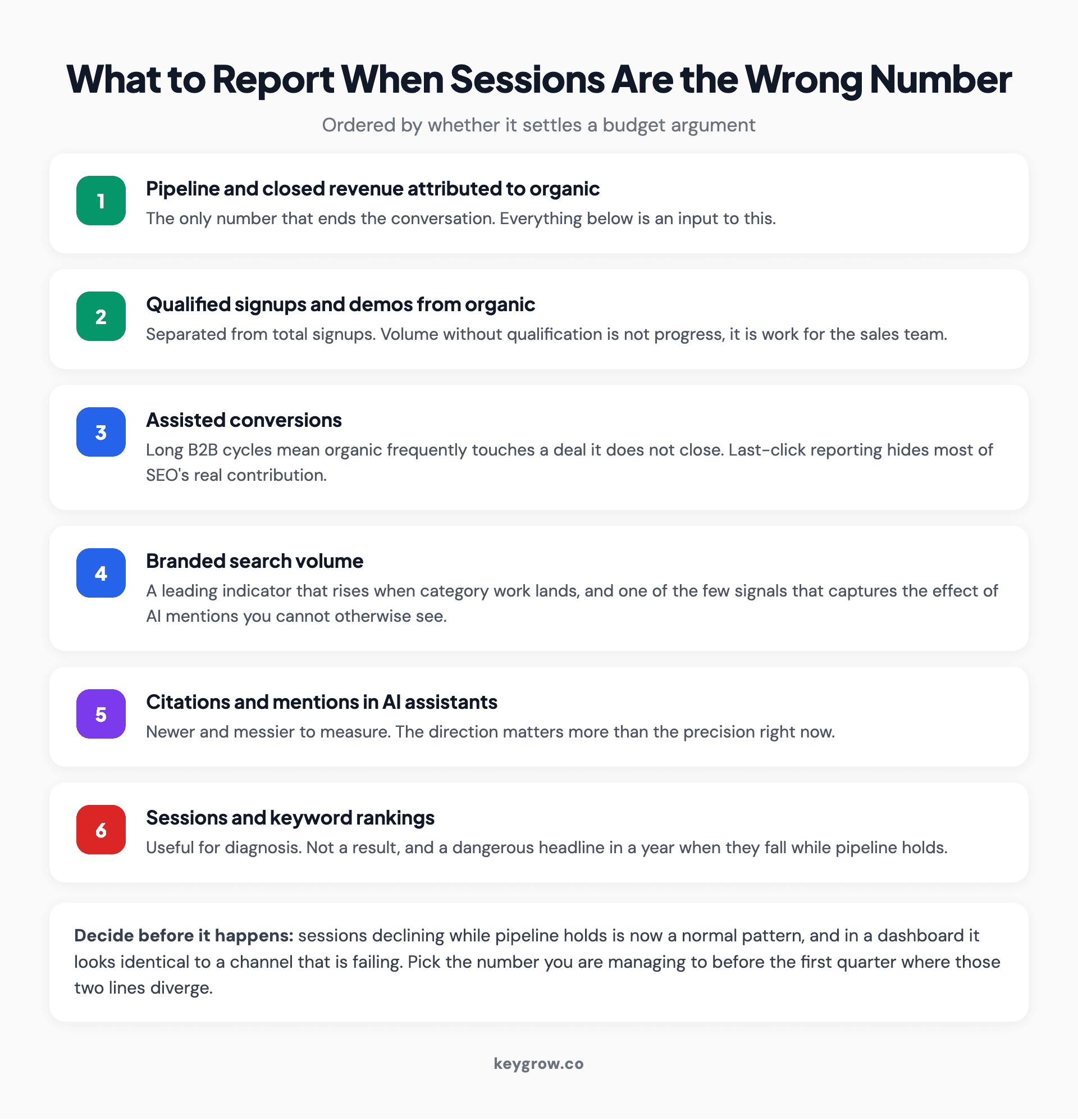
Reporting hierarchy for SaaS SEO showing pipeline and qualified signups as headline metrics above assisted conversions and branded search growth, with raw session counts placed lowest.
A reporting stack that survives contact with a board, in order:
- Pipeline and closed revenue attributed to organic. The only number that settles the budget argument.
- Qualified signups or demos from organic, separated from total signups. Volume without qualification is not progress.
- Assisted conversions. Long B2B cycles mean organic frequently touches a deal it does not close. Last-click reporting hides most of SEO's contribution.
- Branded search volume. A leading indicator that rises when your category work lands, and one of the few signals that captures the effect of AI mentions.
- Citation and mention tracking in AI assistants. Newer and messier, but the direction matters more than the precision.
- Sessions and rankings. Useful for diagnosis. Not a result.
The trap specific to this moment: sessions declining while pipeline holds is a normal, expected pattern, and it looks identical in a dashboard to a channel that is failing. Decide now which number you are managing to, before the first quarter where those two lines diverge.
When a SaaS company should not be doing SEO
Three situations where organic is the wrong place to spend, and I would rather say so than take the retainer.
Pre-product-market fit. If the positioning is still moving, SEO will lock in content describing a product you are about to change. Wait. Paid search can test messaging in a week; organic takes two quarters to correct a wrong turn.
A category that does not exist yet. If you invented the thing, nobody is searching for it, because they do not know its name. Category creation is a demand generation problem, and search is a demand capture channel. You will need the demand to exist first.
A runway shorter than the payback period. Organic takes six to twelve months to become a meaningful channel for most B2B software. If you need pipeline this quarter to survive the next raise, buy it. That is the correct decision and no honest agency should talk you out of it.
There is also a real in-house case here. A SaaS company with a product marketer who understands the buyer will write better comparison and integration pages than any agency, because the raw material is internal knowledge. Bring in outside help for technical work, distribution, and the parts nobody has time for, not for the pages that require knowing your product.
FAQs
How long does SEO take to work for a SaaS company?
Six to twelve months before organic becomes a meaningful pipeline source, and longer in a competitive category. Bottom-of-funnel pages targeting comparison and integration terms often move faster than that, because the competition for those terms is thinner. Plan for the first quarter to produce very little you can point at.
Is SaaS SEO still worth it with AI Overviews taking clicks?
Yes, but with a different content mix. Informational content is the most exposed, with the top-ranking page losing around 34.5 percent of its clicks when an overview appears. Comparison, integration, and product-specific pages are far less affected, and traffic arriving from AI assistants converts at roughly three times the rate of other channels. The channel changed shape rather than stopping.
Should a SaaS company write comparison pages about competitors?
Yes, and honestly. Your buyer is comparing you regardless, and the version they find should be the one you wrote. Pages that acknowledge where a competitor genuinely fits better perform better with readers and get cited more often than pages that pretend there is no trade-off. Check trademark guidance before using another company's name prominently.
How much should a SaaS company spend on SEO?
It varies widely with category competitiveness and whether you have in-house content capacity. The more useful framing is a comparison against your paid cost per acquisition. If organic can produce qualified signups below that number within a year, it is worth funding. If your category has cheap clicks and a short sales cycle, the case is weaker.
What is the difference between SaaS SEO and regular SEO?
The mechanics are the same. The differences are that buying cycles are long enough that last-click attribution hides most of the value, the highest-value keywords have low search volume, the product itself is the strongest content asset, and there is no local component to fall back on. It is a harder measurement problem more than a harder ranking problem.
Do SaaS blogs still work?
For narrow, specific, experience-based topics, yes. For general explainers of concepts anyone could define, much less than they used to. The test is whether an assistant could produce a satisfying answer without your page. If it could, that post is a commodity, and the effort belongs somewhere else.
Should we build programmatic pages?
Only where each page carries genuinely different information: integrations, templates, data sets, real supported locations. If three pages from the set would read the same after deleting the templated wrapper, the set is thin content with a spreadsheet behind it.
Our take
The companies that will do well here are the ones that stop measuring a content library by its size. The old scoreboard, published posts and total sessions, rewards exactly the material that is now most replaceable.
Practically: audit what you have against the tiers above, work out how much of your traffic sits in the exposed informational band, and move the next two quarters of effort into integration pages, honest comparisons, and something built from your own data. Fewer pages, each one harder for anyone else to write.
If you want a second opinion on which half of your content library is load-bearing, that is the kind of audit our SEO team runs, and we will tell you plainly if the answer is that your problem is positioning rather than search.