

You have a business to run and SEO keeps falling to the bottom of the list. So you go looking for help, and the question lands fast: how to outsource SEO without getting burned by an agency that bills for "strategy" and hands you a chart of impressions at the end of the month. Here is the answer before the detail.
To outsource SEO, decide which tasks you are handing off, set a budget you can sustain for at least six months, write down the one number that proves it worked (calls, leads, or booked revenue, never rankings alone), then vet a freelancer or agency against that number and keep them month-to-month. The work is real and slow. The hiring is where most people lose money, because they buy a deliverable list instead of an outcome.
The rest of this guide covers what outsourcing actually includes, whether you should do it at all, which tasks are safe to hand off, a seven-step process, real cost math with sources, the questions to ask before you sign, and the red flags that mean you walk. No fluff about saving time. Time is the easy sell. The hard part is making sure the time you buy back actually produces leads.
What does it mean to outsource SEO?
Outsourcing SEO means paying an outside freelancer or agency to do some or all of the work that gets your site found in search: technical fixes, content, on-page optimization, and link building. You keep the business decisions; they do the execution you do not have time or expertise to run yourself.
That is the clean definition. In practice, outsourcing SEO covers a wide range: a one-off technical audit you buy once, a part-time freelancer who publishes two articles a month, or a full retainer where an agency owns your entire organic channel. Scope is the part most owners skip past, and it decides whether you get value or a monthly invoice for activity.
There is also a quieter version you may already be doing without the label. White-label work is when an agency you hired subcontracts pieces of your SEO to another vendor behind the scenes. Common, not inherently bad, but you should know if it is happening, because the markup and the accountability gap both land on you.
So outsource SEO is not one thing. Before you compare prices, decide what you are buying.
Should you outsource SEO, hire in-house, or keep it DIY?
Outsource when the opportunity cost of your time beats the fee, and you need a range of skills (technical, content, links) that one hire cannot cover. Keep it in-house when SEO is core to your model and you have steady volume to justify a salary. Stay DIY when you are a single location with more time than money.
Most small businesses outsource for a boring reason: SEO needs four or five skill sets, and you cannot hire one person excellent at all of them. A freelancer or agency gives you a technical specialist, a writer, and a link person for less than one mid-level salary. Real numbers are in the cost section below.
Here is the counterpoint most agencies will never tell you. DIY is the right call more often than the industry admits. A single-location business with more time than money should claim their Google Business Profile, gather reviews, and fix the obvious site problems before paying anyone a cent. We wrote why DIY SEO can fail so you know where the DIY ceiling is, but the floor below it is yours to handle for free. Hire help when your own time is worth more spent on the business than on keyword research.

Single-location business owner working on free local SEO basics like Google Business Profile and reviews before hiring an outside provider
In-house only makes sense at scale. If organic search is the engine of your revenue and you publish constantly, a dedicated hire pays off. For everyone else the math favors outsourcing, which is what the rest of this guide assumes.
Which SEO tasks are safe to outsource (and which you should keep)
Hand off the execution: technical audits, content production, on-page optimization, link building, and reporting. Keep the things only you can own: your positioning, your offer, brand voice approval, and the final say on anything that touches how customers perceive you.
The dividing line is accountability, not difficulty. Some work is purely technical and travels fine to an outside team. Other work carries your reputation, and no contractor can hold that for you.
Safe to outsource, roughly in the order most people start:
Keep these in-house, no exceptions:
The tasks you keep are not the hard technical ones. They are the ones where being wrong costs you customers, not rankings.
How to outsource SEO in 7 steps
Seven steps: define scope, set a budget, name your success metric, shortlist freelancers or agencies, vet them against that metric, start month-to-month, then review against the number you set. Skip the metric step and you cannot tell good work from busywork.
1. Define the scope. Decide whether you need a one-off audit, ongoing content, link building, or a full retainer. Write it down. A vague brief gets you a vague proposal.
2. Set a budget you can sustain for at least six months. SEO compounds. A three-month budget buys you the hard part and quits before the payout. Those numbers are below.
3. Name the one success metric. Calls, qualified leads, booked jobs, or revenue. Pick the number that pays your rent. If a provider wants to be judged on rankings or impressions instead, that tells you something.
4. Shortlist providers. Two or three freelancers, two or three agencies. Ask each for references in your industry and recent results you can verify.
5. Vet them against your metric. The questions are in the next section. Make them explain how their work connects to your number.
6. Start small and month-to-month. A pilot scope, no long lock-in. A provider confident in their work will agree.
7. Review against the number. At 60 and 90 days, check leading indicators (indexed pages, ranking movement, traffic). Judge the revenue outcome at six to twelve months, because that is the real clock.
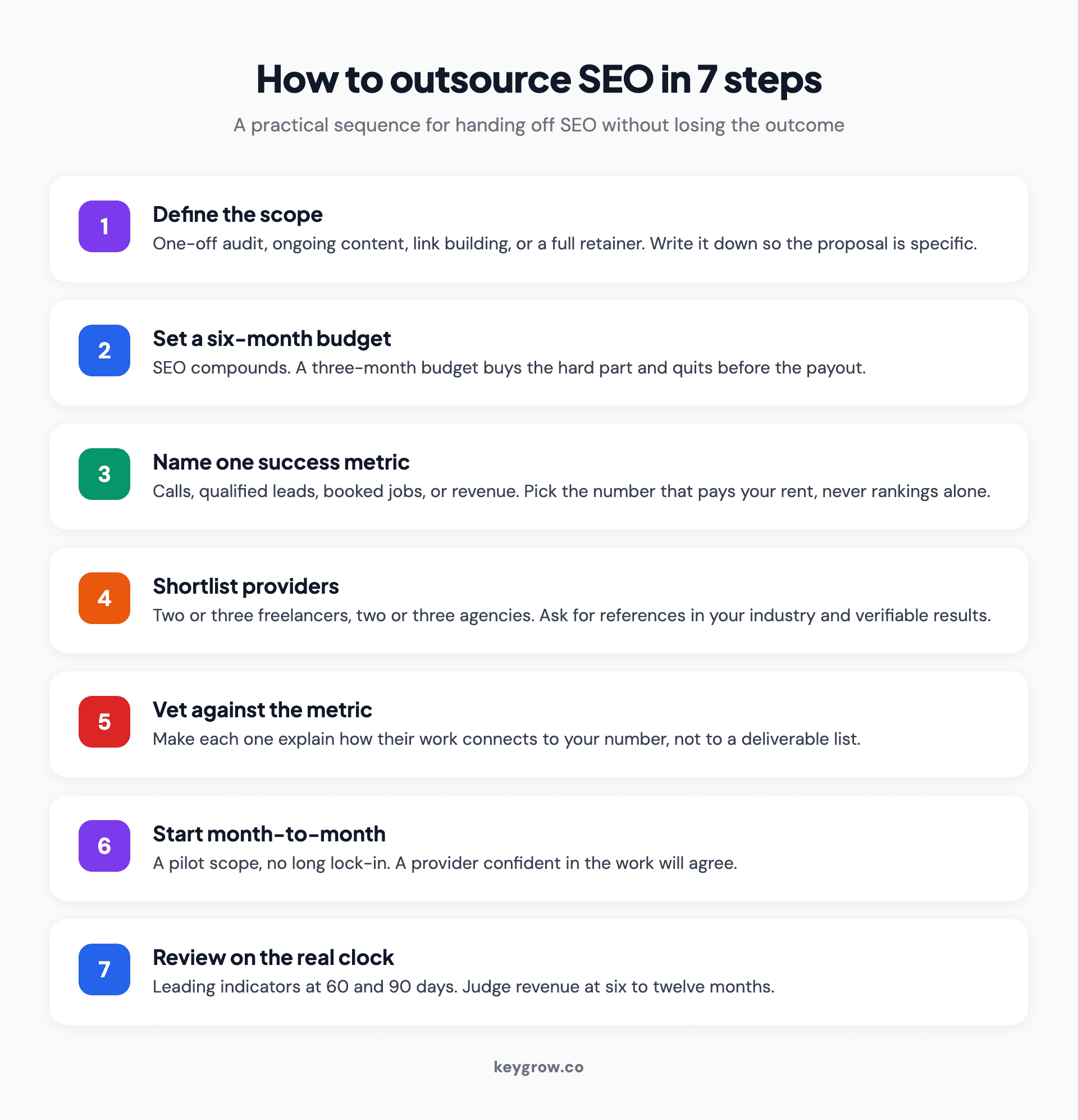
Seven numbered steps for how to outsource SEO: define scope, set a six-month budget, name one success metric, shortlist providers, vet against that metric, start month-to-month, then review on the revenue number.
The hardest step is the third one. Naming the metric forces you to admit what success looks like before anyone can hide behind a vanity chart. Do that and the rest gets honest fast.
What it actually costs: freelancer vs agency vs in-house
For a small business, freelancers typically run $1,000 to $3,500 a month and agencies $1,500 to $5,000 or more, while a single mid-level in-house SEO hire costs $65,000 to $95,000 a year in salary alone. The freelancer is rarely the cheapest path once you account for the gaps one person leaves.
These are the numbers the ranking pages dodge, so here they are with sources. Per BrightLocal, SEO freelancers bill a median of $75 an hour while agencies bill a median of $100 an hour, and 69 percent of freelancers charge under $100 an hour versus only 34 percent of agencies. Freelancers are cheaper per hour. True, and not the whole story.
The monthly and annual ranges come from Scopic Studios: freelancers $1,000 to $3,500 a month, agencies $1,500 to $5,000 or more for small businesses, and a mid-level in-house hire $65,000 to $95,000 a year before benefits, tools, and management time.
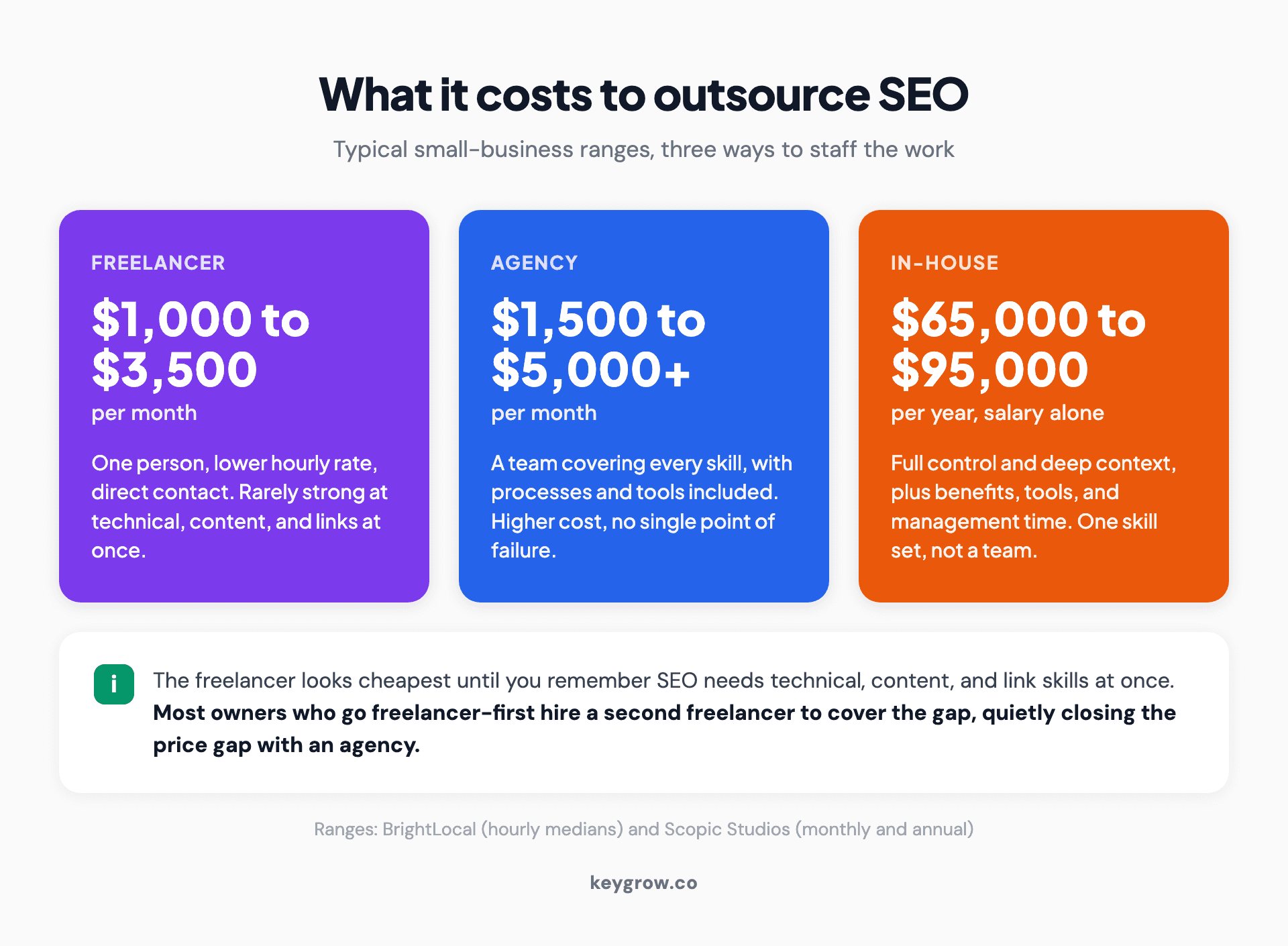
Cost ranges for outsourcing SEO: freelancers $1,000 to $3,500 a month, agencies $1,500 to $5,000 or more a month, and a mid-level in-house hire $65,000 to $95,000 a year in salary alone.
| Option | Typical monthly cost | What you get | The catch |
|---|---|---|---|
| Freelancer | $1,000 to $3,500 | One person, lower hourly rate, direct contact | Skill gaps (rarely strong at technical, content, and links at once); single point of failure |
| Agency | $1,500 to $5,000+ | A team covering every skill, processes, tools included | Higher cost; risk of being a small fish on a junior's plate |
| In-house | $65,000 to $95,000/yr salary | Full control, full attention, deep business context | Plus benefits, tools, and the time to manage them; one skill set, not a team |
The freelancer looks cheapest until you remember SEO needs technical, content, and link skills at once. One person strong at all three is rare and expensive. Most owners who go freelancer-first end up hiring a second freelancer to cover the gap, which quietly closes the price difference with an agency. None of this is a KeyGrow price list. A quote for your situation is a conversation, not a number on a page.
How to vet an SEO partner: the questions to ask before you sign
Ask how they will report on the metric that pays your rent, what their first 90 days look like, who actually does the work, and whether you are locked into a contract, including whether they quietly white-label your ads to a third party. The answers separate consultants from salespeople in about ten minutes.
The vetting conversation is where you earn or lose the next year of budget. The questions that matter, and what a good answer sounds like:
For the longer version of this conversation, our guide on how to choose a good SEO company goes deeper on each question.
Red flags that mean you should walk away
Walk away from guaranteed rankings, "page one in 30 days" promises, secret methods they will not explain, reports built on impressions, and any year-long contract pitched before they have shown you results. Each one signals a provider protecting their fee instead of your outcome.
The red flags are consistent across every bad agency story we have heard:
One bad sign is a maybe. Two or more, and you have your answer.
How to manage the relationship so outsourced SEO actually works
Outsourced SEO works when you stay involved as the owner, not when you hand it off and disappear. Give your provider business context, answer their questions fast, review the lead number monthly, and judge results on the long clock, not week to week.
Handing off does not mean checking out. Accounts fail when the owner goes silent: the provider has no context, no fast answers on positioning, no feedback loop. The accounts that win have an owner who shows up monthly with the lead numbers and the business updates.
A few habits that keep it on track:
Set a clear scoreboard, show up monthly to read it, and let the work compound.
Does outsourcing change now that AI search is reshaping rankings?
Yes. Outsourced SEO now has to feed AI answer engines, not just classic blue-link rankings, which raises the bar on content quality and publishing freshness. A provider still optimizing only for ten blue links is working from a 2021 playbook.
Search is splitting. People ask AI tools and read the answer without clicking, so your content has to be the source the AI cites, not just a page that ranks. That changes what you should expect from anyone you outsource to.
Two numbers make the shift concrete. Adding relevant statistics raised AI-answer visibility by about 40 percent and expert quotes by roughly 37 percent, per Princeton and Georgia Tech research. So outsourced content cannot be thin filler. It has to carry data and credible expertise to get cited at all. Freshness matters too. AI systems tend to cite pages noticeably fresher than the ones that win in regular search, which raises the bar on how often your team publishes and updates.
Add one question to your vetting list: do they optimize for AI answer engines and Bing, not just Google? ChatGPT search runs on Bing's index, so a provider ignoring it is invisible to a growing share of search. Outsourcing to a team stuck on old ranking tactics means paying for a channel that is shrinking.
What outsourced SEO realistically looks like over a year
The timeline sits behind every other question on this page, so here it is honestly. A doctor's practice in Dubai handed us their organic search and committed for a full year. Months one through three looked unimpressive, the kind of stretch where an impatient owner fires the provider and starts over. By month twelve, organic traffic had grown 1,519 percent and the practice was taking 130 or more patient calls a month. Same site, no shortcuts, just consistent technical fixes, content, and authority building.
That is what realistic outsourced SEO looks like: quiet at first, then compounding. Anyone selling you a faster curve is selling a worse outcome.
If you have done the free DIY basics, named the number that pays your rent, and you are ready to hand the execution to a team that reports on leads and stays month-to-month, that is the conversation we are built for. You can weigh the trade-offs in our take on whether SEO services are worth it. If you are a single location with time to spare, do the basics yourself first. We will be here when the math changes.
FAQs
Is it worth outsourcing SEO?
Usually yes, if the value of your time running the business beats the fee and you cannot cover technical, content, and link work yourself. Outsourcing buys a range of skills one hire cannot match. It is not worth it if you are a single location with more time than money and have not yet done the free basics like claiming your Google Business Profile and gathering reviews.
How much does it cost to outsource SEO per month?
For small businesses, freelancers typically charge $1,000 to $3,500 a month and agencies $1,500 to $5,000 or more, according to Scopic Studios. By comparison, a single mid-level in-house SEO hire costs $65,000 to $95,000 a year in salary alone before benefits and tools. The freelancer looks cheapest until you account for the skill gaps one person leaves.
Should I hire an SEO freelancer or an agency?
Hire a freelancer for a defined, single-skill job (a technical audit, a content cadence) when budget is tight. Hire an agency when you need the full range of technical, content, and link skills at once and want a team rather than a single point of failure. Freelancers bill a median of $75 an hour versus $100 for agencies per BrightLocal, but agencies cover gaps a freelancer often cannot.
How long does outsourced SEO take to show results?
Plan on six to twelve months for meaningful revenue impact, with leading indicators like indexed pages and ranking movement visible sooner. One client practice looked flat for three months before traffic compounded to 1,519 percent growth by month twelve. Anyone promising page one in 30 days is a red flag, because that timeline is not realistic for keywords that matter.
What SEO tasks should I never outsource?
Never hand off your business positioning, your offer, brand voice approval, or final say on anything customer-facing. A contractor can draft content and run technical work, but they cannot own what you sell or how customers perceive your brand. Keep approval on anything published under your name, and keep the strategic call on which services and locations matter most.
How do I know if my outsourced SEO is actually working?
Judge it on the metric that pays your rent: calls, qualified leads, booked jobs, or revenue, not rankings or impressions alone. A good monthly report leads with those outcomes. Check leading indicators (indexed pages, rankings, traffic) at 60 and 90 days, and judge the revenue outcome at six to twelve months.
Can I outsource SEO to another country safely?
Yes, many businesses do, but vet for the same things you would locally: clear reporting on your lead metric, fluent content, references you can verify, and month-to-month terms. The risk is not the location; it is generic content and reports built on vanity metrics. Ask to see results from a business like yours before you commit.
What questions should I ask before hiring an SEO company?
Ask what their monthly report leads with (leads or revenue, not impressions), what the first 90 days look like, who does the work, whether you are locked into a contract, and whether they can show results from a business like yours. A 12-month lock-in pitched before any results is a confession that the work cannot hold you on its own.


