


White label PPC is when one company runs Google Ads campaigns that get delivered to a client under a different company's brand. An agency sells "our PPC management," but a separate provider quietly does the keyword research, builds the campaigns, and writes the reports, all stamped with the agency's logo. The client usually never knows a second company touched the account.
There are two people who search this term: an agency owner deciding whether to resell PPC this way, and a business owner who just realized their "agency" might be outsourcing the whole thing. Almost everything written about white label PPC is aimed at the first group and reads like a pitch. This guide is for both, and it is honest about the parts the sales pages leave out, starting with what the client actually pays.
White label versus referral: the distinction people fumble
In a white label deal the provider is invisible and you keep the client relationship. In a referral deal you hand the client to another company, they know it, and you take a finder's fee.
The two models get blurred constantly, so here is the clean version:
- White label (or reseller): You own the client. The provider works behind your brand, you set your own price, and you keep the margin between what they charge you and what you charge the client. Your name is on everything.
- Referral: You introduce the client to another agency, the client works with that agency directly and knows it, and you collect a one-time or ongoing commission. No rebranding, no markup control, no ongoing management relationship.
White label keeps you in the middle of the relationship. Referral steps you out of it. That single difference drives everything else, including who is accountable when a campaign underperforms.

A person working on a laptop at a wooden desk, doing behind-the-scenes agency campaign work.
How white label PPC actually works
The reselling agency sells and manages the client relationship while the provider does the technical work in the background, then hands back white-labeled reports for the agency to deliver.
The typical flow, once a client signs with the reselling agency:
- The agency briefs the provider on the client's goals, budget, and industry.
- The provider sets up the Google Ads account, does keyword research, builds campaigns, and writes ad copy.
- Campaigns launch and the provider manages bids, negatives, and optimization.
- The provider produces a report with the agency's branding on it.
- The agency presents that report to the client as its own work.
The client sees one company. Behind the login, two are involved. Everything hinges on how well the agency in the middle can brief the provider, quality-check the work, and translate results back to the client, because the agency is the only one the client can talk to.
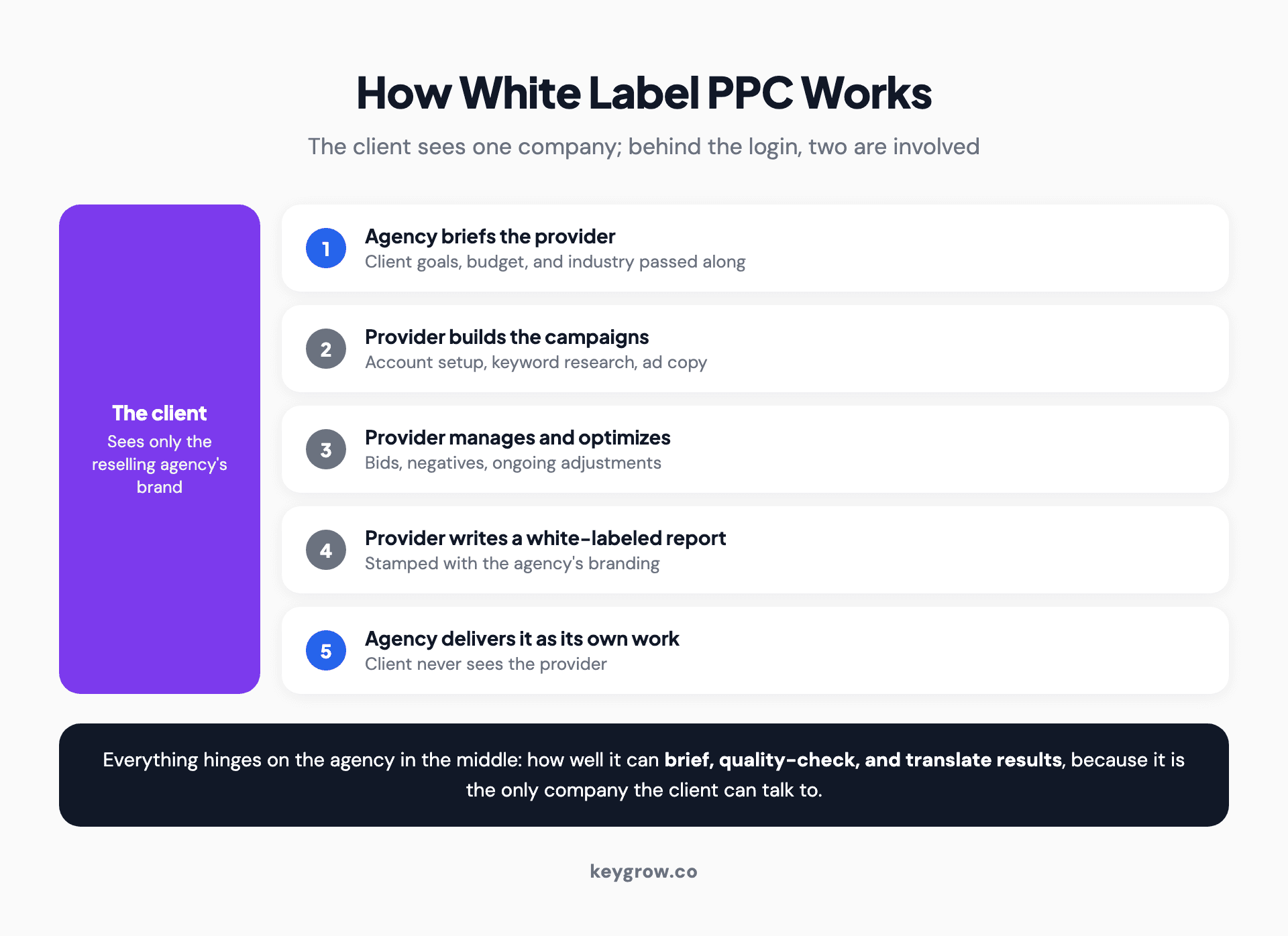
Flow diagram of how white label PPC works: the client hires the reselling agency, which briefs a hidden provider that builds and manages the campaigns, then returns white-labeled reports the agency delivers as its own.
The pricing math nobody spells out
The provider charges the agency roughly 10 to 15 percent of ad spend or a flat monthly fee, then the agency charges the client 18 to 25 percent. The client pays for two layers of management to reach one team doing the work.
Here is the part the reseller-focused guides skip. Say a client spends $5,000 a month on ads.
| Layer | Common rate | Monthly fee |
|---|---|---|
| Provider charges the agency | 10 to 15% of spend | $500 to $750 |
| Agency charges the client | 18 to 25% of spend | $900 to $1,250 |
| The agency's margin (the spread) | $400 to $500 |
Flat-fee arrangements land in a similar place: providers commonly charge agencies roughly $500 to $1,800 a month depending on account size, and the agency marks that up. None of these numbers come from an official rate card, they are just what providers commonly quote, so treat them as a range, not a rule.
The math is not automatically a rip-off. The agency does real work: winning the client, managing the relationship, and quality control. But the client is paying a management fee to a company that is paying a management fee to someone else, and the person actually adjusting the bids is two layers removed from the person paying the invoice. Whether that is worth it depends entirely on how good the agency in the middle is.
When white label PPC is the right call, and when it hurts
For a small agency, white label is smart when you want to offer PPC without hiring a specialist yet. It hurts the client when you are marking up work you cannot oversee or fix.
Honest verdict, agency side first.
It makes sense when: you are new to paid search, you have one or two PPC clients and cannot justify a full-time hire (a specialist runs roughly $65,000 to $90,000 a year, with senior specialists in major markets reaching $100,000 or more, plus overhead), or you want to test whether PPC demand exists among your clients before committing. It can also be a stopgap while you decide whether to hire a dedicated PPC agency or build the skill in-house. Used this way, white label is a sensible bridge.
It goes wrong when: you resell management you cannot evaluate. If you cannot read a search terms report or spot a broken conversion tag, you cannot tell whether the provider is doing good work or quietly burning the client's budget, and you cannot fix it when the client complains. You have become a billing layer, not a partner. That is the version that gives white label a bad name.
For the record, KeyGrow does not white-label client work, because the whole model puts a wall between the person paying and the person optimizing. We would rather the two be the same team. That is a preference, not a universal rule, but it is the reason we can answer any technical question about your account in real time.
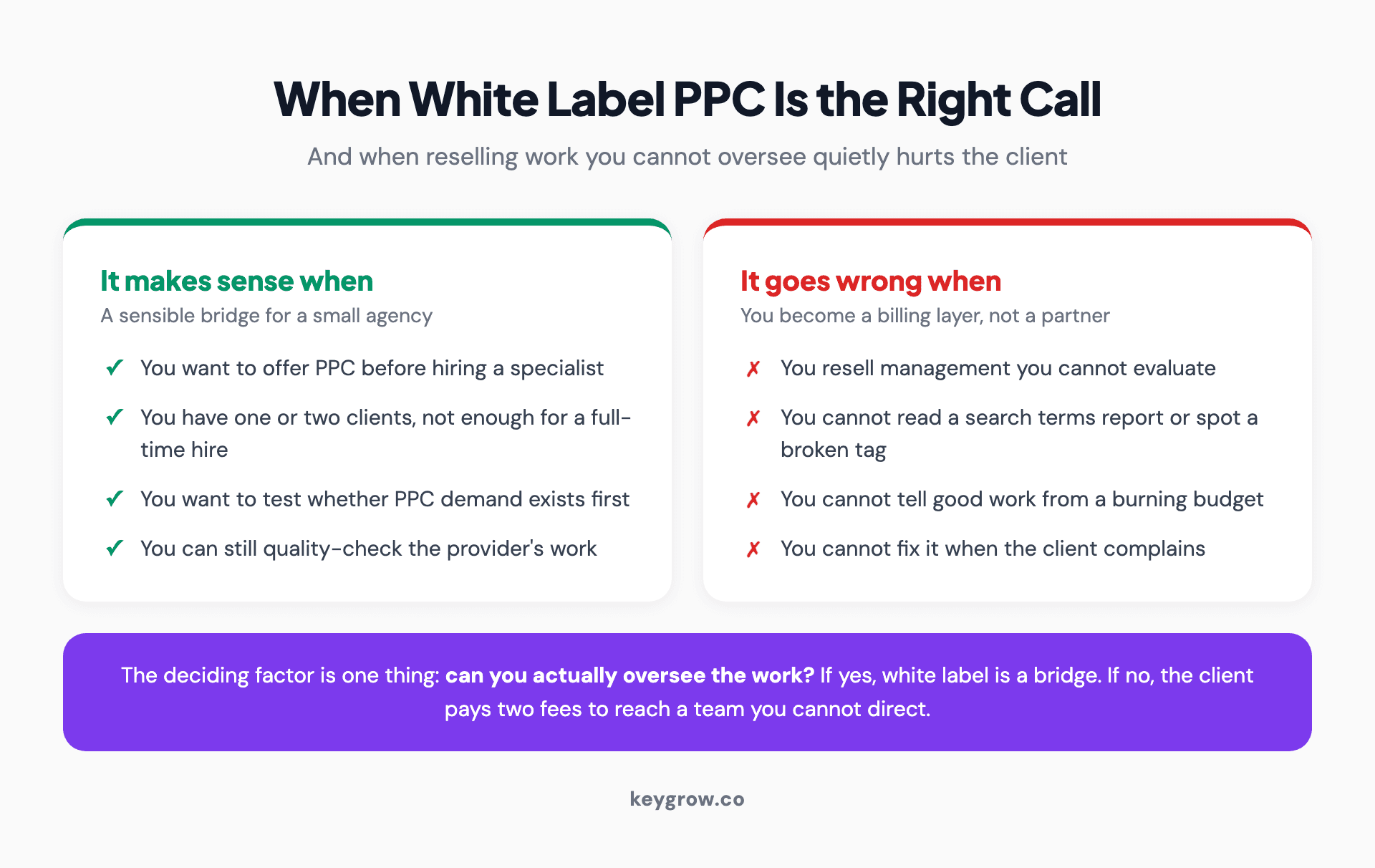
Two-column comparison of when white label PPC is the right call for a small agency versus when it quietly hurts the client, with the deciding factor being whether the reselling agency can oversee the work.
How to vet a white label provider
Check for Google Partner status, insist on client-owned ad accounts, and get the contract terms in writing before you resell anyone's work under your name.
If you are an agency choosing a provider, the non-negotiables:
- Google Partner status. A legitimate provider should hold at least Google Partner standing, which requires a rolling 90-day ad spend of $10,000 across managed accounts, a 70 percent optimization score, and at least half their strategists certified, per Google's requirements. Premier Partner adds a top-3-percent-per-country bar. Ask which they hold and verify it.
- Account ownership. The client should own their Google Ads account, with the provider added as a user. Google's manager account rules confirm the client keeps ownership and can unlink at any time, so never accept a setup where the provider locks the account and the client loses everything if they leave.
- A real contract. Confidentiality, non-solicitation of your clients, reporting cadence, and cancellation terms, all written down. No handshake deals when your brand is on the line.
- A track record you can check. Case studies with verifiable results, not vague promises of "200 percent improvement" with no baseline.
For business owners: is your agency white-labeling you?
If your account manager cannot answer technical questions in real time, refuses you direct access to your own Google Ads account, or sends reports that always lag by a day or two, your work is probably being outsourced.
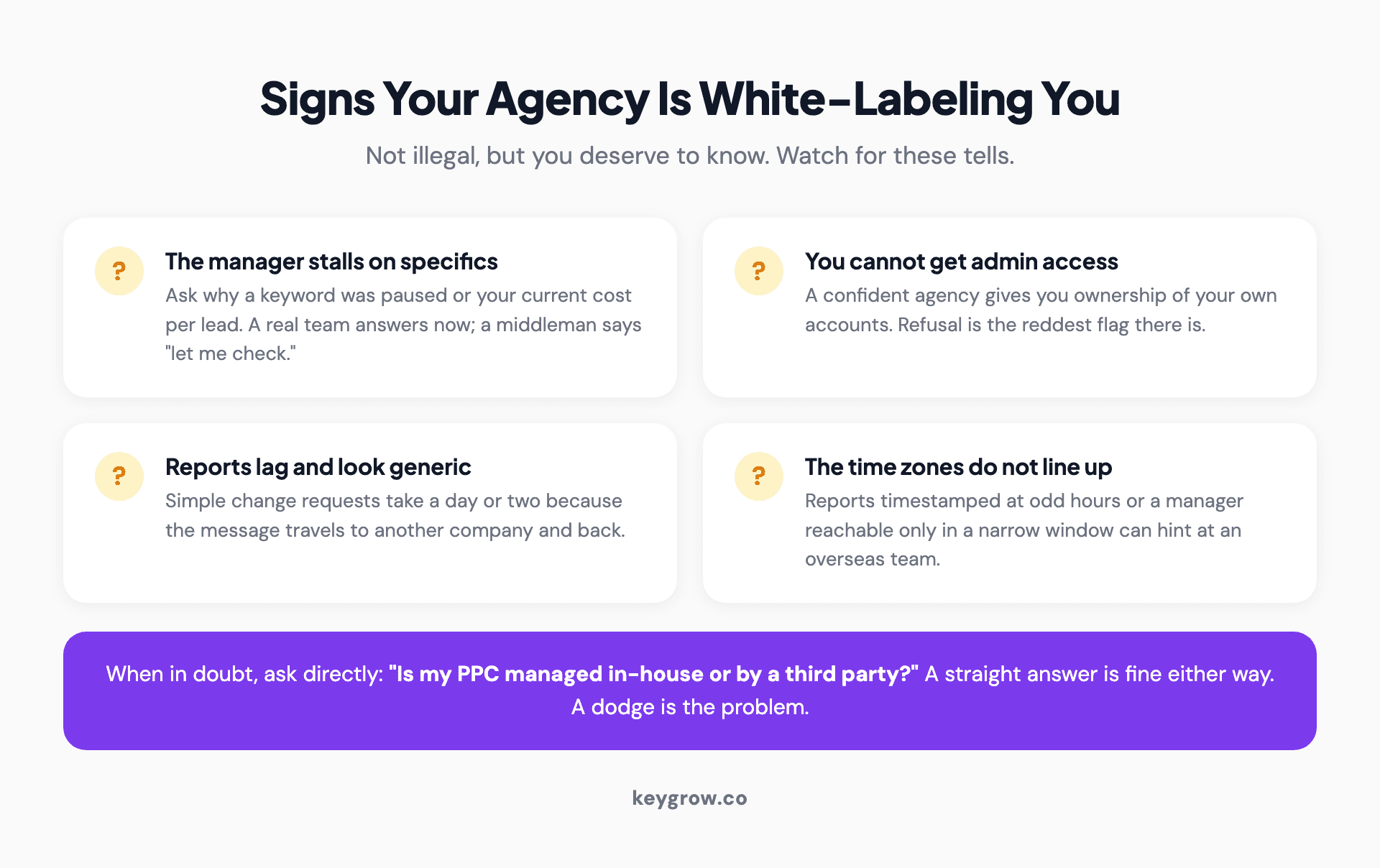
Checklist of signs your agency is white-labeling your PPC: a manager who stalls on specifics, no admin access to your own account, generic reports that lag, and mismatched time zones.
There is nothing illegal about white labeling, and a great agency can white-label and still deliver. But you deserve to know, and there are tells:
- The account manager stalls on specifics. Ask why a particular keyword was paused or what your current cost per lead is. A team doing the work answers immediately. A middleman says "let me check and get back to you."
- You cannot get admin access to your own account. A confident agency gives you ownership of your Google Ads and analytics accounts and adds itself as a user. Refusal is the reddest flag there is.
- Reports arrive on a delay and look generic. Simple change requests take 24 to 48 hours because the message has to travel to another company and back.
- Time zones do not line up. Reports timestamped at odd hours or a manager who is only reachable in a narrow window can hint at an overseas team behind the brand.
If you spot these, just ask directly: "Is my PPC managed in-house or by a third party?" A straight answer is fine either way. A dodge is the problem.
FAQs
What is white label PPC in simple terms?
White label PPC is a service where one company manages Google Ads campaigns that are delivered to the client under another company's brand. The agency sells and presents the work as its own, while a hidden provider does the actual campaign building and management.
How is white label PPC different from a referral?
In white label, the provider is invisible and the reselling agency keeps full ownership of the client relationship and sets its own price. In a referral, you send the client to another agency, the client knows and works with that agency directly, and you take a commission rather than a management margin.
How much does white label PPC cost?
Providers commonly charge the reselling agency around 10 to 15 percent of ad spend or a flat fee of roughly $500 to $1,800 a month, and the agency then charges the client about 18 to 25 percent of spend. These are industry conventions, not fixed rates, so they vary by provider and account size.
Will my clients know I use a white label provider?
Not unless you tell them. The entire point of white labeling is that the work is delivered under your brand, so the provider stays invisible. Many agencies choose to disclose it anyway, and that transparency tends to build more trust than it costs.
Is white label PPC worth it for a small agency?
It can be, when you want to offer PPC before you are ready to hire a specialist or while you test client demand. It stops being worth it when you are reselling management you cannot personally evaluate or fix, because then you are a billing layer rather than a partner your client can rely on.
How can I tell if my agency is white-labeling my ads?
Watch for an account manager who cannot answer technical questions on the spot, refuses to give you admin access to your own Google Ads account, or delivers generic reports on a consistent delay. When in doubt, ask directly whether your account is managed in-house or by a third party.
The honest version
White label PPC is a legitimate model that lets small agencies offer paid search before they can staff it, and it can serve clients perfectly well. It goes wrong in exactly one way: when the company selling the service cannot actually oversee the work, so the client pays two management fees to reach a team the agency itself cannot direct.
If you are an agency, resell only what you can quality-check, and pick a provider you can verify. If you are a business owner, you are allowed to ask who is really running your account, and a good partner will tell you without flinching. Either way, the fix for the whole white-label trust problem is the same: transparency. If you want PPC management where the people optimizing your account are the same people you talk to, that is the version we run, month-to-month.