

You found an agency, asked for a quote, and got back a one-page PDF that says "organic SEO services" near the top and a number near the bottom, with very little in between that tells you what you are actually buying. That gap is the whole problem. So before any pricing conversation, here is the plain version.
What are organic SEO services. Organic SEO services are the ongoing work an agency or specialist does to make your website rank in the unpaid search results, the ones you cannot buy with an ad, by improving three things Google and other engines reward: the technical health of your site, the content on it, and the authority pointing to it. You are not paying for a placement. You are paying for the work that earns the placement, and then keeps it. The single sharpest way to understand the value is this: paid ads are renting attention you stop receiving the moment you stop paying, and organic SEO is building an asset you own that keeps sending traffic after the invoices end.
That distinction is buried under sales copy on almost every vendor page that ranks for this term. This post pulls it back out, walks through exactly what is in the package, lays out real price ranges with sources, gives you a benchmarked timeline from our own 12-month case, and tells you plainly when you should not buy this at all.
What are organic SEO services?
Organic SEO services are paid work to grow your unpaid search traffic. An agency improves your site so search engines rank it higher for the terms your customers type, and you own the result rather than renting it like an ad.
The word "organic" is doing specific work here. In a search result, some listings are ads (marked "Sponsored") and the rest are organic, ranked by the engine on merit. Organic SEO is everything done to win those merit-based spots. You cannot pay Google to put you there directly. You earn it, which is why this is a service built around earning rather than buying.
Here is the pattern in practice. A plumber wants to show up when someone searches "emergency plumber" in their city. The ad slot at the top is paid search, billed per click. The map pack below it is local SEO. The blue-link results under that are organic SEO, and they keep working at 2 AM whether or not anyone is funding an ad campaign that night. Organic SEO services are the retained work that gets the plumber into those blue links and keeps them there as competitors push back.
This is different from a one-time project. A site audit or a single round of fixes is useful, but organic search rewards consistency, which is why most real engagements are retainers. The work does not end at launch. It barely starts there.
What is actually included in organic SEO services?
A real organic SEO package covers three pillars: technical SEO (the site engines can crawl and trust), content (pages that answer what people search), and authority (links and signals that prove you are credible). Most retainers run all three on a monthly cycle.
If a proposal does not name these, ask why. The pillars are not interchangeable, and a package that only sells you one of them is selling you a third of a strategy. Here is what each one means in plain terms.
Technical SEO is the foundation. It covers crawlability, indexing, site speed, mobile usability, internal linking, structured data, canonical tags, and fixing the boring breakages that quietly suppress rankings. None of it is glamorous and all of it is load-bearing. A site that is slow or uncrawlable will not rank no matter how good the writing is. If you have never had a proper pass done, our walkthrough on running a technical SEO site audit covers the exact crawl-and-index checks a good service runs first.
Content is the part most people picture when they hear SEO. It means keyword and topic research, new pages built around real search demand, rewrites of thin existing pages, and a publishing cadence that compounds. Good content services start from a topical map, not a random list of keywords. We have a full breakdown on building an SEO topical map if you want to see how the planning works before the writing starts.
Authority is the off-site work: earning links from credible sites, digital PR, citations, and the reputation signals that tell engines other people vouch for you. This is the slowest and most abused pillar. Anyone selling you a thousand links for ninety-nine dollars is selling you a future manual action, not authority.
Most retainers also bundle in reporting, strategy calls, and competitor monitoring. The deliverables vary, but the shape is consistent.
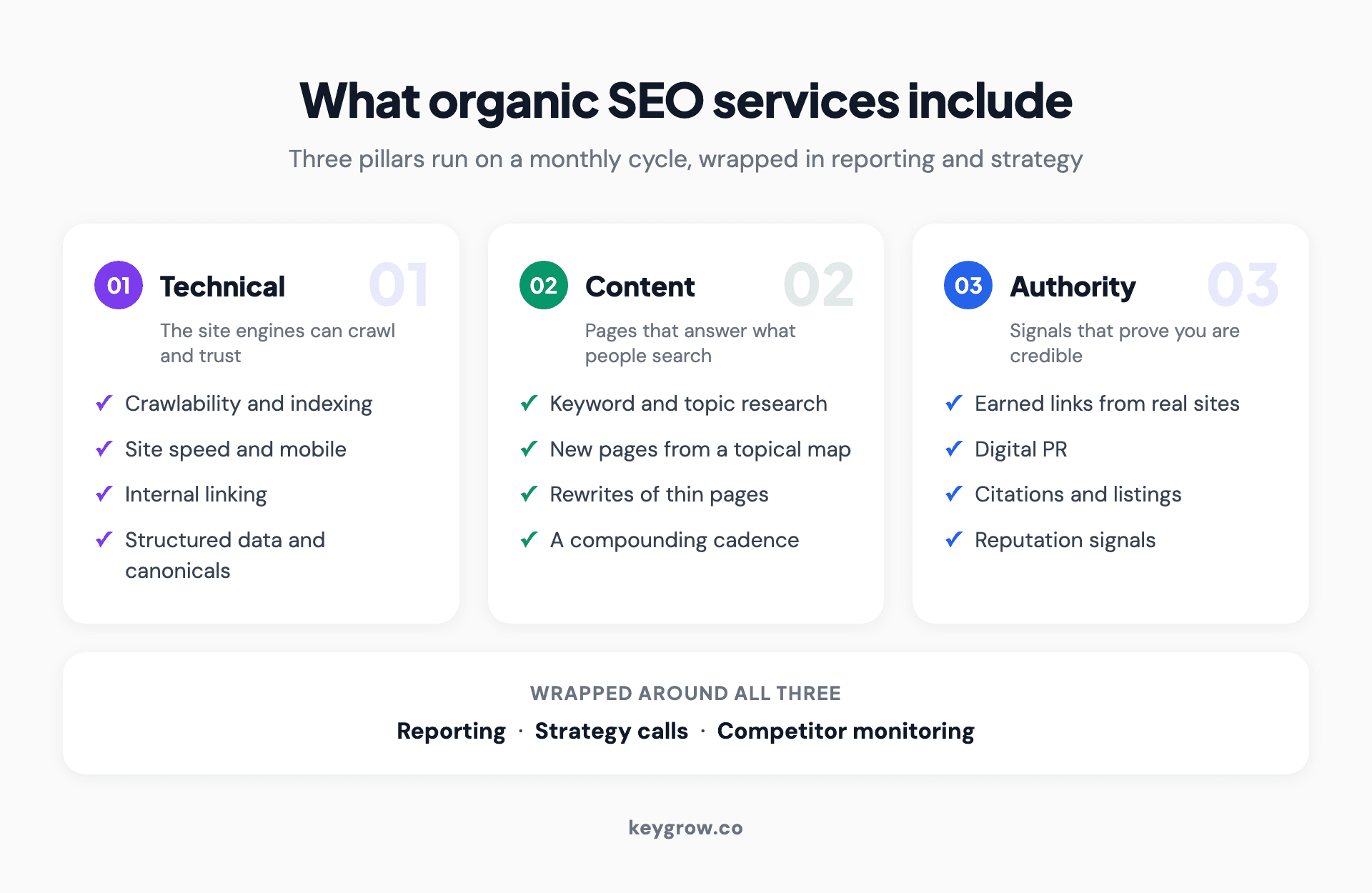
Three-pillar layout of what organic SEO services include: technical SEO covering crawlability speed and structured data, content covering keyword research new pages and rewrites, and authority covering links digital PR and citations, with reporting and strategy wrapping all three
A quick reality check on scope. The exact line items shift by agency and by industry, but the three pillars do not change. A package missing one of them is not cheaper, it is incomplete.
Organic SEO vs paid search: what's the real difference?
The real difference is ownership. Paid search rents attention you lose the moment you stop paying, and organic SEO builds an asset that keeps producing after the work slows. Paid is faster and switch-off-able; organic is slower and compounding.
Neither one is "better" in the abstract. They solve different problems on different timelines, and most businesses that can afford to should run both. Here is the honest side-by-side.
| Factor | Paid search (PPC) | Organic SEO |
|---|---|---|
| Speed to first traffic | Same day | Months |
| What you are paying for | A placement (per click) | The work that earns a placement |
| What happens when you stop | Traffic stops immediately | Traffic decays slowly, often over months |
| Cost per visit over time | Stays roughly flat | Drops as rankings compound |
| Best for | Launches, promos, fast tests, instant leads | Durable demand, long-term cost efficiency |
| Main risk | Spend with nothing to show after | Time and patience with no early payoff |

Split view of a search results page with sponsored ad listings at the top and organic blue-link results below, illustrating paid search versus organic SEO
The opinion I will plant here, with a number behind it: SEO is a compounding asset, not a campaign, and the businesses that quit at month three pay for the hard part and leave before the payout. Our strongest organic case took a full 12 months of consistent work to reach 1,519 percent traffic growth. The first quarter looked unimpressive. The twelfth month did not. Anyone selling you organic SEO as a quick win is either targeting keywords nobody searches or about to burn your domain.
If you need leads this week and have a budget to spend, paid is the right call, and we have written on whether PPC or SEO gets faster results for small businesses. If you want a channel that costs less per lead every quarter it runs, that is organic.
How long do organic SEO services take to work?
Organic SEO typically takes 3 to 6 months to show early movement and closer to 12 months to compound into serious traffic. Anyone promising page one in 30 days is a red flag. The work is front-loaded and the payoff is back-loaded.
This is the question that ends the most agency relationships, almost always because expectations were never set honestly at the start. So let me set them with a real timeline instead of a sales promise.
A doctor's practice in Dubai committed to organic SEO for a full year. Months one through three looked flat on the surface: technical fixes nobody could see, content going live with little immediate traffic, early authority work that had not landed yet. By month twelve, organic traffic had grown 1,519 percent and the practice was fielding 130-plus patient calls a month. Same site, same client, no shortcuts, just consistent technical fixes, content, and authority building stacking up over time. That is the realistic horizon for compounding organic results, and it is the canonical answer to anyone promising the top of page one in a month.
Why so slow. Search engines need to crawl your changes, re-evaluate your site against competitors, and watch how real users respond, and that loop runs on their schedule, not yours. New content also has to accumulate trust before it ranks. Organic results are a verdict the web returns slowly, and you cannot rush the jury.
The practical takeaway: budget for at least 6 months before you judge an organic engagement, and ideally 12 before you judge the channel. If your cash flow cannot survive that wait, run paid in parallel while organic builds underneath it.
What do organic SEO services cost in 2026?
Most US and UK businesses pay between roughly $1,500 and $10,000 per month for organic SEO services that move the needle, with small businesses typically landing in the $1,000 to $3,000 range. Cheaper than that usually means automated output, not strategy.
Pricing is the part vendor pages dodge hardest, so here are real market ranges with a source. Per the WebFX pricing data, the bulk of businesses paying for SEO that produces results sit between $1,500 and $10,000 a month, and small businesses commonly run $1,000 to $3,000 monthly. The spread is wide because "organic SEO services" covers everything from a one-person freelancer running basics to a team doing technical work, content, and digital PR across a competitive market.
| Engagement type | Typical monthly range | What you get |
|---|---|---|
| Cheap automated packages | Under $500 | Spun content, bulk links, little strategy. Often a net negative. |
| Freelancer or solo | $500 to $2,000 | One person, limited bandwidth, good for small local sites |
| Small-business retainer | $1,000 to $3,000 | A team running all three pillars at a modest cadence |
| Mid-market retainer | $3,000 to $10,000 | Full strategy, content volume, digital PR, competitive markets |
| Enterprise or hourly | $10,000+ / $100 to $250 per hour | Large sites, in-house collaboration, heavy technical work |
Two honest notes on price. First, the cheapest tier is usually the most expensive, because spun content and bulk links can trigger a penalty that costs more to clean up than you ever saved. Second, KeyGrow does not publish a flat blog price, because the right number depends on your market and goals, but we are month-to-month and cancel anytime, which matters more than the headline figure. A 12-month lock-in contract is a confession: if an agency needs a contract to keep you, the results are not doing it.
For the value side of this math, our piece on whether SEO services are worth it runs the return calculation and shows you how to check the payback yourself once the work is running.
How organic SEO now feeds AI search and AI Overviews
Organic SEO now drives AI visibility on top of the blue links. AI Overviews and chat assistants pull their answers from the same organic pages that rank in classic search, so strong organic content is increasingly what earns you a citation inside the AI answer.
This is the 2026 angle most vendor pages cover badly or not at all, and it changes the value of organic work rather than reducing it. The pages you build to rank organically are the same pages AI engines quote. Skipping organic does not let you skip into AI search; it locks you out of both.
The data backs this up. ChatGPT search results overlap with the top organic results from its underlying index by roughly 73 to 87 percent, which means classic organic ranking still drives a large share of AI answer visibility. AI systems also cite pages about 25 percent fresher than regular search results, so the ongoing content updates in an organic retainer matter more now, not less, because freshness is a ranking and citation factor. And per the Princeton and Georgia Tech research on generative engine optimization, adding relevant statistics raised AI-answer visibility by about 40 percent and expert quotes by roughly 37 percent. Organic content written to be cited, with real numbers and named sources, wins in AI search the same way it wins in classic search.
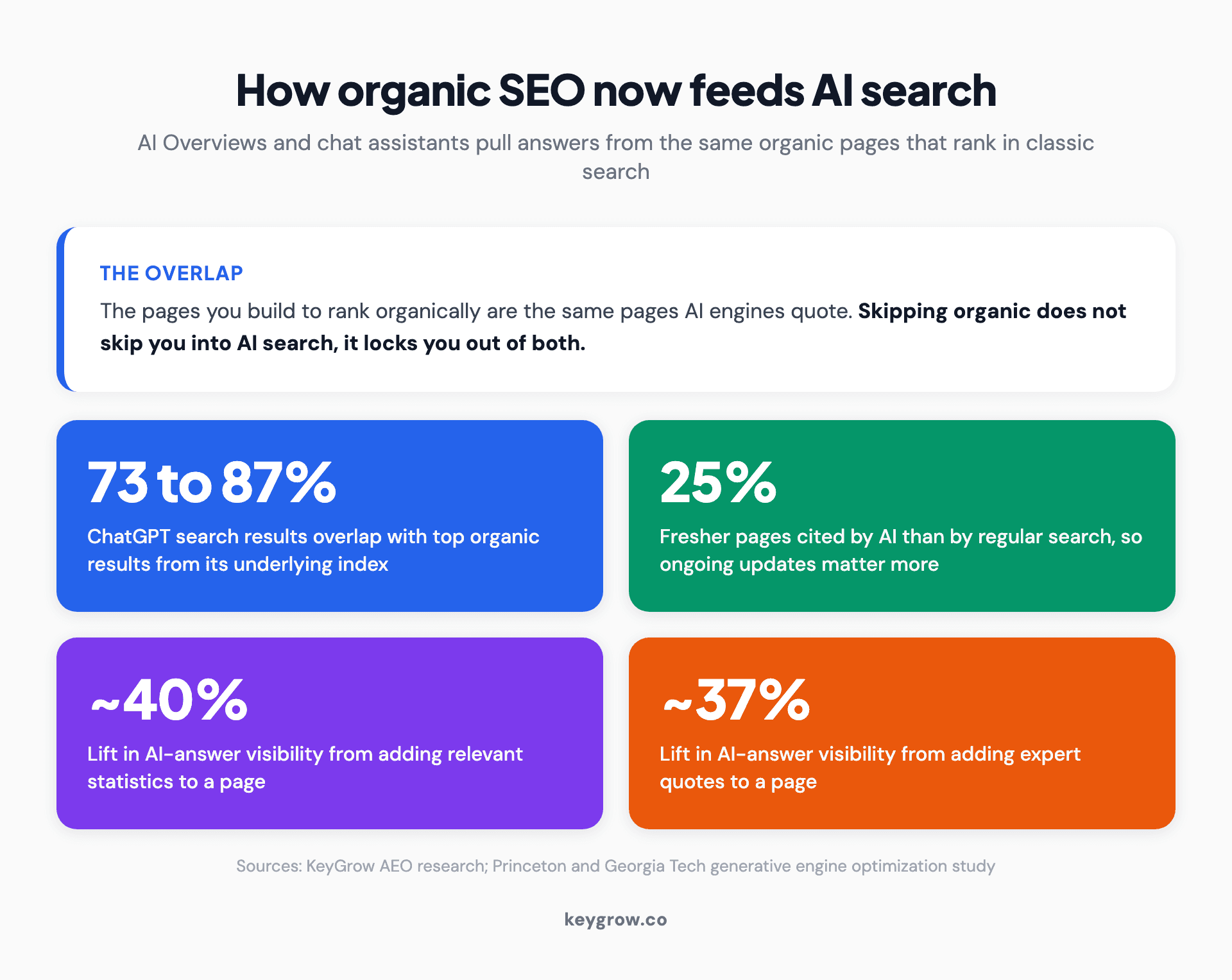
Stat strip showing how organic SEO feeds AI search: ChatGPT results overlap Bing organic 73 to 87 percent, AI cites pages 25 percent fresher, statistics raise AI visibility about 40 percent, expert quotes about 37 percent
What this means for what you buy. A good organic SEO service in 2026 builds pages that answer questions directly, lead with the answer, and back claims with data, because that structure ranks in Google and earns citations in AI answers at the same time. The takeaway: organic is no longer just an SEO play, it sits underneath AI visibility as well.
When you should not pay for organic SEO services
Do not pay for organic SEO if you need leads this week, sell a one-time product nobody searches for repeatedly, run a brand-new site with no budget for a long runway, or have more time than money and can do the basics yourself. In those cases, the fee is wasted.
This is the section vendor pages skip, because turning away a sale feels like bad business. It is actually the most useful thing we can tell you, so here is the honest list of when organic SEO is the wrong purchase.
That last point deserves a beat. We turn away businesses we cannot help, because an agency that will not tell you who is a bad fit is selling, not consulting. If your situation is on this list, a retainer is the wrong move this quarter, full stop.
How to tell if your organic SEO is actually working
You tell if organic SEO is working by tracking outcomes, not vanity metrics: growth in organic traffic to money pages, rankings for commercial keywords, and most of all leads, calls, and revenue. If your report opens with impressions, ask why.
Vanity-metric reporting is the industry's biggest scam. Impressions, clicks, and "engagement" do not pay rent. A real organic SEO report leads with the numbers that show up in your bank account, then supports them with the search metrics that explain the movement. Here is what to watch, roughly in order of importance.
1. Leads, calls, and revenue from organic. The point of the whole exercise. Track form fills, phone calls, and booked jobs attributed to organic search. Our doctor case is measured in patient calls (130-plus a month), not rankings.
2. Organic traffic to pages that make you money. Total traffic is a vanity number if it lands on your blog and never your service pages. Watch the trend on commercial pages.
3. Rankings for commercial-intent keywords. Position for the terms a buyer types, not the informational ones alone. Movement here predicts the lead movement above.
4. Visibility in AI answers. Increasingly worth tracking: whether your pages get cited in AI Overviews and chat assistants for your key questions.
5. Technical health trend. Indexed pages, crawl errors, and Core Web Vitals moving the right way over time.
The first quarter will look thin on the outcome metrics and that is normal, which is exactly why you watch the leading indicators (rankings, indexed pages, content shipped) early and the lagging ones (leads, revenue) later. We have a full guide on how to know your SEO is working if you want a fuller scorecard, including AI-answer visibility.
One rule covers all of it: if you cannot trace the spend to leads within a reasonable window, something is wrong with the strategy or the reporting, and you are allowed to ask hard questions about both.
FAQs
What is the difference between organic SEO and paid SEO?
Organic SEO is the work that earns unpaid search rankings on merit, and you own the result. Paid search (often loosely called paid SEO) is buying ad placements that appear above or beside organic results, billed per click. Paid traffic stops the moment you stop paying; organic traffic keeps coming after the work slows. Most businesses that can afford both run them together.
What is included in an organic SEO service package?
A real package covers three pillars: technical SEO (crawlability, speed, structured data, internal linking), content (keyword research, new pages, rewrites, a publishing cadence), and authority (earned links, digital PR, citations). Most retainers add reporting, strategy calls, and competitor monitoring on a monthly cycle. If a proposal only sells one pillar, it is selling a third of a strategy.
How long does it take for organic SEO to show results?
Organic SEO usually shows early movement in 3 to 6 months and compounds into serious traffic closer to 12 months. Our strongest case, a doctor practice in Dubai, took a full year to reach 1,519 percent organic traffic growth and 130-plus monthly calls. Budget at least 6 months before judging an engagement. Anyone promising page one in 30 days is a red flag.
How much do organic SEO services cost per month?
Most US and UK businesses pay roughly $1,500 to $10,000 per month for organic SEO that moves the needle, with small businesses typically in the $1,000 to $3,000 range. Freelancers run lower; competitive markets and enterprise sites run higher. Packages under $500 a month usually mean automated content and bulk links, which often do more harm than good.
Is organic SEO worth it for a small business?
For most small businesses with recurring search demand, yes, because the cost per lead drops every quarter the rankings hold, unlike ads that reset to zero when you stop paying. It is not worth it if you need leads this week, sell something nobody searches for, or cannot fund a 12-month runway. Match the channel to your timeline and cash flow before committing.
Can I do organic SEO myself instead of hiring an agency?
Yes, for the basics, and often you should. A single-location business can claim its Google Business Profile, gather reviews, fix site speed and titles, and publish honest pages without paying anyone. Hire help when the opportunity cost of your own time beats the fee, or when the work needs technical depth and authority building you cannot do alone. Know the common DIY failure points before you start.
Does organic SEO still work with AI Overviews and ChatGPT?
Yes, and it matters more now. AI Overviews and chat assistants pull answers from the same organic pages that rank in classic search, with ChatGPT results overlapping top organic results by roughly 73 to 87 percent. Pages built to rank organically, with direct answers and cited data, are exactly what AI engines quote. Skipping organic locks you out of both classic and AI visibility.
How do I know if my organic SEO services are working?
Track outcomes, not vanity metrics. Watch leads, calls, and revenue attributed to organic search first, then organic traffic to your money pages and rankings for commercial-intent keywords. Add AI-answer visibility to the scorecard in 2026. If your monthly report opens with impressions and clicks instead of pipeline, ask the agency why.
Where this leaves you
Organic SEO services are paid work to grow the search traffic you own rather than rent. The package is three pillars (technical, content, authority), the timeline is months not weeks, the market price runs roughly $1,000 to $10,000 a month depending on your size and market, and the same work now feeds AI answers as well as blue links. The one promise to distrust is speed.
If you want a straight read on whether organic is the right channel for your business this quarter, that is exactly the conversation we have before anyone signs anything. We are month-to-month, we will tell you if DIY or paid fits you better, and we would rather turn down a bad fit than sell you a retainer you do not need. Get started here and we will look at it with you.


