

A prospect asked me last month why their shiny new landing page, the one their designer was proud of, had pulled exactly zero visitors from Google in three months. The page looked great. It just was not built to be found.
So what is an SEO landing page. It is a single, focused page built to rank in organic search for a specific query and convert the person who arrives, so it has to satisfy both a search engine and a human at the same time. That dual job is the whole point. A page that only ranks gets traffic and no leads. A page that only converts never gets the traffic in the first place. An SEO landing page is the one you build when you want both, from the same URL, for free, over time.
That last part trips people up. Organic traffic is not free to earn, it is free to receive once you have earned it. About 68 percent of online experiences start with a search engine, per BrightEdge research, which is exactly the demand an SEO landing page is designed to capture while your ads are switched off.
What is an SEO landing page?
An SEO landing page is a standalone web page optimized to rank in organic search for a target keyword and to turn that visitor into a lead or sale. One page, one main intent, two jobs.
It sits between a blog post and a pure sales page. A blog post wants to inform. A conversion page wants to close. An SEO landing page does both: it answers the searcher's question well enough to earn the ranking, then points them at one clear action while they are still warm. Someone typing "junk removal near me" or "estate planning attorney" into Google is not browsing. They want a result and a next step, and the page has to give them both before they bounce back to the results.
The keyword choice decides everything else. Pick a query with real commercial intent, build the page around the answer to it, and make the path to contacting you obvious. Get the intent wrong and no amount of design saves the page.

A marketer reviewing a single focused landing page on a laptop, the kind of page built to rank for one keyword and convert the searcher.
SEO landing page vs PPC landing page: what actually changes
The traffic source changes, and that changes almost everything downstream. An SEO landing page earns free organic clicks over months. A PPC landing page buys clicks the moment your ad goes live.
Here is the practical split. A PPC page can be stripped bare, sometimes a single screen with a headline, a form, and no navigation, because you already paid for the click and your only job is the conversion. Google's quality systems care about relevance to the ad, not whether the page ranks. An SEO page cannot be that thin. It needs enough substance to satisfy a search query, internal links so crawlers can find it, and content depth that a one-screen squeeze page simply does not have.
| Factor | SEO landing page | PPC landing page |
|---|---|---|
| Traffic source | Free organic clicks | Paid ad clicks |
| Time to results | Weeks to months | Same day |
| Content depth | Substantial, keyword-relevant | Can be minimal |
| Navigation | Usually kept, for crawling | Often stripped to reduce exits |
| Cost over time | Compounds, drops per-lead | Stops when budget stops |
| Indexed by Google | Yes, that is the point | Often noindexed |
Neither is better. They answer different questions. If you want to know which fits your timeline and budget, we broke that decision down in local PPC vs SEO for small businesses. The short version is that ads buy you today and SEO buys you next year, and most growing businesses end up running both.
What Google looks for on a landing page it will rank
Google ranks pages that match the searcher's intent, load fast, work on a phone, and read like a real authority on the topic. Match the intent first, because nothing else rescues a page aimed at the wrong query.
Intent is the make-or-break signal. If someone searches "what is an SEO landing page" they want an explanation, not a contact form. If they search "estate cleanout service Dallas" they want a local provider they can call. Google has already decided what kind of page deserves to rank for each query, and you can see that decision by looking at what currently ranks. Build the wrong page type and you are fighting the algorithm's own read of the query.
Then come the technical floors. Core Web Vitals are Google's published page-experience thresholds, and the "good" bar is LCP under 2.5 seconds, INP under 200 milliseconds, and CLS under 0.1, measured at the 75th percentile of visits, per Google Search Central. Miss those badly and a slow page loses to a faster competitor that answers the same question. The platform you build on is rarely the bottleneck here. Execution is, which is part of why a careful technical audit catches more ranking problems than a redesign does.
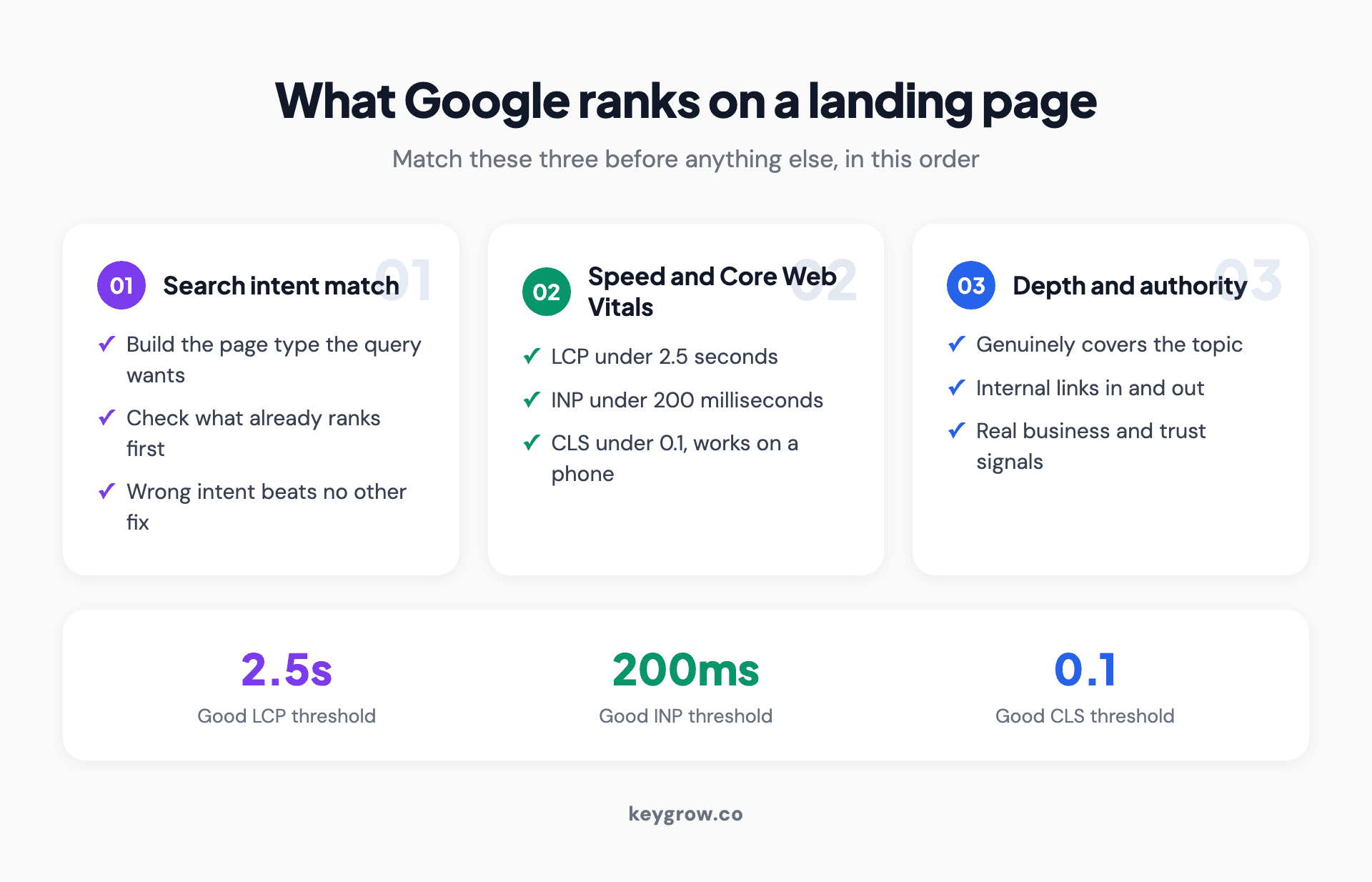
Three card layout showing what Google looks for on a landing page it will rank: search intent match, Core Web Vitals speed thresholds, and topical depth with internal links.
The third signal is depth and authority. Google wants a page that genuinely covers the topic, links to and from relevant pages on your site, and carries the trust markers (real business details, reviews, accurate information) that say a credible operator is behind it.
How to build an SEO landing page that ranks and converts
Start with one keyword and its intent, write the answer first, then design the page so the next step is impossible to miss. The order is the trick: research, then content, then conversion design, never the reverse.
Here is the build I run, in sequence.
1. Pick one primary keyword with commercial intent. One page, one main query. Trying to rank a single page for five unrelated terms dilutes all five.
2. Read the pages that already rank. They show you the format Google rewards and the questions it expects answered. Match the depth, then beat it on clarity.
3. Lead with the direct answer. Put it in the first 100 words. Roughly 44 percent of AI citations come from the first third of a page, and the same answer-first habit helps both classic snippets and AI overviews. Burying the answer to pad word count actively hurts now.
4. Write substantial, specific content. Cover the subtopics a buyer actually wants. Add proof: numbers, examples, a real result.
5. Get the on-page basics right. A keyword-led title tag and a clear meta description matter more than people think. We covered the details in what meta data is in SEO.
6. Make one action obvious. One primary call to action, repeated, not five competing buttons. Clarity converts.
7. Link it into your site. Internal links from related pages help Google find and rank it. For local businesses, our guide on content for local landing pages shows how to add the geo and service detail that ranking pages need.
That sequence is also the answer to the bigger question of whether these pages move the needle at all, which we tackled head-on in do landing pages help SEO.
Should you let Google index it, and the cannibalization trap most sites miss
Index your SEO landing page, but keep it separate from the PPC page you point ads at, or the two will fight each other for the same query. This is the part most guides skip, and it quietly wastes budget.
Here is the trap. A business builds one great page, ranks it organically, then sends paid ads to the same URL for the same keyword. Now they are paying for clicks they were already getting for free, and the ad and the organic listing cannibalize each other in the same result. The cleaner setup is two pages: the SEO version, indexed and earning organic clicks, and the PPC version, often set to noindex so it does not compete in organic and can be stripped down for pure conversion.
The reverse mistake is just as common. People noindex a page they actually want to rank, usually by accident, a leftover staging setting or a careless plugin toggle. If you want organic traffic, the page must be indexable, in your sitemap, and free of any stray noindex tag. One bad directive on a template can hide thousands of pages.
So the rule is simple. SEO page: indexed, in the sitemap, built to rank. PPC page: usually noindexed, built to convert. Same offer, two URLs, no infighting.
How an SEO landing page differs from a homepage or service page
A homepage serves your whole brand and many intents at once. An SEO landing page serves one query with one answer and one action. That focus is exactly why it ranks and converts better for a specific search.
A homepage tries to be everything: who you are, what you do, every service, every audience. That breadth is fine for branded searches ("KeyGrow") but terrible for a specific commercial query, because the page sends mixed signals to Google about what it is even about. A service page is narrower, it covers one service, but it is still written for browsers who already trust you, not for a cold searcher arriving from Google.
The most expensive default in this whole topic is sending traffic, paid or organic, to a homepage instead of a focused page. We saw it with a mobile detailing client paying around $100 per booking from ads that all dumped onto their homepage. We rebuilt the campaign and pointed it at a dedicated booking landing page, and cost per conversion dropped to $22 while bookings grew 650 percent between August and December. The ad was half the job. The page was the other half, and the homepage was the wrong page.
That is the gap an SEO landing page fills: one query, one promise, one action, with nothing else on screen competing for the click.
When an SEO landing page is the wrong tool
When you need leads this week, when nobody searches the term, or when your site has bigger technical problems, an SEO landing page is the wrong first move. It is a compounding asset, not an emergency fix.
Be honest about the timeline. Only about 19 percent of newly published pages reach Google's top 10 within a year, and most take much longer, per Backlinko's study. If your sales pipeline is empty right now, a new SEO page will not save this quarter. Run ads for the immediate demand and build the SEO page for the quarter after. That is the same reason we tell people SEO needs time to compound before it pays off.
Here is the part most agencies will not say. Sometimes you should not pay anyone for this. A single-location business with more time than money, targeting a low-competition local term, can write a solid SEO landing page themselves: pick the keyword, answer it clearly, add their service and location detail, and link it from their other pages. Hire help when the opportunity cost of your own hours beats the fee, or when the keyword is competitive enough that execution quality decides the winner. If the term has no real search volume, skip the page entirely and spend the effort where demand actually exists.

A small business owner weighing whether to build an SEO landing page or run ads first, with notes and a laptop on a desk.
How to tell if your SEO landing page is working
Track keyword rankings, organic clicks, and conversions from those clicks, in that order, and judge the page on leads, not vanity metrics. A page ranking on page two with zero leads is not working, no matter how the impressions look.
The numbers that actually matter:
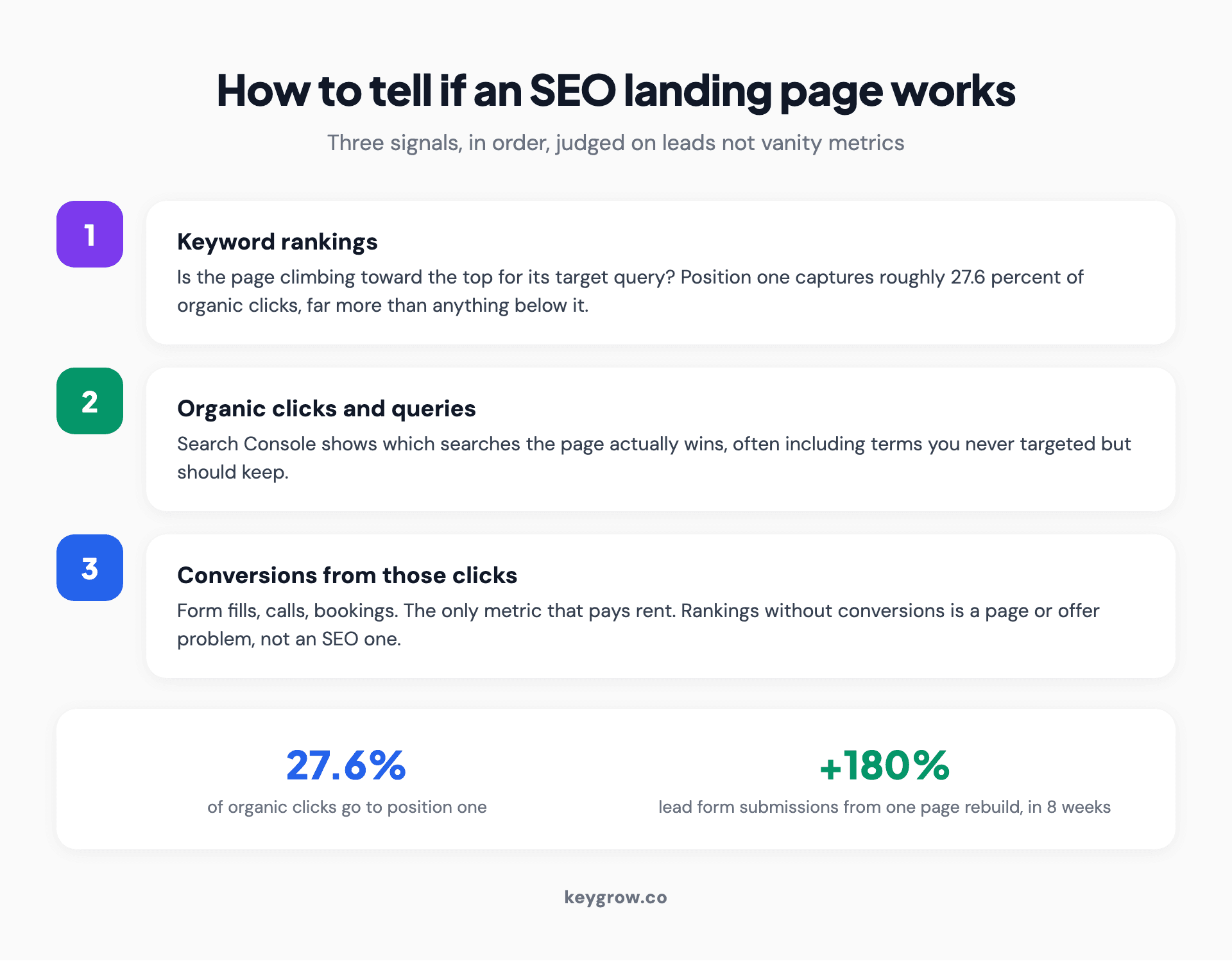
Numbered three step layout for measuring an SEO landing page: track keyword rankings, then organic clicks and queries, then conversions and leads from those clicks.
Rankings without conversions usually means the page ranks but the offer or the call to action is weak, which is a conversion fix, not an SEO one. The fastest way to make the page worth more is often to improve what happens after the click. An Easy Cleanouts LLC landing page rebuild lifted lead form submissions by 180 percent in 8 weeks, on roughly the same traffic, which shows that page quality, not just rankings, is what turns visits into jobs. If you want a fuller framework, we wrote how to know your SEO is working.
FAQs
What is the difference between an SEO landing page and a PPC landing page?
An SEO landing page earns free organic clicks over months and needs substantial, keyword-relevant content to rank. A PPC landing page buys clicks instantly through ads and can be stripped down to a headline and a form because the click is already paid for. The SEO page is usually indexed; the PPC page is often noindexed so the two do not compete for the same query.
Can a landing page rank on Google?
Yes. A landing page can rank organically as long as it is indexable, targets a clear keyword, answers the searcher's intent, and has enough quality content to compete. The catch is timing: only about 19 percent of new pages reach the top 10 within a year, so plan for it as a compounding play rather than an instant win.
Should SEO landing pages be indexed?
Yes, an SEO landing page must be indexed and included in your sitemap, because indexing is the entire point of building it. The opposite is true for a PPC landing page, which is often set to noindex so it does not compete with your organic page for the same keyword. Keep the two as separate URLs to avoid them cannibalizing each other.
How is an SEO landing page different from a homepage?
A homepage serves your whole brand and many search intents at once, which sends mixed signals to Google for any specific query. An SEO landing page targets one keyword with one answer and one clear action, so it ranks and converts better for that exact search. Sending paid or organic traffic to a homepage instead of a focused page is one of the most common and most expensive defaults in marketing.
Does optimizing a landing page for SEO hurt its conversion rate?
Not when it is done well. The two goals overlap more than they conflict: a fast, clear, well-organized page that answers the searcher's question also tends to convert. Problems only appear when SEO is reduced to keyword stuffing or padding, which annoys both Google and the reader. Keep one obvious call to action and the SEO work supports conversion rather than competing with it.
How long does an SEO landing page take to rank?
Usually weeks to several months, and competitive keywords can take a year or more. Backlinko found only about 19 percent of new pages reach the top 10 within a year. Lower-competition local terms move faster than national, high-difficulty ones, so set the timeline by the keyword you are chasing, not by hope.
How many words should an SEO landing page have?
There is no fixed number. Aim for within about 20 percent of the word count of the pages already ranking for your keyword, because that range reflects what Google currently rewards for that intent. A local service page might rank with a few hundred well-targeted words, while a competitive informational query may need well over a thousand. Match the intent and the competition, not an arbitrary quota.
Do I need a separate landing page for SEO and for ads?
In most cases, yes. Keeping the SEO page (indexed, content-rich, built to rank) separate from the PPC page (often noindexed, stripped down to convert) stops the two from cannibalizing each other for the same keyword. It also lets you optimize each for its single job instead of forcing one page to do both compromises at once.
Where this leaves you
An SEO landing page is the page that earns its own traffic and converts it, one keyword and one action at a time. It is slower than ads and worth more than ads once it lands, and the businesses that win run both: ads for this month, SEO pages for the years after. If you want a second set of eyes on whether your pages are built to rank and convert, our team is happy to look, and we will tell you honestly if a page is closer than you think or not worth the build at all.


