


The advice you hear most about motivated seller Facebook ads is to target the sellers. Homeowners 50 and older, a few ZIP codes with lots of foreclosure filings, relationship status set to divorced. In the US, that campaign can't run. Since December 2019, Meta has required advertisers in or reaching the US to declare housing ads as a Special Ad Category, and an ad offering to buy someone's house falls under Meta's housing definition. Age is locked at 18 to 65+. Every gender is included. ZIP codes, exclusions and lookalike audiences are gone, and any city you pick grows to a 15-mile radius.
So the targeting can't find motivated sellers. The ad and the form have to. Motivated seller Facebook ads work when the creative talks about the house and the offer, the instant form sorts people by timeline and condition, someone calls within the hour, and you judge the campaign by cost per signed contract.
Below is one campaign built that way, end to end. The budget and conversion numbers are an illustration to swap for your own. The rules come from Meta's own help pages and policies.
What Meta's Housing category takes off the table
A US housing campaign can't narrow by age, gender or ZIP code, can't exclude anyone, can't use lookalikes, and widens every city to 15 miles.
Meta defines a housing ad as one that "promotes or directly links to a housing opportunity or related service," and its list includes real estate services alongside sale listings. A cash offer on someone's home fits that description. Declare Housing when you create the campaign. Meta says an undeclared housing ad may be rejected.
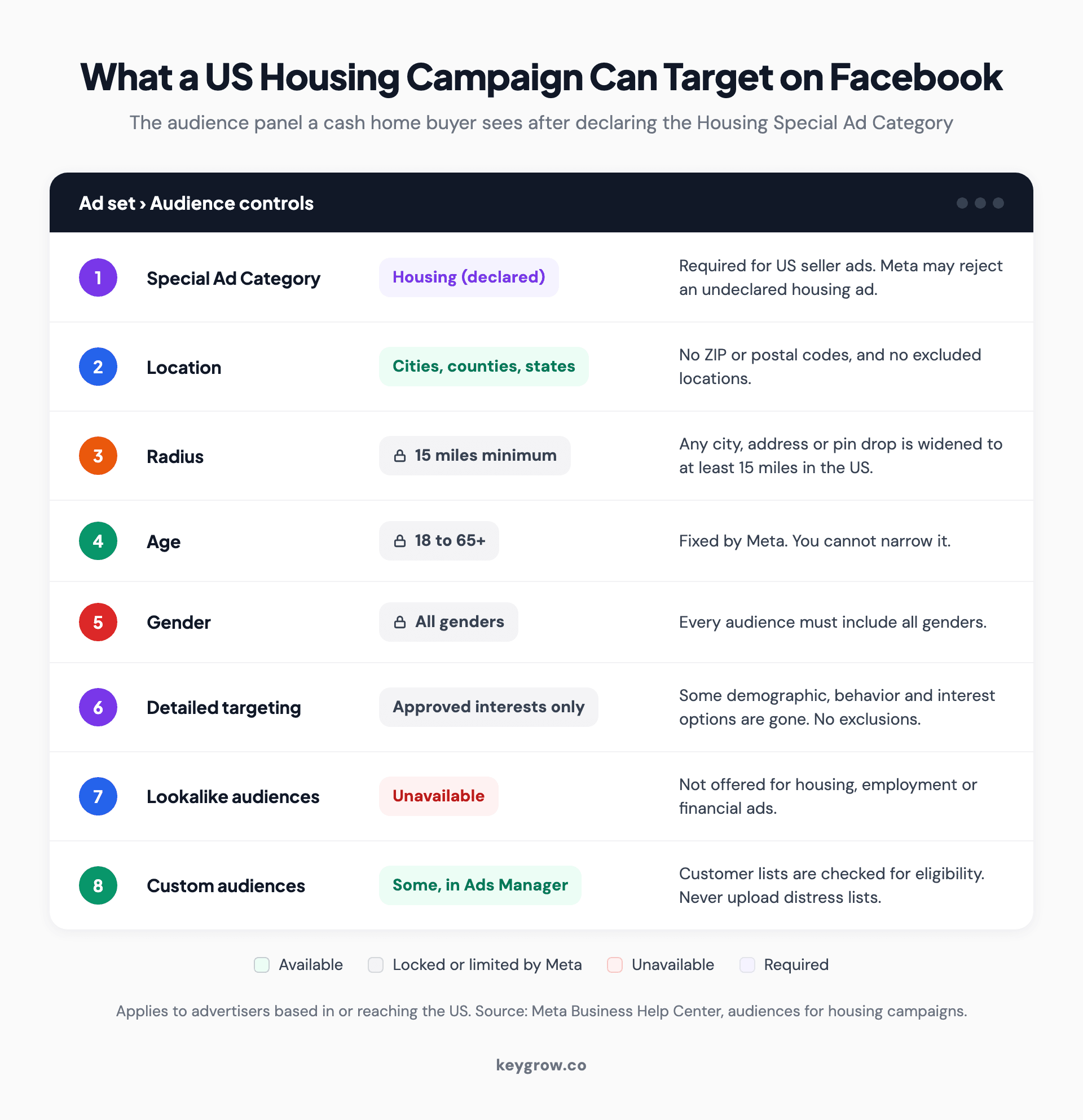
Annotated mock-up of the audience settings in a US Facebook housing campaign for a cash home buyer: Special Ad Category set to Housing, location limited to cities, counties or states with no ZIP codes and no excluded areas, a 15-mile minimum radius around any city or pin, age locked at 18 to 65+, all genders, detailed targeting limited to approved interests with no exclusions, and lookalike audiences unavailable.
Here is what's left, per Meta's audience rules for advertisers based in or reaching the US. You can target a country, state, region or city, but not a ZIP or postal code, and you can't exclude locations. A city, address or pin drop gets an expanded radius of at least 15 miles in the US and Canada. Age covers 18 through 65+, audiences include all genders, and you can't change either one. Some demographic, behavior and interest options disappear, and excluding detailed targeting isn't allowed. Lookalikes are unavailable.
The 15-mile rule hurts small buy boxes most. If you only buy in three neighborhoods on one side of town, Meta still spends across the whole circle, and as you'll see below, the form can't ask where the house is. Budget for some calls about houses you will never buy.
One option Meta mentions is worth taking: US housing ads can carry the Equal Housing Opportunity logo and slogan to show they aren't discriminatory. It costs you a corner of the image.
The example: one metro, two deals a month, $60 a day
The example investor buys houses in one metro area and wants one or two signed contracts a month. The average deal clears about $12,000, whether that's an assignment fee or a projected flip margin. Before spending a dollar, the investor decides a signed contract is worth up to $3,000 in ad spend, a quarter of that profit.
The budget is $60 a day, about $1,800 a month. Every number here is an assumption. Replace each one with yours before you trust the math at the end.
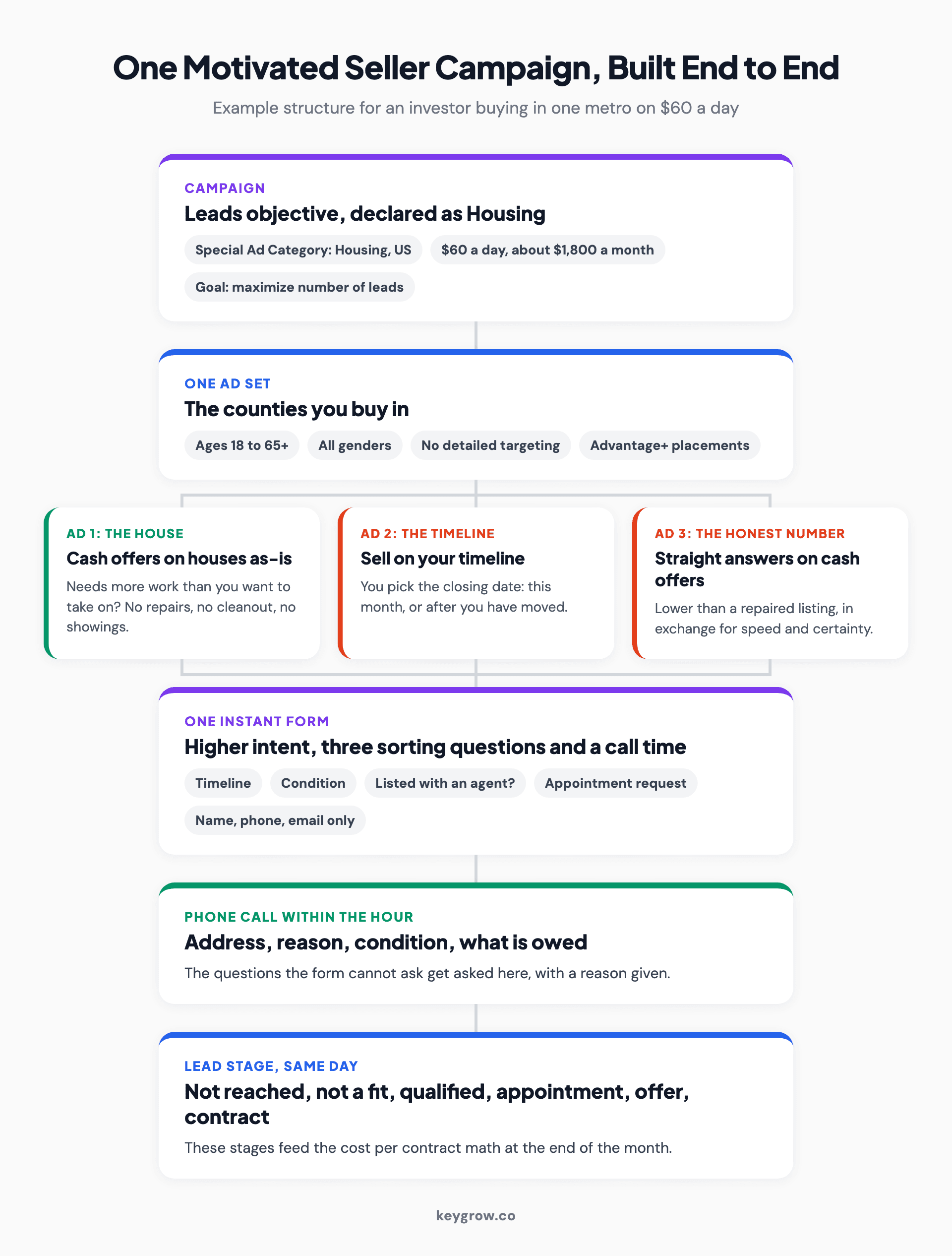
Blueprint of one motivated seller Facebook ad campaign: a Leads campaign declared as Housing with a $60 daily budget, one ad set covering the counties the investor buys in with ages 18 to 65+ and all genders, three ads about the house, the timeline and an honest offer, one Higher intent instant form with three sorting questions and an appointment request, then a phone call within the hour and a lead stage recorded in a spreadsheet.
The structure is deliberately small: one campaign, one ad set, three ads and one form. Splitting the money across several ad sets feels like testing. At this budget it mostly slows learning down.
Meta says an ad set usually leaves its learning phase after about 50 results in the week after its last significant edit. At around 10 leads a week, this ad set will sit at "Learning limited" in the Delivery column. That's normal for a local seller campaign. Leave it alone, because every significant edit restarts the clock.
Campaign and ad set settings, line by line
Most of these settings are either forced by the Housing category or chosen to keep the campaign simple enough to read.
| Setting | Choice in the example | Why |
|---|---|---|
| Objective | Leads | The seller answers without leaving Facebook or Instagram |
| Special Ad Category | Housing, United States | Meta's housing definition covers real estate services |
| Budget | $60 a day | About $1,800 a month, roughly 40 leads at $45 |
| Conversion location | Instant forms | Fast to send, and the address waits for the call |
| Performance goal | Maximize number of leads | The qualified leads goal needs a CRM connection and more volume |
| Location | The counties you buy in | ZIP codes aren't available; cities grow to 15 miles |
| Age and gender | 18 to 65+, all genders | Locked by Meta |
| Detailed targeting | None | The ad copy does the sorting |
| Placements | Advantage+ placements | A Higher intent form only shows in mobile feeds anyway |
| Form type | Higher intent | A review screen weeds out accidental taps |
Two settings need a word. The qualified leads goal teaches Meta from your sales stages, but it needs a Conversions API connection and far more volume than 40 leads a month. We cover when it's worth wiring up in our guide to Facebook ads for leads.
Custom audiences are the other one. Meta still lets housing campaigns use some custom audiences, built in Ads Manager, and it checks each customer list for eligibility. What you shouldn't do is upload a pre-foreclosure or tax-delinquent list and aim ads at it. Meta's terms for customer list audiences forbid audience criteria based on financial or consumer report information, and that list is exactly that. It's also the old targeting sneaking back in through a side door.
Write about the house, not the homeowner
Describe the property and the offer. Meta bans ads that imply a viewer's vulnerable financial status, and fair housing law limits who an ad can prefer.

A hallway in a house mid-renovation, with lumber stacked on the floor and a worker fitting a room at the far end, the kind of as-is property a motivated seller ad should describe instead of describing the owner.
Meta's Advertising Standards bar ads that "assert or imply" personal attributes, and the list includes "vulnerable financial status." Meta's own example of a banned ad is "Are you bankrupt? Check out our services." Swap in "Behind on your payments?" and you have the same ad in a different shirt. The same policy covers age, so a "Seniors, ready to downsize?" angle fails too.
Then there's the Fair Housing Act. Its advertising section, 42 U.S.C. 3604(c), makes it unlawful to publish an ad about the sale of a dwelling that indicates a preference based on race, color, religion, sex, handicap, familial status or national origin. You're buying, but it's still a sale of a dwelling. Keep photos and words about houses, never about the kind of person you picture selling one.
Here are the three ads in the example, each built around the house or the deal:
- The house. "Selling a house that needs more work than you want to take on? We buy houses in [metro] as they are. No repairs, no cleanout, no showings. Tell us about the house and get a cash offer to compare." Headline: Cash offers on houses as-is. Button: Get quote.
- The timeline. "You pick the closing date. Sell this month, or after you've moved. We buy houses in [metro] for cash and work around your schedule." Headline: Sell on your timeline.
- The honest number. "Our offer will be lower than a fully repaired house would list for. In exchange, you skip repairs, showings and agent commissions, and you know your closing date. If top dollar matters most, list with an agent. If speed and certainty matter more, talk to us." Headline: Straight answers on cash offers.
Only promise what's true for your deals. If you charge fees or the seller pays some closing costs, say so.
The third ad feels wrong to write, and it does the most filtering. More traffic is the wrong fix for bad lead quality. A cash home buyer came to us drowning in junk leads from Google Ads. Instead of buying more clicks, we added negative keywords, tightened match types and wrote qualifying language into the ads. Serious leads rose 600% between December and January without a bigger budget, and cost per lead fell from $313 to $124. That was search, not Facebook, but the principle holds: an ad that tells the wrong people to scroll past saves you the phone calls.
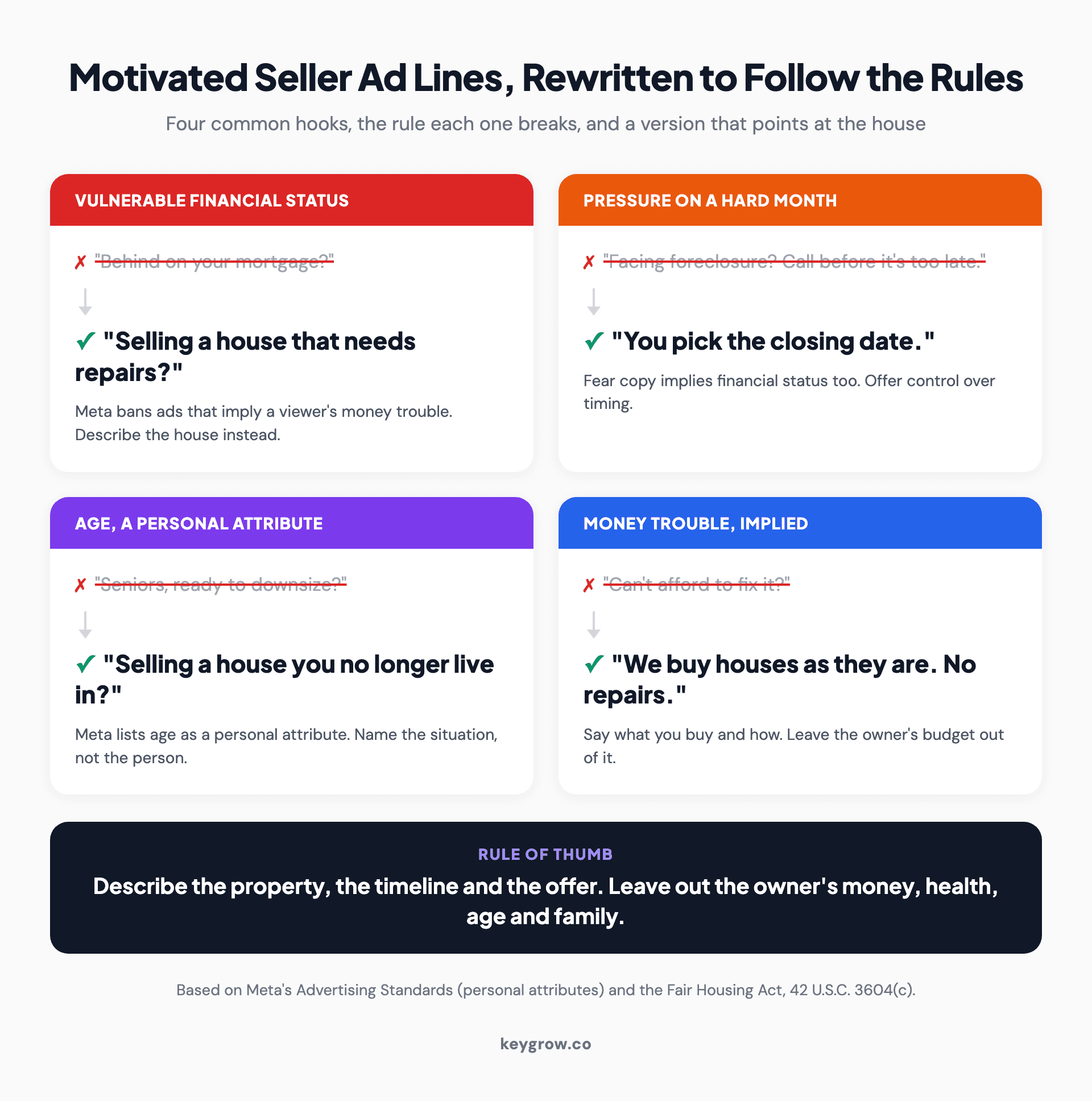
Four common motivated seller ad hooks rewritten to follow Meta's rules: "Behind on your mortgage?" implies vulnerable financial status and becomes "Selling a house that needs repairs?", "Facing foreclosure? Call before it's too late" puts pressure on a hard month and becomes "You pick the closing date", "Seniors, ready to downsize?" names an age group and becomes "Selling a house you no longer live in?", and "Can't afford to fix it?" implies money trouble and becomes "We buy houses as they are. No repairs."
For images, real houses you bought beat stock photos, with the seller's permission and no address showing. For more formats that suit a local buyer, like owner-to-camera video, see these examples of Facebook ads.
The instant form: three questions and an appointment
Use a Higher intent form with multiple-choice questions on timeline, condition and listing status, then close the form for people who are only curious.
Meta's Higher intent form adds a note that the business may follow up and a review screen before submitting. Meta suggests it when every lead needs follow-up, which describes every seller lead. It only shows in the Facebook and Instagram feeds on mobile.
The intro screen repeats the honest-number ad in one line: we make cash offers on houses as they are, usually below what a repaired house would list for, and you choose the closing date. Then come the questions.
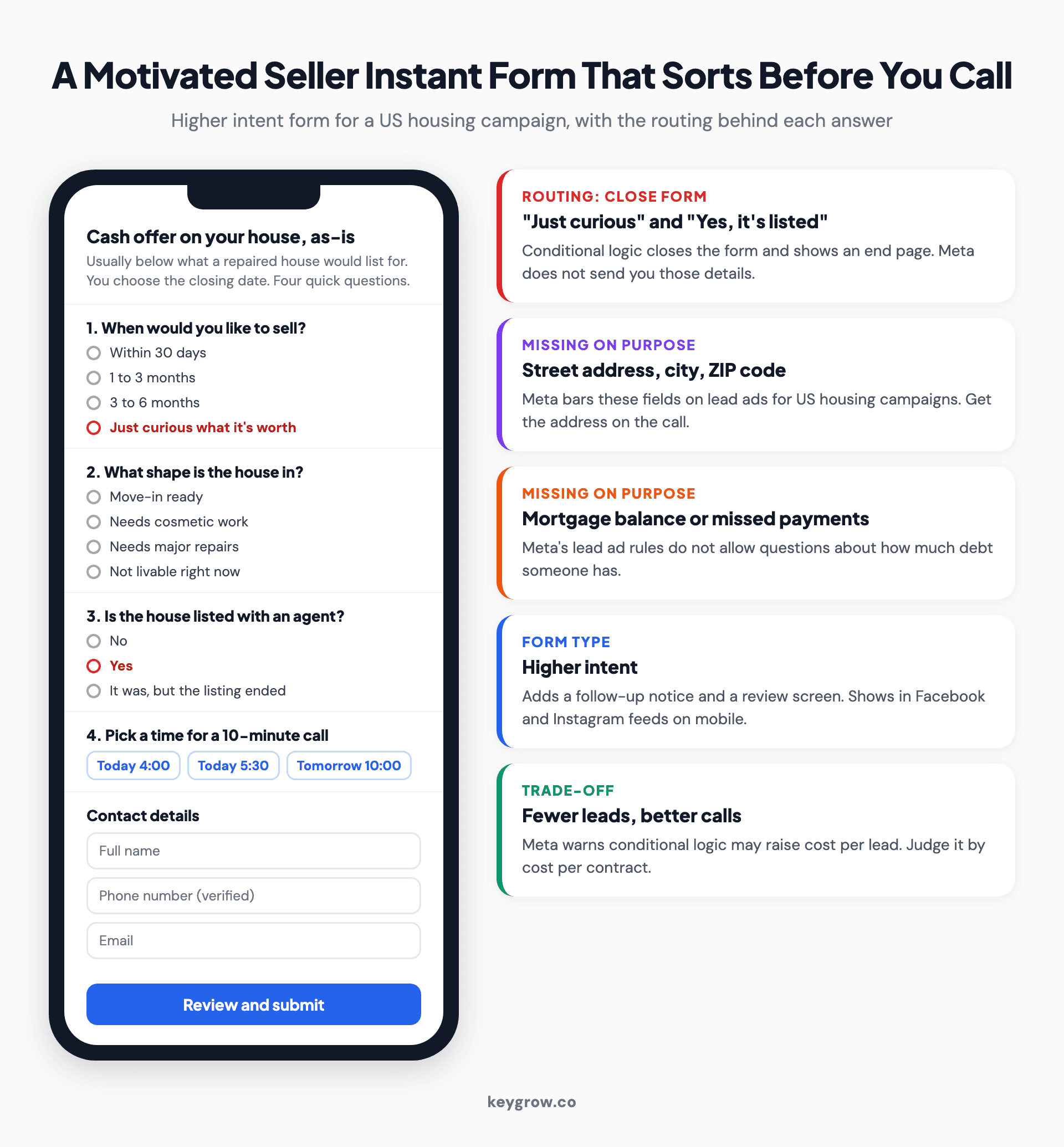
Phone-screen mock-up of a motivated seller Facebook instant form with routing notes: question 1 asks when the owner wants to sell, with "just curious what it's worth" closing the form, question 2 asks what shape the house is in, question 3 asks whether the house is listed with an agent, with "yes" closing the form politely, question 4 is an appointment request for a short call, and the contact fields are name, phone and email only, with no address, city or ZIP code field.
- When would you like to sell? Within 30 days / 1 to 3 months / 3 to 6 months / Just curious what it's worth.
- What shape is the house in? Move-in ready / Needs cosmetic work / Needs major repairs / Not livable right now.
- Is the house listed with an agent? No / Yes / It was, but the listing ended.
- Appointment request: pick a time for a 10-minute call.
Turn on conditional logic and point "Just curious what it's worth" at Close form, with an end page that explains how a cash offer works. Do the same for "Yes" on question 3. Someone under contract with a listing agent should be talking to that agent. Meta warns that conditional logic may raise your cost per lead, and you won't receive the details of anyone who closes the form. That's the point.
For contact details, ask for name, phone and email, and consider Meta's phone number verification. Nothing else. The next section explains why the obvious extra field is missing.
Why can't the form ask for the address or the mortgage?
Meta bars address, city and ZIP fields on US housing lead forms, and its lead ad rules prohibit questions about how much debt someone has.
The address rule is on Meta's lead ads page. Lead ads for housing, jobs or financial products that are based in or aimed at the US or Canada can't collect age, gender or marital status, or "location information, such as street address, city, postal code and zip code." Custom fields can't mimic those prefill questions either. So the one question every investor wants first, "What's the property address?", is the one the form can't ask. At least one investor guide that ranks for this topic still lists the street address as the first form field. That form breaks Meta's rule.
The debt rule sits in the lead ads section of Meta's Advertising Standards. Lead forms must not request financial information, including "how much debt someone has," without Meta's prior permission, and fields asking whether a person has debt are on the not-allowed list. A mortgage balance is debt, and "Are you behind on payments?" asks about it.
Neither question is off limits on the phone, where you can explain why you need the answer. That leaves two workable setups. The example keeps the instant form and gets the address in the first two minutes of the call, then pulls up the property while the seller talks. The other route sends the ad to your own landing page, where the first field can be the address. You'll pay more per lead, but you can look at the house before you dial.
Call within the hour, then grade every lead
Call during the same hour, get the address and the real story on the phone, and record every lead's outcome so the math works.

A man with glasses talking on his phone at a desk with an open laptop, the kind of quick call that should follow a motivated seller Facebook lead within the hour.
Facebook seller leads cool fast. The person tapped through a form between other things on their phone, and an hour later you're a stranger calling about their house. Call during business hours while the ads run. If nobody picks up, text once to say who you are, then try twice more over the next two days.
On the first call, confirm the address, then let them tell you why they're selling and by when, in their own words. Walk through the condition room by room. Ask what's owed on the house, and say why: it decides whether a cash offer can work at all. If it fits, book a time to see it.
Then grade every lead the same day in a spreadsheet or CRM: not reached, not a fit, qualified, appointment, offer, contract. Six stages. Skip this and the next section is guesswork. And before you decide Facebook leads are all tire kickers, check how many of them you reached inside the first hour.
The budget math, from $60 a day to cost per contract
Divide spend by signed contracts, not leads. In the example, $1,800 a month buys about 40 leads, and one contract comes from them.
Start with a public benchmark. LocaliQ's 2026 benchmarks put Real Estate leads campaigns at $13.74 per lead, against $27.39 across all industries. That category lumps every kind of real estate advertiser together, and a seller form with a review screen and four questions asks more of someone than a home-search signup. So the example budgets $45 a lead.
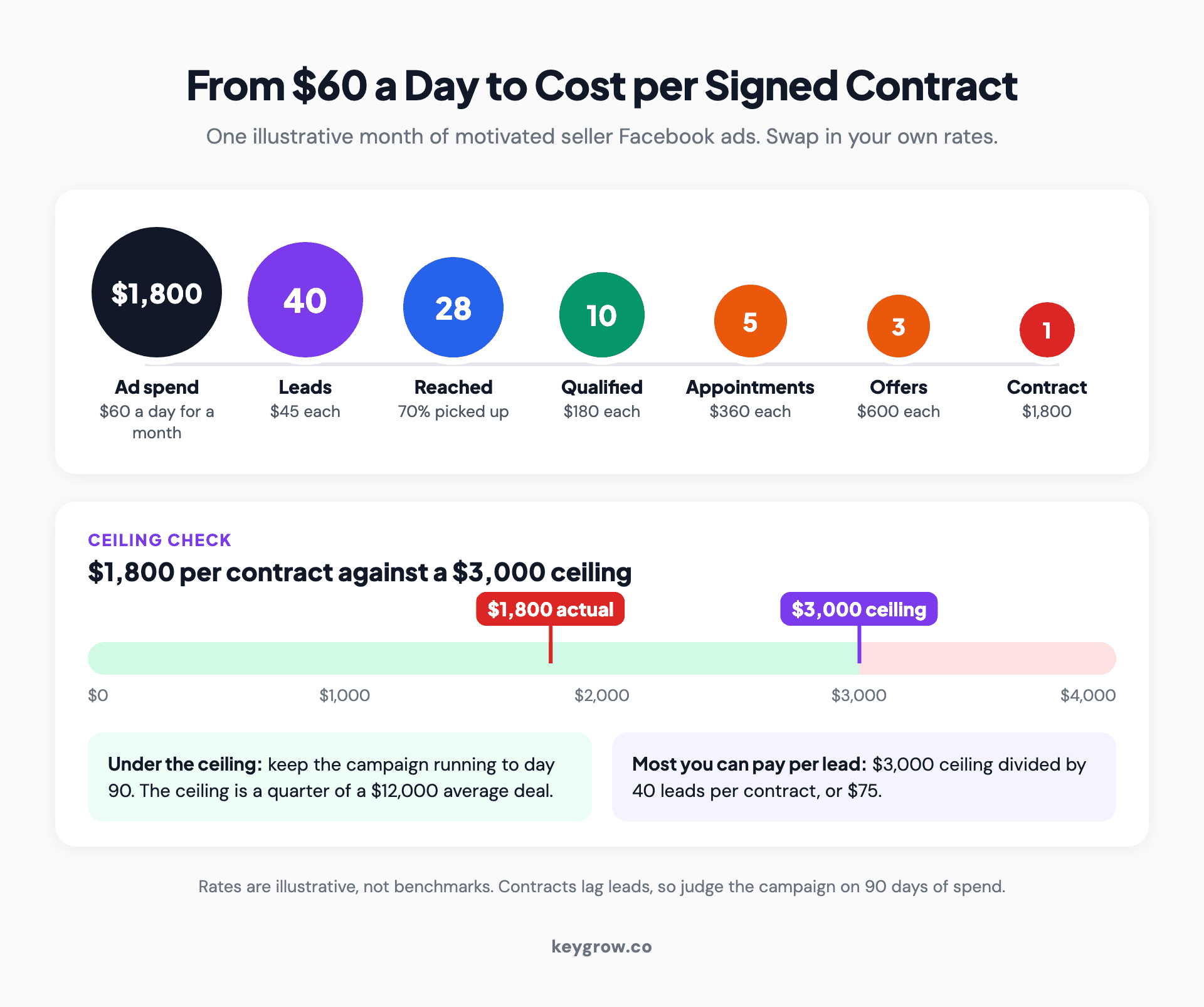
One illustrative month of motivated seller Facebook ads shown as shrinking circles: $1,800 in ad spend, 40 leads at $45 each, 28 reached by phone, 10 qualified at $180 each, 5 appointments at $360 each, 3 offers at $600 each and 1 signed contract at $1,800, with a ceiling check showing $1,800 against a $3,000 ceiling and the most you can pay per lead, $3,000 divided by 40, or $75.
Here's the month, with illustrative rates. $1,800 buys 40 leads. The investor reaches 28 of them by phone. Ten want to sell within 90 days, own the house and are open to an as-is offer. Five book a walkthrough, three get an offer, and one signs. That's $45 per lead, $180 per qualified lead, $360 per appointment and $1,800 per contract. The ceiling was $3,000, so the campaign keeps running.
Now flip it around. The most you can pay per lead is your ceiling per contract divided by the leads it takes to get one. Here that's $3,000 divided by 40, or $75. Lead quality moves that number as much as lead price does:
| Cost per lead | 1 contract per 25 leads | 1 contract per 40 leads | 1 contract per 60 leads |
|---|---|---|---|
| $30 | $750 | $1,200 | $1,800 |
| $45 | $1,125 | $1,800 | $2,700 |
| $75 | $1,875 | $3,000 | $4,500 |
A $30 lead that takes 60 tries costs exactly what a $45 lead that takes 40 does. That's why the form questions are worth their cost.
Contracts also lag leads. A lead from week four might sign in week eight, after the walkthrough, the offer and a few days of thinking. Judge the campaign on 90 days of spend against the contracts those leads produce. Month one will look worse than it is.
When Facebook is the wrong place to find sellers
Skip Facebook seller ads if nobody can call within the hour, your buy box fits in a few neighborhoods, or your contract ceiling is thin.
Search catches the seller who has already decided. Facebook interrupts people who haven't. In a 2025 BiggerPockets thread, a wholesaler who said he had run search campaigns for more than 200 investors described Facebook seller leads as typically cheaper and lower quality than Google's. If people in your market already search "sell my house fast" with your city name, our Google Ads guide for real estate investors is the better first step.
The math rules some investors out too. With a $1,000 ceiling and $45 leads, you'd need a contract from every 22 leads, which is a lot to ask of people who weren't looking to sell when the ad appeared. Compare other sources on cost per closing first. Our breakdown of how to get real estate leads ranks 12 sources by what a closing costs, and the method works for investors too.
You don't need an agency to run any of this. One campaign, one form and a spreadsheet will carry a solo investor, as long as someone answers the phone. Get help when you can't keep up with new ads every few weeks or need the tracking to tie each contract back to the ad that started it.
FAQs
Do Facebook ads work for finding motivated sellers?
They can, but the targeting won't do the work. US housing ads can't target age, ZIP codes or lookalikes, so results depend on ad copy that describes the house, form questions that sort sellers, and a call within the hour. Judge them by cost per signed contract.
Can you target motivated sellers by ZIP code, age or interests on Facebook?
Not in the US. Housing ads run in Meta's Special Ad Category, which locks age at 18 to 65+, includes all genders, removes ZIP codes, exclusions and lookalikes, and widens any city to a 15-mile radius. Only interests on Meta's approved list remain, and none can be excluded.
Are "we buy houses" ads allowed on Facebook?
Yes, as long as you declare the Housing Special Ad Category and follow Meta's ad policies. Meta's housing definition covers real estate services as well as listings, and an undeclared housing ad may be rejected. The copy must not assert or imply anything about the viewer's finances.
What questions should a motivated seller lead form ask?
Ask multiple-choice questions about timeline, the house's condition and whether it's listed, then offer a call time. A US housing instant form can't collect the street address, city or ZIP code, and Meta's rules bar questions about debt. Ask about the address and the mortgage on the call.
How much do motivated seller leads cost on Facebook?
No public benchmark separates seller leads. LocaliQ's 2026 data puts real estate leads campaigns at $13.74 per lead, but a form with qualifying questions costs more, and Meta says conditional logic can raise cost per lead. Set your own ceiling: the most you'll pay per contract divided by the leads one takes.
Should I use an instant form or a landing page for seller leads?
Start with a Higher intent instant form, since it's quick to send and you can get the address on the call. Switch to a landing page if you need the address before you dial, because US housing instant forms can't collect it. Expect a landing page to cost more per lead.
Your first 30 days
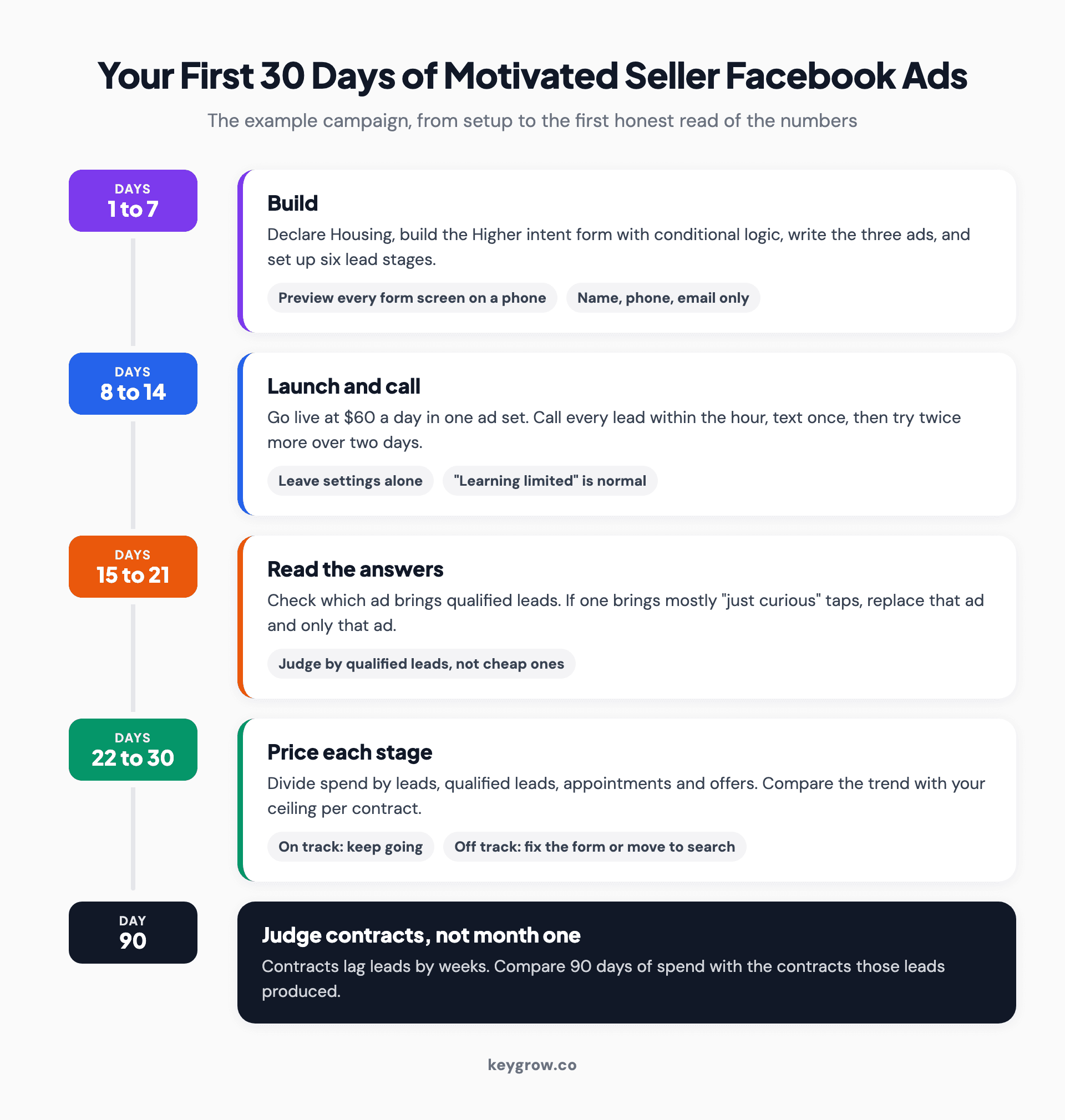
Timeline of the first 30 days of a motivated seller Facebook ad campaign: days 1 to 7, declare Housing, build the Higher intent form and three ads, and set up six lead stages; days 8 to 14, launch at $60 a day and call every lead within the hour without touching settings; days 15 to 21, read the form answers and replace at most one ad; days 22 to 30, price each stage against the ceiling per contract; and day 90, judge contracts rather than month one.
In week one, declare Housing, build the form with conditional logic, write the three ads and set up your six lead stages. Preview every form screen on your phone before you publish.
Launch in week two at $60 a day and call every lead within the hour. Don't touch the settings, however tempting "Learning limited" makes it.
By week three you have form answers to read. If one ad brings mostly "just curious" taps, replace that ad and only that ad. Judge ads by qualified leads, not cheap ones.
At the end of week four, count leads reached, qualified, appointments and offers, and price each stage. If the cost per qualified lead puts you on track for a contract under your ceiling, keep going to day 90. If it doesn't, fix the form or move the money to search.
If you'd rather hand this off, our team builds Facebook ads for real estate investors inside Meta's housing rules and reports on signed contracts, month-to-month.