


Should social media be bringing you leads, or is it the place people go to check you're real before they call?
Decide that first, because the two jobs need different work and different reports. Social media for lead generation pays off when three things are true: your buyers open one platform every day, you have an offer worth trading a phone number for, and someone answers messages within the hour. If one of those is missing, social is a trust channel for your business. That still matters. It just shouldn't be judged on leads.
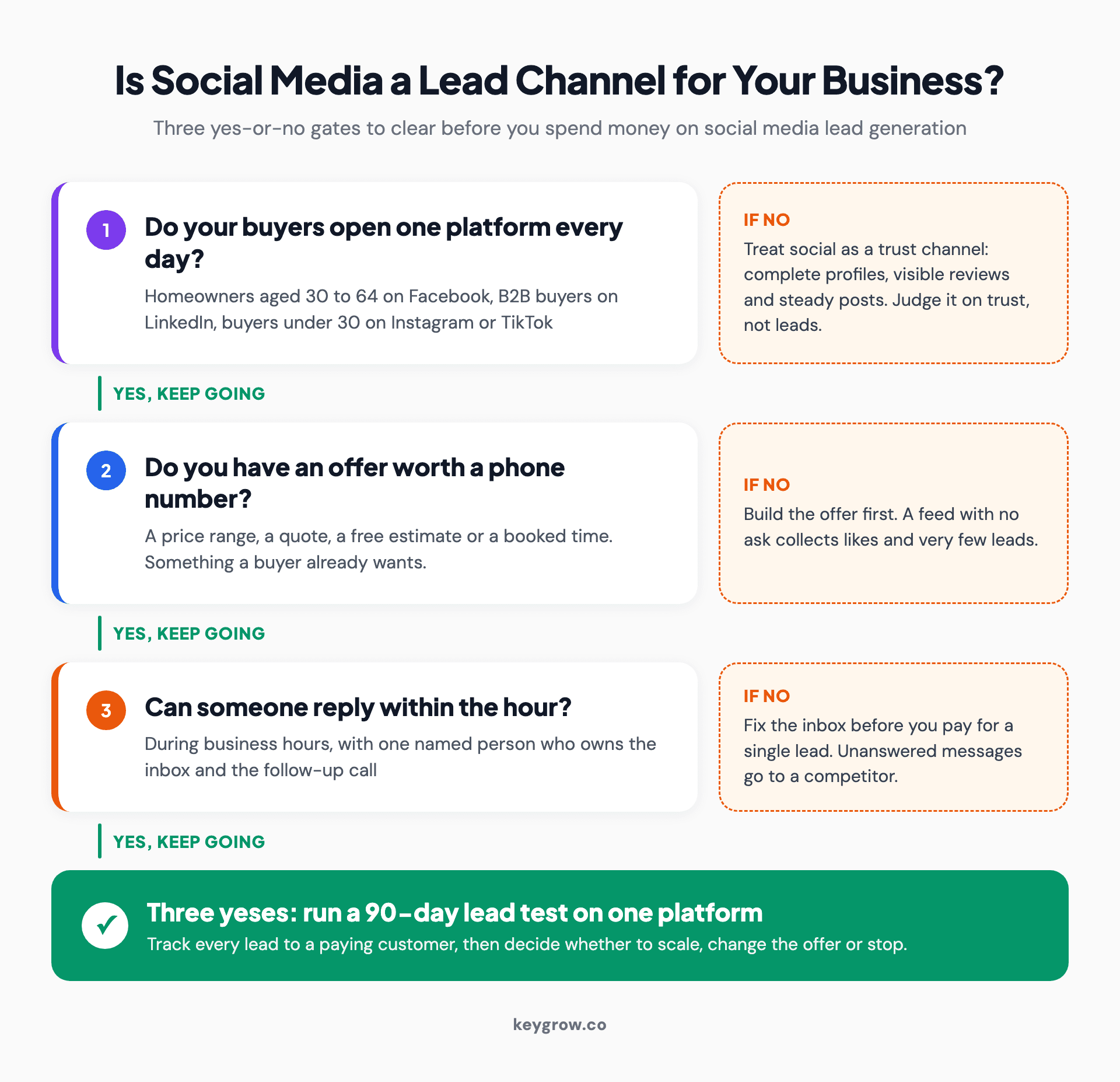
Decision flow with three yes-or-no gates for social media lead generation: do your buyers open one platform every day, do you have an offer worth a phone number, and can someone reply within the hour, with a fallback for each no and a 90-day lead test when all three are yes.
Can social media bring in leads, or just likes?
Yes, when a post or ad asks for one specific action, such as a quote request or a booking, and you count that action instead of reactions.
A social lead is a person who gave you a way to reach them and a reason to. That covers a form submission, a DM asking about price, a tap on the call button in your profile and a booking through the link in your bio. A like is not a lead. Neither is a follower.
Most business accounts never ask. They post tips and team photos, then wonder why the phone stays quiet. A feed with no ask in it is a brochure. For most small accounts we'd run three or four trust posts a week and one that makes a direct offer.
Watch the inbox too. "How much for a 3-bedroom?" is a lead that came in through the side door.
Which social media platform is best for lead generation?
The one your buyers open daily. For most local services that is Facebook, for B2B it is LinkedIn, and buyers under 30 are on Instagram and TikTok.
Reach alone won't decide it, since YouTube (84 percent) and Facebook (71 percent) top the 2025 list. Daily habits say more. According to Pew Research Center, 58 percent of adults aged 30 to 49 and 54 percent of those aged 50 to 64 visit Facebook every day, while about half of 18 to 29 year olds open TikTok daily, against 5 percent of adults 65 and older.
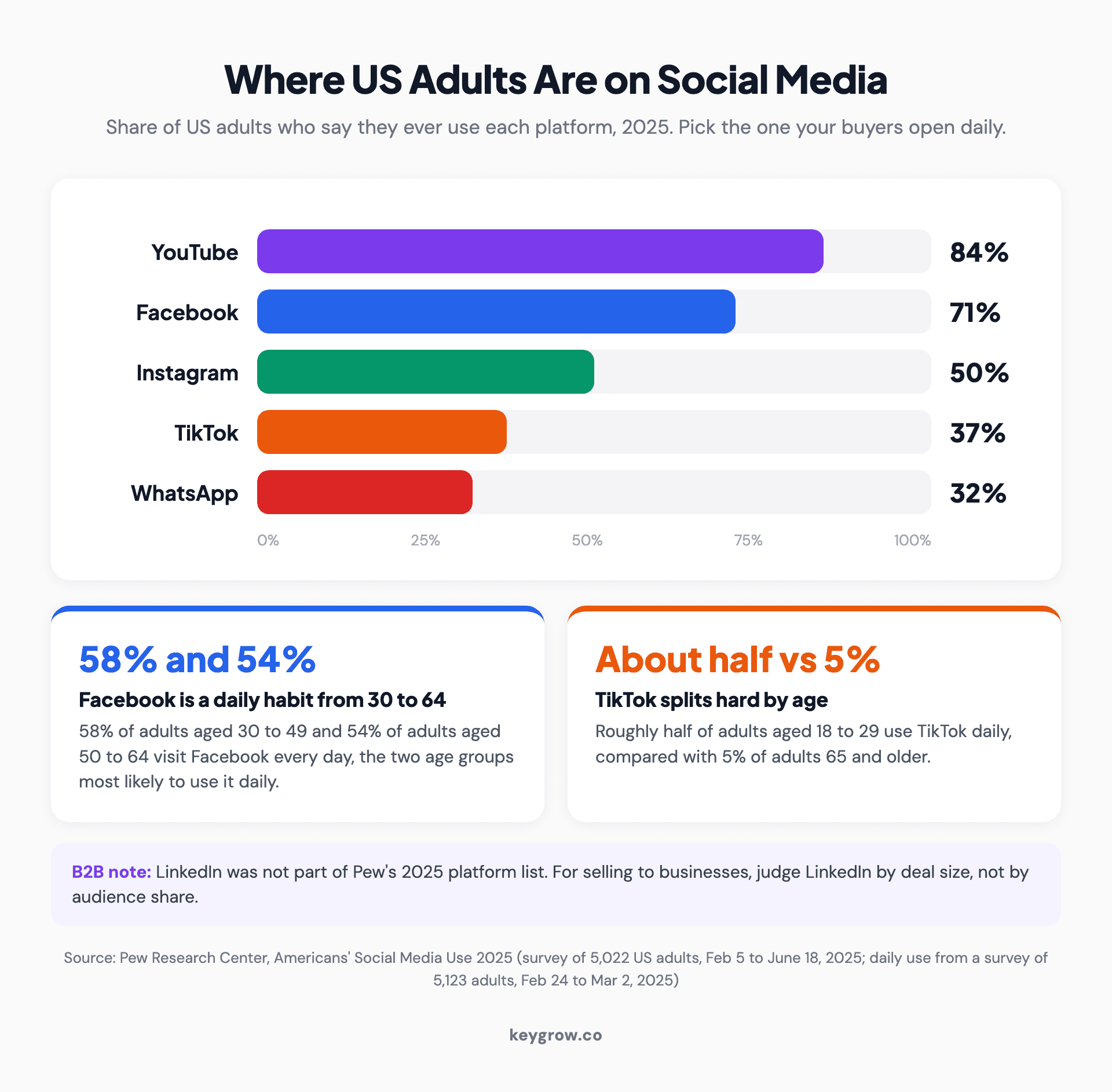
Horizontal bar chart of the share of US adults who use each social platform in 2025, per Pew Research Center: YouTube 84 percent, Facebook 71 percent, Instagram 50 percent, TikTok 37 percent and WhatsApp 32 percent, with callouts that 58 percent of adults 30 to 49 and 54 percent of adults 50 to 64 use Facebook daily, and about half of adults 18 to 29 use TikTok daily compared with 5 percent of those 65 and older.
| Platform | Who is there | Lead tools | Best fit |
|---|---|---|---|
| 71% of US adults, most daily use from 30 to 64 | Instant forms, Messenger, call button | Home services, local quotes | |
| 50%, skews younger | Instant forms, DMs, Story links | Visual work: remodels, salons, real estate | |
| Professionals (not in Pew's 2025 list) | Lead Gen Forms, messages | B2B deals with real contract value | |
| YouTube | 84% | Video ads that send viewers to a page | Bigger purchases that need explaining |
| TikTok | 37%, about half of 18 to 29 year olds daily | Instant forms, DMs | Younger buyers, lower-ticket offers |
Pick one platform, two at most, and give it 90 days. If you sell to businesses, read LinkedIn marketing for B2B first. Agents can start with our Instagram playbook for real estate agents.
What should you offer in exchange for someone's details?
Offer the next step your buyer already wants: a price range, a quote, an assessment or a booked time. Newsletters and giveaways fill lists with people who never buy.
Each rung asks more of the buyer, so fewer people climb it, and the ones who do are closer to buying.
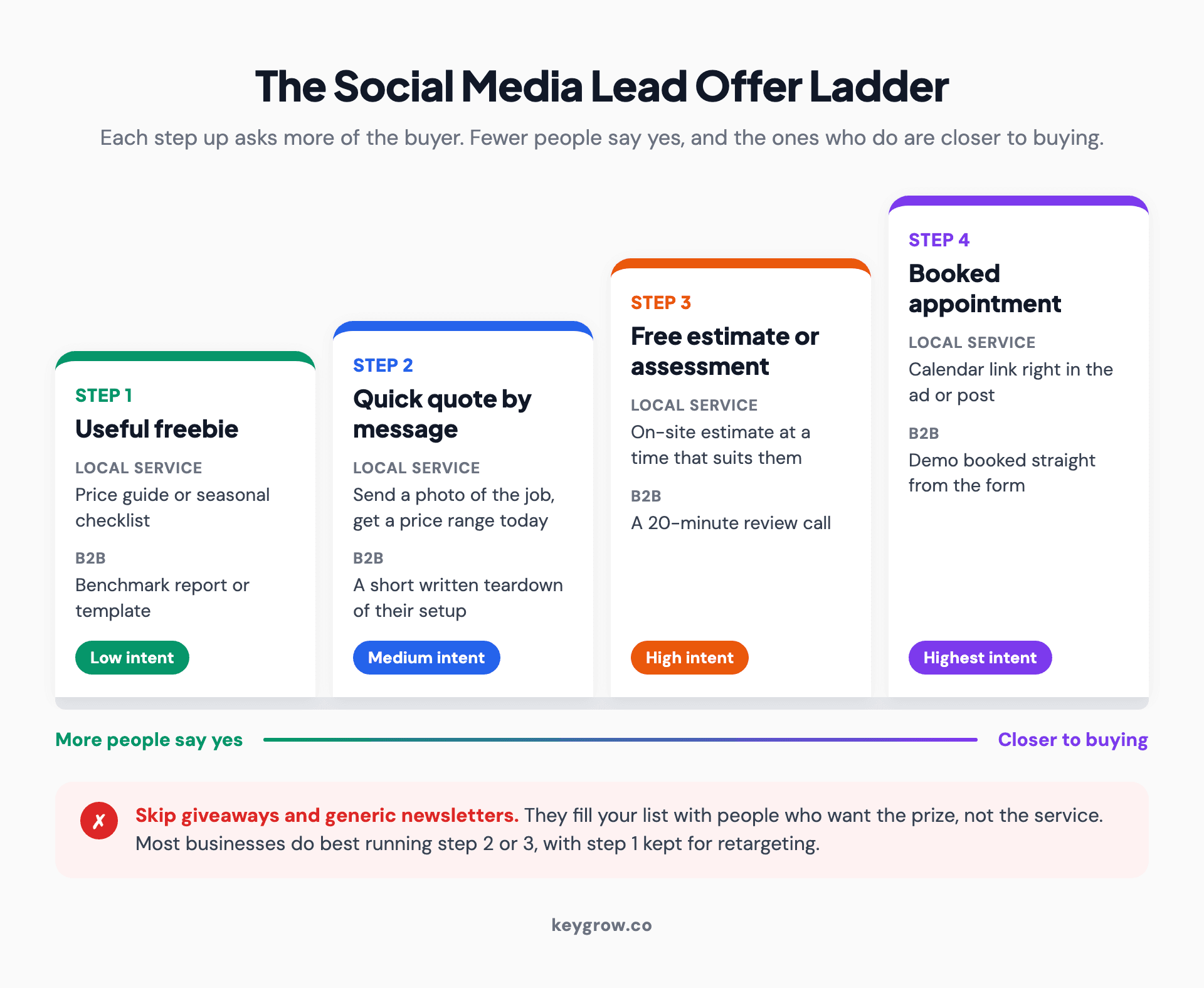
Four-step offer ladder for social media leads, from a useful freebie such as a price guide, to a quick quote by message, to a free estimate or assessment, to a booked appointment, with local service and B2B examples for each step and intent rising from low to highest.
- A useful freebie, like a price guide. Easy to say yes to, so plan to follow up.
- A quick quote by message. "Send us a photo of the job and we'll reply with a price range today" starts a real conversation.
- A free estimate or assessment: a site visit for a contractor, a 20-minute call for a B2B service.
- A booked appointment, with a calendar link in the ad. Highest intent, fewest takers.
For most businesses we'd start on rung 2 or 3. Skip the tablet giveaway. It brings in a few hundred entries from people who want a free tablet.
Where should the lead land: a native form, a DM or your website?
Native forms bring the most leads for the least money. Landing pages bring better ones, and DMs work only if someone answers fast. Never send it to your homepage.
| Where the lead happens | Volume | Quality | What it needs |
|---|---|---|---|
| Native form on the platform | Highest | Mixed, details are pre-filled | A qualifying question, a fast call |
| Direct message | Medium | High when the buyer starts it | Someone watching the inbox |
| Landing page built for the offer | Lower | Usually the best | A page, a tracking pixel, a short form |
| Your homepage | Low | Low | Nothing, which is the problem |
Sending paid clicks to a homepage is the most expensive default in advertising. A mobile detailing client came to us paying $100 per booking from Google Ads, with every click landing on the homepage. We rebuilt the campaigns and pointed traffic at a dedicated booking page. Between August and December 2022, cost per conversion fell to $22 and conversions rose 650 percent. That was search, but a social click lands on the same homepage and leaves just as fast.
If Facebook is your platform, our guide to Facebook ads for leads covers the form settings that filter out accidental taps.
How fast do you need to answer a social media lead?
Within an hour during the working day, and the same day at the latest. About three-quarters of consumers expect a reply on social within 24 hours.
The 2025 Sprout Social Index also has the uncomfortable part. In Sprout Social's research, 73 percent of social users say they'll buy from a competitor if a brand doesn't respond on social. A DM asking for a price is exactly the message they mean.

A small business owner on a phone call at her desk with a laptop open, following up on a social media lead.
Speed comes down to who owns the inbox. Name one person for weekdays and one for Saturday, and put inbox notifications on their phones. Set an instant reply that asks one useful question, such as the job address, so the first human reply can include a price range.
If nobody can own that, hold off on lead ads. Paying for messages that sit unanswered is an expensive way to annoy strangers.
Should you post organically or pay for social ads?
Pay if you need leads this month. Post organically if you can wait a quarter or two. Most businesses with steady social leads do both, and put ad money behind posts that already worked.
Organic gets sold as free. It costs hours, though, and an owner's hours have a price. Put both on the same monthly budget and compare what each customer costs.
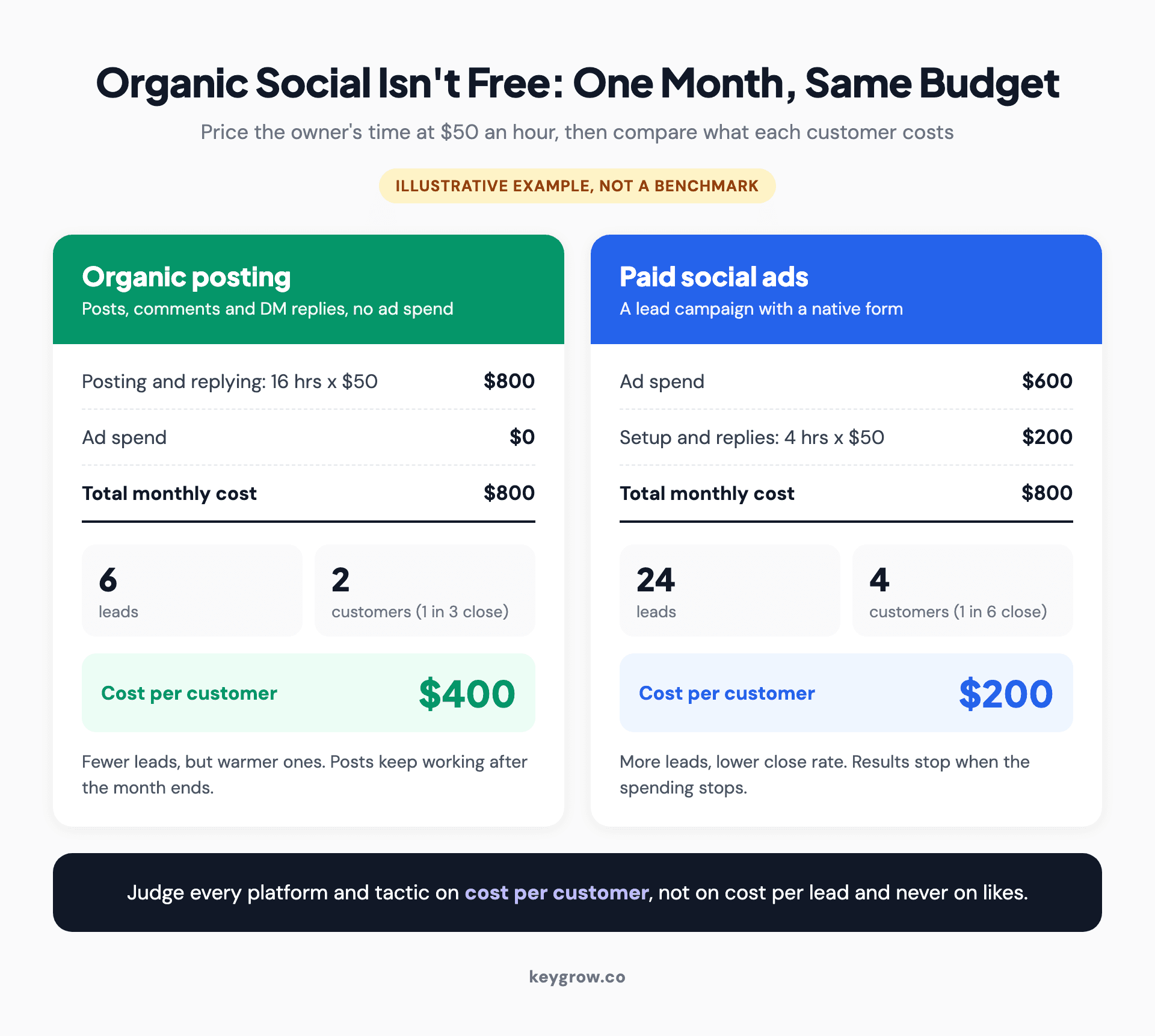
Worked example comparing one month of organic posting and paid social ads at the same $800 cost with owner time priced at $50 an hour: organic used 16 hours and produced 6 leads and 2 customers at $400 per customer, while paid used $600 of ad spend plus 4 hours and produced 24 leads and 4 customers at $200 per customer. Illustrative numbers, not benchmarks.
In that illustrative month, organic brought fewer, warmer leads, and two of six became customers. Paid brought four times the leads and the cheaper customer. Your numbers will differ, but the comparison works the same way.
Organic still earns its place. Good posts keep working after the month ends, and a stranger who clicks your ad often checks your feed before filling in the form.
Paid social also lifts searches for your business name, which we unpack in how social media advertising improves PPC performance.
How much does a social media lead cost?
On Facebook lead campaigns, LocaliQ's 2026 benchmarks put the average at $27.39 per lead, from $12.30 to $61.56 depending on the industry.
A sample from LocaliQ's 2026 benchmarks, updated in September 2026, for campaigns using the leads objective:
| Industry | Average cost per lead |
|---|---|
| Real estate | $13.74 |
| Health and fitness | $27.11 |
| Physicians and surgeons | $32.14 |
| Home and home improvement | $42.95 |
| Beauty and personal care | $50.91 |
| Dentists and dental services | $61.56 |
These are market averages, and the spread tells you more than the mean. A dental practice paying $45 a lead is beating its category. A real estate team paying $45 is not. LinkedIn leads usually cost more, and can still pay off when the deal is big enough.

A laptop and a phone on a dark desk, both showing a dashboard used to compare lead costs by platform.
The platform reports cost per lead because that's the number it controls. Your bank account cares about cost per customer. Before launch, work out your ceiling: close rate times average sale times margin. Close one lead in five on a $500 job at 40 percent margin, and you can pay up to $40 a lead and still break even on the first job.
How do you know which leads came from social?
Tag every link with UTM parameters, save the source in a hidden form field, log DMs and calls by hand, and match each lead to a sale in your CRM.
Platform dashboards count the leads they delivered. Which of those leads paid you lives in your CRM or spreadsheet, and you'll only know if the source travels with the lead from the first tap.
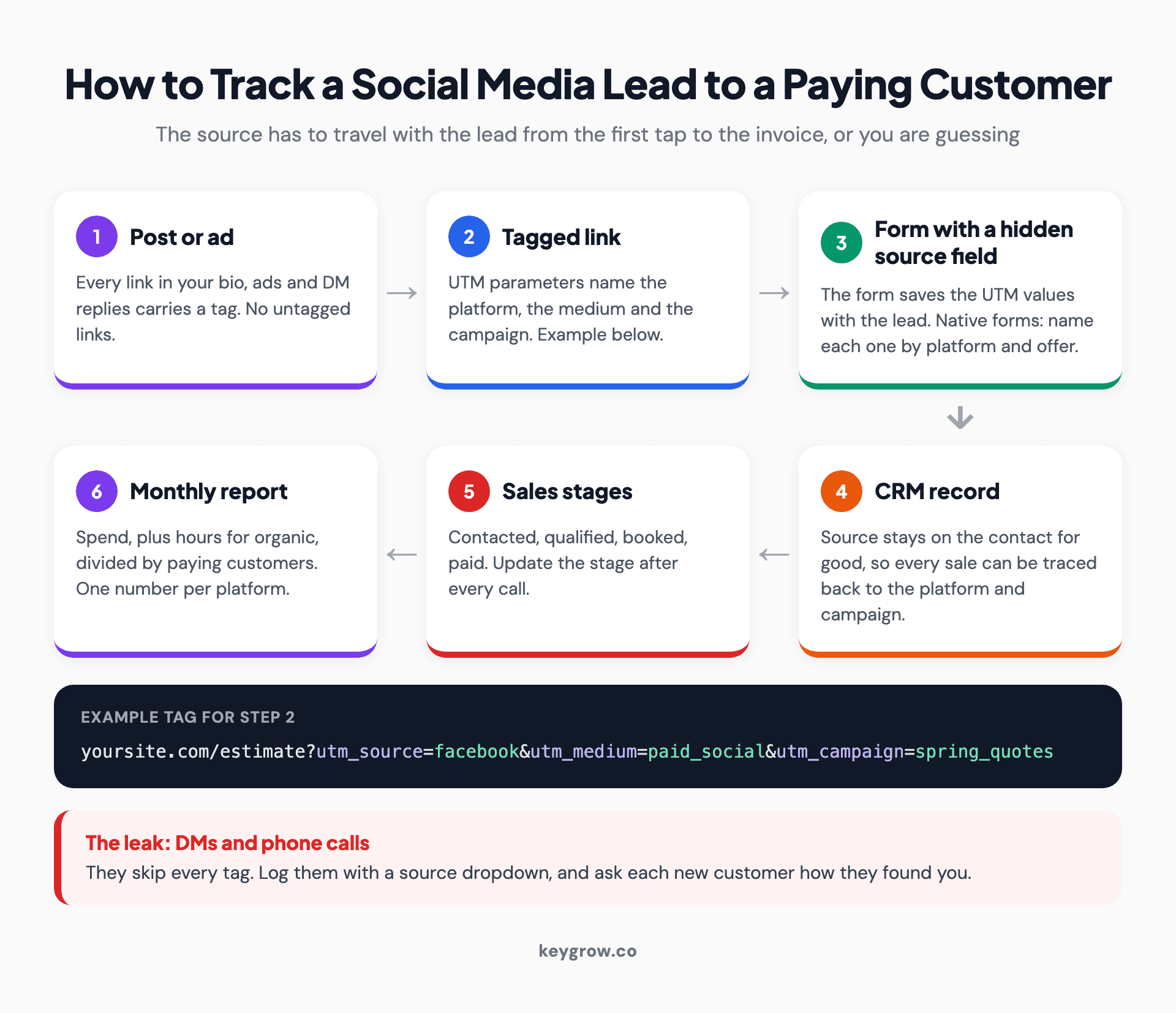
Six-step flow for tracking a social media lead to a paying customer: post or ad, tagged link with UTM parameters, form with a hidden source field, CRM record, sales stages from contacted to paid, and a monthly report of cost per customer by platform, with an example UTM tag and a warning that DMs and calls must be logged by hand.
Native form leads arrive labeled with the form's name, so call it "FB spring estimate," not "Form 3." DMs and calls are where tracking leaks. Add a source dropdown wherever you log calls, and ask every new customer how they found you. It's crude, and it catches what the tags miss.
Once a month, divide each platform's spend (plus your hours, for organic) by the paying customers it produced. That number is the whole report.
When is social media the wrong channel for leads?
When buyers search in a hurry, or when nobody can answer messages fast. In those cases, use social for trust and judge it on that.
Someone with water coming through the ceiling doesn't open Instagram. Emergency trades win on Google and on whoever picks up the phone first. A complete Facebook page is enough social for them, and our guide to social media for local business covers that lighter routine.
Regulated fields add a cost. Ads for housing, jobs or financial products run under Meta's Special Ad Categories, which limit or remove age, gender and ZIP code targeting for US audiences.
If you sell to other companies, social is one channel among several. Our breakdown of lead generation for B2B sales scores the full mix.
You may not need an agency for this. One platform, one offer, one tagged link and a spreadsheet will show a single-location business within 90 days whether social produces customers. Bring in help once the test works and your hours are worth more elsewhere.
FAQs
Can you generate leads on social media without paying for ads?
Yes, but slowly. Organic leads come from posts that make a direct offer and from fast replies to DMs. Expect slow months at the start, and count the hours it costs you.
How long does social media lead generation take to work?
Paid campaigns can bring leads in the first week, though the first month mostly shows you which offer and audience work. Organic is slower, often a quarter or two before leads arrive steadily. Judge any platform on 90 days of data.
Are social media leads lower quality than search leads?
Often, yes. Someone searching Google has a need right now, while someone scrolling was doing something else when your ad appeared. A qualifying question on the form and a fast call close most of that gap.
How many leads should a small business expect from social media?
It depends too much on budget and industry for an honest universal number. For planning, divide your monthly ad budget by your industry's average cost per lead. At LocaliQ's 2026 Facebook average of $27.39, a $1,000 month buys roughly 36 leads.
Is social media lead generation worth it for small businesses?
It is worth testing if your buyers use one platform daily and you can answer messages quickly. Emergency services usually do better on search. A 90-day test on one platform with tracked links gives a clear answer.
Measure the lead, not the like
Likes tell you a post was seen. Leads, and the customers they become, tell you whether social media is earning its keep. Count calls, messages, form leads and bookings by platform, divide spend by customers, and keep only what pays.
If you'd rather hand that off, our social media marketing team builds lead campaigns around those numbers, month-to-month, and will tell you plainly if social shouldn't carry your leads.