


Most B2B companies do not need another lead channel. They need to run fewer of them.
Search for lead generation for B2B sales and the top results hand you lists of 9, 15, 20, even 34 tactics. A list that long feels generous. In practice it pushes a small team into doing a little of everything, which buys a thin trickle from each channel and no clear answer about which one is working. The lists also skip the only question a sales team cares about: what does a qualified meeting cost, and how long until the first one shows up?
So we ranked the nine channels B2B teams use on three things: cost per qualified meeting, time to the first meeting, and the effort each one eats. The short answer is that referrals and high-intent paid search come out on top, SEO pays best over the long run and is the slowest to start, cold email is the strongest outbound option, and trade shows finish last on cost. Pick two, give them 90 days, and judge them on meetings booked rather than leads collected.
The scorecard: nine B2B lead channels, ranked
Referrals rank first, paid search second and trade shows last. The order weighs cost per lead, how often those leads become meetings, speed to the first meeting, and the work involved.
| Rank | Channel | Avg. cost per lead | Time to first meeting | Effort | Verdict |
|---|---|---|---|---|---|
| 1 | Referrals and warm introductions | $25 | Days | Low | Cheapest meeting you can book, but volume is capped |
| 2 | Paid search on high-intent terms | $463 | 2 to 4 weeks | Medium | Pricey per lead, but the lead asked for you |
| 3 | Partner and affiliate programs | $73 | 1 to 3 months | Medium | Borrowed trust, slow to set up |
| 4 | SEO and content | $206 | 6 to 12 months | High, then low | Cheapest at maturity, slowest start |
| 5 | Targeted cold email | $225 | 2 to 4 weeks | High | Best outbound bet if the list is good |
| 6 | LinkedIn and social | $408 (paid) | 1 to 3 months | Medium to high | Pays off above a certain deal size |
| 7 | Cold calling | $300 | Days | Very high | Fast, but burns the most rep hours |
| 8 | Webinars | $267 | 1 to 2 months | High | Registrants are not meetings |
| 9 | Trade shows and events | $840 | Set by the event calendar | Very high | Only works with meetings booked in advance |
The cost per lead column comes from Sopro's 2025 benchmarks, a compilation of channel averages published by an outbound prospecting agency. The partner row uses its affiliate figure and the social row uses paid LinkedIn. The time and effort columns are planning estimates based on how each channel works, not survey data, so read them as ranges.
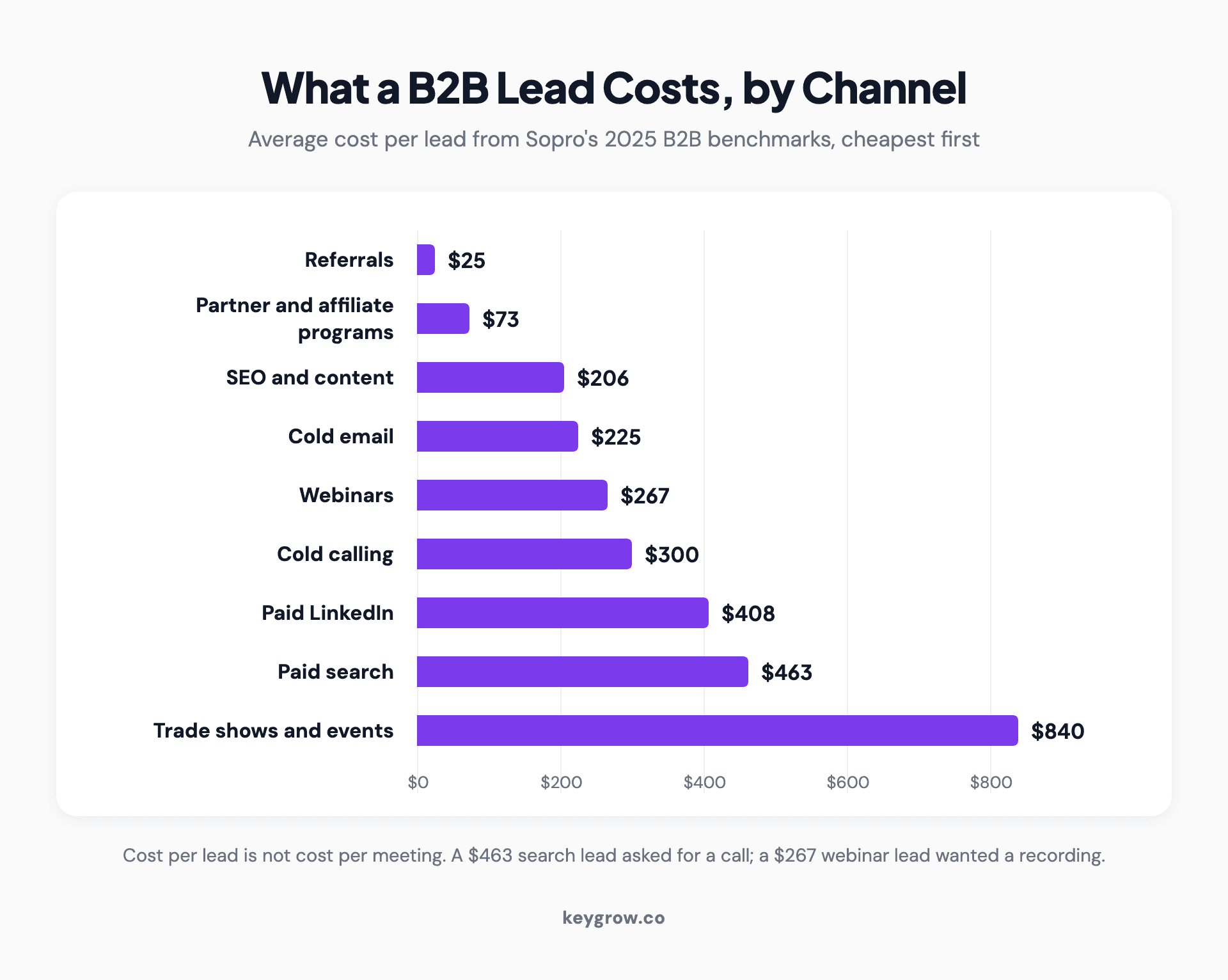
Horizontal bar chart of average B2B cost per lead by channel from Sopro's 2025 benchmarks: referrals $25, partner and affiliate programs $73, SEO $206, cold email $225, webinars $267, cold calling $300, paid LinkedIn $408, paid search $463 and trade shows $840.
Notice that paid search sits near the expensive end of that chart and still ranks second. The gap between a lead and a meeting explains it.
Lead count is the wrong scoreboard
Judge every channel on cost per qualified meeting: what a lead costs, divided by the share of those leads that become a meeting your sales team accepts.
A report that opens with lead volume is the B2B cousin of a report that opens with impressions. Both numbers can climb while revenue sits still. Sopro's State of Prospecting research found 42 percent of B2B companies name lead quality as a top marketing challenge, which is roughly what you would expect when teams count leads instead of meetings.
The fix is one division. Cost per qualified meeting equals cost per lead divided by your lead-to-meeting rate. Run four channels through it with illustrative rates:
- A $25 referral that becomes a meeting six times in ten costs about $42 per meeting.
- A $463 paid search lead (a demo or quote request) that converts four times in ten costs about $1,158.
- A $267 webinar registrant who books a meeting one time in ten costs $2,670.
- An $840 trade show lead at one in seven costs $5,880.
That is why paid search outranks webinars despite the higher cost per lead. A search lead raised a hand. A webinar registrant mostly wanted the recording.
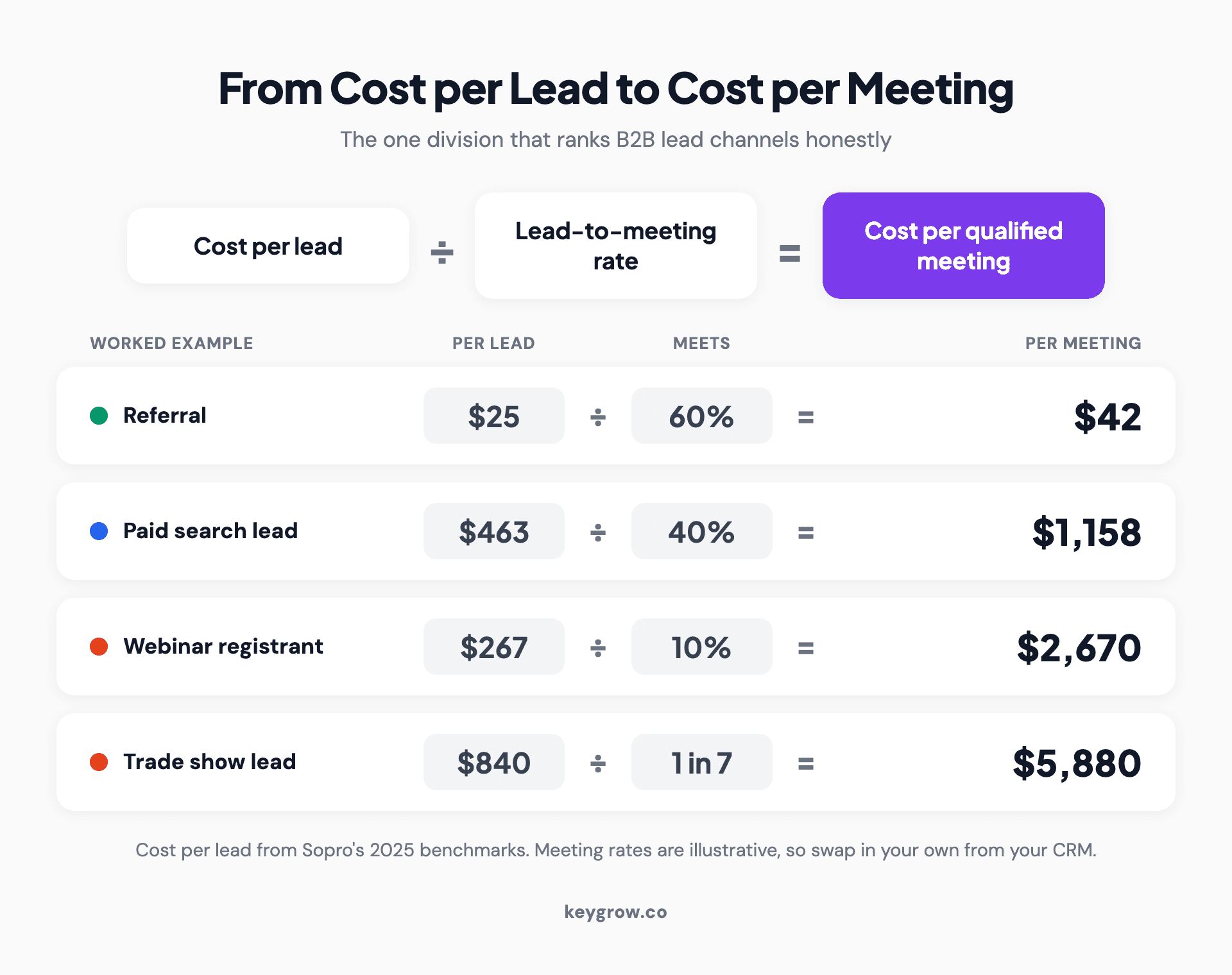
Formula showing cost per qualified meeting equals cost per lead divided by lead-to-meeting rate, with four worked examples: a $25 referral at 60 percent is about $42, a $463 paid search lead at 40 percent is about $1,158, a $267 webinar lead at 10 percent is $2,670, and an $840 trade show lead at one in seven is $5,880.
Those rates are examples, not benchmarks. We have not found a public dataset we trust on lead-to-meeting rates by channel, mostly because every company defines a lead differently. Pull your own: for each lead source, count the leads from the last two quarters, count the meetings sales accepted, and divide. If your CRM cannot produce that report, fix it before you add a channel.
Most deals are decided before your first meeting
B2B buyers build their shortlist before they talk to sales, so the channels that get you onto that list early beat the ones that interrupt buyers late.
The 6sense 2025 Buyer Experience Report surveyed nearly 4,000 B2B buyers. They made first contact with a seller 61 percent of the way through their buying process. In 95 percent of cases the winning vendor was already on the buyer's day-one shortlist, and four out of five deals went to the vendor the buyer preferred before speaking to anyone. The average buying cycle ran 10.1 months.

A buying group meeting in a glass-walled conference room, the kind of discussion where a B2B shortlist gets decided before any seller is invited.
Read that as a ranking rule. Channels that reach buyers while they research alone, such as a peer's recommendation, a search result, a useful article or a credible LinkedIn presence, do the work that decides the deal. Interruption channels like cold email and calling still work, but mostly when they reach an account before its shortlist forms. That makes outbound a timing problem more than a copywriting problem.
1. Referrals and warm introductions
Referrals produce the cheapest qualified meeting in B2B, at about $25 per lead. Their weakness is volume, because you cannot buy more of them on demand.
A referred buyer arrives with the shortlist problem already solved. Someone they trust put you on it. The meeting rate is high, and the conversation starts further along than any cold contact ever will.
Most companies treat referrals as luck rather than a channel. Make it a routine instead. Ask customers at natural high points, like a finished project or a renewal. Make the ask specific ("who else do you know who runs three or more clinics?") rather than "send anyone our way". Give the referrer a two-line description they can forward without editing. Then tag referral as a lead source in your CRM, so these deals stop disappearing into "direct".
The ceiling is real. Referral volume scales with your customer count and the quality of your work, so a company with fifteen customers cannot run on referrals alone.
This channel needs no agency and almost no budget, only the habit of asking. Run it always, and pair it with something you can turn up when you need more.
2. Paid search on high-intent terms
Paid search costs more per lead than most channels ($463 on average), but the leads asked for you, so a high share of them turn into meetings within weeks.
Someone typing "inventory software for distributors" into Google is describing a problem they want solved soon. You pay for that intent, and you should, because it is the nearest thing B2B has to a buyer walking through the door. Paid search is also the quickest channel to test. A focused campaign can produce first leads within a couple of weeks of launch.
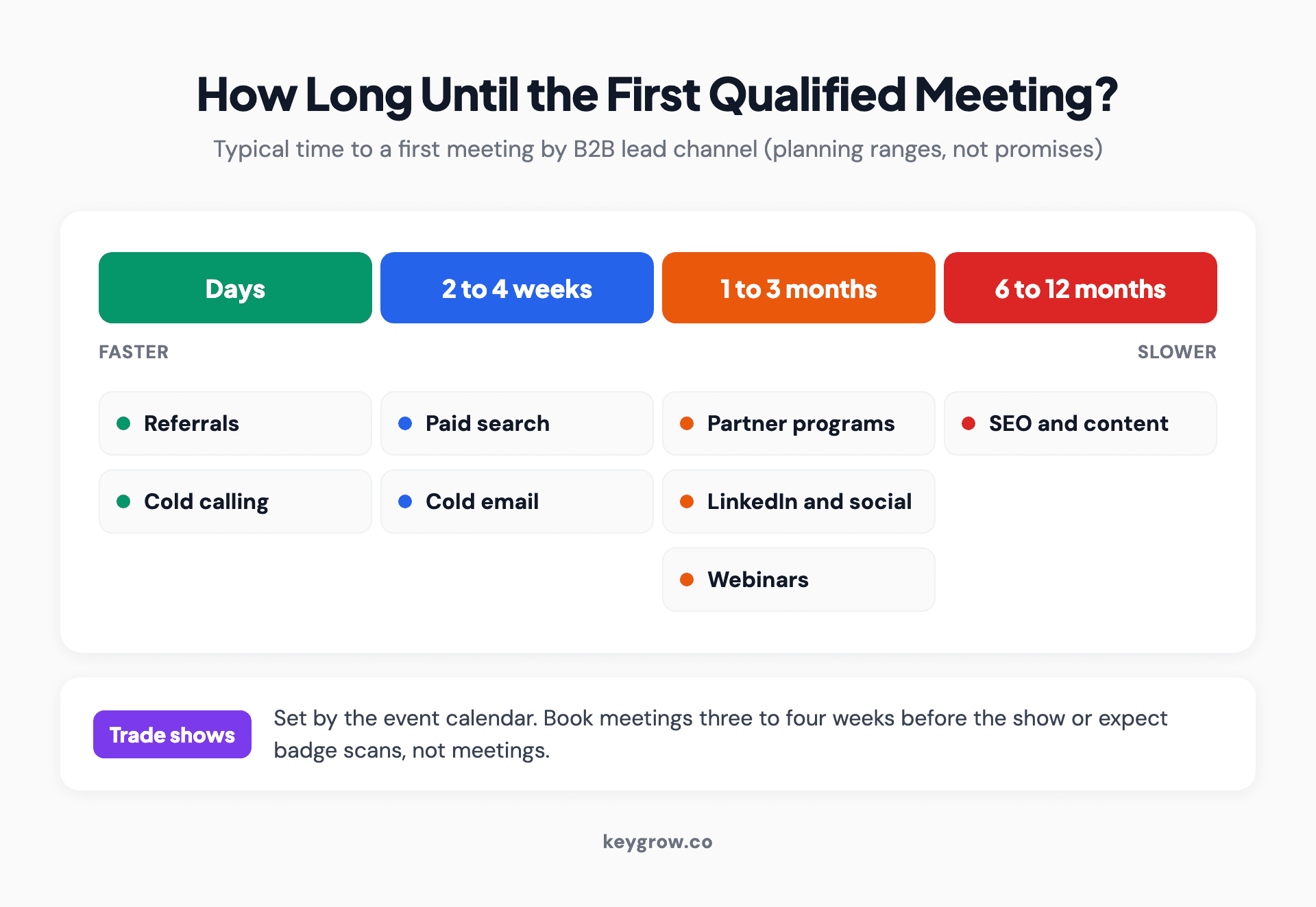
Timeline of how long each B2B lead channel takes to produce a first qualified meeting: referrals and cold calling within days, paid search and cold email within two to four weeks, partners, LinkedIn and webinars within one to three months, trade shows on the event calendar, and SEO in six to twelve months.
Where it fails is the page after the click. An eviction law firm we worked with was getting 1 conversion a week from 22 clicks, at $240 per conversion. Visitors landed on the existing page and could not tell what to do next. We rebuilt the page around one clear action, restructured the campaigns and split-tested small side campaigns. Between September and October 2022 the weekly numbers went to 21 conversions from 189 clicks, at $31.79 per conversion. Same market, same kind of buyer. The page set the price of the lead.
Paid search also needs a deal size big enough to carry the cost of a click. We worked through that math in does PPC work for B2B, and the guide on how to budget for B2B PPC covers how to fund one campaign well enough that it can learn. It is the best fast channel when your category has search demand. If nobody searches for what you sell, skip it.
3. Partner and affiliate programs
A partner who already sells to your buyer can send warm introductions for very little money. Expect one to three months before the first meeting, though.
A good partner already sells to your buyer and does not compete with you. Think of the accounting firm that serves the same clients as your payroll tool, or the agency that implements the software you integrate with. When they recommend you, you inherit their trust. It is the referral effect at a larger scale. Sopro's affiliate average is $73 a lead, which is roughly what borrowed trust costs.
The cost is setup time and attention. You need a few partners who genuinely talk to your buyers, a simple reason for them to bother (a referral fee, or just a better outcome for their client) and one person on your side who keeps the relationship warm. Most programs die because nobody owns them.
Five active partners beat fifty signed agreements that nobody has opened since the launch call.
This is a strong second act once your referral habit is working. It is a poor choice if you need meetings next month.
4. SEO and content
SEO produces some of the cheapest B2B leads once it matures, and it has the slowest start of any channel. Plan on six to twelve months.
Sopro's average puts SEO at $206 a lead. More to the point, search is where buyers do the solo research 6sense describes. A page that answers the question a buyer types at 11pm keeps answering it every night for years, with no per-click bill. That compounding is why SEO ranks fourth rather than lower. On cost alone it would sit near the top.
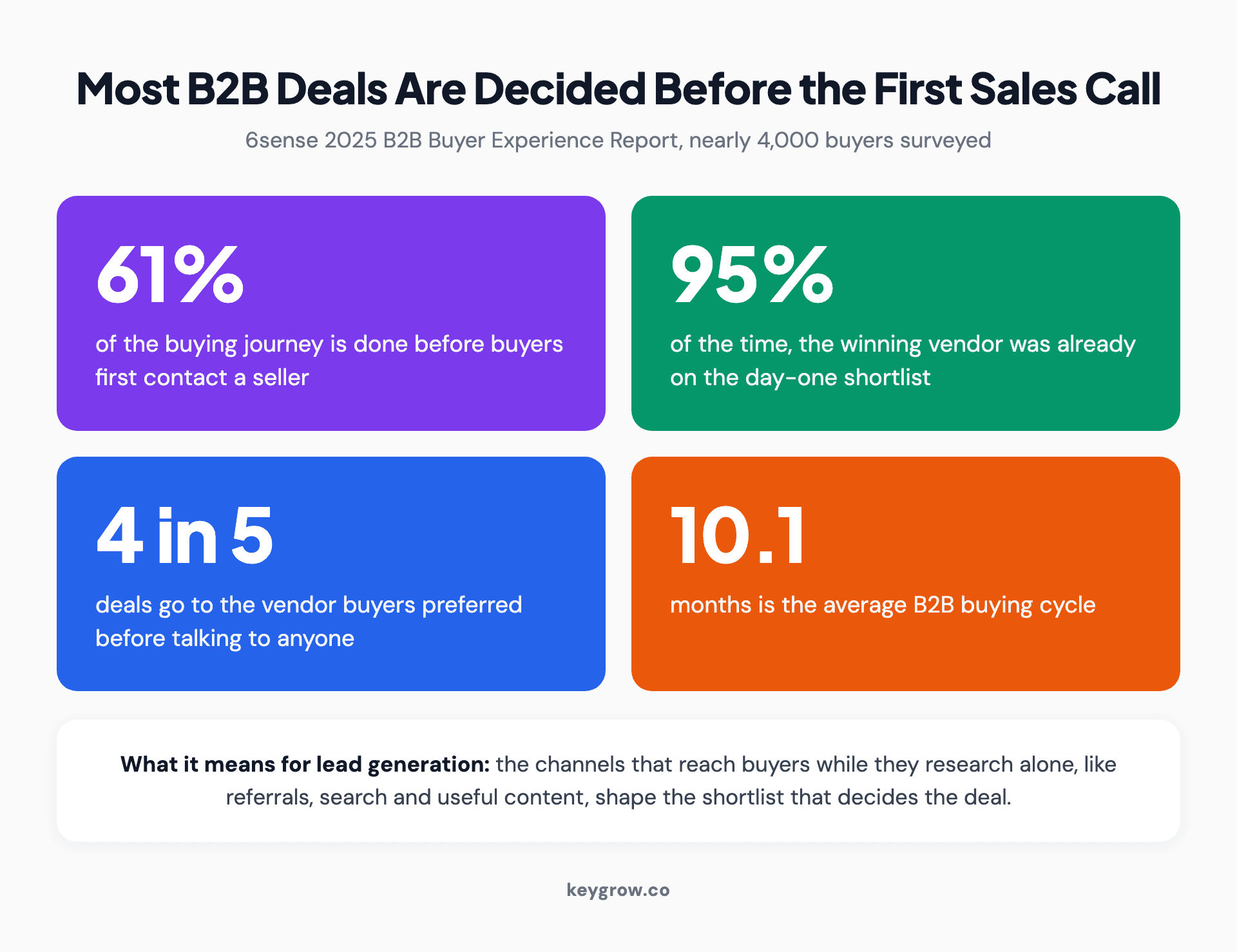
Four stat cards from the 6sense 2025 Buyer Experience Report: buyers make first contact 61 percent of the way through their journey, the winning vendor is on the day-one shortlist 95 percent of the time, four out of five deals go to the vendor preferred before contact, and the average B2B buying cycle is 10.1 months.
Time is the problem. Our strongest organic result took 12 months to reach 1,519 percent traffic growth, and the first quarter of almost any SEO program looks like nothing is happening. If your runway is short, SEO cannot be your first channel. We made the full case, including when B2B SEO is the wrong call, in why SEO is important for B2B.
The strongest setup is often paid search and SEO together. Paid shows you within weeks which search terms produce meetings, and organic pages then go after the winners so you stop renting those clicks. That loop is the subject of combining SEO and PPC for lead generation. Start SEO early, judge it late, and pair it with a fast channel so year-one pipeline does not depend on it.
5. Targeted cold email
Cold email is the strongest outbound channel when the list is tight. Reply rates have fallen, so list quality now decides almost everything.
Instantly's 2026 benchmark data puts the average cold email reply rate at 3.43 percent, down from about 5.1 percent in 2024. Top-quartile senders reach 5.5 percent. And a reply is not a yes, since plenty of replies are polite declines. Sopro puts the average cost at $225 per lead.
Do the arithmetic before you buy a tool. One thousand well-chosen contacts at the average rate gives you about 34 replies. If a third of those are interested and half of the interested ones book, that is roughly six meetings. Those last two ratios are illustrative, but the shape holds: cold email is a volume game played on a small, accurate list.
The programs that work share a pattern. They write to a narrow set of accounts that fit, they have a reason to write now (a new hire in the role you sell to, say, or a second location opening), and the first email is short with one small ask. Plan on a few weeks of warming up any new sending domain before you send at volume, which is why the first meeting usually takes two to four weeks rather than days.
It is the best outbound bet for most B2B companies and a good channel for a founder to run personally. Blasting a bought list is the opposite of this channel, and it burns your domain and your reputation in the same week.
6. LinkedIn and social
For most B2B companies social means LinkedIn, so it gets one row: paid leads average $408, and an organic program needs about 90 days to build.
LinkedIn sells targeting by job title, company size and seniority that no other platform matches, and the price reflects it. The math works when deal sizes are large. Below that, the cost per lead tends to outrun what a deal can support. Organic posting from named people (not the company page) is cheaper and slower, and we covered how to run it in LinkedIn marketing for B2B.
Social also does quieter work. A buyer who gets a referral or a cold email will look up your people's profiles and recent posts before replying. For the wider question of which platforms turn attention into leads, see our guide to social media for lead generation.
Our verdict: use it above a certain deal size, or as a slow organic play run by one or two people, and not as a small team's first channel.
7. Cold calling
Cold calling reaches a first meeting fastest, often within days, but it costs the most rep time per meeting, and its success rate roughly halved in a year.
Cognism's cold calling report, built on WHAM (We Have A Meeting) call data, found that 4.82 percent of conversations turned into a booked meeting in 2024, and that the 2025 rate fell to almost half that. The same report puts the industry standard near 2 percent. Persistence matters more than the script. In that data, 93 percent of all conversations happened by the third call attempt, so stopping after one dial leaves most of them on the table.

A salesperson on a phone call at a desk beside a window, working through a cold calling list with a laptop open.
Sopro's cost per lead for cold calling is $300, but the real cost is rep hours spent dialing. Calling earns its place in markets where decision-makers still pick up, and as the second touch after an email the prospect has already opened.
Treat it as a strong supporting channel inside a sequence. As a primary channel it is expensive.
8. Webinars
Webinar registrants look cheap at $267 each, and they rarely become meetings, which pushes webinars down the ranking on cost per meeting.
A webinar registration is a content download with a calendar invite attached. Many registrants never attend, and many who do wanted the education, not a sales call. That does not make webinars useless. It makes them a nurture channel rather than a meeting channel.
They work best in two situations. One is a small, invite-only session for accounts already in your pipeline, where the goal is to answer the questions holding a deal up. The other is a session co-hosted with a partner whose audience you do not have. Both put the right people in the room. A public webinar promoted to a cold list mostly fills a spreadsheet.
Good for moving existing pipeline forward. Weak at creating new meetings.
9. Trade shows and events
Nothing on this list costs more per lead than a trade show ($840 on average), and shows only pay back when the meetings are booked before the doors open.
Badge scans are not leads. Booth fees, travel, staff time and giveaways add up fast, and many of the people who stop by wanted the pen. Even so, events produce some of the best conversations in B2B, because the buyer chose to spend a day on your category.

A crowded trade show floor with attendees moving between exhibitor booths, the most expensive B2B lead channel per lead in Sopro's benchmarks.
The way to make the math work is to treat the show as a meeting venue rather than a lead source. Email and call your target accounts three to four weeks ahead, book time on site, and judge the event on meetings held. Worth it for large deals in industries that still gather in person. Skip it if you cannot fill a calendar in advance.
Speed versus effort: where each channel lands
Plot the nine channels on speed and effort and the useful pairs appear: one fast channel to feed pipeline now, and one compounding channel to make it cheaper later.
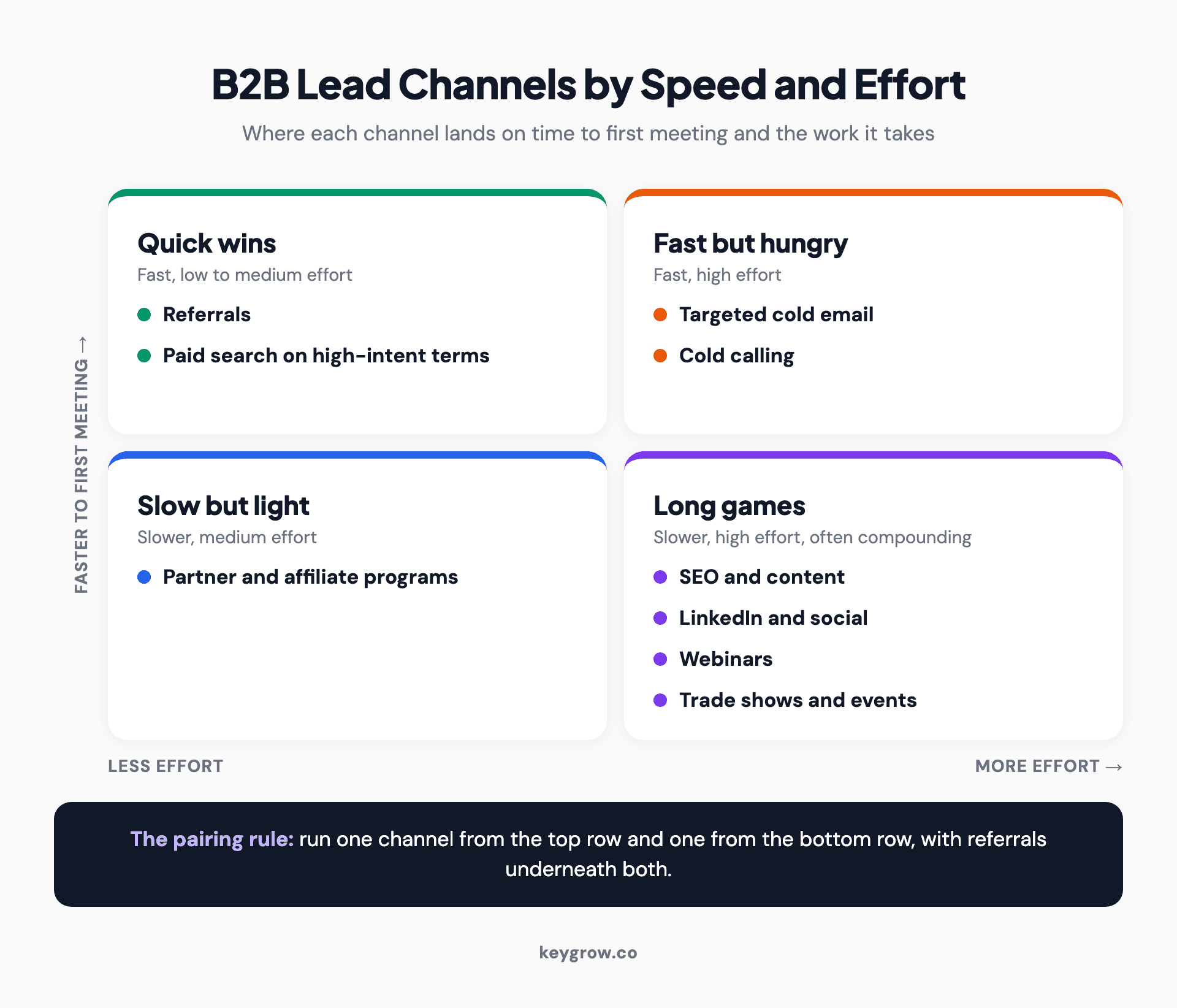
Quadrant map of nine B2B lead channels by speed to first meeting and effort: referrals and paid search are fast with low to medium effort, cold email and cold calling are fast with high effort, partner programs are slower with medium effort, and SEO, LinkedIn, webinars and trade shows are slow with high effort.
The pairing rule falls straight out of the map. Take one channel from the fast half and one from the slow half. Pick two fast ones and you rebuild pipeline by hand every month, because neither compounds. Pick two slow ones and you wait two quarters for a first meeting.
Referrals sit outside the rule. They cost so little to run that they belong underneath whatever pair you choose.
What we left off the list
A few common options did not earn a row, and here is why.
Bought lead lists and contact databases are a data source, not a channel. What you do with the data is cold email or calling, which are already ranked. Direct mail ($250 per lead in Sopro's data) can work for a short list of high-value accounts, but rarely as a main channel. Facebook ads look cheap at $142 per lead, though for most B2B targeting the leads are thin.
Outsourced appointment setting rents someone else's outbound engine. If you try it, pay for meetings that take place, never for leads delivered.
Do you need an agency for any of this?
Often, no. If your company is early, most deals still close through the founder, and you can name every customer from memory, your two channels are probably referrals and founder-led cold email. Neither needs an agency. Paying one to run them also hides the market feedback the founder should be hearing first-hand: which pitch lands and which objection keeps coming up.
Bring in help when the channel you need rewards specialist skill and steady attention, which usually means paid search and SEO, or when your time is worth more than the fee.
FAQs
What is the best lead generation channel for B2B sales?
Referrals produce the cheapest qualified meetings, at around $25 per lead in Sopro's 2025 benchmarks, but you cannot scale them on demand. For a channel you can turn up, paid search on high-intent terms is usually the best choice if buyers search for your category. SEO wins over the long run but takes six to twelve months.
How much does B2B lead generation cost per lead?
Averages run from about $25 per lead for referrals to $840 for trade shows in Sopro's 2025 compilation, with SEO near $206, cold email near $225 and paid search near $463. Industry matters too: legal and software development leads average roughly three times the cost of B2B SaaS leads in the same data. Judge any figure by cost per qualified meeting, not cost per lead.
How long does B2B lead generation take to produce meetings?
Referrals and cold calling can produce a meeting within days, paid search and cold email within two to four weeks, and partners, LinkedIn and webinars within one to three months. SEO usually needs six to twelve months. Run one fast channel beside one slow one so pipeline does not stall while the slow one builds.
Is cold email still worth it for B2B?
Yes, for a tight list of accounts that fit your offer. Average reply rates fell to 3.43 percent in Instantly's 2026 benchmark data, and many replies are polite declines, so a broad list rarely pays. Narrow targeting, a reason to write now and a short first email with one small ask make the difference.
Should B2B companies focus on inbound or outbound lead generation?
Most should run one of each: an inbound channel such as search or referrals that reaches buyers while they research, and an outbound channel such as cold email that reaches accounts before they shortlist. Buyers in 6sense's 2025 research made first contact 61 percent of the way through their process, so being findable during research decides more deals than outbound volume.
Should I outsource B2B lead generation?
Outsource the channels that reward specialist skill and steady attention, usually paid search and SEO, once you know your deal size and close rate. Keep referrals and early cold email in house, especially while the founder still closes most deals. If you hire an outbound firm, pay for meetings held rather than leads delivered.
Pick two channels for 90 days
Choose one channel from the fast half of the map and one from the slow half. For most B2B companies that means paid search or cold email for pipeline now, plus SEO or a LinkedIn program from one named person for cheaper pipeline later. Referrals run underneath both, because they cost almost nothing.
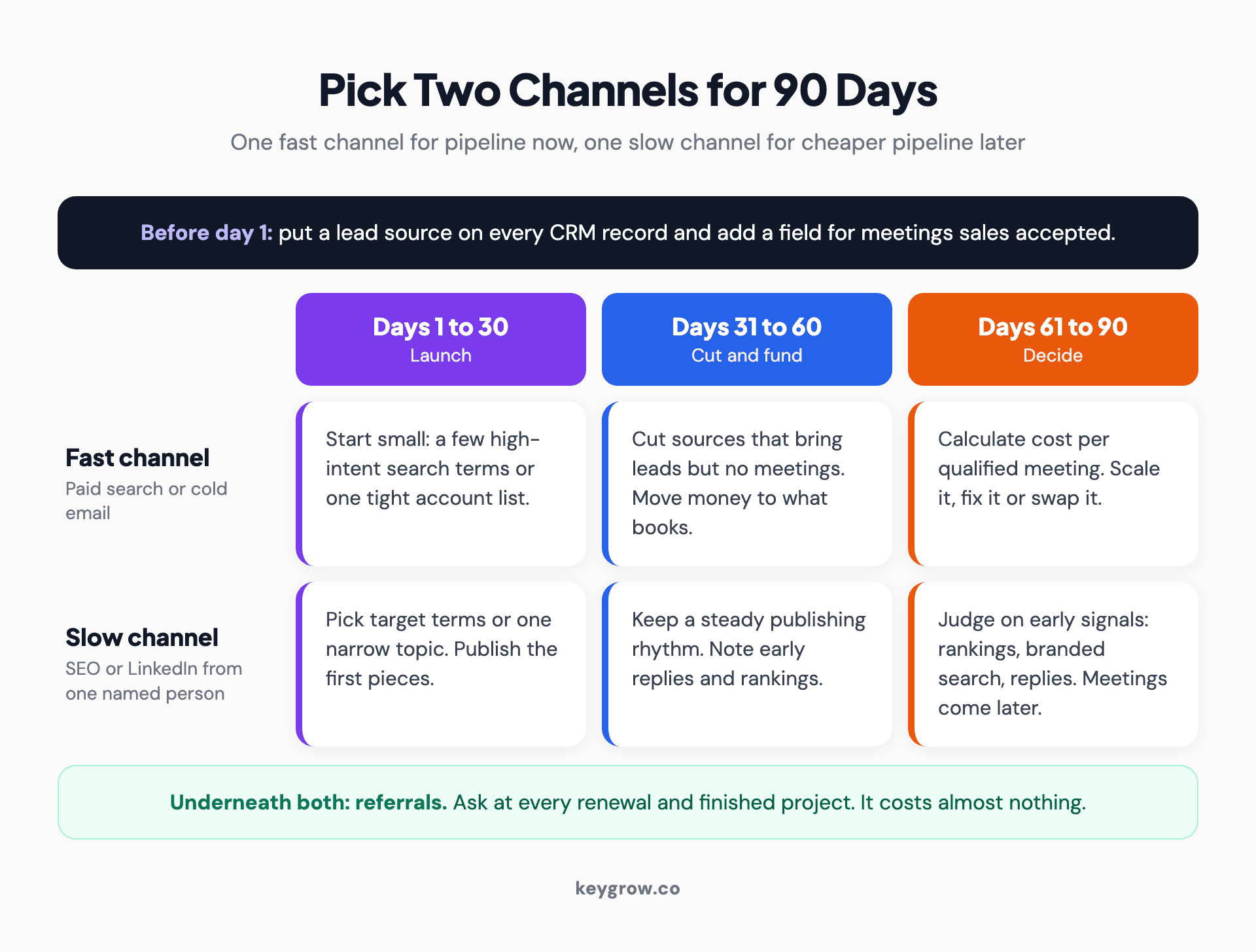
A 90-day plan for two B2B lead channels in three phases after adding lead source tracking before day one: days 1 to 30 launch the fast channel small and publish the first pieces for the slow channel; days 31 to 60 cut what produces leads but no meetings and fund what books; days 61 to 90 calculate cost per qualified meeting and decide to scale, fix or swap.
Before day one, set up tracking: a lead source on every CRM record and a field for meetings sales accepted. In the first 30 days, launch the fast channel small and publish the first pieces for the slow one. Between days 31 and 60, cut whatever produces leads but no meetings, and move the money to the keywords, segments or messages that book. Between days 61 and 90, calculate cost per qualified meeting for the fast channel and decide whether to scale it, fix it or swap it. Judge the slow channel on early signals instead, like rankings for target terms, branded search and replies to posts, because its meetings come later.
If paid search is one of your two, our PPC management can run it, and our SEO team can build the slow half. We work month to month, and if your numbers say a channel cannot work for you yet, we will tell you before you spend on it. Tell us what you sell and we will help you pick the two.