


A competitor bidding on your brand keywords in Google Ads is allowed, it is common, and Google will not stop them. The same rules let you bid on theirs. That is the short answer, and most of the advice on this topic stops there, which leaves you with the wrong question.
The right question is not whether they can. It is what their presence is actually costing you, and that number is specific to your business rather than to the practice in general. The most cited study on this subject found brand ads were worth essentially nothing. It was run at a company in a situation almost nobody reading this is in.
So: what the policy and the courts permit, what Google will act on, how to measure your own exposure rather than borrowing someone else's conclusion, the cheapest way to respond, and the math for bidding on their name instead.
They are allowed to, and Google will not stop them
Using a trademark as a keyword is not a policy violation. Google says so directly.
Google's trademarks policy states that Google will not restrict the use of trademarks as keywords. Keyword use is explicitly outside what the trademark complaint process covers. You can file, and Google will not act on the bidding itself.
This is worth internalizing before you spend a week on it. Every "make them stop" plan that targets the keyword rather than the ad text runs into the same wall. The bidding is not the actionable part.
US courts landed in the same place. In October 2024 two federal appeals courts threw out trademark claims over this exact practice, because neither advertiser had misled anyone about who was behind the ads. In 1-800 Contacts v. Warby Parker, the Second Circuit held that ads clearly identifying the actual advertiser do not create the consumer confusion trademark law protects against.
The Ninth Circuit went further in Lerner & Rowe v. Brown Engstrand, a case between two law firms, and its opinion is worth reading for one number alone: out of 109,322 ad impressions on the plaintiff's brand name, 236 callers seemed confused about who they had reached. That is 0.216 percent, which the court ruled de minimis, legal shorthand for too trivial to support a claim.
The EU and UK are stricter. Under the Interflora line of cases, keyword use of a competitor's mark can infringe if a reasonably well-informed user cannot tell the ad is unconnected to the brand owner. We run ad accounts, not a law practice, so take anything contested to a trademark attorney.
What Google will act on is your name in their ad text
Ad text is a different matter, and this is where a complaint has teeth.
The same policy restricts using trademarks in an ad from a direct competitor, and ads that use the trademark in a confusing, deceptive or misleading way. The distinction that matters: the trademark must appear in the ad itself, not only on the landing page, for Google to consider it.
Exceptions are written into the policy and they catch people out:
- Resellers. If the landing page is primarily dedicated to selling or clearly facilitating the sale of the products, using the trademark can be permitted.
- Informational sites. If the landing page's primary purpose is to provide informative details about the products or services corresponding to the trademark, that can also be permitted.
- Compatible parts and descriptive use. Sellers of compatible parts can use the trademark too, and so can an ad using the word in its ordinary dictionary sense.
Which means a review site or comparison page running "Best [Your Brand] Alternatives" is frequently within policy, and a straight competitor putting your name in a headline usually is not.
One procedural detail worth knowing before you file: Google accepts complaints against specific advertisers identified by their URLs, within the countries and industries where the trademark owner has demonstrated rights. It is not a blanket takedown. You are naming a specific advertiser in a specific market, and you will need to do it again for the next one.
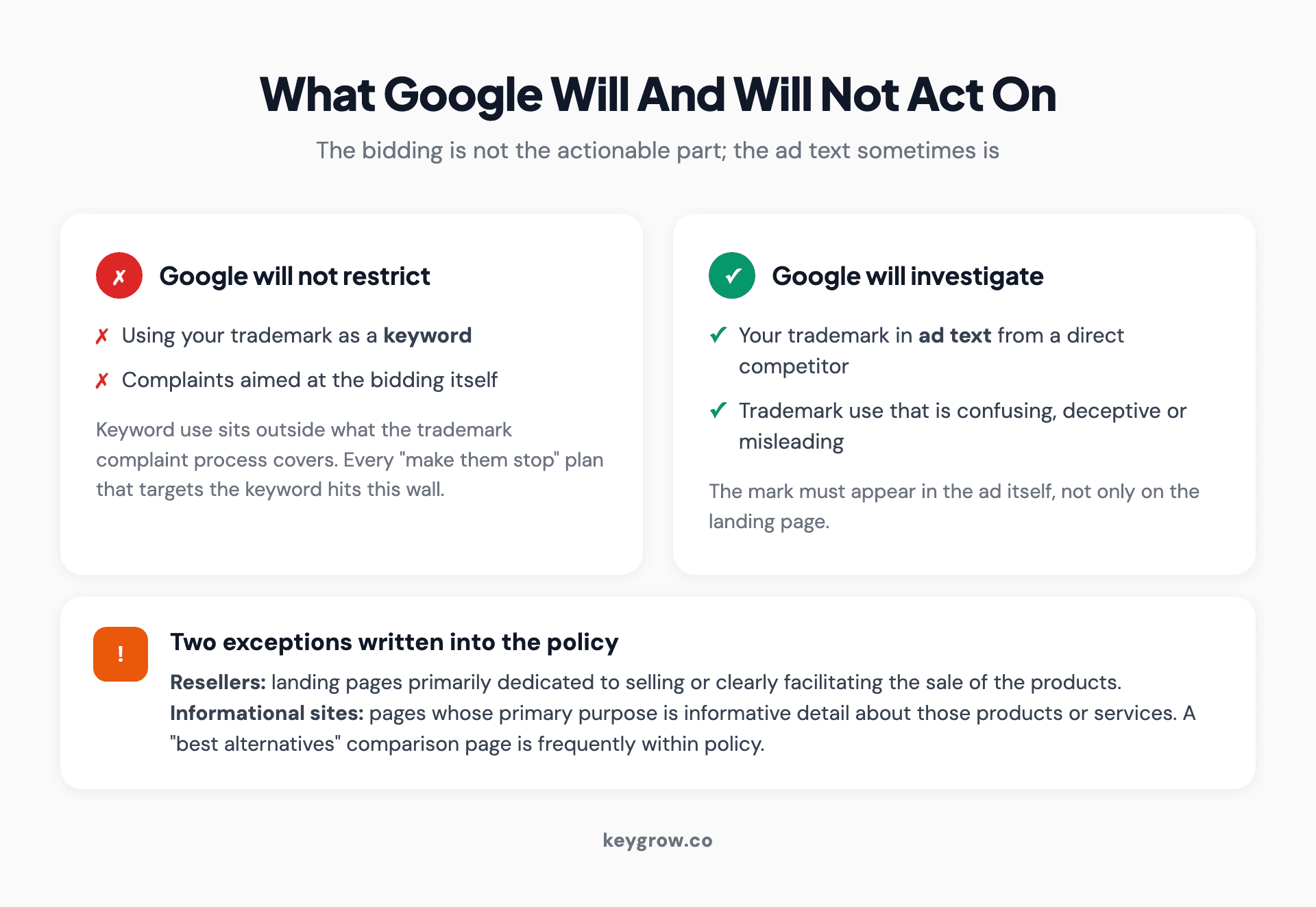
Two-column card layout showing that Google will not restrict trademark use as a keyword but will investigate trademark use in a competitor's ad text, plus the reseller and informational-site exceptions.
The study everyone quotes was run in conditions you do not have
Somebody in this conversation will eventually say that brand advertising is proven worthless. They are referring to a real and very good experiment, and it does not describe your situation.
eBay halted paid search on its own brand terms across regions and measured what happened. The finding, in the authors' words from Blake, Nosko and Tadelis: "almost all (99.5 percent) of the forgone click traffic from turning off brand keyword paid search was immediately captured by natural search traffic." Elsewhere they put it plainly: brand-keyword ads had no measurable short-term benefit.
Now look at the conditions. eBay was one of the most recognized brands on the internet. It held the top organic result for its own name. And critically for this article, it had essentially nobody bidding against it on that term.
That last condition is the entire subject of this post. When a competitor occupies the paid slot above your organic listing, the traffic you would have retained for free is no longer sitting there unguarded. The mechanism the eBay result depends on is exactly the mechanism a competitor breaks.

Two yellow directional arrow signs on a wooden post pointing in opposite directions.
A later replication makes the point from the other direction. For a far smaller online car-shopping brand, Recast's replication found roughly half the traffic arriving through branded search ads would not have arrived through organic links alone.
Two careful experiments, opposite practical conclusions, because they measured brands of very different strength. Which is the actual lesson: anyone who tells you the answer without testing your account is guessing. That goes for the agency recommending a large brand-defense budget and equally for the consultant telling you to switch it off. Confident answers to a company-specific question are the red flag here.
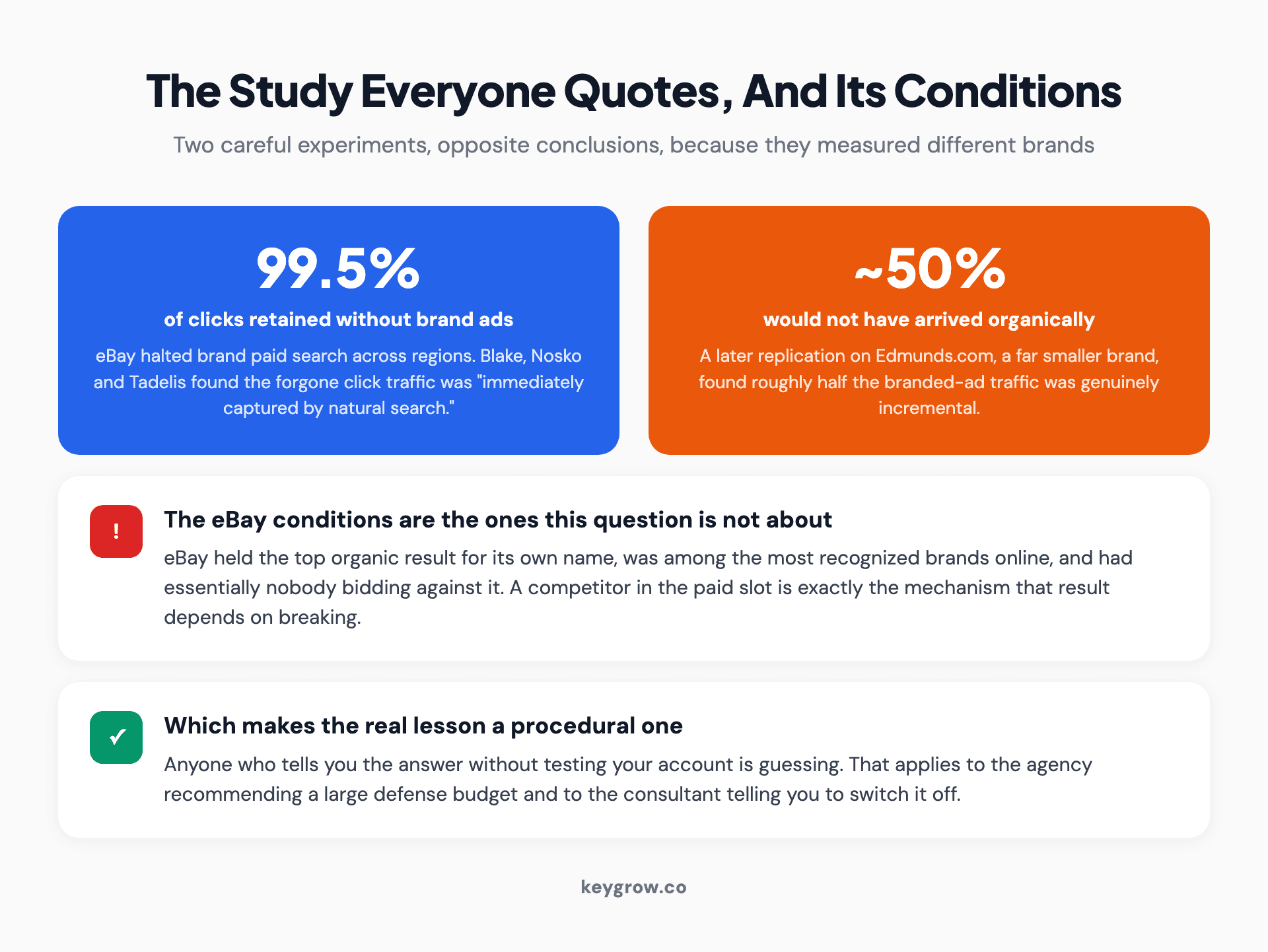
Two stat cards contrasting the eBay experiment, where 99.5 percent of clicks were retained without brand ads, against a replication on a smaller brand where about half the traffic was genuinely incremental.
Find out what your brand traffic is actually worth
Brand bidding is one of the easiest things in paid search to test properly, which makes it strange how rarely anyone does.
Run a geographic holdout. Pause brand campaigns in a representative subset of regions, leave them running everywhere else, and compare total conversions, not paid conversions, between the two groups over a few weeks.
Total is the word doing the work. Paid conversions will obviously fall in the paused regions. The question is whether *total* conversions fall, or whether organic simply absorbed them. If total holds steady, your brand spend is buying traffic you already had. If total drops, you now know the size of the leak and what defending is worth.
A few things that make the test honest:
- Match the regions. Compare like with like on size and seasonality, not coastal cities against rural ones.
- Run it long enough to cover your normal sales cycle, and longer if your purchase decision takes weeks.
- Check whether the competitor is present in both groups. If they are only bidding in some regions, the test measures two different things at once.
- Watch the paused regions for competitor entry. An empty paid slot on your brand name is an invitation.
Do this once and the annual argument about brand spend stops being an argument.
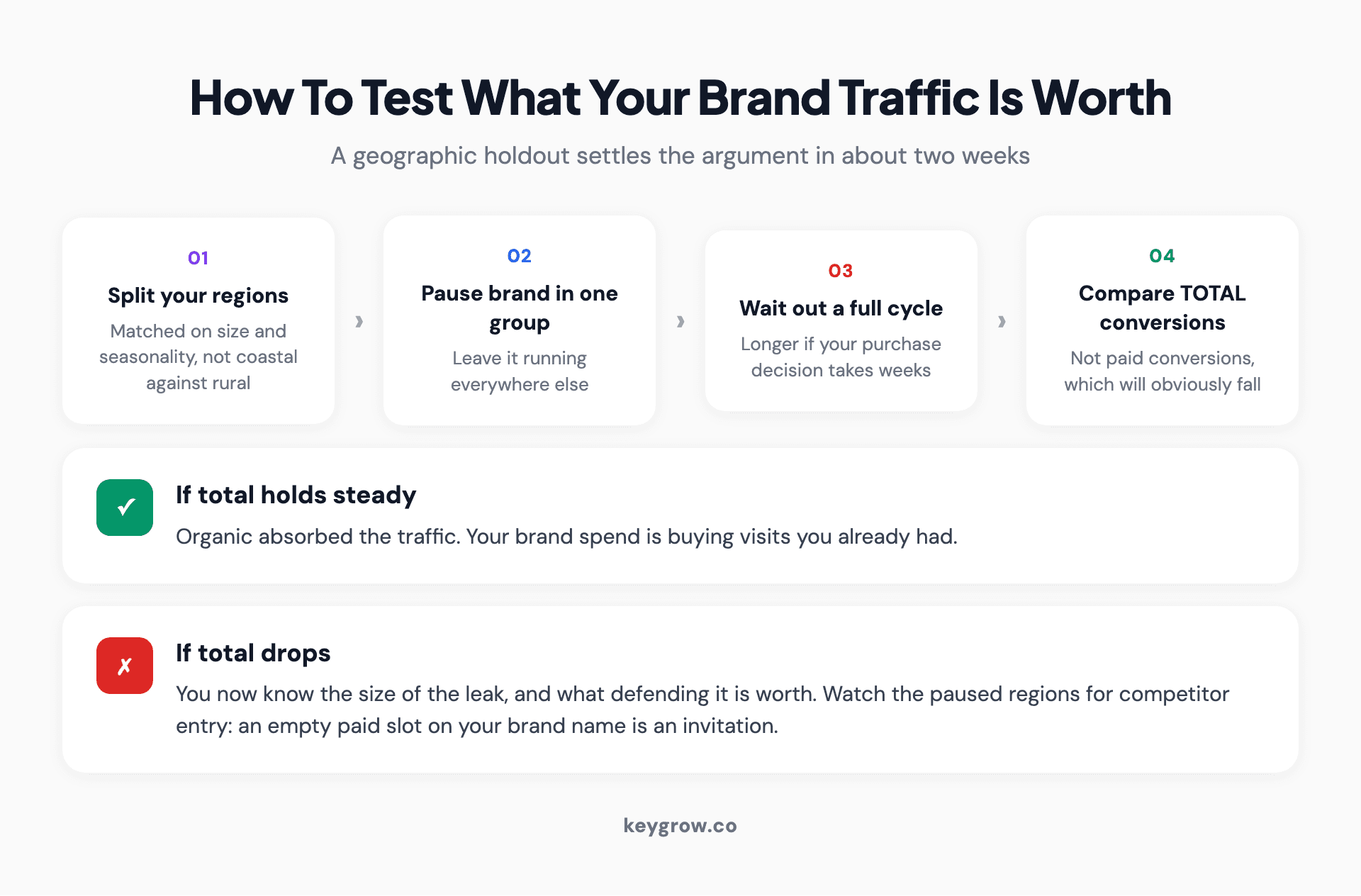
Four-step flow for running a geographic holdout test on brand campaigns: split matched regions, pause brand in one group, wait a full sales cycle, then compare total conversions rather than paid conversions.
The escalation ladder, cheapest first
Work down this list in order. Most situations resolve in the first two steps, and the expensive options are rarely the ones that work.
1. Confirm it is actually happening. The usual first signs are rising branded cost per click and brand impression share sliding from above 90 percent toward 70. Auction Insights on the brand campaign will name the new domain, and the Google Ads Transparency Center lets you see their live ads. Use ad previews, not your own repeated searches, which distort your impression share, and check on different days, because many competitor campaigns run in bursts. There is a method in our guide to checking competitor ads.
2. Make sure your own brand campaign exists and is healthy. A defended brand term is cheap and hard to outrank. Your own brand keywords carry the highest relevance scores in your account, so you can usually hold the top slot at a fraction of what the competitor is paying.
3. Check their ad text. If your name is in their headline or description and they are a direct competitor without a reseller or informational defense, file the trademark complaint. This is the one lever Google will actually pull. Have dated screenshots, proof of the registration and an email on your corporate domain ready. Enforcement on a valid complaint typically lands within days.
4. Contact them. Underrated and frequently effective, particularly with smaller companies who set this up without much thought. A polite note pointing out that you will reciprocate is often enough. It costs nothing and it resolves faster than any other option.
5. Reciprocate, deliberately. Bidding on their brand as a bargaining chip is a real option and a real cost. Enter it as a negotiating position with a defined end, not as a permanent line item, because two companies paying to appear on each other's brand terms is a transfer from both of them to Google.
Steps 4 and 5 can both end in a handshake, which is where to slow down. A truce where both sides stop bidding on each other's names is exactly what the FTC challenged as anticompetitive in a long-running action over a contact lens retailer's bidding pacts. An appeals court overturned the FTC's order in 2021, which leaves the ground unsettled rather than safe, so talk to a lawyer before you agree to one.
6. Legal action. Expensive, slow, and rarely proportionate unless there is genuine consumer confusion or the competitor is impersonating you. Save a cease and desist letter for repeat offenders who edit their ads to dodge enforcement. Trademark law varies by jurisdiction and this is where you want an actual lawyer rather than an article.
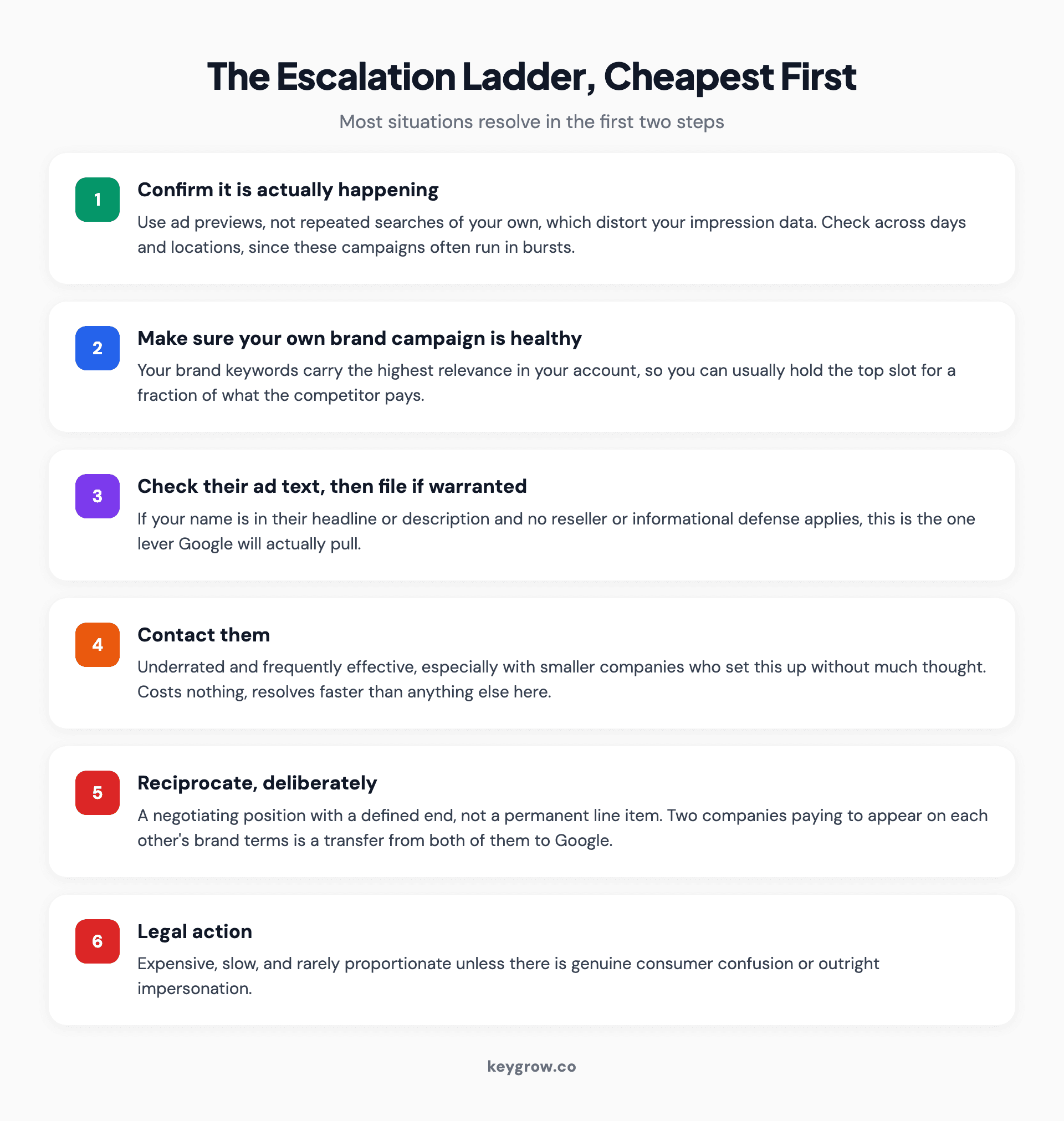
Six numbered steps for responding to a competitor bidding on your brand, from confirming it is happening through to legal action as the last resort.
What a defended brand campaign looks like
Keep it separate, keep it exact, and stop it competing with itself.
Give brand terms their own campaign so the reporting stays honest. Blending brand into a general search campaign is how accounts produce spectacular return figures that mean nothing, because brand conversions get credited to work that did not produce them.
Then:
- Exact and phrase match on your name and its common misspellings, not broad.
- Add your brand as a negative in all non-brand campaigns, so they cannot cannibalize the cheaper brand traffic. Our negative keyword method covers the mechanics.
- Include the terms people actually type, which are usually brand plus login, brand plus reviews, brand plus pricing, brand plus a competitor name.
- Write the ad to close, not to introduce. This person knows who you are. Sitelinks to pricing, login and contact do more here than a value proposition, and a full set of four pushes a rival's ad further down the page.
- Cap it. A defended brand campaign should have a ceiling. If it is consuming a large share of budget, something upstream is wrong.
Multi-location and franchise systems are the most exposed to this of any business model, because the brand is valuable and defending it is nobody's specific job. We covered the governance side in franchise Google Ads.
When the right move is to do nothing
Sometimes the correct response to a competitor on your brand term is to note it and move on. This is not the advice most agencies give, because doing nothing is difficult to bill for.
Do nothing when:
- They are running a short burst. A two-week campaign around a product launch is not worth restructuring your account over.
- Your holdout test showed near-total retention. If total conversions did not move, you have measured your answer. Trust it over the anxiety.
- The searcher is buying something they cannot get elsewhere. If your product is genuinely not substitutable, a competitor ad on your name mostly wastes the competitor's money.
- Your brand search volume is tiny. If forty people a month search your name, this is a rounding error and your attention belongs on non-brand demand.
The failure mode worth avoiding is spending a quarter and a meaningful budget defending against something that was costing you very little, while the actual problem was that not enough people search your name at all.
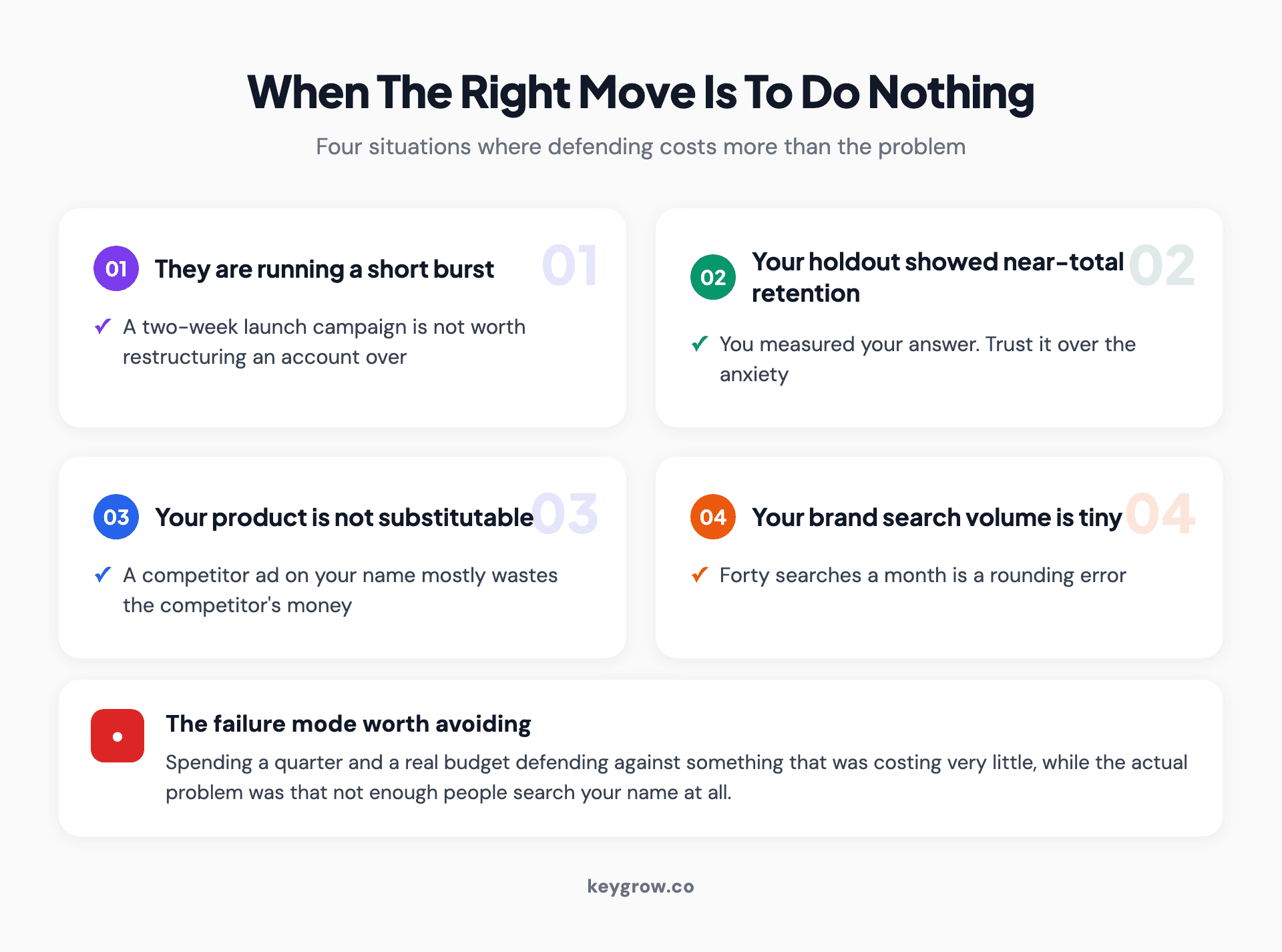
Four cards describing when to take no action against a competitor bidding on your brand, including short bursts, a holdout showing near-total retention, and very low brand search volume.
Bidding on their brand name is legal, and priced like a penalty
The rules that let a competitor bid on your name let you bid on theirs. Whether you should is a math question, because those clicks cost a multiple of your own brand clicks and convert worse.
Quality Score is why. The searcher typed their name and their own ad repeats it. Yours cannot use the name once they complain, so it scores low on expected clickthrough rate, ad relevance and landing page experience, the three things Quality Score measures. No amount of optimization closes that gap.
The gate is one calculation. Your allowable cost per acquisition, multiplied by the conversion rate you can realistically expect on their traffic, gives the most you can pay per click. Say a new customer is worth $600 in margin and you are willing to spend up to $150 to win one. If your normal search campaigns convert 10 percent of clicks but competitor traffic converts at 4 percent, your ceiling is $150 times 0.04, or $6 per click. If clicks on that brand term run $9, the math is over before the campaign starts. Run your own numbers through our Google Ads ROI calculator before testing anything.
Use that degraded rate, not your house rate, because conquest traffic includes people locked into the competitor by warranties or contracts. Then judge the test on cost per acquired customer over 60 to 90 days and ignore clickthrough rate, because conquest campaigns produce flattering activity metrics and unflattering revenue ones.
How to run a competitor campaign that will not get flagged
A compliant competitor campaign is mostly a list of deliberate constraints:
- Separate campaign, own budget. Conquest costs and conversion rates would distort every average in your core campaigns.
- Exact match, intent modifiers first. "Alternative", "pricing" and "reviews" searches signal a comparison shopper. The bare brand name mostly reaches people who wanted that company's website.
- Negative keywords on day one. Careers, login, support, warranty, phone number. Those searchers are employees and existing customers, not prospects.
- Ad copy that never names them. Sell the category and your difference, with two or three approved variants ready so a disapproval means a swap, not a scramble. Our ad title generator drafts headlines that name nobody.
- A comparison page that does name them. The trademark policy stops at your website's front door. Keep the side-by-side honest, because overstated claims are what create false-advertising exposure.
- Automation off. Dynamic keyword insertion would drop their brand name into your headline, and auto-created assets or Performance Max can lift it from your comparison page. Negatives and brand exclusions also stop broad match and Performance Max from conquesting by accident.
- 60 to 90 days of clean data before you judge the results. Our breakdown of how long PPC takes explains what those months look like.
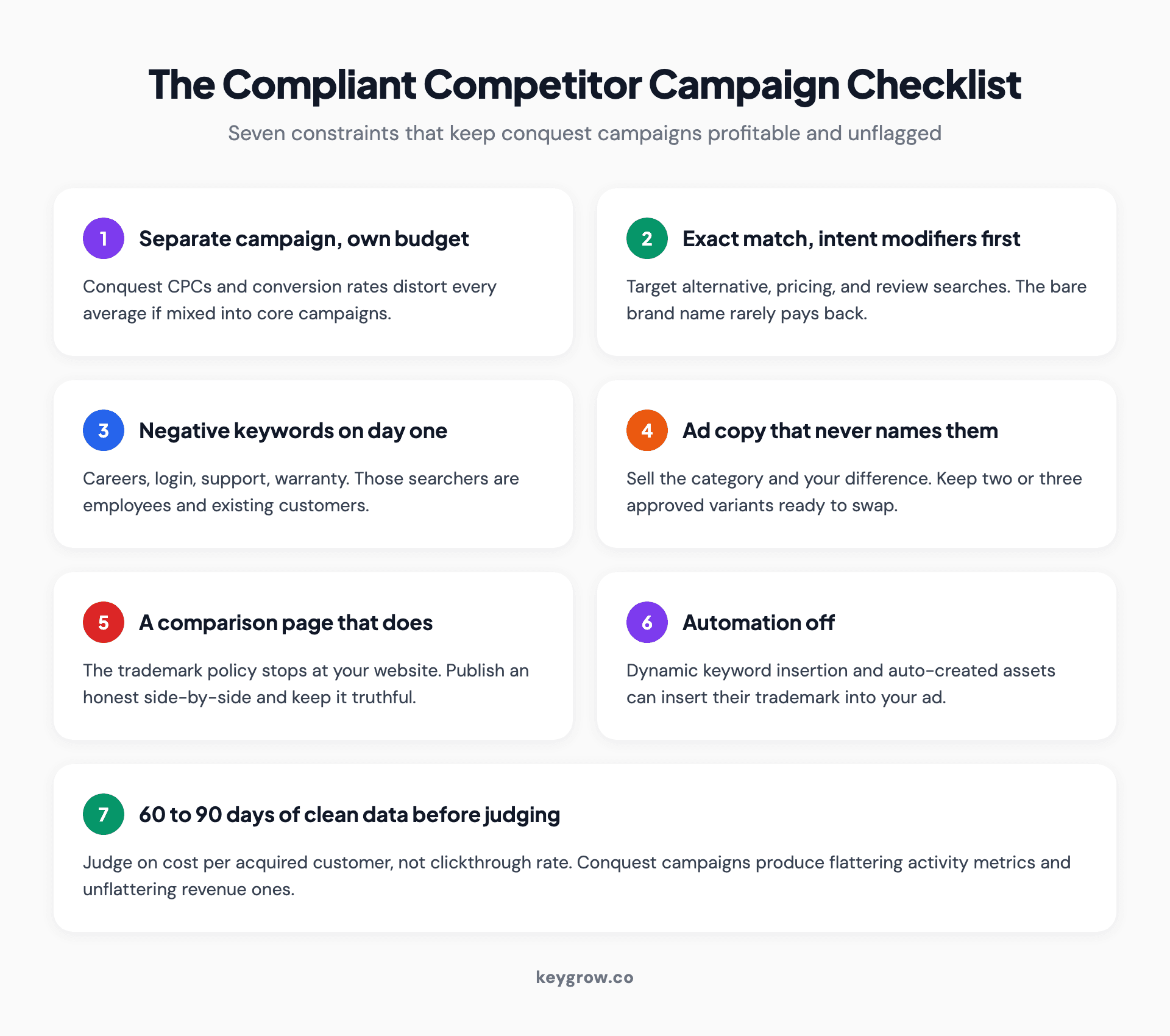
Seven-point checklist for a compliant competitor keyword campaign: separate campaign and budget, exact match with intent modifiers, immediate negative keywords, ad copy that never names the competitor, a comparison landing page that does, automation switched off, and 60 to 90 days of clean data.
Skip conquesting entirely if your budget is tight or you have no honest answer to "why switch". The same goes if your own brand campaign is not running yet, or if your front desk cannot sort the competitor's existing customers from real prospects.
FAQs
Can I bid on a competitor's brand keywords in Google Ads?
Yes. Google's policy does not restrict trademarks as keywords, and in October 2024 two US federal appeals courts confirmed that bidding on a competitor's trademark is not infringement by itself, as long as the ad does not mislead people about who is advertising. The EU and UK are stricter, so ads there must make your identity unmistakable.
Can I make a competitor stop bidding on my brand keywords?
Not through Google, and not on the bidding itself. Google's trademark complaint process covers use of a trademark in ad text, not use as a keyword. The practical routes are a trademark complaint if your name appears in their copy, direct contact with the company, and a healthy brand campaign of your own that holds the top slot.
Is bidding on a competitor's brand name worth it?
Only when the math clears. Multiply your allowable cost per acquisition by the lower conversion rate their traffic will realistically produce, and skip it if real clicks cost more than that ceiling. Bidding back on someone who bids on you should have an end date, because two companies paying for each other's names mostly benefits Google.
Should I bid on my own brand name?
It depends on your brand's strength and whether anyone is bidding against you, and the honest answer is that you should test it. The eBay experiment found 99.5 percent of clicks were retained without brand ads, while a replication on a much smaller brand found only about half would have arrived organically. Run a geographic holdout and measure total conversions rather than paid conversions.
How do I know if a competitor is bidding on my brand?
Use the ad preview and diagnosis tool rather than searching repeatedly yourself, which skews your impression data, and check across several days and locations. Your auction insights report for the brand campaign shows which domains appear alongside you, and the Google Ads Transparency Center shows their live ads.
Where this leaves you
You cannot stop a competitor bidding on your brand name. You can sometimes stop them putting it in their ad, you can hold the top slot cheaply because your own name is the most relevant keyword you will ever own, and you can find out what any of it is actually worth with a two-week geographic holdout.
Do the test before the arguing. The two best experiments on this question reached opposite practical conclusions because they studied brands of very different strength, which means the answer for your business is not in an article. It is in your own account, and it is cheap to find. The same goes for bidding on theirs: legal, and worth paying for only if your break-even math says so.
If you would rather have someone run the holdout and read the result properly, that is part of what our PPC management does, month to month, cancel anytime.