


Open a private window, search your city and the word therapist, and count how far down the page your practice appears.
For most private practices the honest answer is that it does not appear at all. The first screen belongs to two or three paid directories, a hospital system, and a group practice with forty clinicians and a real marketing budget.
That is the starting position, and it is why most advice about SEO for therapists quietly fails. It tells you to compete for the term the directories were built to own. You are not going to win that term this year, and probably not next year. You also do not need it. There is a whole category of search a directory cannot serve properly no matter how much authority it has, and that is where a solo or small practice gets found.
This post is about locating those searches, building the pages that answer them, and skipping the parts of the standard checklist that were written for businesses in a different position than yours.
Who actually owns page one in your city
Directories, health systems and large group practices take almost all of the first page for broad city terms. Your opening is further down the tail, and it is a better opening than it sounds.
Run the search and label what comes back. You will usually find the map pack at the top with three profiles in it, then two or three directory listing pages, then a hospital or university clinic, then a large group practice, then somewhere on page two, individual clinicians.
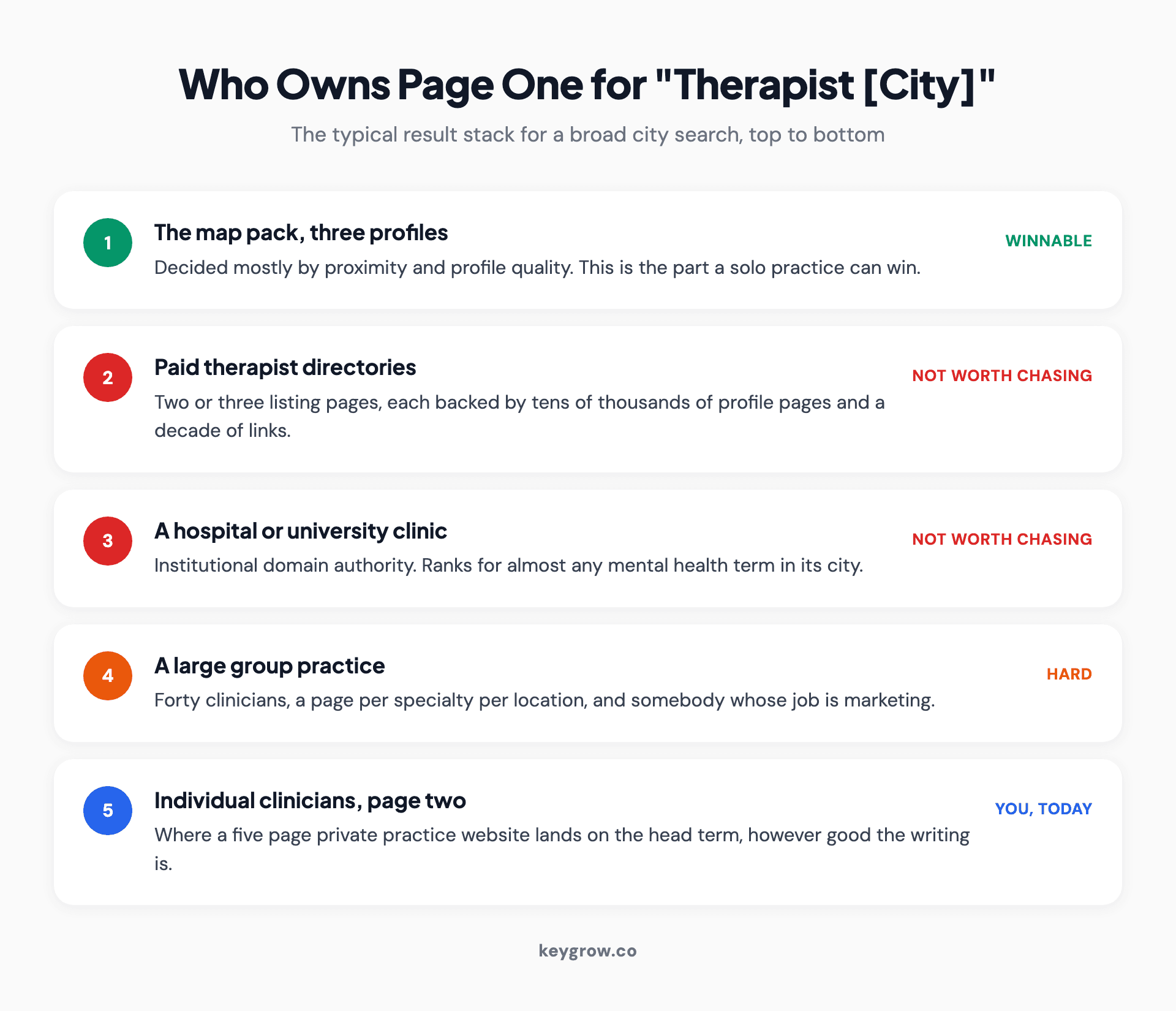
Breakdown of who occupies the first page of Google for a broad city plus therapist search, showing directories, health systems, group practices and where solo clinicians rank.
Two things follow from that picture. The map pack is winnable, because it is decided largely by proximity and profile quality rather than domain authority. And the blue links under it are not winnable with a five page website, because those results are held by domains with tens of thousands of pages and a decade of links.
So stop treating "therapist [city]" as the goal. Treat it as the term you will eventually pick up as a side effect of ranking for forty narrower things.
The searches a directory structurally cannot win
A directory ranks by having a page for every filter combination. What it cannot do is answer a question in one clinician's voice, about one clinician's actual approach.
Directory pages are generated. That is their strength at scale and their weakness on specifics. A page listing sixty local clinicians who checked the "trauma" box cannot tell a reader what the first three sessions of trauma work actually look like, who it is not appropriate for, or why this therapist stopped using a particular protocol. You can.
| What someone types | Who wins it | Why |
|---|---|---|
| therapist [city] | Directory | Built for exactly this, thousands of profiles deep |
| therapist near me | Map pack | Proximity and profile quality, not domain size |
| EMDR therapist [city] | Directory, narrowly | Still a filter they have a page for |
| EMDR for first responders [city] | You | Too specific to have its own filter page |
| therapist who takes [insurance plan] [city] | Split | Directory has the filter, you have the detail |
| what happens in the first EMDR session | You | Needs a practitioner voice, not a listing |
| therapist for adult adoptees | You | Population nobody built a filter for |
| do I need therapy or a psychiatrist | You | Informational, and directories write it badly |
The pattern is that you win where the search carries a detail the filter system does not have a checkbox for. Population, life event, specific protocol, a phrase somebody would only use if they were living it.
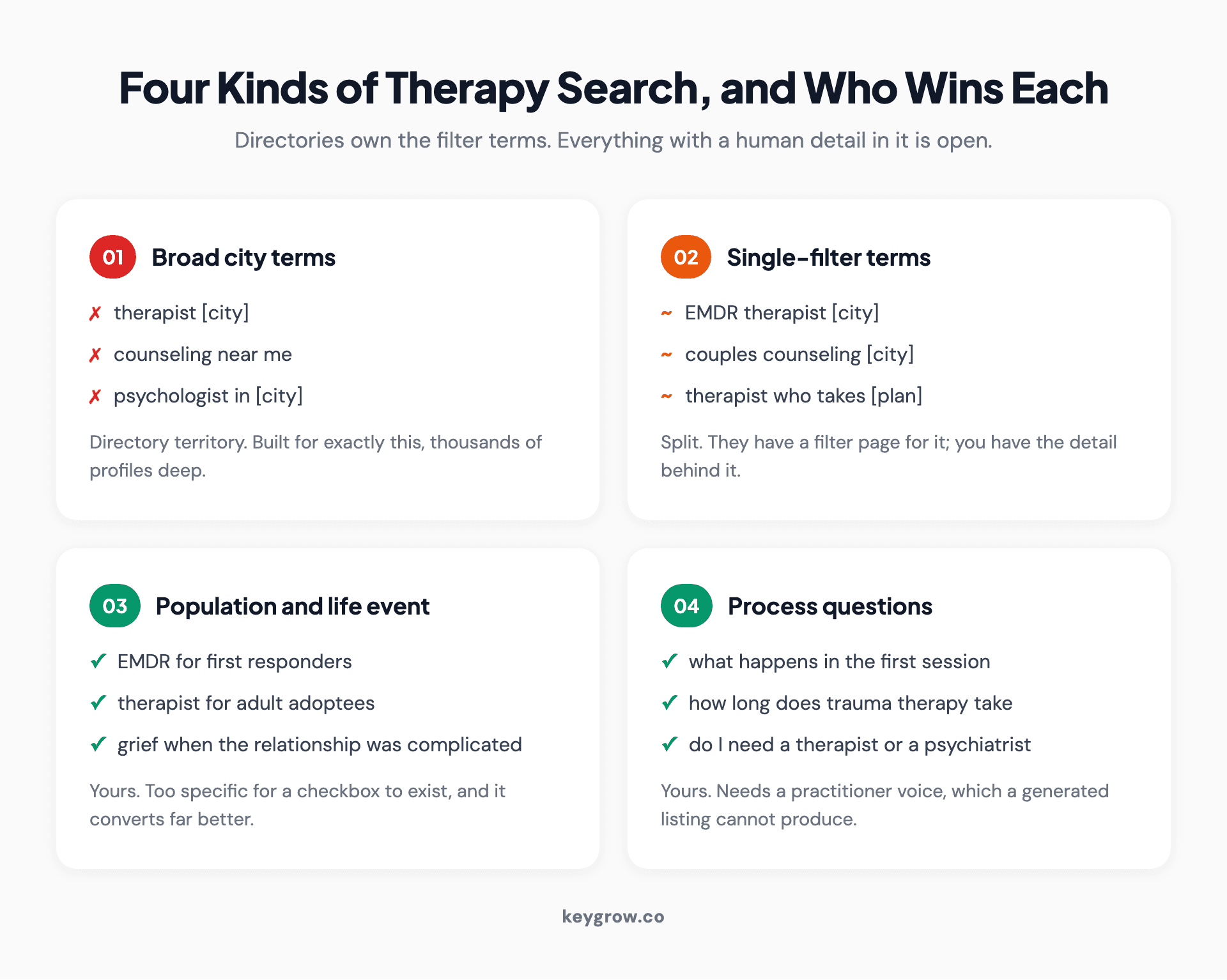
Four categories of therapy-related search showing which ones paid directories dominate and which ones an individual practice can realistically rank for.
Here is the part that makes this worth doing rather than depressing. A directory has to send its traffic somewhere, and it sends it to whoever paid. Your page sends its traffic to you, and the person arriving already read three hundred words in your voice before they clicked anything. The conversion difference between those two visits is not small.
Name the problem the way your client names it
Write one page per problem, using the words a person in that situation would actually type at eleven at night.
Most therapist websites have a services page listing modalities: CBT, DBT, EMDR, IFS, ACT. Nobody outside the profession searches that way on their first attempt. They search what is happening to them.
Somebody does not search "generalized anxiety disorder treatment". They search "why do I feel sick every Sunday night". They do not search "attachment-based therapy", they search "why do I push people away when things go well". The modality is how you work. The problem is what they know.
So the site needs both, and they do different jobs:
- Problem pages capture the search. One page for each thing you genuinely treat, titled in plain language, written to be read by a person who has not decided to book anything yet.
- Modality pages convert the search. Shorter, factual, linked from the problem pages, there for the reader who has done homework and wants to know whether you actually do the thing.
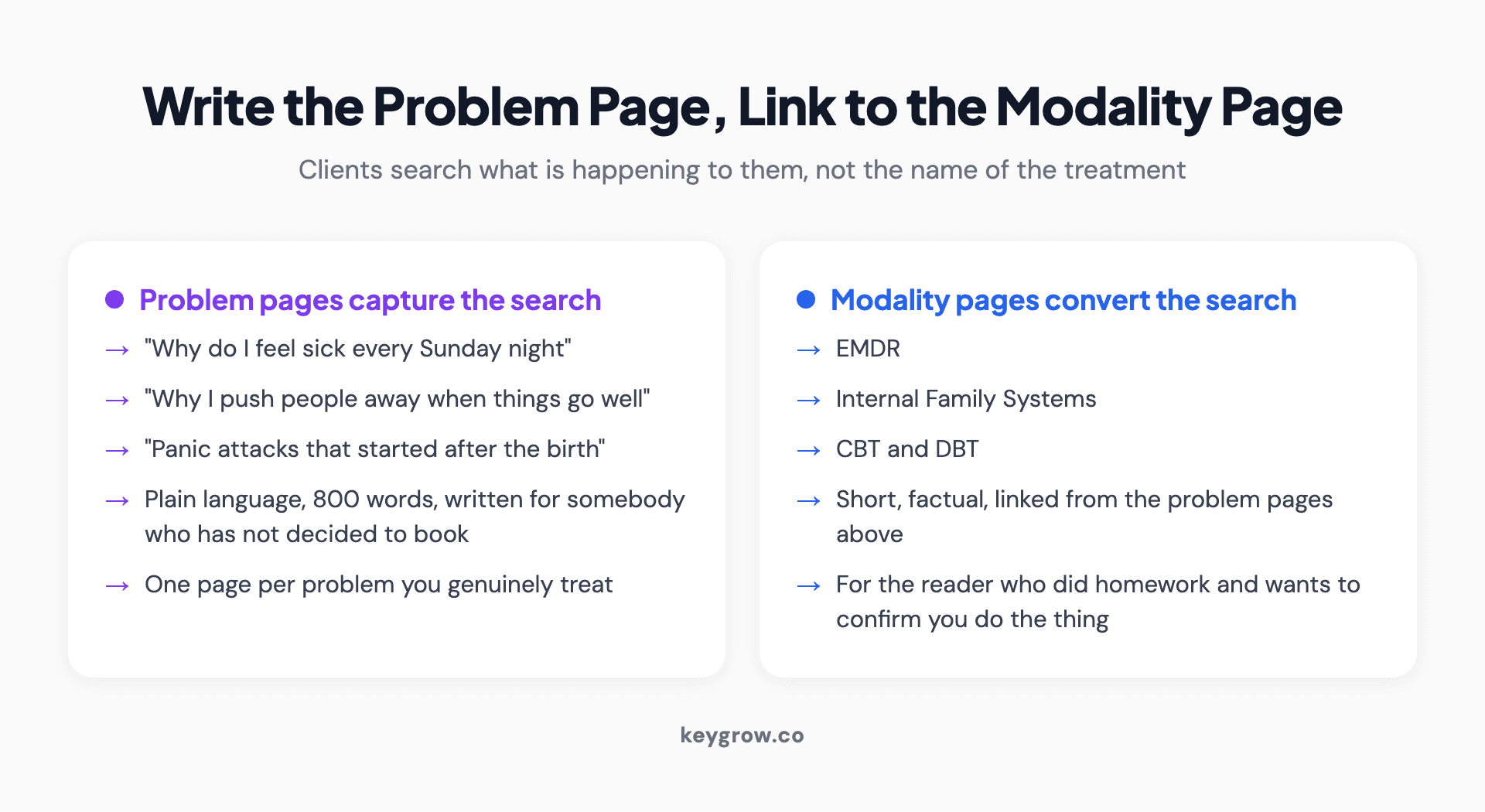
Site structure showing problem-first pages in client language linking through to modality pages, with examples of each type.
The most common structural mistake is one long "Specialties" page listing nine things. That page ranks for nothing, because it is nine pages of intent flattened into one. Split it. Nine thin pages that each answer one question beat one page that gestures at all of them.
A working rule: if you cannot write eight hundred honest words about it, you do not treat it enough to have a page for it. Leave it off. A page you wrote reluctantly reads exactly like a page you wrote reluctantly.
Nobody optimizes for the money question
Payment is the single largest reason an inquiry does not become a client, and almost no therapy website mentions it above the fold.
Go and look at fifteen therapist websites in your area. Most of them either bury fees on a contact page or leave them off entirely, on the theory that price should be discussed on a call. Meanwhile a meaningful share of local search volume looks like this: "therapist that takes [plan] near me", "sliding scale therapy [city]", "how much does therapy cost without insurance", "out of network therapist reimbursement".
Those are people trying to filter you before they call. If your site does not answer the question, they call the practice that did, or they go back to the directory, which does have an insurance filter.
What to publish:
- Your actual session fee, as a number. Not "contact for rates".
- Which panels you are on, named, and a plain statement if you are not on any.
- Whether you provide superbills for out of network reimbursement, and what a client typically gets back.
- Whether you hold sliding scale spots, how many, and how somebody asks.
- What a first appointment costs if it differs.
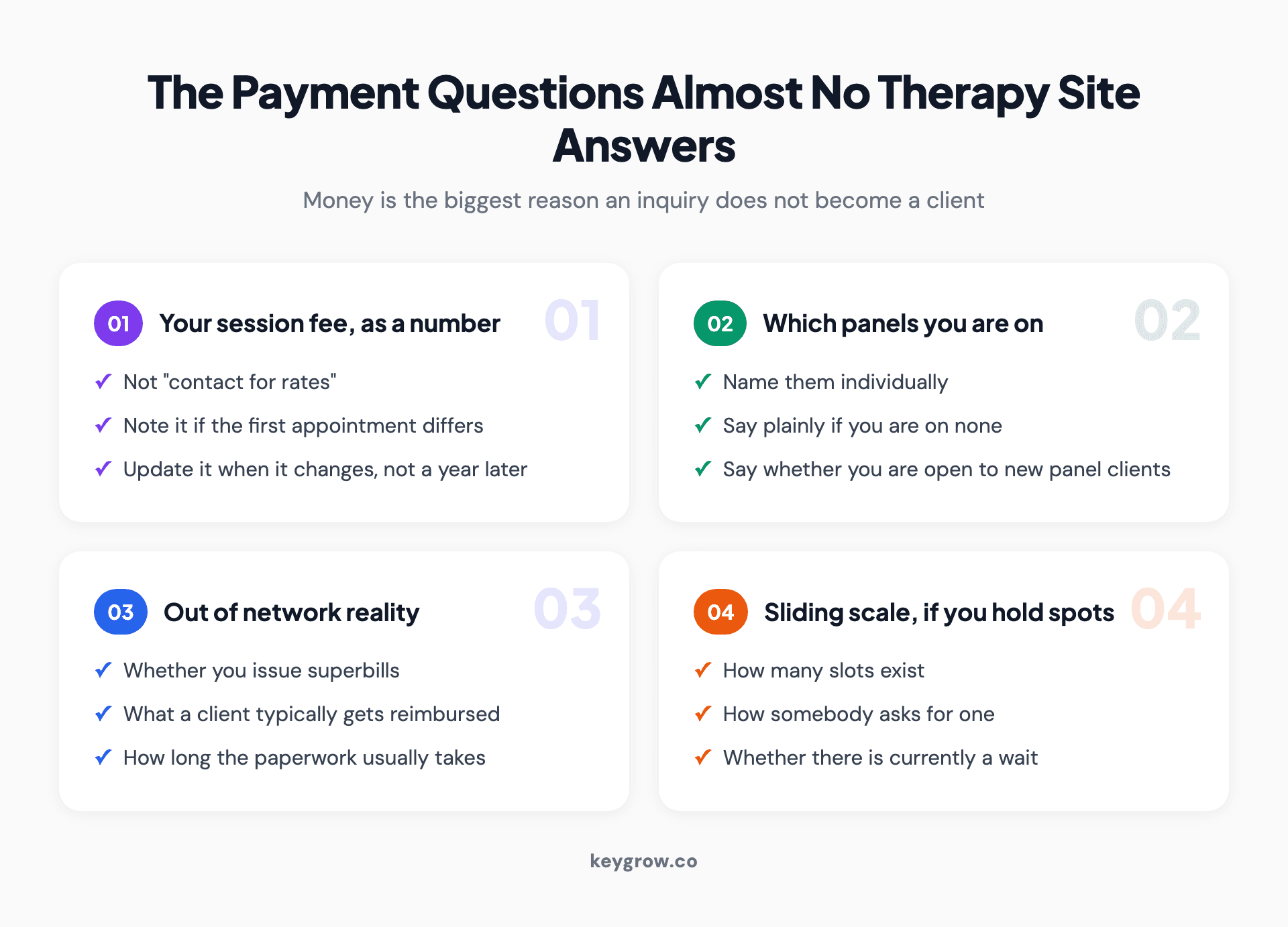
Checklist of payment and insurance information that should appear on a private practice website, including fees, panels, superbills and sliding scale slots.
Two things happen when you publish this. You start ranking for a set of terms your competitors ignored. And the inquiries you get are pre-filtered, which matters enormously when you are a solo clinician with limited intake time. Fewer calls that end in "oh, that is out of my budget" is a real improvement in your week, even though it looks like a drop in lead volume on a report.
Being clear about money is also the most straightforward trust signal a health practitioner can put on a page, and Google's rater guidelines are explicit that health and finance topics get held to a higher standard of transparency than most content.
Your Google Business Profile when there is no waiting room
If you work from home or entirely by telehealth, set the profile up as a service area business with the address hidden. It still ranks, and it is the highest-return hour of work available to you.

A small private consulting room with two armchairs facing a desk, the kind of part-time rented space many therapists work from.
The map pack is the one part of page one where a solo practice competes on equal terms with a group. Google's local ranking factors are relevance, distance and prominence, and distance in particular does not care how large your practice is.
The therapist-specific complication is the address. Many clinicians rent a room part time, work from home, or see clients only online. Some advice tells people to publish a home address, which is a genuine safety problem in this profession. You do not have to.
- Choose the service area business option and hide the street address. You still verify with a real address, it simply is not displayed.
- Set the service area to the towns you actually see clients from, not the whole state.
- Pick the most specific primary category available (Psychotherapist, Counselor, Marriage Counselor, Psychologist) rather than the broad medical one.
- Add services matching your problem pages, with the same wording.
- Answer the Q and A section yourself. Post the payment questions from the section above and answer them. That field is public, indexed, and almost always empty on therapist profiles.
- Post something monthly. It does not have to be clever. A note that you have two openings does more work than a stock inspirational quote.
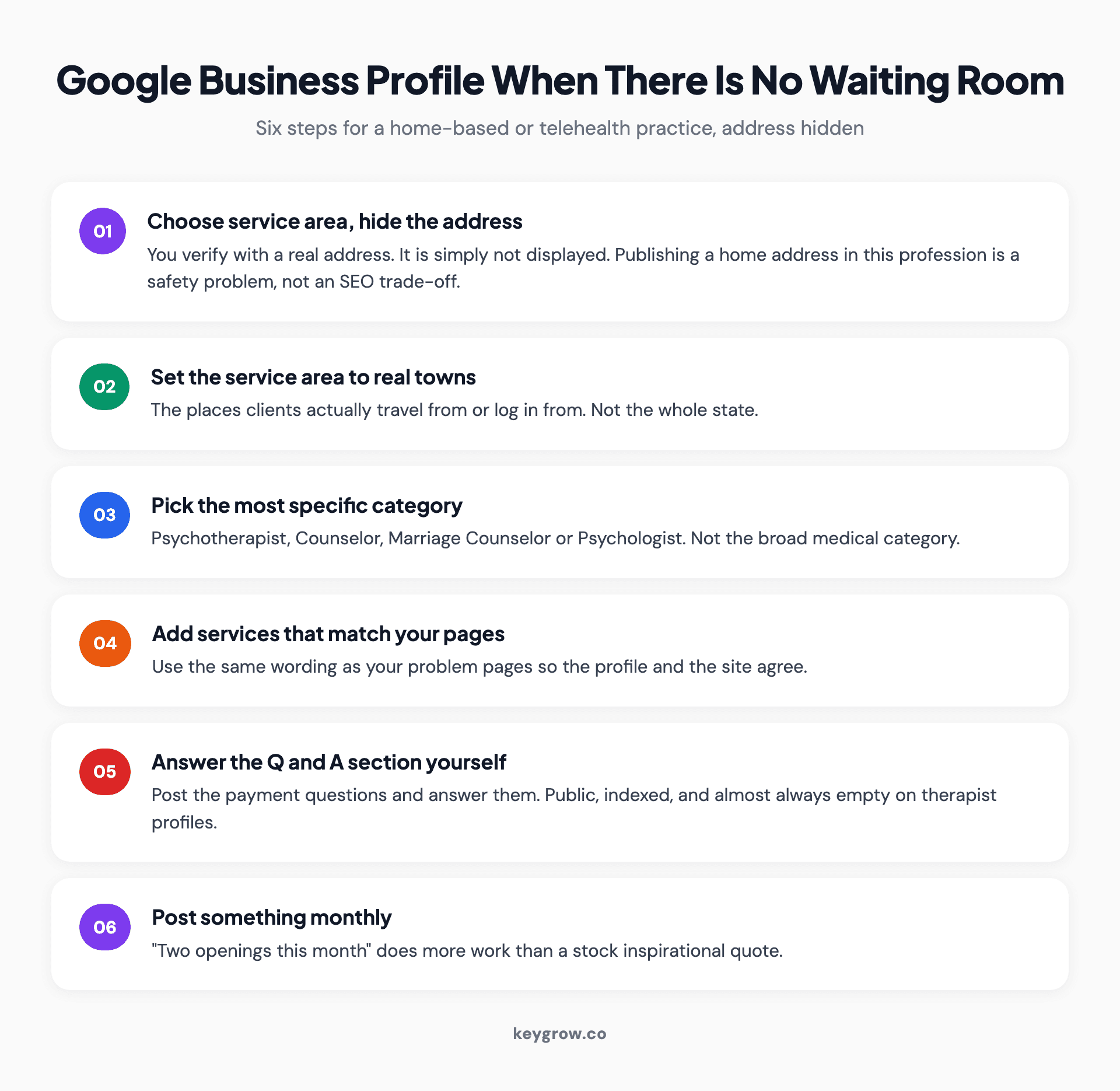
Six numbered steps for setting up a therapist Google Business Profile as a service area business with a hidden address.
One caution about the hidden-address route. A hidden address usually means the profile shows up for searches near the town you named rather than pinned to a spot on the map, so it competes slightly less well than a clinician with a public office in the middle of the search area. That is the trade, and for most home-based practices it is clearly the right one.
Telehealth widened your map less than you hoped
You can only see clients in states where you hold a license, so build state pages only for the states you are licensed in, and expect them to convert worse than local pages.
The pandemic-era assumption was that telehealth turns a local practice into a national one. Licensure says otherwise. Compacts have helped in some professions, but the working reality for most clinicians is a small number of states.
Build a page for each state you are licensed in if, and only if, you would genuinely take a full caseload from there. Name the state in the title, say plainly that you are licensed there and hold the license number, and describe what the sessions look like. A thin page that says "we also serve Ohio" is worse than no page, because it dilutes the site and reads as filler to both a person and a crawler.
The harder truth: online therapy is a national keyword now owned by venture-funded platforms with enormous ad budgets and content teams. The searches worth chasing there are still narrow ones. "Online therapist licensed in [state] for [population]" is winnable. "Online therapy" is not.
The reviews you are largely not allowed to ask for
Most codes of ethics restrict soliciting testimonials from current clients, so build review volume from the sources you are allowed to use and stop treating star count as the main lever.
This is where generic local SEO advice becomes actively dangerous for therapists. Standard guidance says to text every customer a review link. The APA ethics code restricts soliciting testimonials from current therapy clients or others vulnerable to undue influence, and most state boards and professional associations carry similar language. Beyond the rules, a review is a public disclosure that somebody is in therapy, which is precisely the thing your intake paperwork promises to protect.
What is still available:
- Unsolicited reviews. They arrive. Do not delete them, and respond in a way that confirms nothing. "Thank you for taking the time to write this" is the whole response. Never acknowledge that the writer is a client.
- Former clients, where your board allows it, and even then only long after termination, and only if asking would not disturb the work.
- Professional referrals. Other clinicians, physicians, school counselors and attorneys can review your professional relationship with them without disclosing anything about a client.
- Q and A on your profile, which fills the same trust gap and carries none of the risk.
- Everything else on the profile. Photos of the office, complete hours, a filled-in services list, a description written by you rather than pulled from your homepage.
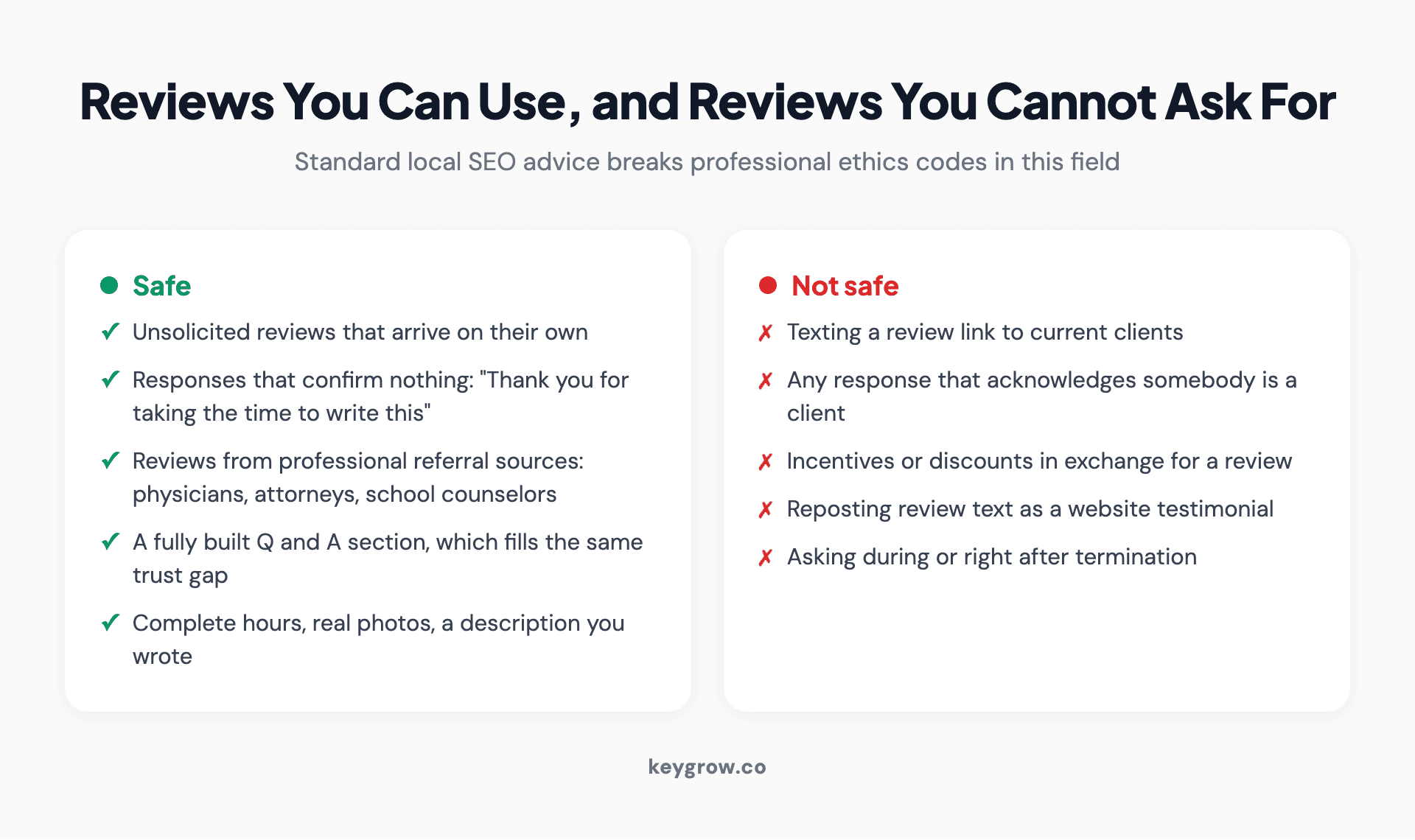
Two-column comparison of review practices that are safe for therapists against practices that violate professional ethics codes.
A practice with six thoughtful reviews and a fully built profile beats a practice with thirty reviews and three empty fields more often than you would expect, because the empty fields are what the ranking system reads.
Keep the directory profile, and know when to downgrade it
Keep the profile, keep it accurate, and stop paying for the premium tier the moment your own pages produce more inquiries than it does.

A quiet practice waiting area with a couch and two patterned armchairs.
There is a reflex among clinicians who start doing SEO to cancel the directory listing out of principle. Do not, at least not yet. A well-filled directory profile is usually the second or third result for your own name, which is what a referred client searches. It also confirms your name, credentials and address across the web, which is one of the inputs local ranking uses.
What it should not be is your only presence, and it should not be your only pipeline. The number worth watching is the ratio of inquiries from your own site to inquiries from the profile. When your site passes the profile, downgrade to the free tier and redirect that budget. Until then, the profile is paying for itself and the SEO is still compounding.
Make sure your name, credentials, address and phone are written identically in all three places: your website footer, your Google profile, and the directory. Inconsistency there is a small drag on local ranking and takes twenty minutes to fix.
What is worth writing, and what is not
Write posts that answer a question a prospective client is already typing. Skip anything a hundred other practices have already published.
Most therapist blogs fail for the same reason: they publish "5 Tips for Managing Stress" and it competes with the entire internet. The posts that work for a private practice have one of three shapes.
The first is process transparency. What actually happens in the first session, how long the work usually takes, what you do if it is not working, how ending is handled. Nobody with authority writes this, because large sites cannot write it in a specific voice, and it is what an anxious person reads at midnight before deciding to call.
The second is population specific. Not "coping with anxiety" but "anxiety in first-generation college students" or "grief when the relationship was complicated". You are writing to a smaller number of people who will recognize themselves in the first paragraph.
The third is the local practical question. What the wait times look like in your area, how the referral process works with local physicians, what the community mental health options are for people who cannot afford private pay. That last one costs you nothing and earns the kind of trust an ad cannot buy.
Two posts a month at that quality beats eight generic ones. If two a month is not realistic, do one. Cadence matters much less than most SEO advice claims; relevance and depth are doing the work.
A page can rank and still not fill the slot
Ranking is half. The other half is whether somebody in distress can figure out what to do next in under ten seconds.
Every private practice site I have looked at has at least one of these problems:
- The only way to make contact is a form with nine required fields, one of which asks for a description of the presenting issue.
- The phone number is an image, or is not a tappable link on a phone.
- There is no indication of whether the practice is accepting new clients, so the reader assumes not.
- The scheduling link opens a calendar with no availability shown for three weeks.
- The photograph is a stock image of a couch.
Fix the availability statement first. A single line near the top saying whether you have openings, updated when it changes, resolves the question the reader came with. Then cut the contact form to name, contact method, and one open field. You can gather everything else at intake. The form only has to get somebody through the door.
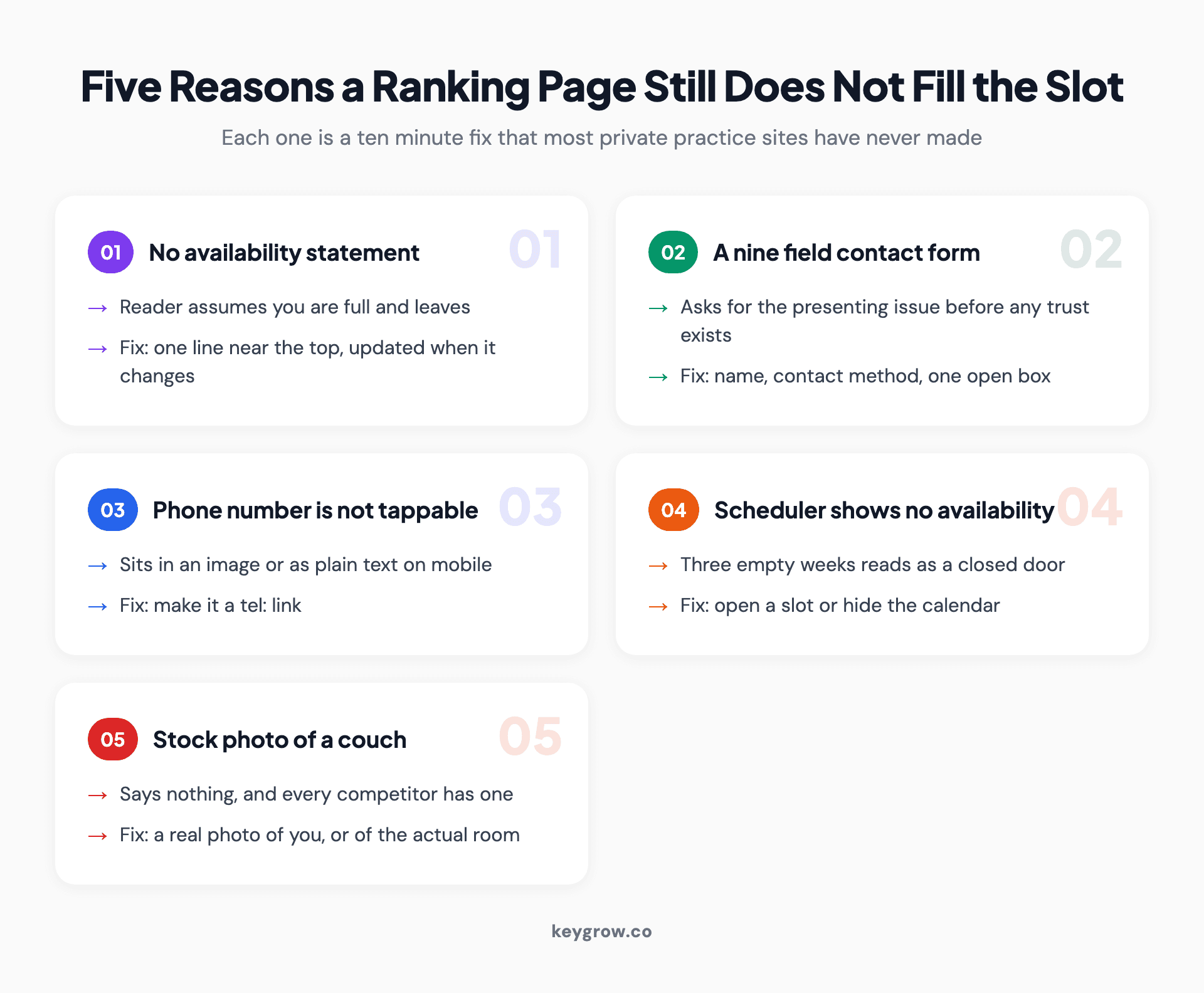
Annotated list of conversion problems on therapy practice websites and the specific fix for each one.
How long this actually takes
Expect movement in the map pack within a month or two and meaningful organic traffic somewhere between month four and month nine, depending on how much content already exists.
We had a doctor's practice in Dubai commit to a full year of organic work. Months one through three looked like nothing was happening, which is the point at which most practices quit. By month twelve organic traffic had grown 1,519% and the practice was fielding 130 or more patient calls a month. Same website, same clinician, no shortcuts, just steady technical work and pages that took months to earn their links. You can see the full set of results on our case studies page.
That is the honest shape of it. Anyone promising page one in thirty days is either targeting phrases nobody searches or doing something you will regret. The other side of that coin: the practice that keeps going through the flat quarter is buying an asset that does not stop working when the invoice does, which is not true of running Google Ads for a therapy practice, where the leads end the day the card declines.
What to measure when you only need four clients
Track inquiries and fit, not rankings and sessions. A solo practice needs single-digit conversions a month, and traffic charts are too noisy at that scale to tell you anything.
This is the part where the standard agency report actively misleads a small practice. A dashboard showing a 40% traffic lift is meaningless if none of it turned into a booked intake, and at your volume, the difference between a good month and a bad one is two people.
Watch these instead:
| What to track | How | Why it matters at small scale |
|---|---|---|
| Inquiries per month | Count them by hand, in a note | The only number that pays rent |
| Source of each inquiry | Ask, on the first call | Tells you what to keep doing |
| Fit rate | Inquiries that became clients | Catches pages attracting the wrong reader |
| Map pack position for 3 core terms | Check monthly from a private window | The one ranking metric worth the time |
| Which page they landed on | Analytics, one report | Shows which problem page is working |
If a page brings four hundred visitors and no inquiries in three months, the page is answering a question that ends there. Either add a next step or accept it as a top-of-funnel piece and stop measuring it that way.
When a therapist should not be paying anyone for SEO
If you have a waitlist, one or two open slots, or a practice under six months old, do the free work yourself and spend nothing.
I say this at the risk of talking somebody out of hiring us. A single-location solo practice with more time than money should claim the Google Business Profile, write four honest problem pages, publish the fees, and wait. That is most of the available return, it costs a weekend, and it does not require an agency.
Hiring makes sense at a different point: when you have several clinicians to fill, when the opportunity cost of your clinical hours clearly exceeds the fee, or when you are trying to build a specialty caseload that the local referral network does not send you. Before that, paying a retainer to have somebody else write four pages is an expensive way to buy time you currently have.
When you do start calling agencies, ask each one what a bad fit looks like for them. The specificity of that answer tells you more than the case studies will.
FAQs
How long does SEO take for a therapy practice?
Local map pack improvements usually show within four to eight weeks of properly setting up and filling in a Google Business Profile. Organic rankings for problem pages take longer, generally four to nine months before they produce steady inquiries. Our strongest organic case study took twelve months to reach 1,519% traffic growth. Anyone quoting thirty days is describing something else.
Can I rank above the big therapist directories?
For broad terms like therapist plus your city, realistically no, and it is not worth the effort. For specific searches combining a population, a life event or a protocol with your location, yes, routinely. Those searches convert better anyway because the reader arrives having already read your writing rather than a filtered list.
Is it against the rules for a therapist to ask for Google reviews?
Most professional ethics codes restrict soliciting testimonials from current clients or anyone vulnerable to undue influence, and many state boards mirror that language. Check your own licensing board and association code before asking anyone. Unsolicited reviews are fine to keep and respond to, as long as your response never confirms that the person is a client.
Should I list my home address on Google if I work from home?
No. Set the profile up as a service area business, verify with your real address, and keep it hidden from display. You will still appear in local results for the towns you list as your service area. Publishing a home address in this profession creates a safety risk that no ranking benefit justifies.
Do I need a blog to rank as a therapist?
Not to start. Four to six well-written problem pages, a complete Google Business Profile, and clear fee information will out-perform a blog attached to a thin site. A blog becomes worth it once the core pages exist and you want to reach people who are not yet searching for a therapist, only for an explanation of what is happening to them.
How much should a private practice spend on SEO?
Solo practices with time to do the work themselves should start at zero and spend it on their own weekend. When outsourcing makes sense, small local practices typically see monthly retainers in the several-hundred to low-four-figure range depending on market and scope. Be wary of anything priced below that, because the economics only work if the provider is producing generic content at volume.
What about ChatGPT and AI search, does that change any of this?
It changes what gets rewarded, not what you build. Answer engines pull from pages that state an answer plainly near the top and cite something checkable. The problem pages and process transparency posts described here are exactly the format those systems quote, which is the same reason they work for a person skimming on a phone. Our answer engine optimization work is largely an extension of the same structure.
Where a solo practice starts
If you take one thing from this: stop competing for the term the directories own and start writing the four pages only you can write.
Concretely, this weekend. Claim and fill the Google Business Profile as a service area business. Publish your fees and insurance situation on a page of their own. Pick the two problems you most want more of and write eight hundred honest words on each, titled the way a client would say it.
Then leave it alone for three months and count inquiries, not rankings.
If you get to the point where the clinical hours are worth more than the fee, our SEO service works month-to-month with no lock-in, and the first conversation is us telling you whether you are actually at that point yet. Plenty of the time the answer is not yet, and we will say so.