


A solo therapist with six open slots and a waitlist by March has a marketing problem that lasts about five weeks a year. Settle that before you open the ads account, because everything below depends on it.
Google Ads for therapists works, and it works faster than SEO. Someone typing "anxiety therapist near me" at 11pm is not researching a topic. They are looking for a phone number. The channel matches the moment better than almost anything else you can buy.
What the setup guides skip is that therapy is one of the few categories where Google has switched off half of its own targeting toolkit. Health is a restricted category for personalized advertising, so the audience features that carry most accounts are simply unavailable to you. Google has also not signed a business associate agreement for Ads or Analytics, which changes what you are allowed to measure. Those two facts shape the entire account, and almost nothing written for therapists mentions either one.
Start with open slots, not with budget
Count the sessions you can actually take this month. That number, not your budget, decides whether ads make sense and what they are worth.
A plumber can absorb forty jobs a week. You cannot. A full-time caseload is somewhere around twenty to twenty-five sessions, and the realistic gap most private practices are trying to close is four to eight recurring clients. That is a small, finite target, and it changes the arithmetic completely.
Here is the uncomfortable version. At the Health and Fitness cost per lead in WordStream's 2026 benchmarks, $67.36, six inquiries costs roughly $404 in media. Not every inquiry becomes a client, so call it eight to ten inquiries to fill six slots, and you are looking at $550 to $675 of spend to solve the problem for a year or more.
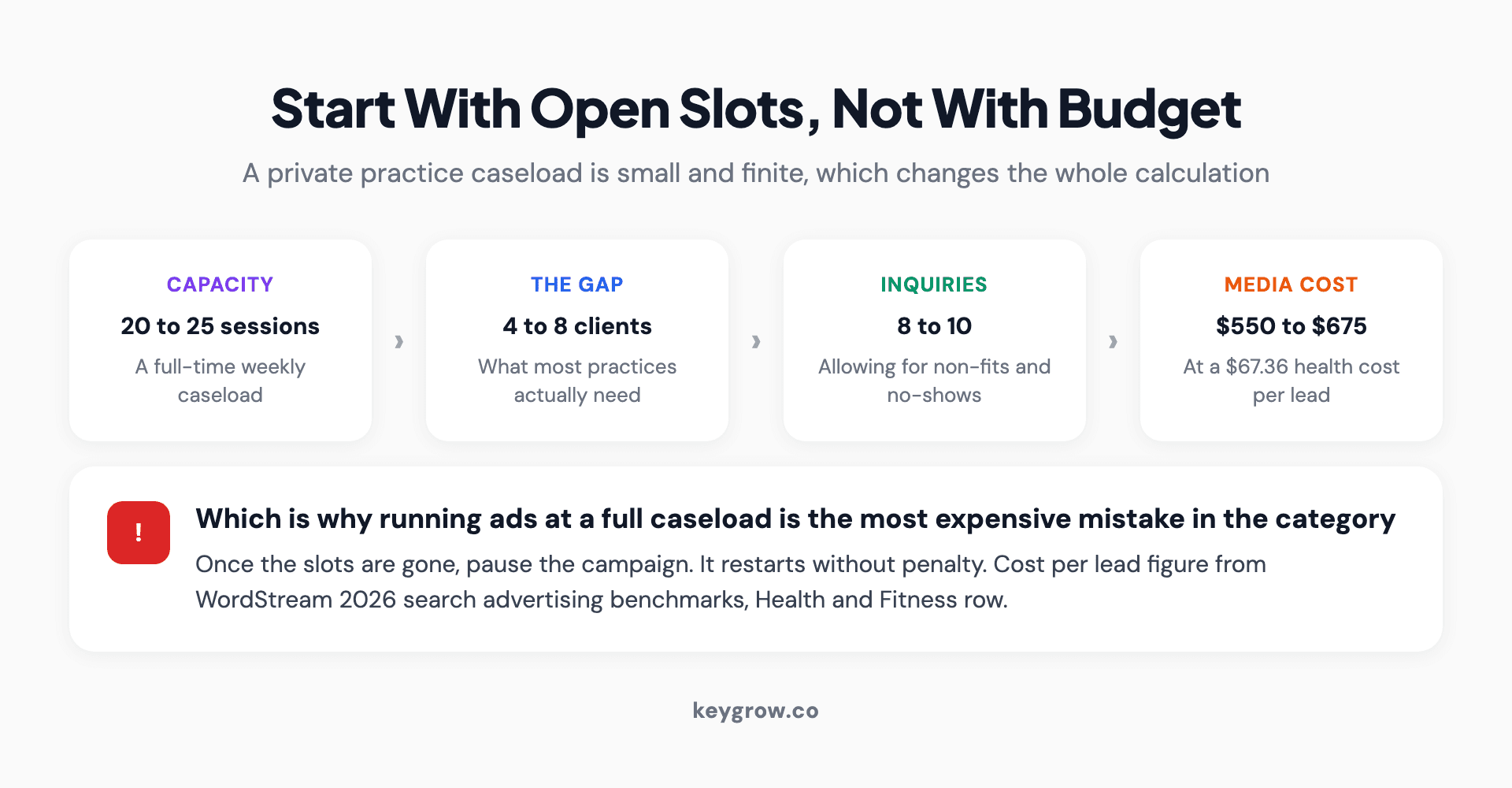
Flow diagram of the therapy caseload calculation: 20 to 25 sessions is a full caseload, 4 to 8 clients is the usual gap, 8 to 10 inquiries fills it, costing $550 to $675 in media.
That is a real number and a manageable one. It is also, in most cases, less than a month of agency management fees.
So here is our position, and it costs us work to say it: a solo therapist filling four to six slots should probably run this themselves. DIY is the right call more often than agencies admit. The account is small, the geography is one city, and the levers are few. Hire help when you are staffing a group practice, running several locations, or the opportunity cost of your own clinical hours genuinely exceeds the fee. Below that line, the fee eats the result.
What a therapy click actually costs
Expect $4 to $12 per click in most markets, higher in large metros, against an all-industry average of $5.42.
The benchmark data does not have a therapy row, which is worth saying plainly rather than quoting a number that was measured on something else. The two nearest rows behave very differently:
| Benchmark row | Avg CPC | Avg CTR | Avg conv. rate | Avg cost per lead |
|---|---|---|---|---|
| Health and Fitness | $6.17 | 5.81% | 6.94% | $67.36 |
| Physicians and Surgeons | $4.76 | 6.61% | 12.43% | $40.04 |
| All industries | $5.42 | 6.64% | 8.18% | $66.69 |
Private practice sits between them and leans toward the first row. Physicians convert at 12.43% partly because a lot of that traffic is booking a routine appointment covered by insurance. A therapy inquiry is a bigger decision, made by someone who may be paying out of pocket, and it converts more slowly.
Treat the spread as your planning range rather than a promise. The number that matters is not cost per lead anyway, which brings us to the part most therapist marketing gets wrong.
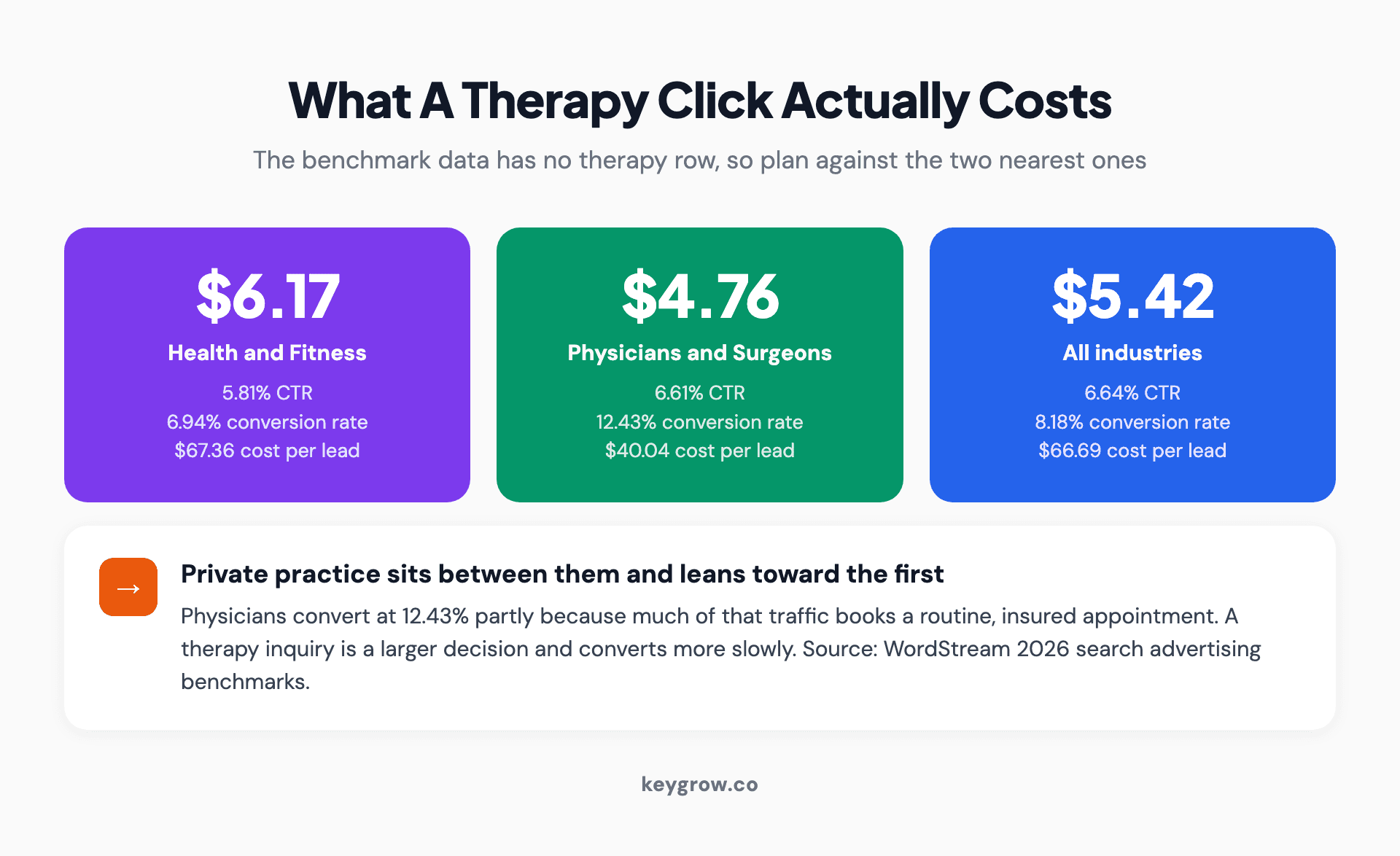
Three stat cards comparing Google Ads benchmarks: Health and Fitness at $6.17 cost per click, Physicians and Surgeons at $4.76, and the all-industry average at $5.42, each with CTR, conversion rate and cost per lead.
A client is worth a year, not a session
One retained client at $150 a session, weekly, for eight months is roughly $4,800. Compare that to your cost per inquiry and the math stops being tight.
This is the single most useful reframe available to a private practice, and it justifies paying considerably more per inquiry than a per-session view would allow. It also means a $70 inquiry that turns into a twelve-week course of treatment is not expensive. It is one of the best returns in local advertising.
The catch is that this only holds if the person is a fit. An inquiry from someone who needs a psychiatrist, cannot afford your fee, or lives ninety minutes away has a lifetime value of zero and still cost you $70. Which is why therapy ads are a qualification problem rather than a traffic problem.

A wall clock, a small plant and a desk lamp against a plain wall in a quiet office.
Half of Google's targeting toolkit is closed to you
Health is a sensitive interest category for personalized advertising. That single classification removes most of the audience features other advertisers rely on.
Under Google's personalized advertising policy, advertisers promoting products or services in sensitive interest categories cannot use advertiser-curated audiences, because those audiences "may inadvertently contain sensitive user signals." In practice that closes off:
- Customer Match, so you cannot upload a client list
- Your own data segments, so no retargeting list built from site visitors
- Audience expansion
- Lookalike segments
Google's predefined audiences remain available, because Google strips sensitive signals from them before they reach you.
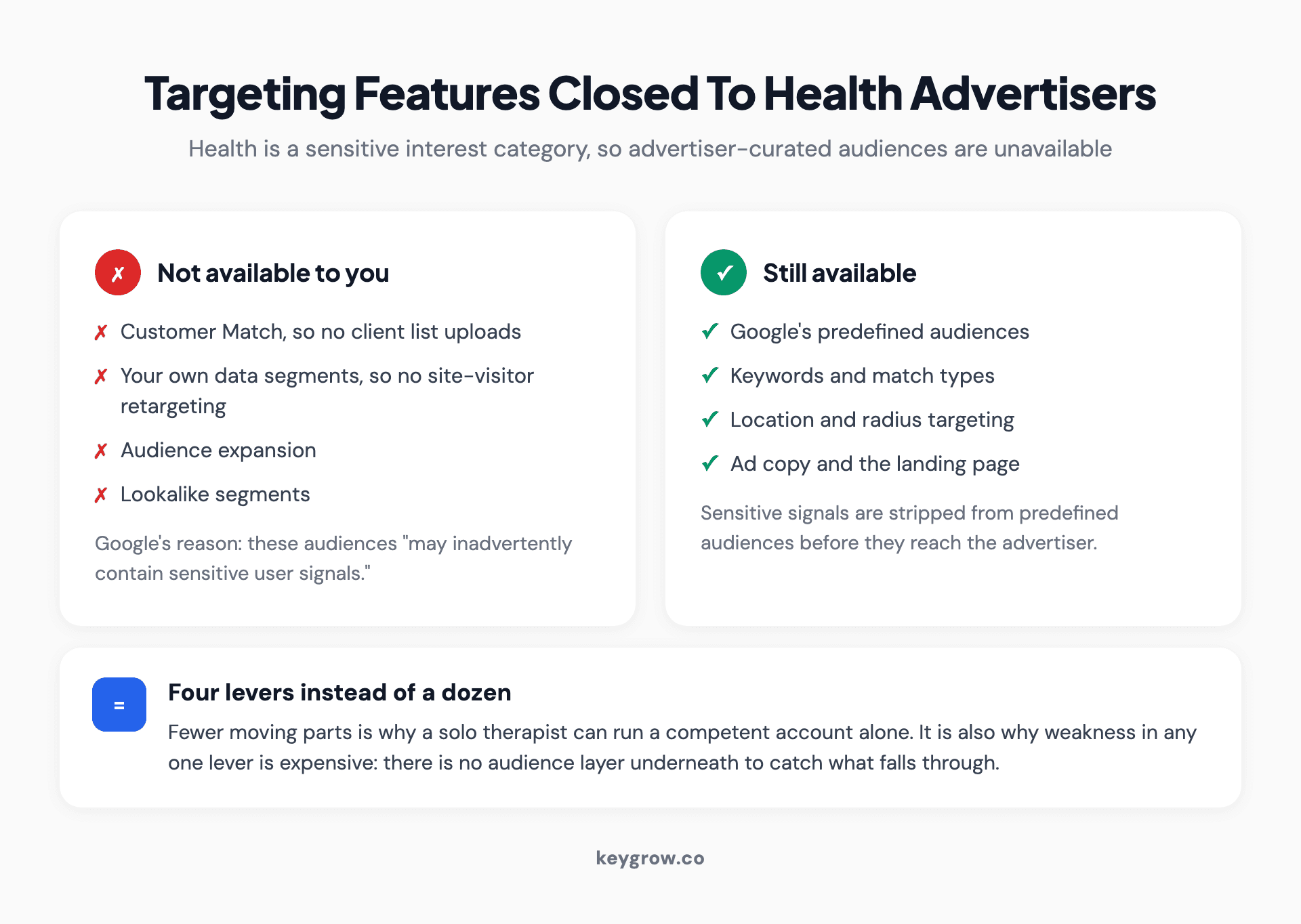
Two-column card layout showing which Google Ads targeting features are unavailable to health advertisers, including Customer Match and lookalike segments, against what remains available.
Read that list again and notice what it means. Every generic PPC guide tells you to build a remarketing audience and chase visitors who did not convert. You cannot. The clever audience layering that rescues a mediocre account elsewhere is not on your menu.
What is left is keywords, geography, ad copy, and the landing page. Four levers. That is genuinely fewer moving parts than most advertisers get, and it is why a therapist can run a competent account without an agency. It is also why sloppiness on any one of the four is expensive: there is nothing else to compensate with.

A quiet, warm consulting room with plants, bookshelves, a sofa and an armchair.
Google has not signed a BAA for Ads or Analytics
Google's business associate agreement covers Google Cloud and Google Workspace products. Google Ads and Google Analytics are not on the covered list, so protected health information must never reach them.
This is not a theoretical compliance point. It has three practical consequences, and the default setup violates at least one of them.
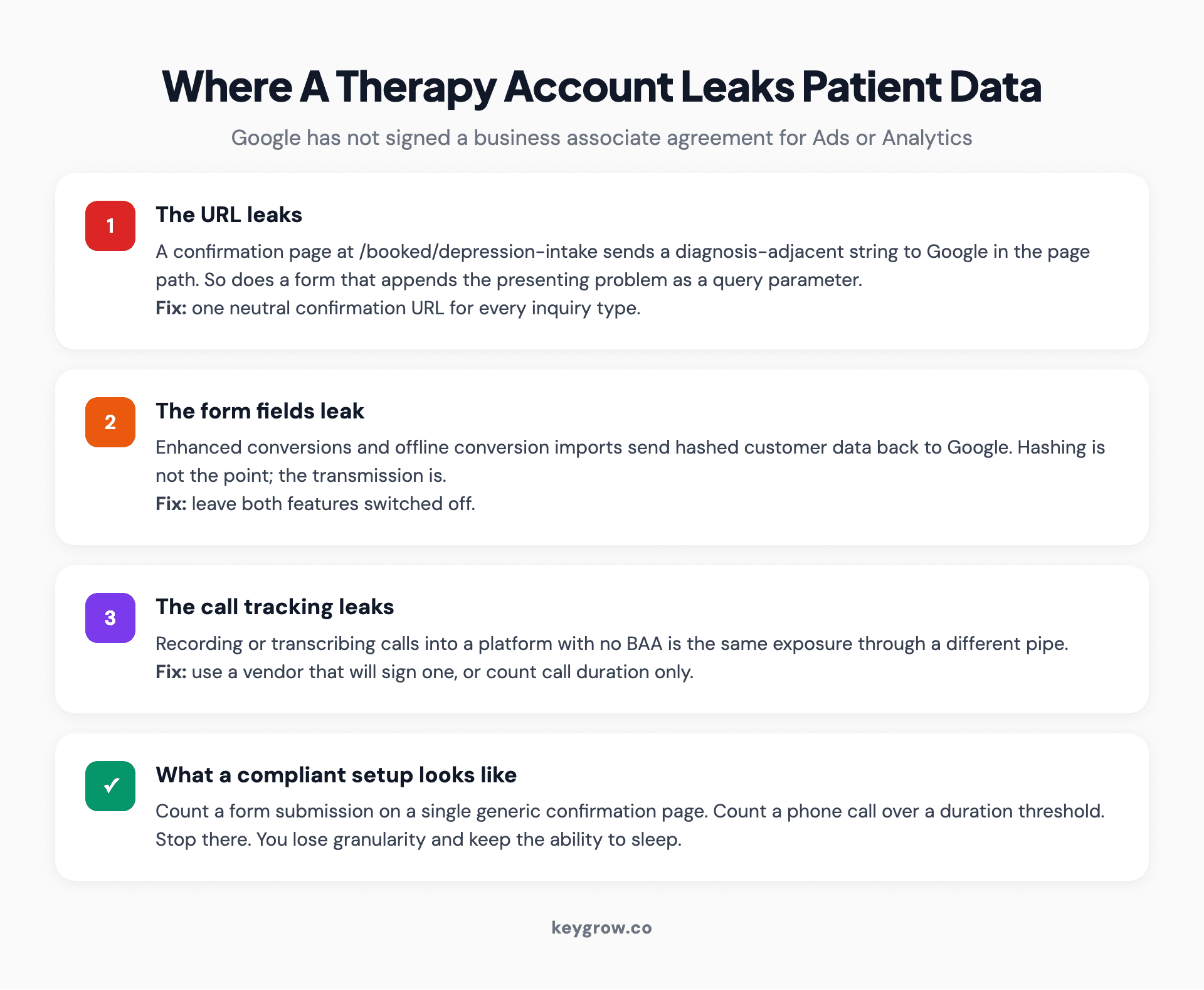
Four numbered cards showing the three places a therapy Google Ads account leaks protected health information, the URL, the form fields and call tracking, plus what a compliant setup looks like.
Your URLs leak. A thank-you page at `/booked/depression-intake` sends a diagnosis-adjacent string to Google in the page path. So does a form that appends the presenting problem as a query parameter. Use one neutral confirmation URL for every inquiry type.
Your form fields leak. Enhanced conversions and offline conversion imports work by sending hashed customer data back to Google. Hashing is not the point. The problem is that you are transmitting information about an identified individual's health services to a vendor with no BAA in place. Leave those features off.
Your call tracking might leak. Recording or transcribing calls into a third-party platform that has not signed a BAA is the same exposure with a different pipe. Use call tracking that will sign one, or count call duration only.
The workable setup is narrow and boring: count a form submission on a single generic confirmation page, count a phone call over a duration threshold, and stop there. You lose granularity. You keep the ability to sleep. If you are running a larger practice and want the granularity back, Google's HIPAA documentation is where to start on a server-side setup, and it is a real project rather than a checkbox.
Step 1: Bid on problems, not on your job title
Build ad groups around the three or four presenting problems you actually want to treat. The word "therapist" on its own is the worst keyword in the account.
Here is why, and it is specific to your profession. "Therapist" is shared with at least four other jobs: physical therapists, massage therapists, occupational therapists, and speech therapists. Bid on it broadly and you will pay for people with a torn rotator cuff. That is before the job seekers, the students researching degrees, and the people looking for free services arrive.
Buy the presenting problem plus the location instead:
- "anxiety therapist [city]"
- "couples counseling [city]"
- "emdr therapist near me"
- "adhd assessment [city]"
- "grief counseling [city]"
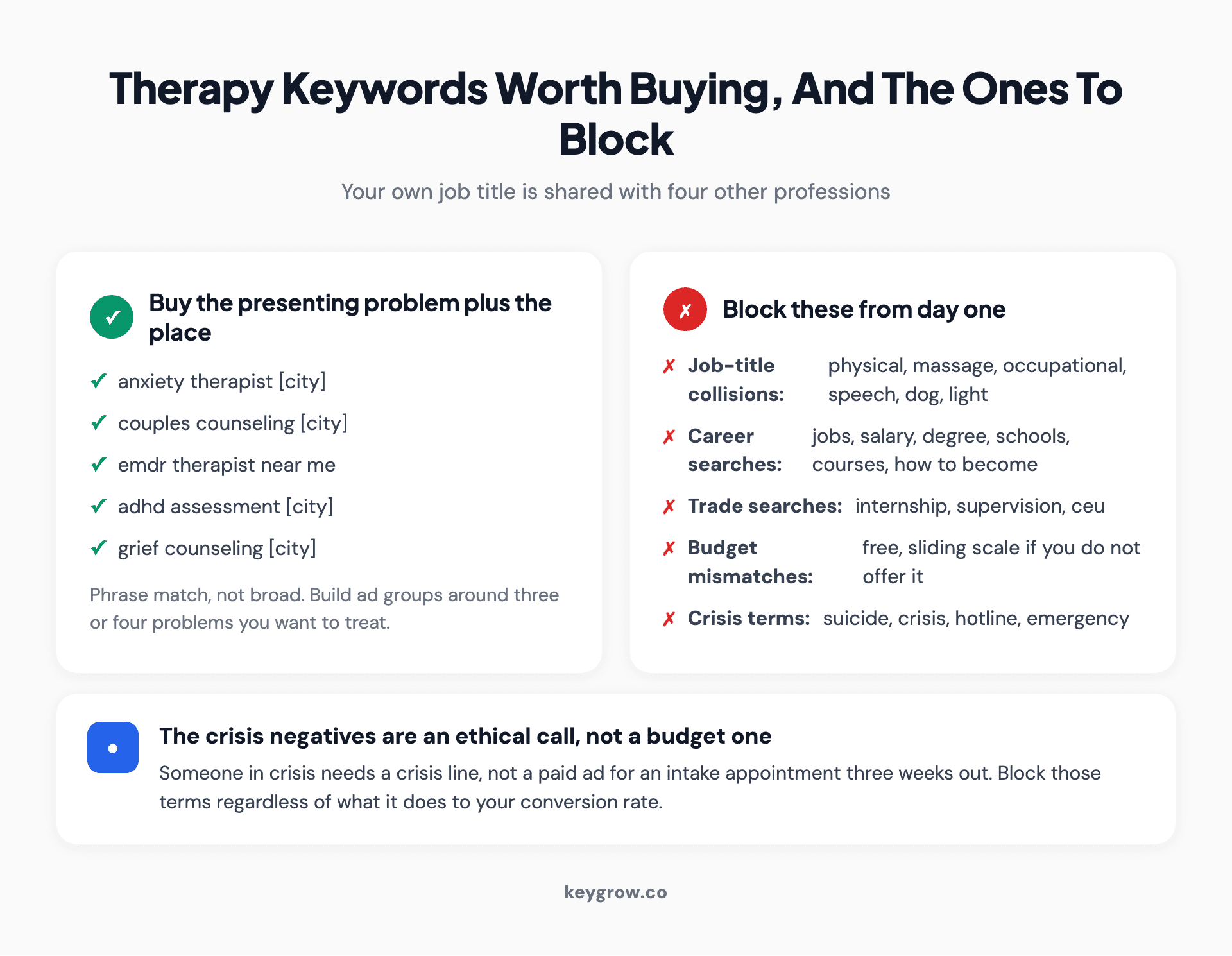
Two-column card layout of therapy keywords worth buying, such as anxiety therapist plus city, against the negative keyword groups to block including job-title collisions and crisis terms.
Phrase match, not broad. Then build the negative list, which for a therapy account is unusually load-bearing: *jobs, salary, career, degree, schools, courses, how to become, internship, supervision, ceu, free, sliding scale* if you do not offer it, plus *physical, massage, occupational, speech, dog, light* to peel off the collisions on your own job title.
One more, and it is an ethical call rather than a budget one. Add *suicide, crisis, hotline, emergency* as negatives. Someone in crisis needs the number of a crisis line, not a paid ad for an intake appointment three weeks out. Our view is that intercepting that search is the wrong thing to do regardless of what it does to your conversion rate. Broad match without a negative list is a donation to Google in every industry; in this one it can also put your ad somewhere it should not be. There is a fuller method in our guide to negative keywords in Google Ads.
Step 2: Put the fee and the insurance answer in the ad
State your session fee, or your insurance position, in the ad copy. It will lower your click-through rate and raise the number of clients you sign.
This is counterintuitive enough that almost nobody does it, so it is worth being concrete about the mechanism. Two-thirds of the people clicking a therapy ad have one question they will not ask on the first call: can I afford this, and will insurance cover it. If your ad and page stay quiet, they click, read, fail to find the answer, and leave. You paid $8 for that.
Say it in the description line. "In-network with most major plans." Or "Private pay, $175 per session, superbills provided." Either one is fine. Silence is not.
The ad copy rules that follow are less about persuasion than about tone:
- Name the problem in the headline, not your credentials. "Anxiety Therapy in Austin" beats "LCSW, 15 Years Experience."
- Skip urgency language. Countdown framing is wrong for this decision and reads as predatory.
- Do not promise outcomes. Beyond the ethics, outcome claims in health advertising attract disapprovals.
- Put availability in the ad if you have it. "Now accepting new clients, evening slots" answers the second unasked question.
Step 3: Draw the map around the drive, not the city
Set a radius people will actually travel, then check the setting that quietly undoes it.
For in-person therapy, twenty to thirty minutes of driving is roughly the limit for a weekly commitment. A twenty-five mile radius around a dense city is not that. Draw the shape around the commute, exclude the parts of the map nobody drives from, and be honest about which side of the river people will cross.
Then open the location options and set targeting to Presence: people in or regularly in your targeted locations. The default includes people merely *interested in* your area, which for a therapy account means paying for someone three states away reading about therapy in your city.
If you are licensed in several states and offer teletherapy, that is a separate campaign with a separate budget and separate ad copy, not a widened radius on the same one. The two convert differently and mixing them hides which is working.
Step 4: Four things the page has to settle
The landing page has to answer four questions before someone will call. Most therapy websites answer none of them above the fold.
- Do you treat my problem? The page the ad points at should be about anxiety, or couples work, or whatever the ad group bought. Not a general "Services" page.
- What does it cost, and do you take my insurance? Publish the fee. The therapists who do this report fewer inquiries and far better ones.
- Are you taking new clients, and when? "Currently accepting new clients, typically within two weeks" removes the biggest silent objection in the category.
- What happens if I contact you? Say it literally. "You will get a reply within one business day, then a free fifteen-minute call to see if we are a fit."
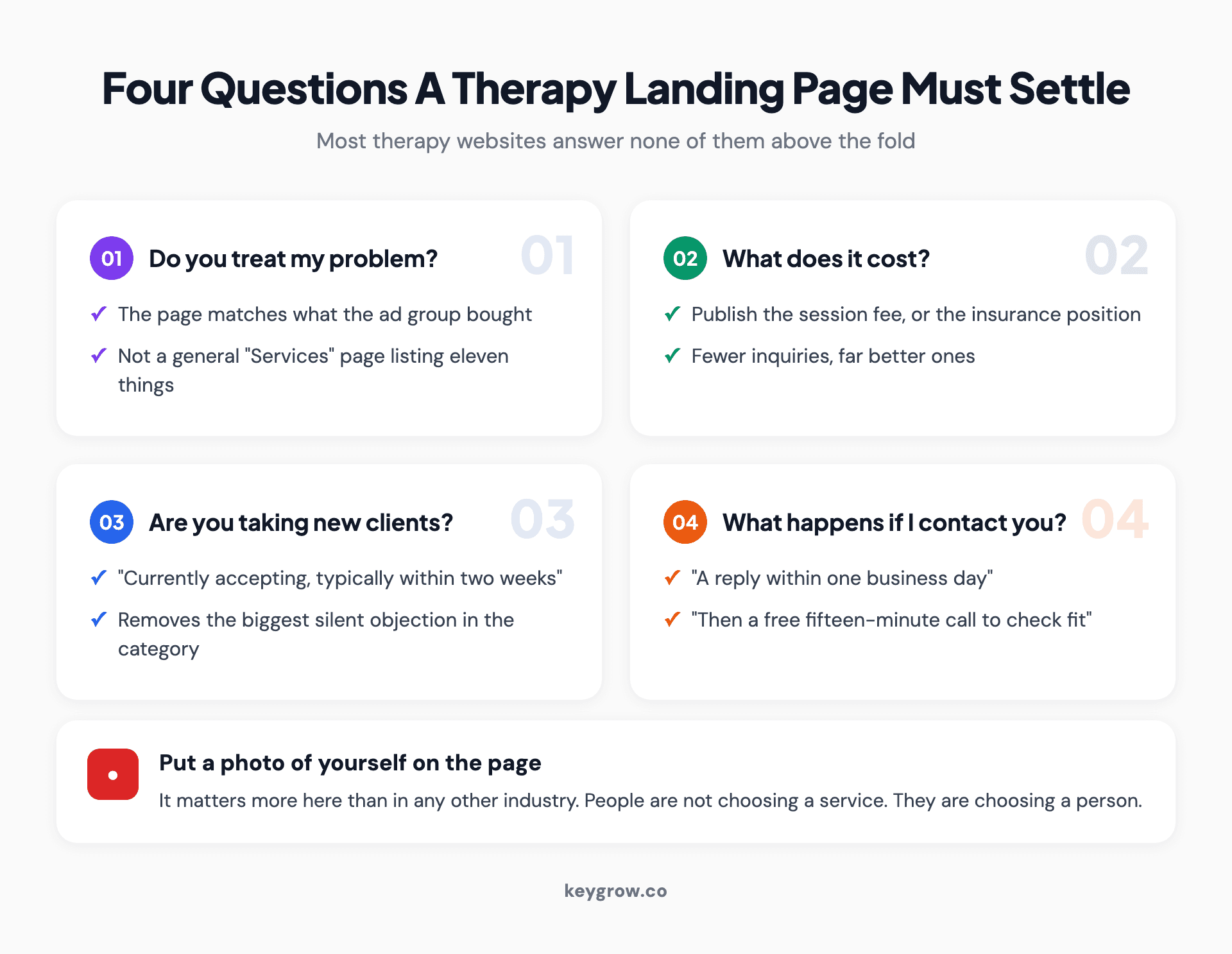
Four numbered cards covering the questions a therapy landing page must answer: do you treat my problem, what does it cost, are you taking new clients, and what happens if I contact you.
A photo of you helps here more than in any other industry. People are choosing a person.
We rebuilt a landing page for a real estate service client around one clear action and the facts people needed before they would take it, and the conversion rate went up 85% in four weeks. Nothing about that is industry-specific. It was the same failure therapy sites have: traffic arriving on a page that made them hunt for the answer. If you are weighing whether to build a dedicated page at all, we covered the trade-off in ad landing pages versus your website.
Step 5: Count kept first sessions
Track inquiries, but judge the account on first sessions that actually happened. The gap between the two is where therapy budgets disappear.
The chain runs: click, inquiry, reply, consultation call, booked first session, kept first session. A practice reporting a $67 cost per inquiry might be at $250 or more per client once no-shows, non-fits, and people who ghost after the consult are counted.
Neither of these needs software. A spreadsheet with six columns and five minutes on a Friday will tell you more than any dashboard, and it stays clear of the compliance problem entirely, because it lives in your practice management system rather than in Google's.
Two numbers are worth watching weekly: your search terms report, which is where wasted spend hides, and the ratio of inquiries to kept first sessions. If that ratio is poor, the fix is upstream in your ad copy and page, not in your bids. Our budget calculator will do the forward-looking version of this arithmetic if you would rather not build the sheet.
The channel that keeps working after you stop paying
Ads stop the day the card declines. Organic does not, which is why most practices should be building both rather than picking one.
The searches worth owning organically are not the same ones worth bidding on. Paid works on the high-intent terms where somebody is ready to book. Organic works on the narrow, specific searches a paid therapist directory has no filter page for, and on the process questions people read weeks before they call. We wrote the full playbook for that side in SEO for therapists, including the payment questions almost no practice website answers.
If your budget only supports one, start with ads while the openings are urgent and add organic once the caseload is stable enough that a four month runway is not frightening.
Where the budget usually goes
Five patterns account for most of the money therapists waste, in rough order of cost.
- Running ads at full caseload. The most expensive mistake, and the easiest to fix. Pause the campaign. Google will not remember you fondly for staying on, and the account restarts fine.
- Buying your own job title broadly. Covered above. It is the single biggest source of irrelevant clicks in this category.
- Sending clicks to the homepage. The ad promised anxiety therapy. The homepage offers eleven services and a mission statement.
- Staying silent on fees. You are paying for the click either way. You may as well pay for the ones who can afford you.
- Judging the account in week two. Ads move faster than SEO, but a therapy inquiry still takes a few weeks to become a kept appointment. Give it six weeks of data before you conclude anything.
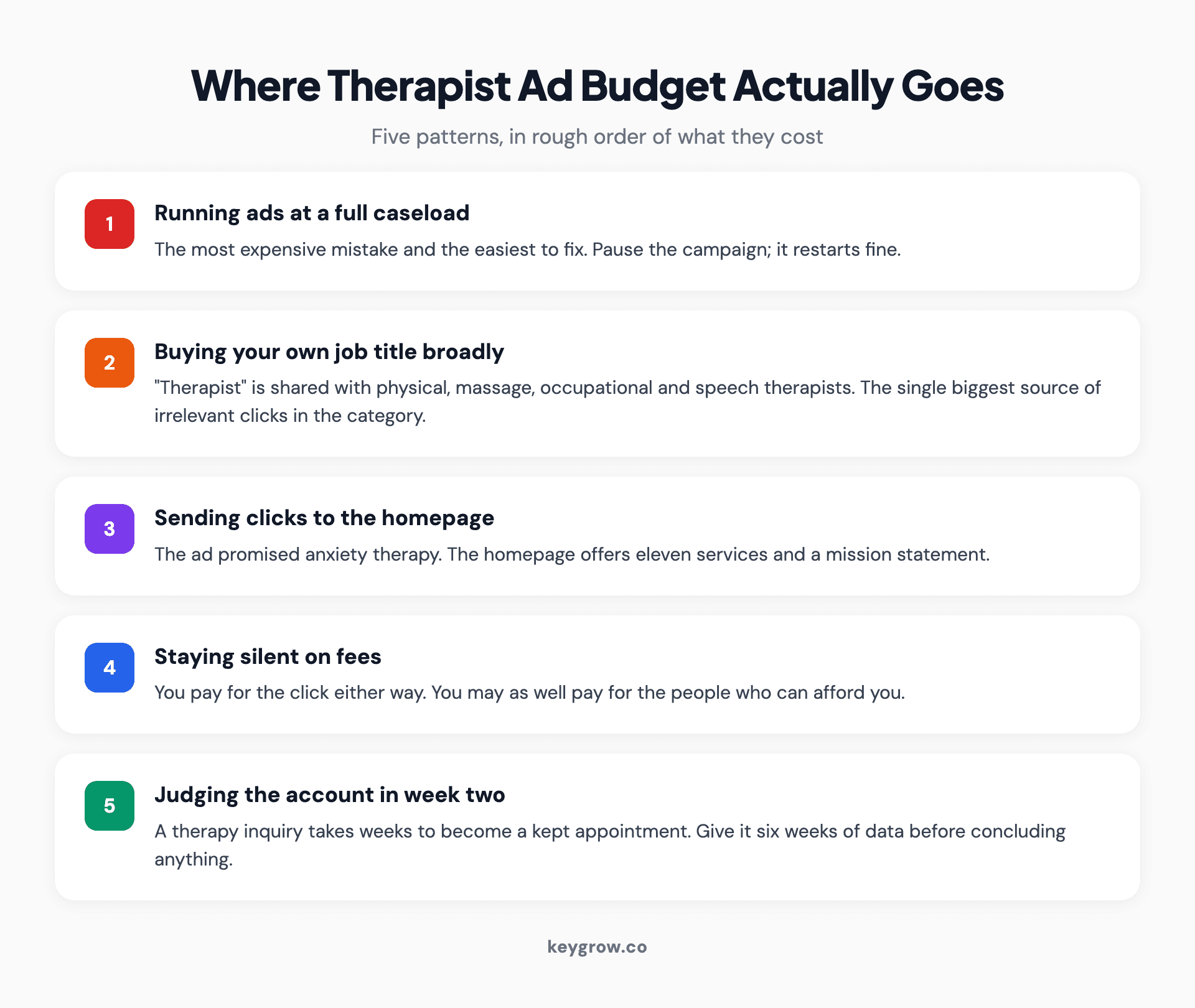
Five ranked cards showing where therapist ad budget is wasted, from running ads at a full caseload down to judging the account in week two.
If your practice is part of a larger clinic or you are weighing paid against organic across the whole practice, our notes on paid search in healthcare and on Google Ads for doctors go further into the group-practice version of these questions.
FAQs
How much should a therapist spend on Google Ads per month?
Between $400 and $1,000 a month covers most solo private practices. At a $4 to $12 cost per click you need roughly 60 to 100 clicks a month to produce enough inquiries to fill a handful of slots. Spending more than that as a solo practitioner usually means you are buying more inquiries than you have hours to serve.
Do Google Ads work for a solo private practice?
Yes, and often better than for larger businesses, because you need so few clients. Filling four to six recurring slots is a small target that a modest budget can hit. The constraint is your caseload, not the channel. Once you are full, the correct move is to pause rather than to optimize.
Is Google Ads HIPAA compliant for therapists?
Google will not sign a business associate agreement for Google Ads or Google Analytics, so those tools are not covered and protected health information must never be sent to them. You can still advertise compliantly by using a single neutral confirmation page, avoiding condition-specific URLs and form parameters, and leaving enhanced conversions and offline conversion imports switched off.
Can I retarget people who visited my therapy website?
No. Health is a sensitive interest category for personalized advertising, which means advertiser-curated audiences including your own data segments, Customer Match, lookalike segments and audience expansion are unavailable. Google's predefined audiences remain usable because sensitive signals are stripped from them first.
Should I put my session fee in the ad?
Yes, or at minimum your insurance position. It reduces clicks and raises the quality of the ones you get. Cost is the question most prospective clients will not ask on a first call, so leaving it unanswered means paying for visitors who were never going to book once they found out.
How long does it take for Google Ads to bring in therapy clients?
Expect first inquiries within days and a readable picture in about four to six weeks. The lag is not the ads, it is the decision. Someone may inquire in week one, take a consultation call in week two, and attend a first session in week four. Judge the account on that full cycle rather than on the first two weeks.
Are Google Ads better than a therapist directory listing?
They serve different moments. A directory listing reaches people browsing and comparing profiles, usually with insurance filters applied. Search ads reach people who have already decided to find someone and are looking for a specific kind of help in a specific place. Most full practices use both, and directories tend to be cheaper per inquiry while ads tend to convert faster.
Can I advertise teletherapy in states where I am not licensed?
No. Advertise only where you hold a license, and build teletherapy as its own campaign with location targeting set to the states you are licensed in. Running it as a widened radius on your in-person campaign blurs the two and makes it impossible to tell which is producing clients.
Our take
Therapy is one of the few Google Ads categories where the platform hands you fewer tools and that turns out to be fine. You cannot retarget, you cannot upload a client list, and you cannot let Google's audience machinery do the thinking. What is left is the part that was always doing the work: buying the right search, in the right place, with an ad and a page that tell the truth about cost and availability.
Get those four right and a small budget fills a small practice. Get them wrong and no amount of spend will fix it, because there is no audience layer underneath to catch what falls through.
If you are running a group practice or several locations and want someone to build this properly, our PPC management and healthcare marketing work covers it, month to month, cancel anytime. If you are a solo therapist with six slots to fill, take the five steps above and keep the fee.