


Which practice are you actually marketing? A new solo practice with more open hours than clients. A steady solo practice that stays full until 3 people finish in the same month. Or a group practice where the hard part is filling other clinicians' calendars. Answer that first, because it decides nearly everything else.
Marketing for therapists is the work of getting the right people to contact you while you have room for them: a profile they can find, a website that answers the fee question, a few referral relationships, and sometimes paid search. The channels are the same for every practice. The order is not. Most guides hand a clinician 3 months into private practice the same 8-channel list they hand a group with 12 clinicians, and both end up doing the wrong thing first.
Demand is rarely the problem. In the APA's 2024 survey, 53 percent of psychologists said they had no openings for new patients. People are looking. The ones who find you are the ones who searched for the exact thing you treat, in a week when you had a slot, and saw your fee before they had to ask.
Which stage is your practice in?
Pick the row that matches your calendar today, not the practice you plan to have in 2 years. Each stage has one real constraint, and your first hours or dollars belong there.
| Stage | What it looks like | The real constraint | Spend first on | Skip for now |
|---|---|---|---|---|
| New solo practice | Under a year in, fewer than half your hours booked | Nobody knows you exist yet | Your own time: profiles, referral calls, a short website | Social content calendars, paid social, a rebrand |
| Steady solo practice | Full most months, then several openings at once | Openings arrive in waves | Pages that rank for what you treat, ads you can switch on and off | Anything that runs at the same pace all year |
| Group practice | 2 or more clinicians, some with open hours | Filling other people's calendars quickly | Intake speed, clinician pages, tracked paid search | Awareness campaigns with no inquiry count attached |
Some practices sit between rows. A solo clinician who hires an associate becomes a group practice the day the associate starts, because the slots that most need filling are no longer yours. A group that has run a waitlist for 2 years behaves more like the steady solo row. Its problem is timing, not volume.
The rules that hold at every stage
Ethics codes, ad platform policies and privacy rules apply to a three-month-old solo practice exactly as they apply to a large group. Settle them before you choose a channel.
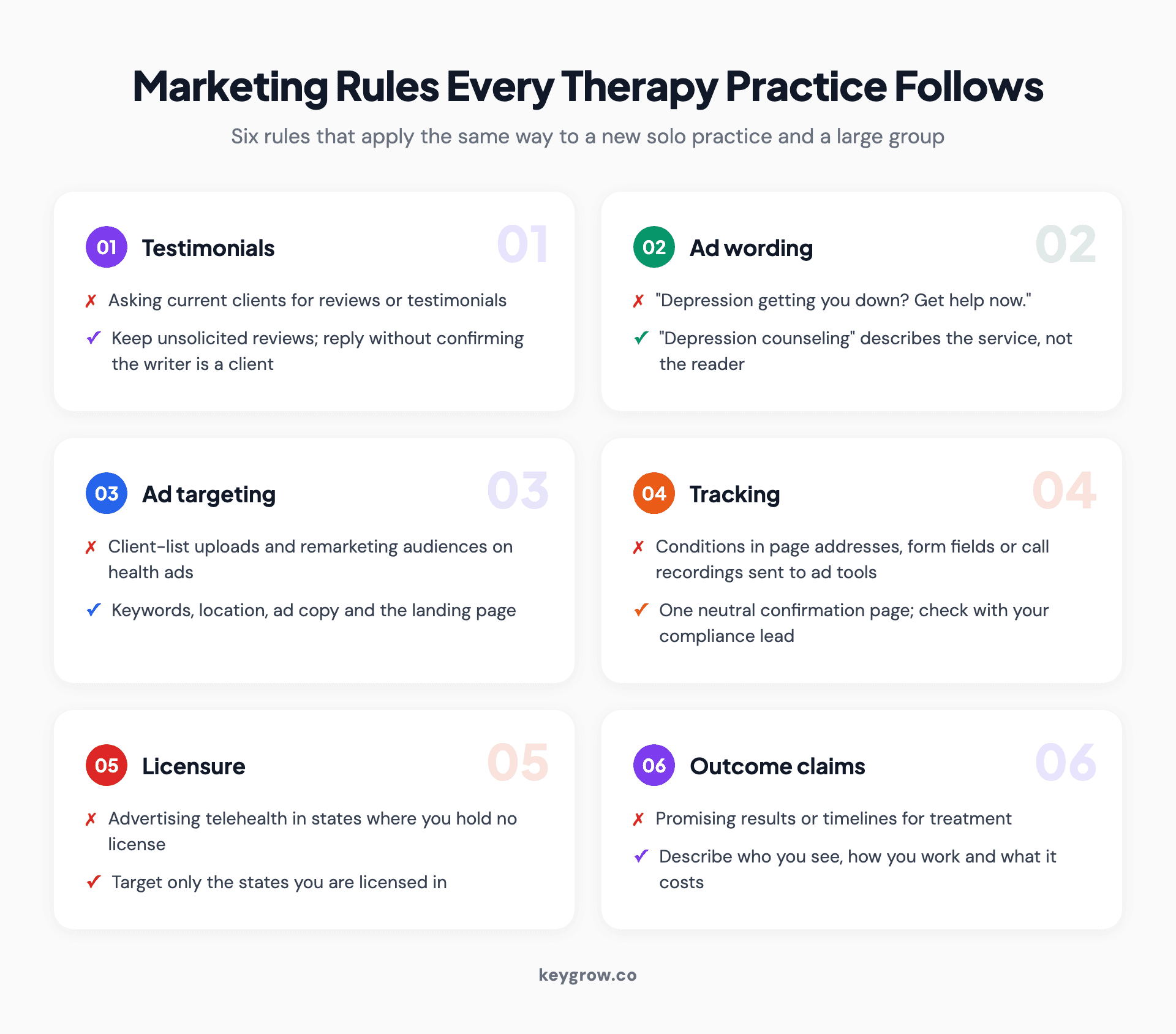
Checklist of six marketing rules that apply to every therapy practice, covering testimonials, ad wording, ad targeting, tracking, licensure and outcome claims.
- Testimonials. Standard 5.05 of the APA ethics code says psychologists do not solicit testimonials from current clients or from anyone vulnerable to undue influence. Counseling, social work and marriage and family codes carry similar language, so read your own. The standard local marketing advice, texting every customer a review link, does not transfer to this profession.
- Ad wording. Meta's ad standards ban ads that assert or imply a viewer's health condition. Meta's own examples allow "Depression counseling" and reject "Depression getting you down? Get help now." Write about the service, never about the reader.
- Targeting. Google classes health as a sensitive interest category for personalized ads, so client-list uploads and remarketing audiences are unavailable. Our post on Google Ads for therapists walks through what that leaves you.
- Tracking. Keep anything that hints at a client's condition out of ad and analytics tools, whether it travels in a page address, a form field or a call recording. Where the line falls on a website is a legal question, so check with your compliance lead before you install a tracking tag.
- Licensure. Advertise only in states where you hold a license. That includes telehealth.
- Outcome claims. Do not promise results or timelines. Most professional codes treat that as a misleading claim.
In practice this just crosses a few tactics off the list. Some of the advice ranking for this topic still tells therapists to encourage current clients to leave reviews, or to build custom audiences of people seeking mental health support. That advice was written for a different industry, and it shows.
Stage 1: the new solo practice
Spend hours, not money. The first 90 days come down to one directory profile, a Google Business Profile, a short website that states your fee, and 20 conversations with people who can refer.
A new practice has a single problem: nobody knows it is there. The fixes are cheap in dollars and expensive in evenings.

Two people talking over coffee at an outdoor cafe table, the kind of short meeting that starts a referral relationship.
- One paid directory profile, written well. A directory is where a lot of people compare therapists side by side. Write to the person reading it, name the 2 or 3 problems you most want to treat, and state your fee and insurance position plainly.
- A Google Business Profile. It is free, and the map results lean on distance and profile completeness more than practice size. If you work from home, set it up as a service area business with the street address hidden.
- A 5-page website. Home, about, the 2 problems you most want to treat, and a fees page. A practice that publishes its fee gets fewer calls that end with "that is not in my budget".
- 20 referral conversations. Primary care offices, psychiatrists, school counselors, therapists who are already full, and anyone else who meets your future clients before you do. A short email, a 15-minute call, and a one-page note on who you see and when you have openings.
- A free consult call offered from every page. Fifteen minutes is enough.
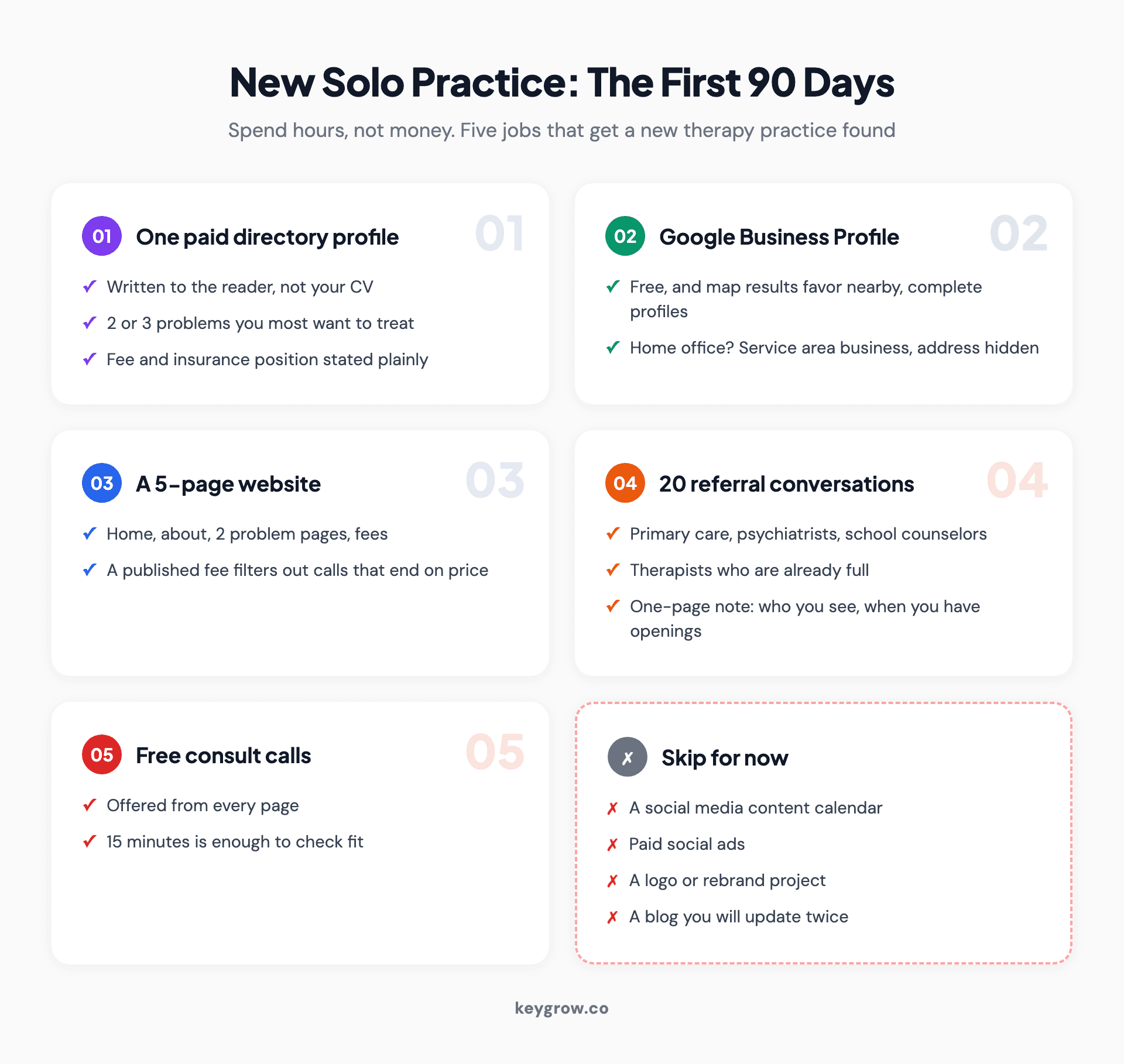
Five-item checklist for marketing a new solo therapy practice in its first 90 days: directory profile, Google Business Profile, five-page website, twenty referral conversations and free consult calls.
What to skip: a social media content calendar, paid social ads, a logo project and a blog you will update twice. None of them is a bad idea. They pay back over years, and you need clients this season.
Paid search is the one exception. If rent is due and the calendar is empty, a small campaign on the problems you treat is the fastest way to get inquiries. Size it to the slots you have open, not to a revenue target. Our Google Ads budget calculator does the arithmetic.
You do not need an agency at this stage, and we would tell you the same thing on a call. A solo clinician with more time than money should do every item above personally. It takes a few weekends. A monthly retainer would probably cost more than the clients it brought in during the first few months.
Stage 2: the steady solo practice
Your problem is waves, not volume. You are full for months, then 3 clients finish in the same fortnight and you need replacements within weeks.

A desk calendar open on a wooden table beside a ceramic vase and a few colored markers.
This is where we see the most money wasted. The practice runs marketing at one steady pace all year while its need for clients spikes and drops. Build for the spikes.
Start with one sentence near the top of the website and the directory profile that says whether you have room: "Accepting 2 new clients, evening slots." Update it the day it changes. When it says you are full, most inquiries stop, which is what you want.
Then build the slow channel. Organic search keeps producing when you are not paying for it, so write one page per problem you treat, in the words a client would use, and check Google Search Console once a month to see which of those pages people are finding. Our guide to SEO for therapists has the full method, including why the broad "therapist plus city" term is not worth chasing.
Paid search is the fast one, and its best feature here is the off switch. Turn it on the week 3 slots open, pause it the week they fill. A paused campaign restarts without penalty.
Two cheap habits round it out:
- An interest list of names and contact details, kept in your practice management system rather than a marketing tool. When a slot opens, you contact the list before you spend anything.
- A quarterly note to the 5 people who refer you the most, saying what you have open. Practices let this one go cold first.
If your calendar refills within a month every time it dips, your marketing works and you do not need to buy more of it. Get help when the gaps start lasting longer than a month, or when you want a specialty caseload your referral network does not send.
Stage 3: the group practice
You are now marketing other people's calendars. The constraint moves from being found to intake: how fast an inquiry gets a reply, and whether it reaches the clinician who actually has the opening.
A group of 5 clinicians might have 12 open slots spread across 3 people with different specialties. Generic "now accepting new clients" marketing fills the wrong calendar.
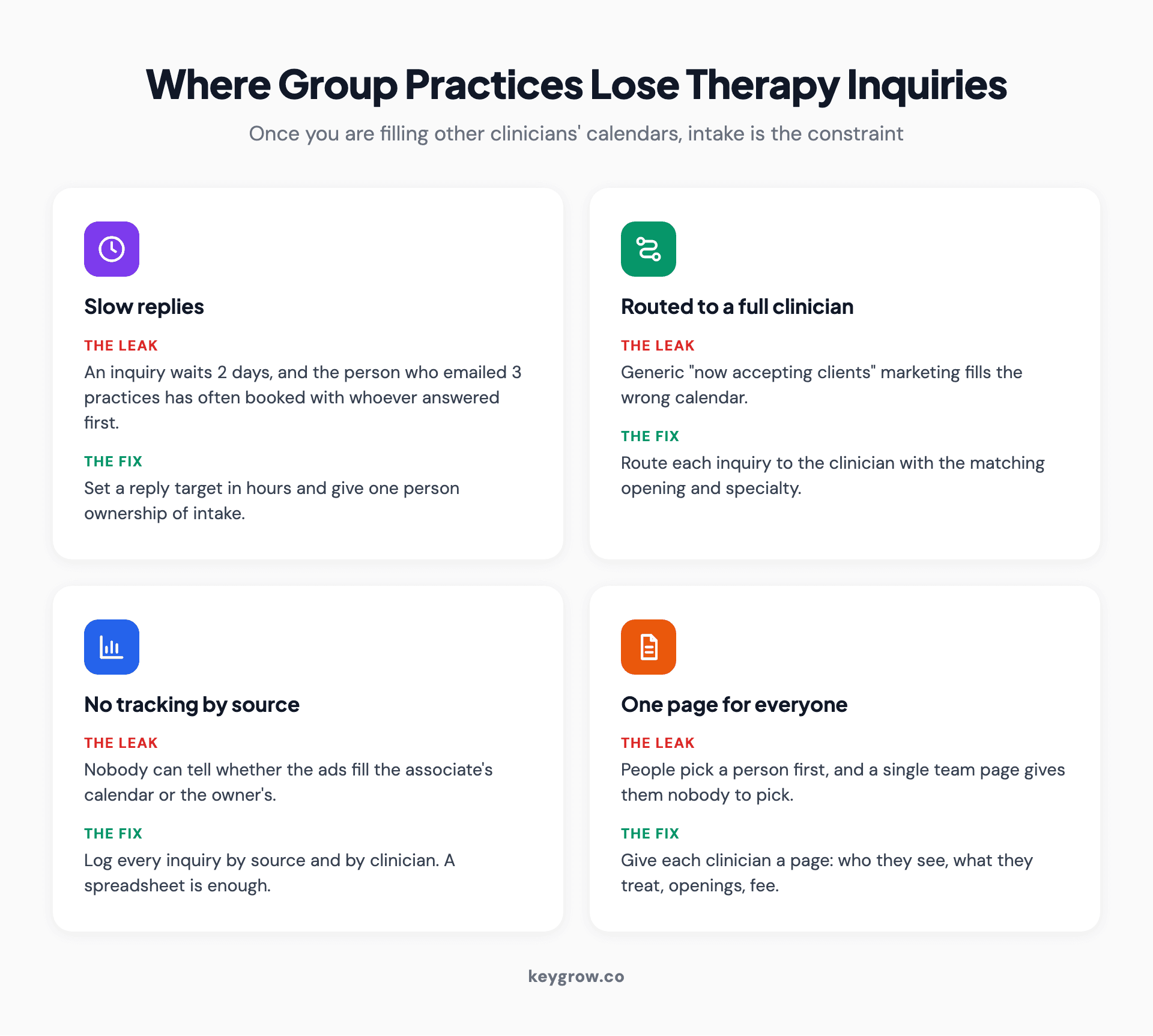
Four places a group therapy practice loses inquiries: slow replies, inquiries routed to a full clinician, no tracking by source, and one generic page for every clinician.
What changes at this size:
- A page for each clinician: who they see, what they treat, when they have openings, what they charge. People pick a person first.
- One intake path, owned by one person, with a reply target measured in hours. Someone who emailed 3 practices tends to book with whoever answers first.
- Inquiries logged by source and by clinician. A spreadsheet is fine. Without it you cannot tell whether the ads are filling the associate's calendar or the owner's.
- Paid search split by specialty, so couples work, adolescents and trauma each get their own campaign and budget follows the open slots.
- A commitment to organic search measured in years, not months. A group has enough specialties to justify a page for each and enough revenue to wait for them to rank.
That last item takes patience, so fix the intake path first, because it pays back in weeks. When we rebuilt an estate planning firm's landing page around one clear next step, its conversion rate rose 70% in 3 weeks. A group practice with one intake owner and a clinician page for every specialty is the same fix in a different setting.

An empty waiting area with a leather sofa, two yellow armchairs and a low table with a plant.
This is the stage where outside help usually pays for itself. A clinician-owner's hours are expensive, and an account with 5 calendars and 4 campaigns needs weekly attention. Our healthcare marketing services are built for practices at this size, and the post on healthcare marketing strategy covers the multi-location version of the plan.
What each channel costs you
Every channel costs you time or money, and each one pays back on its own clock. Match it to your stage rather than to whatever a vendor is pushing this month.
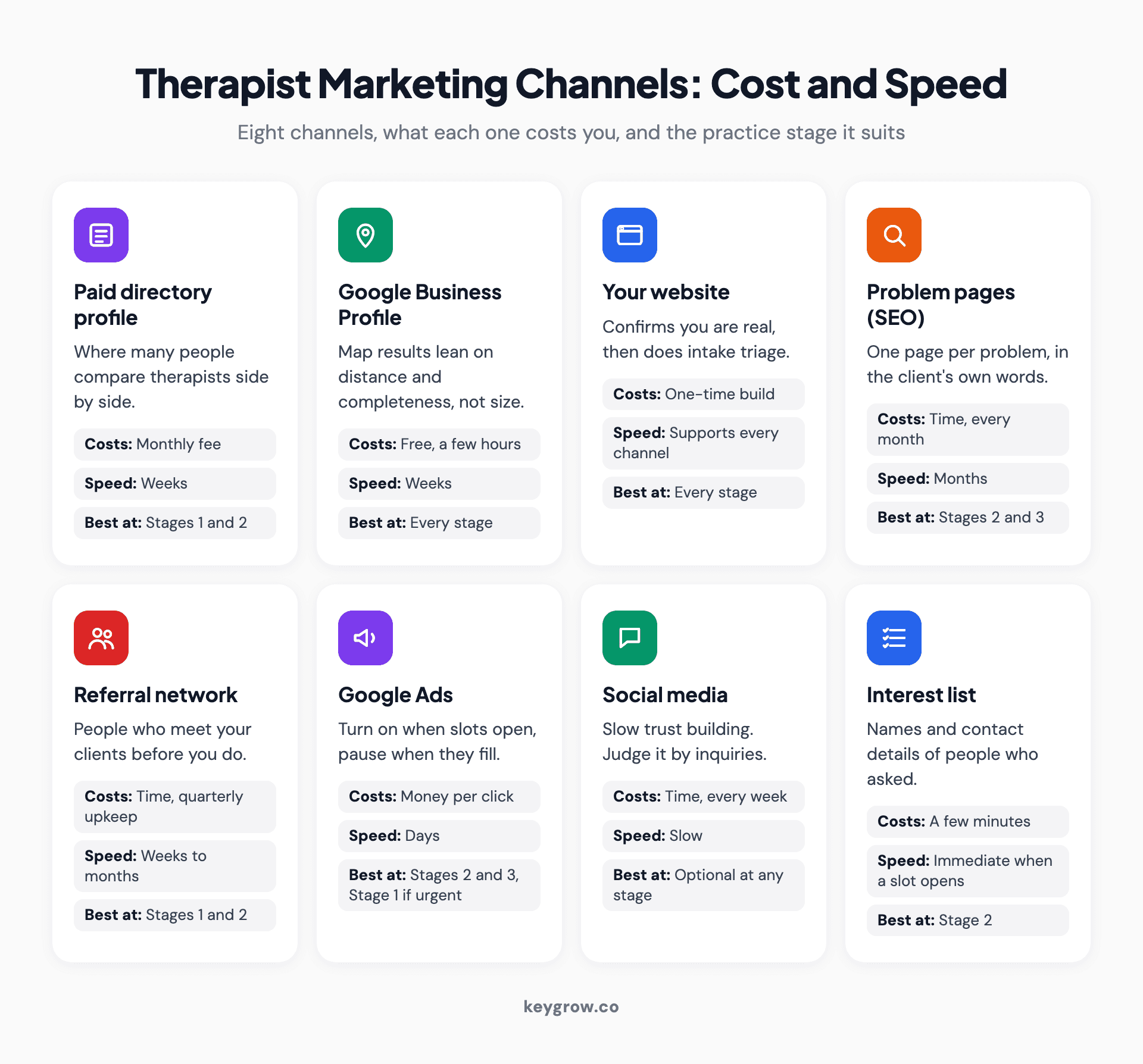
Icon grid of eight therapist marketing channels showing what each costs in time or money, how quickly it produces inquiries, and the practice stage it suits best.
Social media gets its own paragraph because it is the most oversold channel in therapy marketing. Followers do not book first sessions. If a marketing report opens with reach and engagement, ask how many inquiries those numbers produced. For a solo practice trying to fill 5 slots, a month of posts that produced no inquiries is worth nothing, however many people liked them. Post if you enjoy it. Just do not plan your first clients around it.
The website matters at every stage, though it does a different job in each. In stage 1 it confirms you are real. By stage 3 it is doing intake triage, so a page per clinician and a visible fee schedule carry real weight. If yours was built as a brochure, healthcare website design is the fix worth paying for before any campaign.
FAQs
How do therapists get clients quickly?
The fastest routes are referral conversations with people who already see your future clients, and a small paid search campaign on the specific problems you treat. A complete directory profile and a Google Business Profile support both. Social media and blogging are slow and rarely fill a calendar in the first months.
How much should a therapist spend on marketing?
It depends on the stage. A new solo practice spends mostly time, plus a paid directory listing and a basic website. Paid search is the first line item that scales with money, and it should be sized to the number of open slots rather than a percentage of revenue. Group practices spend more because they are filling several calendars at once.
Can therapists ask clients for Google reviews?
Most professional codes restrict soliciting testimonials from current clients or anyone vulnerable to undue influence, including Standard 5.05 of the APA ethics code. Check your own board and association code before asking anyone. Unsolicited reviews can stay up, and any reply should never confirm that the writer is a client.
Is social media worth it for a therapy practice?
It is worth it as long-term trust building if you enjoy making content, and it is a poor way to find first clients. Judge it by inquiries, not followers or likes. If a platform has produced no inquiries after 6 months of steady posting, move that time to referrals or your website.
Should a therapist rely on a directory or their own website?
Use both, for different jobs. The directory is where many people compare therapists, so keep the profile complete and accurate. Your own website tends to convert better because the reader is hearing only your voice, and once it produces more inquiries than the paid directory, consider dropping to a free listing.
When should a therapy practice hire a marketing agency?
When the gaps in your calendar last longer than a month, when you are filling other clinicians' calendars, or when your clinical hours are clearly worth more than the fee. A new solo practice or a solo practice that refills on its own usually does better doing the work itself.
Fill the next five slots
Whatever your stage, the plan comes down to one piece of arithmetic. Take 5 open weekly slots. As a worked-example assumption, not a benchmark, say 1 in 3 inquiries becomes an ongoing client after the consult call. You need about 15 inquiries.
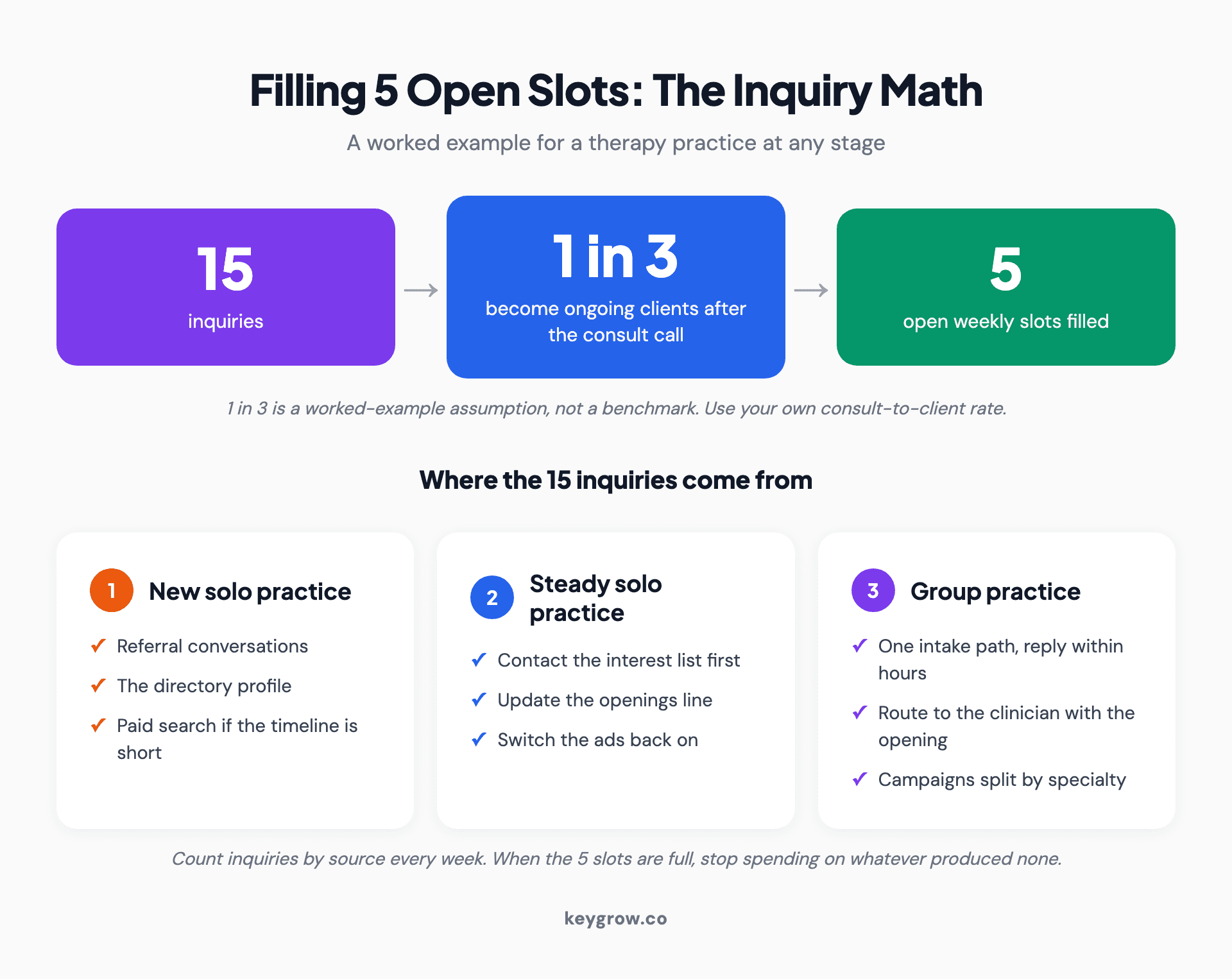
Worked example showing how a therapy practice fills five open weekly slots: about fifteen inquiries at a one-in-three conversion assumption, and where those inquiries come from at each practice stage.
Where those 15 come from depends on the row you picked at the top. A new solo practice gets them from referral conversations and the directory profile, with paid search if the timeline is short. A steady solo practice contacts its interest list first, updates the openings line, then switches the ads back on. A group practice runs them through one intake path and routes each to the clinician with the matching opening.
Count inquiries by source every week until the 5 slots are full. Then stop spending on whatever produced none.
If you run a group practice and want someone to build and run that system, tell us about your practice. We work month-to-month, cancel anytime, and the first call is mostly us working out whether you are at that stage yet. If you are a solo clinician with 5 slots to fill, the plan above is yours to run, and the retainer money stays in your practice.