


The right nonprofit marketing strategy is the one your team can still run in month ten. Ambition is rarely the problem. Most nonprofit plans die in March because they were written for a marketing department the organization does not have.
So size the plan to your capacity first and pick channels second. Work out which of three budget tiers you are really in (no budget, small, or funded), build the same base underneath all of them, keep the donors you already have before chasing new ones, and use the Google Ad Grant as the bridge from the first tier to the second. The five steps below work at every tier. Only the volume changes.
What a nonprofit marketing strategy has to do
A nonprofit marketing strategy is the plan for how your organization gets found by, converts and keeps three groups: the people you serve, the people who fund you, and the people who give time. It names the goal for each group, the channels, the hours and the budget, and how you will know it worked.
Most guides stop at "know your audience" and "tell your story". Both are true, and neither tells you what to do on Tuesday. The number that should shape your plan is retention.
The Fundraising Effectiveness Project's 2025 data, published in AFP's April release, found that dollars raised grew an estimated 5.0 percent while the number of donors fell 3.6 percent. Overall donor retention was 43.3 percent.
Run that through a simple worked example. Say you have 1,000 donors this year (an assumption for illustration). At a 43.3 percent retention rate, about 567 of them will not give again next year. Before your marketing grows anything, it has to replace those 567 people just to stand still.
That is why every tier below starts with keeping people and only then moves on to finding them.
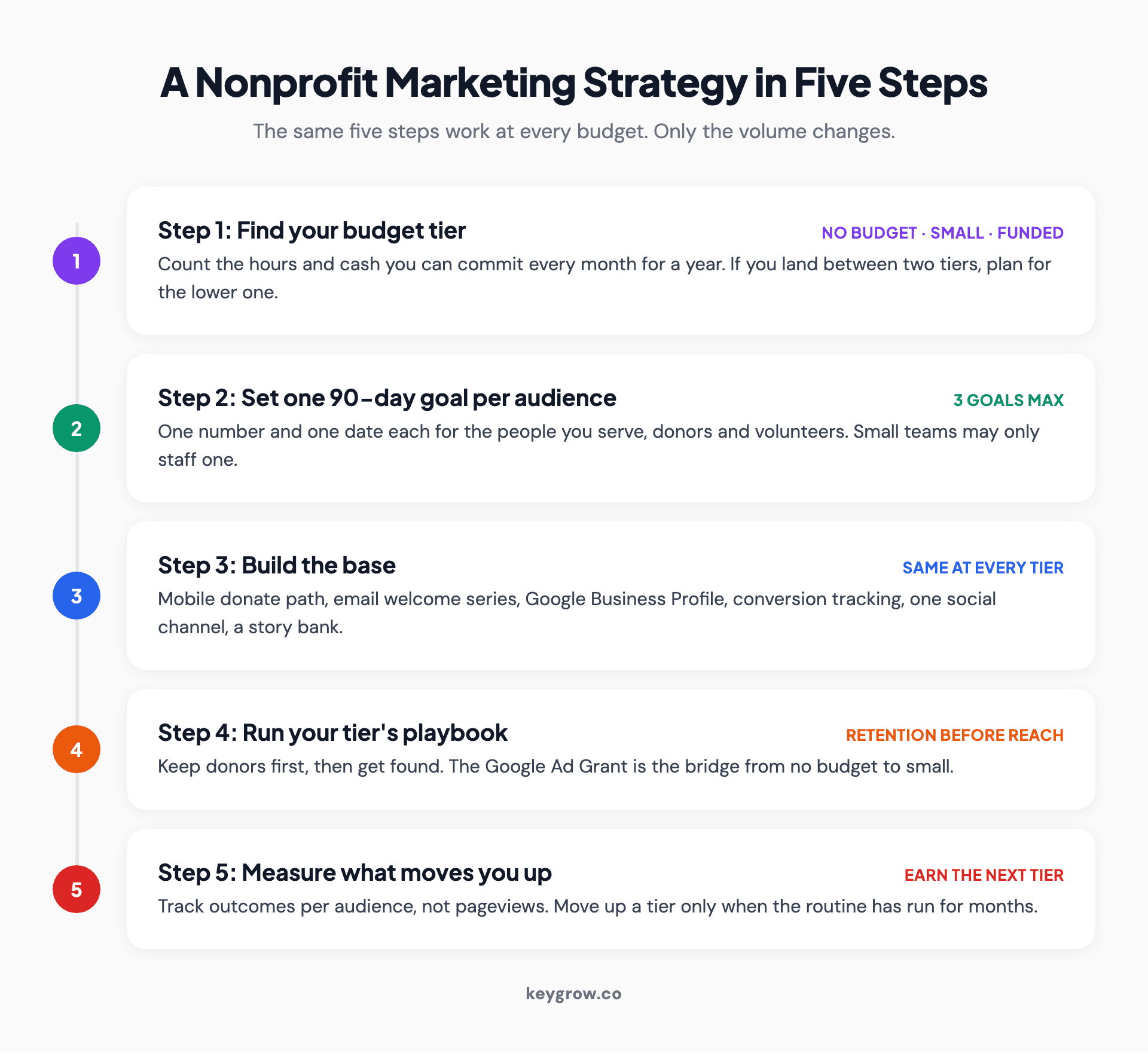
Five-step nonprofit marketing strategy process: find your budget tier, set one 90-day goal per audience, build the base, run your tier's playbook, and measure what moves you up a tier.
Step 1: Find your tier before you pick a channel
Your tier is set by the hours and cash you can commit every month for a year, not by what you hope to raise. Count both honestly, then read across.
| Tier | Cash per month | Time per month | Who usually runs it | Where the effort goes |
|---|---|---|---|---|
| No budget | $0 | 4 to 8 hours | The executive director, a board member or one steady volunteer | Email to your existing list, Google Business Profile, one social channel, the Ad Grant application |
| Small | Up to about $1,000 | 15 to 30 hours | Part-time staff or a volunteer with a fixed weekly slot | A monthly giving program, a managed Ad Grant, retargeting, design help |
| Funded | More than $1,000, plus a salary | 80 hours or more | A staff marketer, an agency, or both | Paid search and social for new donors, year-round content, structured testing |
The tier boundaries are our working definitions, not an industry standard. What matters is the honesty of the count.
A board member who says "I'll do social" is not 4 hours a month until they have done it for three months running. Count the hours you have already seen, not the hours you have been promised. If the count lands between two tiers, plan for the lower one. A small plan that runs all year beats a funded plan that stops after one quarter.

A small nonprofit team reviewing documents around a wooden table while planning their marketing for the year.
Step 2: Set one 90-day goal per audience
Pick one measurable goal for each audience you are working on this quarter, and no more than one. Three goals across three audiences is already a full plan for a small team.
Good goals name a number and a date:
- People you serve: 40 more calls to the helpline from search by the end of June.
- Donors: convert 25 one-time donors to monthly giving this quarter.
- Volunteers: fill the Saturday shift roster for eight straight weeks.
At the no-budget tier, you may only have the hours for one of these. That is fine. Pick the one that hurts most if it slips, and leave the others for next quarter.
Ninety days is long enough for email and the Ad Grant to show a result, and short enough that a goal nobody is working on gets noticed before the year is gone.
Step 3: Build the base that every tier runs on
The base is the set of free or near-free assets that every channel depends on. Without it, money spent at the funded tier leaks out of the same holes that held back the no-budget tier.
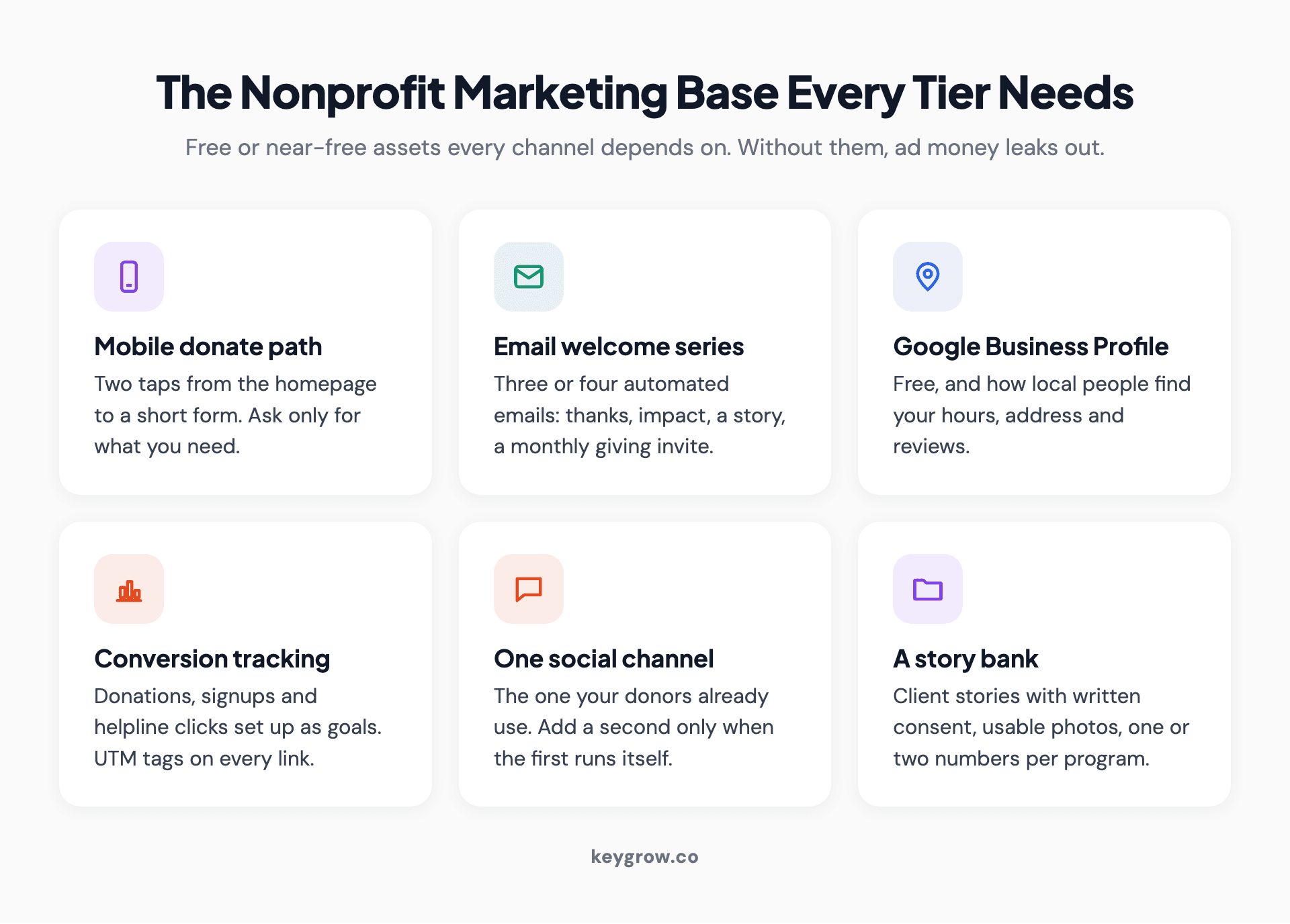
Icon grid of the six-part nonprofit marketing base every budget tier needs: a donate path that works on a phone, an email list with a welcome series, a Google Business Profile, conversion tracking, one social channel, and a story bank.
A donate path that works on a phone. Two taps from the homepage to a form that asks only for what you need. If you are rebuilding the site, our guide to nonprofit website design covers what donors and volunteers check before they act.
An email list with a welcome series. Three or four automated emails for every new donor or volunteer: thanks, what their gift did, a story, and a soft invitation to give monthly.
A Google Business Profile if anyone ever visits a building. It is free and it is how local people find your hours. Our walkthrough of Google Business Profile optimization applies to a food pantry exactly as it does to a dentist.
Conversion tracking. Donations, volunteer signups and helpline clicks set up as goals in analytics, once, properly. Tag every email and social link with a UTM builder so you can see which channel sent the gift.
One social channel, run well. The one your donors already use. A second channel comes when the first runs without anyone thinking about it.
A story bank. A shared folder of client stories with written consent, photos you are allowed to use, and one or two numbers per program. Every channel draws from it.
Tier 1: Run it on hours, not dollars
At the no-budget tier, your best channel is the list of people who already gave. Email them more thoughtfully, ask them for something specific, and spend the rest of your hours on being findable.
A month at this tier looks like this:
- One email to donors that is an update rather than an appeal: one story, one number, then a short line about giving monthly.
- One page for the people you serve, answering a question your staff hear every week. Our guide to SEO for nonprofits explains why those pages outrank donation pages and how to write them from a twenty-minute interview.
- Four to eight social posts on your one channel, pulled from the story bank.
- One ask of a partner (a business, church, school or council page that already mentions you) to link to a specific page on your site.
The monthly giving line is the most valuable sentence in that email. The M+R Benchmarks study found that monthly giving accounted for 27 percent of all nonprofit online revenue in 2025, and 22 percent for organizations raising under $1 million online. A monthly donor is a retention problem you have already solved.

A vintage typewriter holding a paper sign that reads Donations, a reminder that the best nonprofit marketing starts with the donors you already have.
Here's the reality: this tier does not need an agency. Four to eight hours a month, done every month for a year, will tell you more about which channels work for your cause than any proposal you could pay for.
Is the Google Ad Grant worth it for your organization?
Yes, if someone can give it one hour a month. The Google Ad Grant gives eligible nonprofits up to $10,000 a month in Google search ads at no cost, and it is the cheapest way to move from Tier 1 into Tier 2.
The catch is that the grant has rules a normal ads account does not. According to Google's Ad Grants policy, accounts must keep a 5 percent click-through rate across the account each month, or they are temporarily deactivated after two consecutive months below it. Newer accounts also need working conversion tracking that records at least one conversion a month, a conversion-based bidding strategy, at least two sitelink assets, and location targeting that matches where you actually serve.
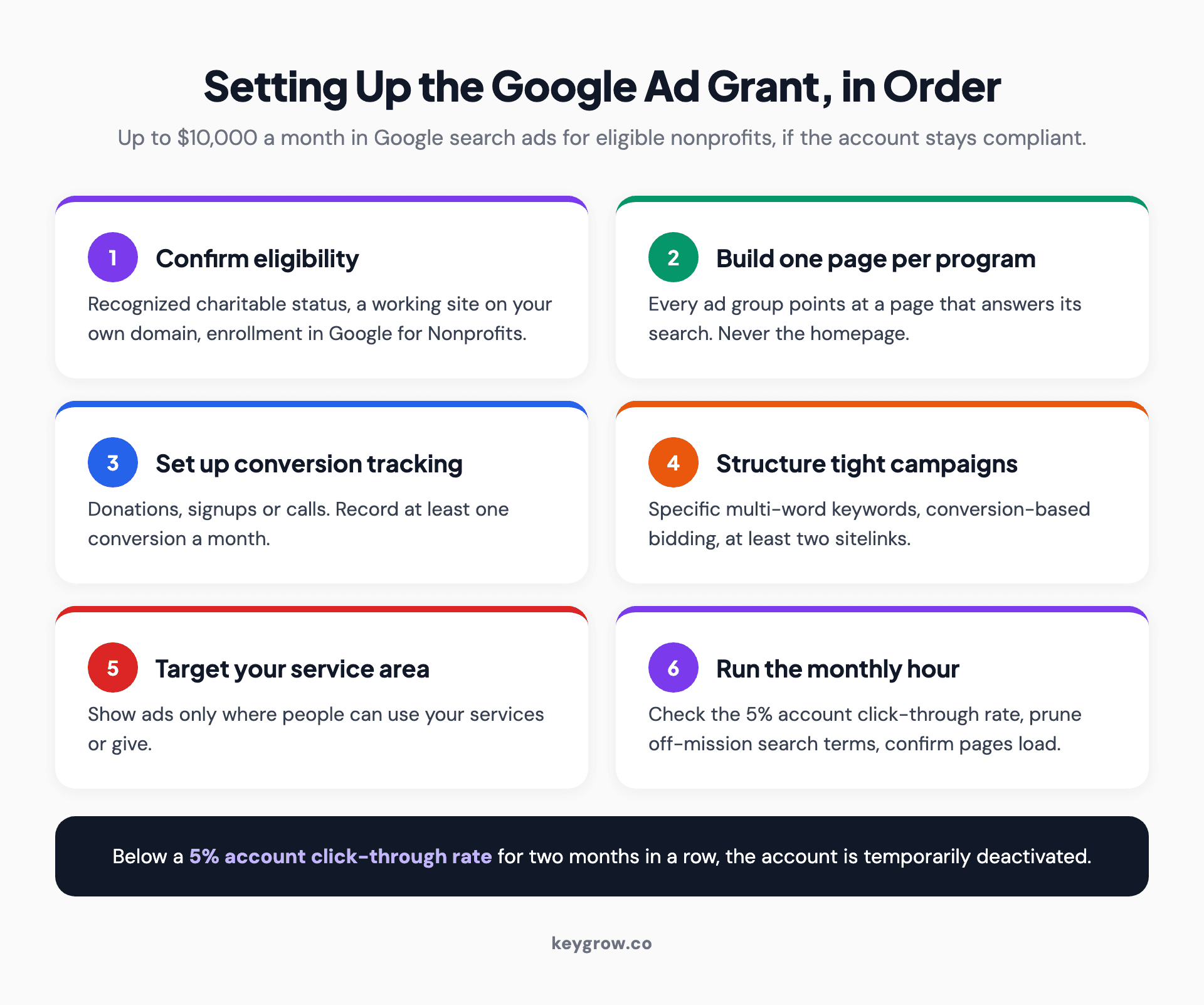
Six-step Google Ad Grant setup process for a nonprofit: confirm eligibility, build mission pages, set up conversion tracking, structure tight campaigns, target your service area, and run a monthly one-hour check.
The easiest way to fall under that 5 percent line is to send every click to the homepage.
We think that is the most expensive default in paid search, and the grant only hides the cost. On a car detailing account we took over, all ad clicks went to the homepage and each booking cost about $100. We rebuilt the campaigns and pointed traffic at a dedicated booking page, and cost per conversion dropped to $22, with conversions up 650 percent between August and December 2022.
A nonprofit is not paying per click, but the same mechanism decides whether the grant survives. A page that matches the search lifts click-through rate and records conversions. A homepage does neither. Build one page per program, and if you have nobody to build them, landing page design is the first thing worth paying for at this tier.
The monthly hour is a short routine. Check the account click-through rate against the 5 percent line, read the search terms report and exclude anything off-mission, confirm conversions are still recording, and confirm the landing pages still load. Our conversion tracking setup guide covers the part that trips most accounts.
Tier 2: Spend the first dollars on keeping people
At the small-budget tier, put money into the things that turn a one-time gift into a second gift. Acquisition can wait until you are keeping more of what you already have.
Here is how we would split a small monthly budget. It is a worked example of priorities, not a price list:
| Line | Share of the small budget | Why it comes first |
|---|---|---|
| Monthly giving program and email tooling | About 30 percent | Recurring donors are the fastest fix for the retention math |
| Design and landing pages for grant campaigns | About 30 percent | Keeps the Ad Grant compliant and converting |
| Retargeting ads to site visitors | About 25 percent | Reaches people who already showed interest, the cheapest paid audience you have |
| Video or photo for the story bank | About 15 percent | Feeds every other line |
We would start paid social with retargeting at this size, because the audience has already visited your site and knows who you are. Cold audiences need more budget and more fresh creative than a small team can usually produce.
The hours change too. Somebody now owns a calendar, the grant account and the list. If that is a volunteer, give them a written one-page routine, so that when their life gets busy the next person does not start from zero.
Tier 3: Buy reach once the base converts
At the funded tier you can afford to find new donors, but only after the donate path, tracking and retention emails are converting the ones you have. Paid acquisition poured onto a leaky base buys first gifts that never become second gifts.
The first addition is usually paid search beyond the grant. Grant ads only show on Google search results. A separate paid account can bid on high-intent donation terms without the grant's restrictions, and it can run remarketing and video too. This is where paid search management earns its fee, because the two accounts have to be set up so they do not bid against each other for the same searches.
Paid social comes next: lookalike audiences built from your donor list, peer-to-peer fundraising pages, event promotion. Judge it on cost per new donor and on whether that donor gives a second time. If nobody on staff has the hours, social media marketing services can run it for you. Ask whoever runs it to report second gifts.
Then content that keeps working, like program pages, resource guides and an annual impact page, which rank all year and feed both the grant and organic search. And testing, one variable at a time: subject lines, ask amounts, donate page layouts. Small lists rarely have the volume to read a test, which is one reason testing belongs at this tier and not earlier.
Plan the year backward from December
Nonprofit giving is heavily seasonal, so build the calendar backward from the end of the year. The M+R study found that nonprofits received 37 percent of all their 2025 online revenue in December alone.
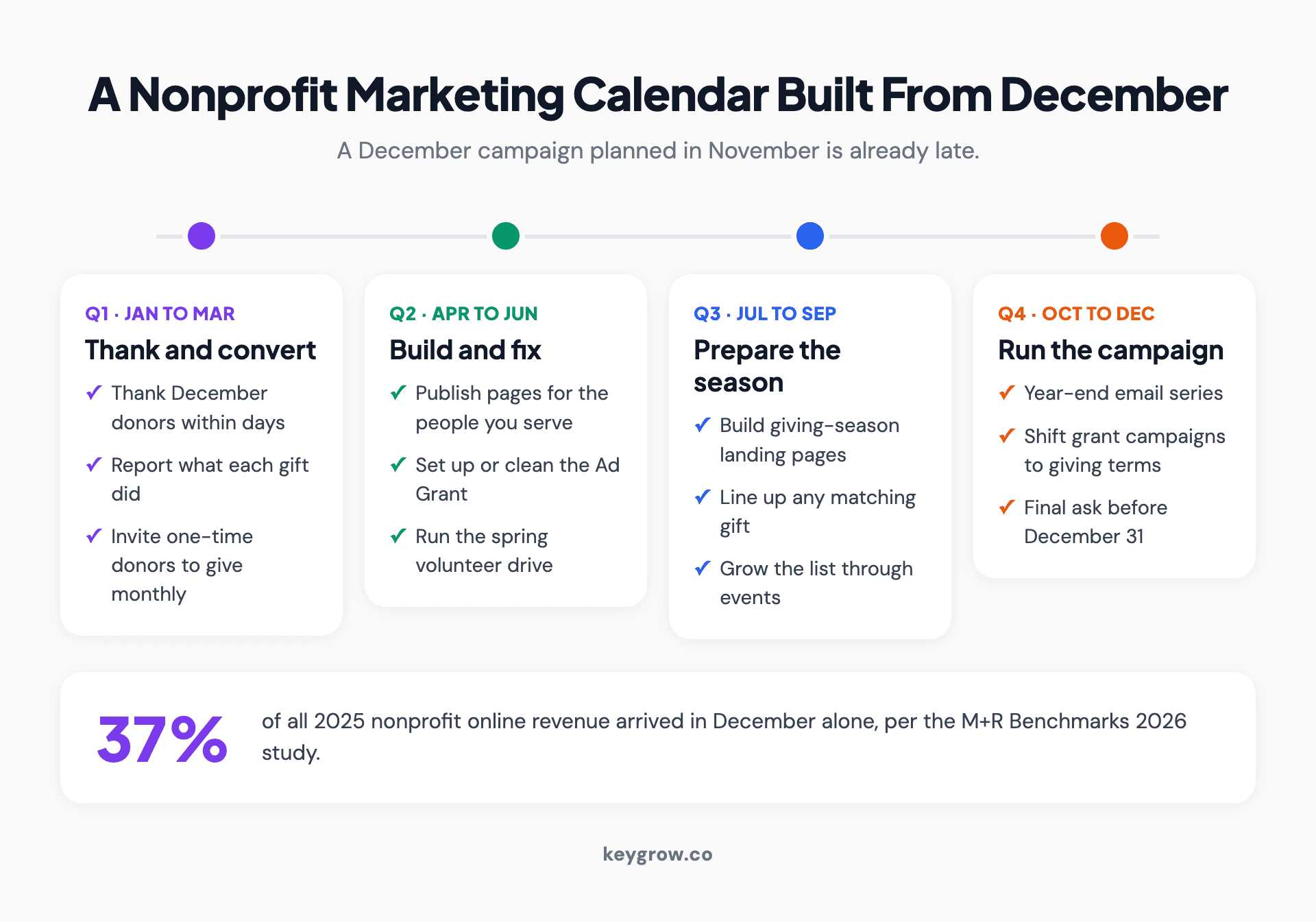
Quarter-by-quarter nonprofit marketing calendar planned backward from December: thank and convert donors in Q1, build pages and the Ad Grant in Q2, prepare giving-season pages in Q3, and run the year-end campaign in Q4.
That number cuts both ways. December matters enormously, and a December campaign planned in November is already late. Giving-season pages need months to rank, email segments need to be built and tested, and the Ad Grant's campaigns need a few weeks of data before the busiest month.
January to March: thank December donors within days, report what their gift did, and invite one-time December donors to give monthly.
April to June: publish the pages for the people you serve, set up or clean the Ad Grant, and run the spring volunteer drive.
July to September: build the giving-season landing pages, line up any matching gift, and grow the list through events.
October to December: run the year-end email series, shift grant campaigns toward giving terms, and send the final ask before December 31.
Step 5: Measure what moves you up a tier
Measure outcomes per audience, then use them to decide whether you have earned the next tier. Pageviews and likes tell a board nothing about whether anyone was helped or anything was raised.
| Tier | What to track monthly | The signal to move up |
|---|---|---|
| No budget | Donor retention, email click rate, helpline or directions clicks, volunteer signups | The same routine has run for six months and someone is asking for more hours |
| Small | Monthly donors added, Ad Grant click-through rate and conversions, cost per retargeted gift | The grant spends most of its $10,000 and the base converts reliably |
| Funded | Cost per new donor, second-gift rate, revenue by channel | Each new donor costs less than they give in their first two years |
That last line is a decision rule, not a benchmark. Work out your own average gift and retention, then decide what you can afford to pay for a donor who stays.
When you do not need an agency
Most small nonprofits do not need one yet. If your base is not built, the grant is not running and nobody has sent a donor update in six months, an agency retainer buys an expensive version of work you can do for free.
Hire help when one of three things is true. You have reached the funded tier and nobody on staff has the hours. The Ad Grant is spending near its cap and needs proper management rather than a monthly check. Or you are competing with national organizations for the same searches and donors, and the testing work has become a job of its own.
When you do hire, ask what the report will open with. If the answer is impressions, keep looking.
FAQs
What is a nonprofit marketing strategy?
A nonprofit marketing strategy is a plan for how an organization reaches, converts and keeps the people it serves, its donors and its volunteers. It sets one goal per audience, the channels and hours to reach it, and the measures that show whether it worked. The best ones are sized to the time and money the organization can sustain all year.
How much should a nonprofit spend on marketing?
Start from the hours you can staff every month, then add cash where it removes a bottleneck. The percentage rules that circulate online are rarely sourced, so treat them as rough guidance. A no-budget nonprofit can run a working plan on 4 to 8 hours a month plus the free Google Ad Grant.
What is the best marketing channel for a nonprofit?
For keeping donors, email to people who already gave is usually the strongest channel, because they already know you. For being found, Google search (organic pages plus the Ad Grant) reaches people at the moment they are looking for help or a cause to support. Pick one social channel your donors already use and run it well before adding a second.
Can a small nonprofit get the Google Ad Grant?
Yes, size is not a requirement. Eligible organizations need recognized charitable status in their country, a working website on their own domain, and enrollment in Google for Nonprofits. Government entities, hospitals and schools are generally excluded, though their charitable foundations may qualify.
How do you market a nonprofit with no money?
Email your existing donors with impact updates and a monthly giving invitation, claim your Google Business Profile, publish pages that answer the questions the people you serve ask, and apply for the Google Ad Grant. Ask partners who already mention you to link to a specific page. All of it costs time, not money.
How do you measure nonprofit marketing success?
Track outcomes for each audience: donor retention and monthly donors added, volunteer signups, and helpline calls or direction requests from the people you serve. Set these up as conversions in analytics once, at the start. Pageviews and follower counts are easy to report and say very little about results.
When should a nonprofit hire a marketing agency?
When the work outgrows the hours available, not before. Good triggers are an Ad Grant spending near its monthly cap, a funded plan with no staff marketer, or direct competition with national organizations for donors and searches. Until the basics are in place, doing it yourself is usually the better use of money.
Pick the tier you can sustain
Choose the tier your team can run for twelve months, build the base, and let the numbers tell you when to move up. Then look at the tier again each January, this time with a year of your own data instead of a guess.
If you have outgrown the hours you have and want a second opinion on where the next dollar should go, tell us where you stand and we will say honestly whether you need us yet.