

SEO for nonprofits works the same way it does for any other organization, with one difference that changes the whole calculation: you are competing for three separate audiences with one website, and you have access to a free advertising budget that no business gets. Most nonprofit SEO advice ignores both facts and hands you the same checklist a plumber would get.
This is the version written for the constraints you actually have. No budget, borrowed time, a board that wants a number by the next meeting, and an unfair advantage sitting unclaimed in most organizations.

Volunteers in matching shirts working together at a community event.
You are optimizing for three audiences, not one
This is the thing almost every guide gets wrong. A nonprofit website serves three groups who search in completely different language, and treating them as one pool of "traffic" is why so much nonprofit content ranks for nothing.
People who need what you do. They are searching for the problem, not the organization. Someone looking for "free legal help with eviction" is not searching for your name, your mission statement, or your annual report. They are in trouble at 11pm.
People who might give. They search comparatively and cautiously: what a cause costs, which organizations are legitimate, where money actually goes. They arrive skeptical, and the content that converts them looks nothing like the content that helps a beneficiary.
People who might help. Volunteers, corporate partners, grantmakers and journalists. Lower volume, much higher value per visit, and almost never targeted deliberately.
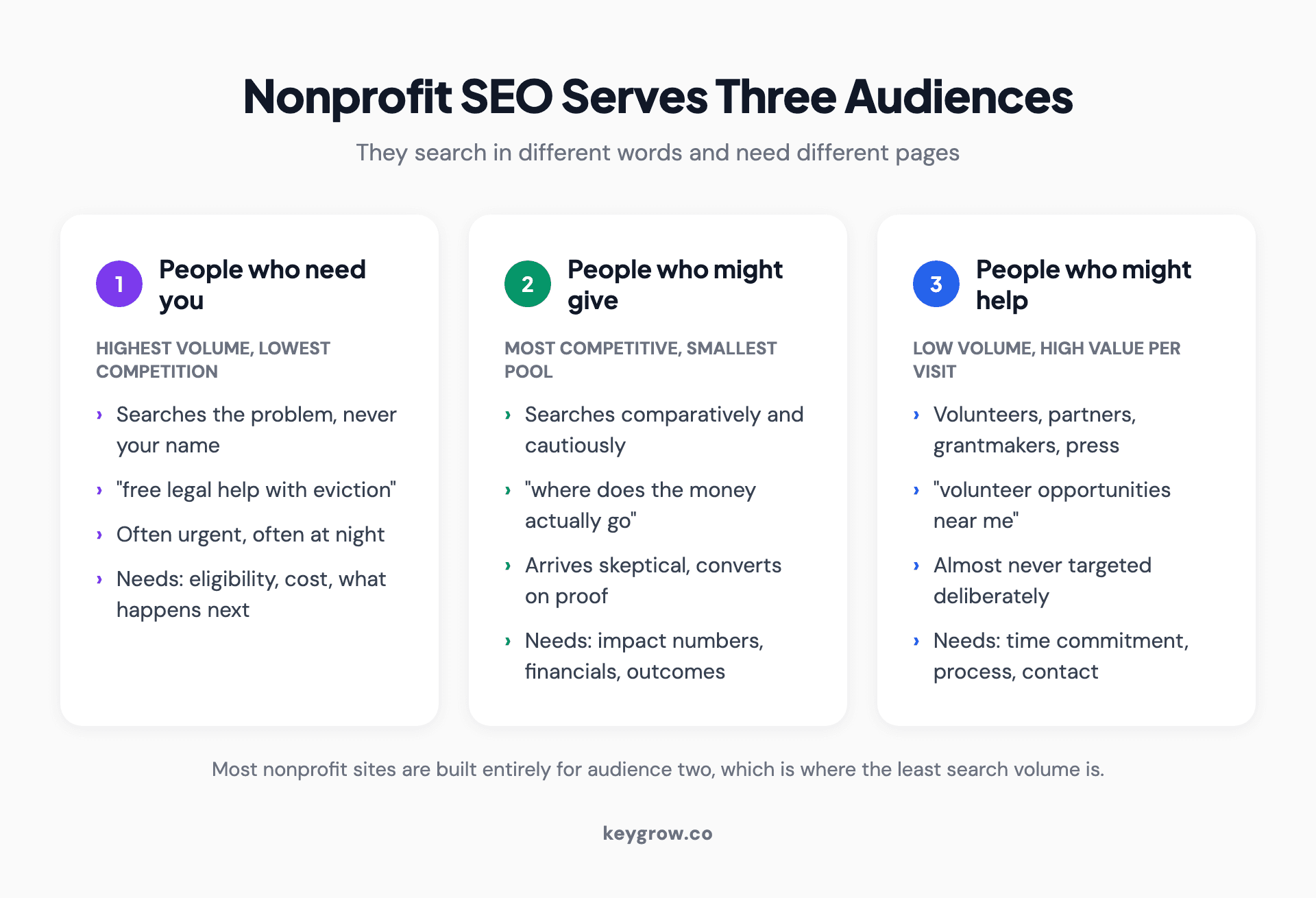
Three-audience map for nonprofit SEO showing what beneficiaries, donors and volunteers each search for and which pages serve them.
Most nonprofit sites are built almost entirely for the second group, because that is the group the board asks about. The first group is where the search volume actually is, and the traffic it brings is what makes the site credible enough for the other two.
Start with what your beneficiaries are typing
The highest-volume, lowest-competition, most useful keywords a nonprofit can own are the ones describing the problem you exist to solve.
A food bank should be findable for what a person types when they cannot afford groceries this week. A domestic violence shelter should be findable for the questions someone asks before they are ready to call anyone. A literacy charity should be findable for a parent worried about a seven-year-old who is not reading.
None of those searches contain your organization's name. Very few of them contain the word "charity" or "nonprofit". They are practical, urgent and specific, and the pages that answer them are often thin or absent because the organizations best placed to write them are busy delivering the service instead.
Write those pages first. They serve the mission directly, they rank more easily than donation-intent pages, and they are the pages that later earn links from local news, government resource lists and other organizations.

People in matching shirts clearing debris during a community cleanup project.
There is a practical caution here. If your beneficiaries are in crisis, the page has to be built for someone under stress: the phone number near the top, plain language, no donation popup, and no requirement to read three paragraphs of mission before finding the address. Optimizing that page for conversions the way a business would is the wrong instinct and occasionally a harmful one.
The ten thousand dollars a month most nonprofits never claim
Registered nonprofits can apply for Google Ad Grants, which provides up to $10,000 per month in Google search advertising. It is not a discount or a matching scheme. It is a monthly budget you do not pay for.
Most organizations either never apply, apply and get suspended, or run it so badly that it spends a fraction of what is available. The reason is that the grant comes with rules that are unlike a normal ads account, and nobody explains how those rules interact with the rest of your marketing.
The requirements that catch people out:
| Rule | What it means in practice |
|---|---|
| 5 percent account click-through rate every month | Miss it two months running and the account is temporarily deactivated |
| No single-word keywords | With narrow exceptions for your own brand and certain medical terms |
| Keywords scoring 1 or 2 on quality must be paused | Low-relevance keywords have to be actively pruned, not left running |
| Ads must reflect the mission | Generic traffic-buying gets the account flagged |
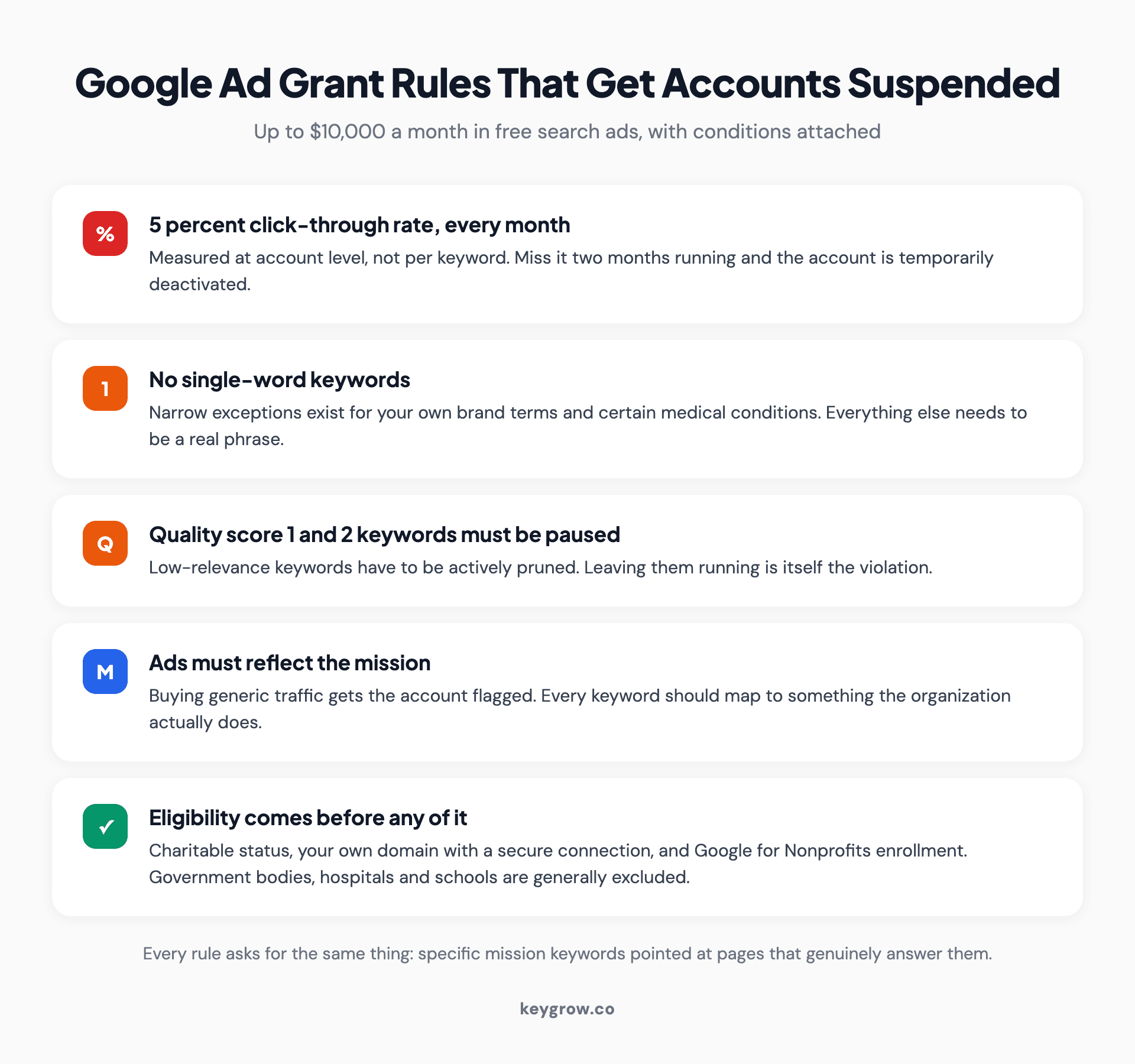
Google Ad Grants compliance rules for nonprofits: the five percent click-through rate, keyword restrictions and quality score pruning.
The full list lives in Google's compliance guide, and it is worth reading once before you apply rather than after your first deactivation.
Eligibility comes first and trips up more organizations than the ad rules do. You need recognized charitable status in your country, a working website on your own domain with a secure connection, and enrollment in Google for Nonprofits. Government entities, hospitals and schools are generally excluded, though their affiliated charitable foundations often are not, which is a distinction worth checking rather than assuming.
Read those rules again with an SEO brain and something becomes obvious. Every one of them is asking for the same thing: specific, mission-relevant search terms pointed at pages that genuinely answer them.
That is not a coincidence, and it is the most useful thing in this article.
Why the grant and your SEO are the same project
The reason nonprofits fail the 5 percent click-through requirement is almost always that they bid on broad terms and send the clicks to a homepage. The fix for that is identical to the fix for weak organic performance: build specific pages that answer specific questions.
Here is the loop. You write a page answering a real question a beneficiary has. That page becomes the landing page for a tightly matched ad group, which lifts click-through rate because the ad, the keyword and the page all say the same thing. The grant traffic then tells you within days which questions people actually click on, which is data your organic content strategy would otherwise take six months to guess at.
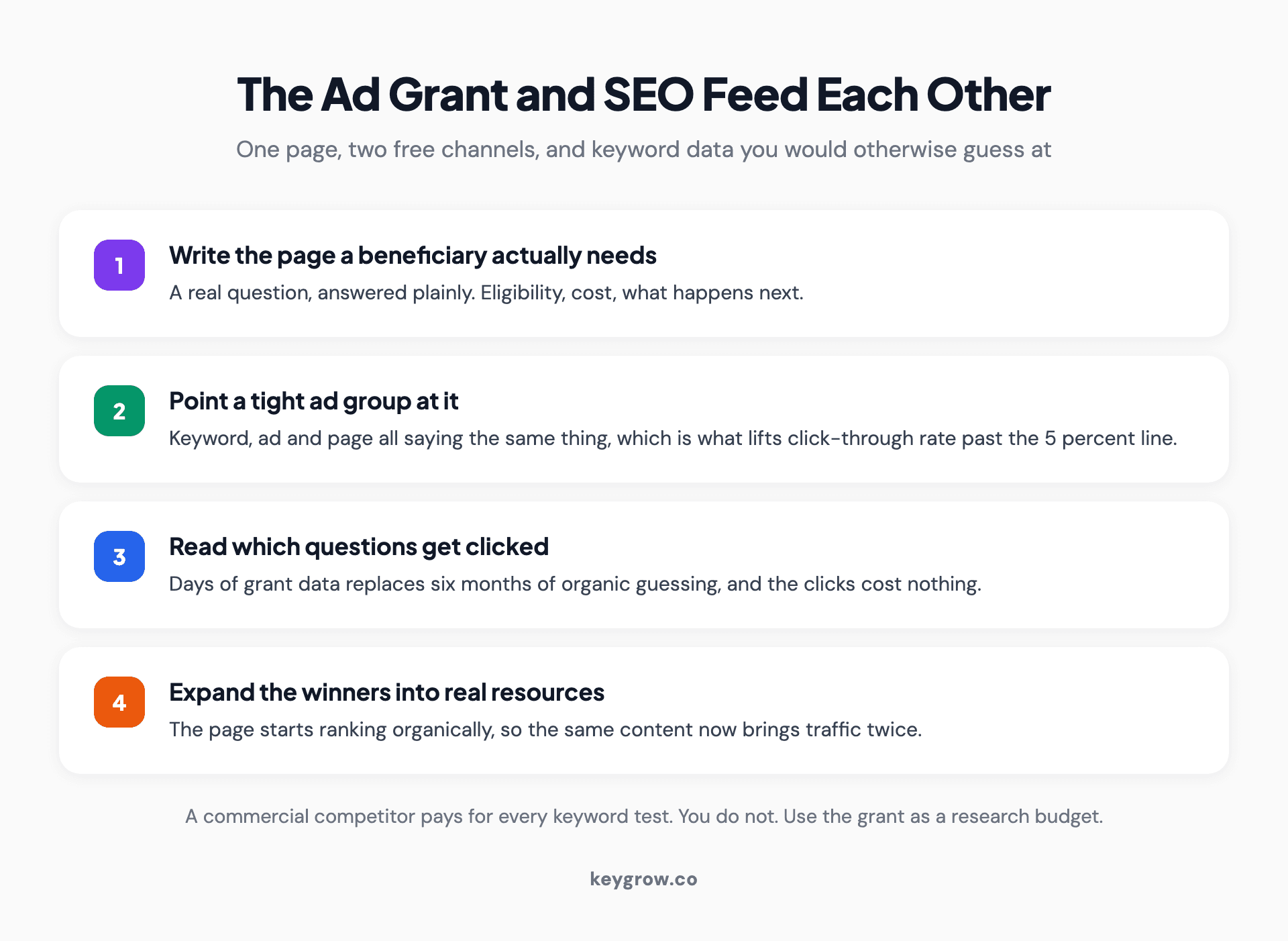
Diagram of the loop between nonprofit SEO content and the Google Ad Grant, where each channel feeds the other with pages and keyword data.
Run in the other direction, the same loop compounds. Ad grant data shows a question getting clicks and converting. You expand that page into a proper resource, it starts ranking organically, and now you are getting the traffic twice, once free from the grant and once free from search.
No business gets this. A commercial competitor testing keywords is paying for every click. You are not. Use it as a research budget, not just a traffic source.
The catch, and it is a real one: the grant only works if somebody looks at it monthly. An unmanaged grant account drifts below the click-through threshold and gets deactivated, and reactivation is a chore. If nobody in the organization has an hour a month, do not open the account yet.
That monthly hour has a fixed shape. Check the account-level click-through rate against the 5 percent line, pause anything sitting at quality score 1 or 2, read the search terms report for queries you did not intend to match and add them as negatives, and confirm the landing pages the ads point at still exist. It is closer to bookkeeping than marketing, which is why it suits a methodical volunteer better than an enthusiastic one, and why treating it as a paid search discipline rather than a grant formality is what keeps it alive.
What to publish when the content budget is zero
Nonprofits have something most organizations pay a fortune to fake: genuine subject matter expertise and real stories.
The programs team knows what actually helps. The caseworkers know what people ask. The volunteers know what surprised them. That is publishable content, and the only reason it is not published is that nobody has turned "the thing you explain on the phone forty times a month" into a page.
The most productive move is an interview, not a writing assignment. Sit with the person who answers the phones, ask what people ask, record it, and write the answers up. Twenty minutes of their time produces a page that no competitor can copy because they do not have your caseworkers.
Three formats that consistently earn their keep:
- The question everyone asks, answered properly. Eligibility, cost, what happens next, what to bring.
- The local resource list. Every organization in your area that helps with the adjacent problem, including the ones that are not you. These earn links reliably because they are genuinely useful.
- The plain-English explainer. Whatever the confusing government form or legal process is in your field, explained without jargon.
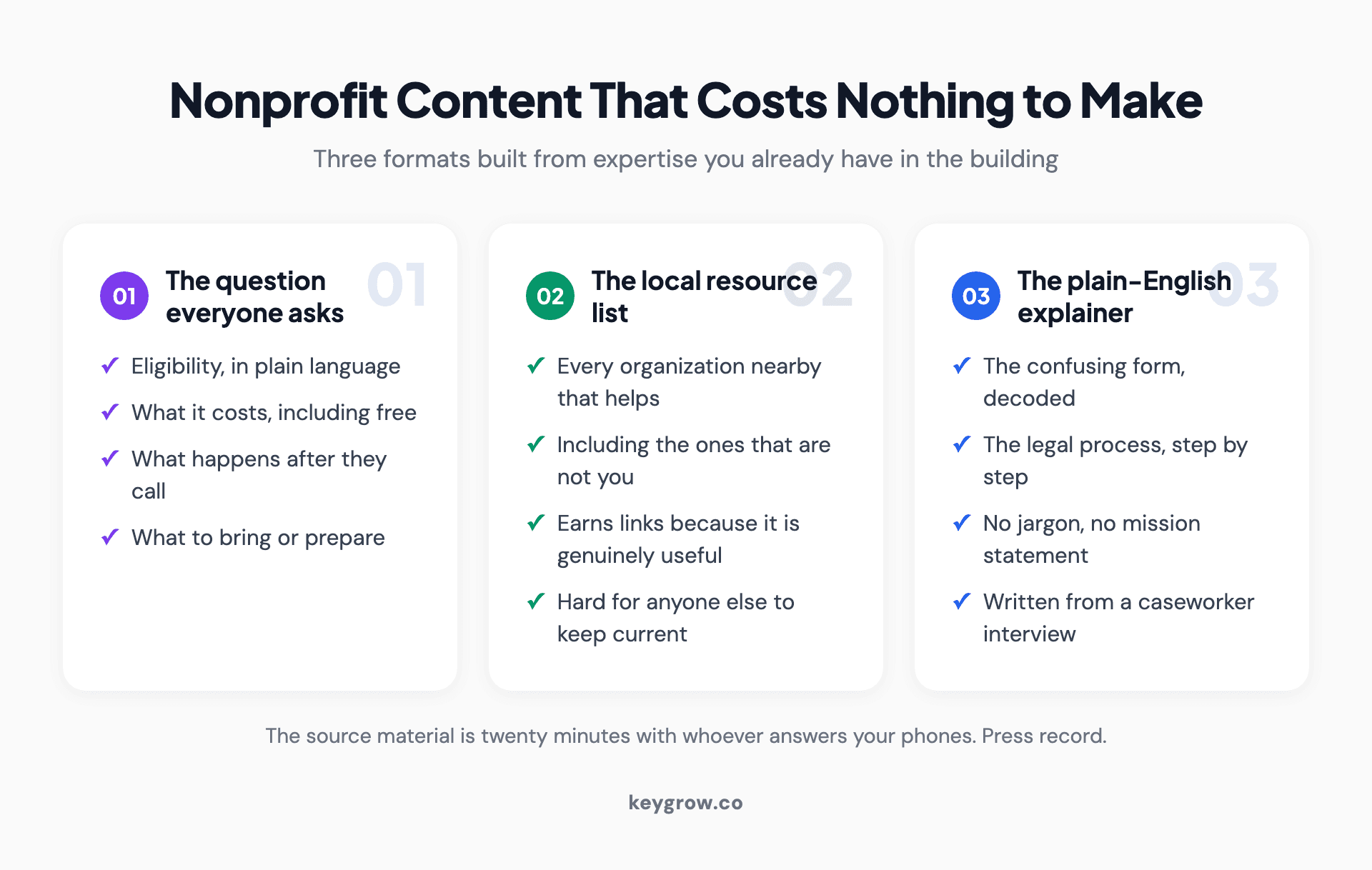
Three nonprofit content formats that need no budget: the question everyone asks, the local resource list, and the plain-English explainer.
Notice that none of these require a content writer, a keyword tool, or a budget. They require someone to press record.
Nonprofits have an unfair advantage in link building
Getting other websites to link to you is the hardest part of SEO for a commercial business. For a nonprofit it is genuinely easier, and most never try.
Local and regional news outlets cover charitable work as a matter of editorial policy. Corporate partners publish their community involvement and will usually link to the organizations they fund if asked. Universities and schools link to community resources. Government and council pages maintain lists of local services. Other nonprofits will exchange links to each other's resource pages because it serves both sets of beneficiaries.
Every one of those is a link that a commercial competitor cannot get at any price.
The ask is the missing step. Most nonprofits are already in these relationships and simply never send the email that says "you mention us on your community page, would you mind linking to our eligibility guide rather than our homepage."
Two things to avoid. Do not buy links or accept a package from anyone offering them, because a suspended domain is a far worse problem for a nonprofit than a slow one. And avoid the sponsor-directory link farms that market specifically to charities; a paid listing on a low-quality directory is a paid link, whatever the invoice calls it.

Group of volunteers in matching shirts gathered at an organized community event.
Local SEO if you have a physical location
If people come to a building, the same local search rules apply to you as to any local business, and most of them are free.
Claim and complete the Google Business Profile, choose the category that matches what a searcher would call you, keep the hours accurate including holidays, and gather reviews from the people you have helped. We covered the mechanics of that in detail in our Google Business Profile guide, and none of it costs anything.
Reviews are the part nonprofits skip, usually out of a reasonable worry about asking a person in crisis to rate the experience. The people to ask are volunteers, partner organizations and donors who have visited, all of whom can speak honestly about the organization without anyone being put in an awkward position.
If you serve an area rather than a single building, hide the address and set a service area instead. Listing an office you do not staff, or a board member's home, is the fastest way to lose the profile, and the rules apply to charities exactly as they do to businesses.
The year-end problem nobody plans for
A large share of charitable giving happens in the final weeks of December, which creates a scheduling trap that catches organizations every year.
The trap is that SEO does not respond in December. If your giving-season content goes live on December 1st, it will not rank in time, because new pages take months to earn position. Local SEO timelines do not bend for a fiscal year.
The fix is unglamorous. Build and publish giving-season pages in August or September, let them age and accumulate links through the autumn, and refresh rather than recreate them each year. A page that has ranked through three giving seasons will outperform a new one every time.
This is also where the ad grant earns its place in the calendar. Paid grant traffic responds immediately, which covers exactly the window organic cannot.
What to measure when there is no revenue number
Nonprofit reporting is where vanity metrics do the most damage, because the board asks for a number and traffic is the easiest number to produce.
Pageviews and impressions tell you nothing about whether the organization helped anyone or raised anything. Our strongest opinion on marketing reporting applies with extra force here: if a report opens with traffic, it is hiding something.
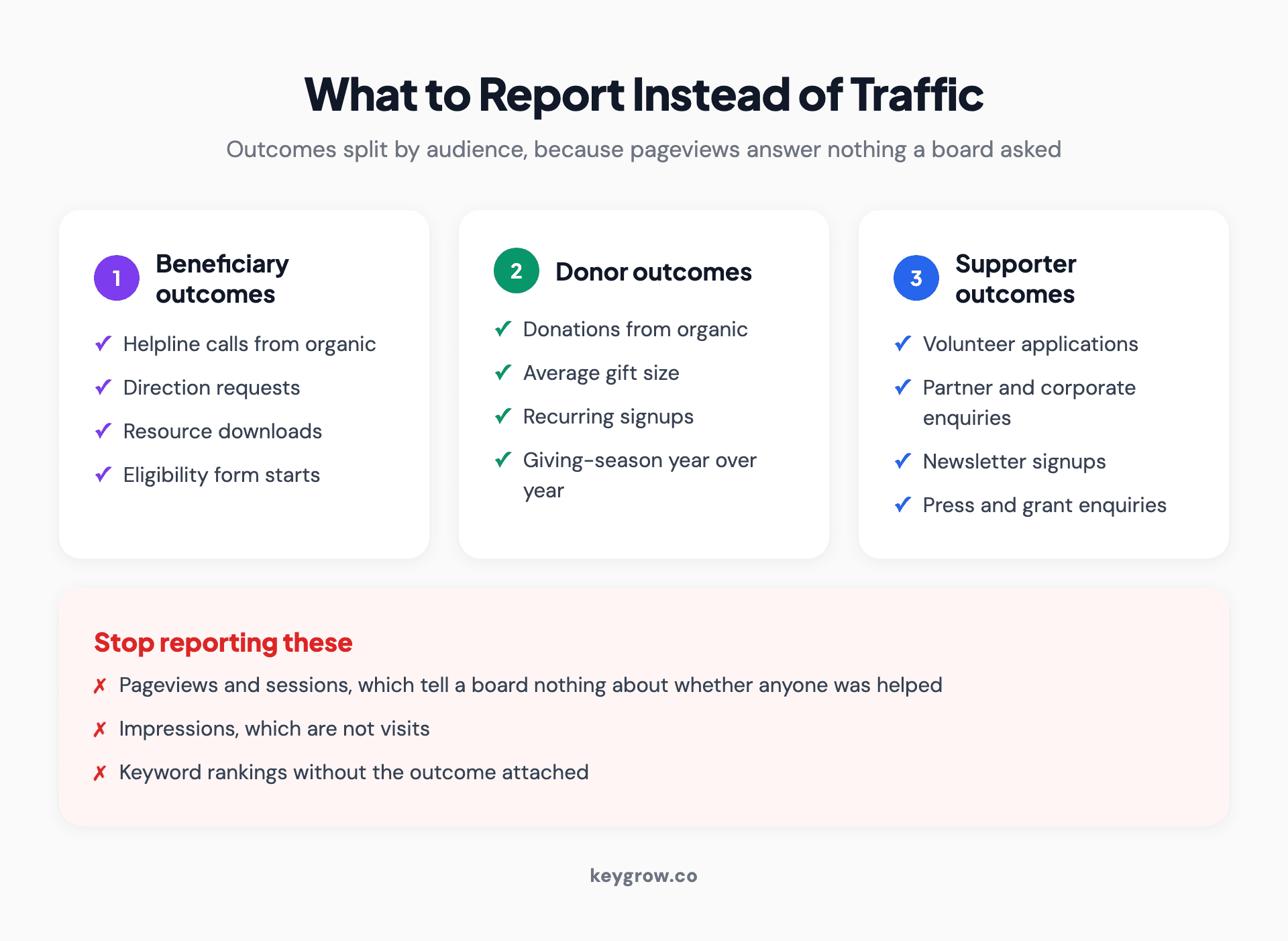
Nonprofit SEO metrics worth reporting to a board: assisted contacts, donations, volunteer signups and resource downloads, replacing pageviews.
Track outcomes instead, split by the three audiences. For beneficiaries: helpline calls, directions requests, resource downloads, form starts on the eligibility page. For donors: donations, average gift, recurring signups from organic. For supporters: volunteer applications, partner enquiries, newsletter signups.
Set these up as conversions in analytics once, properly, at the start. A nonprofit that has been running content for a year without conversion tracking has a year of data that cannot answer any question worth asking.
Be honest about the timeline while you are at it. The strongest organic result we have produced took a full year to reach 1,519 percent traffic growth for a medical practice, and months one through three looked unremarkable. That is the shape of the curve. A board expecting a quarterly result from SEO is going to defund it at exactly the wrong moment, and managing that expectation is part of the job.
Doing this with volunteers
Volunteer-delivered SEO fails for a predictable reason: it depends on one enthusiastic person, and then that person's life gets busy.
What survives handover is documentation. A one-page brief covering who your three audiences are, which pages exist and why, where analytics lives and who has access, and what the monthly routine is. Without it, every volunteer transition restarts the project from zero, which is the actual reason many nonprofit websites have three abandoned blogs on them.
Give volunteers the bounded tasks: publishing a page from an interview transcript, checking the grant account for disapproved keywords, chasing a link that was promised. Keep the strategy and the account ownership with staff, even if staff is one person with no time.
When a nonprofit should not hire an SEO agency
Most small nonprofits should not, and the honest version of this is worth saying plainly.
If you have no Google Business Profile, no analytics, no ad grant and fewer than a dozen real content pages, an agency retainer is the wrong purchase. Everything in the first four sections of this article is free and takes weeks, not months, and doing it yourself is the fastest route to knowing whether search is even a channel for your cause.
Some causes have very little search volume. An organization serving a rare condition or a narrow geography may find that the total available search demand is a few hundred queries a month, in which case a retainer will never pay for itself and the money belongs in direct outreach.
Hiring makes sense in a narrower set of cases: you are competing against large national organizations for the same searches, the ad grant is running near its cap and needs real management, or you have multiple locations and the consistency work has become an operational job. If you get there, SEO services are worth buying properly rather than as a discounted afterthought, and be wary of anyone whose nonprofit pitch is mostly about the discount.
FAQs
What is SEO for nonprofits?
SEO for nonprofits is the practice of making a charitable organization's website findable in search for the three audiences it serves: people who need its services, people who might donate, and people who might volunteer or partner. It differs from commercial SEO mainly in the audience split and in the availability of the Google Ad Grant.
Is SEO worth it for a small nonprofit?
Usually yes for the free work, often no for a paid retainer. Claiming a Google Business Profile, publishing pages that answer beneficiary questions, and applying for the ad grant cost nothing but time and produce most of the available benefit. Retainers make sense when you are competing with national organizations or managing a grant account near its cap.
What is the Google Ad Grant and how does it relate to SEO?
The Google Ad Grant gives eligible nonprofits up to $10,000 per month in Google search advertising at no cost. It relates to SEO because its policies require specific, mission-relevant keywords pointed at genuinely relevant pages, which is the same work that produces organic rankings. The same content serves both channels.
Why do Google Ad Grant accounts get suspended?
The most common cause is failing the 5 percent account click-through rate for two consecutive months, which triggers temporary deactivation. Other causes include running single-word keywords outside the permitted exceptions and leaving keywords with quality scores of 1 or 2 active instead of pausing them.
How long does nonprofit SEO take to work?
The same as any other SEO: months, not weeks. Local profile work can move within a few weeks, but content pages generally take three to six months to hold a position, and the compounding shows up after that. Plan giving-season content by late summer, because December is far too late for a new page to rank.
What keywords should a nonprofit target?
Start with the problem you solve, in the words a person in that situation would use. Those searches have real volume, low competition, and almost never contain the words charity, nonprofit, or your organization's name. Donation-intent keywords are more competitive and convert a smaller audience, so they come second.
How do nonprofits build backlinks without a budget?
Through relationships they already have. Local news outlets, corporate partners, schools and universities, council resource pages, and other nonprofits will all link to genuinely useful pages when asked. The missing step is almost always the ask, not the eligibility. Never buy links or accept a paid directory package.
What the first ninety days look like
If you are starting from nothing, the order matters more than the effort.
The first month is free groundwork: claim the Google Business Profile, set up analytics with real conversions defined, and interview the person who answers your phones. The second month is publishing what that interview produced, three or four pages that answer the questions your beneficiaries actually ask. The third month is the ad grant application and pointing it at those pages, plus asking five existing partners to link to something specific.
That sequence costs nothing, and at the end of it you will know whether search is a meaningful channel for your cause. That answer is worth more than any agency proposal you could buy before having it.
If you get past that point and the work outgrows the people available to do it, our team is happy to look at where you stand.