


A healthcare marketing strategy is the plan that decides which patients a practice needs more of, where those patients will come from, and how many appointments each source has to produce to keep every provider's schedule full. SEO, ads, referral visits and reviews are the parts. The strategy is the arithmetic that tells you which parts to buy, for which location, and in what order.
Most guides on this topic skip the arithmetic. They list channels, recommend a SWOT analysis, and stop. That is why so many practices end up with a social media calendar and a half-empty schedule at their newest site.
This guide is for independent practices and clinics with one to five locations: primary care, specialty groups, dental, dermatology, physical therapy. It is not written for hospital systems. If you run a home health agency, the buyer and the referral chain are different, and home healthcare marketing covers that separately.
The worked plan further down is the part most guides leave out: one practice, three locations, a year of decisions, built from capacity up.

Empty clinic waiting room with rows of blue upholstered chairs and abstract art on the wall.
What a healthcare marketing strategy is, and what it is not
A strategy answers four questions: which patients, from which sources, at which locations, and at what cost per new patient. Anything that does not answer those is a tactic or a calendar.
The confusion between the three costs real money, so it is worth separating them.
| Layer | What it decides | Example | How often it changes |
|---|---|---|---|
| Strategy | Who you need, where they come from, what a new patient is worth | "Location C needs 40 more new patients a month, mostly from referrals and local search" | Once a year |
| Plan | The order and budget for the year | "Quarter one fixes tracking and the phones; quarter two starts referral visits" | Quarterly |
| Tactics | The individual pieces of work | A condition page, a referral lunch, a search campaign | Weekly |
A practice that starts at the tactics layer usually ends up doing what the last vendor sold it. A practice that starts at the strategy layer can say no to most of those pitches, because it already knows the two or three sources that will fill the schedule.
One more distinction. A patient's choice is shaped by their insurance, a referring doctor and how far they are willing to drive, and all three sit outside your ads account.
Where do a practice's new patients come from?
New patients reach a practice through five doors: physician referrals, local search, paid search, word of mouth and reviews, and existing patients moving between your locations. A strategy decides which doors to widen first.
The weighting depends on the specialty. A dermatology or orthopedic group lives on referrals. An urgent care or cosmetic practice lives on search. Primary care sits in the middle, with insurance directories doing more work than most owners realize.
Referrals are bigger than they look from the front desk. A study of specialty referrals in the Milbank Quarterly found that more than a third of patients are referred to a specialist each year, and that specialist visits make up more than half of outpatient visits. The same study found that primary care doctors often do not know whether a referred patient was ever seen. That gap is a marketing opportunity, and we come back to it in the plan.
| Source | What it costs | How fast it works | What to measure |
|---|---|---|---|
| Physician referrals | Staff time, lunches, a fast reply letter | Two to four months to build | New patients per referring practice |
| Local search (map pack and location pages) | Monthly SEO work | Three to twelve months | Calls and bookings per location |
| Paid search | Cost per click plus management | Days | Cost per kept first appointment |
| Reviews and word of mouth | A request process | Ongoing, slow to build | Review count and recency per location |
| Moving patients between locations | Scheduling effort | Weeks | Wait time at the full site |
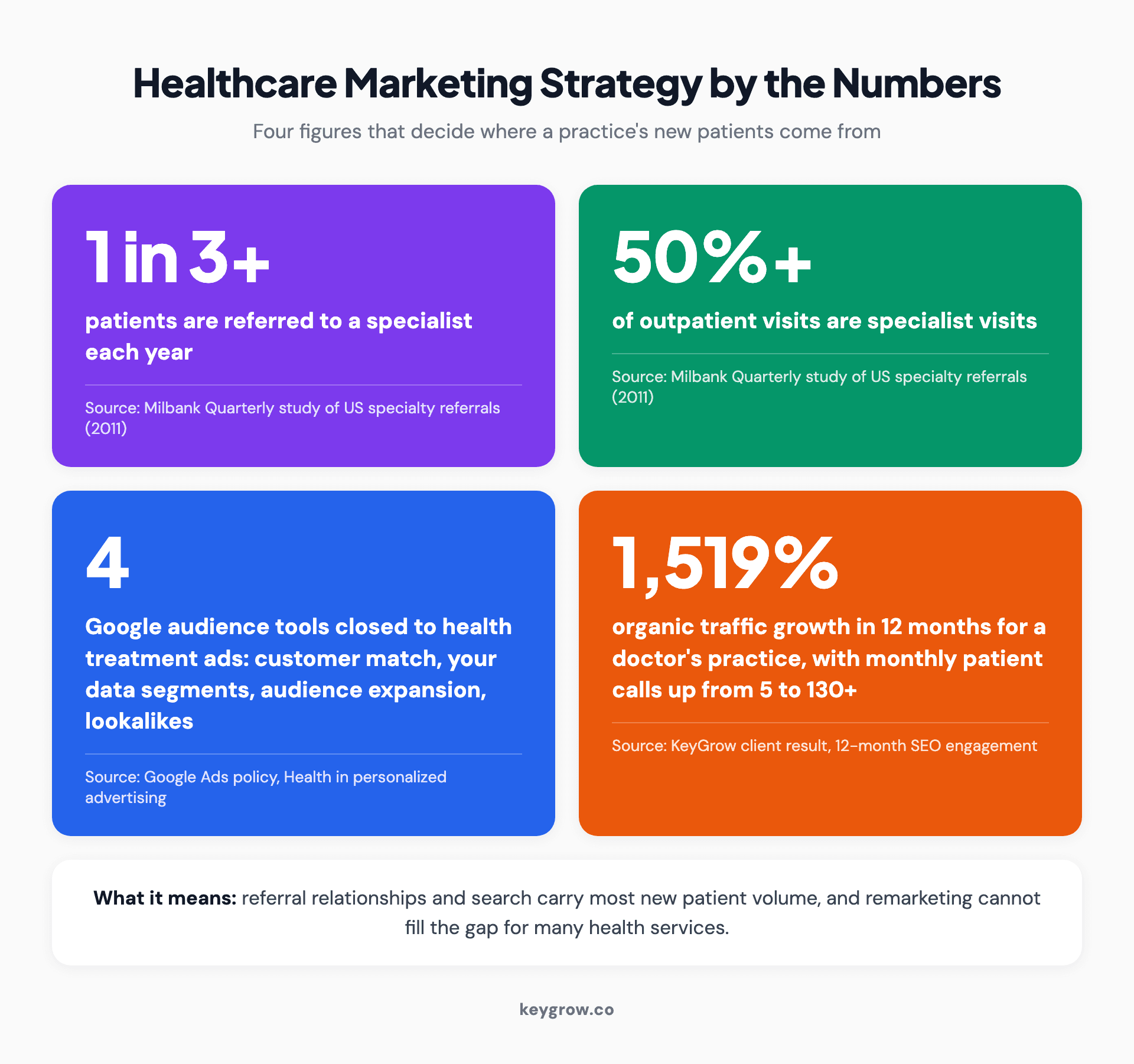
Stat strip on healthcare marketing strategy: more than a third of patients are referred to a specialist each year, specialist visits are more than half of outpatient visits, four Google audience tools are closed to health treatment ads, and a doctor's practice grew organic traffic 1,519 percent in 12 months.
The rules that shape every healthcare plan
Three sets of rules change what a healthcare plan can include: HIPAA's limits on tracking, Google's limits on health ad targeting, and what you can say about a patient in public. Plan around them from day one.
Tracking. The HHS Office for Civil Rights says in its tracking technologies guidance that HIPAA-covered practices may not use tracking tools in a way that sends protected health information to the vendor without permission. Patient portals and other logged-in pages sit squarely inside that guidance. A federal court in Texas vacated one part of it in June 2024, covering certain tracking on public, logged-out pages, and HHS has noted the ruling on the page. In practice we keep ad pixels off portals, appointment request forms and anything a patient fills in, and we set up call tracking that does not record clinical detail. The exact line for your setup is a question for your compliance lead, not your agency.
Ad targeting. Google treats health as a sensitive interest category. Its health advertising policy lists treatments for chronic conditions such as diabetes or arthritis, and counseling for depression, anxiety and addiction, among the promotions that cannot use customer match, your data segments, audience expansion or lookalike segments. Remarketing to past site visitors is off the table for those service lines. Search intent and location targeting still work, which is why healthcare plans lean on search.
Patient privacy in public. A reply to an online review should never confirm that the reviewer was a patient. A testimonial or before and after photo needs the patient's written permission, and state boards add their own advertising rules. Again, check with your compliance lead before anything goes live.
A worked one-year plan for a three-location practice
This is a fictional practice built to show the method. Every number in this section is a stated assumption for the example, not a benchmark. Swap in your own and the logic holds.
| Assumption | Location A | Location B | Location C |
|---|---|---|---|
| Specialty | Dermatology | Dermatology | Dermatology, opened 14 months ago |
| Providers | 3 | 2 | 2 |
| New patient slots per provider per month | 40 | 40 | 40 |
| New patients seen last month | 120 (full) | 64 | 40 |
| Wait for a new patient visit | Seven weeks | Two weeks | Three days |
| Open slots per month | 0 | 16 | 40 |
The owner's first instinct is usually "we need more patients." The table says something more specific: the practice needs 56 more new patients a month, all of them at B and C, and none at A. Any campaign aimed at "the practice" will mostly send people to the location with the seven-week wait.

A small team discusses a plan around a conference table with laptops open.
Map capacity before you pick a channel
Start with open slots per provider per location. Marketing fills empty slots; it cannot create provider time. A full location needs a new hire or a waitlist plan, not more ads.
When we take on a healthcare account, the first call is not about channels. We ask for three numbers: open new patient slots by provider, the share of calls answered, and where last quarter's new patients came from. Most practices can answer the first. Very few can answer the other two, which tells you where quarter one goes.
For our example practice, capacity mapping produces the cheapest win of the year. Location A has a seven-week wait, and some of those waiting patients live nearer to C. Offering them an appointment at C within the week fills slots without buying a single click. Assume 10 patients a month accept the move. The practice-wide gap drops from 56 to 46 before any marketing starts, and that 46 is the number the rest of the plan has to produce.
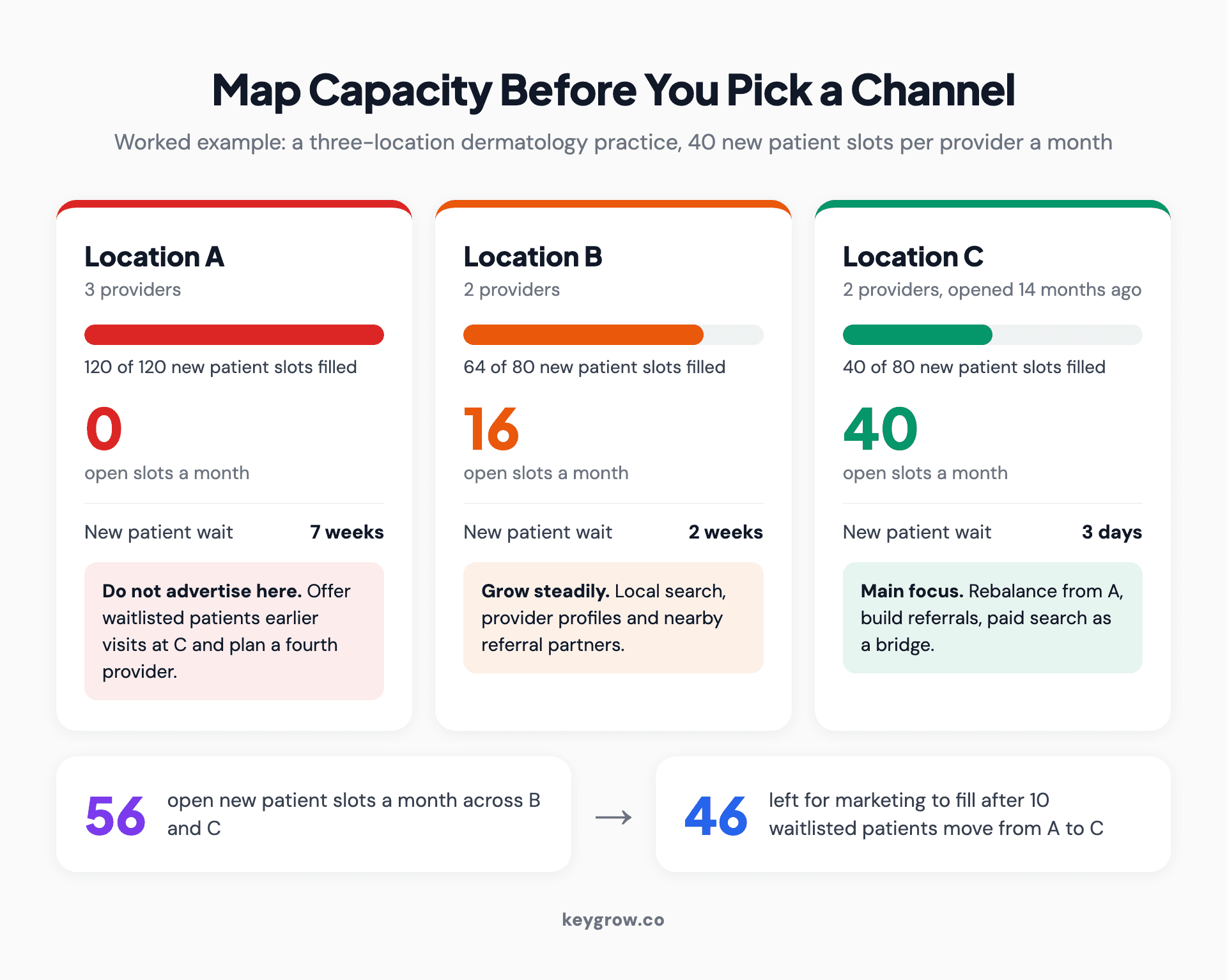
Capacity map of a three-location dermatology practice: Location A is full with a seven-week wait, Location B has 16 open new patient slots a month, and Location C has 40, so marketing goes to B and C, and moving 10 waitlisted patients from A to C cuts the gap from 56 to 46.
Do the referral math
Work backwards from open slots to the number of calls and forms you need. Three ratios do the work: show rate, booking rate and answered-call rate.
Here is the math for those 46 patients, with assumed ratios.
- Kept first visits needed: 46 a month.
- Booked visits needed: at an 85 percent show rate, 55.
- Answered inquiries needed: if 60 percent of answered calls and forms book, 92.
- Inquiry attempts needed: if the front desk answers 80 percent of calls, 115.
Now look at step four. If the practice raises its answered-call rate from 80 to 95 percent (a second phone line at peak hours, or a callback rule for missed calls), it needs 97 attempts instead of 115. That is 18 fewer inquiries to buy every month, for the price of a scheduling change. We have watched practices spend real money on ads while the phone rang out over lunch.
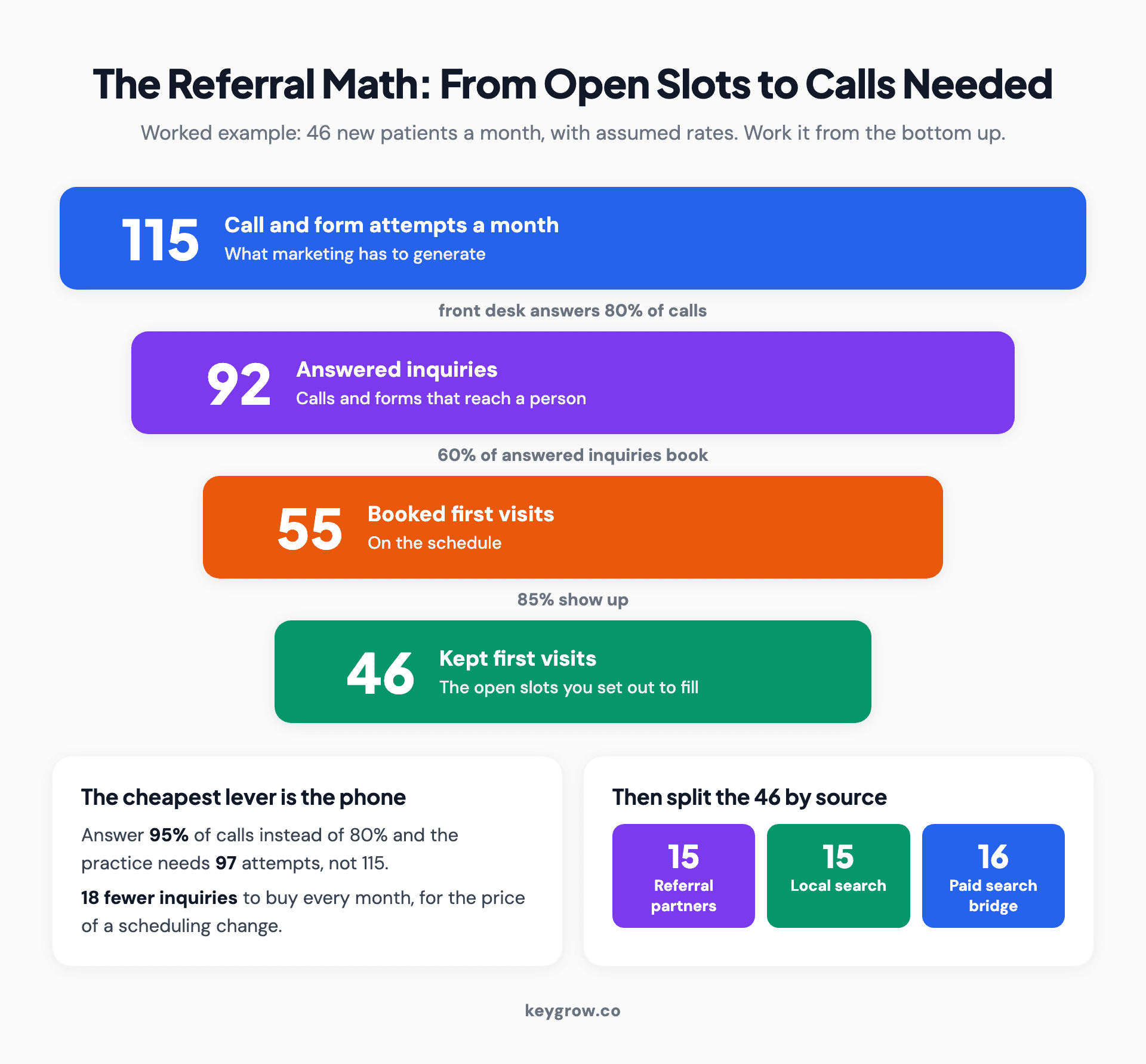
Funnel showing the referral math for a practice that needs 46 new patients a month: 115 call and form attempts, 92 answered, 55 booked and 46 kept first visits, and how raising the answered-call rate from 80 to 95 percent cuts the attempts needed to 97.
Then split the 46 by source. For this practice we assume 15 a month from new referral relationships near C, 15 from local search by the second half of the year, and 16 from paid search while those two build. Paid search carries the gap early and gives ground as the slower sources grow.
Run the year in four quarters
Each quarter has one main job. Doing them in order matters more than doing them fast.
Quarter one: fix the plumbing. Set up call tracking by location, add a "how did you hear about us" field at intake that names the referring practice, and give every location and every provider their own Google Business Profile. Build one page per location with that site's providers, parking and hours. Start paid search for B and C only, with tight radius targeting. If your site cannot do this cleanly, medical website design comes before any campaign.
Quarter two: build the referral loop. Pull the intake data and rank referring practices by volume. Visit the ten primary care offices nearest C. The Milbank finding is the pitch: referring doctors often never learn whether their patient was seen. Promise a same-week appointment and a consult note back within days, then keep that promise. That one habit does more for referral volume than any brochure. Start a steady review request at each location in the same quarter.

Two clinicians in scrubs and caps review notes on a clipboard in a bright hospital corridor.
Quarter three: build what search rewards. Write condition and procedure pages signed by the provider who treats them, and give each provider a real bio. This is the slow part of healthcare SEO services, and it is the part that keeps paying after the budget moves. The same pages feed AI assistants that patients now ask "who treats this near me", which is most of what healthcare AEO services work on. Our guide to SEO for medical practices goes through page structure in detail.
Quarter four: reallocate. Compare cost per kept first visit by source and by location. Trim paid search where organic rankings now cover the same searches. Run a recall campaign for existing patients due for an annual check. Then decide whether Location A needs a fourth provider, because no amount of marketing fixes a seven-week wait.
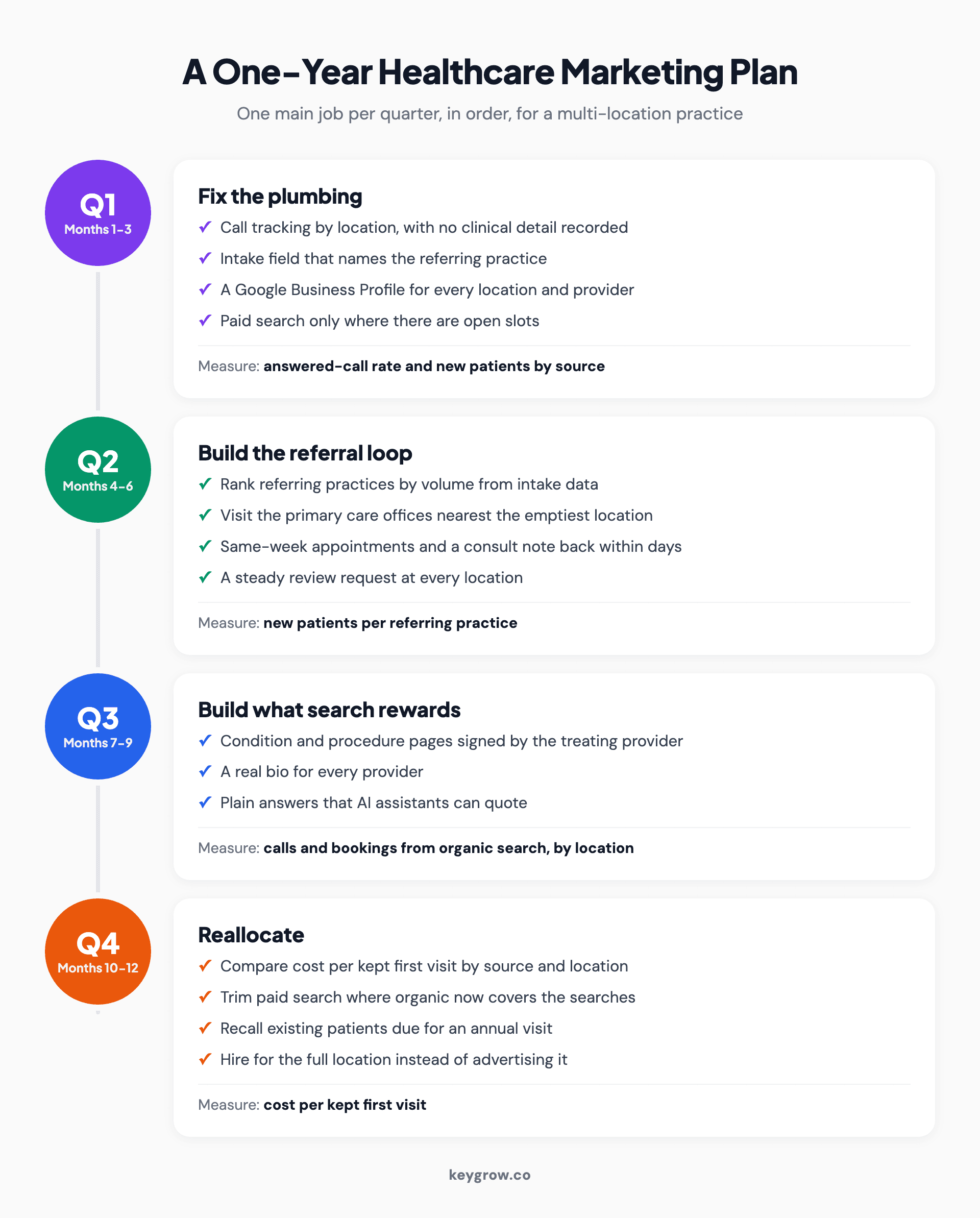
One-year healthcare marketing plan in four quarters: quarter one fixes tracking, profiles and phones; quarter two builds referral relationships and reviews; quarter three builds condition pages and provider bios; quarter four compares cost per new patient by source and reallocates budget.
How long before the strategy shows results?
Paid search and rebalancing show results within weeks. Referral relationships take a quarter or two. Organic search takes most of a year, and that is normal.
For paid search, the cost depends heavily on specialty and city. Our breakdown of Google Ads for doctors covers what practices pay and how to structure the campaigns, and healthcare PPC management is what we run for practices that want it handled.
Organic is the one owners give up on too early. SEO behaves like a compounding asset: it looks unimpressive for the first quarter and embarrassingly good after a year. We worked with a doctor's practice in Dubai that committed to a full twelve months. Monthly patient calls went from 5 to 130+, and organic traffic grew 1,519% over those 12 months. Months one to three looked like nothing was happening. A practice that quits at month three pays for the hard part and leaves before the payout.
That is also why the worked plan treats paid search as a bridge. It fills the gap while the slower sources grow, then steps back.
What to measure every month
Measure kept first visits by source and by location, and cost per kept first visit. Clicks, impressions and followers only count once they turn into those.

A white desk phone sits on a dark counter, the kind that takes a practice's new patient calls.
A one-page monthly report for a multi-location practice needs five lines per location:
- New patients seen, against open slots
- Where each one came from, with referring practices named
- Answered-call rate, split by hour of day
- Cost per kept first visit for each paid source
- New reviews and the current wait for a new patient visit
If a report leads with impressions, ask what happened to the phones. A location with rising traffic and falling bookings has a front desk or a scheduling problem, and no channel will fix that.
When a practice does not need an agency
Plenty of practices should not hire anyone for this. If every location is full and the wait is long, spend the money on capacity first. More demand only lengthens the wait and sends patients to the practice down the road.
A single-location practice with a stable referral base and an owner who has a few hours a month can do the basics alone: claim the profiles, ask every patient for a review, answer the phone at lunch, and send consult notes back quickly. Referral relationships are also something an owner does better than any agency. We cannot have lunch with your referring physicians for you.
Hire help when you have open slots at more than one location, when the referral math says you need a paid source to bridge the gap, or when your time is worth more in the exam room than in an ads account. Therapists face a different version of this decision, and marketing for therapists walks through it by practice stage.
FAQs
What are the 4 Ps of healthcare marketing?
The 4 Ps are product, price, place and promotion. In healthcare, product means the services and providers you offer, price is mostly which insurance you accept, and place is location, hours and how fast a new patient can be seen. Promotion is the part people usually mean by marketing, and it works best once the other three are sorted.
How much should a medical practice spend on marketing?
Build the budget from the referral math rather than a flat percentage of revenue. Work out how many new patients each location needs, estimate cost per kept first visit for each paid source, and multiply. Percentage rules are a useful sanity check, but they do not know that one of your locations is already full.
What is the most effective marketing for a medical practice?
For specialty practices, physician referral relationships and local search usually produce the most new patients per dollar. For elective or cash-pay services, paid search and reviews tend to carry more weight. The most effective channel is the one that fills the open slots at the location that has them.
Does HIPAA affect healthcare marketing?
Yes. HIPAA limits how tracking tools on your website can handle patient information, and it restricts using a patient's details in marketing without written permission. Keep ad pixels off patient portals and forms, never confirm someone is a patient in a review reply, and check every setup with your compliance lead.
How long does a healthcare marketing strategy take to work?
Paid search can produce booked appointments within weeks. Referral relationships usually take two to four months to show up in intake data. Organic search takes most of a year, and the gains compound after that.
Should each location have its own marketing plan?
Each location should have its own numbers inside one shared strategy. Capacity, wait times and competition differ by site, so budgets and targets should too. One brand and one website can still serve every location, as long as each site has its own page and profile.
How do you get more physician referrals?
Make referring easy and close the loop. Offer referring offices a fast appointment for their patients and send a consult note back within days, because many referring doctors never learn whether a patient was seen. Track referrals by practice so you know which relationships to invest in.
Start with the referral math
Before you buy a single campaign, write down open slots by location, your answered-call rate, and where last quarter's new patients came from. Those three numbers tell you which sources to build and which location needs them.
If you want a second pair of eyes on that math, our team handles healthcare digital marketing for practices on month-to-month terms. Tell us about your practice and we will show you where the open slots are and what it would take to fill them.