


It is 11:40 on a Tuesday night. A woman in Denver is on her laptop, trying to line up help for her father in Tucson, who fell on Sunday and goes home from the hospital on Thursday. She searches "home care near me Tucson", opens the three agencies with the most recent reviews, and calls all three. One answers.
That is home healthcare marketing in a single scene. Home healthcare marketing is the work of getting a home health or home care agency chosen by the three groups who decide: the professionals who refer patients, the families who search for care, and the caregivers you have to hire before you can say yes. Most guides hand you twenty tactics with equal weight. This one ranks the channels by how much referral value they tend to produce, and says plainly which ones to skip.
The short answer: referral partners first, your Google Business Profile and reviews second, the intake line third, the website fourth, paid search fifth (for private-pay care only), family education sixth. Recruiting runs alongside all of them, because a referral you cannot staff is a referral you lose.

A laptop on a dark wooden desk at night, lit by a single desk lamp, with city lights through the window behind it.
Home health or home care? Decide before you rank anything
Medicare home health is skilled care a doctor has to order, so referral sources control the volume. Private-pay home care is bought by families, so search and reviews carry far more weight.
The rules make the split. Per Medicare's coverage page, Medicare pays for home health only when the patient is homebound, needs part-time skilled care, has seen a doctor or allowed practitioner who orders it, and uses a Medicare-certified agency. Bathing, dressing and other personal care are not covered when that is the only care someone needs. That personal care is the private-pay home care market, and the person paying is usually an adult child with a credit card and a deadline.
So the same word, "home healthcare", hides two different buyers. A skilled nursing agency that markets like a non-medical agency wastes money on ads nobody can act on without an order. A non-medical agency that only courts hospitals misses the families searching at night.
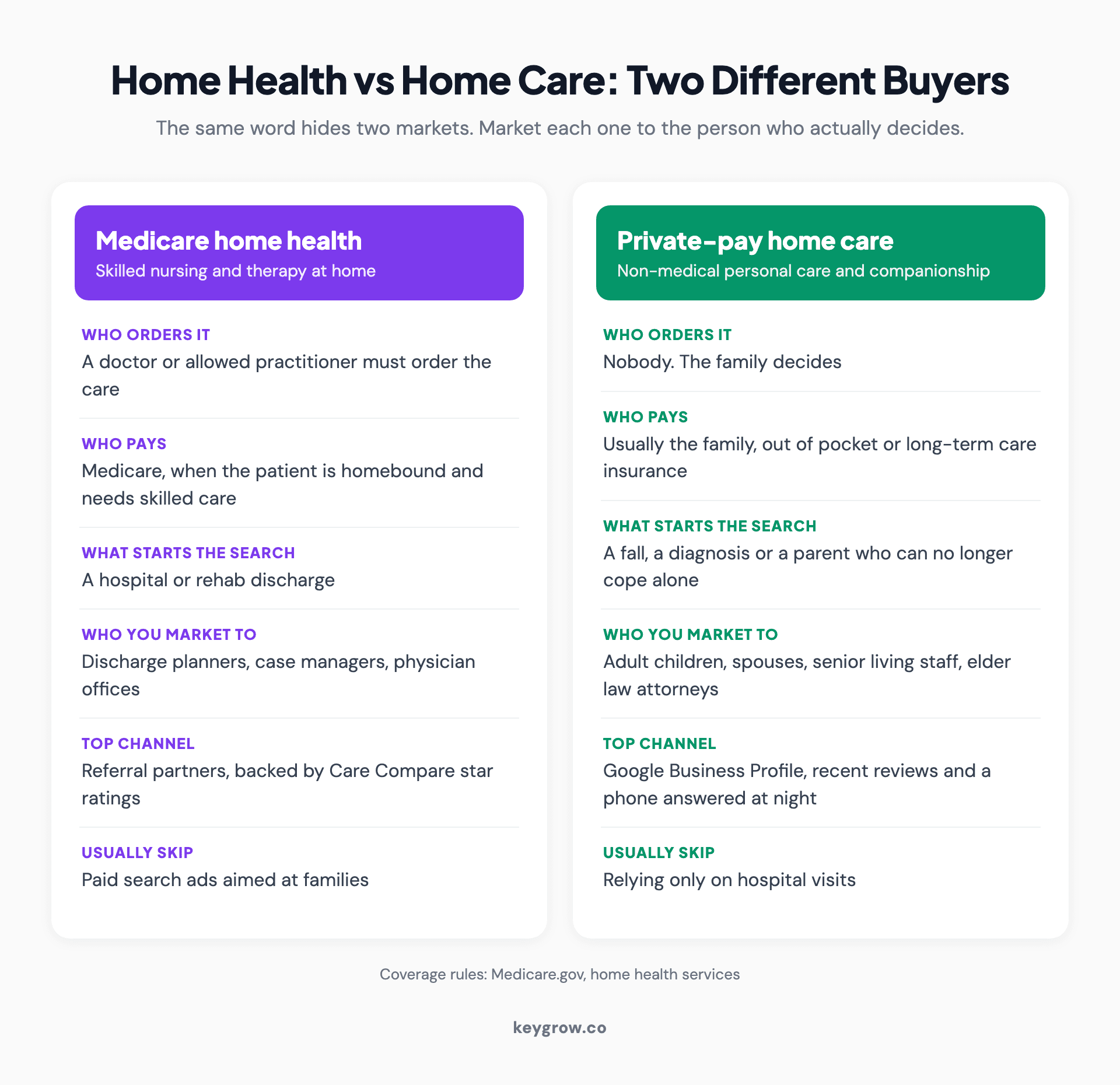
Two-column comparison of Medicare home health and private-pay home care marketing: who decides, who pays, what triggers the search, and the top channel for each.
Plenty of agencies run both lines under one name. That works, as long as each line gets its own service pages and tracked phone number, and you pitch referral partners on them separately.
The ranking at a glance
Here is the order we would put an agency's time and money in, with the reason each channel sits where it does. The time column describes typical patterns, not promises.
| Rank | Channel | Strongest for | What it costs you | Time to first client | Skip it if |
|---|---|---|---|---|---|
| 1 | Referral partners | Medicare home health, and both lines | A liaison's time, every week | Weeks to a few months | You cannot accept or decline a referral within a day |
| 2 | Google Business Profile and reviews | Private-pay home care | Mostly time | One to three months | Never |
| 3 | Intake and after-hours phone | Both | An answering rota or service | Immediate | Never |
| 4 | Website and local SEO | Private-pay care and recruiting | A build, then monthly content | Six to twelve months | You will stop at month three |
| 5 | Google search ads | Private-pay home care | Per click, from day one | Days | You are Medicare-only, or nobody answers the phone |
| 6 | Family caregiver education | Both, over time | Time and consistency | Months | You cannot keep it going for a year |
Recruiting is not on the list because it is not a client channel. It is the ceiling on all six, so it gets its own section below.
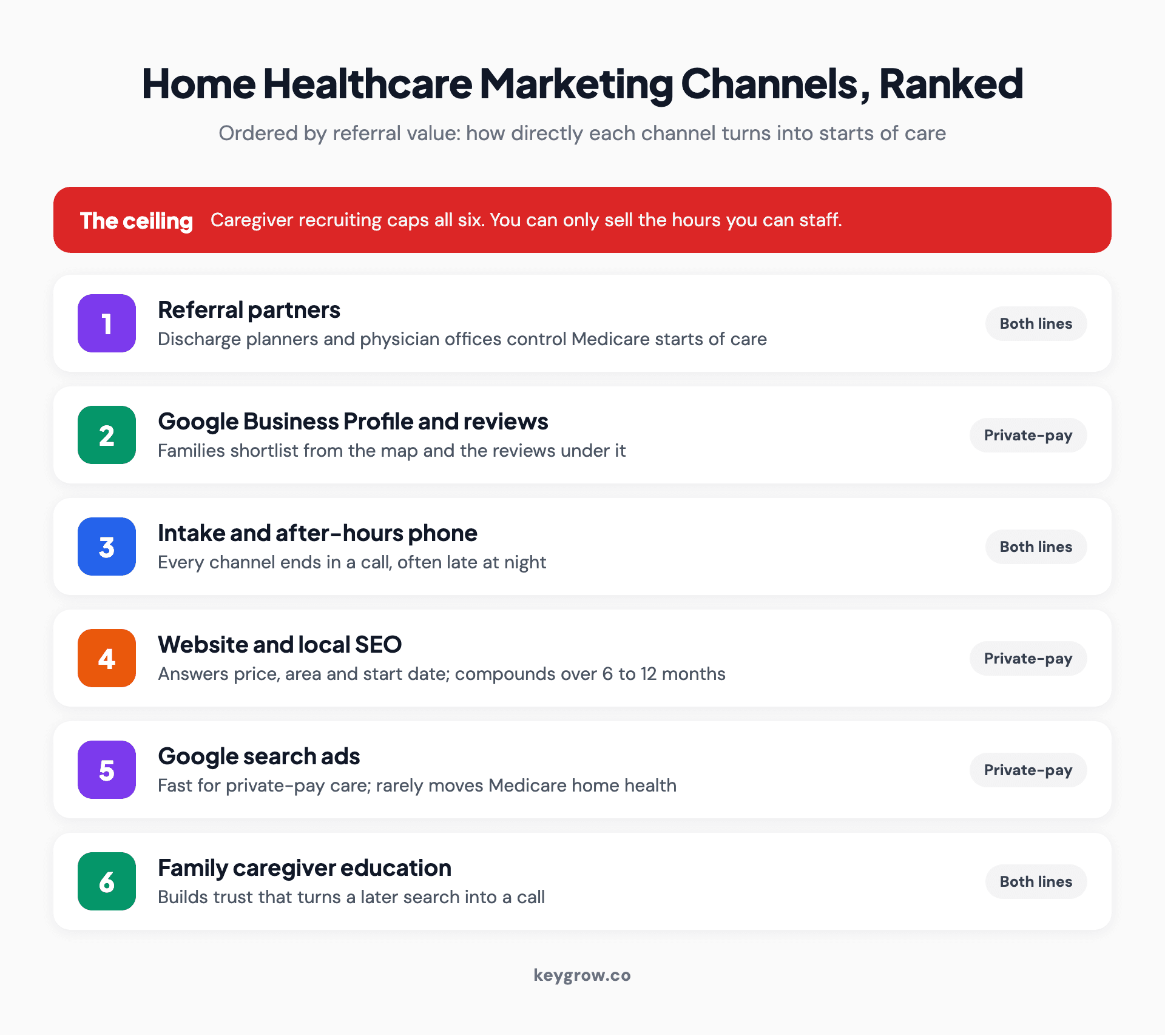
Ranked ladder of six home healthcare marketing channels by referral value, from referral partners at the top to family caregiver education, with recruiting shown as the ceiling on all of them.
1. Referral partners: the channel that decides Medicare home health
For Medicare home health, discharge planners and physician offices are the market. You win them by being the easiest agency on the list to refer to, which mostly means answering fast and being honest about what you can staff.
There is a regulatory reason this works. Under 42 CFR 482.43, a hospital discharging a patient home with home health has to give them a list of Medicare-participating agencies that serve their area, cannot limit their choice, and has to help them choose using quality and resource-use data that fits their goals. Read that from the agency side. Your star ratings on Medicare's Care Compare, which CMS refreshes every quarter, are part of your sales pitch whether you treat them that way or not.

Two healthcare workers talking in a hospital corridor, one in a green uniform and one with a staff lanyard, both smiling.
Who belongs on the list depends on the line. For skilled home health: hospital discharge planners and case managers, skilled nursing facility social workers, and physician offices, starting with orthopedics, cardiology and primary care. For private-pay home care: assisted and independent living communities, elder law attorneys, geriatric care managers, and Medicare home health agencies whose patients still need help after skilled visits end.
What planners need is boring and specific. Which zip codes you cover. Which payers you take. Whether you can start a patient on a Saturday. Who picks up the phone, with a cell number. Put all of it on one page.
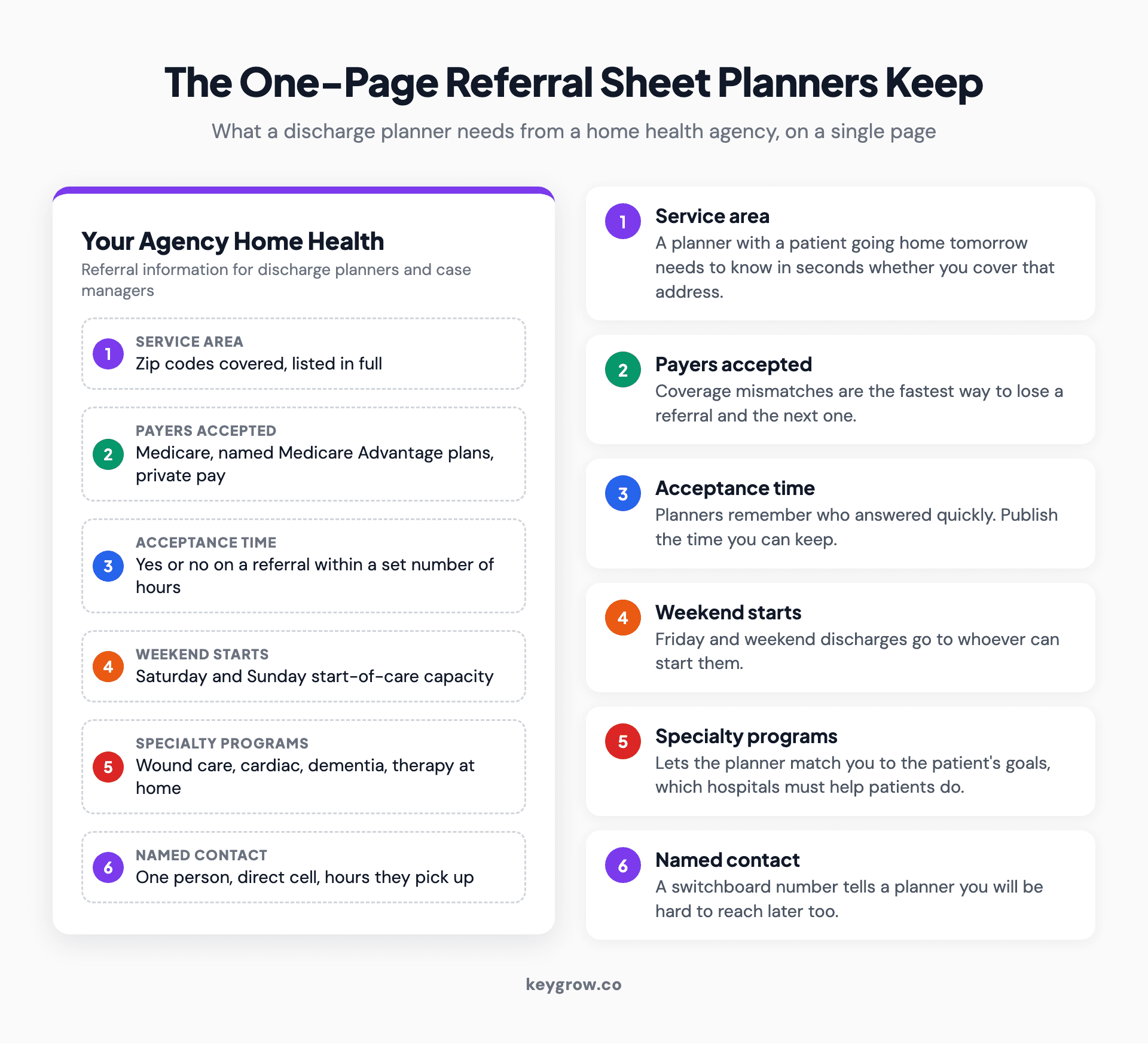
Annotated mockup of a one-page referral sheet for discharge planners, with callouts for service area by zip code, payers accepted, weekend start capacity, acceptance time, specialty programs and a named contact.
Skip this: the pastries-and-pens drop-in with nothing a planner can use. And be careful with anything of value. The federal anti-kickback statute, per the OIG's summary, prohibits knowingly and willfully paying remuneration to induce or reward referrals of services federal health programs pay for, and remuneration means anything of value, not only cash. Check with your compliance lead before any gift, meal or sponsorship aimed at a referral source.
Track this channel by referrals per partner per month and how often you accept them. A log of visits tells you the liaison was busy, which is a different thing.
2. Google Business Profile and reviews: where families shortlist
Families build their shortlist from the map results and the reviews under them. A complete profile with recent reviews is the cheapest client channel a home care agency has.
The numbers are blunt. In BrightLocal's 2026 survey of 1,002 US consumers, 97 percent read reviews before choosing a local business, 47 percent will not use a business with fewer than 20 reviews, and 74 percent only look at reviews from the last three months. An agency sitting on 14 reviews, the newest from last spring, does not make the 11:40 pm shortlist, however good its care is.
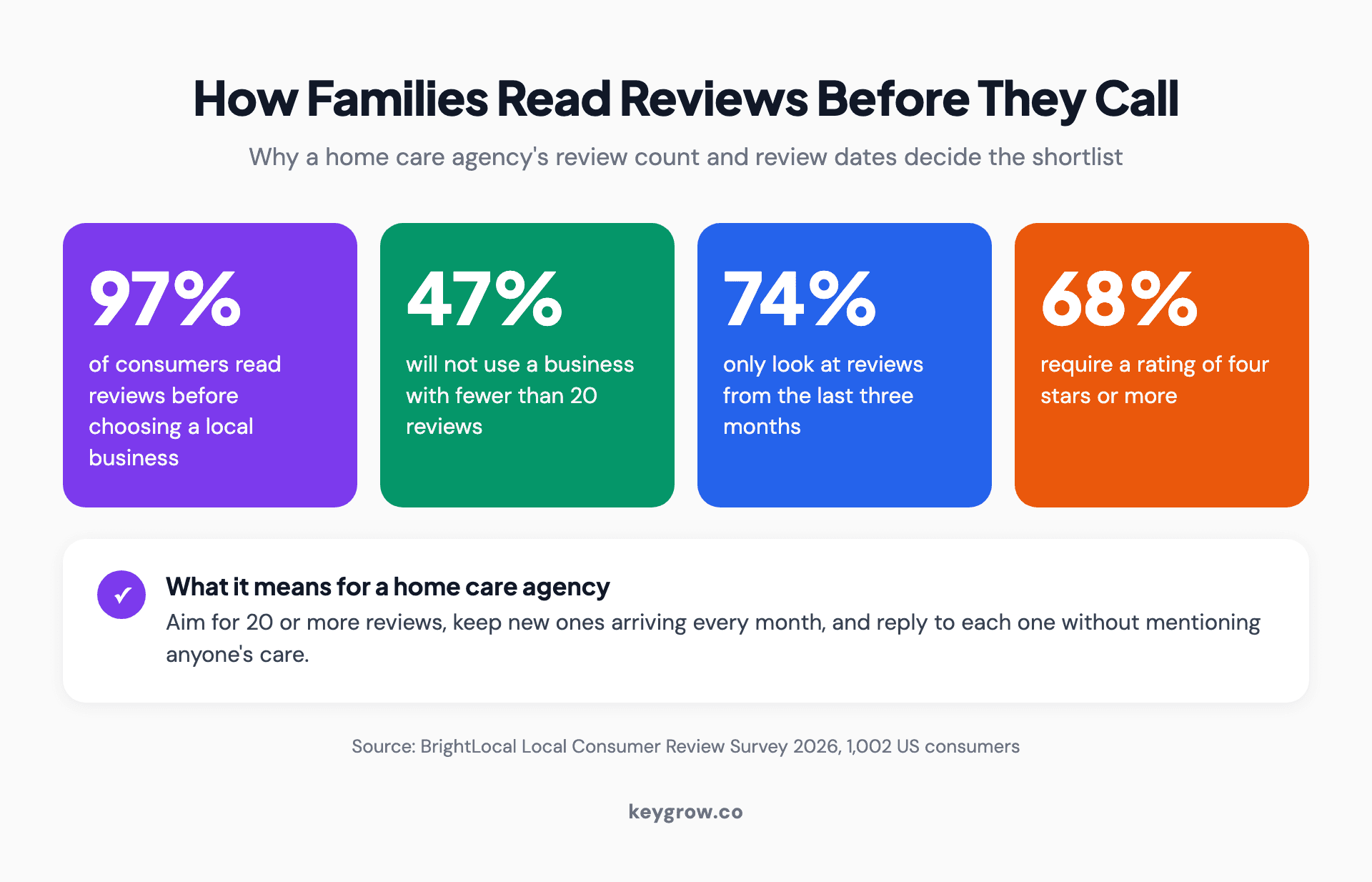
Stat strip of four 2026 local review findings that shape home care shortlists: 97 percent read reviews, 47 percent avoid businesses under 20 reviews, 74 percent only read the last three months, 68 percent require four stars or more.
Three things move the profile. First, the primary category has to match what your license lets you sell, skilled home health or non-medical home help, and our guide to choosing Google Business Profile categories covers how to pick it. Second, a steady review rhythm: ask families around the 30-day mark, when the routine has settled, and use the tactics in our piece on getting more Google reviews. Third, replies.
Replies are where healthcare differs. Many compliance teams treat a response that confirms someone was a patient as a privacy risk, so thank the reviewer, take the detail offline, and never mention the care itself. Our walkthrough on responding to Google reviews has wording you can adapt, and your compliance lead should approve the template.
For Medicare agencies, Care Compare is the second review site. Planners see it even if families never do.
3. The intake line: answer the call you already earned
Every channel above ends in a phone call, often after business hours. An agency that answers live at night wins families and referrals that other agencies send to voicemail.
Go back to the cold open. Three agencies earned the call. Two lost it at the last step, after paying for everything that came before.
This is the least glamorous channel and the one we would fix first if it is broken. Run a live answering rota or a trained after-hours service, give whoever answers a short script (care type, location, start date, who pays, best callback number), and promise a callback time you can keep.
Measure it like a funnel: calls answered live, time to callback, inquiry to in-home assessment, assessment to start of care. Use call tracking so you know which channel produced each start, and keep health details out of whatever the tracking tool records.
4. A website written for the adult child, with local SEO behind it
The site's job is to answer what a worried family member asks at night: what care you provide, where, what it costs, who pays, and how fast you can start.
That means one page per care type (personal care, dementia care, skilled nursing, therapy at home), one page per city or county you serve, a plain page on what Medicare pays for versus what you charge, and a page on what the first week of care looks like. Publish your hourly range and minimum shift. Plenty of agency sites hide pricing, which is exactly why showing it earns the call.
Keep careers separate, because job seekers and families search different words and want different pages. A healthcare website design built this way does double duty for recruiting.

A caregiver in a red top holding the hands of an elderly woman with a walker beside a sofa in a bright living room.
Watch the tracking. The HHS tracking bulletin tells HIPAA-covered agencies that pixels on pages handling health information can be impermissible disclosures. A federal court vacated one part of it in June 2024 (an IP address plus a visit to a public page), but the rest still stands, including logged-in pages and forms that collect health details. If you are a covered entity, check your intake forms and pixels with your compliance lead.
Local SEO is slow, and agencies should plan for that. Our local clients show the usual shape: a phone repair shop reached 115+ phone calls a month after 7 months, and a junk removal company reached 50+ after 6. Neither had meaningful inbound calls when we started, and the first few months looked like nothing. Our view is firm on this: SEO is a compounding asset, and agencies that quit at month three pay for the hard part and leave before the payout. If you want that work done for you, it is what our healthcare SEO services cover.
5. Google search ads: yes for private-pay care, mostly skip for Medicare home health
Search ads work when a family is paying privately and needs care this week. Medicare home health runs on orders from a doctor, so ads rarely move it.
For private-pay care, the setup is narrow on purpose. Target care type plus city ("dementia care Mesa", "overnight caregiver Scottsdale"). Run ads only during hours when someone answers live. Send clicks to the matching city or service page, never the homepage. Add "jobs", "hiring" and "pay" as negative keywords on client campaigns so you are not paying for applicant clicks, and give recruiting its own campaign.
Expect fewer targeting tools than other industries get. Google limits remarketing and audience lists for health advertisers, which we unpack in whether healthcare businesses should use PPC. You compete on keywords, location and the page. Our healthcare PPC management runs inside those limits.
Skip this if you only offer Medicare skilled care. Spend the money on a liaison instead.
6. Family caregiver education: the slow trust builder
Content that answers family caregivers' real questions builds the trust that turns a later search into a call. It sits sixth only because it pays slowly.
Write the answers families cannot find elsewhere. "Does Medicare pay for home care?" deserves an honest answer: skilled home health, sometimes; personal care alone, no. "What should we ask before a hospital discharge?" makes a good checklist, and a printed version doubles as something a planner can hand out.
Offline counts too. A talk on fall prevention at a senior center or library reaches the exact families who will search in six months. Email families who inquired but did not start, with their permission, when their situation is likely to change.
Our guide to building a healthcare marketing strategy covers how this fits a full-year plan.
Recruiting: the channel that caps every other one
You can only sell the hours you can staff. Treat caregiver recruiting as a separate funnel with its own pages and its own budget.

Two healthcare workers in blue scrubs and face masks, one wearing a stethoscope, talking in a clinic room.
Here is the pattern in practice: an agency books a referral partner, wins the profile, answers the phone at night, and then turns down a 40-hour client because nobody can cover Sunday. Every dollar above that point was spent to say no.
Build a careers page with the pay range, the shift types and a mobile application that takes three minutes. Make one job page per city. Reply to applicants within a day. Social ads earn their keep here more than on the client side, because caregivers scroll and families in crisis search. Measure how many applicants reach a first shift. The raw application count flatters everyone.
What to skip, and what to do instead
Most wasted home care budgets go to the same five places. Each has a cheaper replacement that works better.
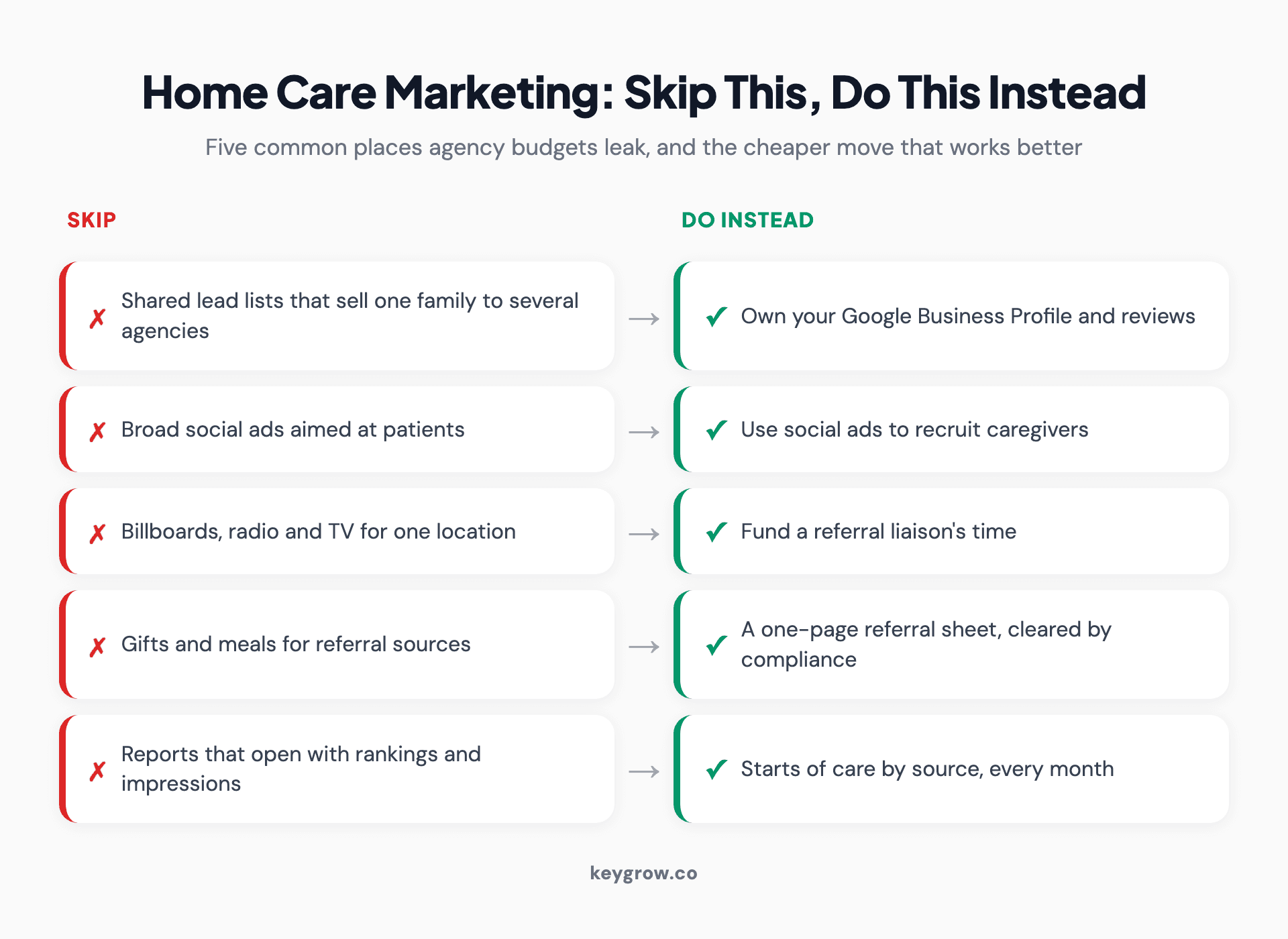
Five side-by-side cards contrasting home care marketing spend to skip, such as shared lead lists, broad social patient ads, billboards, gifts to referral sources and rank-only reports, with what to do instead.
- Shared lead lists from lead-selling platforms that sell the same family to several agencies. Unless you call back within minutes, you are paying to come fourth. Own your profile and reviews instead.
- Broad social ads aimed at patients. Use social for recruiting.
- Billboards, radio and TV for a single-location agency. The money does more as a liaison's salary.
- Gifts to referral sources. See the anti-kickback note above.
- Reports that open with rankings and impressions. Ask for starts of care by source. If your marketing report cannot tell you that, ask why.
When you don't need an agency (us included)
If referrals already exceed the hours you can staff, do not buy marketing. Spend on recruiting.
The same goes for a single-location agency with an owner who has some evenings free. Claim and fill out the Google Business Profile, get to 20 recent reviews, build the one-page referral sheet, visit ten referral partners a week, and make sure someone answers at night. That covers ranks one to three, and none of it needs us.
Bring in help when your time is worth more than the fee, or when the work is technical: local SEO across several service areas, paid search, and tracking that stays inside the privacy rules.
FAQs
How do home health agencies get referrals?
Mostly from hospital discharge planners, case managers, skilled nursing facilities and physician offices. Planners must give patients a list of Medicare-participating agencies and help them choose using quality data, so strong star ratings, fast acceptance and clear coverage information win more referrals than visits alone.
What is the difference between home health and home care marketing?
Home health is skilled care a doctor orders and Medicare can cover, so marketing targets referral sources. Home care is non-medical help that families usually pay for privately, so marketing leans on local search, reviews, the website and how fast the phone gets answered.
How much should a home care agency spend on marketing?
Start from capacity rather than a percentage of revenue. If you cannot staff more hours, spend on recruiting first. Once you can, fund the free channels (profile, reviews, referral visits, intake) before paid ones, and judge any paid spend by cost per start of care against what a client is worth over their stay.
Can a home health agency give gifts to referral sources?
Be very careful. The federal anti-kickback statute prohibits offering anything of value to induce referrals of services federal health programs pay for, and state rules can add more. Check with your compliance lead before any gift, meal or sponsorship.
Do Google Ads work for home care agencies?
They can for private-pay home care, when ads target care type plus city, run only while someone answers live, and land on a matching page. They rarely help Medicare-only home health, where a physician order drives the start of care.
How long does home healthcare marketing take to work?
Referral partnerships and paid search can produce clients within weeks. A Google Business Profile with steady reviews usually shows movement within a few months. Organic search on your own site takes longer, often six to twelve months before it carries real call volume.
Win the late-night search
Tonight, around 11 pm, pick up your phone somewhere in your service area and act like the woman in Denver. Search "home care near me". Note where you appear on the map, how many reviews you have, and how old the newest one is. Tap call and see who answers. Then open your site and time how long it takes to find your service area, your price range and how fast you can start.
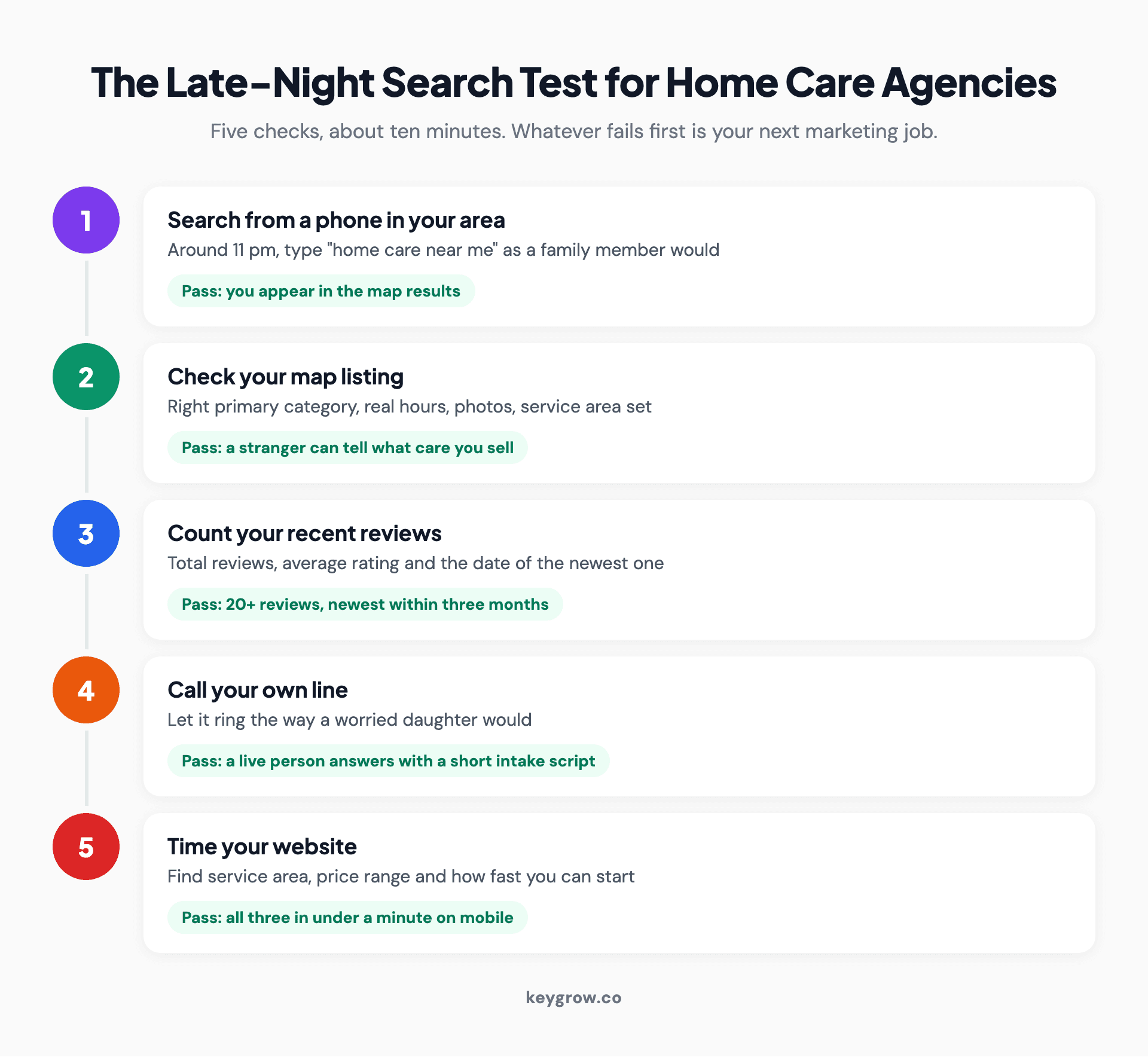
Five-step late-night search test for home care agencies: search from a phone in your area, check map position, count recent reviews, call your own line, and time how fast the website answers price, area and start date.
Whatever fails first is your next job. If it is the profile or the site, our team can map the fix and the cost, month-to-month, cancel anytime.