


A good therapy website is short, and it answers four questions before a stranger has to ask them.
Web design for therapists is the work of building that site: a handful of pages that tell a nervous first-time client who you help, what a session costs, whether you have room, and how to get in touch without typing anything private into a web form. The color palette and the logo come after that.
Most of what ranks for this topic is a gallery of attractive practice sites or a template vendor's feature list. Of the seven guides we read before writing this one, only one mentioned that a federal rule puts a specific notice on a practice website, and none warned that the contact form bundled with most site builders asks exactly the wrong question.
The six pages a private practice site needs
A solo practice needs six pages: home, about, one page per specialty, fees and insurance, contact, and policies. A group practice adds one page per clinician.
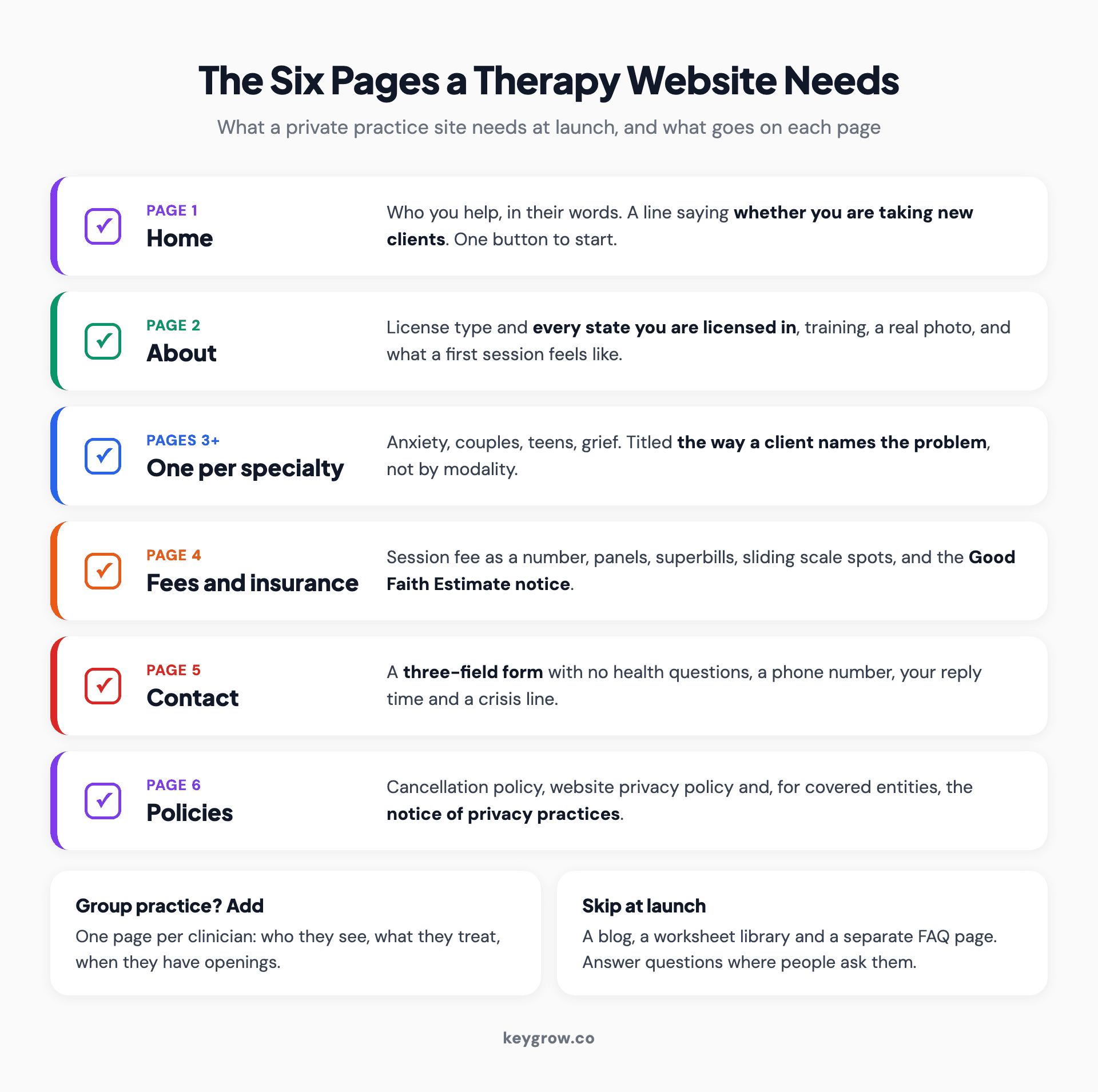
Checklist of the six pages a private practice therapy website needs: home, about, specialty pages, fees and insurance, contact, and policies, with what goes on each page.
- Home. Who you help, in the words they would use, a line saying whether you are taking new clients, and one button to start.
- About. You as a clinician and as a person: license type, the states you are licensed in, training, a real photo, and what a first session feels like.
- One page per specialty. Anxiety, couples work, teens, grief, whatever you actually treat. Our guide to SEO for therapists explains why each one should be titled the way a client names the problem, not the way a training program names the modality.
- Fees and insurance. Your session fee as a number, the panels you are on, superbills, sliding scale spots, and the Good Faith Estimate notice covered further down.
- Contact. A short form, a phone number, how quickly you reply, and a crisis line.
- Policies. Your cancellation policy, your website privacy policy and, if you are a covered entity, your notice of privacy practices.
You can skip a blog, a resources page full of worksheets and a separate FAQ page at launch. Answer the common questions on the pages where people ask them.
What a first-time client sees on your homepage
On a phone, the first screen has to cover the person you help, your availability, your fee and the first step. Everything else can sit below it.
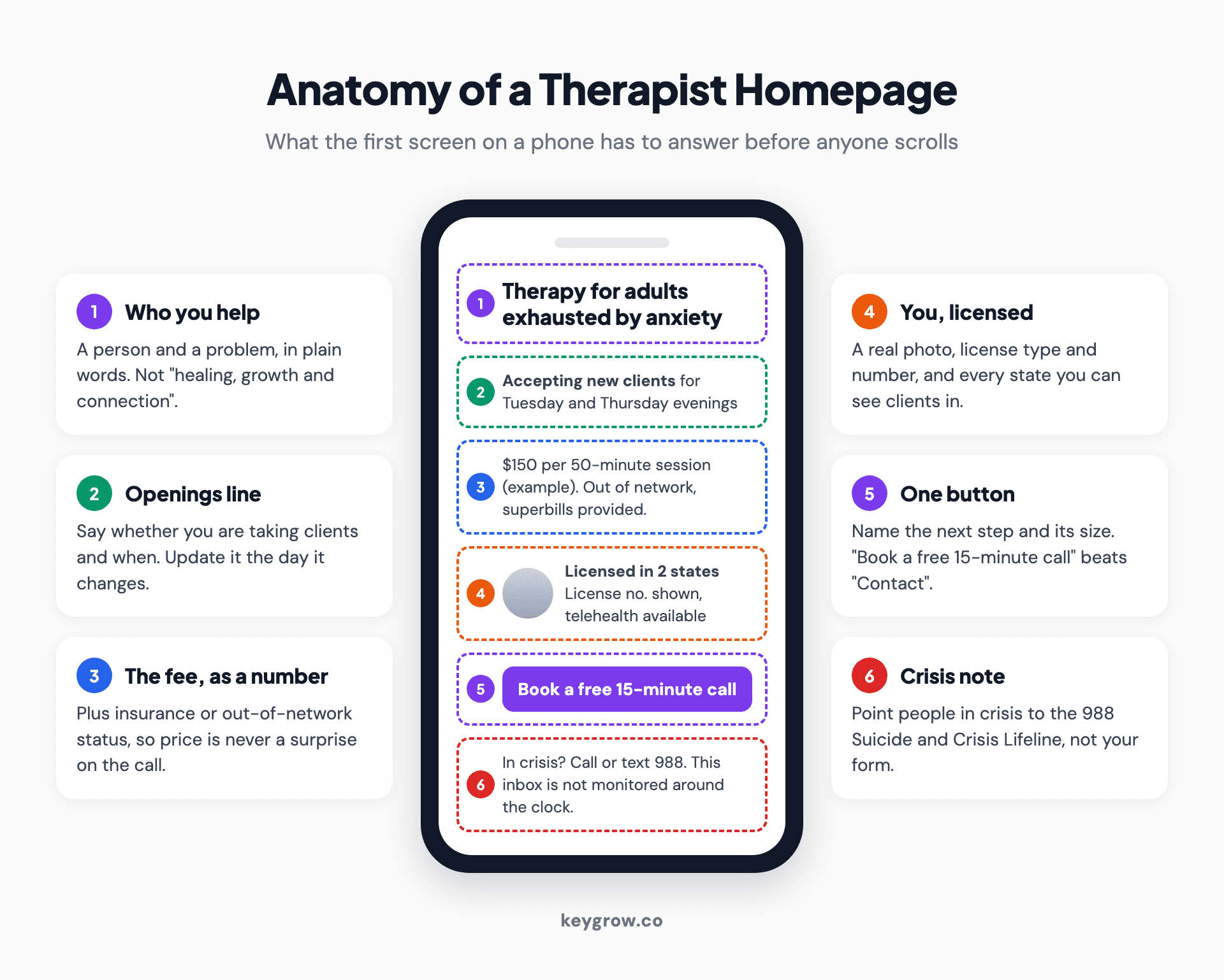
Annotated mockup of a therapist homepage on a phone screen, with callouts for the who-you-help headline, the accepting new clients line, the fee and insurance line, a real headshot with license details, a single booking button and a crisis line note.
The headline names a person and a problem. "Therapy for adults who are exhausted by anxiety" does more work than "Healing, growth and connection", which could describe a yoga studio.
Under it goes the openings line. "Accepting new clients for Tuesday and Thursday evenings" saves a reader from writing to you only to hear you are full. When you are full, say so, and point to a waitlist or a colleague.
Then the fee. A line such as "$150 per 50-minute session, out of network, superbills provided" (the figure is only an example) lets readers who cannot afford it leave quietly. That is a consult call you were never going to convert.
One button, labelled with what happens next. "Book a free 15-minute call" beats "Contact" because it tells a hesitant person the commitment is small.
Trust signals that matter more than the design
A first-time client trusts specifics: your license and the states it covers, a real photo, a stated fee and an honest line about openings. Most of the testimonial playbook is off the table.

A small wooden door hanger reading please do not disturb, therapy in progress, resting beside a tissue box on a dark table.
Here is what a careful reader looks for, roughly in this order:
- Your license type and number, and every state it covers. Telehealth clients need to know you can legally see them where they live.
- A recent photo of you. Not a couch, not a sunset, not a stone balanced on another stone.
- How the first session works: how long it lasts, what you will ask, and whether they can stop if it does not feel right.
- A crisis line on the contact page. Your inbox is not watched around the clock, so say so and list the 988 Suicide and Crisis Lifeline beside the form.
Testimonials are where generic web design advice goes wrong for this profession. Standard 5.05 of the APA ethics code bars soliciting testimonials from current clients or anyone vulnerable to undue influence, and most counseling, social work and family therapy codes say something similar. If your template shipped with a testimonial carousel, delete it and let the specifics above carry the weight.
Keep health details out of the contact form
Ask for a name, a way to reach them and a good time to call. Why they are reaching out belongs in your secure intake process, not a website form.
The form that comes with most site builders sends each submission as an ordinary email to your inbox. Add a box labelled "What brings you to therapy?" and people will type their history into it, sometimes a long one, at 1 a.m., to someone they have never met.
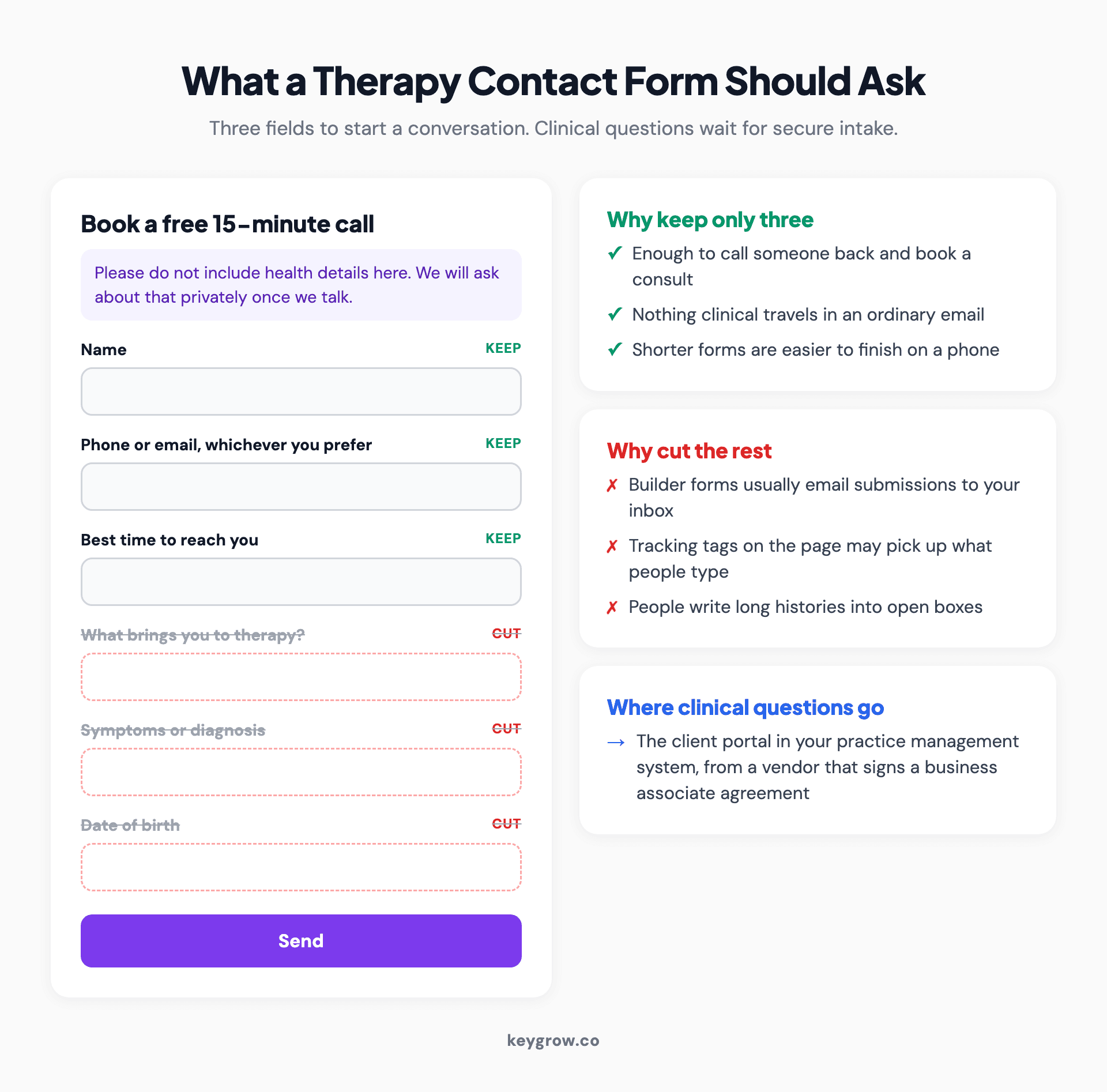
Mockup of a short therapy website contact form with three kept fields, name, preferred contact method and best time to reach you, and three cut fields, reason for seeking therapy, symptoms or diagnosis and date of birth, with a note to save clinical questions for secure intake.
Tracking scripts make it worse. In its bulletin on online tracking technologies, HHS says tracking code on a page where people book appointments may collect "an individual's email address, or reason for seeking health care typed or selected by an individual". The same bulletin says a covered entity needs a business associate agreement with any tracking vendor that receives that kind of information. A federal court vacated part of the bulletin in June 2024, the part about public pages that only discuss health conditions, so the legal edges are still moving. Check with your compliance lead before you put any analytics or ad tag on a contact or booking page.
What we set up on therapy sites:
- A three-field form, with a line above it asking people not to include health details.
- Clinical intake through the client portal in your practice management system, from a vendor that will sign a business associate agreement.
- No ad pixels on the contact, booking or thank-you pages.
Ad conversion tracking raises the same problem, and our post on Google Ads for therapists works through it step by step.
Two rules that put specific items on your site
Answer two questions before launch: are you a HIPAA covered entity, and do you see uninsured or self-pay clients? Each yes puts a specific item on your website.
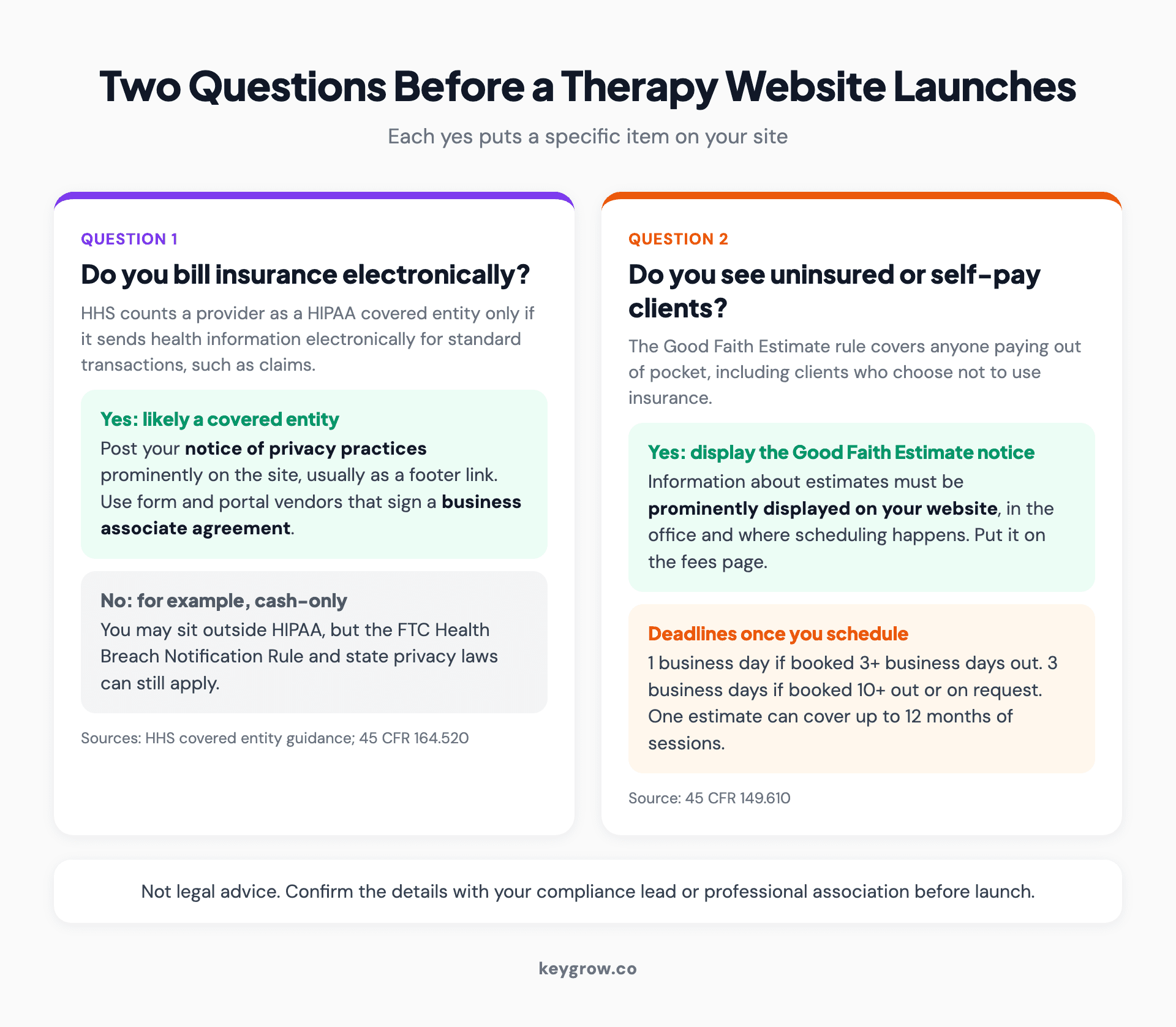
Two-question flow for therapy websites: if the practice bills insurance electronically it is likely a HIPAA covered entity and must post its notice of privacy practices on the site; if it sees uninsured or self-pay clients it must display information about Good Faith Estimates on the site.
Are you a covered entity? HHS lists psychologists and other providers as covered entities "only if they transmit any information in an electronic form in connection with a transaction for which HHS has adopted a standard". Billing insurance electronically usually counts. If you are covered, the privacy notice rule at 45 CFR 164.520 says a covered entity with a website about its services "must prominently post its notice on the web site". A footer link labelled Notice of Privacy Practices is the usual answer. A cash-only practice may sit outside HIPAA, though the same HHS bulletin points out that the FTC's Health Breach Notification Rule can reach health data held by non-HIPAA businesses.
Do you see uninsured or self-pay clients? Under the Good Faith Estimate rule, information about the availability of good faith estimates must be "prominently displayed (and easily searchable from a public search engine)" on your website, in the office, and wherever scheduling happens. The estimate itself is due within 1 business day when a session is booked at least 3 business days out, and within 3 business days when it is booked 10 or more business days out or when someone asks. For ongoing therapy, one estimate can cover recurring sessions for up to 12 months.
Put that notice on the fees page and link it from the footer.
We build websites and do not give legal advice, so treat this section as a map. Run the specifics past your compliance lead or your professional association before launch.
Directory profile or your own website?
Keep both. The directory is where people compare therapists side by side, and your site is where they decide. Each does a job the other cannot.
| What you need | Directory profile | Your own website |
|---|---|---|
| Found by people comparing therapists | Strong, it is built for this | Weak until your pages rank |
| Control over layout and wording | Fixed template, word limits | Full control |
| Fee, insurance and Good Faith Estimate detail | A few fields | As much as you need |
| A page per specialty that can rank | No | Yes |
| Booking flow | Their message system | Your form or client portal |
| Cost | Monthly listing fee | One-time build plus hosting |
| If you stop paying | The profile disappears | The site stays yours |
Use the profile's website field well. Point it at the specialty page that matches the profile, not the homepage, so the reader lands on the subject they were already reading about.
Over time, you want your own specialty pages to bring in inquiries without the directory in the middle. If you would rather have someone build that up for you, our healthcare SEO services cover the specialty pages, the Google Business Profile and local rankings together.
What a therapist website costs, by build route
A do-it-yourself builder costs a monthly plan fee and your weekends. Our professionally built sites are $1,400 for up to six pages, $2,800 for bigger sites, and $5,600 for 30 or more pages, one time.

A person holding a smartphone in front of an open laptop on a wooden table with small potted plants.
| Build route | Upfront | Ongoing | Best for | Watch out for |
|---|---|---|---|---|
| Do-it-yourself site builder | Your time | Monthly plan fee | A new solo practice | The default contact form |
| Therapist template platform | Low or none | Monthly subscription | Launching this week | Looking like every peer, and a rebuild if you leave |
| Freelance designer | Quoted per project | Hosting, edits by the hour | A practice with a clear brief | Who owns the domain and the login |
| KeyGrow Business Website | $1,400 one time | Hosting and care plan optional | Up to 6 pages, copy written for you | Outgrown once you add clinicians |
| KeyGrow Premium Website | $2,800 one time | Hosting and care plan optional | Group practices with several specialties | More than a new solo practice needs |
| KeyGrow Enterprise Website | $5,600 one time | Hosting and care plan optional | 30 or more pages, several locations | Only worth it at real scale |
Each of our plans includes professional copywriting, a WordPress build, SEO foundations, speed optimization and 30 days of fixes after launch. A simple brochure site takes 4 to 5 weeks, and most builds take 6 to 8. For prices outside therapy, our breakdown of what a website costs compares every price band.
The platform matters less than people think. Our speed target is the same on all of them: under 2 seconds and 90 or higher on Google PageSpeed Insights. Structure is what moves inquiries. In our junk removal website redesign, we rebuilt the site around dedicated service pages and one clear call to action, and lead form submissions rose 180% in 8 weeks. It is not a therapy practice, but the fix carries over: one page per thing you do, and one obvious next step.
Practices that want the clinician pages, intake flow and footer notices built for them can see how our healthcare website design projects run.
When you do not need us
A new solo practice with a complete directory profile can build these six pages on a site builder over a few weekends, and probably should. Swap the default form for three fields, write your fee down, add the notices that apply, and launch. Pay for a build when you are filling other clinicians' calendars or the site is plainly costing you inquiries. Our marketing plan for therapists shows where the website fits at each practice stage.
FAQs
What should a therapist website include?
A homepage that says who you help and whether you have openings, an about page with your license details, one page per specialty, a fees and insurance page, a short contact form, and a policies page. Group practices add a page for each clinician. Most solo practices do not need a blog at launch.
Does a therapist website need to be HIPAA compliant?
HIPAA applies to covered entities, and HHS counts a provider as covered only if it transmits health information electronically for standard transactions such as insurance billing. If you are covered, your website must post your notice of privacy practices, and any form or tool that handles client health information needs a vendor willing to sign a business associate agreement. Check the details with your compliance lead.
Should therapists list their fees on their website?
Yes. A stated session fee filters out inquiries that would end at the price question. Self-pay clients also have a federal right to a Good Faith Estimate, and information about that right must be displayed on your website.
Can I use a regular contact form on my therapy website?
Only if it asks for nothing clinical. Keep it to a name, a contact method and a good time to reach the person, add a line asking people not to include health details, and move clinical questions into your practice management system's secure intake.
How much does a therapist website cost?
A do-it-yourself builder costs a monthly plan fee plus your time, and therapist template platforms charge a monthly subscription. Our professionally built sites cost $1,400 for up to six pages, $2,800 for bigger sites and $5,600 for 30 or more pages, one time, with copywriting included.
Do I need a website if I already have a directory profile?
For most practices, yes. The directory helps people compare you with other therapists, but your own site holds the fee detail, the specialty pages and the booking flow, and it stays yours if you stop paying for the listing.
Write the page a nervous first-time client needs
Picture the person reading your site. It is late, they have put this off for months, and they are on a phone in bed with the sound off. They will give your homepage a few seconds before deciding whether writing to you feels safe.
So write for that reader before anyone else. Put the openings line and the fee where a thumb lands first, cut the form to three fields, and add the notices that apply to you. The redesign can wait until those are live.
If you would rather hand the build to someone who has done it before, tell us about your practice and we will say plainly whether you need a new site or just a better contact page.