

A website costs between $0 and roughly $100,000, which is a useless answer, so here is a more honest one. Most small businesses spend $2,000 to $10,000 for a professional build. A do-it-yourself site on a builder runs $150 to $600 a year. A custom site for a company with real requirements starts around $15,000 and climbs from there.
Those ranges are everywhere on the internet. What almost nobody explains is why the same six-page website gets quoted at $1,800 by one shop and $14,000 by another, and what you can actually do about it.

Designer working at a desk with a computer and tablet, planning a website build.
The tiers, and what each one really buys
| Route | Build cost | Ongoing | What you actually get |
|---|---|---|---|
| DIY builder | $0 to $500 | $150 to $600/yr | A template you fill in yourself, plus your own time |
| Template plus freelancer | $800 to $3,000 | $200 to $800/yr | Someone else fills the template in, faster and better |
| Small agency, custom design | $5,000 to $20,000 | $1,000 to $5,000/yr | Design work, real content help, a build to spec |
| Full custom or ecommerce | $20,000 to $100,000+ | $5,000 to $50,000/yr | Bespoke functionality, integrations, ongoing engineering |
WebFX's pricing guide puts agency design at $3,000 to $30,000 and large ecommerce builds at $40,000 to $100,000 or more, which lines up with what we see quoted in the market. At the other end, GoDaddy's figures put builder subscriptions at roughly $10 to $21 a month and domains at up to $30 a year, which is the realistic floor for anything you would put a business name on.
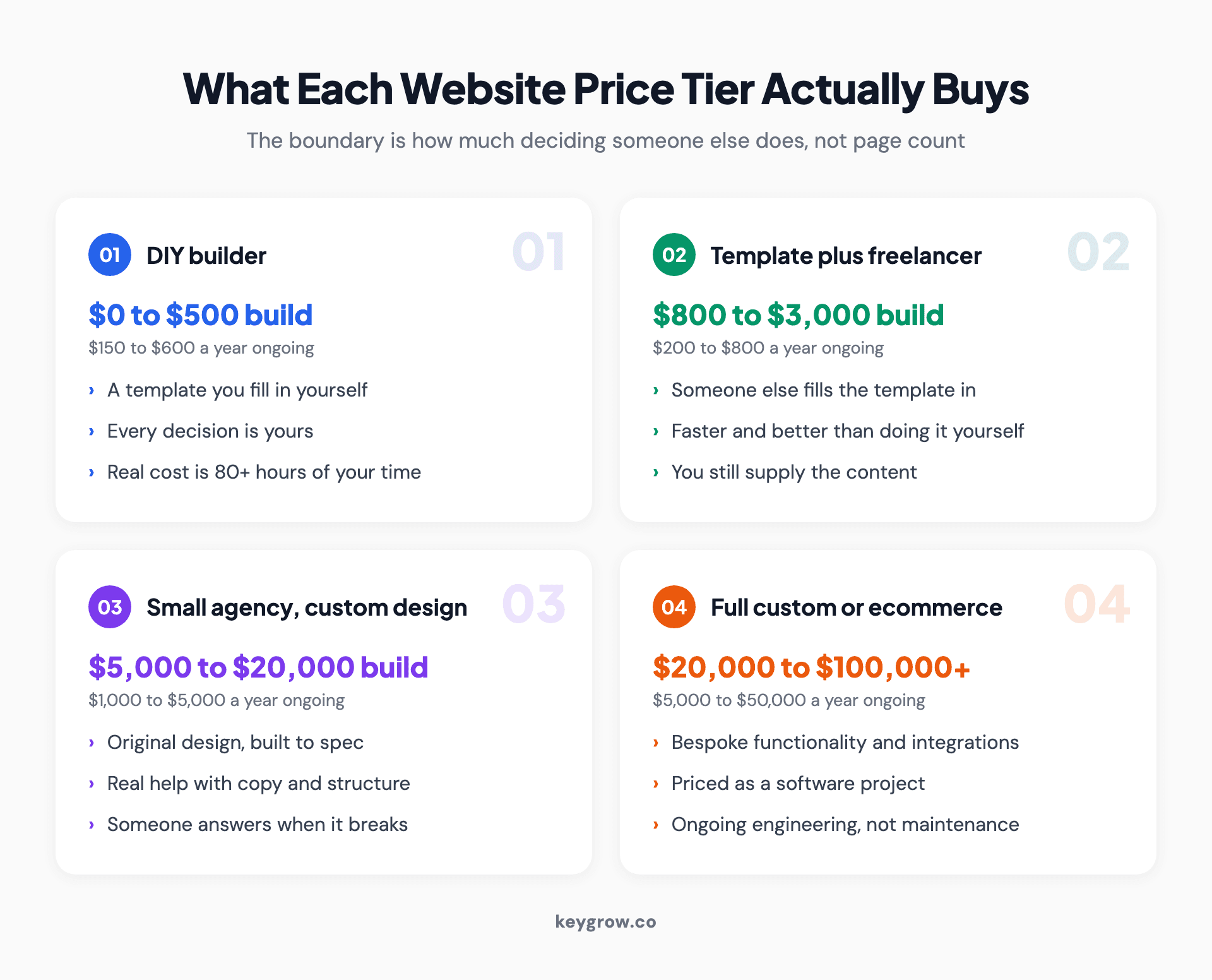
Website cost tiers from DIY builder to full custom build, showing build price, ongoing cost and what each tier actually delivers.
The tier boundaries are not really about page count. They are about how much thinking somebody else does for you. At the bottom you make every decision and do every task. At the top you hand over an objective and someone returns a finished thing. Everything in between is a mix, and the price tracks the mix far more closely than it tracks features.
Why the same website gets quoted at wildly different prices
Because most of what you are paying for is not the building. It is the deciding.
A quote is a bet on how long the project will take, and the biggest variable in that bet is not the number of pages. It is how many unresolved questions the client is carrying. Who is writing the copy. Whether the logo exists. Whether anyone has agreed what the site is for. Whether there is one decision maker or four with opinions.
An agency looking at a vague brief prices in the revisions it can see coming. An agency looking at a brief that says "eight pages, copy supplied, brand guidelines attached, one approver, launch by March" prices the actual work. Same website, materially different number, and the difference is not margin.
This is the single most actionable thing in this article. You can lower a website quote substantially without negotiating, by removing the uncertainty the quote is pricing.
What actually drives your number
Six things account for most of the variance. Ranked roughly by how much they move the total:
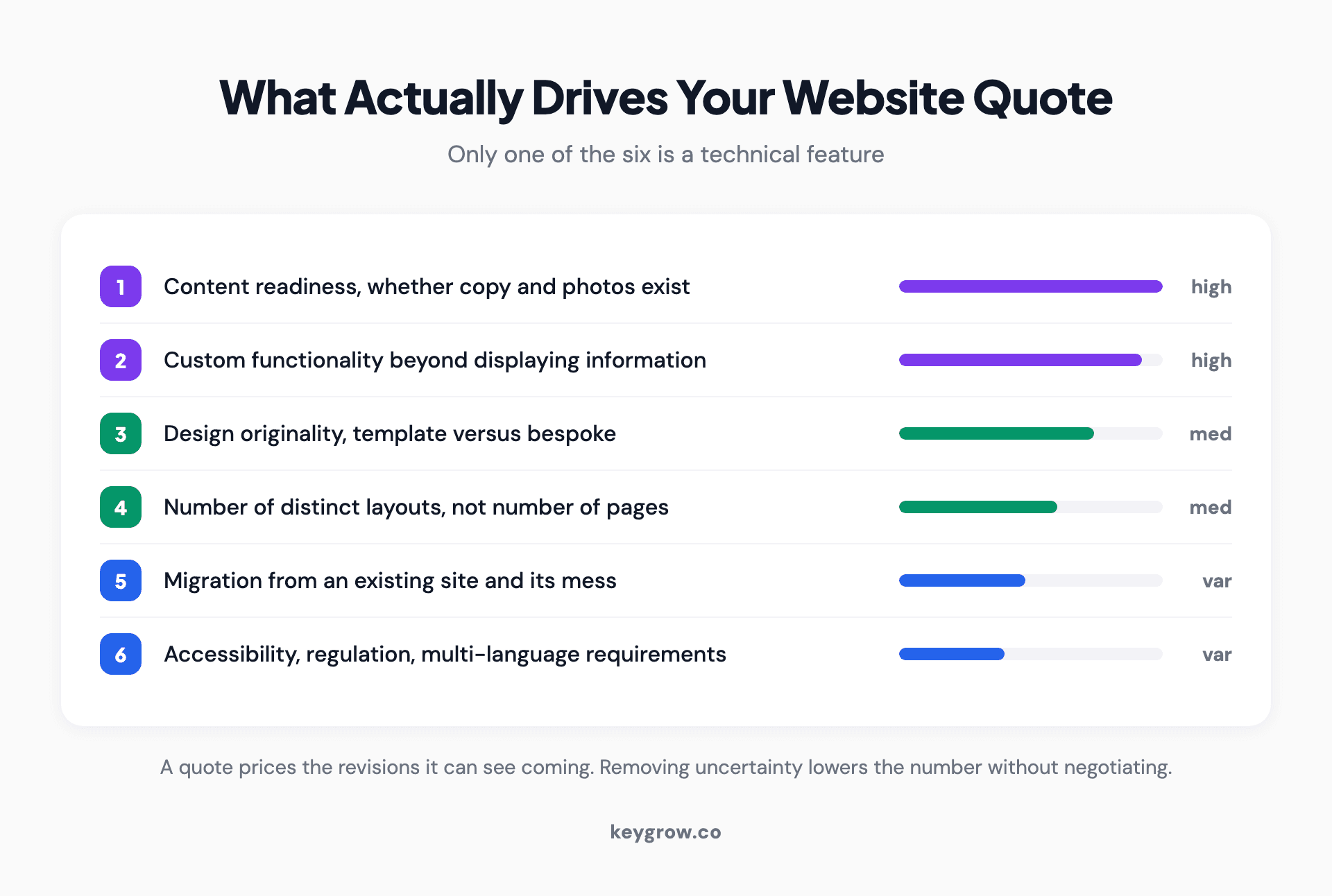
The six factors that drive website cost, ranked by impact, from content readiness to custom functionality.
Content readiness. The most underestimated line item by a distance. Copy, photography, product descriptions and case studies either exist or someone has to make them. Written content for a small site is frequently a four-figure cost on its own, and it is the thing that stalls more projects than any technical problem.
Custom functionality. A brochure site is a solved problem. A booking system, a member area, a quoting tool, a stock feed or an integration with the software you already run is engineering, and engineering is priced by the hour whether the invoice says so or not.
Design originality. Configuring a template is hours. Designing an original interface, then building it to work at every screen size, is weeks. Both produce a website. Only one produces something that does not look like the other businesses using that template.
Page count, but less than you think. Ten pages built on the same three layouts cost far less than five pages that are each different. Ask any quote to price layouts, not pages, and the number often drops.
Migration and existing mess. Moving a site with a decade of URLs, or extracting content from something nobody has admin access to any more, is real work. So is preserving rankings through the change, which we covered in redesigning without losing SEO and which is worth paying for.
Compliance and edge requirements. Accessibility conformance, industry regulation, multi-language, data residency. Each one is a real cost and each one is cheaper designed in than retrofitted.
Notice that only one of those six is a technical feature. The rest are questions about your business.

Laptop open on a wooden desk during a website planning session.
The content bill nobody quotes for
Content is the largest hidden cost in most website projects and the most common reason they run late. It is worth pricing separately in your own head before anyone quotes you.
A typical small business site needs somewhere between eight and twenty pages of original copy, a set of photographs that are not stock, and whatever proof exists in the form of case studies, testimonials or before-and-after examples. Somebody produces all of that. The only question is who, and whether they are being paid.
The three ways it goes:
You write it. Free in cash, and it is the option most owners choose. It is also the option that stalls the most projects, because writing eight pages about your own business turns out to be harder and slower than expected, and the build sits waiting on it for six weeks.
The agency writes it. Typically several hundred dollars per page for a professional writer, so a four-figure line item on a small site. Worth it when the site has a job to do beyond existing, and the fastest route to launch.
Somebody uses a generative tool and nobody edits it. Free, fast, and the reason a growing number of sites read identically to their competitors. The tool is a fine first draft engine. It is a poor substitute for knowing what your customers actually ask.
Photography deserves its own line. A half day with a local photographer produces images of your actual premises, team and work, and it is one of the few spends that visibly separates a small business site from a template. Stock photos of a generic office are the visual equivalent of filler copy.
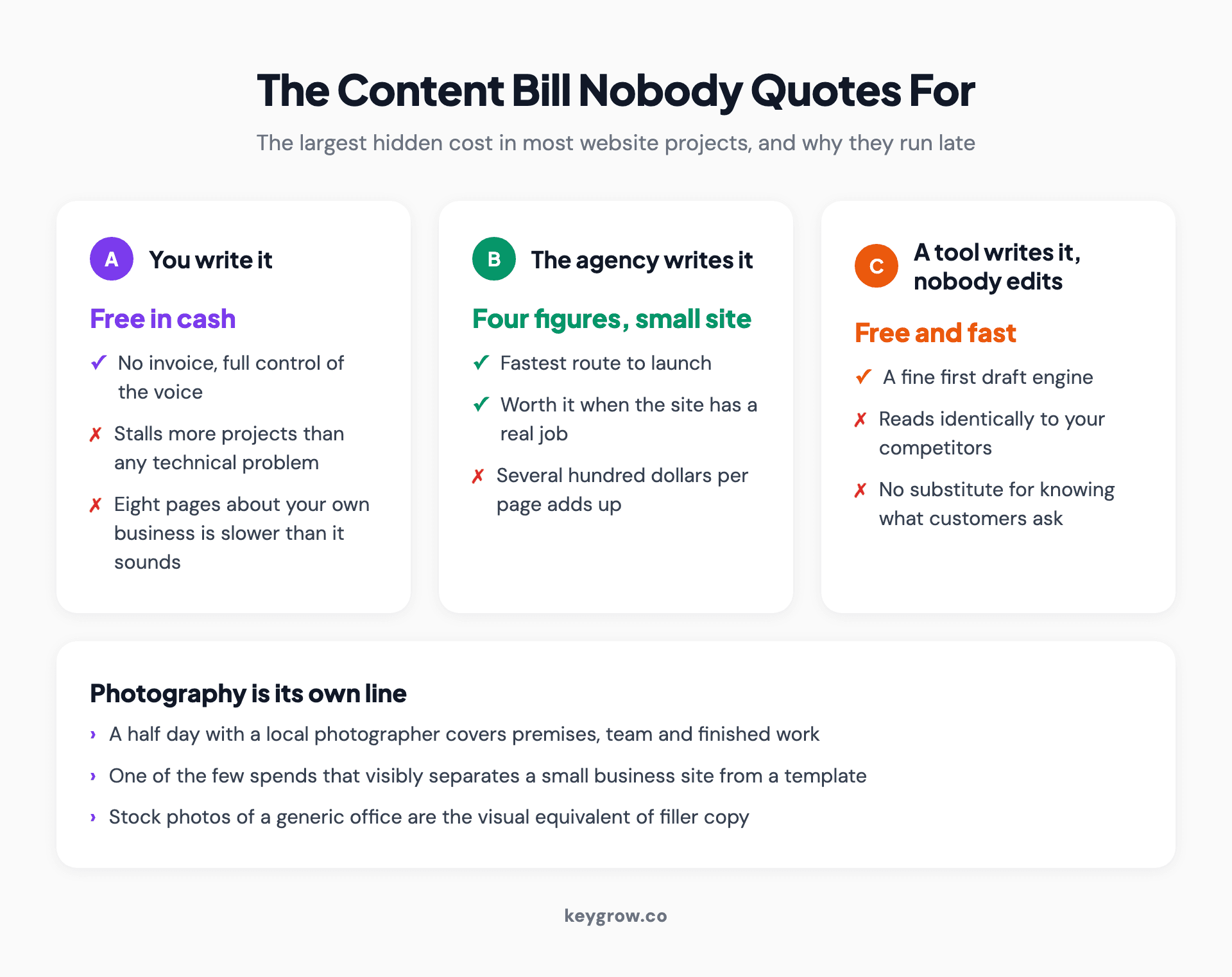
Where website content costs actually land: copy, photography and proof, and the three ways each gets produced.
Budget the content before the build. A project where the copy is written and the photographs exist runs on schedule and gets quoted lower, for the reason described above.
The costs that arrive after launch
The build price is the part people compare. The running cost is the part that decides whether the site is still working in three years.
| Item | Typical range | Notes |
|---|---|---|
| Domain | $10 to $25 a year | Renewal, not the discounted first year |
| Hosting | $60 to $1,200 a year | Shared at the bottom, managed at the top |
| SSL | $0 to a few hundred a year | Free through most modern hosts |
| Platform or plugin licences | $0 to $1,500 a year | Adds up quietly on plugin-heavy builds |
| Maintenance and updates | $500 to $6,000 a year | Security patches, breakages, small changes |
| Content updates | Varies wildly | Whoever does it, it costs time or money |
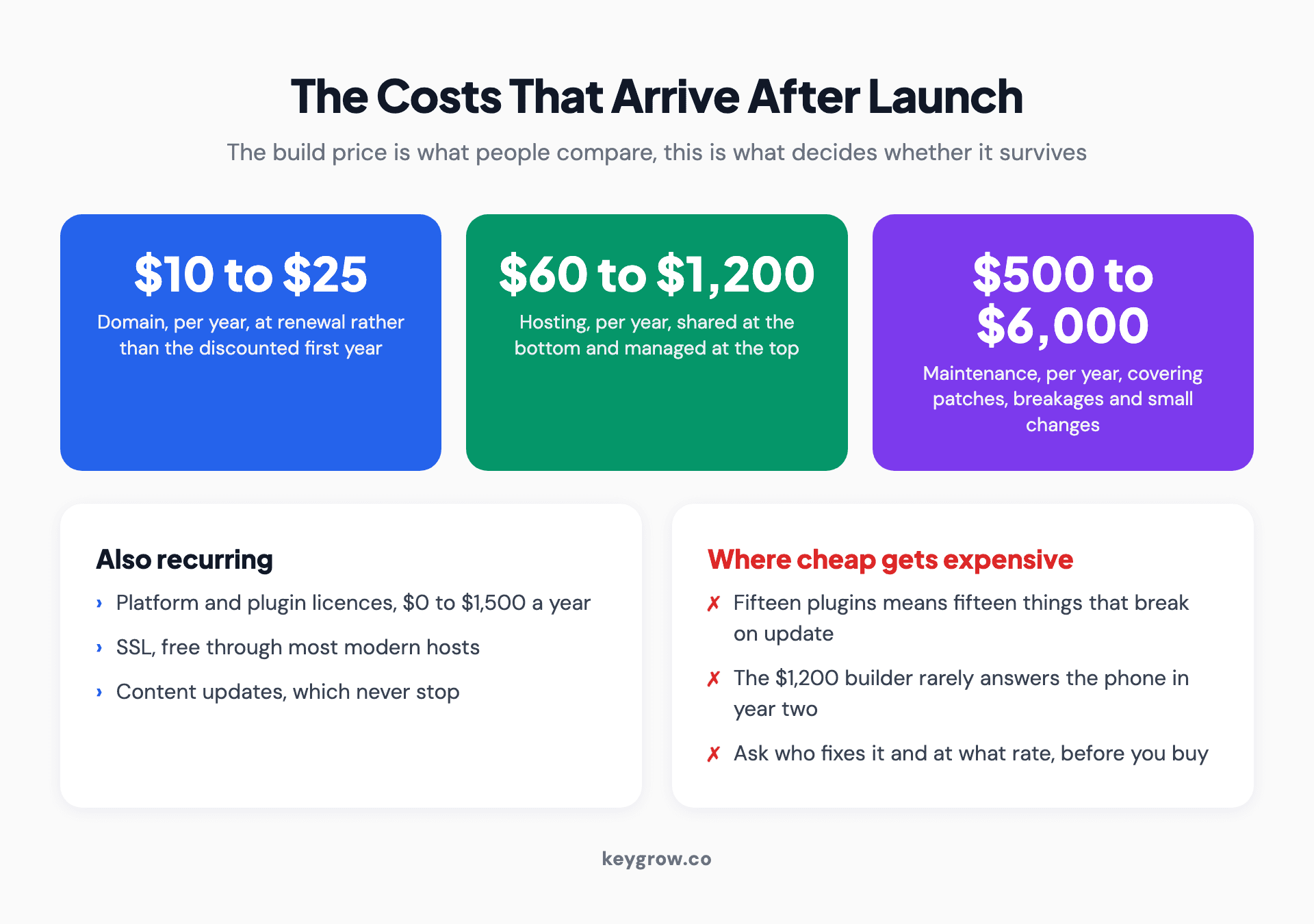
Ongoing website costs after launch, covering hosting, domain, licences, maintenance and content updates.
Maintenance is where cheap builds get expensive. A site assembled from fifteen plugins has fifteen things that can break on update, and the person who built it for $1,200 is rarely still answering the phone two years later. Ask before you buy who fixes it when it breaks and what that costs.
Run the three-year number, not the build price
Comparing a $1,500 quote against an $8,000 quote is comparing the wrong figures. Websites last three to five years, so compare what each one costs over that period.
Take the same small business site three ways over three years:
| DIY builder | Freelancer build | Agency build | |
|---|---|---|---|
| Build | $0 | $2,500 | $9,000 |
| Hosting and platform | $900 | $600 | $1,800 |
| Maintenance | $0 | $1,500 | $4,500 |
| Your time | 80+ hours | 15 hours | 8 hours |
| Three-year total | ~$900 plus your time | ~$4,600 | ~$15,300 |
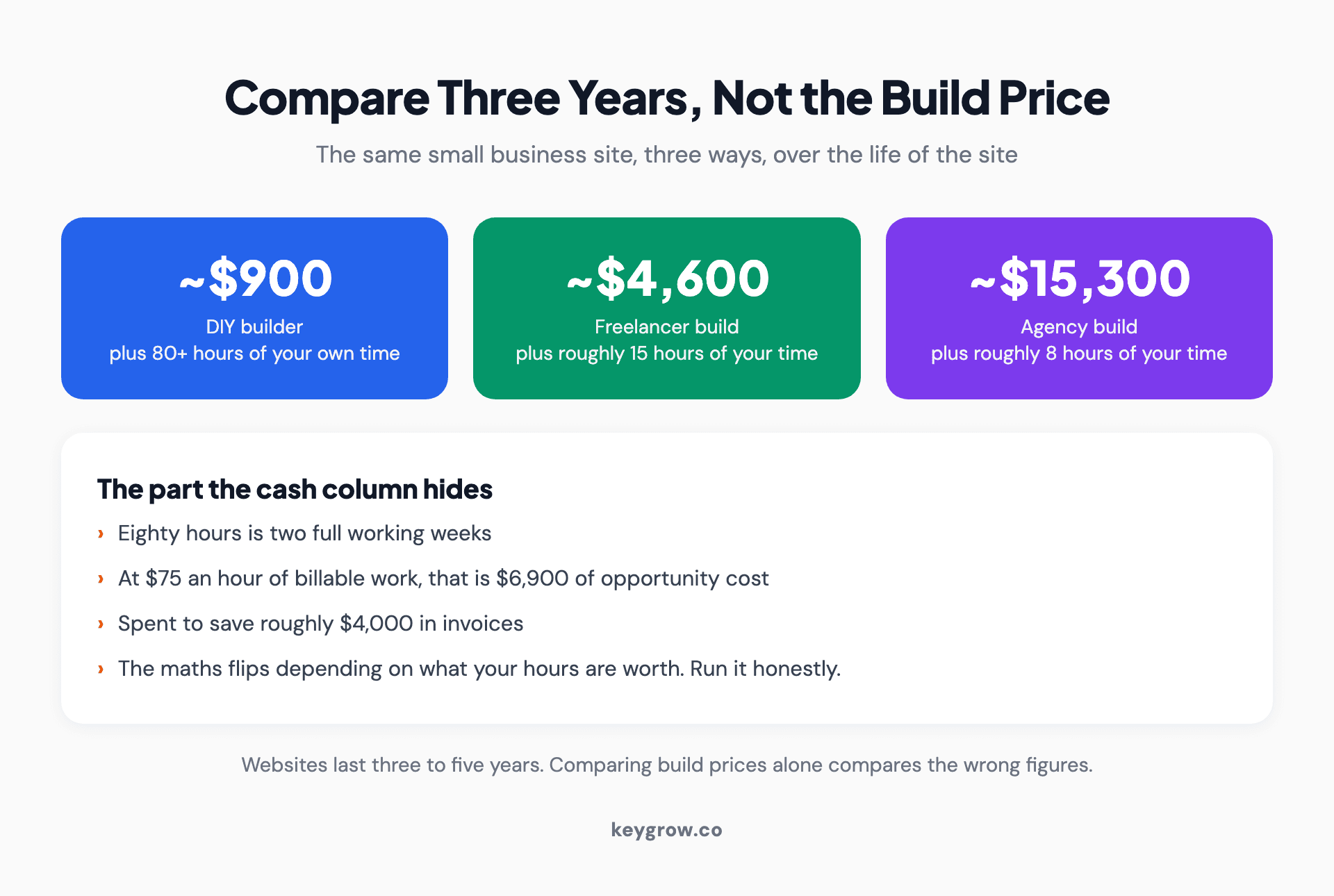
Three-year total cost of ownership comparison for a DIY, freelancer and agency website build.
The DIY column is genuinely cheapest in cash, and for plenty of businesses it is the right answer. It is not free, though. Eighty hours is two working weeks, and if your time is worth $75 an hour on billable work, the DIY site cost $6,900 in opportunity cost to save $4,000 in invoices.
That calculation flips depending on what your hours are worth and how much slack you have. Run it honestly rather than assuming cheapest means cheapest.
Ecommerce changes the arithmetic
Selling online is a different question with a different cost curve, and treating it as "a website plus a shopping cart" is how ecommerce budgets get blown.
The build is often the smaller half. A hosted store on a mainstream platform starts at a few hundred dollars a month all in, and a designer configuring a good theme with your branding is a few thousand. That gets a real store live.
What arrives afterwards is the part to plan for. Transaction fees on every order. Payment processing. Apps and integrations for shipping, tax, reviews, email and inventory, each with its own monthly fee, which collectively often exceed the platform subscription. Product photography, which scales with catalogue size rather than page count. And product descriptions, which are content, priced per product rather than per page.
A hundred-product catalogue is a hundred content items and a hundred sets of images. That single fact explains most of the difference between a $6,000 store and a $60,000 one, and it has nothing to do with the software.
Custom ecommerce, meaning a bespoke checkout or deep integration with the system that runs your warehouse, is engineering. (Manufacturers deciding how much of their ERP a site should touch can use the three integration levels in our guide to web design for manufacturers.) Price it as a software project rather than a website, because that is what it is.
What about AI website builders?
They are genuinely good now for a specific job, and genuinely oversold for everything else.
The tools that generate a site from a description will produce a clean, responsive, presentable brochure site in an afternoon for the price of a builder subscription. For a business that needs a credible online presence and nothing more, that is a real option and it was not one three years ago.
The limits show up in the same places they always did. The generated copy is generic unless you rewrite it, which is the work you were trying to avoid. Anything beyond a standard layout still needs a person. And the site tends to look like the other sites the same tool generated, which matters more in some markets than others.
The honest framing: an AI builder replaces the cheapest tier, not the expensive one. If you were choosing between a template and a freelancer, it is worth trying first. If you were considering a custom build because the site has to do a specific job, it will not get you there.
The requirements that cost more than people expect
Three things routinely arrive late in a project and cost more than they would have upfront.
Accessibility. Making a site usable with a screen reader and a keyboard is straightforward when designed in and expensive when retrofitted, because it touches colour contrast, markup structure, form labels and every interactive component. It is also increasingly a legal exposure rather than a nice-to-have, depending on your sector and jurisdiction. Ask for it in the brief.
Migration. Moving an existing site means preserving URLs, redirecting what changes, and getting content out of a system whose admin password left with an employee in 2019. Budget real hours for it, and read redesigning without losing SEO before anyone touches the URL structure.
Performance. A fast site is not a feature you add at the end. It comes from image discipline, restrained plugin use and a host that is not the cheapest available. Retrofitting speed onto a finished slow site is usually more expensive than building it right, and the slow site is losing conversions the whole time.
Where the money is genuinely well spent
Not evenly. Some parts of a website budget return far more than others, and the split surprises people.
The pages that receive traffic you pay for deserve the most attention, because that is where the arithmetic is sharpest. A mobile detailing client of ours was paying around $100 per booking from Google Ads, sending every click to their homepage. We pointed the traffic at a dedicated booking page built for that one job, and cost per booking fell to $22 while bookings grew 650 percent between August and December.
The website did not get bigger. One page got better, and it changed the unit economics of the entire ad account.
That is the shape of the return, and it is why the two or three pages receiving real traffic deserve a different standard from the rest of the site.
So if the budget is tight, the honest allocation is not "spread it evenly across twelve pages." It is: make the two or three pages that receive real traffic genuinely good, and let the rest be adequate.

Person reviewing documents alongside a calculator and laptop while budgeting a project.
When the cheap option is the right option
Plenty of businesses are told they need a custom site when they do not, so here is the counter-case.
Use a builder or a template if you are pre-revenue and testing whether anyone wants the thing. Use one if your website is essentially a business card with a phone number and your customers arrive from a map listing or word of mouth. Use one if you have more time than money and you genuinely enjoy this sort of task.
In all three cases a $30-a-month builder plus a weekend produces something respectable, and the four thousand dollars you did not spend is better deployed on the Google Business Profile work that will actually bring people to it. Our step-by-step plan for a small business website lays out the pages and launch checks for that weekend.
Move up a tier when one of these becomes true: the site has to do a job beyond describing you, you are buying traffic and the pages are wasting it, the DIY site is now consuming hours you should be selling, or you have lost work you can name to a competitor whose site looked more credible.
That last one is real but it is also the one people use to justify spending they cannot afford. Name the lost job before you use it as a reason.
How to compare quotes without being technical
You do not need to evaluate the code. You need to make the quotes comparable, which is a different and much easier problem.
Send every shop the same written brief: page list, who supplies copy and images, what the site must do beyond display information, who approves, and the deadline. For a bigger project, our website redesign RFP template turns that brief into a full request for proposal with a scoring sheet. Identical inputs make the outputs comparable, and the shops that ask good follow-up questions about the brief are usually the ones worth hiring.
Then ask each quote five things:
- How many design revision rounds are included, and what does an extra one cost
- Who writes the copy, and is that in this number
- What happens after launch: who fixes breakages, for how long, at what rate
- Do I own the site, the domain and the accounts outright
- What is not included in this price
That last question is the useful one. A quote that cannot answer it clearly is a quote that will grow.
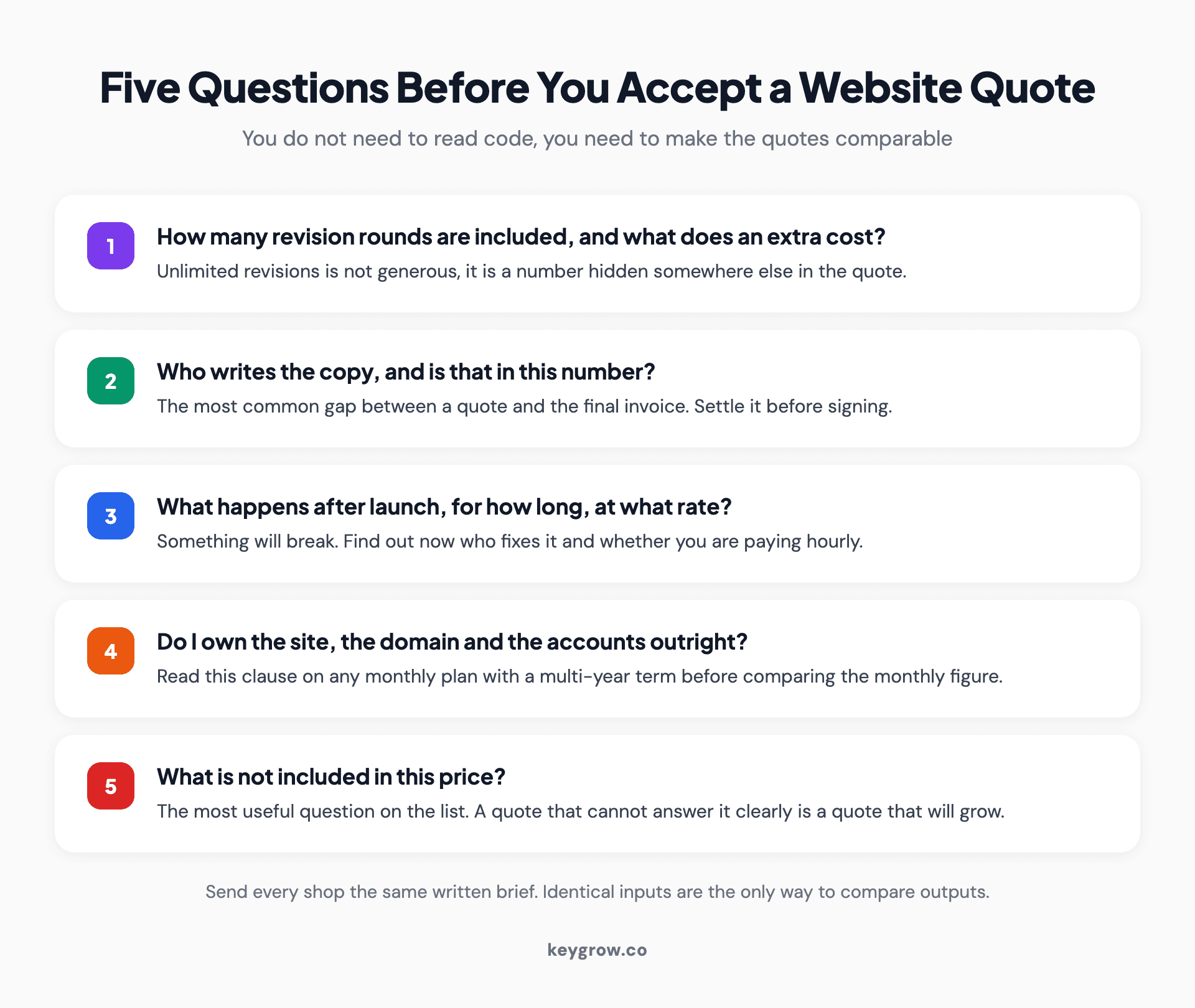
Five questions to ask before accepting a website quote, covering revisions, copy, support, ownership and exclusions.
One warning worth stating plainly. Be careful with monthly website plans that bundle build, hosting and support into a small recurring fee with a multi-year term. Some are fine. Many are financing arrangements where you never own the site, the total paid over the term far exceeds a normal build, and leaving means starting again. Read the ownership clause before the price.
FAQs
How much does a website cost for a small business?
Most small businesses spend between $2,000 and $10,000 for a professional build, or $150 to $600 a year using a website builder and doing it themselves. The gap between those figures is mostly labour: how much of the deciding, writing and building someone else does for you.
Why do website quotes vary so much for the same site?
Because a quote prices uncertainty, not just work. Vague briefs, undecided content, multiple approvers and unclear objectives all predict revision rounds, and the quote includes them. The same site with a clear written brief and supplied copy is frequently quoted materially lower.
What are the ongoing costs of a website?
Domain renewal at roughly $10 to $25 a year, hosting from around $60 to $1,200 a year, plugin or platform licences, and maintenance ranging from nothing on a builder to several thousand a year on a complex custom site. Content updates are the cost people forget, and they never stop.
Is a cheap website worth it?
Often yes. A builder site is the right choice for a pre-revenue business, a business whose customers arrive by referral or map listing, or an owner with more time than money. It becomes the wrong choice once you are paying for traffic the site cannot convert, or maintaining it is eating hours you should be billing.
How long does a website take to build?
A template build with content ready takes one to three weeks. A custom small business site typically runs six to twelve weeks. Larger custom and ecommerce projects run three to six months. The single biggest cause of overrun is content that was supposed to be supplied and was not.
Should I pay monthly for a website instead of upfront?
Only after reading the ownership terms. Some monthly plans are genuine managed services. Others are multi-year finance arrangements where the total paid exceeds a normal build and you never own the site or the domain, which makes leaving expensive. Check who owns what before comparing the monthly figure.
Does a more expensive website rank better on Google?
Not directly. Price and rankings are unrelated. What correlates is what the money bought: a fast, crawlable, well-structured site with real content ranks better than a slow one with thin pages, and those things tend to cost more. A $30,000 site with nothing to say still ranks for nothing.
Working out your own number
Skip the calculators. Answer four questions and you will have a range tighter than any of them produce.
What does this site have to do beyond describing the business? Who is writing the words and taking the photographs? How many genuinely different page layouts are there, not how many pages? And what is your own time worth if you do this yourself?
Those four answers place you in a tier and remove most of the uncertainty a quote would otherwise price. Write them down, send the same document to three shops, and compare what comes back.
If you would rather have someone scope it with you, our web development team does that as a conversation rather than a proposal, and there is a companion piece on the recurring side of the budget in what SEO costs.