


Most website redesign RFPs are written to collect a price, and that is exactly why the prices that come back can't be compared.
A website redesign request for proposal is the document you send agencies so they can propose how they would rebuild your current site, what it will cost and why they are the right team for it. The useful ones cover what most templates skip: the site you already have, including what it ranks for, and who owns what when the project ends. They also tell every bidder, before anyone writes a word, how the responses will be scored.
Below is a fill-in version you can copy one section at a time. Each section has the text to adapt and the buyer mistake it prevents. After the template there is a scoring sheet, three sample proposals scored side by side, and a one-page version for smaller projects.
The nine sections a redesign RFP needs
A redesign RFP needs nine sections: summary, goals, current site, scope, SEO and migration, technical needs, ownership, budget and pricing format, then timeline and scoring.
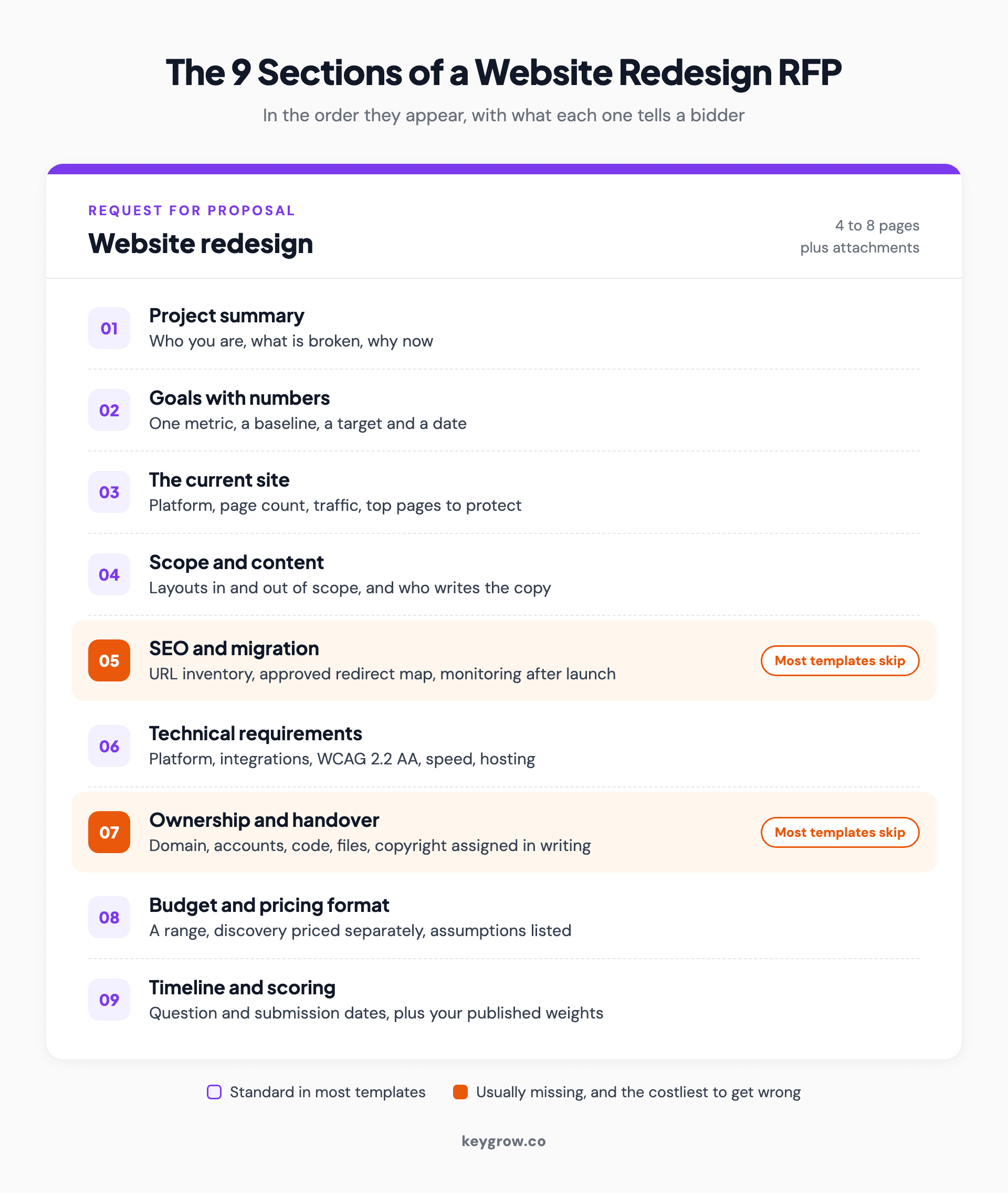
The nine sections of a website redesign request for proposal, in order: project summary, goals with numbers, the current site, scope and content, SEO and migration requirements, technical requirements, ownership and handover, budget and pricing format, and timeline with scoring criteria.
Agencies read the summary, the budget and the dates first, because those three decide whether bidding is worth their time. Everything after that is what they price.
Migration and ownership are the two sections most templates skip or squeeze into one line. They also cost the most when they go wrong, since a lost ranking or a site you can't move is something you find out about after you've paid.
Keep the whole thing to four to eight pages plus attachments. The agencies you want are reading it between client projects.
Section 1: Who you are and why you are redesigning now
Open with the problem, not the solution. Agencies decide quickly whether your project fits them, and this paragraph is what they decide on.
Fill in: "[Company] is a [what you do] serving [who] in [where]. Our current site, [domain], launched in [year] on [platform]. We are redesigning it because [the specific problem: for example, it produces about [number] enquiries a month and we need more / our team cannot edit it without a developer / it is slow and hard to use on phones]. We want one partner for [strategy, design, build, content, migration], and the site must launch by [date] because [reason]."
The mistake this prevents is the RFP that opens with a solution, such as "we need a modern, responsive site with a blog." Every agency can promise that. Describe what is broken and you get proposals that argue about how to fix it, which is the part you actually need to compare.
Section 2: Goals you can measure after launch
A goal is a number with a date attached. "Modern and intuitive" is a design preference, and every proposal will claim to deliver it.
Fill in: "Our primary goal is to increase [quote requests / booked calls / online orders] from [current monthly number] to [target] within [number] months of launch. Secondary goals: [goal two], [goal three]. Our main audiences are [audience one], who come to the site to [task], and [audience two], who need to [task]. We will measure results in [analytics tool / CRM / call tracking]."
Writing the goal down this way changes the proposals, and it settles the argument after launch. When we redesigned a junk removal company's site, the number that mattered was lead form submissions. They rose 180 percent within 8 weeks. Nobody had to debate whether the new site was working.
If you don't know your current numbers, pull them before you send anything. A goal with no baseline can't be scored later.
Section 3: The site you have now
A redesign starts from something that already exists. Give bidders the inventory: platform, page count, traffic, top pages, and what has to survive the move.

A tablet on a desk displaying a website with images and article cards.
Fill in:
- Platform and hosting: [CMS], hosted with [host]. Admin access is held by [name or company].
- Approximate page count: [number], of which [number] are blog posts, [number] are service or product pages and [number] are location pages.
- Organic visits per month, 12-month average: [number], from [analytics tool or Search Console].
- Top 20 pages by organic traffic and by conversions: see attached export.
- Pages and features that must carry over: [quote form, location pages, blog archive, customer login].
- What works today: [pages or features users rely on].
- Known problems: [slow mobile pages, broken forms, outdated content, duplicate pages].
Agencies price uncertainty. Our breakdown of website costs shows the same six-page site quoted at $1,800 by one shop and $14,000 by another, and a lot of that gap is guesswork about things the client could have written down in ten minutes.
Section 4: Scope, and who writes the words
List what is in scope, what is out, and who supplies the copy and photos. Content is the line item that stalls more projects than any technical problem.
Fill in: "In scope: discovery and a sitemap, wireframes for [number] unique page layouts, visual design, build on [platform or vendor's recommendation], migration of [all / the attached list of] existing pages, copywriting for [number] pages, on-page SEO, analytics and conversion tracking setup, training for [number] editors and [30] days of post-launch fixes. Out of scope unless priced as an option: [hosting, ongoing SEO, paid advertising, photography]. Content: [we will supply final copy for all pages by [date] / we need the vendor to write [number] pages and edit the rest]. Photography: [we have current photos / we need a shoot]."
Ask for layouts, not pages. Forty location pages built on one template are one layout of design work and forty pages of content. If the RFP says "forty pages," some bidders will price forty designs.
Section 5: SEO and migration requirements
If your site earns search traffic, make migration a requirement: a URL inventory, an approved redirect map, carried-over metadata, a blocked staging site and monitoring after launch.
None of the eight RFP templates and guides we read for this article asks bidders for a redirect map, and this is where redesigns lose the most money. When old URLs change and nothing points to the new ones, the rankings those pages earned go with them. Google's site-move guide tells site owners to map every old URL to its new address and to keep the redirects in place for at least a year.
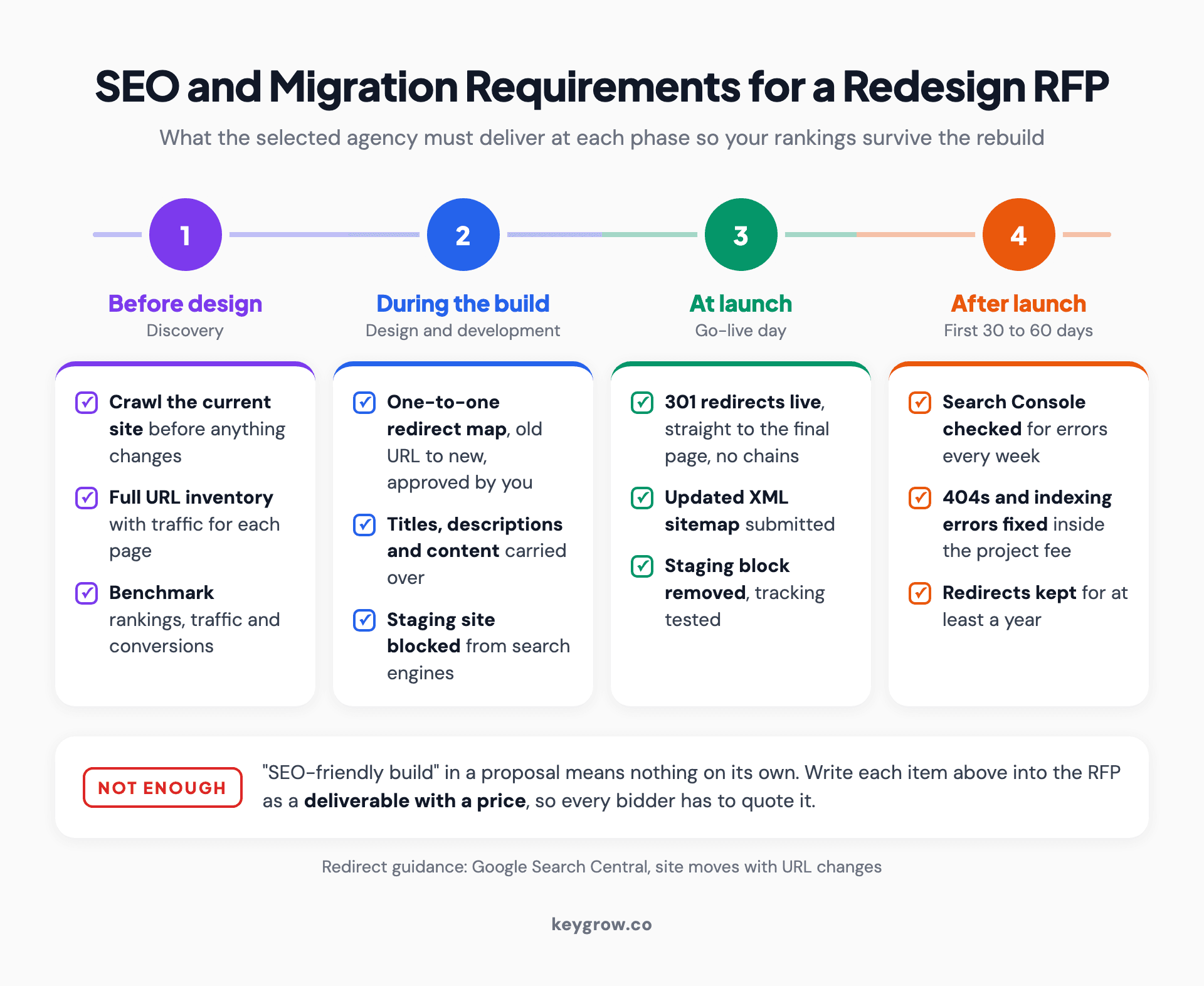
SEO and migration requirements for a website redesign RFP across four phases: before design, crawl the site, build a URL inventory with traffic per page and benchmark results; during the build, a one-to-one redirect map approved by you, carried-over titles and content, and a blocked staging site; at launch, live 301 redirects with no chains, an updated XML sitemap and the staging block removed; after launch, 30 to 60 days of Search Console checks, errors fixed within the fee and redirects kept for at least a year.
Fill in: "The selected vendor will:"
- Crawl the current site before design starts and deliver a full URL inventory with traffic for each page.
- Deliver a one-to-one redirect map, old URL to new URL, for our approval before launch. Redirects will be permanent (301) and go straight to the final page, with no chains.
- Carry over page titles, meta descriptions, headings and body content on every page we keep, unless we approve a change.
- Keep the staging site blocked from search engines, and confirm the block is removed at launch.
- Submit an updated XML sitemap at launch and monitor Search Console for [30 / 60] days, fixing 404 errors and indexing problems within the project fee.
- Keep analytics, conversion tracking and call tracking working through launch.
A proposal that says "SEO-friendly" without listing a redirect map as a deliverable hasn't priced the work. Our guide to redesigning without losing SEO walks through each step, so you can tell whether a bidder's plan is real.
Section 6: Technical requirements
Name the platform constraints, integrations, accessibility level, speed target and hosting needs you already know. Where you don't know, say you're open to a recommendation.
Fill in: "Platform: [required CMS / open to recommendation, with reasons]. Editors: [number] people need to update [pages, blog posts, products] without a developer. Integrations: [CRM], [email platform], [booking or payments], [call tracking], each described in one sentence of how it should work. Accessibility: the site must conform to WCAG 2.2 Level AA. Performance: the main templates should load quickly on mobile and pass Core Web Vitals. Hosting: [we will host / vendor to recommend and price hosting separately], with daily backups and security updates included."
Industry details belong here too. A manufacturer should list the quote request form and the drawing file types it must accept; our guide to web design for manufacturers covers what those pages need. A software company should name its trial signup flow and product analytics, and our SaaS website guide explains why the pricing page needs an owner.
Section 7: Ownership and handover
State that you will own the domain, accounts, code, design files and content, and that copyright in the work transfers to you in writing on final payment.

Hands signing a printed form with a pen on a dark table.
Paying for a website does not, by itself, make you the copyright owner. Under US law a commissioned work only counts as "made for hire" if it falls into one of nine categories in the Copyright Act and both sides sign a written agreement saying so, as the Copyright Office's Circular 30 explains. A website does not fit neatly into those categories, which is why web contracts usually include a written assignment of copyright as well. Have your lawyer read the final clause, but make sure there is one to read.
Fill in: "On final payment, [Company] will own all deliverables created for this project, including design files, code, written content and graphics, and the vendor will assign copyright in them to [Company] in writing. The domain, hosting account, CMS administrator access, analytics, tag manager and Search Console accounts will be registered to [Company], with the vendor added as a user. Proposals must list any third-party or pre-existing code, themes, plugins, fonts and stock images, with their license terms. Proposals must state any exceptions to these terms."
The last sentence matters most. A vendor who ignores the clause hasn't agreed to it, so make them write their exceptions down. Our guide on choosing a web design agency lists the six assets to get in writing before you sign.
Section 8: Budget and pricing format
Give a budget range, price discovery separately, and ask for a fixed price only on scope you have written down, with every assumption listed.
The tempting move is to ask for one fixed price before anyone has defined the work. Faced with a vague scope, a careful agency pads the number, and a hungry one lowballs it and recovers the difference through change orders. You end up comparing two guesses.
Share the range, even if it feels like giving away your negotiating position. Shops that can't work within it drop out, and the rest propose what fits. For orientation only, market ranges run from about $2,000 to $10,000 for most small business builds and from around $15,000 for custom sites with integrations, as our cost breakdown shows. Your scope decides where you land.
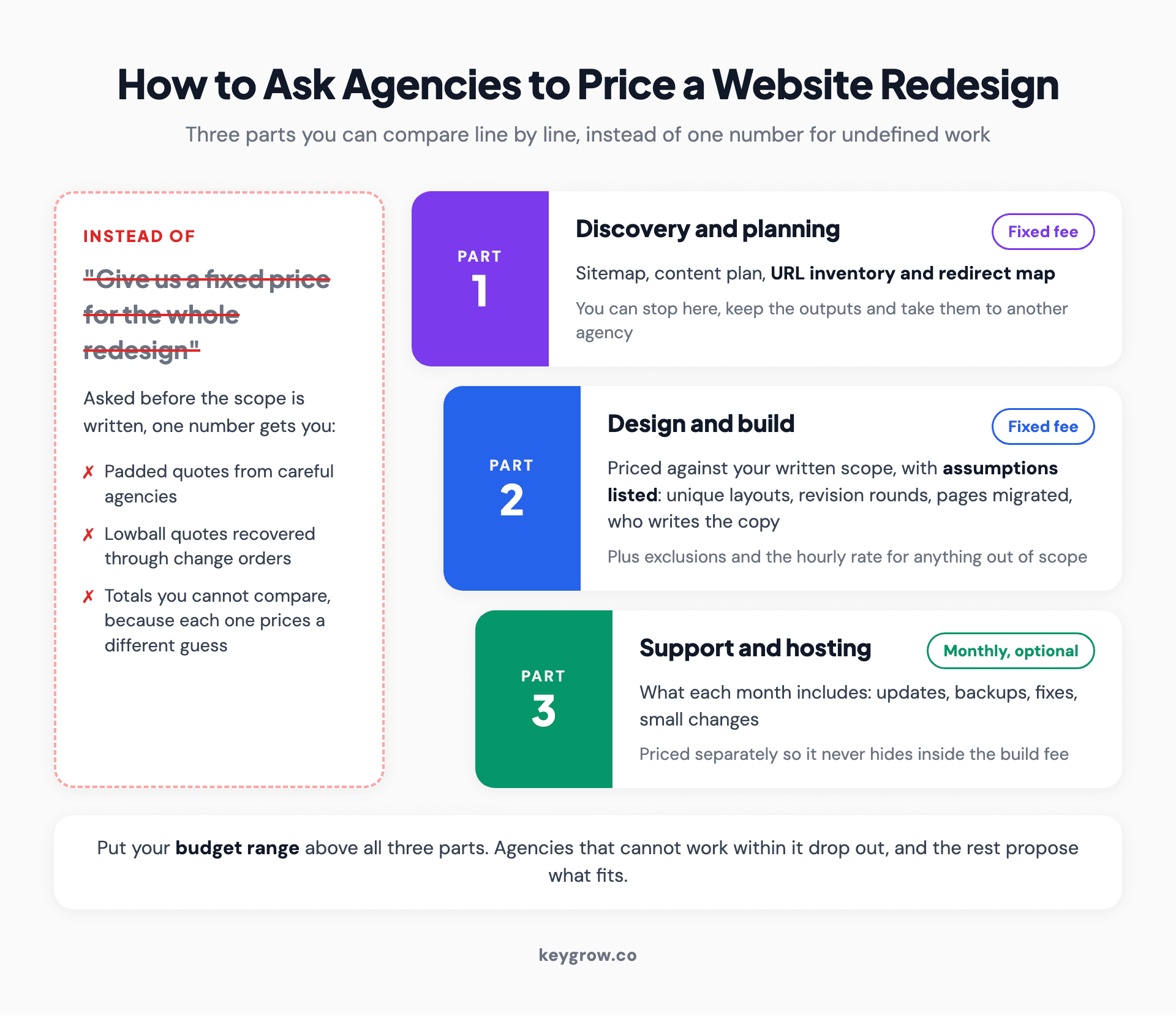
How to ask agencies to price a website redesign in three parts: a fixed fee for discovery and planning, a fixed fee for design and build against the written scope with assumptions listed, and an optional monthly fee for support and hosting, instead of one fixed price for undefined work.
Fill in: "Our budget for design and build is [$X to $Y]. Hosting and support are budgeted separately at [amount per month / to be decided]. Please price your proposal in three parts:"
- Discovery and planning (sitemap, content plan, URL inventory, redirect map): fixed fee.
- Design and build against the scope in this RFP: fixed fee, listing your assumptions on unique layouts, revision rounds, pages migrated and who supplies copy.
- Support and hosting after launch: monthly, optional, with what each month includes.
"Please list anything not included, and your rate for work outside the scope."
Splitting out discovery also gives you an exit. If the discovery work is poor, you can stop there, keep the sitemap and redirect map, and take them to another shop.
Section 9: Timeline, submission and scoring
Give the dates for questions, submissions, presentations and the decision, and publish your scoring weights so bidders write to what you care about.
Fill in: "Questions are due by [date] and will be answered to all bidders by [date]. Proposals are due by [time, date] as one PDF to [email]. Shortlisted vendors will present on [dates], and we will decide by [date]. Target launch: [date]. Proposals will be scored out of 100: understanding of our goals (20), relevant work and results (20), SEO and migration plan (15), team and process (15), price and what it includes (20), ownership and support terms (10). Please keep proposals under [12] pages, plus case studies."
Publishing weights feels like showing your hand. It is standard practice in public procurement. The State Bar of California's 2024 redesign RFP printed its weights in the document: half the score for ability and experience, 30 percent for total cost, and 10 percent each for responsiveness and agreement with its contract terms.
Two practical notes. Send it to three to five agencies, because fewer gives you no comparison and more gives you a week of reading. And allow two to three weeks for responses, so the good shops aren't writing yours at midnight.
How to score the proposals that come back
Score each proposal from 0 to 5 on every criterion, convert to points using the weights, have two people score separately, and read the price section last.
| Criterion | Weight | What a 5 looks like | What a 1 looks like |
|---|---|---|---|
| Understanding of your goals | 20 | Restates your goal as a number and questions part of your brief | Repeats your RFP back to you |
| Relevant work and results | 20 | Similar redesigns with before and after numbers | Screenshots, no outcomes |
| SEO and migration plan | 15 | URL inventory and redirect map as priced deliverables | "SEO-friendly build" |
| Team and process | 15 | Names who does the work and shows the first two weeks | A process diagram with no names |
| Price and what it includes | 20 | Fixed fees with assumptions and exclusions listed | One number, no assumptions |
| Ownership and support terms | 10 | Accepts the clause, lists third-party licenses | Silence, or a platform you can't leave |
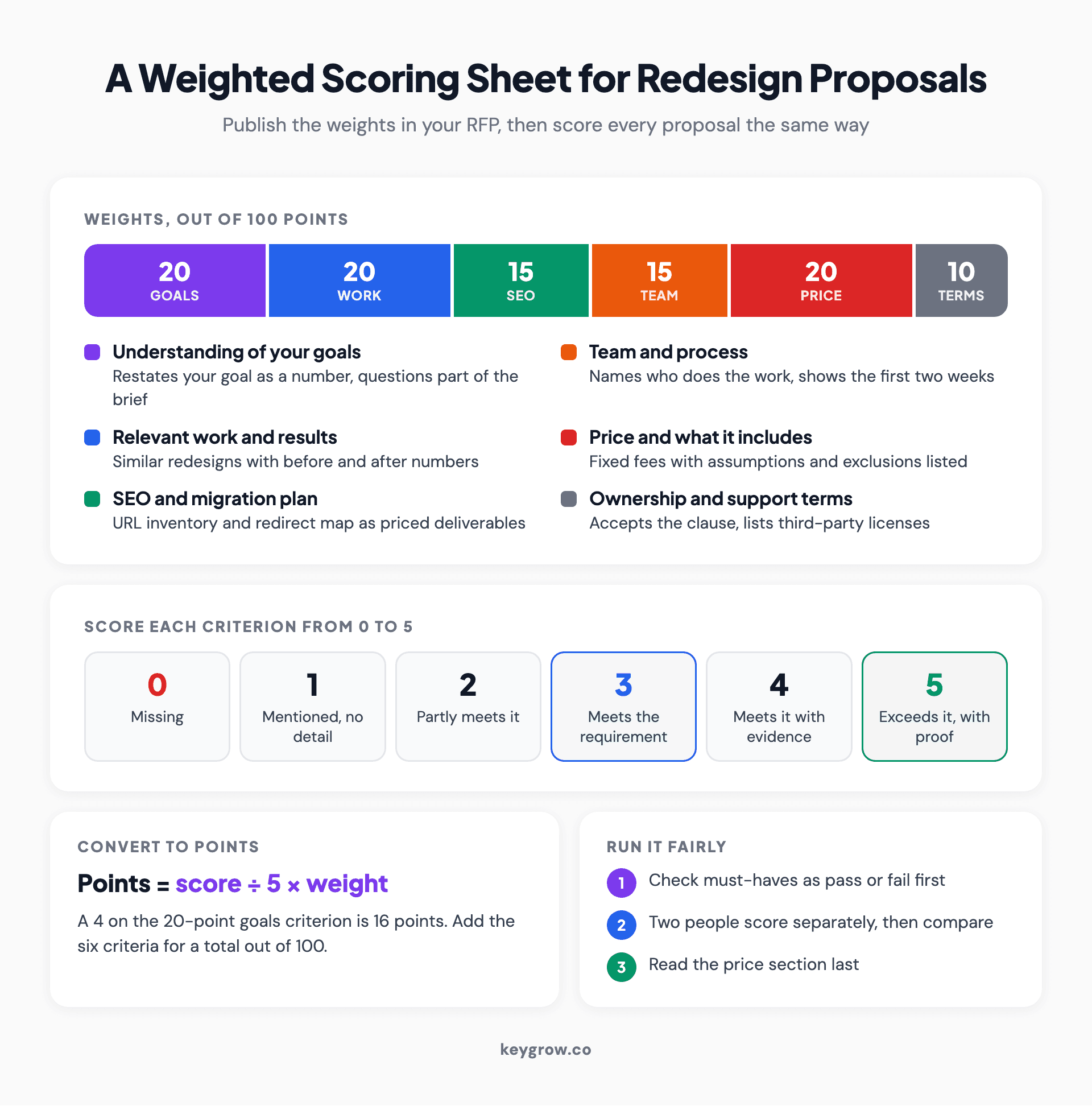
A weighted scoring sheet for website redesign proposals: goals 20, relevant work 20, SEO and migration 15, team 15, price 20 and terms 10 points, a 0 to 5 scale from missing to exceeds with proof, and the formula points equal score divided by 5 times weight.
Points for each criterion are the score divided by 5, multiplied by the weight. A 4 on a 20-point criterion is 16 points.
Before scoring anything, run the must-haves as pass or fail. If you require a copyright assignment and a bidder refuses it, the proposal is out, however good the portfolio looks.
Read the price last, after the quality scores are in. Seeing a low number first makes every other answer in that proposal look better than it is.
A worked example: three proposals, scored
Here is how the sheet plays out on three made-up proposals for the same 40-page redesign with a $12,000 to $20,000 budget.
Agency A quotes $9,500. Copywriting is extra at $2,800 on its rate card, and redirect mapping is "available at our hourly rate." Agency B quotes $16,000 with discovery included, lists its assumptions (eight layouts, two revision rounds, 40 pages migrated) and puts the redirect map in its deliverables. Agency C quotes $24,000, has the strongest portfolio of the three, and wants the site hosted on its own platform for 24 months, licensing the code to you rather than assigning it.
| Criterion (weight) | Agency A | Agency B | Agency C |
|---|---|---|---|
| Goals (20) | 2 = 8 pts | 5 = 20 pts | 4 = 16 pts |
| Relevant work (20) | 3 = 12 pts | 4 = 16 pts | 5 = 20 pts |
| SEO and migration (15) | 1 = 3 pts | 5 = 15 pts | 4 = 12 pts |
| Team and process (15) | 3 = 9 pts | 4 = 12 pts | 4 = 12 pts |
| Price and inclusions (20) | 4 = 16 pts | 4 = 16 pts | 2 = 8 pts |
| Ownership and support (10) | 4 = 8 pts | 5 = 10 pts | 1 = 2 pts |
| Total (100) | 56 | 89 | 70 |
Agency A is still the cheapest once you add the copywriting back ($12,300), so it scores well on price. It loses on migration, because a 40-page site with search traffic and no redirect plan is an expensive way to save $3,700. Agency C has the best design work and loses on terms. If ownership is a pass or fail requirement for you, C never gets scored at all.
Agency B wins without being the best at anything except the parts that protect you. That is the usual result when the scoring is written before the proposals arrive.
Red flags in the responses
Some proposals tell you more by what they leave out. Watch for these:
- The proposal repeats your RFP back to you, and nobody asked a single question during the question window.
- A price with no assumptions, no exclusions and no rate for extra work.
- "SEO included," with no URL inventory or redirect map anywhere in the deliverables.
- Silence on the ownership clause, or a proprietary platform you can only leave by rebuilding.
- Rankings promised within weeks.
That last one deserves a hard line. "Page one in 30 days" is a red flag, full stop. Our strongest organic result took 12 months to reach 1,519 percent traffic growth, and anyone promising a month is either targeting phrases nobody searches or doesn't know what they are selling.
Do you need a formal RFP at all?
For a small brochure site with one decision maker, a formal RFP usually costs more time than it saves. Send a one-page brief to three shops instead.
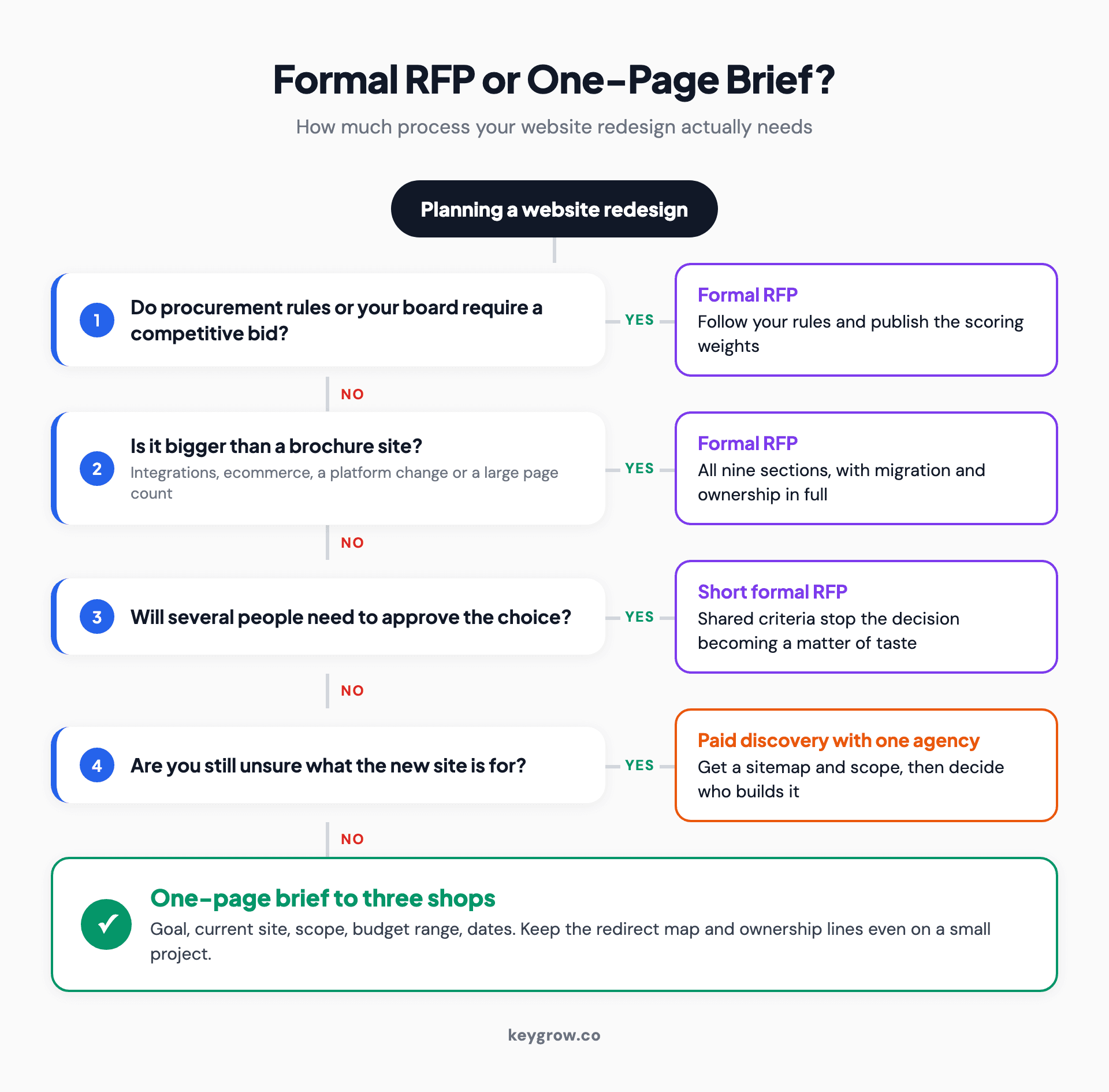
A decision flow for choosing between a formal website redesign RFP and a one-page brief: a formal RFP if procurement rules require a competitive bid, if the project is bigger than a brochure site or if several people must approve the choice; paid discovery with one agency if you are unsure what the site is for; otherwise a one-page brief to three shops that keeps the redirect map and ownership lines.
Answering a full RFP is hours of unpaid work for the agency, and some good studios decline formal bids on small projects for exactly that reason. A heavy process can shrink your pool to the shops with the biggest sales teams, which is not the same list as the shops with the best work. Keep the redirect and ownership lines from the one-page version below, though. A small site can still lose its rankings.
Skip it, too, if you don't yet know what the site is for. Pay one agency for a short discovery project, get a sitemap and a scope out of it, then decide whether to build with them or take the scope elsewhere.
And if you already know who you want to hire, an RFP sent only to produce two losing quotes wastes three agencies' time. Check that one shop properly instead.
FAQs
What should a website redesign RFP include?
A project summary, measurable goals, an inventory of the current site, scope and content responsibilities, SEO and migration requirements, technical needs, ownership terms, a budget range with a pricing format, and the timeline with scoring weights. The current-site inventory and migration requirements are what make it a redesign RFP rather than a new-build RFP.
Should you include a budget in a website RFP?
Yes. A range lets agencies propose what fits and lets the ones who can't work within it drop out before they waste your time. Without one, you get proposals priced for completely different projects and no fair way to compare them.
How long should a website redesign RFP be?
Four to eight pages is enough for most projects, plus attachments such as your analytics export and page inventory. Length doesn't make an RFP clearer. A short document with real numbers gets better answers than a long one full of boilerplate.
How many agencies should you send a website RFP to?
Three to five is the practical range. Fewer than three gives you little to compare, and more than five turns evaluation into a week of reading while costing a lot of agencies unpaid work.
How long should agencies get to respond to an RFP?
Two to three weeks is reasonable for a website redesign. Add a question deadline in the first week and share every answer with all bidders, so the proposals are built on the same information.
What is the difference between an RFP and an RFQ for a website?
An RFQ asks for a price on a fully defined specification, while an RFP asks vendors to propose an approach and price it. A redesign is almost always an RFP, because the right sitemap, platform and migration plan are part of what you are buying.
How do you evaluate website RFP responses?
Score each proposal from 0 to 5 on weighted criteria that you publish in the RFP, with two people scoring separately before comparing notes. Run must-have requirements as pass or fail first, and read the price section after the quality scores are in.
The one-page version
If your project is small, or you just want something to send this week, this is the whole RFP compressed:
- Who we are and why we are redesigning: [two sentences on the business and the problem].
- Goal: [metric] from [current number] to [target] by [date].
- Current site: [platform], about [number] pages, [number] organic visits a month, top pages attached.
- Scope: [number] unique layouts, [number] pages migrated, copy written by [us / you], integrations with [tools].
- Must-haves: a redirect map we approve before launch, WCAG 2.2 AA, [30] days of post-launch fixes.
- Ownership: we own the domain, accounts, code, design files and content, with copyright assigned to us on final payment.
- Budget: [$X to $Y]. Price discovery, build and support separately, with your assumptions listed.
- Scoring: goals 20, relevant work 20, SEO and migration 15, team 15, price 20, terms 10.
- Dates: questions by [date], proposals by [date], decision by [date].
That fits on one page and covers the parts that decide whether the project goes well. If you'd like our web development team to answer it, send it over, and we'll tell you if your project needs less process than this.