

Most manufacturing websites don't lose quote requests because they look dated. They lose them because they were built for the wrong buyer.
Good web design for manufacturers starts with four questions: who lands on the site, whether you sell capabilities or products, how a deal closes, and where your product data lives. Answer those and the page list, the RFQ form and the budget mostly decide themselves. Skip them and you get a nice homepage that an engineer abandons because the tolerance they needed was buried in a PDF three clicks deep.
That's the gap in what currently ranks for this search. The results are mostly agency service pages and galleries of pretty factory sites. Plenty of inspiration, very little help deciding what your own site has to do.

CNC machining centers lined up on a clean shop floor with tool carts and workbenches, the kind of operation a manufacturing website has to represent accurately.
Why the inspiration galleries are the wrong place to start
Technical buyers come to your site for data, not looks. They want specs they can check, and they do most of their checking before they ever call you.
GlobalSpec's 2026 survey of more than 1,000 engineers and technical buyers found that 62 percent of the buying process happens online before anyone contacts a vendor. Supplier websites are one of the two places they routinely research, used by 74 percent of respondents. When they finally do reach out, the top reason is a pricing or inventory question they couldn't answer on the site.
Now look at what they find useful. In the 2022 edition of the same research, 77 percent of engineers named datasheets as useful when researching a significant purchase. CAD drawings came second at 45 percent. Corporate overview videos came last at 7 percent.
So here's our position, and the numbers back it: the design and the platform matter far less than whether the spec an engineer needs is on the page. A $200,000 site with a slow-motion hero video of a robot arm welding is a corporate overview video with extra steps.
The four questions that decide what you build
Every manufacturing site comes down to the same four decisions. Each one changes the page list, the forms and the cost, so answer them in order.
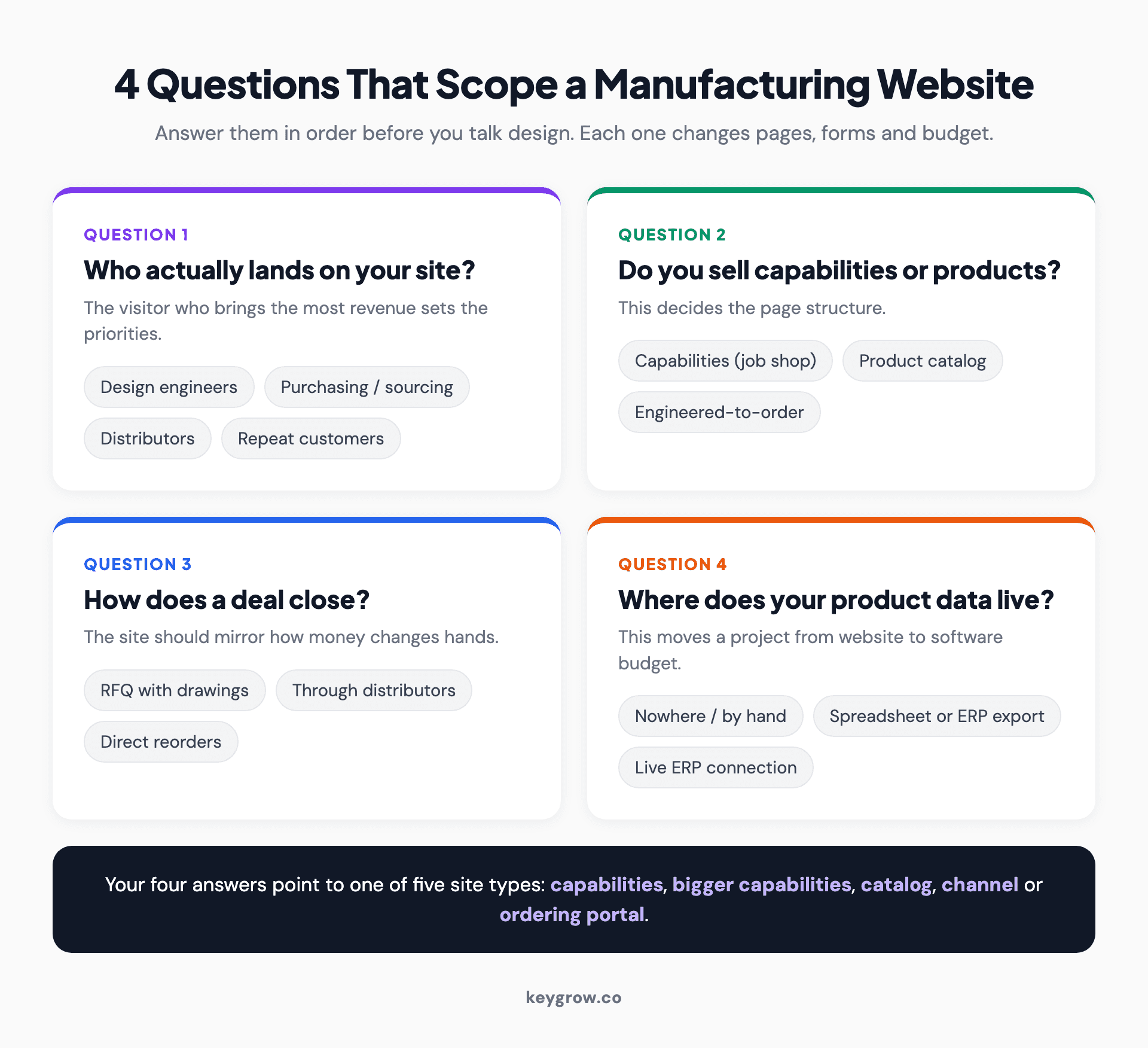
Four-card framework for scoping web design for manufacturers: who lands on the site, whether you sell capabilities or products, how a deal closes, and where product data lives, with the options under each question.
The questions are not about colors or layouts. A designer can make any of these answers look good. What a designer can't do is guess which buyer pays your bills, and that guess is where redesigns often go wrong.
Question 1: Who actually lands on your site?
Most manufacturers have three or four visitor types, and each one is checking something different. Write down which one brings in the most revenue, because that person sets the priorities.
| Visitor | What they're checking | Page that serves them | Why they leave |
|---|---|---|---|
| Design engineer | Tolerances, materials, specs, CAD | Product or capability page with a spec table | Specs only in a gated PDF |
| Purchasing or sourcing | Certifications, capacity, lead times, location | Quality page, equipment list, about | No cert numbers, no capacity info |
| Distributor or dealer | Literature, pricing sheets, stock | Distributor portal or resources page | Has to email you for a brochure |
| Existing customer | Reorders, part numbers, order status | Customer login or reorder form | Calls in because the site can't help |
The engineer and the purchasing manager often work on the same deal and never look at the same page. The engineer decides whether your part can work. Purchasing decides whether your company can be trusted with the order. Your site needs a clear path for each, starting from the homepage.
If most of your revenue comes from one big OEM buying to print, your visitor is mostly purchasing and quality. If you sell standard components through a catalog, it's mostly engineers.
Those two sites look very different.
Question 2: Do you sell capabilities or products?
This is the split that decides your page structure. A job shop or contract manufacturer sells what its machines and people can do. A product manufacturer sells a catalog of parts with fixed specs.
Capability sellers need one page per process: CNC machining, sheet metal, welding, finishing, whatever you quote. Each page should list the materials you run, the tolerances you hold, part size limits, typical volumes and the machines behind it. Then an equipment list, a quality page with certification numbers, and an industries page. Depending on how many processes you quote, that's anywhere from six pages to a few dozen.
Product sellers need a catalog. One page per product family, a spec table on each product page in plain HTML, and downloadable datasheets and CAD files. The page count tracks your catalog, so 30 or more pages is normal.
Engineered-to-order shops sit in between. They need capability pages plus application examples, because the buyer is trying to judge whether you can solve a problem nobody has drawn yet.

Machined aluminum parts resting on engineering drawings, the kind of spec and drawing detail buyers expect to find on a manufacturer's website.
Here's what a capability page should hold. The order matters: proof of fit first, then the ask.
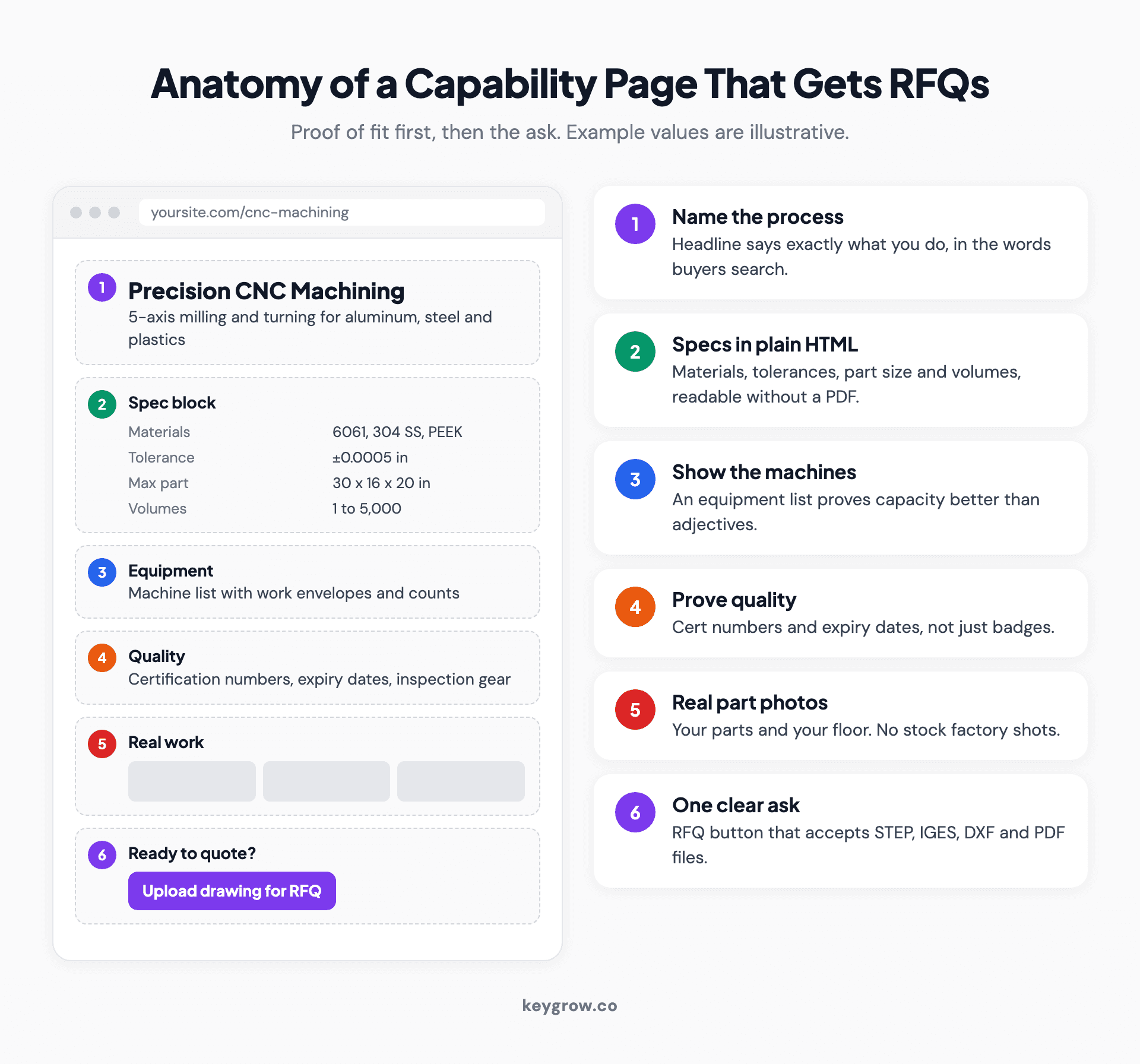
Annotated layout of a manufacturing capability page: a headline naming the process, a spec block with materials, tolerances and part size limits, an equipment list, certifications with numbers, real part photos, and an RFQ button that accepts drawing files.
Question 3: How does a deal close?
Your site should mirror how money changes hands. There are three common patterns, and many manufacturers run two of them at once.
Through an RFQ with drawings
If buyers send drawings and you quote, the RFQ form is the most important thing on the site. Make it accept the files engineers send (STEP, IGES, DXF and PDF at minimum) with a size limit big enough for real models. Ask only what you need to quote: part files, material, quantity, target date, contact. Everything else can wait for the follow-up email.
Engineers prefer that follow-up by email. GlobalSpec found 59 percent of technical buyers want their first vendor contact by email and 22 percent by phone, so don't force a phone call into the form.
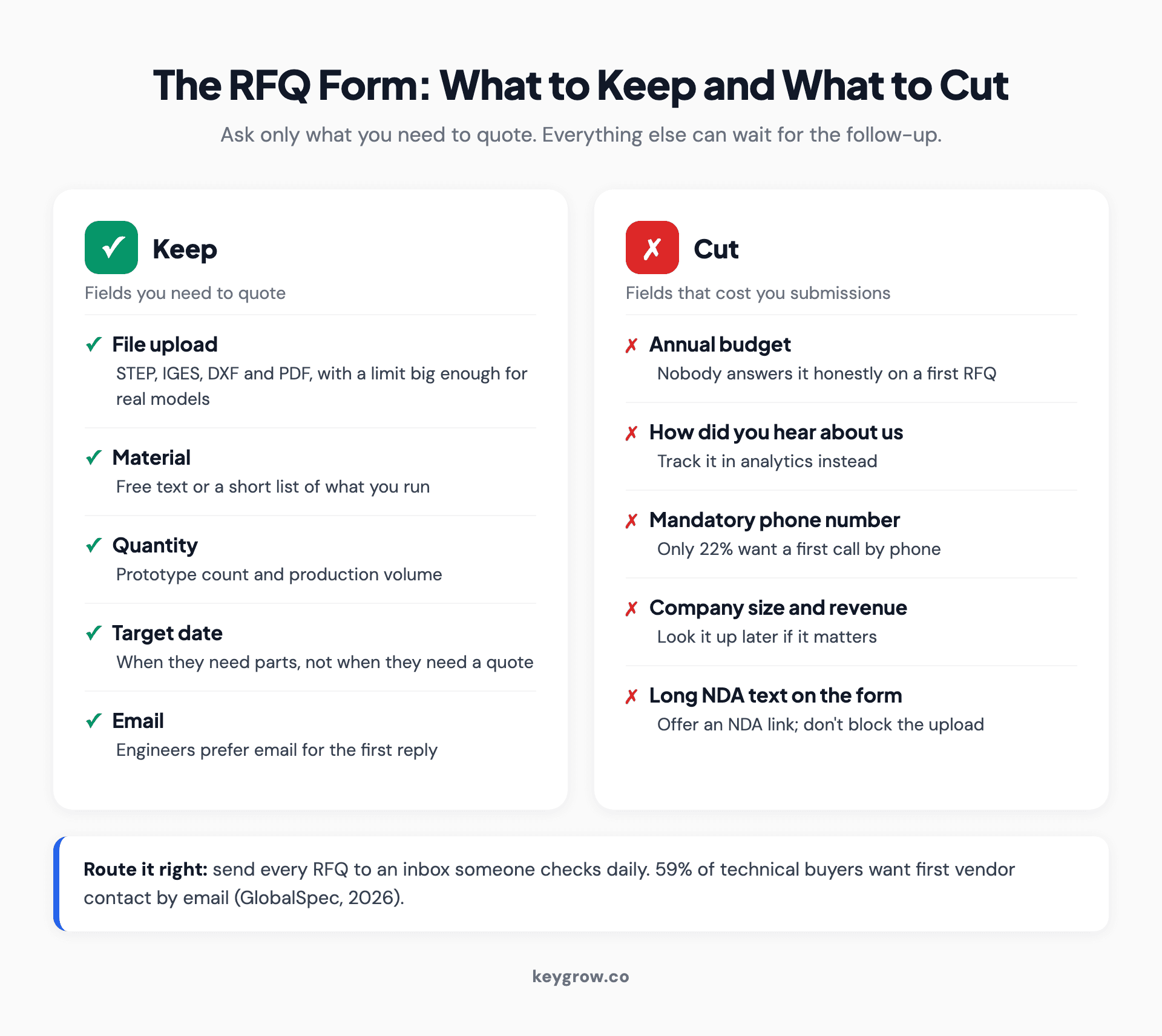
Two-column RFQ form guide for manufacturing websites: fields to keep, such as file upload for STEP, IGES, DXF and PDF, material, quantity, target date and contact email, and fields to cut, such as annual budget, how did you hear about us, and mandatory phone number.
One client story fits here, even though the client wasn't a manufacturer. An eviction law firm was getting 1 conversion a week from 22 clicks, at $240 per conversion. Visitors landed and didn't know what to do next. We rebuilt the page around one clear action, restructured the campaigns, and over September to October 2022 weekly conversions went from 1 to 21 and cost per conversion fell to $31.79. An RFQ page has the same job: one obvious next step.
Through distributors
If distributors sell most of your volume, your site has a different job. It should help a buyer find a distributor and help the distributor sell. That means a where-to-buy page or locator, datasheets anyone can download, and a gated area for price sheets, sales literature and stock files.
Be careful with list prices.
Publishing them can undercut the distributors who carry your line, so it's usually safer to keep pricing behind a distributor login.

Staff walking through a large distribution warehouse with stocked pallet racking, where a manufacturer's distributor channel moves most of its volume.
Through direct orders
If customers reorder standard parts from you, a reorder form or a customer login saves your inside sales team hours of phone calls. A full B2B ordering portal with account pricing is a bigger project, which brings us to the last question.
Question 4: Where does your product data live?
If your specs, prices and stock live in an ERP or a spreadsheet, decide early how much of it the website needs to touch. This single decision moves a project from a website budget to a software budget.
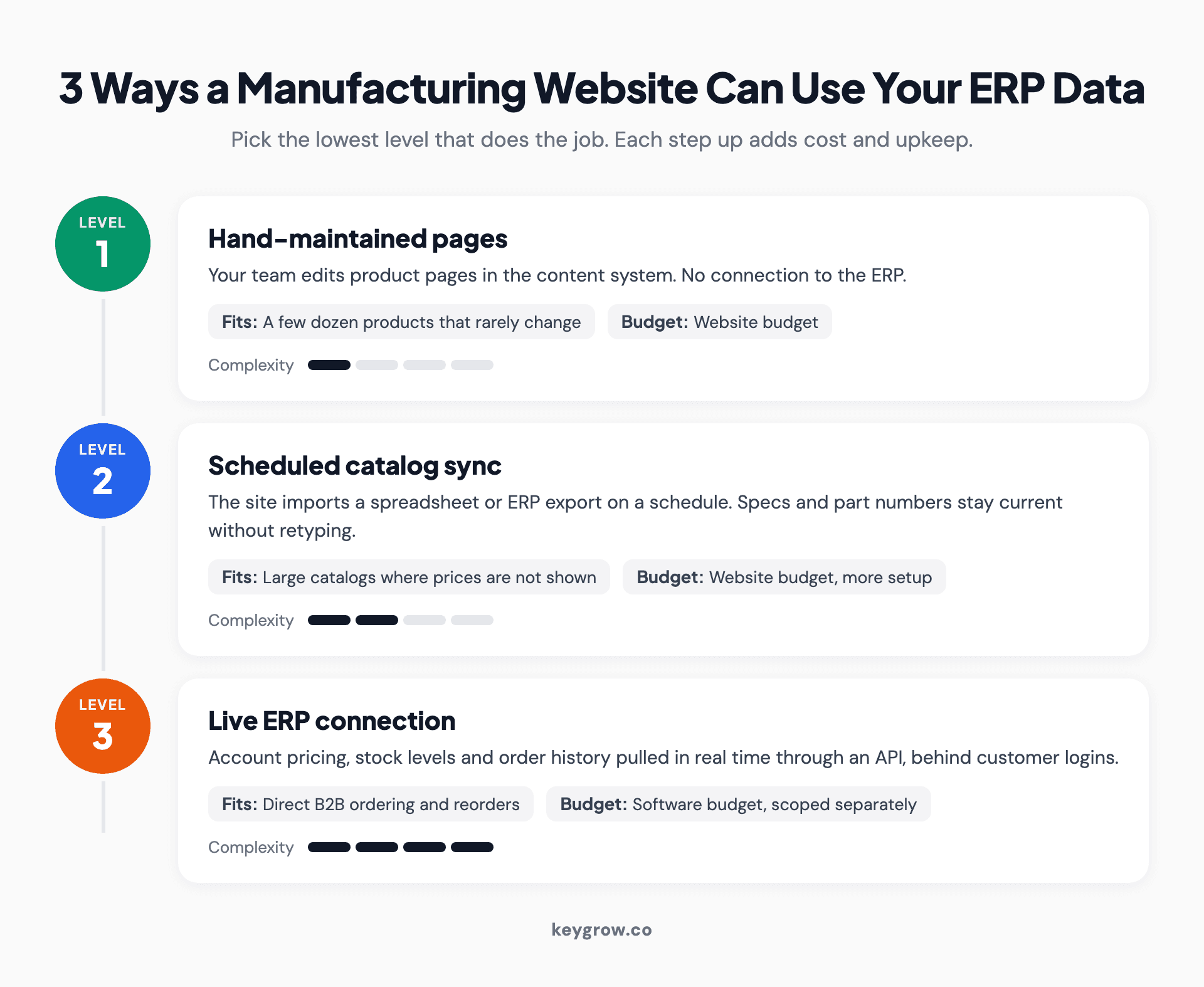
Three integration levels for a manufacturing website and its ERP: level one, hand-maintained pages for small catalogs; level two, a scheduled catalog sync from an ERP or spreadsheet export; level three, live pricing, stock and order history through an API, scoped as a software project.
Level 1, hand-maintained. Someone on your team updates product pages in the content system. Fine for a few dozen products that rarely change.
Level 2, scheduled sync. The site imports a catalog export on a schedule, so specs and part numbers stay current without retyping. This suits large catalogs where prices aren't shown.
Level 3, live connection. Account pricing, stock levels and order history pulled from the ERP in real time. That's custom software, and it should be scoped and priced as software.
One note on spec sheets, because the advice online points both ways. Google's documentation lists PDF as a file type it indexes, so your datasheets aren't invisible. But a PDF can't be filtered or compared, and a buyer on a phone won't open five of them. Put the core specs in an HTML table on the page and keep the PDF as the download.
Match your answers to a site type
Put your four answers together and most manufacturers land in one of five site types. The last column is what moves the price, so you can see why two quotes for "a manufacturing website" can be miles apart.
| Your answers | Site type | What it needs | What drives the cost |
|---|---|---|---|
| Sell capabilities, close by RFQ, small process list | Capabilities site | Process pages, equipment, quality, RFQ with uploads | Number of process pages and how much spec copy has to be written |
| Sell capabilities across many processes or industries | Bigger capabilities site | Everything above plus industry and application pages | More pages, plus industry and application content |
| Sell a product catalog, hand-maintained or synced | Catalog site | Product families, spec tables, datasheets, CAD downloads | Catalog size, spec tables, CAD and datasheet handling, any catalog sync |
| Sell through distributors | Channel site | Where-to-buy, open datasheets, gated distributor area | Catalog size and the gated distributor area |
| Live pricing, stock and ordering from the ERP | Ordering portal | Custom integration and account logins | ERP integration level, scoped as software |
Most of our builds run 6 to 8 weeks from discovery to launch, and simple sites 4 to 5 weeks. Expect the slow part of a manufacturing build to be content, not design: the equipment list, the cert numbers and the spec data. For sourced market ranges, our breakdown of what a website really costs covers them, and for your own numbers, the cleanest route is a quote against your four answers.
When you don't need a new website
You may not need a redesign at all.
If two or three customers send you nearly all your work and they found you through referrals, a new site won't change much.
In that case, fix three things yourself. Make the RFQ form accept drawing files and send to an inbox someone checks daily. Add an equipment list. Add a quality page with your certification numbers and expiry dates. That covers most of what a new buyer checks.
The same goes for a manufacturer that sells everything through distributors. Your site's job is open datasheets and a where-to-buy page, and you probably don't need to pay for search work yet.
A full build earns its cost when you want buyers you can't name, people searching for a process or a part you make. That's when search matters, and our piece on why SEO matters for B2B explains why a page with 18 visitors can still carry a six-figure deal. If you need RFQs this quarter rather than next year, B2B PPC is the faster channel, as long as the click lands on a capability page and not your homepage.
If you're comparing agencies, the questions in how to choose a web design agency apply here too. Ask to see a capability page they built, not a homepage.
FAQs
How much does a website for a manufacturer cost?
It depends on three things: how many process or product pages you need, how the site handles RFQs, CAD files and datasheets, and how much it connects to your ERP. A small capabilities site and a synced catalog are website projects. A portal with live pricing and stock is custom software and is priced as one.
What pages does a manufacturing website need?
At minimum: a page for each process or product family, an equipment list, a quality page with certification numbers, an industries or applications page, and an RFQ page that accepts drawing files. Catalog manufacturers also need spec tables and datasheet and CAD downloads. Channel-first manufacturers need a where-to-buy page.
Should manufacturers put prices on their website?
Only if you sell direct and your prices are stable. If distributors carry your line, public list prices can undercut them, so keep pricing in a gated distributor area. Job shops can't price custom work online and should make the RFQ path fast instead.
Should spec sheets be PDFs or web pages?
Both. Google can index PDFs, but buyers can't filter or compare specs inside them, and they're hard to read on a phone. Put the core specs in an HTML table on each product page and offer the PDF as a download.
How long does it take to build a manufacturing website?
Most sites take 6 to 8 weeks from discovery to launch, and simple sites 4 to 5 weeks. Large catalogs or ordering portals run 10 to 12 weeks or more. The usual delay is gathering equipment lists, certification details and spec data, so start collecting them before kickoff.
Is a template good enough for a manufacturer?
For a small job shop, often yes, as long as it supports file uploads on the RFQ form and lets you build a proper spec table. Templates struggle with large catalogs, product filtering and distributor logins. Pick based on your four answers, not on how the demo looks.
What to send your web designer
Before the first call, gather these. A designer who has them can scope your site in one meeting instead of four.
- Your buyer list. Which visitor type brings the most revenue: engineers, purchasing, distributors or repeat customers.
- Your last 20 RFQs or orders. They show what people ask for, in their own words.
- The equipment list, with machine models, work envelopes and capacity.
- Certification numbers and expiry dates, plus any customer approvals you can name publicly.
- Sample datasheets and the CAD formats you offer.
- The file types your RFQ form must accept and who should receive each submission.
- Where your product data lives (ERP, spreadsheet, nowhere) and whether it can export.
- Your distributor list and what they need from you.
- Three supplier sites your buyers mention, good or bad.
If you'd like us to take that pack and quote it, our web development team builds manufacturing sites, and you can request a quote here.