

Most advice on how to choose a web design agency hands you a list of questions and leaves you to score the answers. That is the hard part, and it is the part nobody helps with. Any competent salesperson can answer twenty questions well.
So this is organized around the decision instead of the interview. Three stages: work out what you are actually buying, filter the shortlist using things you can verify without a meeting, then use the call to test the two or three claims that cannot be checked any other way.
The single most expensive mistake in this category is not hiring a bad designer. It is hiring a good designer to do a job that also required somebody who understands search, and finding out four months after launch when the traffic never came back.
First, work out what you are actually buying
Web design covers at least four different products sold under one name, at prices that differ by a factor of fifty. Being clear on which one you need saves you from comparing quotes that were never comparable.
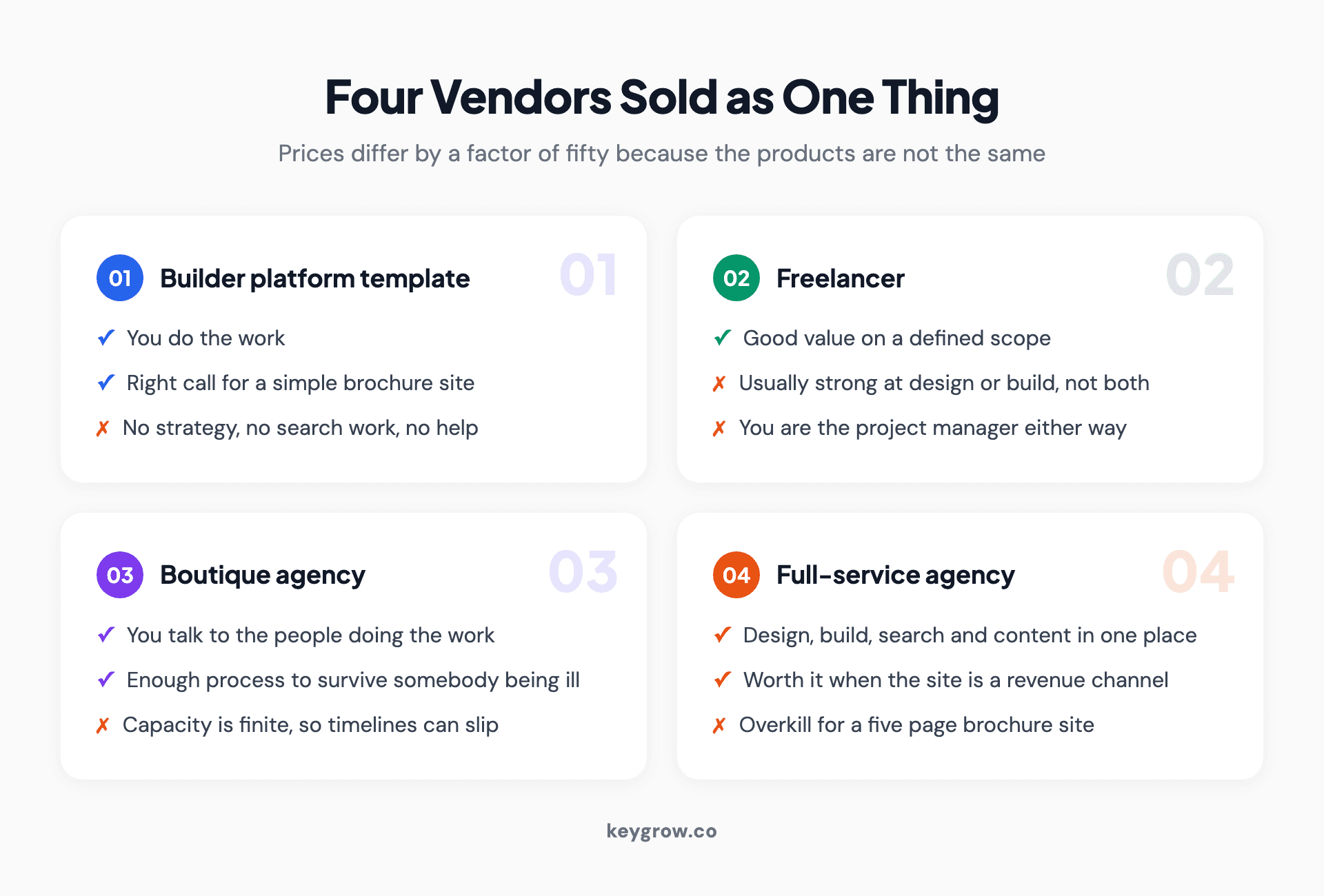
Four types of web design vendor compared: builder platforms, freelancers, boutique agencies and full-service agencies, with what each is right for.
A builder platform with a template. You do the work. Genuinely fine for a simple brochure site, and the right call more often than agencies admit.
A freelancer. One person, usually strong in either design or development rather than both. Good value, real key-person risk, and you are the project manager whether you planned to be or not.
A boutique agency. A handful of people who between them cover design, build and sometimes content. Enough process to survive someone being ill, small enough that you talk to the people doing the work.
A full-service agency. Design, development, SEO, content, sometimes paid media under one roof. Costs more, and worth it when the site is a revenue channel rather than a brochure.
The question that sorts you is not budget, it is what the site is for. A site that exists so people can confirm you are real needs a template and good photography. A site that is your primary route to new customers needs somebody thinking about how people find it, not just how it looks. Those are different purchases. Our breakdown of what a website actually costs covers the money side in detail.
What you can verify before you ever get on a call
Shortlisting on portfolios alone is how people end up with beautiful sites nobody visits. Before you book anything, run four checks that take about twenty minutes total and cannot be talked around.
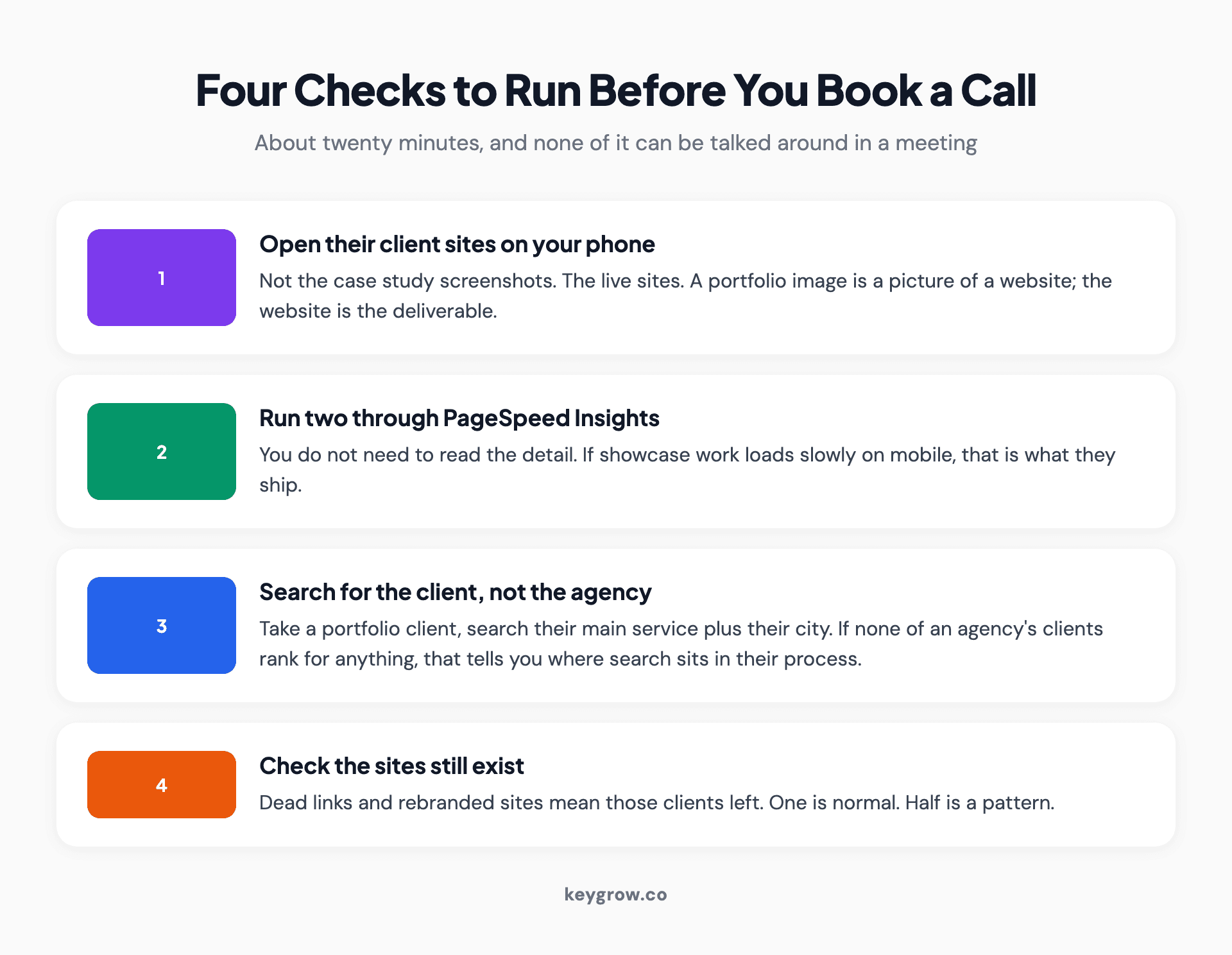
Four checks to run on a web design agency before booking a call: load their live client sites, test speed on mobile, search for the client, and check the site still exists.
Open their client sites on your phone. Not the case study screenshots, the live sites. A portfolio image is a picture of a website. The website is the deliverable.
Run two of those sites through PageSpeed Insights. You do not need to interpret the detail. If an agency's showcase work loads slowly on mobile, that is what they ship.
Search for the client, not the agency. Take a portfolio client, search their main service plus their city, and see whether they appear. If none of an agency's clients rank for anything, that tells you where search sits in their process.
Check the sites still exist. Dead links and rebranded sites in a portfolio mean those clients left. One is normal. Half is a pattern.
None of this proves an agency is good. It reliably tells you when one is not, which is what a filter is for.
The portfolio question everybody asks wrong
In the meeting, the instinct is to react to the work: this one is nice, that one is a bit busy. Your taste is not the thing being tested.

A small agency team reviewing website designs together in an office.
Ask about one project in their portfolio: what was the client trying to fix, what did you change, and what happened to their numbers afterwards.
The answer sorts agencies quickly. A design-led shop describes the visual direction and the client's reaction to it. A business-led shop describes the problem, the decision, and a measurement. Neither is wrong, but only one of them is going to care whether your site makes money.
Push once more: can you introduce me to that client. Agencies with happy clients say yes and take a week to arrange it. Agencies that dodge the question are telling you something.
A related test that costs nothing: ask what the site did before and after. Website rebuilds should move numbers you can see. In our own work a security company's conversion rate went up 95 percent within four weeks of a rebuild, and a law firm's went up 70 percent in three. Those are ordinary outcomes for a page built around a specific action, and any agency that has done this work should be able to name similar numbers of their own.
The question that separates two kinds of agency
Here is the one that matters most, and it is barely mentioned on any of the question lists you will find.
Ask: what happens to my existing URLs and rankings when the new site goes live, and can you show me a redirect map from a previous project.
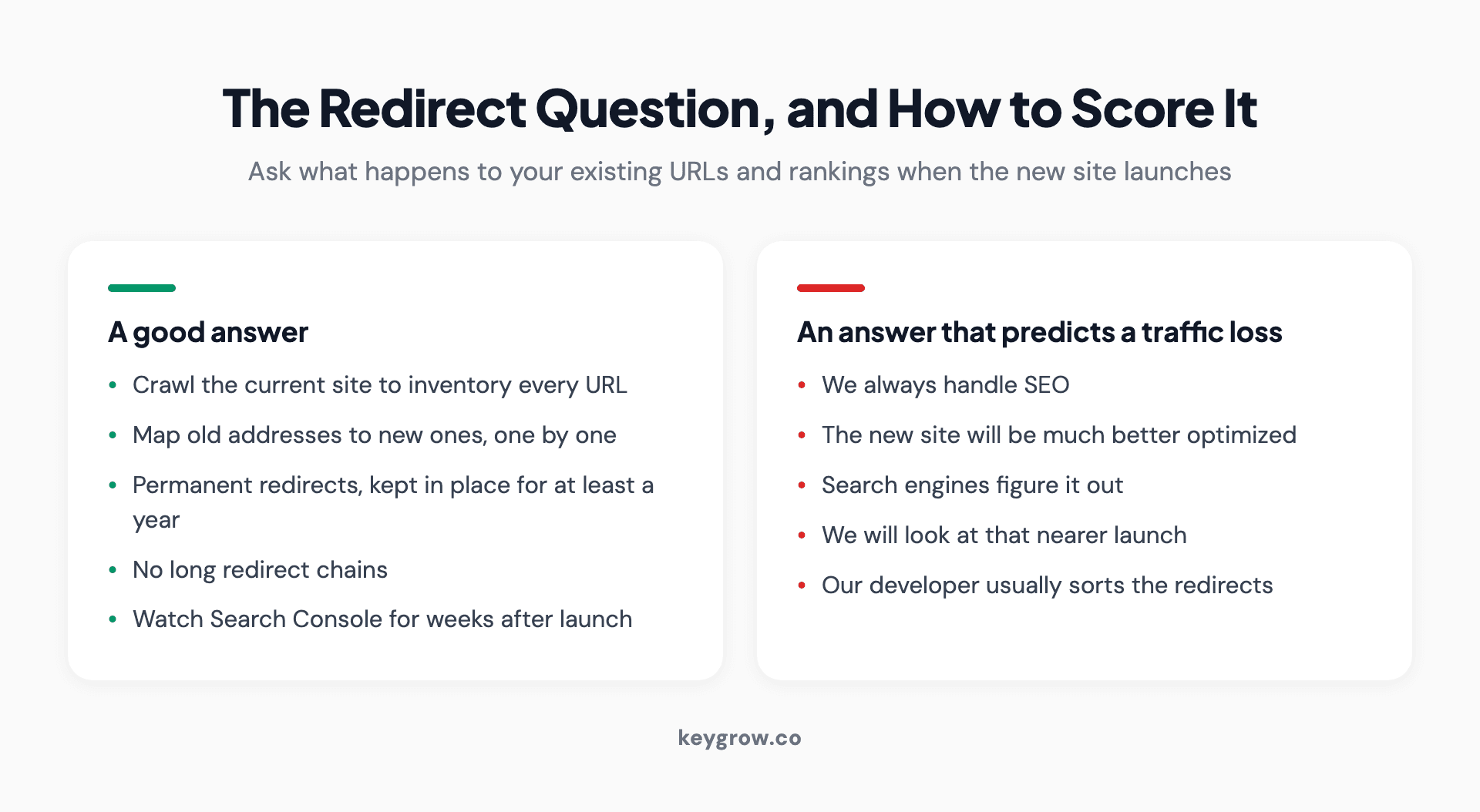
Two columns contrasting a strong answer about redirect planning with the vague answers that predict a traffic loss after launch.
A good answer sounds specific and slightly boring. They will talk about crawling your current site to inventory every URL, mapping old addresses to new ones one by one, using permanent redirects, and watching Search Console for weeks after launch. Google Search Central tells site owners to keep those redirects in place for at least a year and to avoid chaining more than a few together, and an agency that has done this will already know that.
A bad answer sounds reassuring and vague. We always handle SEO. The new site will be much better optimized. Search engines figure it out.
They do not figure it out. A rebuild that changes URLs without a redirect map hands Google a site full of addresses that no longer exist, and the rankings that took years to earn go with them. The recovery is slow and sometimes incomplete. We wrote up the full process in our guide to redesigning a website without losing SEO, and it is worth skimming before the meeting so you can tell whether the answer you get is real.
If your site currently gets meaningful organic traffic, this single question should carry more weight in your decision than the entire portfolio.
Who is actually going to do the work
Agencies sell with their best people. Not all of them deliver with their best people, and that is not automatically a problem as long as you know before you sign.
Ask three things. Who will I speak to week to week after we start. Will the person presenting today be involved in the build. What happens if that person leaves mid-project.
The answers you want are names and a plan, not reassurance. An agency using contractors or an offshore development team is not doing anything wrong, and plenty of them do excellent work. An agency hiding it is a different matter, because the thing they are hiding from you now is the thing you will be arguing about in month three.
Worth asking about AI as well, since it is now sitting in the middle of this. Not as a gotcha. Used well it speeds up the boring parts of a build. Used badly it produces twelve pages of generic copy that reads like every competitor's site. The answer you want is a clear account of where they use it and where a human still writes and reviews.
How to take a reference call that is worth taking
Every reference an agency hands you will say they were great to work with. That is what references are selected for. The call is still worth twenty minutes if you ask questions that have an uncomfortable answer.
Skip "how was it" entirely. Ask these instead:
Did it launch on the date you were originally given? Almost nothing launches on the first date. What you are listening for is whether they were told early and honestly, or found out when the date passed.
What did you get billed for that you assumed was included? Every project has one. A reference who says nothing at all either had an unusually tight scope or is not being candid.
What went wrong, and how did they handle it? The handling matters more than the problem. An agency that fixed something at its own cost has told you what it is like when things go sideways.
How long did they take to answer you after launch? Responsiveness drops once the invoice is paid at some agencies, and the people who have lived through that will say so.
Would you hire them again for a bigger project? The best question in the set. "Yes, definitely" and "yes, probably" are different answers, and the pause before either one is informative.
Ask for a reference whose project resembles yours in size and complexity. A glowing reference from a $40,000 ecommerce build tells you very little about how the agency handles a $6,000 brochure site, and vice versa.
What a real process looks like in the first two weeks
Process is easy to describe and hard to fake once you know what to look for, because a real one produces artifacts.
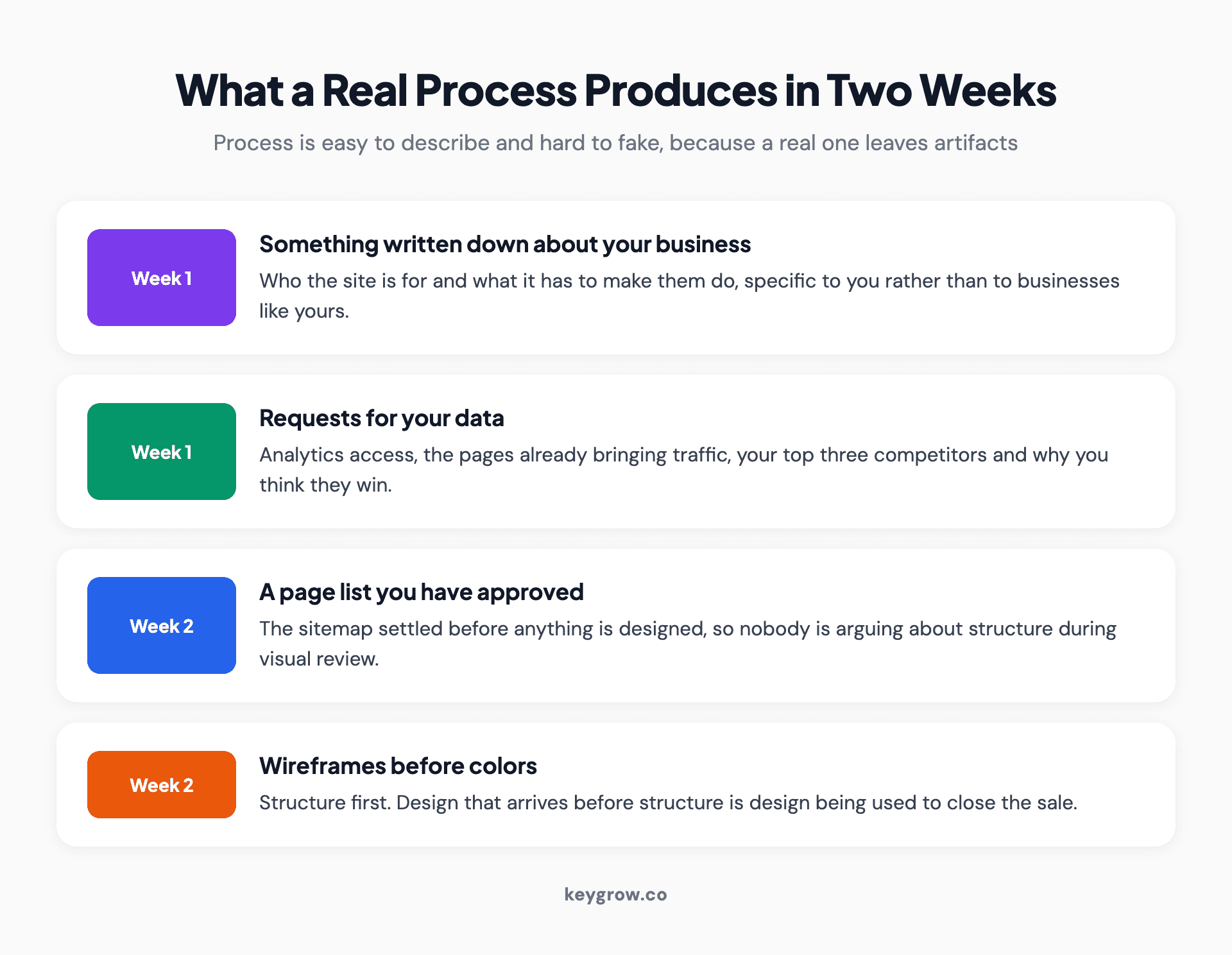
Four artifacts a real web design process produces in its first two weeks: a written brief, requests for your analytics and competitors, an approved page list, and wireframes before colors.
In the first fortnight of a properly run project you should see something written down that is specific to your business: a summary of who the site is for and what it has to make them do, a sitemap or page list you have approved, and a wireframe or structural layout before anybody picks colors. Design that arrives before structure is design being used to close the sale.
You should also be asked for things. Access to your analytics so they can see which pages already work. A list of the pages currently bringing in traffic. Your top three competitors and why you think they win. An agency that needs none of that before starting is going to build from assumptions.
If the first deliverable is a full visual mockup of the homepage in week one, be a little careful. It is impressive and it is usually a template with your logo on it. The homepage is the last page that should be designed, not the first, because it summarizes pages that do not exist yet.
What you own when it is over
Ownership is where friendly projects turn unpleasant, usually about two years later when you want to change agency.
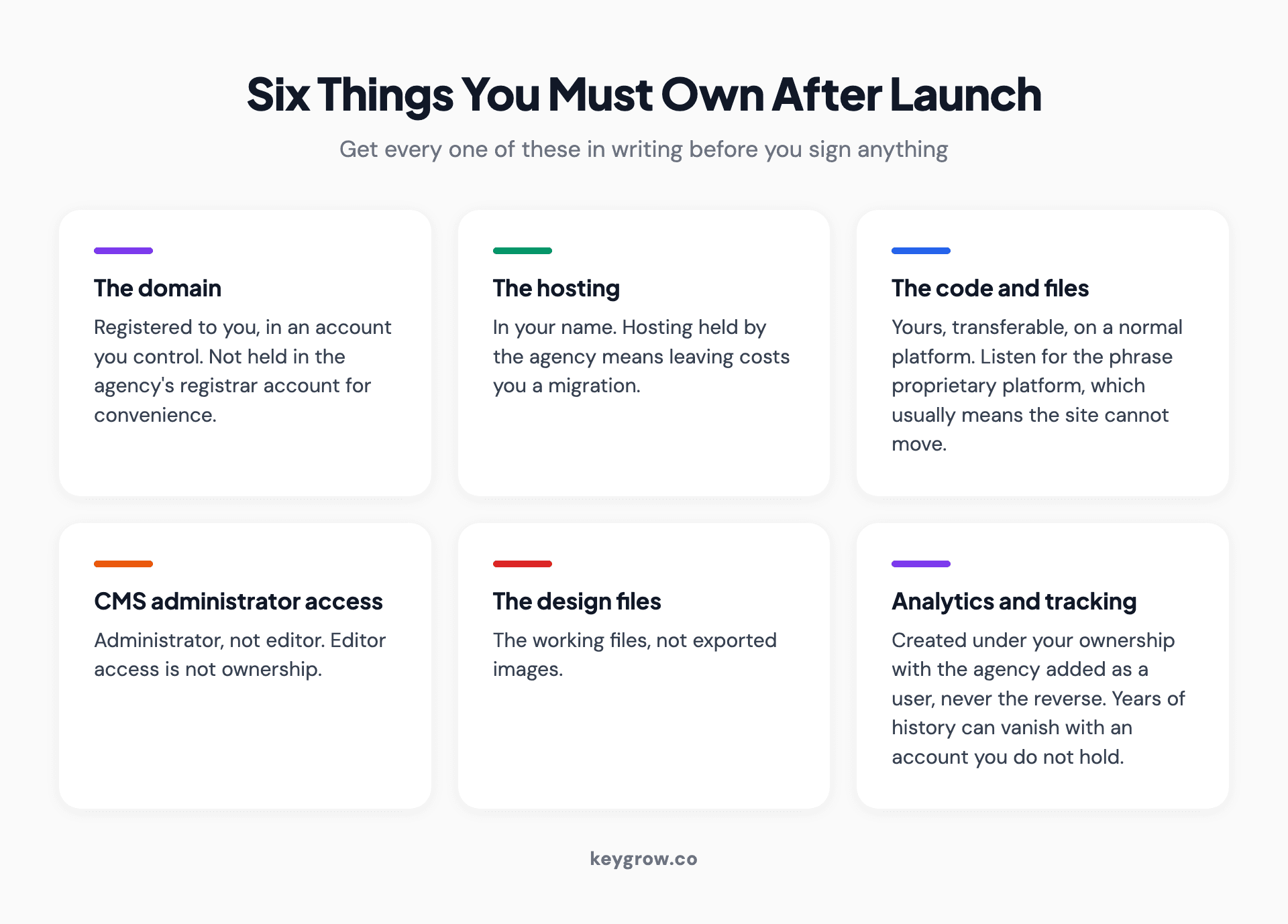
Six assets to confirm ownership of before signing: the domain, hosting, the site code, CMS administrator access, design files, and analytics and tracking accounts.

Lines of website code displayed on a monitor.
Get all six of these in writing before you sign:
The domain. Registered to you, in an account you control. Not in the agency's registrar account "for convenience."
The hosting. Same principle. Hosting held by the agency means leaving costs you a migration.
The code and the site files. Yours, transferable, on a normal platform. The phrase to listen for is "our proprietary platform," which usually means the site cannot move.
Administrator access to the CMS. Not editor access. Administrator.
The design files. The working files, not exported images.
Analytics and tracking accounts. Created under your ownership with the agency added as a user, never the reverse. Losing years of historical data because it lived in somebody else's account is a genuinely common and entirely avoidable loss.
Ask the direct version: if we part ways in eighteen months, what do I walk away with and what stays with you. A good agency answers this immediately, because they have been asked before and the answer is everything.
Pricing models, and what each one pays them to do
Every pricing structure creates an incentive. None of them are dishonest. They just push behavior in different directions, and it helps to know which way yours pushes.
| Model | What it pays them to do | Watch for |
|---|---|---|
| Fixed project fee | Finish efficiently and move on | Scope defined tightly, extras billed |
| Hourly or day rate | Be thorough, and be slow | No ceiling unless you set one |
| Monthly retainer | Keep improving the site | Paying for maintenance you do not need |
| Subscription site | Keep you subscribed | You often never own the site |
| Value or performance based | Move a specific number | Rare, and needs agreed measurement |
Subscription website deals deserve a closer look. Low monthly fee, no big upfront cost, and the site remains the provider's property for as long as you pay. That can be a sensible trade for a business that wants no capital outlay. It is a bad surprise for a business that assumed they were buying an asset. Read which one you signed.
Whatever the model, ask what the number covers and what it does not. Copywriting, photography, stock licensing, forms, integrations, training, and the first month of fixes after launch are the line items that most often turn out to be extra.
Scope, revisions, and the words that start arguments
Most agency disputes are not about quality. They are about whether something was included.

A project team discussing a website plan around a meeting table.
Four things to pin down in writing:
How many pages. Specifically, and what counts as a page. A template applied to forty product pages is not forty pages of design work, and both sides should agree on that before anyone starts.
How many rounds of revisions. And what a round is. One consolidated set of feedback, or every email you send.
Who writes the copy. This is the single biggest cause of stalled projects. Agencies commonly assume the client supplies content, clients commonly assume it is included, and the project sits waiting for text for six weeks.
What happens after launch. How long are bugs fixed for free, what counts as a bug rather than a change, and what ongoing support costs.
Accessibility belongs in the scope conversation too, and it is more than a nice-to-have in the United States. The Department of Justice has stated its position that the ADA's requirements apply to what public accommodations offer on the web, and it points to the Web Content Accessibility Guidelines as the practical standard even though it has not written those into a regulation. Ask whether accessibility is in scope or extra. Agencies that have thought about it will have an answer ready.
Red flags that should end the conversation
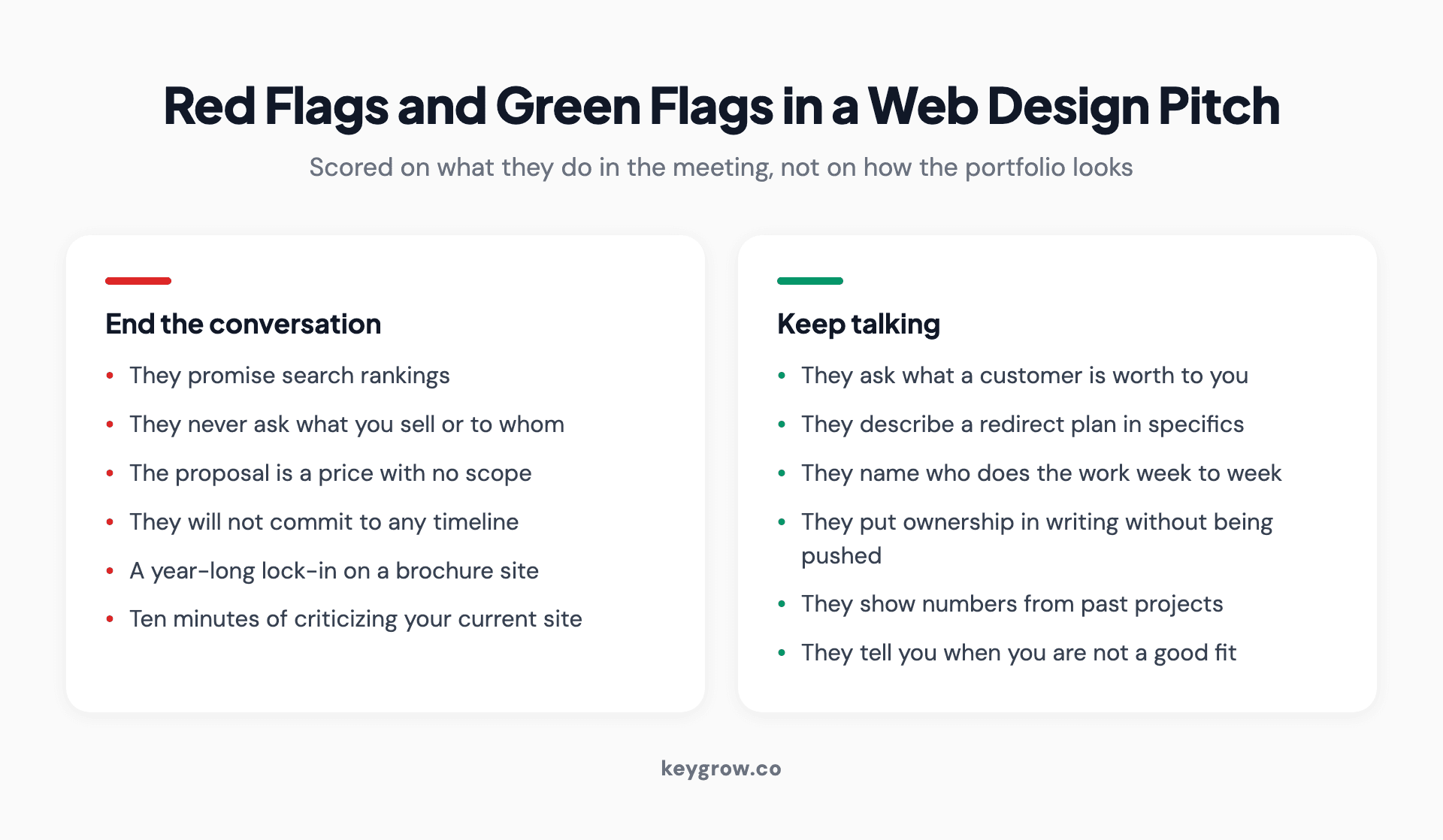
Two columns contrasting red flags in a web design pitch with the green flags that suggest a competent agency.
They promise rankings. Nobody can promise search positions. An agency saying otherwise is either inexperienced or counting on you not checking.
They never ask about your business. If the discovery call is entirely about design preferences and never reaches what you sell, to whom, and what a customer is worth, the strategy is going to be decorative.
The proposal is a price with no scope. A number with no deliverables attached is not a quote, it is an opening position.
They will not name a timeline. Projects slip. Agencies that refuse to commit to any dates at all are telling you about their capacity.
The contract locks you in for a year on a brochure site. Long lock-ins on ongoing services can be reasonable. On a one-time build with a maintenance plan attached, ask what the lock-in is protecting.
They badmouth your current site in the first ten minutes. Confidence is fine. An opening that consists of listing everything wrong with what you have, before asking why any of it is the way it is, usually predicts how the rest of the relationship goes.
What a good agency asks you
Reverse the test. The questions coming back at you tell you more than the answers going out.
An agency worth hiring wants to know what a customer is worth to you, where your leads come from now, what has failed before and why, who inside your business has to approve things, and what you will consider a win twelve months from now.
If nobody asks any of that, you are being sold a website rather than being helped to buy one.
The customer value question is the load-bearing one. An agency that knows a new client is worth $4,000 to you will argue for different things than an agency that does not, because at that number a single extra lead a month pays for the entire build inside a year. An agency that never asks has no way to tell whether it is recommending something sensible or something expensive.
The strongest signal of all is an agency telling you that you are not a good fit. It happens rarely because it costs the agency money, which is exactly why it is worth something. We run a whole not-qualified path on our own site for the same reason: a business we cannot help is a bad month for us and a bad year for them.
When you should not hire a web design agency
The honest section. Plenty of businesses reading this do not need an agency at all.
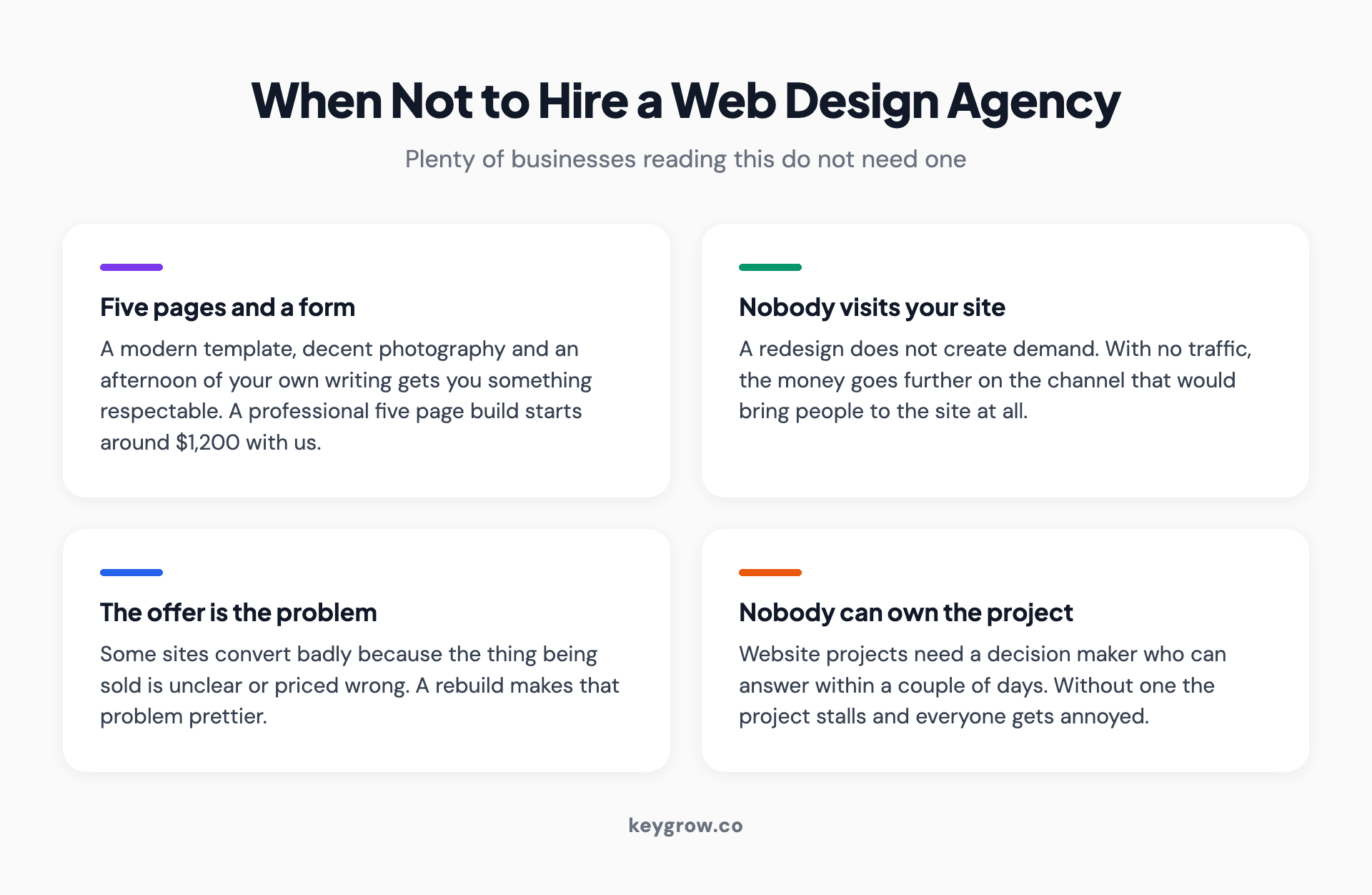
Three situations where a web design agency is the wrong purchase: a simple brochure site, a business with no traffic to redesign, and a budget below the cost of a professional build.
You need five pages and a contact form. A modern template, decent photography and an afternoon of your own writing will get you something respectable. A professional five page build starts around $1,200 with us, and below that budget you are buying a worse version of what the template already gives you.
Nobody visits your current site. A redesign does not create demand. If you have no traffic, the money goes further on the channel that would bring people to the site in the first place, and the redesign can wait until there is something to convert.
The real problem is the offer, not the presentation. Some sites convert badly because the thing being sold is unclear or priced wrong. A rebuild makes that problem prettier.
You cannot dedicate anyone to it. Website projects need a decision maker on your side who can answer questions within a couple of days. Without one, the project stalls, the agency moves other work in front of yours, and everyone gets annoyed. If nobody has the time this quarter, start next quarter.
FAQs
How much should a web design agency cost?
It depends on what you are buying rather than who you are buying from. Template-based brochure sites sit at the low end, custom marketing sites with strategy, copy and search work sit considerably higher, and ecommerce and integrations push it higher again. Compare quotes on scope, not on headline price.
What is the most important question to ask a web design agency?
Ask what happens to your existing URLs and rankings when the new site launches, and ask to see a redirect map from a previous project. It is the one question that separates agencies that understand search from agencies that only understand design, and getting it wrong is the most expensive mistake in the category.
Should I hire a local web design agency?
Location matters less than it used to, and for most projects it is not a deciding factor. It helps if your site needs a lot of on-site photography, or if your business is the kind where somebody genuinely needs to see the operation to describe it. Otherwise judge on the work and the process.
Who owns the website after it is built?
You should, and it should be written down. Confirm the domain, hosting, code, CMS administrator access, design files and analytics accounts are all in your name. Watch for proprietary platforms and subscription arrangements where the site stays with the provider.
How long does a website redesign take?
A small brochure site is typically a few weeks. A custom marketing site is commonly two to four months. Most delays come from content rather than build work, so the timeline depends heavily on who is writing the copy and how fast approvals come back from your side.
Do web design agencies handle SEO?
Some do properly, some do a checklist, and some do neither while saying they do. The difference shows in whether they can talk specifically about redirect mapping, page structure and measurement rather than generally about being SEO friendly. Ask for a client example and check whether that client ranks.
A short scoring sheet
If you take one thing into your next call, take this. Score every agency on four things rather than on how much you liked the presentation: what you verified about their live client work before the meeting, whether they can describe a redirect plan in specifics, what you will own if you leave, and whether anybody on their side asked what a customer is worth to you.
An agency that clears all four is a reasonable hire even if their portfolio is not the prettiest one you saw. An agency that fails the redirect question is a risk regardless of how good the work looks.
If you would like the web development side handled by people who treat rankings as part of the build rather than as somebody else's problem, tell us what you have now and we will tell you honestly whether a rebuild is what you need.


