

A business owner gets a slick new website, signs off the invoice, and assumes search traffic is handled. Six months later, the site has near-zero organic visitors and nobody can explain why. The confusion almost always traces back to one question: is SEO part of web development? The honest answer is yes and no. Part of SEO gets built into the site during development and part of it never stops, long after the developer has logged off. The trick is knowing exactly where that line sits, because mixing them up is how people end up paying twice or assuming a job is done that has barely started.
Organic search is too big to leave to chance. It drives 53 percent of all trackable website traffic, the largest share of any channel, according to BrightEdge research reported by Search Engine Land. Getting the split right decides whether your most valuable traffic channel actually works.
The one-line answer: some of SEO is built in, some of it never ends
Technical SEO is genuinely part of web development. Content, keywords, and authority are a separate, ongoing job that no developer finishes.
That is the whole thing in one sentence. A web developer can and should wire in the technical foundations while the site is being built: crawlability, page speed, semantic HTML, sane URLs, redirects, canonical tags, and the scaffolding for structured data. Those are code decisions, made once, at build time. What a developer cannot do is "finish" your SEO, because the other half (writing pages that match what people search, earning links, and refreshing it all over time) has no finish line. It runs for as long as you want to rank.
So when a developer says "SEO is included," the right follow-up is which half. Most web build contracts cover the technical basics and stop there. That is reasonable. It is also the exact gap that surprises clients who assumed "included" meant the whole discipline.
What technical SEO actually shares with web development
Technical SEO is the part of search optimization that lives in code: how a site is structured, how fast it loads, and how easily a search engine can read it. All of that is built during development.
Here is the part that overlaps, point by point:

A web developer at a desk working on a website build with code displayed on the monitor
None of those require a marketing brain. They require a developer who knows that search engines exist and builds accordingly. A useful test of whether your build covered them is to run the site through a technical SEO audit, which checks exactly this list.
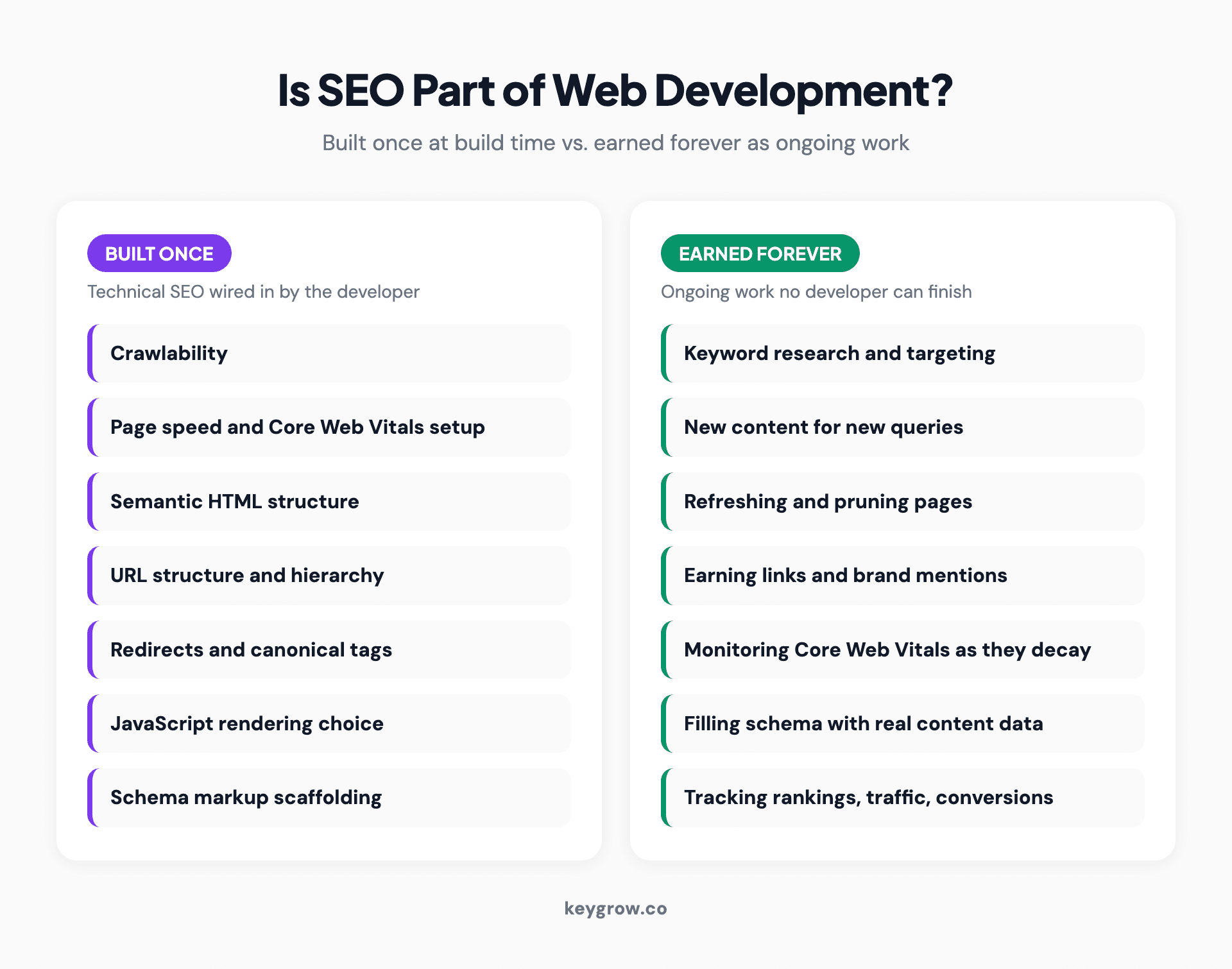
Infographic mapping which SEO tasks are built once during web development versus which are earned forever as ongoing work, shown as two left-accent columns: the built-once column lists crawlability, page speed, semantic HTML, URL structure, redirects and canonicals, and schema scaffolding; the earned-forever column lists content and keyword targeting, link earning, content refreshes, and rankings and traffic monitoring.
Why JavaScript sites prove SEO is a code decision, not a bolt-on
On JavaScript-heavy sites, search visibility is decided in the code itself. Google reads a page in two passes, and if the build gets it wrong, your content may sit unindexed for far longer than you would expect.
This is the strongest reason technical SEO cannot be a marketing add-on, and almost nobody explains it. Per Google Search Central, Googlebot crawls a page's raw HTML first, then queues the JavaScript rendering for later. Google says a page may stay on that queue for a few seconds, but it can take longer than that, and in practice the wait stretches to days or weeks on large or low-priority sites. If your site is built so the content only appears after JavaScript runs (common with frameworks like React or Vue rendered in the browser), Google may read an empty shell on the first pass and not see your real content until the render queue catches up, if it ever does.
You cannot fix that with a content calendar or a link campaign. The fix is a rendering decision made during development: server-side rendering, static generation, or pre-rendering so the content exists in the HTML before any JavaScript runs. That is a code choice, made by the developer, at build time. Get it wrong and the best content in the world sits invisible. This is why "we will add SEO later" falls apart on modern sites: how your content gets rendered for search engines is baked into the architecture, and retrofitting it can mean re-engineering the front end.
Core Web Vitals: tuned at build, then they quietly decay
Core Web Vitals are Google's page-experience metrics for loading, responsiveness, and visual stability. They are set up during development and they slip over time, which is why they straddle both sides of the line.
There are three, and they are worth naming because most articles either skip them or treat them as a giant ranking factor (they are not). In March 2024, Interaction to Next Paint (INP) replaced First Input Delay as a Core Web Vital, per Google's page experience documentation. The three are:
Two honest caveats. First, page experience is a ranking signal, but Google is explicit that it does not replace relevance. Fast and stable will not save a page that does not answer the query. Second, these are tuned at build (lazy loading, reserved image dimensions, lean scripts) and then they degrade. Someone adds a chat widget, a tracking script, three plugins, and a few uncompressed hero images, and six months later the scores have slid. They start as a development job and become a maintenance one.
Speed is not a vanity metric here. Think with Google found that as mobile load time goes from one second to three seconds, the probability of a bounce rises 32 percent; at five seconds it is up 90 percent, and at six seconds 106 percent. Every extra second is people leaving before they read a word.
The other half: content, keywords, and authority no developer can finish
Content SEO and authority building are a separate discipline with no end state. A developer can build the fastest, cleanest site on earth, and it will still rank for nothing if there is no content worth ranking and no signals of trust pointing at it.
This is the half people forget when they ask if SEO is part of web development. It includes:
Here is the opinion, and it is backed by a number: SEO is a compounding asset, not a one-time deliverable, and pretending otherwise is how businesses waste money. Ahrefs found that only about 1.74 percent of newly published pages reach Google's top 10 within a year, while the average number-one page is around five years old. You do not buy that with a website build. You earn it over time, which is the entire premise of ongoing SEO.
We watched this play out with a doctor's practice in Dubai. The technical foundation was sorted early, but months one through three looked unimpressive. By month twelve, organic traffic had grown 1,519 percent and the practice was fielding 130-plus patient calls a month. Same site, same client. The difference was twelve months of content and authority work the developer was never going to "finish."
Built once versus earned forever: the boundary map
The cleanest way to think about it: some tasks are built once during development and then mostly left alone, and some are earned forever and never stop. Here is the line drawn explicitly.
| Built once during development | Earned forever (ongoing) |
|---|---|
| Crawlability (robots.txt, sitemap, internal links) | Keyword research and targeting |
| Page speed foundation and Core Web Vitals setup | New content for new queries |
| Semantic HTML structure | Refreshing and pruning existing pages |
| URL structure and hierarchy | Earning links and brand mentions |
| Redirects and canonical tags | Monitoring Core Web Vitals as they decay |
| Schema markup scaffolding | Filling in schema with real content data |
| Mobile-responsive build | Tracking rankings, traffic, conversions |
A few things straddle the line, and that is the honest part. Core Web Vitals get set up once and then need ongoing attention. Schema gets scaffolded in code but filled with content that changes. The middle column is not "optional extras." It is the work that actually moves you up the results, sitting on top of a foundation the build provides.
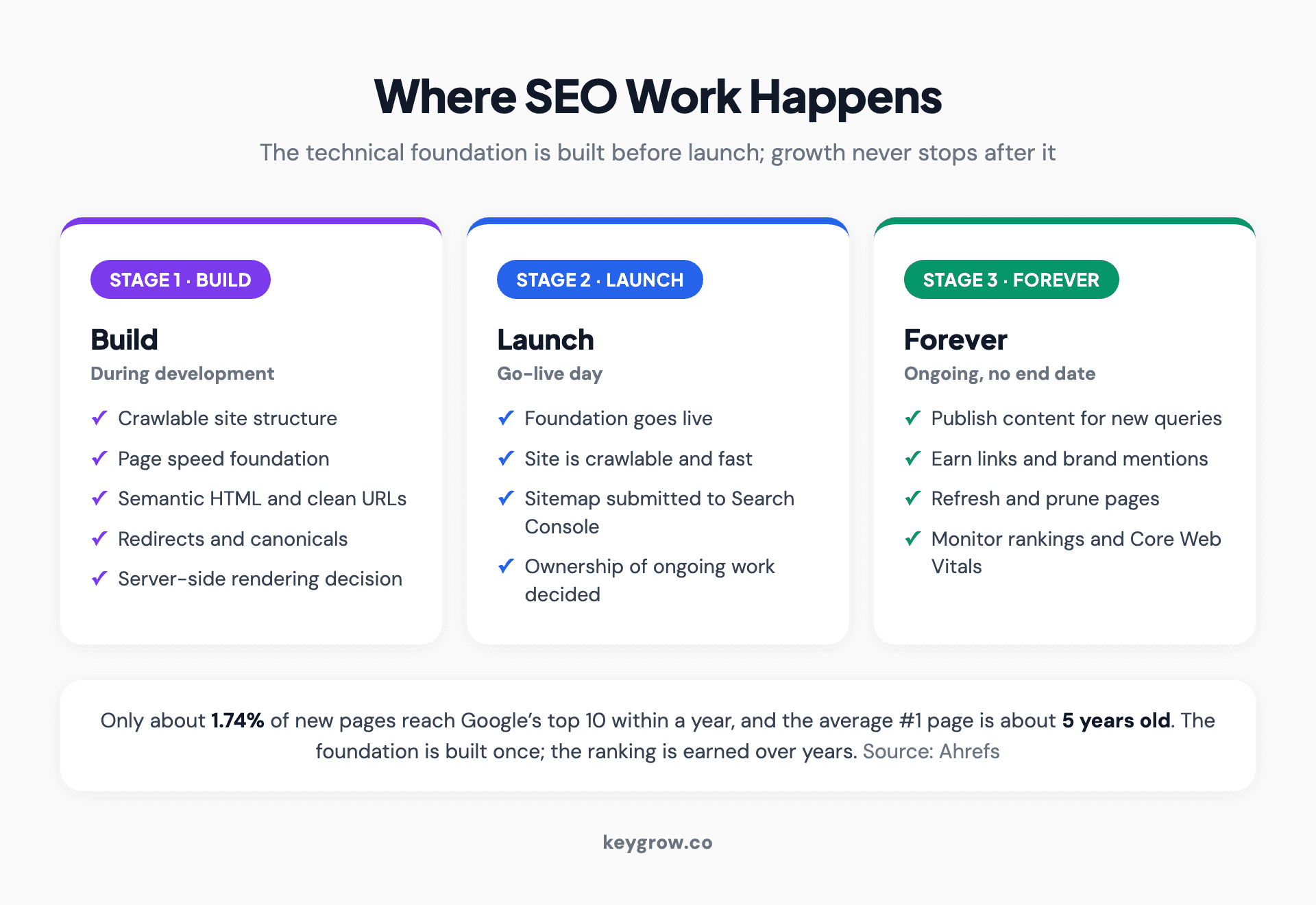
Infographic showing a three-stage horizontal flow for where SEO work happens across a website lifecycle: stage one Build, the developer wires in crawlability, speed, semantic HTML, URLs, redirects and rendering; stage two Launch, the technical foundation goes live and the site becomes crawlable and fast; stage three Forever, the ongoing team publishes content, earns links, refreshes pages and monitors performance with no end date.
What it actually costs to retrofit SEO after launch
Bolting SEO on after launch is more expensive than building it in, sometimes dramatically. The damage shows up as migrations, redirect maps, re-architected navigation, and re-rendering work that a build-time decision would have avoided for free.
People say "do not add SEO later" without showing why. Here is the why. If the URLs were structured carelessly, fixing them means changing every URL and building a redirect map so you do not lose existing ranking signals, the same delicate work involved in any website redesign without losing SEO. If the navigation buried important pages, fixing crawlability means re-architecting the site. And if the site renders content only in the browser, making it indexable can mean re-engineering the rendering layer, close to a partial rebuild.

Sticky notes and a marker laid out on a desk beside a computer during website planning
Compare that to the build-time cost: structuring URLs well, adding a sitemap, and choosing server-side rendering cost a developer almost nothing extra if they think about it from the start. The expense is not the work. It is doing the work twice. The honest caveat: if your site is tiny, already fast, and already indexed fine, you do not need to tear anything up chasing a perfect technical score. Retrofitting is only worth it when something is actually broken or costing you traffic.
Who owns what: is your developer's scope enough?
Most web development contracts include technical SEO basics and exclude content and off-page work. Whether that is enough depends on whether anyone is handling the ongoing half, and that is the question to settle before you sign anything.
Use this as a plain accountability check. The developer's scope should cover the build-time column: crawlable structure, decent speed, semantic HTML, clean URLs, redirects, canonicals, mobile-responsive, and schema scaffolding. Ask directly whether each is included, because "SEO-friendly" on a proposal can mean anything from all of it to none of it.
What is almost never in a build contract: keyword research, ongoing content, link building, and monitoring. If nobody owns that column, your site will be technically fine and commercially invisible. That work goes to an in-house person, you, or a separate SEO partner.
And here is the when-not-to-hire moment. If you run a single-location business with more time than money, you do not need to pay anyone for the early ongoing work. Claim your Google Business Profile, gather reviews, and publish pages that answer your customers' real questions. Hire help when the opportunity cost of your time beats the fee, not before. An agency that will not tell you that is selling, not advising. And steer clear of anyone promising page one in 30 days. Our strongest organic result took twelve months. Anyone quoting a month is either targeting keywords nobody searches or about to damage your site.
The platform you build on matters far less than people fear. Whether the technical basics get done well is what counts, not whether you chose WordPress or Webflow. Both can rank. Both can flop. Execution is the variable.
FAQs
Is SEO a part of front-end development, back-end, or neither?
It touches both, but most technical SEO lives in the front end. Semantic HTML, page speed, Core Web Vitals, and how content renders for search engines are front-end concerns. Redirects, canonical headers, and server-side rendering reach into the back end and server configuration. The content and authority half of SEO sits outside development entirely.
Do web developers do SEO, or do you need a separate SEO specialist?
Most web developers handle the technical SEO that gets built into the site and stop there. Content, keyword strategy, link building, and ongoing monitoring usually need a separate specialist or an in-house owner. Always ask a developer which specific SEO tasks their contract includes, because "SEO-friendly" can mean almost anything.
Should SEO be done during web development or after the site launches?
Both, in two stages. Technical SEO must be done during development, because retrofitting crawlability, URL structure, and JavaScript rendering after launch is expensive and sometimes means a partial rebuild. Content, links, and monitoring start at launch and continue indefinitely. The foundation is build-time; the growth is forever.
Is technical SEO the same thing as web development?
No. Technical SEO is the slice of web development focused on making a site easy for search engines to crawl, read, and rank. Web development also covers design, functionality, and features that have nothing to do with search. Technical SEO is a part of development, not the whole of it.
Can a website rank on Google without ongoing SEO?
Rarely, and not for long in competitive markets. A technically sound site might rank for a few low-competition terms at first, but rankings decay as competitors publish and refresh content. Ahrefs found the average number-one page is about five years old, which reflects sustained effort, not a one-time launch.
Which is harder to learn, SEO or web development?
They are hard in different ways. Web development has a steeper technical learning curve up front: languages, frameworks, and tooling. SEO is easier to start and harder to master, because the rules shift with algorithm updates and results depend on judgment and patience, not just correct code. Most people find development harder to begin and SEO harder to keep winning at.
Where to draw your own line
Treat the website build and the search work as two jobs that meet at launch. The build owns the technical foundation: crawlability, speed, semantic HTML, clean URLs, redirects, and how your content renders for search engines. That foundation should be in place the day you go live, because fixing it later is the expensive path. Everything after that, the content, the links, the refreshes, the monitoring, is a separate discipline with no end date, and someone has to own it.
So before you approve a website, ask your developer exactly which SEO tasks are in scope, then decide who handles the ongoing half. Get both answers in writing and the six-months-later traffic mystery never happens. If you want a second opinion on where your build stops and your growth work should start, get in touch. We are month-to-month, cancel anytime, and we will tell you if you do not need us yet.


