

Here is the answer most people came for, before the 3,000 words: is WordPress or Shopify better for SEO? It depends almost entirely on what you are building. WordPress (specifically WooCommerce, its store plugin) gives you more control and the deepest content tooling on the planet, but you have to do the technical work yourself. Shopify hands you a fast, clean, mostly-correct technical setup out of the box and asks you to color inside slightly narrower lines. Neither wins outright. If you are running a content-heavy business with a shop bolted on, WordPress. If you are running a store that also publishes, Shopify. Most of the "is WordPress or Shopify better for SEO" debate online compares a blank WordPress blog to a Shopify store, which is the wrong fight, and we will fix that in the next section.
That is the verdict. The rest of this post is the evidence behind it, dimension by dimension, with real numbers instead of vibes, plus a plain "pick X if" framework at the end so you do not have to hold all of it in your head.
One thing up front, because it saves a lot of anxiety. The platform is rarely the reason a site does or does not rank. We have ranked sites on both, and on a few others besides. What decides outcomes is whether Google can crawl your pages, whether your content is good, and whether anyone links to you. The platform only decides how much friction you hit getting there. So read this as a friction comparison, not a "which one Google secretly prefers" comparison, because Google does not prefer either.
WordPress or Shopify for SEO: the honest verdict in one paragraph
WordPress is better for SEO when content and flexibility are the priority; Shopify is better when you want a fast, technically clean store without managing the plumbing yourself. Both can rank at the top of competitive results. The difference is who does the work.
Here is the trade in one breath. WordPress is a blank, endlessly configurable canvas. You can do anything, which means you can also break anything, and your SEO outcome tracks how disciplined your setup is. Shopify is a managed system with strong defaults and guardrails. You get a fast, mostly-correct technical foundation on day one, at the cost of some control over URL structure and a handful of advanced settings.
If you forced us to pick a single deciding question, it would be this: does your business win on content or on conversion? A law firm, a SaaS, a local service business that lives on blog posts and resource pages should lean WordPress. A product business whose growth comes from selling more units, faster, with fewer technical headaches should lean Shopify. The rest of this post is just that sentence with the receipts attached.

Person comparing two website platforms on a laptop while planning an SEO strategy
The honest matchup is not WordPress vs Shopify, it is WooCommerce vs Shopify
For anyone selling products, the honest comparison is Shopify versus WooCommerce, because almost nobody runs a serious store on plain WordPress. WooCommerce is the ecommerce plugin that turns WordPress into a store, and that is the matchup that actually decides your real-world SEO.
This is the reframe nearly every top-ranking guide misses. They pit a clean Shopify storefront against a stripped WordPress blog, declare WordPress "more flexible," and move on. But if you are reading this because you want to sell things, you will not be on bare WordPress. You will be on WooCommerce, and WooCommerce behaves very differently from a content-only WordPress install.
The numbers back this up. According to the 2025 Web Almanac from HTTP Archive, WooCommerce powers 44.4 percent of detected ecommerce sites and Shopify 25.3 percent. So the most common live store-versus-store decision a buyer faces is exactly Shopify or WooCommerce, not Shopify or a hobby blog.
That reframe changes the speed and complexity story, because WooCommerce inherits all of WordPress's flexibility and all of its responsibility. You choose the host, the theme, the caching, the image handling, the security. Shopify makes those choices for you. Hold that thought, because it runs through every section below. We dig deeper into each platform on its own in our standalone reads on whether WordPress is good for SEO and whether Shopify is good for SEO. This post is the head-to-head.
Control and flexibility: where WordPress pulls ahead
WordPress wins decisively on control. You can edit any URL, customize every meta field, install plugins for any SEO task, and modify the underlying code without restriction. Shopify limits some of this by design, trading flexibility for a managed, predictable system.
This is WordPress's home turf, and it is not close. The platform runs about 43.4 percent of all websites and roughly 60.8 percent of every site that uses a CMS, per W3Techs. That scale created the deepest plugin and documentation ecosystem in existence. Whatever niche SEO problem you have, someone has written a plugin, a tutorial, or a Stack Overflow answer for it.
Where that control shows up in practice:
The catch is that every one of those freedoms is also a way to misconfigure your site. We once audited a WordPress install running three competing SEO plugins, with duplicate meta tags everywhere and a robots file quietly blocking half the catalog. Shopify protects you from most of that by simply not handing you the rope. Whether that trade is worth it depends on whether you have someone who can use the control well.
Technical SEO out of the box: where Shopify saves you from yourself
Shopify wins on default technical SEO. It auto-generates a clean sitemap, sets canonical tags, handles SSL, produces mobile-responsive themes, and serves everything on a fast global content delivery network without you touching a setting. WordPress can match all of it, but only after you configure it.
This is the mirror image of the previous section. Shopify's narrower lane is exactly what makes its baseline so strong. The defaults are sensible, and most of the technical SEO foundation is just there on day one:
WordPress can produce every one of these. The difference is that on WordPress they are tasks. You pick a host, install and configure an SEO plugin for the sitemap and canonicals, add a caching layer, set up a CDN, and keep it all updated. None of it is hard. All of it is work, and all of it is a place to make a mistake.
Here is the honest version most platform comparisons will not say: for a non-technical owner, Shopify's guardrails are a feature, not a limitation. The control WordPress offers is only valuable if someone on your side can actually wield it. If nobody can, those settings just sit at their defaults anyway, and Shopify's defaults are better than an unconfigured WordPress install's.
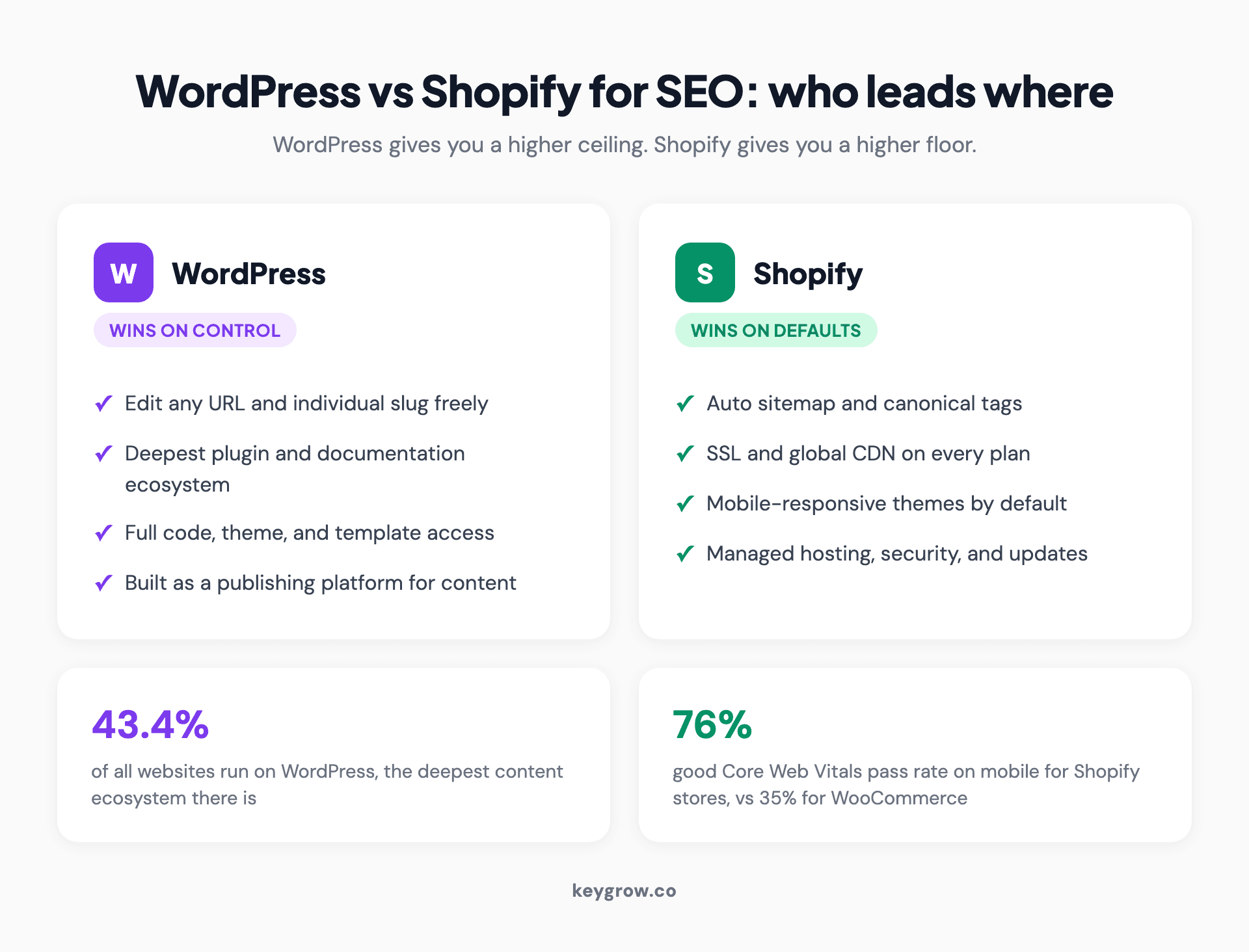
Two-card comparison showing where each platform leads: WordPress wins on control with editable URLs, plugin depth, and full code access, while Shopify wins on defaults with an auto sitemap, canonical tags, SSL, and a built-in CDN.
The pattern is consistent. WordPress gives you a higher ceiling. Shopify gives you a higher floor. Your team decides which one you can actually reach.
Page speed compared: what the Web Almanac data actually shows
On real-world speed, hosted Shopify stores beat self-hosted WooCommerce stores by a wide margin in the latest data. That gap matters because slow pages lose visitors before they ever read a word, and Core Web Vitals are a confirmed ranking factor.
Most speed claims in platform comparisons are unsourced assertions. Here is sourced data instead. In the 2025 Web Almanac ecommerce chapter, Shopify stores hit a 76 percent good Core Web Vitals pass rate on mobile, versus 35 percent for WooCommerce. On the CMS side, self-hosted WordPress passed Core Web Vitals on mobile at only about 45 percent, trailing several hosted platforms.
Why such a gap? It is not that WordPress code is slow. It is that the average WooCommerce store carries a heavy theme, several plugins, large unoptimized images, and shared hosting, while the average Shopify store runs on a tuned, managed stack the merchant cannot easily bloat. Defaults again. A carefully built WooCommerce site on good hosting can be blisteringly fast. The average one, in the wild, is not.

Web performance and page speed metrics displayed on a screen during a site audit
The reason any of this matters for SEO and revenue: 53 percent of mobile visits get abandoned if a page takes longer than three seconds to load, according to Think with Google. On an ecommerce store, that abandonment is lost sales, not just lost rankings. Default speed matters more here than on a content site, because the slowest part of a store (product pages with many images) is exactly where the money is.
So the honest read on speed: Shopify is faster by default, WordPress is faster when expertly tuned, and "expertly tuned" is doing heavy lifting in that sentence. If you do not have someone who will own performance, the data says you will end up faster on Shopify.
Content and blogging: WordPress was built for it, Shopify tolerates it
WordPress was built as a publishing platform, so its blogging and content tools are far ahead of Shopify's. Categories, tags, content types, editorial workflows, and a vast library of content plugins make it the stronger choice for any business that competes on content.
This is the flip side of the speed section, and it is where WordPress earns its keep. Shopify has a blog. It is fine. It is also clearly the afterthought feature, with a limited taxonomy, a clunkier editor, and far fewer tools for building out a real content operation. WordPress treats content as the main event, because that is literally what it was made for.
If your SEO strategy leans on publishing, and for most businesses it should, WordPress gives you room to grow that you will eventually bump into on Shopify.
Here is a client story that makes the stakes concrete. A doctor's practice in Dubai committed to SEO for a full year, with content as the engine. Months one through three looked unremarkable. By month twelve, organic traffic had grown 1,519 percent and the practice was fielding 130-plus patient calls a month. That kind of compounding comes from publishing a lot of well-structured content over time, and the platform you publish on either helps or fights you the whole way. For a content-led play like that, WordPress's publishing depth is a real advantage. For a store whose growth comes from product pages, the blog matters less, and Shopify's lighter content tooling is an acceptable trade.
The thing to be honest about: a Shopify blog is good enough for most stores. You do not need WordPress's full content stack to publish helpful buying guides and rank for them. You need it when content is the strategy, not a supporting act.
Ecommerce SEO specifics: product pages, collections, and duplicate URLs
For ecommerce SEO, the platform decisions that matter most are product page control, collection (category) structure, and how each platform handles duplicate URLs. Shopify is cleaner by default here, while WooCommerce gives you finer control if you put in the configuration.
This is the section the blog-versus-store comparisons skip entirely, and it is the one that decides real store rankings. Three things matter:
Product pages. Both platforms let you optimize titles, descriptions, images, and schema, but the workflow differs. On WooCommerce you have total control and total responsibility. On Shopify the structure is more constrained and more consistent. Whichever you pick, the fundamentals are the same, and we wrote a full playbook on ecommerce product page SEO that applies to both.
Collection and category structure. How you group products into collections becomes your site's URL architecture and internal linking spine. Shopify's collection system is clean but opinionated. WooCommerce category structures are flexible but easy to nest too deeply, which buries products from crawlers.
Duplicate URLs. This is the classic ecommerce SEO trap, and both platforms have versions of it. Shopify historically created duplicate product URLs (a product reachable both at its own URL and under each collection it belongs to) and handles it with canonical tags. WooCommerce can spawn duplicate and thin URLs through filters, sorting parameters, and tag archives. Either way, you have to know it exists, because left alone it dilutes your rankings. The platform just changes the specifics of the fix. If you are still weighing whether ranking your store is worth the effort at all, why SEO matters for ecommerce makes that case.
The takeaway: Shopify gives you fewer ways to break ecommerce SEO and slightly fewer ways to perfect it. WooCommerce is the reverse. Neither is disqualifying.
Which platform wins for AI search and AI Overviews
Neither platform has a built-in edge for AI search, because AI engines and AI Overviews reward content structure and authority, not the CMS underneath. Both can be optimized to get cited; the work is the same on each.
This is the angle the older comparison guides do not cover at all, and it is increasingly the part that decides who wins. The question shifted from "how do I rank" to "how do I become the source AI quotes." That shift is platform-agnostic. ChatGPT and Google's AI Overviews read your headings and pull short, self-contained passages, and they do not care whether those passages were served by WordPress or Shopify.
What does matter, on either platform, is answer-first structure, clean headings, and content backed by real numbers. Roughly 44 percent of AI citations come from the first third of a page, so the answer has to sit near the top no matter which CMS served it.
There is one second-order point in WordPress's favor. Because content depth and structure drive AI citations, and because WordPress is the stronger content platform, a content-heavy WordPress site has more surface area to get cited from. That is not a platform advantage in the engine's eyes; it is a content advantage that WordPress happens to make easier. On a pure store with a handful of product pages, the AI-search difference between the two is essentially zero.
So if AI visibility is your goal, stop comparing platforms and start comparing your content structure to whoever is getting cited. The CMS is not the lever here.
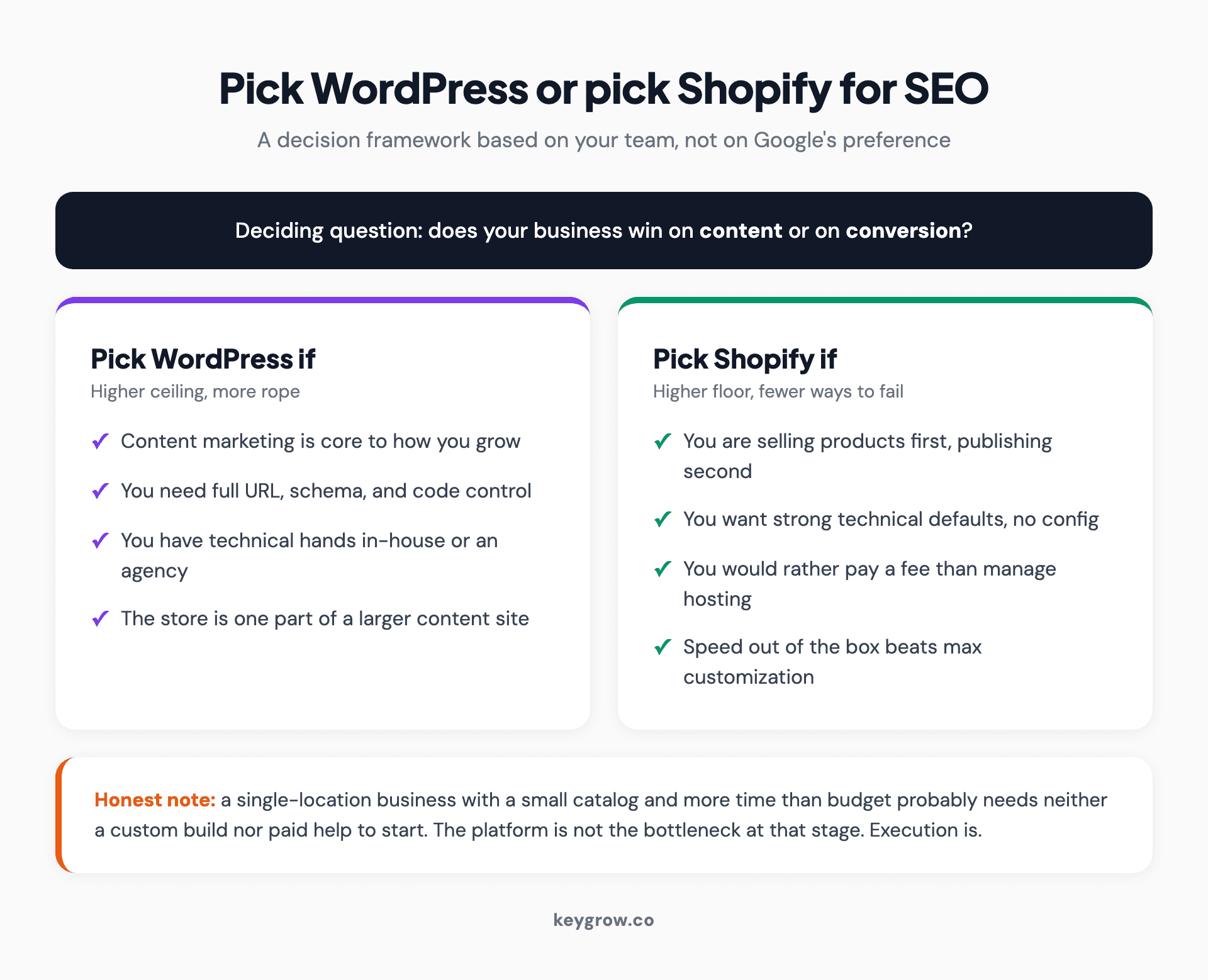
Decision framework showing pick WordPress if you compete on content, need full URL and code control, or run a content-heavy site with a shop, versus pick Shopify if you want fast technical defaults, a store-first build, and minimal maintenance.
Pick WordPress if, pick Shopify if: a plain decision framework
Pick WordPress if content and control are central to your business. Pick Shopify if you want a fast, technically clean store without managing the technical side yourself. The deciding factor is your team's capacity, not Google's preference.
Here is the framework, stated plainly.
Pick WordPress (or WooCommerce) if:
Pick Shopify if:
And here is the part most agencies will not say out loud. If you run a single-location business with a small catalog and more time than budget, you probably do not need a custom WordPress build or paid SEO help to start. Pick the platform that matches your skills, lean on sensible defaults, claim your Google Business Profile, gather reviews, and publish a few genuinely useful pages. The platform is not your bottleneck at that stage. Execution is. Hire help, on either platform, when the cost of your own time clearly beats the fee.
If you are migrating between the two, do not do it for SEO reasons alone, and do not do it casually. A platform move can erase years of rankings when URLs and redirects are mishandled, so treat the redirect map as the most important part of the job. And if you are still platform-shopping more broadly, whether Webflow is good for SEO covers the third option people usually weigh alongside these two.
Where this leaves you
WordPress and Shopify can both rank at the top of competitive results. WordPress gives you a higher ceiling and more rope to hang yourself; Shopify gives you a higher floor and fewer ways to fail. Pick based on whether your business runs on content or on conversion, and on whether you have the hands to use WordPress's control well. The platform you choose is a friction decision, not a ranking destiny.
If you want a second opinion on which one fits your specific business, or help making either one rank, that is the kind of thing our team does every week. Start a conversation at get started and we will tell you honestly which platform we would pick for you, including when the answer is "stay where you are."
FAQs
Does Google rank WordPress or Shopify higher?
Google does not rank either platform higher than the other. It ranks pages based on content quality, crawlability, speed, and authority, none of which is tied to your CMS. A well-built site on either platform can outrank a poorly built site on the other. The platform affects how easily you reach those outcomes, not whether Google favors one.
Is Shopify better than WooCommerce for SEO?
Shopify is better for SEO out of the box, while WooCommerce is better if you put in the configuration. In the 2025 Web Almanac data, Shopify stores passed Core Web Vitals on mobile at 76 percent versus 35 percent for WooCommerce, mostly because Shopify is a managed, tuned platform and the average WooCommerce store carries heavy themes and plugins. A carefully optimized WooCommerce store can match Shopify, but the typical one will not.
Can you rank a Shopify store without paid SEO apps?
Yes. Shopify ships with the core technical SEO foundation already in place: automatic sitemaps, canonical tags, SSL, mobile-responsive themes, and a fast CDN. Paid apps add conveniences like bulk meta editing or advanced schema, but they are optional, not required to rank. Strong product pages, a clean collection structure, and helpful content matter far more than any app.
Should I migrate from WordPress to Shopify for better SEO?
Not for SEO reasons alone. A migration can wipe out years of rankings if URLs and redirects are mishandled, and the SEO gain from switching platforms is usually small compared to the risk. Migrate only if the platform genuinely fits your business better for operational reasons, and then treat the URL mapping and 301 redirects as the most important part of the move.
Is WordPress faster than Shopify?
In real-world data, the average Shopify store is faster than the average self-hosted WooCommerce store. Web Almanac 2025 showed self-hosted WordPress passing Core Web Vitals on mobile at about 45 percent, behind several hosted platforms. WordPress can be faster than Shopify when expertly tuned with good hosting, caching, and image optimization, but that requires deliberate work that most stores never do.
Which platform is better for content marketing and blogging?
WordPress, clearly. It was built as a publishing platform, so its blogging tools, taxonomies, editorial workflows, and content plugins are far ahead of Shopify's. Shopify has a usable blog, but it is a secondary feature with limited structure. If content is central to how you grow, WordPress gives you room you will eventually need.
Do I need a developer to do SEO on either platform?
Not for the basics on either platform. Shopify is friendly enough for a non-technical owner to handle titles, descriptions, and content alone, and WordPress with a good SEO plugin is manageable too. You need a developer when you hit advanced technical issues, custom templates, performance tuning, or a migration. The everyday SEO work is doable without one on both.
Which is better for SEO if I sell products and publish content?
If you do both heavily, WordPress with WooCommerce gives you the strongest content platform plus a capable store, at the cost of more setup and maintenance. If selling is the priority and content is supporting, Shopify gets you a fast, clean store and a good-enough blog with far less work. The deciding question is which half of your business drives more growth.


