


A general dentist tells a parent their eleven year old needs an orthodontic consult, writes your name on a slip, and hands it over. That night the parent types your practice name into Google.
What comes back on that screen decides whether the referral turns into a consultation. Not your ranking for "orthodontist near me". Not your blog. The page of results that appears when somebody searches your name.
Most advice about SEO for orthodontists skips this entirely and starts with keyword research, which is roughly like optimizing the second page of a book you have not finished writing. A large share of orthodontic case starts arrive already knowing who you are. Search is where they check.
So this post runs the funnel backwards, from the moment somebody types your name, out to the searches where you are still a stranger.
Search your own practice name and look at the whole screen
Everything visible on that results page is part of your SEO whether you built it or not: the profile, the review score, the third-party listings, the old address, the AI summary.
Do this now, in a private window, on a phone. A parent who was handed your name is going to see:
- Your Google Business Profile card, with a star rating and a review count
- Your website, and whatever your title tag says about you
- Two or three directory profiles you did not create
- A review site you have never logged into
- Possibly an AI summary assembled from all of the above
- If you are unlucky, a former associate's page or an address you left in 2019
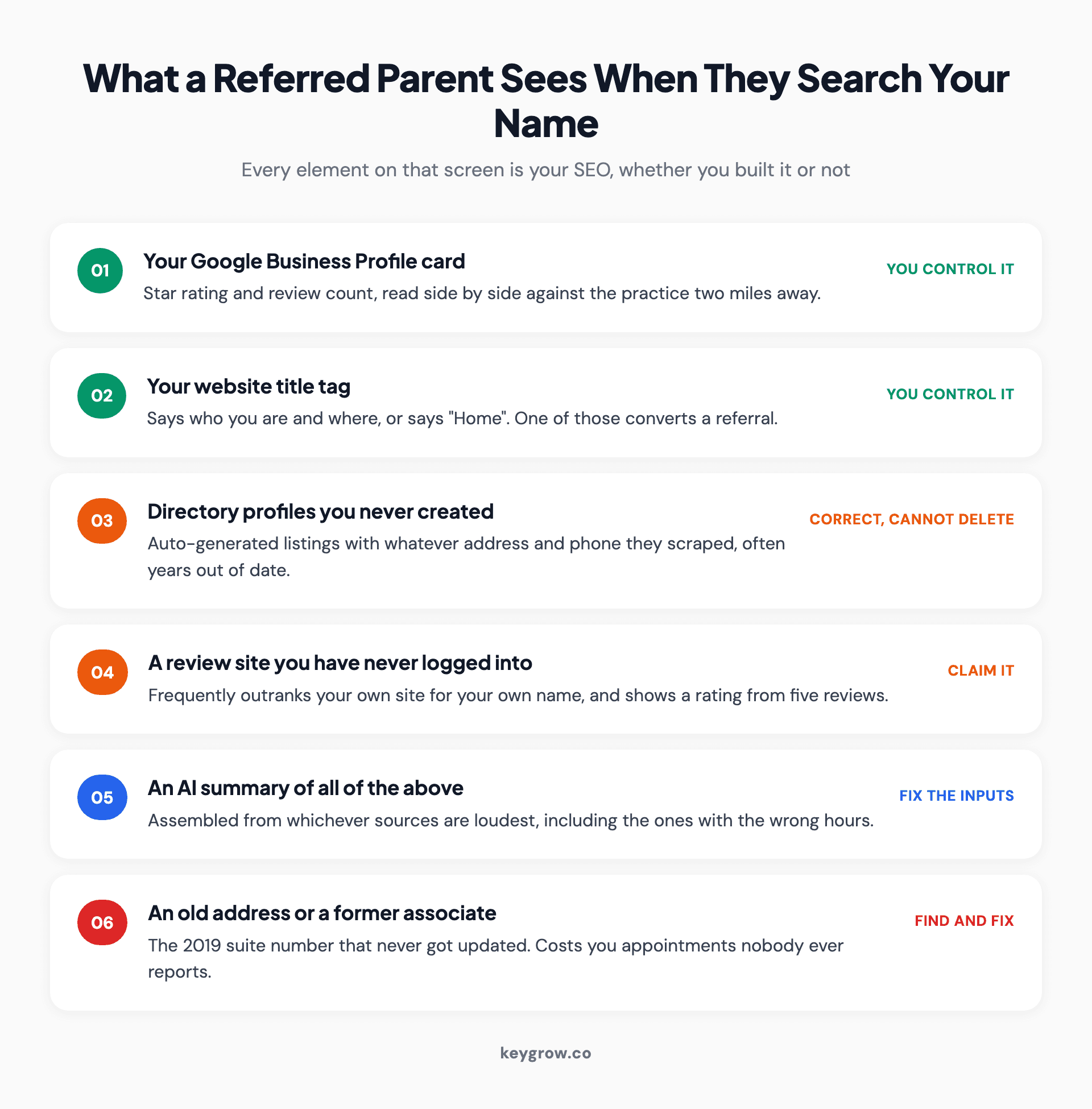
The brand SERP a parent sees after a referral, showing each element and who controls it.
That screen is the highest-converting search in your entire practice and almost nobody manages it deliberately. The fixes are unglamorous: claim the profiles you can, correct the ones you cannot, get the review count above the threshold where it stops looking sparse, and make sure the title on your own site says who you are and where, not "Home".
If you do one thing from this post, do that audit. It takes twenty minutes and it protects the referrals you are already earning.
The consultation is the conversion, not the form fill
Track consultations booked, consultations kept, and case starts. A form fill that never becomes an appointment is not a result, and orthodontic marketing reports are full of them.
There is a long gap in this practice model between interest and revenue: form, call, consultation booked, consultation attended, records, treatment plan presented, case accepted, contract signed. A website change can move the top of that chain and leave the bottom untouched.
We see the same pattern in conversion work outside dentistry. Rebuilding one page for a law firm lifted conversion 70 percent in three weeks, and a services client saw 120 percent in five weeks. Those numbers describe the same thing every time: the page was asking people to do something unclear, and the fix was making the next step obvious. In an orthodontic practice the obvious next step is almost always a specific, low-commitment consultation with a stated duration and a stated cost, not "request an appointment".
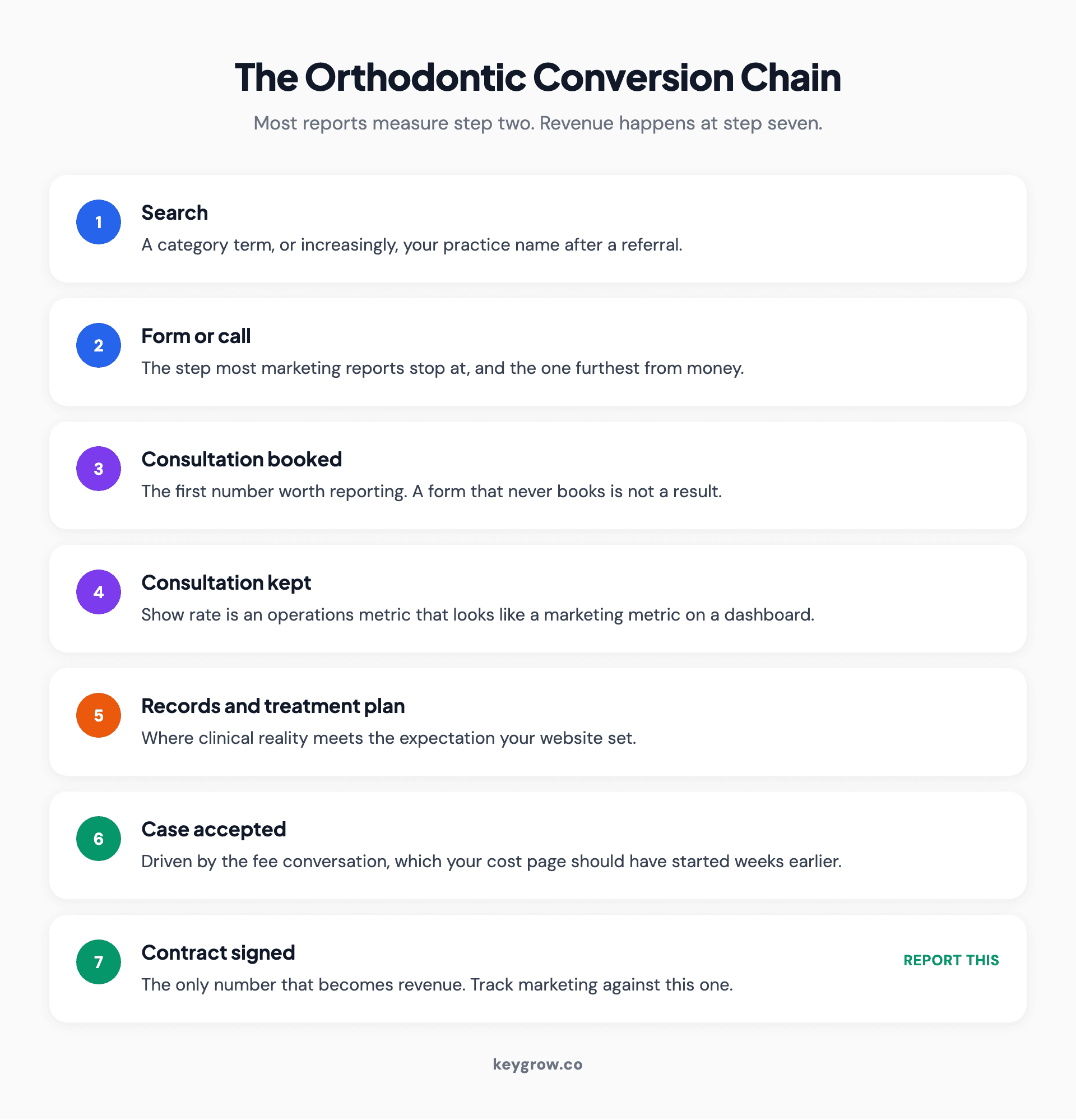
The orthodontic conversion chain from first search to signed case, showing which step most practices actually measure.
Two treatment populations, and only one of them is your patient
Adolescent treatment is searched by a parent. Adult aligner treatment is searched by the person who will wear them. They want different pages, different tone and different proof.
The parent is doing risk assessment. Is this necessary, is this the right age, how long, how much, will insurance cover any of it, is this person qualified. They read carefully and they compare two or three practices.
The adult is doing self-assessment and often feels slightly awkward about it. Can this be fixed at my age, will it show at work, how long before people notice, what does it cost per month. They read fast, on a phone, usually at night, and they are more price-sensitive than the parent because no insurance plan is helping.
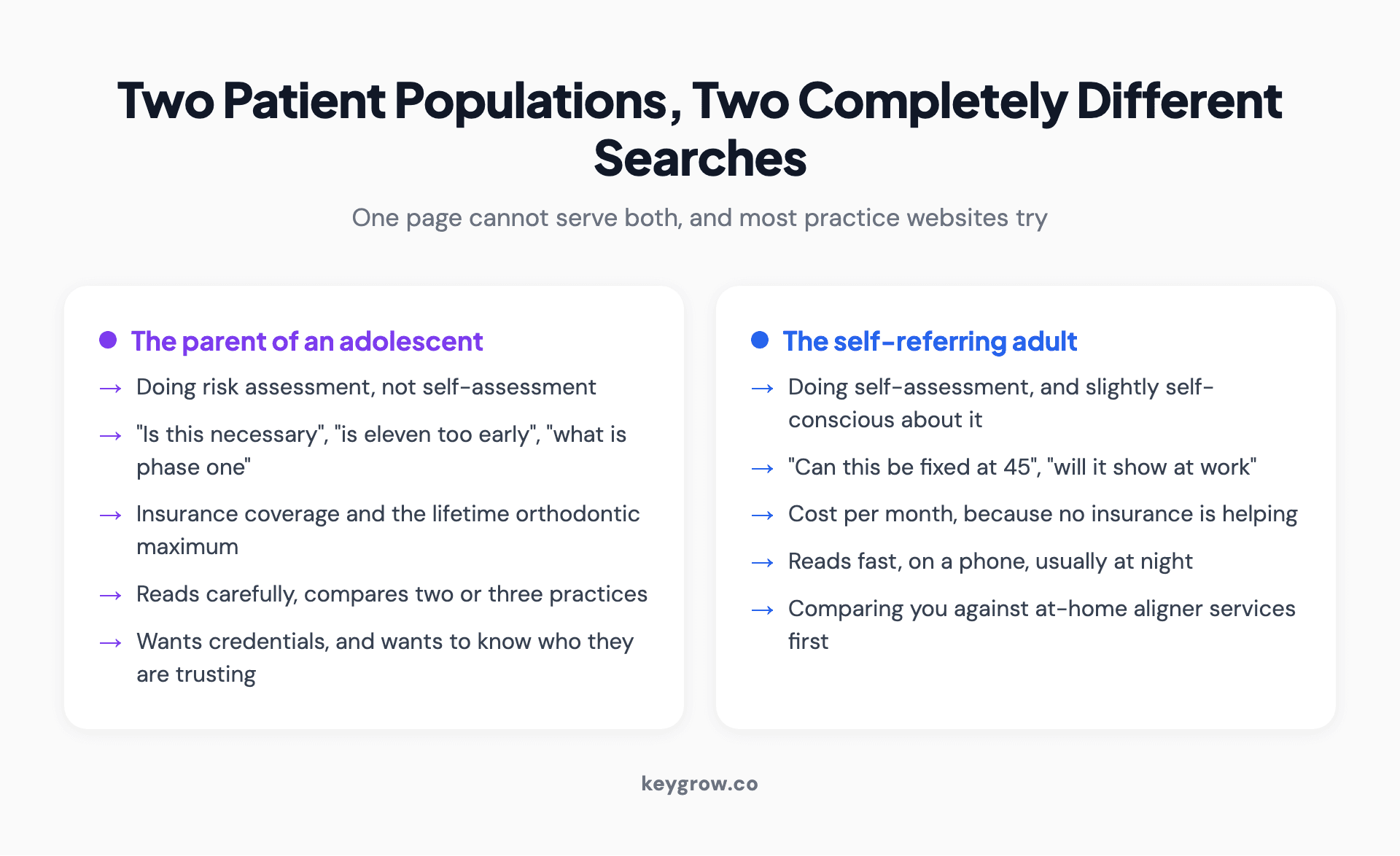
The two orthodontic patient populations side by side, showing what a parent researches against what an adult patient researches.
One page cannot serve both, and most practice sites try. Split them:
- A treatment for children and teens section written to the parent, covering timing, the early evaluation age, what phase one actually means and when it is genuinely warranted
- An adult treatment section written to the adult, covering discretion, duration, cost per month and what happens at work
This is the same split we build into dentist SEO services for general practices, except the ages and the buyers are further apart here.
Then write the pages that only exist in one of those worlds. "Is my child too young for braces" belongs to the first. "Can I straighten my teeth at 45" belongs to the second.
The comparison search you cannot afford to skip
People compare in-office treatment against mail-order aligner services before they ever call a practice, and if you have not written that comparison somebody else has written it for you.

A person fitting a clear plastic dental aligner over their teeth.
At-home aligner companies changed the search behavior in this category permanently. A meaningful share of your prospective adult patients start by wondering whether they can avoid the office visit entirely, and they search for that comparison in plain terms.
Two ways to handle it. The common one is silence, which leaves the comparison to the companies selling the alternative. The better one is to write the honest version: what those services do well, what cases they genuinely cannot treat, what supervision means in practice, what happens when a case goes wrong and who is responsible.
Write it without naming brands. "At-home aligner services" and "remote treatment" carry the meaning without the exposure, and the page ages better because it does not depend on which company is currently advertising.
The credibility comes from admitting the honest part: for a small number of very mild cases, remote treatment is not unreasonable, and saying so is what makes the rest of the page believable. A page that says every alternative is dangerous reads as marketing. Google's rater guidelines hold health content to a higher standard than most topics, and demonstrated first-hand clinical judgment is exactly what that standard is looking for. The ADA's topic library is a reasonable place to anchor the clinical points you make.
Cost and payment are the searches, and the page is usually blank
"How much do braces cost" and "monthly payment" searches have more volume than almost anything clinical, and orthodontic sites answer them less often than any other specialty.
The reasoning mirrors what happens in contracting: every case differs, so the practice says nothing, and a national estimator with no idea what a case costs in your market sets the expectation instead.
What to publish:
- A range by treatment type, with what moves a case to the top of it
- What a typical monthly payment looks like, because that is the number people actually decide on
- Whether you take insurance assignment and how the lifetime orthodontic maximum works, which almost nobody explains clearly
- Whether the consultation costs anything
- What a records fee covers and whether it is credited
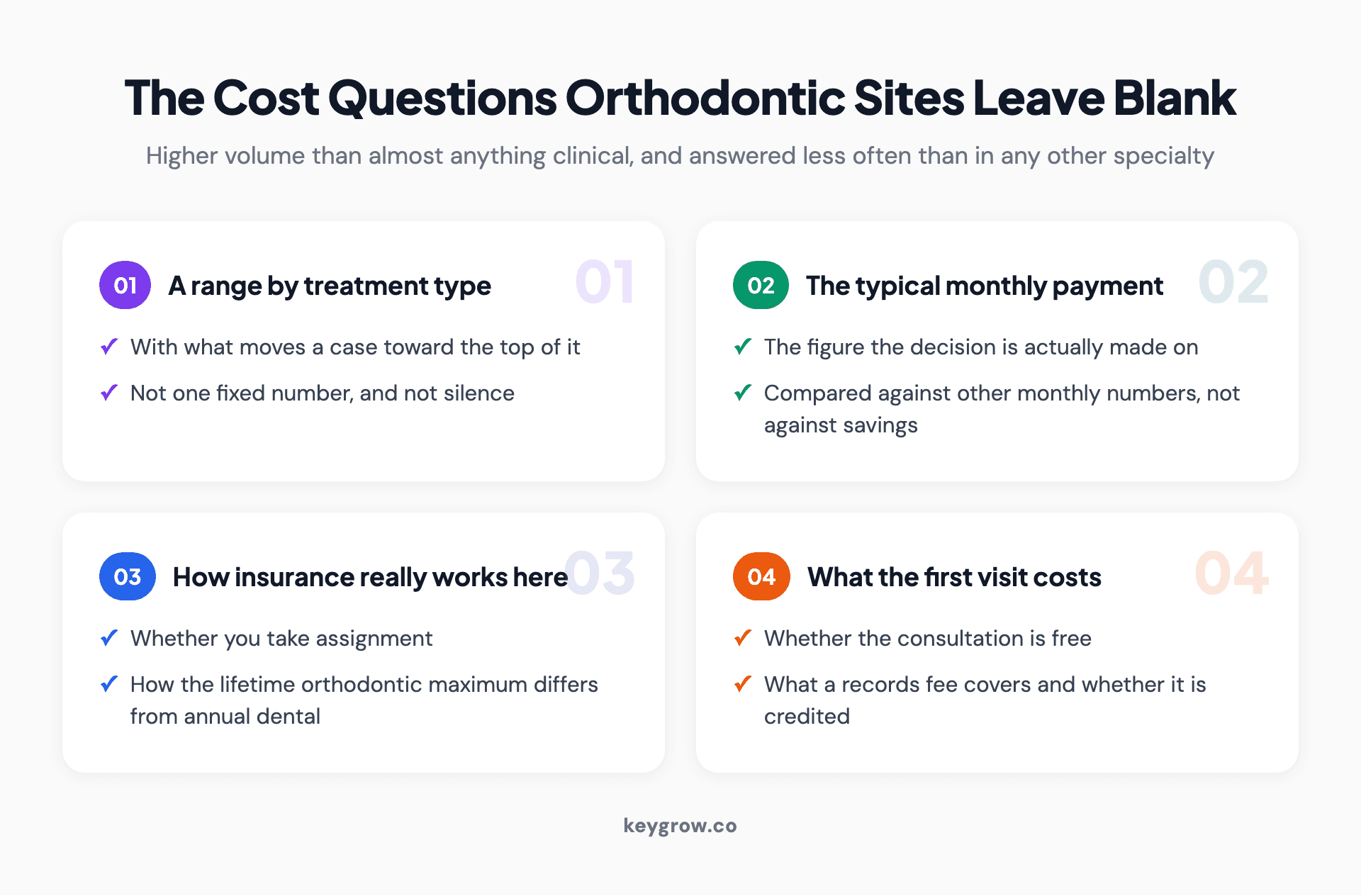
Payment and cost information a prospective orthodontic patient searches for, and what each item does for the practice when published.
Publishing the monthly figure rather than the total is not a trick, it is the frame the patient is already using. Somebody deciding between treatment and no treatment is comparing a monthly number against their other monthly numbers.
Treatment time is the second question, always
"How long do braces take" and "how long do aligners take" run close behind cost, and the answer that converts is the one with ranges and conditions rather than a single number.
Write it by case type, not as one figure. Mild crowding, moderate crowding, bite correction, phase one, adult relapse after a retainer was abandoned in 2004. Give the range, then say what makes a case run long: compliance with elastics, missed appointments, growth timing, whether extractions are involved.
This is also the most useful place in the whole site to be candid. A practice that says plainly "if you do not wear the elastics, this takes considerably longer, and that is the single biggest variable" sounds like a clinician. A practice that promises a fast average sounds like an advertisement, and the parent reading it has already seen four of those.
Before and after, and the rules that come with it
Case galleries are the strongest proof an orthodontic practice has and the most regulated content on the site. Get consent in writing and check your state board's advertising rules before publishing anything.

A close view of fixed braces on upper teeth.
The mechanics that make a gallery work for search rather than just for decoration:
- Each case on its own page, not forty images in one carousel
- A title describing the case, not "Case 12"
- Treatment type, approximate duration, and age band
- One line on what the case involved clinically
- Descriptive alt text on every image
- Written consent on file, and a process for a patient withdrawing it later
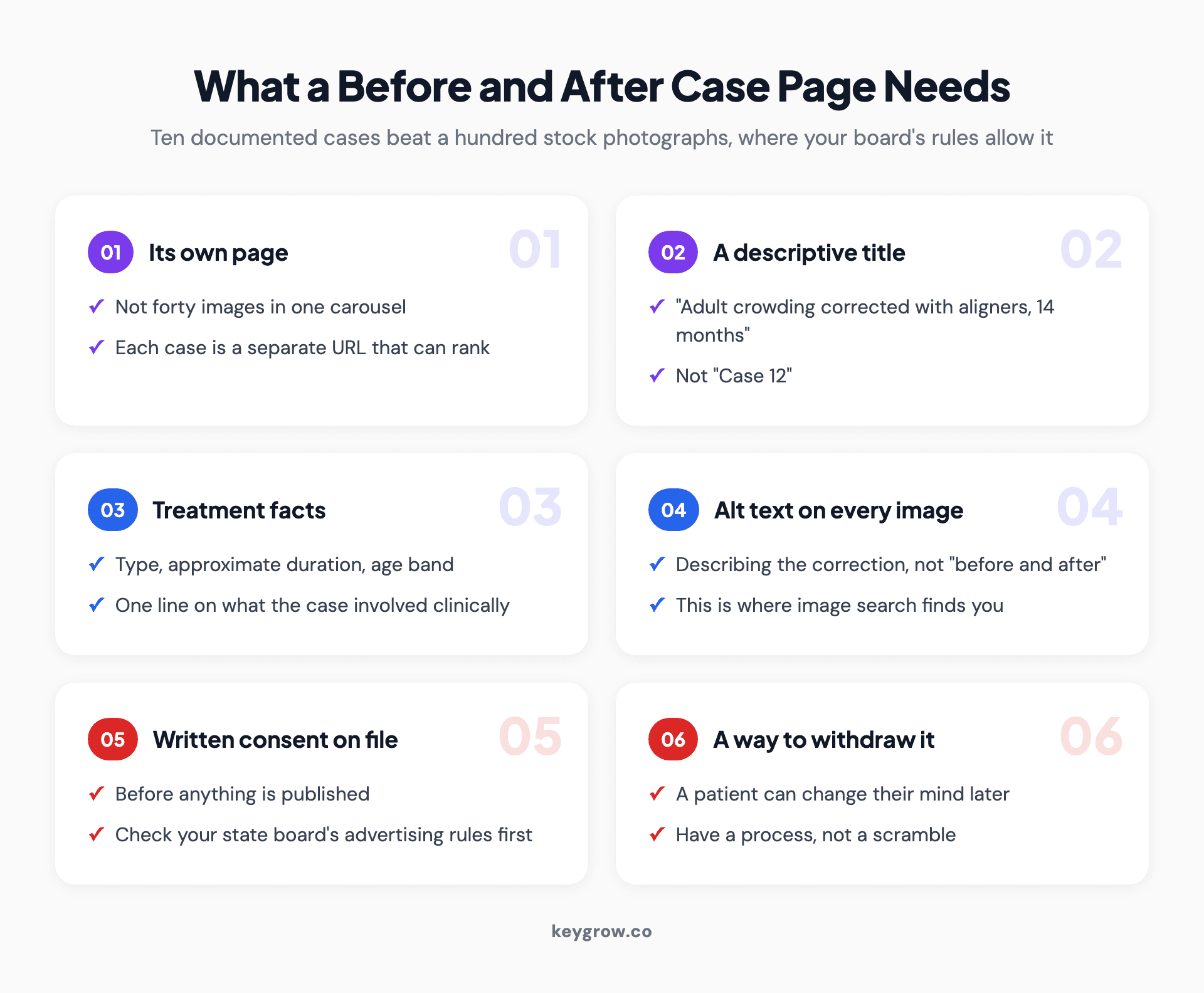
What a case gallery page needs to work for search as well as for proof, including the consent requirements.
The compliance side is real and varies by state, so this is a conversation with whoever handles your board requirements rather than with a marketing agency. Where the rules allow it, ten documented cases outperform a hundred stock photographs of teenagers laughing.
Reviews written by a parent about a two-year relationship
Ask at debond, and ask the parent rather than the patient, because the parent had the two-year experience of scheduling, billing and emergencies.
Orthodontics has an unusual review dynamic. Treatment runs eighteen to thirty months, the patient is often a minor, and the person with the strongest opinion about the practice is the adult who took time off work for twelve appointments.
Ask at debond, when the result is visible and the relief is genuine. Ask the parent. And prompt lightly for specifics, because "great office" helps nobody, while "they got us in the same day when a bracket came off before a school photo" is the sentence the next parent is looking for.
Respond to every review with something specific and nothing clinical. Never confirm treatment details in a public reply, however friendly the review.
The referral relationship has a search dimension nobody manages
General dentists send cases. Those cases search your name afterwards. Which means your brand SERP is part of your referral strategy, and your referring dentists are part of your link profile.
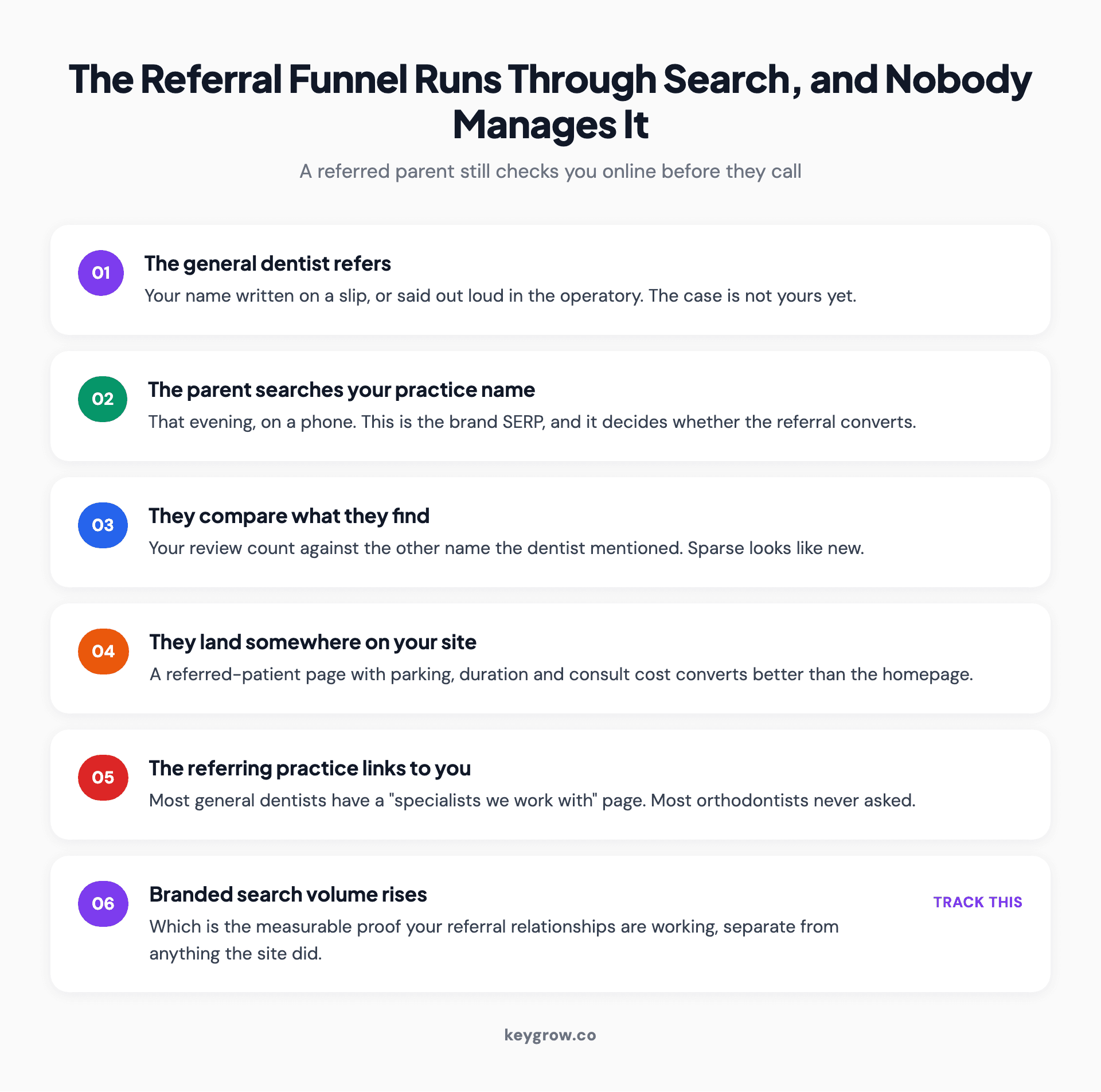
The orthodontic referral search funnel, from the general dentist's referral slip through the parent's branded search to the booked consultation.
Two practical things follow.
First, make the referral easy to act on. A dedicated page for referred patients, with parking, what to bring, how long the first visit takes and whether the consult is free, converts better than the homepage and can be printed on the referral slip.
Second, ask your referring practices to link to you. Many general dentists have a "specialists we work with" page, and most orthodontists have never asked. These are the most relevant local links available to you, they exist already, and they cost one email.
The reverse also matters. Linking out to the general dentists you work with, on a page that names them, is the kind of thing that gets reciprocated without a negotiation.
One practice, several locations, one recurring problem
If you run satellite offices, each needs its own profile and its own page with genuinely different content, including which days you are actually there.
Satellite offices are common in this specialty and they create the same failure as any multi-location business: three pages that differ only by town name, and three profiles listing the same hours when the doctor is only at each office two days a week.
Google's local ranking factors come down to relevance, distance and prominence, and the hours question feeds all three indirectly, because wrong hours generate the complaints and edits that erode a listing. Publish the real schedule per office, list the services actually offered at each, and photograph each location separately.
If a satellite is open one day a week, say so plainly on the page. Somebody driving forty minutes to a locked door leaves a review about it.
What to measure when a case start is worth thousands
Case starts by source, consultation show rate, and cost per case start. Traffic and rankings are too far from revenue to steer by at this volume.
A practice starting fifteen to forty cases a month cannot read a traffic chart usefully. The variance swamps the signal. What is readable:
| Track | Why it matters here |
|---|---|
| Case starts by source | The only number that becomes revenue |
| Consultations booked versus kept | A show-rate problem looks like a marketing problem on a report |
| Cost per case start | Comparable across every channel you run |
| Adult versus adolescent mix | Tells you which half of the site is working |
| Branded search volume | Rises when referrals rise, and confirms the referral funnel is healthy |
That last row is the one specific to this specialty. If branded searches for your practice name are climbing, your referral relationships are working, and that is worth knowing separately from anything the website did.
While we are talking about reporting: an agency that requires a twelve month contract is telling you something about its confidence. We work month to month because a client who is not seeing results should be able to leave, and because an agency that keeps clients by contract stops having to earn them. Dental and orthodontic marketing has more twelve month agreements in it than almost any category we work in, and that is not a coincidence.
Orthodontists who should not be buying SEO
A single-location practice with a healthy referral network, a full schedule, or fewer than fifteen reviews should do the free work first and spend nothing.
The free work is genuinely most of the available return here: the brand SERP audit at the top of this post, the profile completed properly, thirty reviews gathered at debond over a few months, and the cost and treatment-time pages written by somebody in the practice who knows the answers.
If you are weighing organic against paid, we ran that comparison for the adjacent specialty in SEO vs Google Ads for dentists, and the economics carry over closely.
Hiring makes sense when you are opening a location, when adult treatment is a growth target and your referral network only sends adolescents, or when a corporate group has moved into your area and started outspending you. Those are three real reasons. "Our rankings are low" is not one of them if your chairs are full.
FAQs
How long does SEO take for an orthodontic practice?
Profile and brand SERP improvements show within about two months. Rankings for treatment and cost pages generally take four to nine months, and the case-start impact lags further because orthodontic decisions are rarely made the same week. Judge it over a year, and watch case starts rather than rankings.
Is orthodontic SEO different from dental SEO?
Yes, in two ways that matter. A large share of orthodontic patients arrive by referral and search your name rather than a category term, so brand SERP management carries more weight. And the practice serves two separate populations, parents of adolescents and self-referring adults, who search in completely different language and need separate pages.
Should an orthodontist publish treatment prices?
Publish a range by treatment type and a typical monthly payment. A single fixed price is a problem and total silence is worse, because it leaves a national cost estimator to set the expectation before the patient ever speaks to you. The monthly figure matters most, since that is the number the decision is actually made on.
How do I compete with at-home aligner companies in search?
Write the comparison yourself, honestly, without naming brands. Cover what remote treatment can reasonably handle, what it cannot, what supervision means and who is accountable if something goes wrong. Admitting that a small set of very mild cases is a reasonable fit is what makes the rest of the page credible.
Do before and after photos help orthodontic SEO?
They help considerably when each case gets its own page with a descriptive title, treatment type, duration and alt text, rather than being dumped into one gallery. They also carry consent and state advertising requirements, so check your board's rules and get written permission before anything is published.
How many Google reviews does an orthodontic practice need?
There is no threshold that switches something on, but a practice with under fifteen reviews looks sparse next to competitors with two hundred, and that comparison happens on the brand SERP a referred parent is looking at. Ask at debond, ask the parent, and aim for steady recent volume rather than a one-off push.
Does AI search change anything for orthodontic practices?
It raises the cost of leaving questions unanswered. Assistants answer cost, treatment time and aligner comparison questions by assembling whatever is published, and if your practice published nothing, the answer is built from national averages and from companies selling an alternative. Clear answers near the top of a page are what those systems quote, which is the same thing our answer engine optimization work is aimed at.
Do the twenty minute version first
Search your practice name on a phone, in a private window, and look at every element on that screen. Fix the wrong address, claim the profile you did not know existed, and count your reviews against the practice two miles away.
Then write two pages: what treatment costs here with a monthly figure, and how long it takes by case type. Those two answer more searches than everything else on an orthodontic website combined, and they are currently blank on most of them.
Everything after that is ordinary local SEO, and if your chairs are full you may not need it at all. We work month to month with no lock-in, and we will say so if your referral network is already doing the job. If you want a look at your brand SERP and where the gaps are, start here, or read how we approach SEO for practices where a single new patient is worth thousands.