

Programmatic SEO is building a large set of pages from one template and a structured dataset, so that a repeatable search pattern gets a page each instead of one page trying to cover all of them.
If your customers search the same shape of question with a different noun in the middle, roofers in Austin, roofers in Round Rock, roofers in Pflugerville, that shape is a pattern. Programmatic SEO is the decision to answer the pattern once, in a template, and let the data fill in the rest.
The technique is neither clever nor risky by itself. What decides how it goes is whether the pages that come out the other end are worth the reader's time. Google has written this down almost that plainly, and we will get to the exact wording, because it is the part most guides paraphrase into something less useful.
The three ingredients, and which one is actually hard
Every programmatic page set is the same three things.
A pattern with real demand. A repeatable query shape where each variation gets searched. This is the part that fails most often and the part people check last.
A dataset. Something structured enough to drive the pages: locations, product attributes, job titles, integrations, materials, price points. It can be a spreadsheet. It does not need to be a database.
A template that produces a page worth reading. Not a page with the variable swapped. A page that would survive a reader who arrived expecting an answer.
The first two are logistics. The third is the entire project. Anyone can generate 400 URLs in an afternoon; the reason most programmatic SEO fails is that the 400 pages had nothing in them except the 400 nouns.
What it looks like at three different scales
Almost every article on this topic illustrates it with a marketplace holding tens of millions of pages. That is accurate and useless if you run a six-van plumbing company, because none of the operational advice survives the change in scale.
| Scale | Typical pattern | Page count | What actually limits you |
|---|---|---|---|
| Marketplace or directory | Every listing, every category, every city | Hundreds of thousands | Crawl budget and infrastructure |
| Software or tooling | Every integration, every use case, every comparison | Hundreds to thousands | Having something true to say per page |
| Local service business | Every service crossed with every area you serve | Dozens | Whether the terms are searched at all |
At the top of that table the problems are technical. At the bottom they are editorial and arithmetic. A local business building thirty service-area pages is doing programmatic SEO in the same sense that a corner shop and a national chain are both in retail: the word applies, the playbook does not.
Our own work sits at the bottom of that table. A junk removal client had six service pages built and ranking within six weeks, which is a small number that mattered more than a large number would have, because each one targeted something people actually typed.
Google's position, in Google's own words
Here is where most coverage goes soft, so read the actual policy language.
Google's spam policies define scaled content abuse as "when many pages are generated for the primary purpose of manipulating search rankings and not helping users." Doorway abuse is defined separately: "when sites or pages are created to rank for specific, similar search queries" that "lead users to intermediate pages that aren't as useful as the final destination."

A person writing notes on paper beside a laptop while planning a content project.
Two things follow from that wording, and they matter more than any tactic in this post.
The first is that the method of production is not the violation. Google's spam policies treat generating pages with AI tools, scraping, or stitching existing content together as the same category of problem, and the common thread is not automation. It is generating pages without adding value. A hand-written page with nothing in it is in the same trouble as a generated one.
The second is that the test is about the reader, not the count. There is no page number at which a site becomes spam. A million useful pages are fine. Forty useless ones are not.
That is genuinely good news for anyone building something real, and genuinely bad news for anyone hoping the rules only apply above some threshold.
The test that separates a page set from a doorway set
Policy language is hard to apply at 2am when you are deciding whether to ship. Here is the operational version we use.
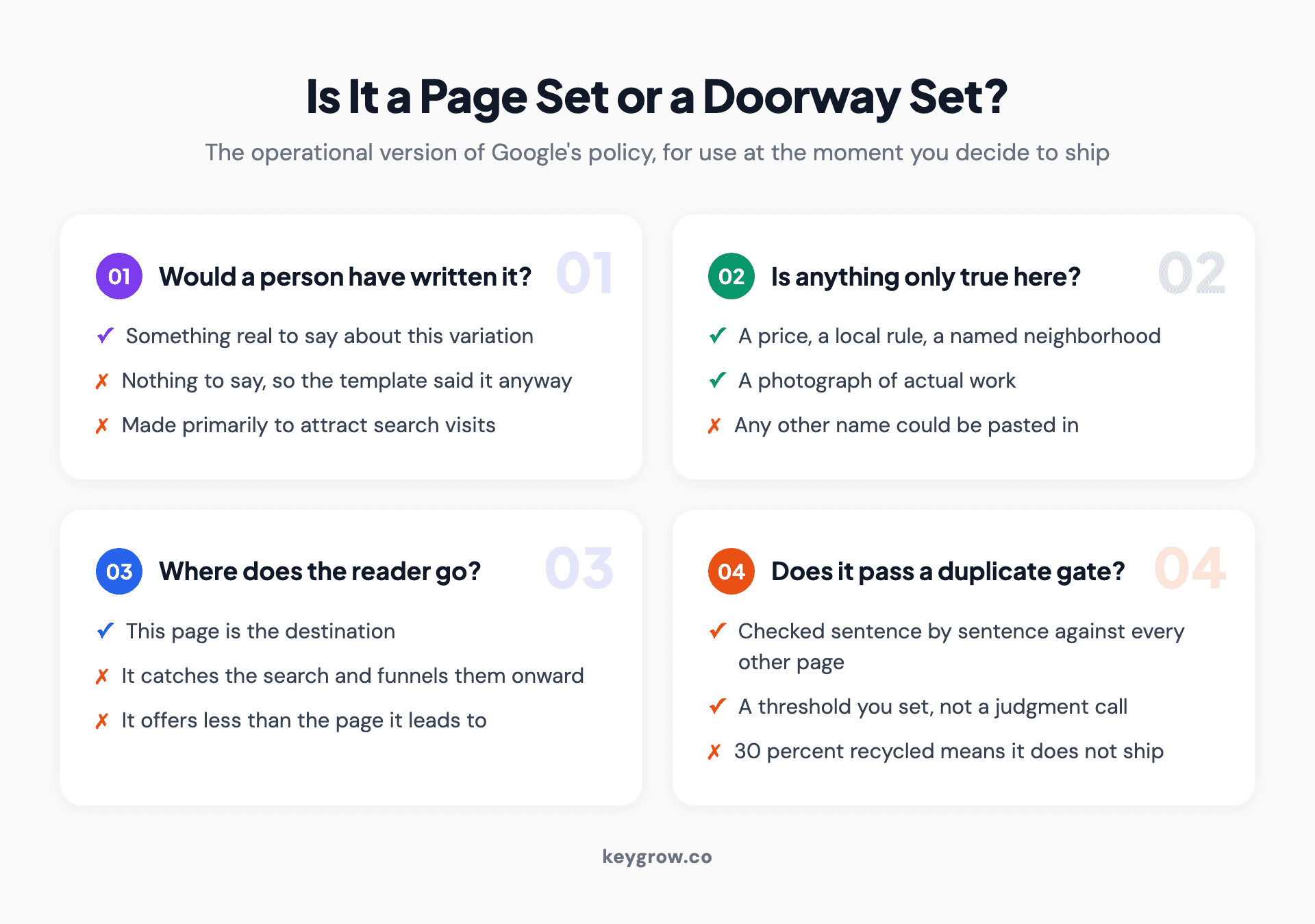
Four questions that separate a legitimate programmatic page set from a doorway set: whether a human would have written it, whether it says something only true of that variation, whether the reader is sent elsewhere, and whether it survives a mechanical duplicate check.
Would a person have written this page if the template did not exist? If the answer is no, because there is nothing to say about that variation, the page should not exist either. Google's helpful content guidance poses the blunter version of the same question: is the content primarily made to attract visits from search engines.
Does it contain at least one thing that is only true of this variation? A city page that could have any other city's name pasted in has failed. A price, a local regulation, a photograph of actual work, a named neighborhood, a response time: something.
Is the reader being sent somewhere else? That is the doorway definition. If the page's job is to catch the search and funnel the visitor to the real page, it is the thing Google named.
Would a mechanical duplicate check pass it? This is the useful one because it removes your judgment from the decision. Compare each new page against every other page you have, sentence by sentence, and set a threshold. If a page is 30 percent recycled, it does not ship.
That last check is worth building even if you only have twenty pages. Human review consistently fails at this, because the pages were written to be similar and similar is exactly what you stop noticing by page nine.
Start with volume, or you will build pages nobody searches for
The most expensive programmatic SEO mistake is not a penalty. It is building 200 well-made pages for phrases that nobody types.
Patterns feel like demand. Service plus city feels like it must be searched, in every city, because it is how you would phrase it. Search volume does not work that way. Demand concentrates in a few large places and thins out fast, and most of the long tail people build for is not a long tail at all. It is an empty one.
We ran this properly on our own site rather than assuming. For one state we measured 200 city-and-service combinations of a page type we were planning to build. Fewer than two percent of them had any measurable search volume. We stopped the project. That was a cheaper outcome than building the pages and discovering the same thing a year later.
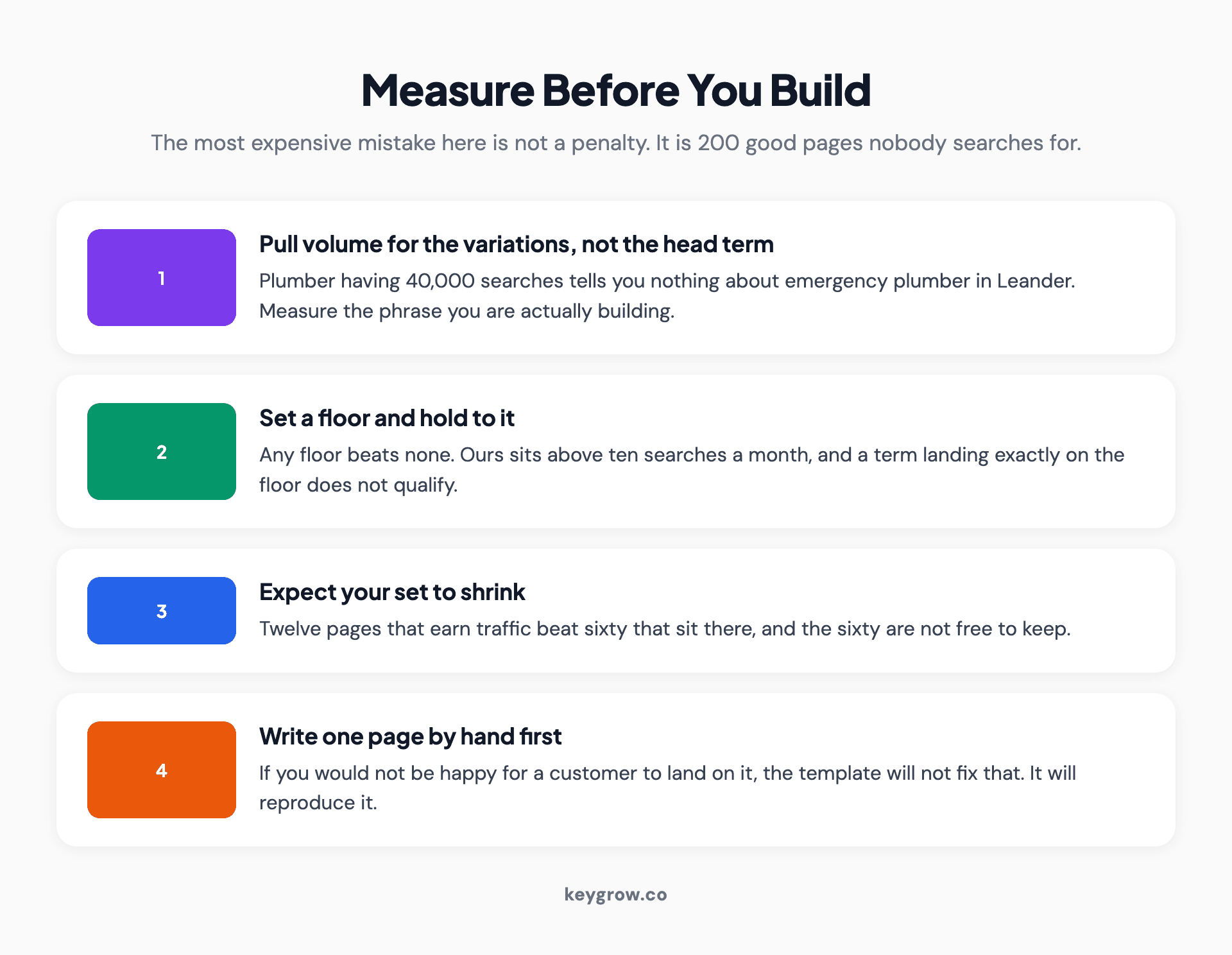
Three checks before committing to a programmatic page set: measure every variation, set a floor above zero, and build only the variations that clear it.
So before the template, before the data:
Pull real volume for the variations themselves, not the head term. "Plumber" having 40,000 searches tells you nothing about "emergency plumber in Leander."
Set a floor and hold to it. Any floor is better than none. We use a threshold above ten searches a month, and a term sitting exactly at the floor does not qualify.
Accept that your set will be smaller than your spreadsheet. Twelve pages that earn traffic beat sixty that sit there. The sixty also cost you something, which is the next section.
Why the unused pages are not free
A common defense of building everything is that extra pages cannot hurt, so you may as well cover the set. They can, in three specific ways.

A laptop on a desk beside a coffee cup, showing a website under construction.
They dilute. A site where most pages get no traffic and no links looks different, in aggregate, from a site where most pages do. That signal is not something you can point at in a report, and it is real.
They compete with each other. Twelve near-identical service-area pages all target roughly the same thing, and Google has to pick one. Sometimes it picks none.
They cost maintenance. Every page is a thing that can go stale, break, or contradict another page. Multiply by 200 and a small content problem becomes a project.
The honest framing is that an empty page is not neutral. It is a small liability you are choosing to carry in exchange for coverage you may never need.
Template pages and AI answers
This is the part that has changed most recently and it is barely in the SERP for this topic yet.
Answer engines do not behave like a ranking list. They pull in a batch of pages and then quote a small slice of it, roughly 15 percent in ChatGPT's case. Getting retrieved has become the easy half of the job. Being the page worth quoting is the half that decides whether any of this shows up in an answer.
Mass-produced template pages are exactly the wrong shape for that. If forty of your pages say the same thing with a different noun, none of them is the distinctive source on anything. The page that gets cited is the one carrying a number, a specific, or a claim the others do not have.
Which points at the same conclusion from a different direction: the variation-specific content is not a compliance exercise for Google's benefit. It is the only part of the page with any chance of being quoted. Our guide to optimizing a website for ChatGPT goes deeper on what those engines actually pick up.
The linking problem nobody warns you about
Generate 200 pages and, by default, you have created 200 orphans. Nothing links to them except the sitemap, which is the weakest possible signal that a page matters.

A monitor displaying a website structure diagram.
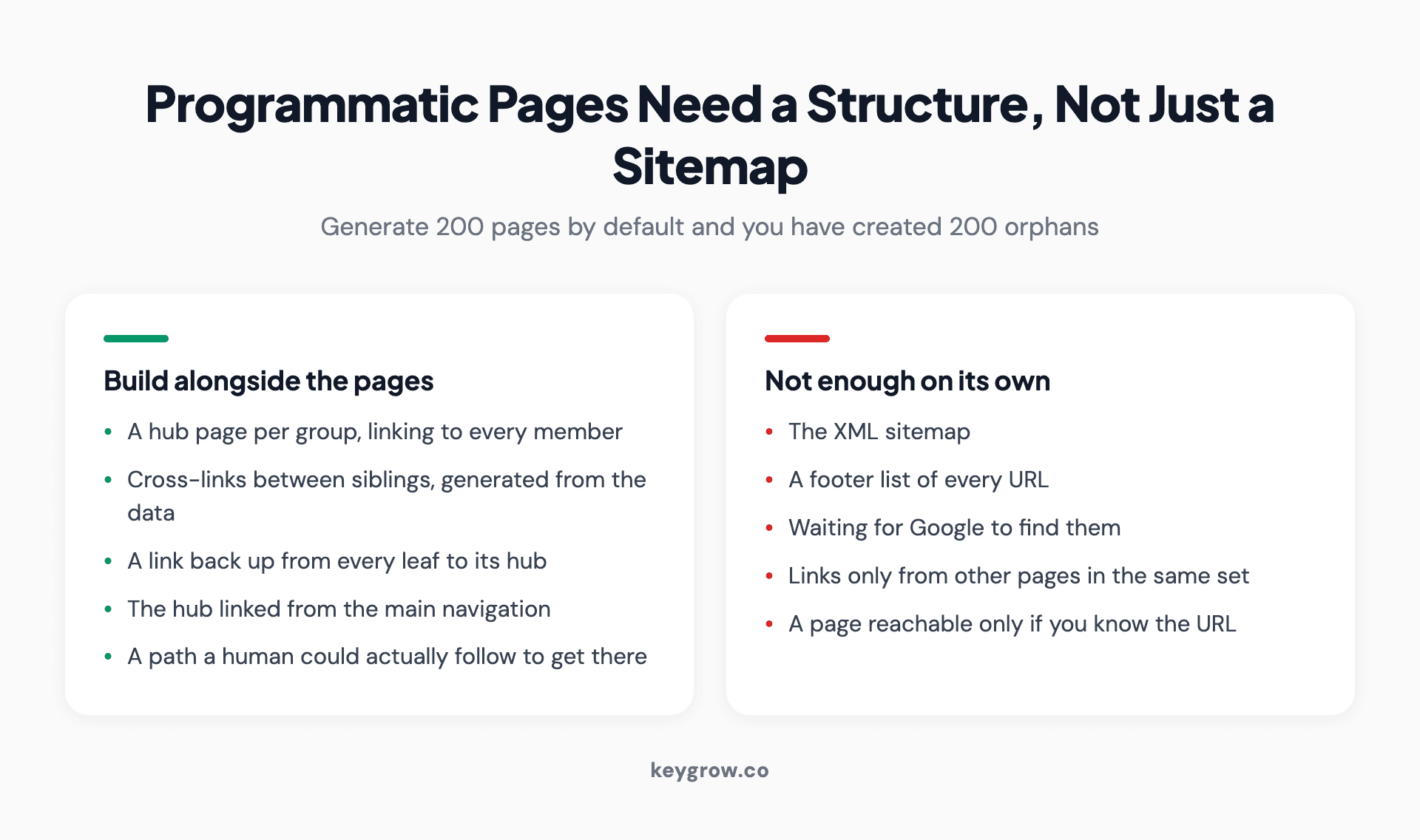
Two columns separating the internal linking a programmatic page set needs from the things that are not enough on their own, including the XML sitemap.
Programmatic page sets need a structure built at the same time as the pages:
A hub page per group that lists the set and links to every member. A services index, a locations index, a comparisons index.
Cross-links between siblings, generated from the data. Nearby cities, related integrations, adjacent product sizes. These are easy to produce programmatically and they do most of the work.
A link back up from every leaf to its hub and from the hub to the main navigation. A set that the main site never links to is a set the main site is not vouching for.
A real path from somewhere a human would start. If the only way to reach a page is to already know its URL, that is a structural answer to whether it should exist.
The sitemap is not a substitute for any of this. It tells Google the pages exist. Internal links tell Google which ones matter.
What to automate, and what never to automate
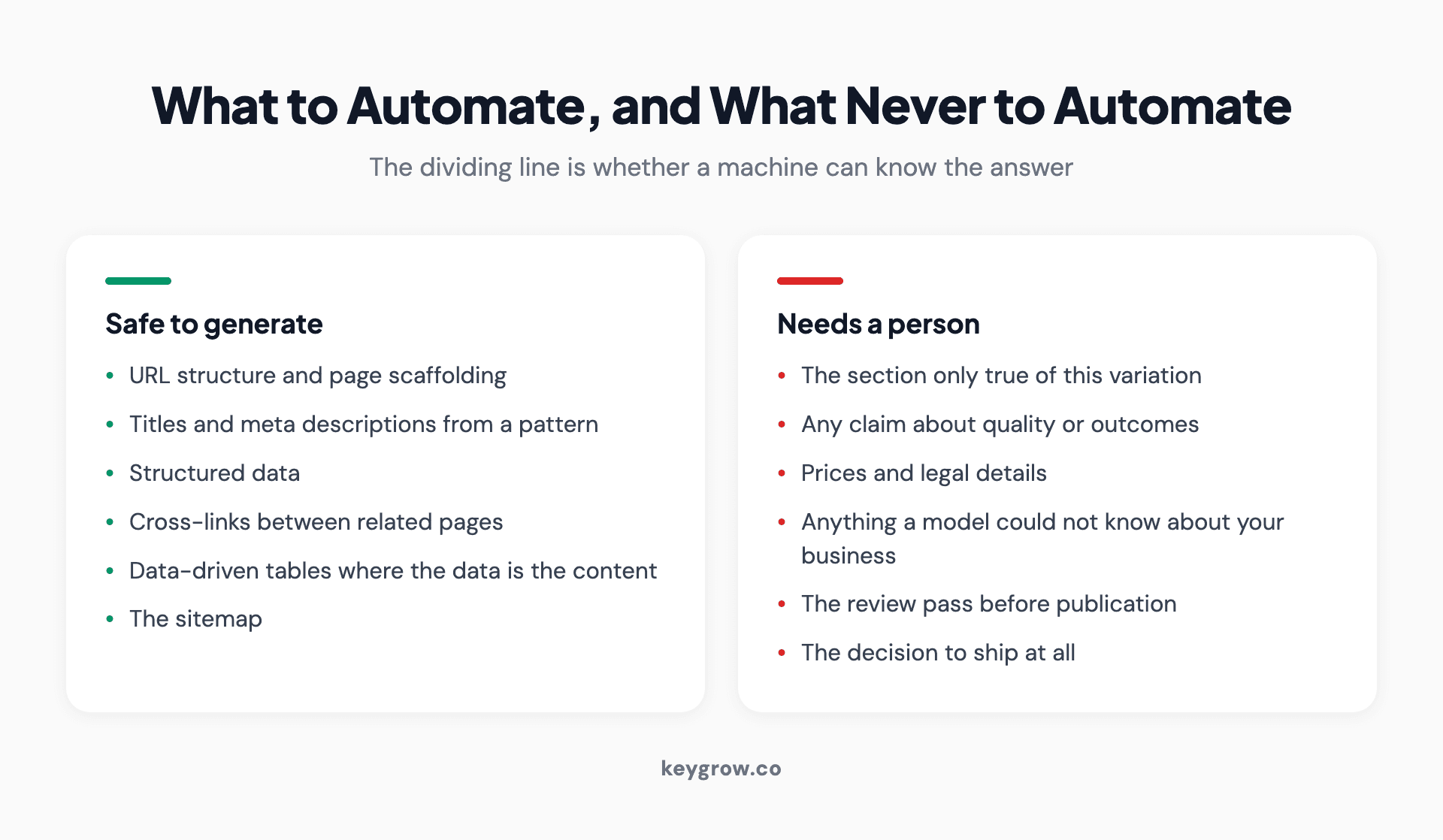
Two columns separating the parts of a programmatic page that are safe to generate from the parts that need a person.
Safe to generate: the URL structure, the page scaffolding, titles and meta descriptions from a pattern, structured data, the cross-links between related pages, the tabular or data-driven sections where the data itself is the content, and the sitemap.
Needs a person: the section that says something only true of this variation, any claim about quality or outcomes, anything involving a price or a legal detail, and the review pass before publication.
The middle ground is AI-assisted drafting, which is fine and which most teams are already doing. The thing that makes it work is the same thing that makes everything else work here: somebody who knows the subject reads each page before it ships and adds what the model could not know. If nobody in the process has that knowledge, the page set will read exactly as generic as it is, and no amount of prompt work fixes that.
Publish in batches, with a gate
Do not ship 200 pages on a Tuesday.
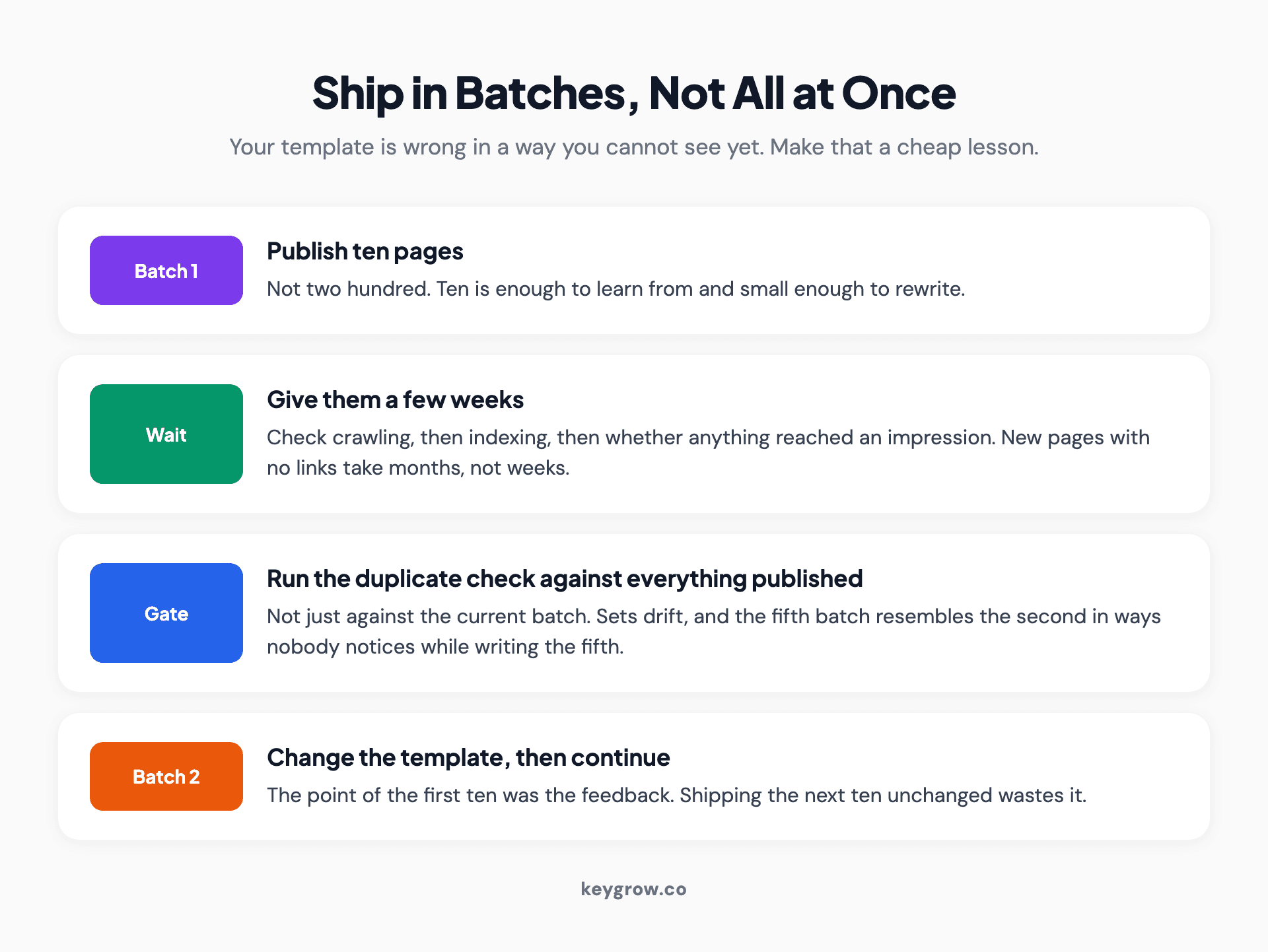
Four-step batch release method for a programmatic page set: publish ten, wait and watch indexing, run the duplicate gate against everything published, then change the template before continuing.
Ship ten. Give them a few weeks. Look at whether they get crawled, whether they get indexed, and whether anything reaches an impression. Then ship the next batch, having changed the template based on what the first ten taught you.
Two reasons this matters beyond caution. The first is that your template is wrong in some way you cannot see yet, and a small batch makes that a cheap lesson rather than a 200-page rewrite. The second is that nothing obliges Google to index what you publish. It decides which pages are worth holding, and a large set of thin pages arriving in one go is a reasonable way to be told no.
Run the duplicate gate on every batch, against every page already published, not just against the current batch. Sets drift. The fifth batch resembles the second in ways nobody notices while writing the fifth.
When programmatic SEO is the wrong tool
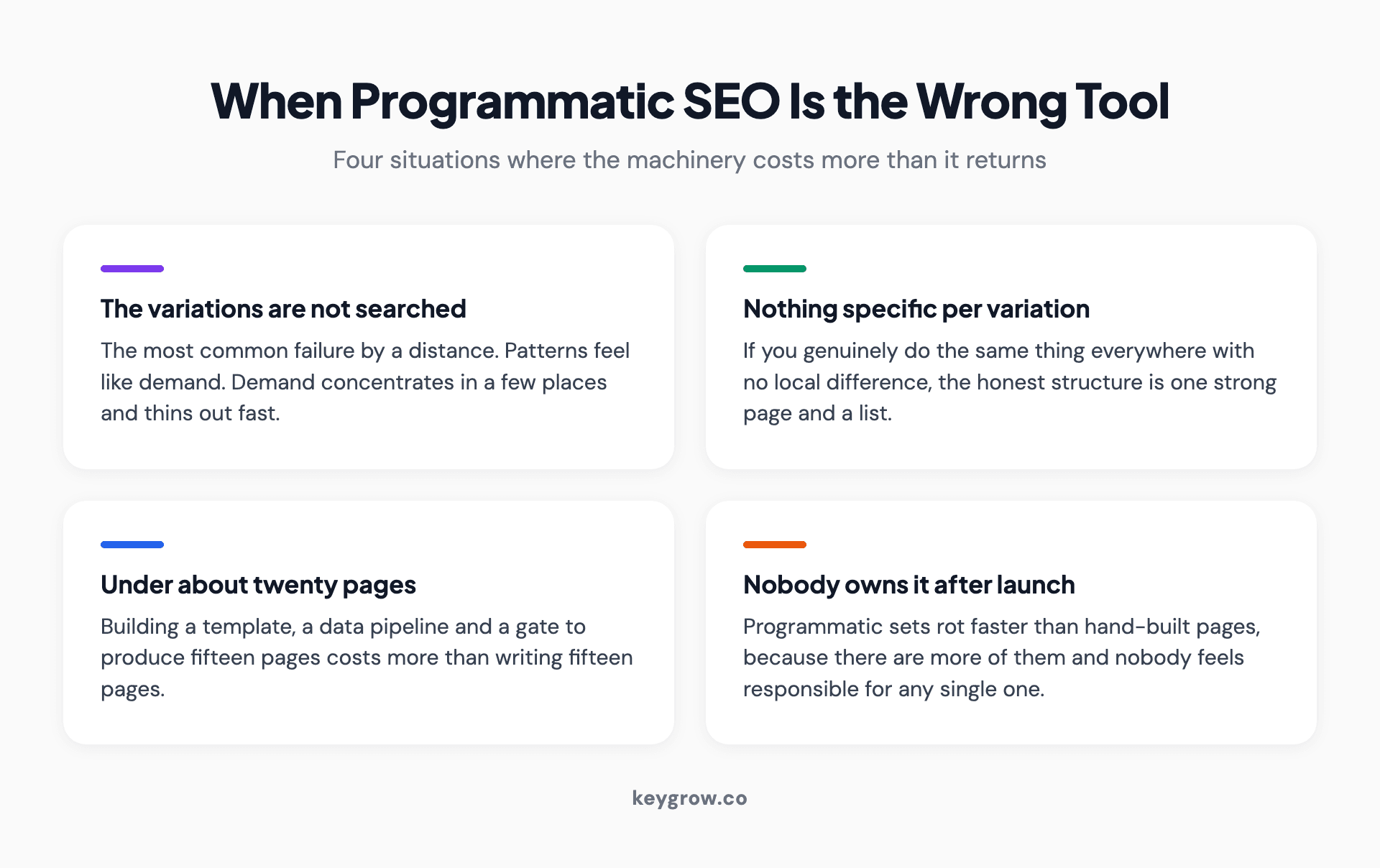
Four situations where programmatic SEO is the wrong approach: no measured demand, nothing unique to say per variation, no capacity to maintain the set, and a small set that should just be hand-written.
The variations are not searched. Covered above, and it is the most common one by a distance.
You have nothing specific per variation. If every city page would say the same thing because you genuinely do the same thing everywhere with no local difference at all, the honest structure is one strong page and a list, not thirty pages.
Under about twenty pages, it is not worth the machinery. Building a template, a data pipeline and a gate to produce fifteen pages costs more than writing fifteen pages. Write them.
Nobody owns it after launch. Programmatic sets rot faster than hand-built pages because there are more of them and nobody feels responsible for any single one. If there is no plan for who updates the data, do not start.
There is also a version of this that is just doorway pages with better tooling, and the people building it usually know. If the plan depends on Google not noticing, it is not a plan.
How to tell whether it worked
Judge the set, not the pages, and judge it on three numbers.
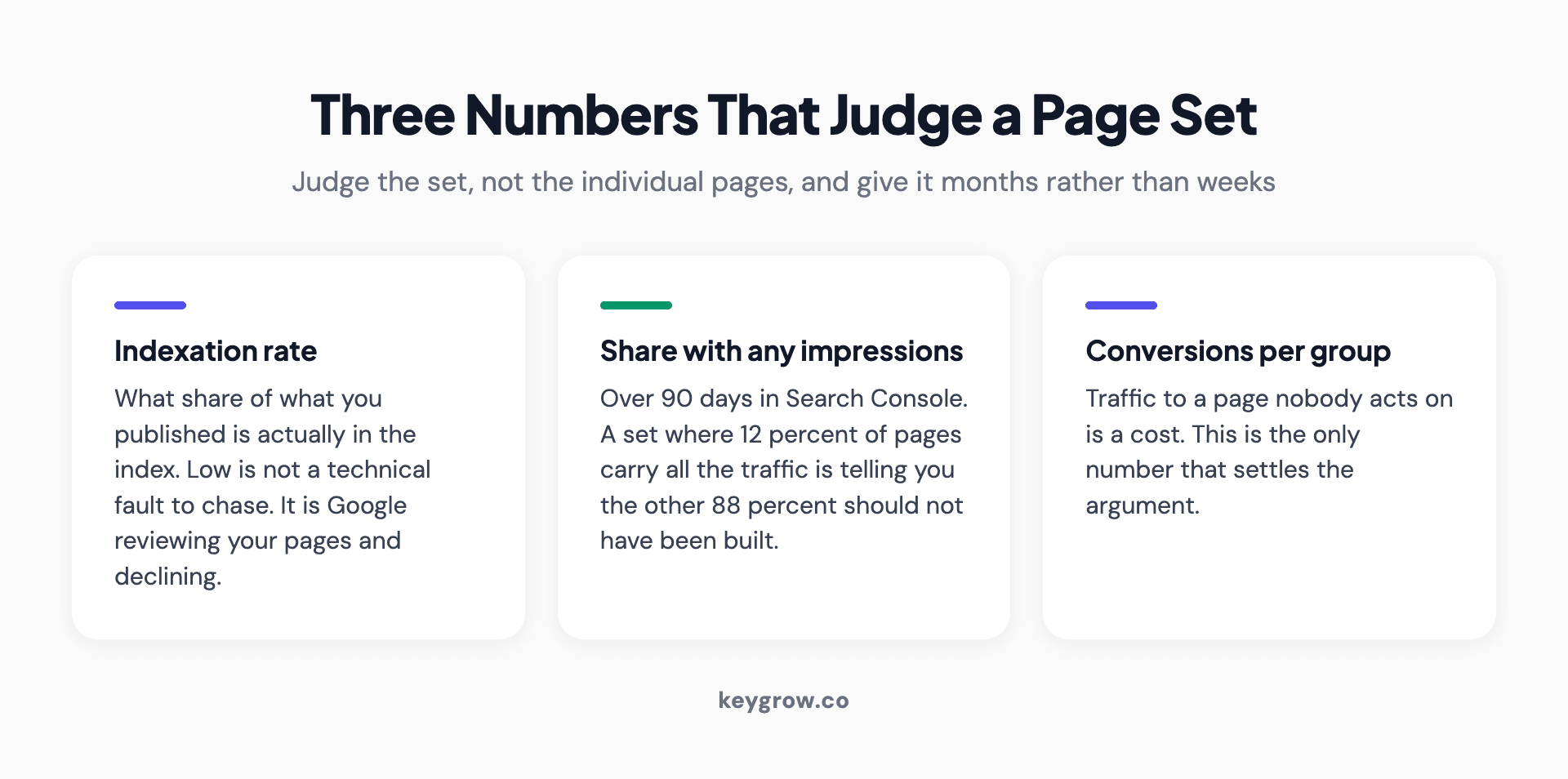
Three measures that judge a programmatic page set: indexation rate, the share of pages with any impressions over 90 days, and conversions per group.
Indexation rate. What share of what you published is actually in the index. If it is low, Google has reviewed your pages and declined. That is feedback, not a technical fault to chase.
The share of pages with any impressions. In Search Console, over 90 days. A healthy set has most of its pages doing something. A set where 12 percent of pages carry all the traffic is telling you the other 88 percent should not have been built.
Conversions, per group. Traffic to a page nobody acts on is a cost. This is where local service sets usually justify themselves or fail to, and it is the only number that settles the argument.
Give it time before reading any of it. New pages with no links take months, not weeks, and the first impression numbers will be noise.
FAQs
What is programmatic SEO in simple terms?
It is creating many pages from one template and a structured dataset, so that each variation of a repeatable search gets its own page. A site with pages for every city it serves, every product attribute it stocks, or every tool it integrates with is doing programmatic SEO.
Is programmatic SEO against Google's guidelines?
No. Google's spam policies target pages generated primarily to manipulate rankings without helping users, and they apply the same test regardless of how the content was produced. A large set of genuinely useful pages is fine. A small set of empty ones is not.
How is programmatic SEO different from doorway pages?
Doorway pages exist to catch a search and push the visitor somewhere else, and they offer less than the destination they lead to. A programmatic page is the destination. If your template pages send readers onward to the page that actually answers them, you have built doorways.
How many pages do you need for programmatic SEO?
There is no minimum, but below roughly twenty pages the setup costs more than writing them by hand. The number that matters is not the page count, it is how many of your variations have real search demand behind them.
Can I use AI to write programmatic SEO pages?
For drafting and for the structural parts, yes, and most teams do. The variation-specific content still needs someone who knows the subject, because that is the only part of the page a model cannot supply and the only part a reader or an answer engine will value.
Why are my programmatic pages not getting indexed?
Usually because Google has assessed them and decided they add little. Check whether each page has something unique, whether anything internal links to it, and whether the terms behind it are searched at all. Low indexation on a large thin set is the expected outcome, not a bug.
Build the smallest version first
The way this goes wrong is almost never technical. It goes wrong because the pattern had no demand, or the template had nothing in it, and both of those are knowable before you write a line of code.
So do the boring order. Measure the variations. Throw out the ones with no volume. Write one page by hand and ask whether you would be happy for a customer to land on it. Only then build the template, and ship the first ten before you build the rest.
If you want a second opinion on whether a page set is worth building at all, our SEO work starts with the keyword measurement rather than the build, and we would rather tell you the pattern is empty than take money to fill it. Send us what you are planning and we will tell you which variations are worth having.


