


Facebook ads for travel work best as a funnel that follows how people plan a trip. You inspire them while they are dreaming, retarget them with live prices while they plan, and sell the extras once they have booked. The clicks are cheap: travel averaged $0.42 per click on Facebook traffic campaigns in LocaliQ's 2026 benchmarks, against $0.60 across all industries.
So the click is rarely the problem.
The usual failure is one campaign aimed at everyone: a "book now" ad shown to people with no destination in mind, and a sunset video shown to someone whose checkout is already open in another tab.
This blueprint covers each stage, the Meta tools behind it and the number to judge it on. It is written for tour operators, travel agents, independent hotels and rental managers. Airlines with a data science team can stop here.
The funnel on one page
Each stage gets its own campaign and its own success number. Judge a dreaming campaign on bookings and you will switch off the thing that fills every other stage.
| Stage | Where the traveler is | Campaign | Audience | Judge it on |
|---|---|---|---|---|
| 1. Dreaming | Undecided on a destination | Video, Reels or travel ads for prospecting | Broad, in the cities your guests live in | Cost per landing page view |
| 2. Planning | Comparing places and prices | Travel ads for retargeting | Site visitors, 0-7 and 8-30 days | Cost per checkout started |
| 3. Booking | Mid-checkout | Sales campaign | Checkout starters who did not buy | Cost per booking |
| 4. Pre-trip | Booked, waiting to go | Cross-sell and upsell | Recent purchasers | Add-on revenue per booking |
| 5. Post-trip | Home with photos | Reviews and next-trip offers | Past guests | Repeat bookings |
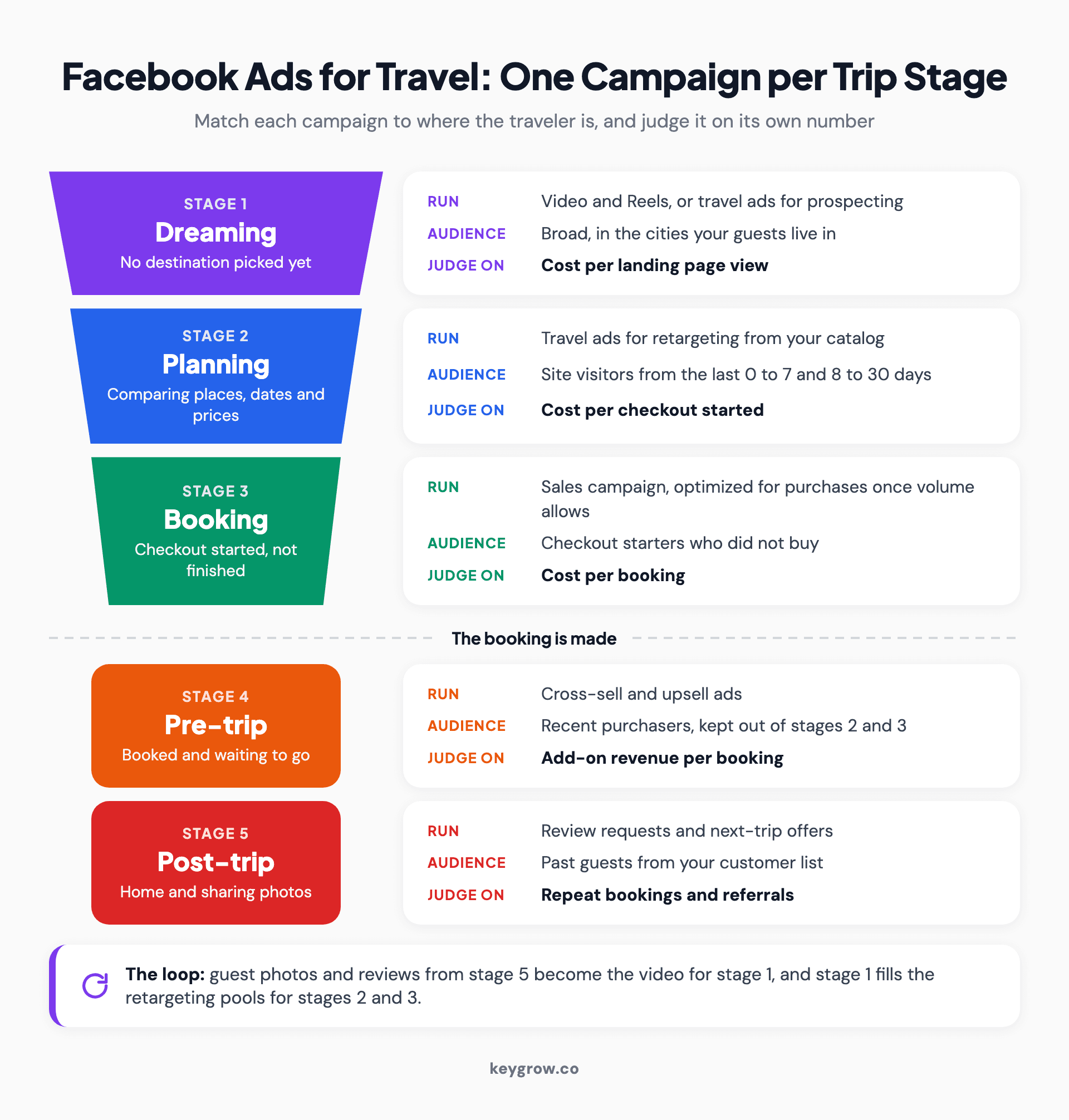
Five-stage funnel for Facebook ads for travel: dreaming runs video or travel ads for prospecting to a broad audience in the cities guests live in, judged on cost per landing page view; planning runs catalog retargeting to site visitors from the last 0 to 7 and 8 to 30 days, judged on cost per checkout started; booking runs a sales campaign to checkout starters, judged on cost per booking; pre-trip runs cross-sell and upsell ads to recent purchasers; post-trip runs review requests and next-trip offers to past guests, whose photos loop back into stage 1 creative.
Meta built its travel ads around the same idea. Meta's travel ads page describes prospecting that finds travelers at different points in planning, from people with no destination yet to people already looking at specific places.
Stages 2 and 3 only reach people who already visited your site, so they can never outgrow your traffic. That is the whole case for stage 1.
Stage 1, dreaming: sell the place before the price
Nobody is shopping yet. Put the experience in front of the right people and collect the ones who show interest, so the later stages have someone to retarget.
Run video and Reels built around the trip itself: the view from the trail, the first swim, the guide mid-story. Optimize for landing page views or video views, because these people are weeks or months from a checkout. Our annotated Facebook ad examples cover formats that work on small budgets.

A woman checking her phone at a forested canyon overlook, the kind of idle scrolling moment when a travel video plants the idea for the next trip.
Aim at the cities your guests travel from. In Meta's location targeting, location means where people are now, not where they want to go, so a lake lodge targeting its own county is advertising to its neighbors. Pull your top two or three home cities from past bookings. With a destination catalog, Meta's travel ads for prospecting can run this stage for you. Meta's advice there is to keep targeting to location and demographics and to skip lookalikes and stacked behavior targeting, which it says can limit delivery.
What stages 2 to 4 run on
Retargeting with live prices needs a catalog of what you sell and a pixel reporting four travel events. Without both, stages 2 to 4 fall back to generic retargeting ads.
Meta's travel ads are a type of Advantage+ catalog ad (formerly dynamic ads). They pull names, images and prices from a feed that can refresh hourly, daily or weekly. Pick the catalog that fits:
| If you sell | Catalog | From Meta's setup pages |
|---|---|---|
| Rooms | Hotel | Can be built from a Google Hotel List Feed |
| Flights | Flight | Each item carries origin, destination and price |
| Places or trip ideas | Destination | Each item is a place, such as a city |
| Packages | Hotel plus destination | Hotel ads retarget, destination ads prospect |
| Tours | Activities, or none | Newly listed in the catalog docs, with guided tours |
Travel ads need four pixel events, and the content ID in each must match the ID column in your catalog exactly.
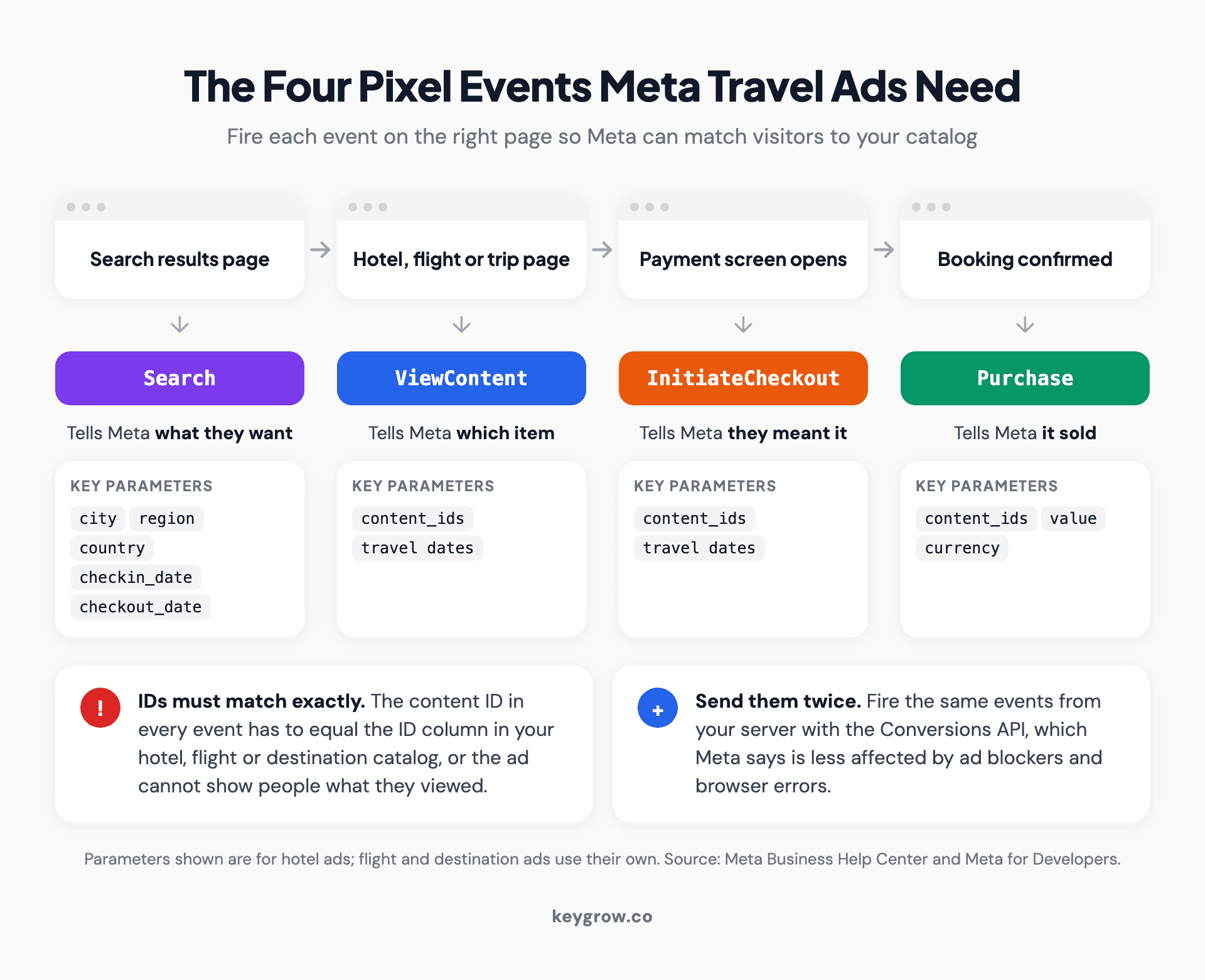
Flow diagram of the four Meta pixel events travel ads need: Search on the search results page with city, region, country and check-in and check-out dates, ViewContent on the hotel, flight or trip page with the content ID, InitiateCheckout when the payment screen opens, and Purchase when the booking is confirmed with value and currency, plus notes that content IDs must match the catalog exactly and that the same events should also be sent through the Conversions API.
For hotel ads, Search carries the city, region and country, plus check-in and check-out dates, which Meta calls highly recommended because they make booking window targeting possible. Purchase needs the booking value and currency. Flight and destination ads use their own parameters.
Send the same events through the Conversions API as well. Meta says server data is less affected than the pixel by browser errors, connectivity issues and ad blockers, and that many integrations need no developer.
For tour operators, the activities catalog runs on the standard catalog events (ViewContent, AddToCart and Purchase), not the travel four. Ask your reservation software whether it can send that feed before building one by hand.
Stage 2, planning: show people what they looked at
Someone who viewed a trip page last Tuesday is the cheapest good prospect you will ever have.
Show them that trip, at today's price, while they decide. One catalog campaign covers every room, route or tour you sell. Meta recommends carousel over single image as the default, and dynamic overlays can print the price or a struck-through sale price on the image, on Facebook Feed only.
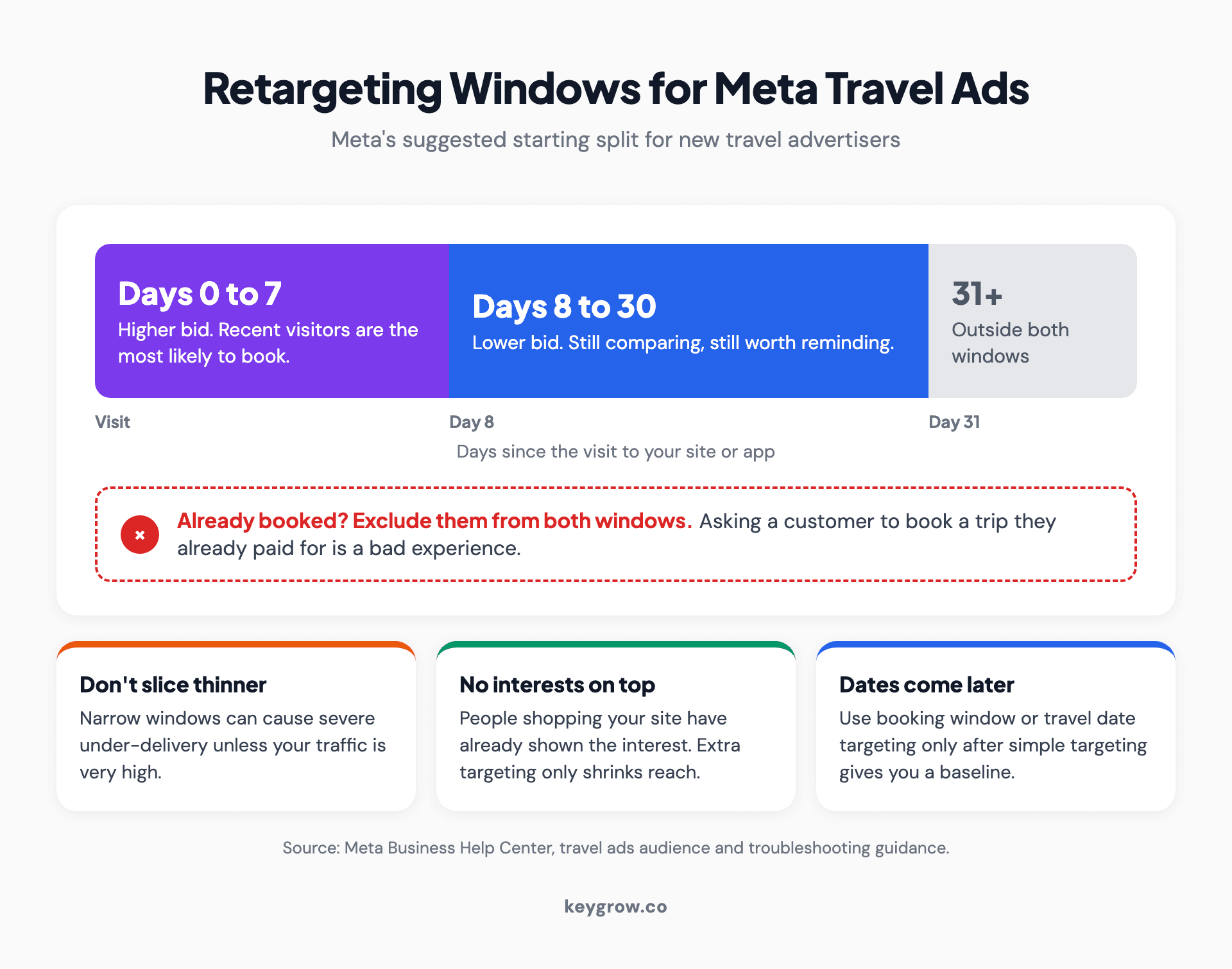
Timeline of Meta's suggested retargeting windows for travel ads: site visitors from days 0 to 7 get a higher bid, visitors from days 8 to 30 get a lower bid, and anyone who already booked is excluded from both, with three rules: do not slice windows thinner, do not add interest targeting on top, and add travel date targeting only after a baseline.
Split the audience the way Meta's travel ads troubleshooting page suggests for new advertisers, with visitors from the last 0 to 7 days on a higher bid and 8 to 30 days on a lower one. Meta warns that thinner slices lead to severe under-delivery unless your traffic is very high.
Skip interest targeting on top; people shopping your site have already shown the interest. Exclude anyone who just booked, too, unless you enjoy customers asking whether you lost their reservation. Booking window and travel date targeting can wait until simple targeting gives you a baseline.
Stage 3, booking: when should you optimize for purchases?
Only when you have the volume. Meta's threshold is at least 15 one-day click-through conversions a day from travel ads. Below that, it recommends optimizing for link clicks.

A couple sitting together and smiling at a tablet, the moment a trip moves from planning to booking.
Most tour operators and independent hotels will not get 15 ad-driven bookings a day, so "optimize for purchases" is not the default it looks like. For new campaigns, Meta suggests optimizing for clicks for three or four days, then for purchases or InitiateCheckout. Checkouts happen more often than bookings, so they reach the threshold sooner.
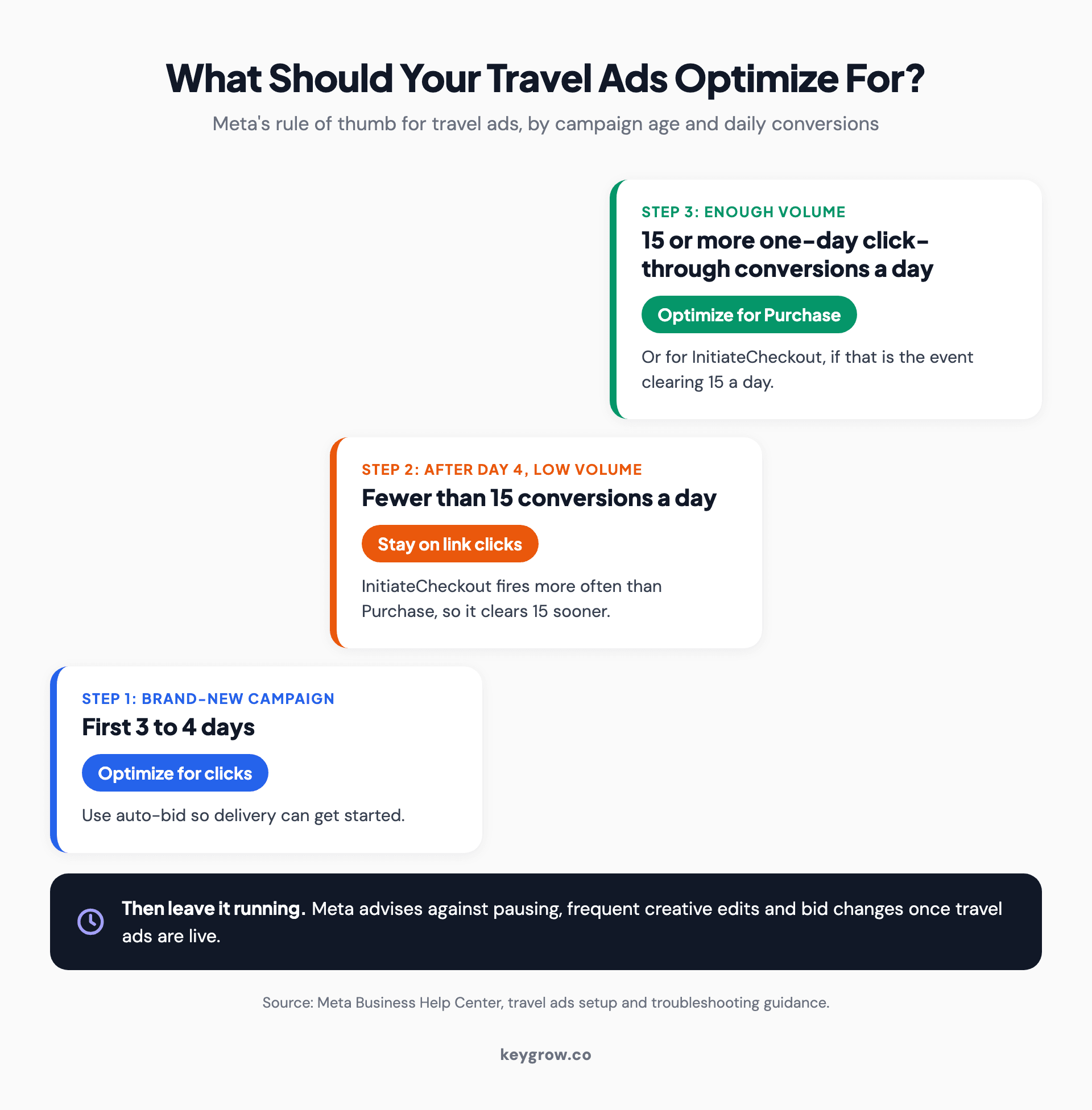
Three-step staircase showing what Meta travel ads should optimize for: clicks with auto-bid for the first 3 to 4 days, link clicks while a campaign has fewer than 15 conversions a day, and Purchase, or InitiateCheckout, once it reaches 15 or more one-day click-through conversions a day, then leave the campaign running.
Then leave it alone.
Meta advises against pausing, frequent creative edits or bid changes once ads are running. For a seasonal sale, build the campaign a week early, pause it, and switch it on the day the sale starts.
Selling custom trips that start with a conversation? Then the booking is a lead, and our guide to Facebook ads for leads covers forms and filter questions.
Watch financing offers. A lender's pay-monthly offer can turn the ad into a financial products and services ad, a category US advertisers have had to declare since January 21, 2025, and that limits age, gender, ZIP code, lookalike and exclusion targeting.
Stage 4, pre-trip: sell the extras to people who already said yes
A booked customer is your warmest audience, and an easy one to forget until the trip is over. Between booking and departure, sell what makes the trip better.
Meta's developer guide describes cross-selling hotels to people who bought a flight and upselling seat selection or priority boarding. Smaller operators have the same move:
- After a room booking, a tour, a dinner reservation or an airport transfer
- After a tour booking, the private upgrade or an extra night nearby
- After a package booking, a second excursion

A traveler with a backpack standing in an airport terminal watching the departures board, the stretch between booking and the trip when add-ons sell.
Run these ads to a purchaser audience with its own product set and judge them on add-on revenue per booking. You are not paying to find anyone.
Stage 5, post-trip: turn the last trip into the next one
The guest who just got home has photos, opinions and often a date in mind for next year. Upload your customer list as a custom audience, with consent, and give it two jobs.
First, ask for reviews and permission to use their photos. Real guest footage is the best stage 1 creative you will get, and it is free. Second, time a next-trip offer to how far ahead your guests book. A family that books its summer trip every March wants a nudge in February.
That closes the loop: stage 5 feeds stage 1 its creative.
What the 2026 benchmarks do and don't tell you
LocaliQ's 2026 numbers show travel buying cheap, clickable Facebook traffic. They say nothing about whether that traffic books.
| Facebook traffic campaigns, 2026 | Travel | All industries |
|---|---|---|
| Average click-through rate | 2.28% | 1.93% |
| Average cost per click | $0.42 | $0.60 |
Vanity-metric reporting is the industry's biggest scam, and cheap travel clicks make it easy to run. A 2.28 percent click-through rate at 42 cents a click makes a gorgeous screenshot and proves nothing about bookings.
If your report opens with clicks or reach instead of cost per booking, ask why.
There is no reliable public cost-per-booking figure (LocaliQ's lead benchmarks skip travel), so build your own ceiling: average booking value times your margin. Our post on Google Ads for tour operators runs that math with marketplace commission, and Google Ads vs Facebook Ads helps if you are still choosing a platform.
When the full funnel is overkill
Five stages and a catalog suit a business with real inventory and steady traffic. Plenty of travel businesses have neither.
Selling a handful of fixed departures a year? Skip the catalog. One video campaign in your top home market plus one retargeting campaign for site visitors and video viewers covers stages 1 to 3, and a single operator can set that up in an afternoon without an agency.
With only a few hundred site visits a month, retargeting pools stay tiny, so spend on stage 1 first. And if bookings arrive by phone and you cannot tell which came from ads, fix tracking before you spend more.
FAQs
Do Facebook ads work for travel businesses?
Yes, when each campaign matches a trip-planning stage. Video reaches people without a destination, catalog retargeting reaches people comparing options, and offers to past guests work after the trip. One generic campaign aimed at everyone usually disappoints.
How much do Facebook ads cost for travel?
Travel averaged $0.42 per click on Facebook traffic campaigns in LocaliQ's 2026 benchmarks, against $0.60 across all industries. There is no reliable public cost-per-booking figure, so set your own ceiling from average booking value times your margin.
What are Meta travel ads?
They are Advantage+ catalog ads, formerly dynamic ads, built for travel. They pull hotels, flights or destinations from a catalog and show each person the options they are most likely to book, either as retargeting to your site visitors or as prospecting to a broad audience.
Which pixel events do Facebook travel ads need?
Four: Search, ViewContent, InitiateCheckout and Purchase, fired on the results, detail, payment and confirmation pages. The content IDs must match your catalog IDs, and Meta recommends sending travel dates with Search.
Can tour operators use Facebook travel ads?
The travel catalogs cover hotels, flights and destinations, so tours do not fit neatly. Meta's catalog documentation now lists an activities vertical that includes guided tours. Without a feed, a tour operator can still run the funnel with video ads and site-visitor retargeting.
Book the test, then scale
Start with two campaigns, not five: a stage 1 video in your best home market and a stage 2 retargeting campaign with the 0 to 7 and 8 to 30 day split. Get the four events and the Conversions API firing before you spend a dollar.
Wait at least as long as your typical booking lead time, then judge on cost per booking against your ceiling.
Small, separate tests beat one big bet. An eviction law firm we worked with went from 1 conversion a week to 21, and from $240 to $31.79 per conversion, between September and October 2022, partly by testing side campaigns on small slices of budget and keeping only the winners. That was Google Ads, not Facebook, but the method carries over.
Once booking works, add pre-trip and post-trip, then raise budget in steps. If you would rather have it built for you, our social media advertising team handles Meta and our PPC management covers search, both month to month, cancel anytime.